

The Effectiveness of Rehabilitation Interventions on the Employment and Functioning of People with Intellectual Disabilities: A Systematic Review
Open accessThe DOI matches its Crossref record; 79 of the 79 references it cites were found in a registry or an index.
Abstract
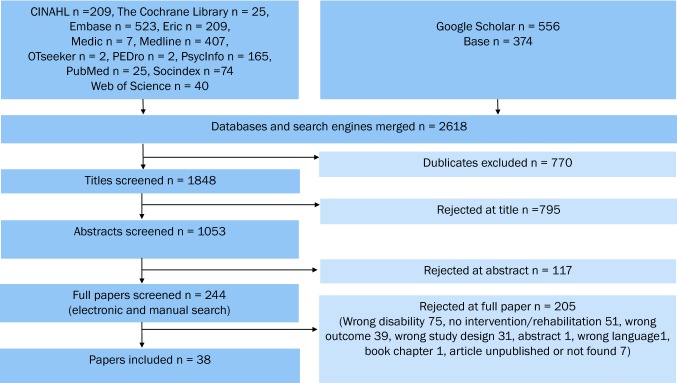
Purpose This systematic review analyzed the effectiveness of rehabilitation interventions on the employment and functioning of people with intellectual disabilities (ID), as well as barriers and facilitators of employment. Methods This was a systematic review of quantitative, qualitative, and mixed methods studies. The outcomes were employment, transition to the open labor market and functioning. The review included qualitative studies of employment barriers and facilitators. The population comprised people with ID aged 16-68 years. Peer-reviewed articles published in English between January 1990 and February 2019 were obtained from the databases Cinahl, the Cochrane Library, Embase, Eric, Medic, Medline, OTseeker, Pedro, PsycInfo, PubMed, Socindex, and the Web of Science. We also searched Google Scholar and Base. The modified selection instrument (PIOS: participants, intervention, outcome, and study design) used in the selection of the articles depended on the selection criteria. Results Ten quantitative (one randomized controlled, one concurrently controlled, and eight cohort studies), six qualitative studies, one multimethod study, and 21 case studies met the inclusion criteria. The quantitative studies showed that secondary education increases employment among people with ID when it includes work experience and personal support services. Supported employment also increased employment in the open labor market, which sheltered work did not. The barriers to employment were the use of sheltered work, discrimination in vocational experience, the use of class teaching, and deficient work experience while still at school. The facilitators of employment were one's own activity, the support of one's family, job coaching, a well-designed work environment, appreciation of one's work, support form one's employer and work organization, knowledge and experience of employment during secondary education, and for entrepreneurs, the use of a support person. Conclusions The employment of people with ID can be improved through secondary education including proper teaching methods and personal support services, the use of supported work, workplace accommodations and support from one's family and employer. These results can be utilized in the development of rehabilitation, education, and the employment of people with ID, to allow them the opportunity to work in the open labor market and participate in society.
Overview
The claims and statistics of this paper haven’t been checked yet.
Free: it reads the open-access text and checks the first 5 claims that cite a source we can check. Create a free account to check every claim.
Integrity signals
Registry
Cites
Statistics
Figures
Verification
Claims the paper makes
The claims and statistics of this paper haven’t been checked yet.
Free: it reads the open-access text and checks the first 5 claims that cite a source we can check. Create a free account to check every claim.
Claims other papers make about this one
Each is checked against this paper’s own text: does it say what the citing paper says it does?
The cited source says what the claim attributes to it.
In the citing paper
“Reviews of studies on interventions to support people into gaining work have also been published, covering intellectual disability, 110 autism, 111 severe mental health conditions, 112 and other mental health conditions.113”
From The Lancet Commission on ending stigma and discrimination in mental health (2022) · cites this paper as [110]
Self-check
Percentages, sums and reported differences re-computed from the paper’s own numbers.
The self-check needs the paper’s full text.
Citations
Cites
1 retracted
Notice of Redundant Publication
(2011) · Intellectual and developmental disabilities · doi:10.1352/1934-9556-49.4.221 · Cited by 26
RetractedCochrane Handbook for Systematic Reviews of Interventions: Cochrane Book Series
(2008) · doi:10.1002/9780470712184 · Cited by 25,048 · cited 2×
“We included quantitative, qualitative, and multimethod studies, because they provided different knowledge regarding this phenomenon [29, 30].”
Method(2014) · Medical Entomology and Zoology · Cited by 17,633
Grading quality of evidence and strength of recommendations
(2004) · BMJ · doi:10.1136/bmj.328.7454.1490 · Cited by 8,477
Updated Method Guidelines for Systematic Reviews in the Cochrane Collaboration Back Review Group
van Tulder, M., Furlan, A., Bombardier, C., & Bouter, L. (2003) · Spine · doi:10.1097/01.brs.0000065484.95996.af · Cited by 2,180 · cited 3×
“[32], which has also been used in other reviews concerning rehabilitation [28, 33, 34] and workplace accommodation [35].”
BackgroundResultPrevalence of intellectual disability: a meta-analysis of population-based studies
Maulik, P. K., Mascarenhas, M. N., Mathers, C. D., Dua, T., & Saxena, S. (2011) · Research in Developmental Disabilities · doi:10.1016/j.ridd.2010.12.018 · Cited by 1,770
Cieza, A., Fayed, N., Bickenbach, J., & Prodinger, B. (2019) · Disability and Rehabilitation · doi:10.3109/09638288.2016.1145258 · Cited by 594
Multi-disciplinary rehabilitation for acquired brain injury in adults of working age
Turner-Stokes, L., Pick, A., Nair, A., Disler, P. B., & Wade, D. T. (2015) · Cochrane Database of Systematic Reviews · doi:10.1002/14651858.cd004170.pub3 · Cited by 493 · cited 1×
“[32], which has also been used in other reviews concerning rehabilitation [28, 33, 34] and workplace accommodation [35].”
McKenzie, K., Milton, M., Smith, G., & Ouellette-Kuntz, H. (2016) · Current Developmental Disorders Reports · doi:10.1007/s40474-016-0085-7 · Cited by 453
Life expectancy of people with intellectual disability: a 35‐year follow‐up study
Patja, K., Iivanainen, M., Vesala, H., Oksanen, H., & Ruoppila, I. (2000) · Journal of Intellectual Disability Research · doi:10.1046/j.1365-2788.2000.00280.x · Cited by 409
Self-citationDisability and employment–overview and highlights
Vornholt, K., Villotti, P., Muschalla, B., Bauer, J., Colella, A., Zijlstra, F., Van Ruitenbeek, G., Uitdewilligen, S., & Corbière, M. (2018) · European Journal of Work and Organizational Psychology · doi:10.1080/1359432x.2017.1387536 · Cited by 407
Defining the Review Question and Developing Criteria for Including Studies
O'Connor, D., Green, S., & Higgins, J. P. (2008) · Cochrane Handbook for Systematic Reviews of Interventions · doi:10.1002/9780470712184.ch5 · Cited by 374 · cited 1×
“We used the modified selection instrument (PIOS: participants, intervention, outcome, and study design) [29, 31] to select the titles, abstracts, and full papers according to the selection criteria.”
MethodMultidisciplinary rehabilitation for adults with multiple sclerosis
Khan, F., Turner-Stokes, L., Ng, L., Kilpatrick, T., & Amatya, B. (2007) · Cochrane Database of Systematic Reviews · doi:10.1002/14651858.cd006036.pub2 · Cited by 286
People with Learning Disabilities in England
Emerson, E., & Hatton, C. (2008) · Cited by 253
Multi-disciplinary rehabilitation for acquired brain injury in adults of working age
Turner-Stokes, L., Nair, A., Sedki, I., Disler, P. B., & Wade, D. T. (2005) · Cochrane Database of Systematic Reviews · doi:10.1002/14651858.cd004170.pub2 · Cited by 245
Nevala, N., Pehkonen, I., Koskela, I., Ruusuvuori, J., & Anttila, H. (2015) · Journal of Occupational Rehabilitation · doi:10.1007/s10926-014-9548-z · Cited by 180
Self-citationICF- INTERNATIONAL CLASSIFICATION OF FUNCTIONING, DISABILITY AND HEALTH
Buono, S., & Zagaria, T. (2003) · Cited by 179
Ellenkamp, J. J. H., Brouwers, E. P. M., Embregts, P. J. C. M., Joosen, M. C. W., & van Weeghel, J. (2016) · Journal of Occupational Rehabilitation · doi:10.1007/s10926-015-9586-1 · Cited by 177
McMahon, D., Cihak, D. F., & Wright, R. (2015) · Journal of Research on Technology in Education · doi:10.1080/15391523.2015.1047698 · Cited by 150
Multidisciplinary rehabilitation for adults with multiple sclerosis
Khan, F., Turner‐Stokes, L. F., Ng, L., & Kilpatrick, T. J. (2008) · Postgraduate Medical Journal · doi:10.1136/jnnp.2007.127563 · Cited by 143 · cited 1×
“[32], which has also been used in other reviews concerning rehabilitation [28, 33, 34] and workplace accommodation [35].”
Foley, K.-R., Dyke, P., Girdler, S., Bourke, J., & Leonard, H. (2012) · Disability and Rehabilitation · doi:10.3109/09638288.2012.660603 · Cited by 131 · cited 1×
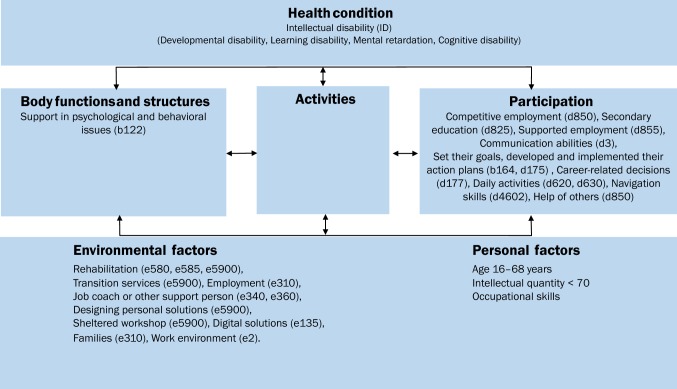
“The meaningful concepts of each outcome were linked to the ICF categories [40, 41].”
MethodRatti, V., Hassiotis, A., Crabtree, J., Deb, S., Gallagher, P., & Unwin, G. (2016) · Research in Developmental Disabilities · doi:10.1016/j.ridd.2016.06.015 · Cited by 117
The impact of employment on the quality of life of people with an intellectual disability
Eggleton, I., Robertson, S., Ryan, J., & Kober, R. (1999) · Journal of Vocational Rehabilitation · doi:10.3233/jvr-1999-00047 · Cited by 110 · cited 1×
“Employment can lead to positive psychosocial and economic benefits for people with ID, including a sense of purpose, opportunities for new friendships [1, 2], health [3] and better quality of life [4, 5].”
BackgroundNational snapshot of adults with intellectual disabilities in the labor force
Siperstein, G. N., Parker, R. C., & Drascher, M. (2013) · Journal of Vocational Rehabilitation · doi:10.3233/jvr-130658 · Cited by 105
Khan, F., Ng, L., & Turner‐Stokes, L. F. (2009) · Cochrane Database of Systematic Reviews · doi:10.1002/14651858.cd007256.pub2 · Cited by 101 · cited 2×
“ICF provides a detailed framework for describing disease experiences as a dynamic interaction between its components, and ‘core sets’, comprising lists of ICF categories [28].”
BackgroundAnner, J., Schwegler, U., Kunz, R., Trezzini, B., & de Boer, W. E. L. (2012) · BMC Public Health · doi:10.1186/1471-2458-12-470 · Cited by 99 · cited 2×
“The ICF identifies and classifies the component of environmental factors, including rehabilitation, as one of its health-related components [26, 27].”
BackgroundAllen, K. D., Burke, R. V., Howard, M. R., Wallace, D. P., & Bowen, S. L. (2012) · Journal of Autism and Developmental Disorders · doi:10.1007/s10803-012-1519-7 · Cited by 98
Shogren, K. A., & Turnbull, H. R. (2010) · Intellectual and developmental disabilities · doi:10.1352/1934-9556-48.5.375 · Cited by 96
Bauer, S. M., Elsaesser, L.-J., & Arthanat, S. (2011) · Disability and Rehabilitation: Assistive Technology · doi:10.3109/17483107.2010.529631 · Cited by 94 · cited 1×
“The ICF identifies and classifies the component of environmental factors, including rehabilitation, as one of its health-related components [26, 27].”
BackgroundGilson, C. B., & Carter, E. W. (2016) · Journal of Autism and Developmental Disorders · doi:10.1007/s10803-016-2894-2 · Cited by 91
Sannicandro, T., Parish, S. L., Fournier, S., Mitra, M., & Paiewonsky, M. (2018) · American Journal on Intellectual and Developmental Disabilities · doi:10.1352/1944-7558-123.5.412 · Cited by 83
Prevalence of intellectual disability: a comprehensive study based on national registers
Westerinen, H., Kaski, M., Virta, L. J., Almqvist, F., & Iivanainen, M. (2007) · Journal of Intellectual Disability Research · doi:10.1111/j.1365-2788.2007.00970.x · Cited by 81
Beyer, S., Meek, A., & Davies, A. (2016) · Advances in Mental Health and Intellectual Disabilities · doi:10.1108/amhid-05-2014-0015 · Cited by 81
Dean, E. E., Shogren, K. A., Hagiwara, M., & Wehmeyer, M. L. (2018) · Journal of Vocational Rehabilitation · doi:10.3233/jvr-180950 · Cited by 80
Joshi, G. S., Bouck, E. C., & Maeda, Y. (2012) · Career Development and Transition for Exceptional Individuals · doi:10.1177/0885728811433822 · Cited by 74
Kaehne, A., & Beyer, S. (2013) · Journal of Intellectual Disability Research · doi:10.1111/jir.12058 · Cited by 73
What predicts re-employment after job loss for individuals with mental retardation?
Howarth, E., Mann, J. R., Zhou, H., McDermott, S. W., & Butkus, S. (2006) · Journal of Vocational Rehabilitation · doi:10.3233/jvr-2006-00334 · Cited by 72 · cited 5×
“Employment can lead to positive psychosocial and economic benefits for people with ID, including a sense of purpose, opportunities for new friendships [1, 2], health [3] and better quality of life [4, 5].”
BackgroundResultInfluentialCimera, R. E. (2011) · Journal of Vocational Rehabilitation · doi:10.3233/jvr-2011-550 · Cited by 70
The Effects of Covert Audio Coaching on the Job Performance of Supported Employees
Bennett, K., Brady, M. P., Scott, J., Dukes, C., & Frain, M. (2010) · Focus on Autism and Other Developmental Disabilities · doi:10.1177/1088357610371636 · Cited by 68
Dotson, W. H., Richman, D. M., Abby, L., Thompson, S., & Plotner, A. J. (2013) · Research in Developmental Disabilities · doi:10.1016/j.ridd.2013.04.009 · Cited by 67
Kemp, D. C., & Carr, E. G. (1995) · Research and Practice for Persons with Severe Disabilities · doi:10.1177/154079699602000401 · Cited by 66 · cited 2×
“People with severe ID were participants in three case studies [61, 67, 69].”
BackgroundMcGlashing-Johnson, J., Agran, M., Sitlington, P. L., Cavin, M., & Wehmeyer, M. L. (2003) · Research and Practice for Persons with Severe Disabilities · doi:10.2511/rpsd.28.4.194 · Cited by 65
"Doing my own thing": Supported self-employment for individuals with cognitive disabilities
Hagner, D. C., & Davies, T. (2002) · Journal of Vocational Rehabilitation · doi:10.3233/jvr-2002-00146 · Cited by 62 · cited 2×
“However, two qualitative studies [53, 54] and two case studies [62, 64] did not report the age of the participants.”
BackgroundCimera, R. E., Burgess, S., & Bedesem, P. L. (2014) · Research and Practice for Persons with Severe Disabilities · doi:10.1177/1540796914534633 · Cited by 58 · cited 2×
“1 3 transition from education to work [43, 48, 49, 51, 55, 75].”
BackgroundMank, D., Cioffi, A., & Yovanoff, P. (2003) · Mental Retardation · doi:10.1352/0047-6765(2003)41<188:seoaad>2.0.co;2 · Cited by 54
Laarhoven, T. R. V., Carreon, A., Bonneau, W., & Lagerhausen, A. (2018) · Journal of Autism and Developmental Disorders · doi:10.1007/s10803-018-3512-2 · Cited by 53
Mediation as a Transition Process: The Impact on Postschool Employment Outcomes
DEVLIEGER, P. J., & Trach, J. S. (1999) · Exceptional Children · doi:10.1177/001440299906500406 · Cited by 50
Donelly, M., Hillman, A., Stancliffe, R. J., Knox, M. F., Whitaker, L., & Parmenter, T. R. (2010) · Work · doi:10.3233/wor-2010-1023 · Cited by 48
Taber, T. A., Alberto, P. A., & Fredrick, L. D. (1998) · Research in Developmental Disabilities · doi:10.1016/s0891-4222(98)00008-0 · Cited by 46
Kärki, A., Anttila, H., Tasmuth, T., & Rautakorpi, U.-M. (2009) · Acta Oncologica · doi:10.1080/02841860902755251 · Cited by 46 · cited 1×
“An additional score of ‘Partially’ was added, as the original checklist was not able to adequately differentiate between the quality of the studies [38].”
BackgroundSelf-citationCarson, K. D., Gast, D. L., & Ayres, K. M. (2008) · European Journal of Special Needs Education · doi:10.1080/08856250802130475 · Cited by 45
Residential Provision for People with Intellectual Disabilities in England, Wales and Scotland
Emerson, E., & Hatton, C. (1998) · Journal of Applied Research in Intellectual Disabilities · doi:10.1111/j.1468-3148.1998.tb00030.x · Cited by 43
Chang, Y., Wang, T.-Y., & Chen, Y. (2011) · Research in Developmental Disabilities · doi:10.1016/j.ridd.2011.06.006 · Cited by 37
People with an intellectual disability living in an intentional community
Randell, M., & Cumella, S. (2009) · Journal of Intellectual Disability Research · doi:10.1111/j.1365-2788.2009.01181.x · Cited by 34
The Transition of Young People With Learning Disabilities1 to Employment: What Works?
Beyer, S., & Kaehne, A. (2008) · ORCA Online Research @Cardiff (Cardiff University) · Cited by 32
A palmtop-based job aid for workers with severe intellectual disabilities1
Furniss, F., Ward, A., Lancioni, G. E., Rocha, N. P., Cunha, B., Seedhouse, P., Morato, P., & Waddell, N. (1999) · Technology and Disability · doi:10.3233/tad-1999-10106 · Cited by 30
Arvidsson, J., Widén, S., Nyman, C. S., & Tideman, M. (2016) · Journal of Policy and Practice in Intellectual Disabilities · doi:10.1111/jppi.12157 · Cited by 28
Longitudinal Job Satisfaction of Persons in Supported Employment
Test, D. W., Carver, T., Ewers, L., Haddad, J., & Person, J. (2000) · Education and training in mental retardation and developmental disabilities · doi:10.1177/215416470003500402 · Cited by 27 · cited 2×
“Keywords Employment · Intellectual Disability · Developmental Disability · Learning Disability · Rehabilitation · Systematic review · Barriers · Facilitators Background Employment is one of the primary goals of people with intellectual disabilities (ID) [1, 2].”
BackgroundEmployment of Young Adults With Disabilities in Dubai—A Case Study
Alborno, N. E., & Gaad, E. (2012) · Journal of Policy and Practice in Intellectual Disabilities · doi:10.1111/j.1741-1130.2012.00341.x · Cited by 25
Winsor, J. E., Butterworth, J., & Boone, J. (2011) · Intellectual and developmental disabilities · doi:10.1352/1934-9556-49.4.274 · Cited by 25
Self-Advocacy, “Learning Difficulties,” and the Social Model of Disability
Goodley, D., Armstrong, D., Sutherland, K., & Laurie, L. (2003) · Mental Retardation · doi:10.1352/0047-6765(2003)41<149:sldats>2.0.co;2 · Cited by 24
Damianidou, D., Foggett, J., Arthur‐Kelly, M., Lyons, G. S., & Wehmeyer, M. L. (2018) · Advances in Neurodevelopmental Disorders · doi:10.1007/s41252-018-0070-8 · Cited by 24
Positive behaviour support and supported employment for adults with severe disability
West, E. A., & Patton, H. A. (2010) · Journal of Intellectual & Developmental Disability · doi:10.3109/13668251003694580 · Cited by 23
Sheltered Employment and the Second Generation Workshop
Rosen, M., Bussone, A., Dakunchak, P., & Cramp, J. (1993) · Journal of rehabilitation · Cited by 22
Kilsby, M., & Beyer, S. (2002) · Journal of Vocational Rehabilitation · doi:10.3233/jvr-2002-00152 · Cited by 20 · cited 12×
“Two reviewers independently assessed the methodological quality of the included RCT and CCT studies using the checklist by van Tulder et al.”
BackgroundMethodInfluentialEffect of job coaches on employment likelihood for individuals with mental retardation
Gray, B. R., McDermott, S. W., & Butkus, S. (2000) · Journal of Vocational Rehabilitation · doi:10.3233/jvr-2000-00061 · Cited by 20 · cited 5×
“Four cohort studies [45, 46, 48, 51] and one multimethod study [59] were considered to be of intermediate quality.”
BackgroundMethodInfluentialEmployment supports for young adults with autism spectrum disorder: Two case studies
Ham, W., McDonough, J., Molinelli, A., Schall, C., & Wehman, P. (2014) · Journal of Vocational Rehabilitation · doi:10.3233/jvr-140677 · Cited by 18
The effects of rehabilitation on intellectually-disabled people – a systematic review
Sechoaro, E. J., Scrooby, B., & Koen, D. (2014) · Health SA Gesondheid · doi:10.4102/hsag.v19i1.693 · Cited by 18
Hsu, T.-H., Ososkie, J. N., & Huang, Y.-T. (2009) · Journal of rehabilitation · Cited by 17
Project SEARCH workshop to work: Participant reflections on the journey through career discovery
Christensen, J. J., & Richardson, K. (2017) · Journal of Vocational Rehabilitation · doi:10.3233/jvr-170871 · Cited by 16
Postschool Services and Postschool Outcomes for Individuals With Mild Intellectual Disability
Bouck, E. C., & Chamberlain, C. (2016) · Career Development and Transition for Exceptional Individuals · doi:10.1177/2165143416665802 · Cited by 13
Goldberg, R. T., McLean, M., Lavigne, R. M., Fratolillo, J., & Sullivan, F. (1990) · PubMed · Cited by 11
Simmons, T. J., & Flexer, R. W. (1992) · Education and training in mental retardation · doi:10.1177/104298599202700308 · Cited by 10 · cited 4×
“The interventions also included supported work (supported employment, SE) (d855) [66], the use of a job coach or other support person (e340, e360) [45, 63], and designing personal solutions (e5900) [64].”
BackgroundInfluentialDisabled Persons and the Labor Market in Sweden
Jarhag, S., Nilsson, G., & Werning, M. (2009) · Social Work in Public Health · doi:10.1080/19371910802595315 · Cited by 8
Transition from School to Competitive Employment
Wehman, P., Gibson, K., Brooke, V., & Unger, D. D. (1998) · Focus on Autism and Other Developmental Disabilities · doi:10.1177/108835769801300301 · Cited by 8
Aspinall, A. (2007) · Journal of Assistive Technologies · doi:10.1108/17549450200700020 · Cited by 6
The Use of Extended Follow-Along Procedures in a Supported Employment Setting
Renzaglia, P., Hanson, H. B., Wheeler, J. J., & Miller, S. R. (1991) · Education and training in mental retardation · doi:10.1177/104298599102600106 · Cited by 6
Grossi, T. A., Kimball, J. W., & Heward, W. L. (1994) · Research in Developmental Disabilities · doi:10.1016/0891-4222(94)90029-9 · Cited by 3
Compulsory School Is Over and Now? Vocational Experiences of Women with Intellectual Disability
Fasching, H. (2014) · Creative Education · doi:10.4236/ce.2014.510087 · Cited by 2
Research works printed but not linked: 5
- Siperstein GN Parker RC Drascher M Natl Snapshot Adults Intellect Disabil Labor Force 2013 39 3 157 165
- Austin BS Lee C-L A structural equation model of vocational rehabilitation services Predict Employ Outcomes Clients Intellect Co-occurring Psychiatr Disabil 2014 80 8 11 20
- AAIDD. Intellectual disability. Definition, classification, and systems of supports. The 11th edition of the AAIDD definition manual. Washington D.C.: AAIDD, 2010.
- Higgins JPT, Green S, (Eds.) Cochrane handbook for systematic reviews of interventions. The Cochrane Collaboration, 2012. Available: http://onlinelibrary.wiley.com/doi/10.1002/9780470712184.fmatter/pdf. · doi:10.1002/9780470712184.fmatter/pdf
- Nevala N, Pehkonen I, Teittinen A, Vesala HT, Pörtfors P, Anttila H. Kuntoutuksen vaikuttavuus kehitysvammaisten toimintakykyyn ja työllistymiseen sekä sitä estävät ja edistävät tekijät (The effectiveness of rehabilitation on the functioning and employment of people with intellectual disabilities and barriers or facilitators: A systematic review). Järjestelmällinen kirjallisuuskatsaus. Kela, Työpapereita 133, 2018. Available: https://helda.helsinki.fi/bitstream/handle/10138/230842/Tyopapereita133.pdf?sequence=l.
Cited by
The Lancet Commission on ending stigma and discrimination in mental health
Thornicroft, G., Sunkel, C., Alikhon Aliev, A., Baker, S., Brohan, E., el Chammay, R., Davies, K., Demissie, M., Duncan, J., Fekadu, W., et al. (2022) · The Lancet · doi:10.1016/s0140-6736(22)01470-2 · Cited by 748
Employment for persons with intellectual disability in the Nordic countries: A scoping review
Garrels, V., & Sigstad, H. M. H. (2021) · Journal of Applied Research in Intellectual Disabilities · doi:10.1111/jar.12880 · Cited by 64
Algeo, N., Bennett, K., & Connolly, D. (2021) · BMC Cancer · doi:10.1186/s12885-021-08613-x · Cited by 59
Employment Sustainability for People with Intellectual Disability: A Systematic Review
Taubner, H., Tideman, M., & Nyman, C. S. (2021) · Journal of Occupational Rehabilitation · doi:10.1007/s10926-021-10020-9 · Cited by 61
“Two more recently published reviews [18, 19] addressed the issue of employment specifically for people with ID.”
BackgroundElectronic assistive technology use and supported employment
Heman, P., Rhodes, D. L., & Cox, C. (2022) · Journal of Applied Research in Intellectual Disabilities · doi:10.1111/jar.13005 · Cited by 23
Metadata
- Authors
- Nevala, N., Pehkonen, I., Teittinen, A., Vesala, H. T., Pörtfors, P., & Anttila, H.
- Affiliations
- Finnish Institute of Occupational Health (FI)
- Finnish Institute for Health and Welfare (FI)
- Corresponding author
- Nevala, Nina
- Venue
- Journal of Occupational Rehabilitation
- Published
- 2019-05-16
- Volume
- 29
- Issue
- 4
- Pages
- 773-802
- ISSN
- 1053-0487 (ISSN-L)
- 1573-3688
- PMC
- PMC6838041
- OpenAlex
- W2946481069
- Cited by
- 89
- References
- 79
- Citations by year
- 2026: 16 · 2025: 11 · 2024: 19 · 2023: 18 · 2022: 10 · 2021: 13 · 2020: 2
- FWCI
- 1.64
- Type
- journal article
- Language
- en
- Open access
- hybrid
- doi.org
- Licence
- cc-by
- creativecommons.org/licenses/by/4.0 (tdm)
- creativecommons.org/licenses/by/4.0 (vor)
- Locations
- Journal of Occupational Rehabilitation (publishedVersion, cc-by)
- PubMed Central (publishedVersion, cc-by)
- PubMed (publishedVersion)
- STM:n Hallinnonalan avoin julkaisuarkisto (Julkari) (submittedVersion)
- WOS
- Funders
- The Social Insurance Institution of Finland
- Topics
- Social Sciences › Education › Disability Education and Employment
- Health Sciences › Health Professions › Occupational Therapy › Occupational Therapy Practice and Research
- Health Sciences › Medicine › Public Health, Environmental and Occupational Health › Down syndrome and intellectual disability research
- Keywords
- intellectual disability, rehabilitation therapy, employment, supported employment, sheltered work, barriers to employment, facilitators of employment, secondary education, work experience, workplace coaching, workplace accommodations, family support, employer support
- MeSH terms
- Adolescent, Adult, Employment, Female, Disabled Persons, Persons with Disabilities, Humans, Male, Intellectual Disability, Middle Aged, Rehabilitation, Vocational, Employment, Supported, Qualitative Research, Young Adult
About these checks
Registry, retraction, Cites and statistics results are computed, not judged, with one exception: a printed reference that no index lists is read once by a model before it counts as a citation error. Claims are extracted by a model and kept only when their quote appears verbatim in the text; each cited source is then checked, with a model’s help, for whether it says what the claim relies on. Those verdicts can be wrong — read the claim’s quote and the cited source before relying on one.
Statistics and arithmetic are recomputed, not judged.
Confidence bands are shown only for fields calibrated on our annotated test set. None is calibrated yet, so no band is shown.
What counts as a claim ›How we measure confidence ›How we check this ›
Are you an author, or do you see a problem with this page? Request a review
Data sources
Bibliographic data: Semantic Scholar, OpenAlex, Crossref.
Contains information from the Semantic Scholar Academic Graph Datasets, made available under the ODC Attribution License (ODC-BY 1.0).
Semantic Scholar’s data is described in: Kinney, R., et al. (2023). The Semantic Scholar Open Data Platform. arXiv:2301.10140.
