

Worldview Under Stress: Preliminary Findings on Cardiovascular and Cortisol Stress Responses Predicted by Secularity, Religiosity, Spirituality, and Existential Search.
Open accessThe DOI matches its Crossref record; 61 of the 63 references it cites were found in a registry or an index.
Abstract
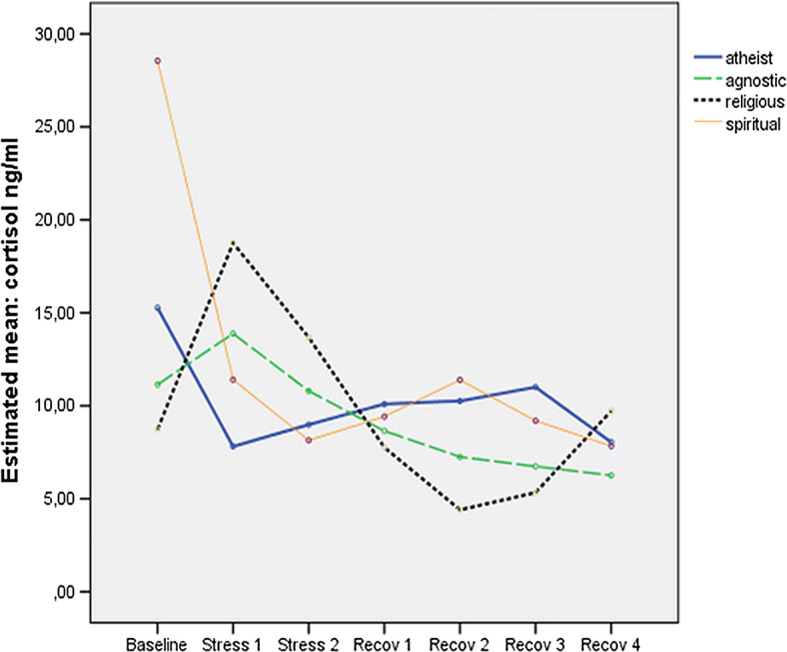
This study reports preliminary findings on the hypothesis that worldview can predict cardiovascular and cortisol responses to social stress. Based on theory and previous findings, we assumed that worldview security would provide a basis for stress resilience. Accordingly, religious and atheist individuals were expected to show higher stress resilience than spiritual and agnostic participants. Likewise, dimensional measures of religiosity and atheism were hypothesized to predict decreased, and existential search-indicating worldview insecurity-was hypothesized to predict increased physiological stress responses. Subjects included 50 university students who completed online questionnaires and took part in a standardized social stress test (Trier Social Stress Test). Systolic and diastolic blood pressure (SBP/DBP), heart rate (HR), and salivary cortisol (SC) were assessed at baseline, immediately after stress testing, and during a forty-minute recovery period. Worldview comparisons revealed lower cardiovascular stress responses among religious than among atheist and spiritual participants and particularly high baseline SC among spiritual participants. Across the entire sample, existential search showed substantial positive correlations with SBP, HR, and SC stress parameters. The findings suggest that worldview security might partly explain the health benefits often associated with religion.
Overview
The claims and statistics of this paper haven’t been checked yet.
Free: it reads the open-access text and checks the first 5 claims that cite a source we can check. Create a free account to check every claim.
Integrity signals
Registry
Cites
Statistics
Figures
Verification
Claims the paper makes
The claims and statistics of this paper haven’t been checked yet.
Free: it reads the open-access text and checks the first 5 claims that cite a source we can check. Create a free account to check every claim.
Claims other papers make about this one
Each is checked against this paper’s own text: does it say what the citing paper says it does?
The cited source says what the claim attributes to it.
In the citing paper
“cardiovascular and cortisol stress responses of a sample of university students can be predicted by secularity, religiosity, spirituality, and existential search [60].”
The cited source says what the claim attributes to it.
In the citing paper
“Studies have repeatedly established positive links between spirituality, religion and health.”
Self-check
Percentages, sums and reported differences re-computed from the paper’s own numbers.
The self-check needs the paper’s full text.
Citations
Cites
SPSS for Windows Step by Step: A Simple Guide and Reference
Mallery, P., & George, D. (1998) · Cited by 10,394
Handbook of Religion and Health
Koenig, H. G., McCullough, M. E., & Larson, D. B. (2004) · The American Journal of Geriatric Psychiatry · doi:10.1097/00019442-200405000-00015 · Cited by 3,268
Religion, Spirituality, and Health: The Research and Clinical Implications
Koenig, H. G. (2012) · ISRN Psychiatry · doi:10.5402/2012/278730 · Cited by 2,423 · cited 2×
“2008; Koenig 2012; Koenig et al.”
Aune, D., Giovannucci, E., Boffetta, P., Fadnes, L. T., Keum, N., Norat, T., Greenwood, D. C., Riboli, E., Vatten, L. J., & Tonstad, S. (2017) · International Journal of Epidemiology · doi:10.1093/ije/dyw319 · Cited by 2,419
A farewell to Bonferroni: the problems of low statistical power and publication bias
Nakagawa, S. (2004) · Behavioral Ecology · doi:10.1093/beheco/arh107 · Cited by 2,097 · cited 1×
“To prevent further substantial reduction in statistical power of rejecting an incorrect H0, no Bonferroni corrections were employed and readers are asked to evaluate the findings’ relevance by focusing on effect sizes and confidence intervals (cf., Nakagawa 2004).”
MethodHandbook of religion and health, 2nd ed.
Koenig, H. G., King, D. E., & Carson, V. B. (2012) · Cited by 1,197
SPSS for Windows Step by Step: A Simple Guide and Reference 18.0 Update
George, D., & Mallery, P. (2001) · Cited by 1,162
Handbook of Religion and Health
Koenig, H. G., VanderWeele, T., & Peteet, J. R. (2024) · doi:10.1093/oso/9780190088859.001.0001 · Cited by 1,139
Religion and spirituality: Linkages to physical health.
Powell, L. H., Shahabi, L., & Thoresen, C. E. (2003) · American Psychologist · doi:10.1037/0003-066x.58.1.36 · Cited by 1,093
The Centrality of Religiosity Scale (CRS)
Huber, S., & Huber, O. W. (2012) · Religions · doi:10.3390/rel3030710 · Cited by 982 · cited 1×
“1–5; Huber 2008; Huber and Huber 2012), and existential search (Schnell and Geidies 2016; sample item: As far as my worldview is concerned, I am in constant development.”
Background
Research works printed but not linked: 1
- Kosmin BA Keysar A American Religious Identification Survey (ARIS 2008): Summary report 2009 Hartford, CT Trinity College
Cited by
Handbook of Religion and Health
Koenig, H. G., VanderWeele, T., & Peteet, J. R. (2024) · doi:10.1093/oso/9780190088859.001.0001 · Cited by 1,139
Spitzenstätter, D., & Schnell, T. (2020) · Death Studies · doi:10.1080/07481187.2020.1848944 · Cited by 57
“…contradict a number of previous studies on relationships between mental well-being and religiosity (Eliassen et al., 2005; Galen & Kloet, 2011; Hodapp & Zwingmann, 2019; Ross, 1990; Schnittker, 2001) as well as spirituality (King et al., 2013; Schnell, 2012; Schnell et al., 2020; Vittengl, 2018).”
BackgroundResultInfluentialSelf-citationTrifunovic-Koenig, M., Strametz, R., Gerber, B., Mantri, S., & Bushuven, S. (2022) · International Journal of Environmental Research and Public Health · doi:10.3390/ijerph19084857 · Cited by 27
“Thus, an alternative method could rather entail the following: (1) life conceptions, identity issues, or religious beliefs (“internal”); and (2) socialization and integration in social groups (“external”)—these interacting factors have a significant impact on coping [42].”
MethodWorlds apart? Atheist, agnostic, and humanist worldviews in three European countries.
Schnell, T., de Boer, E. M., & Alma, H. A. (2021) · Psychology of Religion and Spirituality · doi:10.1037/rel0000446 · Cited by 25
Self-citationA Systematic Review on Alcohol Consumption among Non-Religious and Religious Adults
Chagas, C., Martins, L. B., Bezerra, A. G., de Paula, T. C. S., Xavier, A. C. A., Zangari, W., & Galduróz, J. C. F. (2022) · Substance Use & Misuse · doi:10.1080/10826084.2022.2155477 · Cited by 24
“While studies in these health fields have produced promising results (Baker et al., 2018; Hayward et al., 2016; Pöhls et al., 2020; Schnell et al., 2020; Walker et al., 2021), researchers have made less progress in the area of alcohol and other drugs in respect of a more global understanding…”
BackgroundResultGamaiunova, L., Brandt, P.-Y., & Kliegel, M. (2023) · Journal of Religion and Health · doi:10.1007/s10943-023-01964-8 · Cited by 21
Koenig, H. G., VanderWeele, T. J., & Peteet, J. R. (2023) · Oxford University Press eBooks · doi:10.1093/oso/9780190088859.003.0001 · Cited by 12
Fellinger, M., Holzinger, D., Fogler, J., & Fellinger, J. (2023) · Social Psychiatry and Psychiatric Epidemiology · doi:10.1007/s00127-023-02451-x · Cited by 13
Stress Responses Among Individuals with Spiritual Struggles in Hungary: An Experimental Study
Kéri, S. (2023) · Journal of Religion and Health · doi:10.1007/s10943-023-01819-2 · Cited by 13
“We considered the newest available protocol for TSST, including a standardized background questionnaire for confounding variables and physiological recordings (Narvaez Linares et al., 2020).”
BackgroundMethodInfluentialRönne-Petersén, L., Niemi, M., Walach, H., Lavebratt, C., Yang, L. L., Gerdle, B., Ghafouri, B., & Falkenberg, T. (2024) · PLoS ONE · doi:10.1371/journal.pone.0308924 · Cited by 4
Chagas, C., Martins, L. B., de Paula, T. C. S., Zangari, W., & Galduróz, J. C. F. (2024) · International Journal for the Psychology of Religion · doi:10.1080/10508619.2024.2439716 · Cited by 4
“…that observed better health outcomes in people with high religiosity and atheists, compared to people with low religiosity and agnostics (Galen & Kloet, 2011; Hayward et al., 2016; Mochon et al., 2011; Schnell et al., 2020; Walker et al., 2021; Wilkinson & Coleman, 2010; Zhang et al., 2024).”
Dempsey, A., Larkin, E., Howard, S., & Gallagher, S. M. (2025) · International Journal of Psychophysiology · doi:10.1016/j.ijpsycho.2025.112596 · Cited by 10
Carneiro, É. M., Oliveira, L. F. A., da Silva, D. A. A., Catarino, J. D. S., Timóteo, R. P., Desidério, C. S., Rodrigues, V., & Borges, M. D. F. (2022) · Journal of Complementary and Integrative Medicine · doi:10.1515/jcim-2020-0305 · Cited by 7
Koenig, H. G., VanderWeele, T. J., & Peteet, J. R. (2023) · Oxford University Press eBooks · doi:10.1093/oso/9780190088859.003.0002 · Cited by 5
Understanding the Religion, Mental, and Social Health Relationship
Koenig, H. G., VanderWeele, T. J., & Peteet, J. R. (2023) · Oxford University Press eBooks · doi:10.1093/oso/9780190088859.003.0016 · Cited by 7
Kéri, S. (2024) · Religion Brain & Behavior · doi:10.1080/2153599x.2024.2307373 · Cited by 4
“…stress situation, existential/spiritual search and worldview instability correlated with higher blood pressure, increased heart rate, and saliva cortisol concentration, suggesting that spiritual uncertainty predicts heightened stress responses during everyday challenges (Schnell et al., 2020).”
Reini, K., Kolk, M., & Saarela, J. M. (2024) · Journal of Epidemiology & Community Health · doi:10.1136/jech-2023-221532 · Cited by 3
O’Riordan, A., Costello, A. M., & Hill, T. D. (2025) · Journal of Religion and Health · doi:10.1007/s10943-025-02392-6 · Cited by 5
“…associated with lower cardiovascular responses to a variety of stressors including structured interviews (Edmondson et al., 2005; Lawler & Younger, 2002), mental arithmetic and interpersonal challenges (Masters & Knestel, 2011), and the trier social stress test (Schnell et al., 2020).”
Contemplative Practices as a Form of Stress Management for Patients with Kidney Disease
Bruce, M. A., Thorpe, R. J., Schneider, R. H., Hercz, A. E., Williams, S. F., & Norris, K. C. (2025) · Clinical Journal of the American Society of Nephrology · doi:10.2215/cjn.0000000829 · Cited by 4
Psychological Well-Being and Positive Emotions
Koenig, H. G., VanderWeele, T. J., & Peteet, J. R. (2023) · Oxford University Press eBooks · doi:10.1093/oso/9780190088859.003.0012 · Cited by 2
Koenig, H. G., VanderWeele, T. J., & Peteet, J. R. (2023) · Oxford University Press eBooks · doi:10.1093/oso/9780190088859.003.0025 · Cited by 1
Substance Use and Substance Use Disorders
Koenig, H. G., VanderWeele, T. J., & Peteet, J. R. (2023) · Oxford University Press eBooks · doi:10.1093/oso/9780190088859.003.0010 · Cited by 2
Koenig, H. G., VanderWeele, T. J., & Peteet, J. R. (2023) · Oxford University Press eBooks · doi:10.1093/oso/9780190088859.003.0014 · Cited by 4
Koenig, H. G., VanderWeele, T. J., & Peteet, J. R. (2023) · Oxford University Press eBooks · doi:10.1093/oso/9780190088859.003.0015 · Cited by 1
Dempsey, A., Howard, S., & Gallagher, S. (2026) · Religion Brain & Behavior · doi:10.1080/2153599x.2026.2617648 · Cited by 1
“Schnell et al. (2020) found group differences among religious, atheist, and spiritual individuals, with religious individuals showing lower cardiovascular responses.”
Johnson, K. A. (2026) · Cambridge University Press eBooks · doi:10.1017/9781009527842 · Cited by 1
Kéri, S. (2023) · Religions · doi:10.3390/rel14081072 · Cited by 1
“…including smoking, alcohol intake, exercising before participation, hours of sleep the previous night, being postmenopausal, acute or chronic illness, hormonal contraception, and distance walked during the pilgrimage and holiday (Narvaez Linares et al. 2020; Schnell et al. 2020) (Table 1).”
BackgroundKoenig, H. G., VanderWeele, T. J., & Peteet, J. R. (2023) · Oxford University Press eBooks · doi:10.1093/oso/9780190088859.003.0027 · Cited by 1
Koenig, H. G., VanderWeele, T. J., & Peteet, J. R. (2023) · Oxford University Press eBooks · doi:10.1093/oso/9780190088859.003.0008 · Cited by 2
Public Health and Human Flourishing
Koenig, H. G., VanderWeele, T. J., & Peteet, J. R. (2023) · Oxford University Press eBooks · doi:10.1093/oso/9780190088859.003.0032 · Cited by 1
Understanding the Religion–Physical Health Relationship
Koenig, H. G., VanderWeele, T. J., & Peteet, J. R. (2023) · Oxford University Press eBooks · doi:10.1093/oso/9780190088859.003.0031 · Cited by 1
Koenig, H. G., VanderWeele, T. J., & Peteet, J. R. (2023) · Oxford University Press eBooks · doi:10.1093/oso/9780190088859.003.0017 · Cited by 1
Koenig, H. G., VanderWeele, T. J., & Peteet, J. R. (2023) · Oxford University Press eBooks · doi:10.1093/oso/9780190088859.003.0006 · Cited by 1
Lebensbedeutungen – Quellen des Lebenssinns
Schnell, T. (2020) · Springer eBooks · doi:10.1007/978-3-662-61120-3_6 · Cited by 1
Self-citationKoenig, H. G., VanderWeele, T. J., & Peteet, J. R. (2023) · Oxford University Press eBooks · doi:10.1093/oso/9780190088859.002.0003 · Cited by 1
Religion, Spirituality, Well-Being, and Ill-Being in a Church-Renewal Movement: The Case of Finland
Hannikainen, P. (2021) · Journal of Empirical Theology · doi:10.1163/15709256-12341414 · Cited by 1
Humanização em saúde: um olhar sobre a arte de cuidar
Beltrão, J. R., Beltrão, M. R., Vendramini, D. R., Dotto, R. N., Dezan, T. H., Sedrez, P. C., Simão, T. C. M., Hornung, F. L., de Oliveira, M. L. F., & Andraus, G. S. (2022) · Texto e contexto editora eBooks · doi:10.54176/mlcs7453
Religiosidade, Espiritualidade e Doenças Cardiovasculares: O que Mostram as Pesquisas?
Dias, A. B., & Ceresér, K. M. M. (2022) · Kerygma · doi:10.19141/1809-2454.kerygma.v17.n1.pe01488
Koenig, H. G., VanderWeele, T. J., & Peteet, J. R. (2023) · Oxford University Press eBooks · doi:10.1093/oso/9780190088859.003.0034
Koenig, H. G., VanderWeele, T. J., & Peteet, J. R. (2023) · Oxford University Press eBooks · doi:10.1093/oso/9780190088859.003.0021
Koenig, H. G., VanderWeele, T. J., & Peteet, J. R. (2023) · Oxford University Press eBooks · doi:10.1093/oso/9780190088859.003.0007
Koenig, H. G., VanderWeele, T. J., & Peteet, J. R. (2023) · Oxford University Press eBooks · doi:10.1093/oso/9780190088859.003.0005 · Cited by 1
Koenig, H. G., VanderWeele, T. J., & Peteet, J. R. (2023) · Oxford University Press eBooks · doi:10.1093/oso/9780190088859.003.0029
Levin, J. (2023) · Oxford University Press eBooks · doi:10.1093/oso/9780190088859.002.0007
Koenig, H. G., VanderWeele, T. J., & Peteet, J. R. (2023) · Oxford University Press eBooks · doi:10.1093/oso/9780190088859.003.0033
Koenig, H. G., VanderWeele, T. J., & Peteet, J. R. (2023) · Oxford University Press eBooks · doi:10.1093/oso/9780190088859.002.0009
Alzheimer’s Disease and Other Dementias
Koenig, H. G., VanderWeele, T. J., & Peteet, J. R. (2023) · Oxford University Press eBooks · doi:10.1093/oso/9780190088859.003.0023
Koenig, H. G., VanderWeele, T. J., & Peteet, J. R. (2023) · Oxford University Press eBooks · doi:10.1093/oso/9780190088859.003.0024
Koenig, H. G., VanderWeele, T. J., & Peteet, J. R. (2023) · Oxford University Press eBooks · doi:10.1093/oso/9780190088859.003.0020
Koenig, H. G., VanderWeele, T. J., & Peteet, J. R. (2023) · Oxford University Press eBooks · doi:10.1093/oso/9780190088859.003.0026
Disease Prevention, Detection, and Treatment
Koenig, H. G., VanderWeele, T. J., & Peteet, J. R. (2023) · Oxford University Press eBooks · doi:10.1093/oso/9780190088859.003.0030 · Cited by 1
Koenig, H. G., VanderWeele, T. J., & Peteet, J. R. (2023) · Oxford University Press eBooks · doi:10.1093/oso/9780190088859.003.0019
Koenig, H. G., VanderWeele, T. J., & Peteet, J. R. (2023) · Oxford University Press eBooks · doi:10.1093/oso/9780190088859.002.0004
Personality Traits and Disorders
Koenig, H. G., VanderWeele, T. J., & Peteet, J. R. (2023) · Oxford University Press eBooks · doi:10.1093/oso/9780190088859.003.0011
Schizophrenia and Other Psychoses
Koenig, H. G., VanderWeele, T. J., & Peteet, J. R. (2023) · Oxford University Press eBooks · doi:10.1093/oso/9780190088859.003.0009
Koenig, H. G., VanderWeele, T. J., & Peteet, J. R. (2023) · Oxford University Press eBooks · doi:10.1093/oso/9780190088859.003.0004
Koenig, H. G., VanderWeele, T. J., & Peteet, J. R. (2023) · Oxford University Press eBooks · doi:10.1093/oso/9780190088859.003.0018
Koenig, H. G., VanderWeele, T. J., & Peteet, J. R. (2023) · Oxford University Press eBooks · doi:10.1093/oso/9780190088859.003.0003 · Cited by 1
Koenig, H. G., VanderWeele, T. J., & Peteet, J. R. (2023) · Oxford University Press eBooks · doi:10.1093/oso/9780190088859.003.0013
Koh, H. K. (2023) · Oxford University Press eBooks · doi:10.1093/oso/9780190088859.002.0006
Koenig, H. G., VanderWeele, T. J., & Peteet, J. R. (2023) · Oxford University Press eBooks · doi:10.1093/oso/9780190088859.003.0028
Koenig, H. G., VanderWeele, T. J., & Peteet, J. R. (2023) · Oxford University Press eBooks · doi:10.1093/oso/9780190088859.003.0022
Studies on Religion and Health
Koenig, H. G., VanderWeele, T. J., & Peteet, J. R. (2023) · Oxford University Press eBooks · doi:10.1093/oso/9780190088859.005.0001 · Cited by 1
The protective effect of frequent religious service attendance on pregnancy loss
Shropshire, S. J., & Williams, A. (2025) · Discover Public Health · doi:10.1186/s12982-025-00400-4 · Cited by 1
“Frequent religious attendance may mitigate these effects, as religious people may have lower levels of cortisol compared to individuals who identify as agnostic, spiritual, or atheist [34, 35].”
Plopeanu, A. P. (2025) · Springer eBooks · doi:10.1007/978-3-319-57365-6_413-1
Religiosity, spirituality, and cardiovascular responses to acute psychological stress
Dempsey, A., Howard, S., & Gallagher, S. (2026) · Psychology and Health · doi:10.1080/08870446.2026.2739468
Religiosity/Spirituality Association on Oral Diseases: A Systematic Review
da Costa, V. B. A., Filho, W. R. A., Guimarães, L. S., Antunes, L. S., Antunes, L. A., & Assaf, A. V. (2022) · International Journal of Health Sciences (IJHS) · doi:10.15640/ijhs.v10n1a5
Lee, S. Z., & Falkner, R. A. (2026) · Journal of Religion and Health · doi:10.1007/s10943-026-02649-8
МЕЖДИСЦИПЛИНАРНЫЙ ТРУД «WFS-РЕГЕНЕРАЦИЯ: СИСТЕМНАЯ МОДЕЛЬ ВОССТАНОВЛЕНИЯ»Preprint
Трушкинг, О. (2026) · doi:10.24108/preprints-3116703
Metadata
- Authors
- Schnell, T., Fuchs, D., & Hefti, R.
- Affiliations
- Universität Innsbruck (AT)
- Innsbruck Medical University (AT)
- University of Bern (CH)
- Corresponding author
- Schnell, Tatjana
- Venue
- Journal of Religion and Health
- Published
- 2020-03-27
- Volume
- 59
- Issue
- 6
- Pages
- 2969-2989
- ISSN
- 0022-4197 (ISSN-L)
- 1573-6571
- PMC
- PMC7677289
- OpenAlex
- W3013364483
- Cited by
- 69
- References
- 63
- Citations by year
- 2026: 5 · 2025: 5 · 2024: 4 · 2023: 45 · 2022: 6 · 2021: 2 · 2020: 2
- FWCI
- 7.60
- Type
- journal article
- Language
- en
- Open access
- hybrid
- doi.org
- Licence
- cc-by
- creativecommons.org/licenses/by/4.0 (tdm)
- creativecommons.org/licenses/by/4.0 (vor)
- Locations
- Journal of Religion and Health (publishedVersion, cc-by)
- PubMed Central (publishedVersion, cc-by)
- PubMed (publishedVersion)
- Digital Library of the University of Innsbruck (University of Innsbruck) (submittedVersion, cc-by)
- NORA - Norwegian Open Research Archives (submittedVersion, cc-by)
- Funders
- Medizinische Universität Innsbruck
- Universität Innsbruck
- Topics
- Social Sciences › Health › Religion, Spirituality, and Psychology
- Life Sciences › Neuroscience › Behavioral Neuroscience › Stress Responses and Cortisol
- Social Sciences › Sociology and Political Science › Religion and Society Interactions
- Keywords
- worldview, social stress, stress resilience, religiosity, atheism, spirituality, existential search, salivary cortisol, cardiovascular stress response, heart rate, blood pressure, Trier Social Stress Test, religion and health
- MeSH terms
- Adult, Cardiovascular Diseases, Existentialism, Female, Humans, Hydrocortisone, Male, Religion, Saliva, Stress, Psychological, Spirituality
About these checks
Registry, retraction, Cites and statistics results are computed, not judged, with one exception: a printed reference that no index lists is read once by a model before it counts as a citation error. Claims are extracted by a model and kept only when their quote appears verbatim in the text; each cited source is then checked, with a model’s help, for whether it says what the claim relies on. Those verdicts can be wrong — read the claim’s quote and the cited source before relying on one.
Statistics and arithmetic are recomputed, not judged.
Confidence bands are shown only for fields calibrated on our annotated test set. None is calibrated yet, so no band is shown.
What counts as a claim ›How we measure confidence ›How we check this ›
Are you an author, or do you see a problem with this page? Request a review
Data sources
Bibliographic data: Semantic Scholar, OpenAlex, Crossref.
Contains information from the Semantic Scholar Academic Graph Datasets, made available under the ODC Attribution License (ODC-BY 1.0).
Semantic Scholar’s data is described in: Kinney, R., et al. (2023). The Semantic Scholar Open Data Platform. arXiv:2301.10140.
