

The DOI matches its Crossref record; 72 of the 75 references it cites were found in a registry or an index, and 1 are not checked yet.
Associations between adolescents' interpersonal relationships, school well-being, and academic achievement during educational transitions
Open accessAbstract
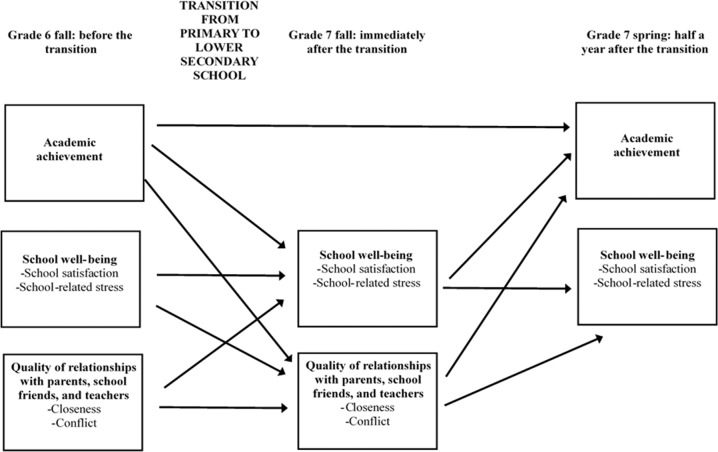
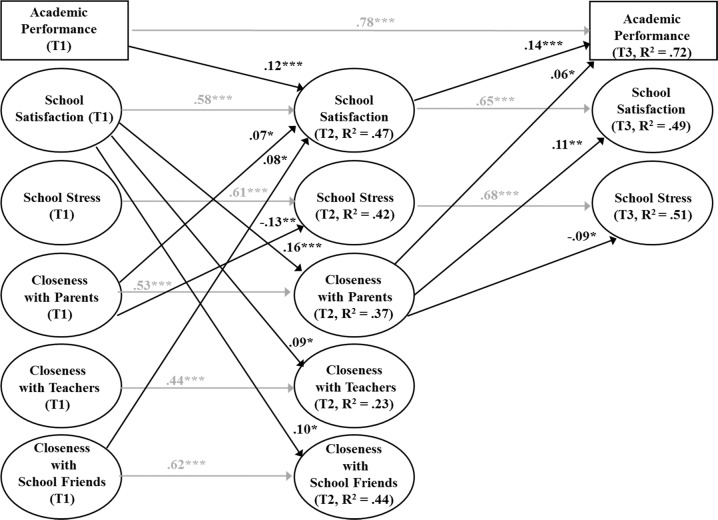
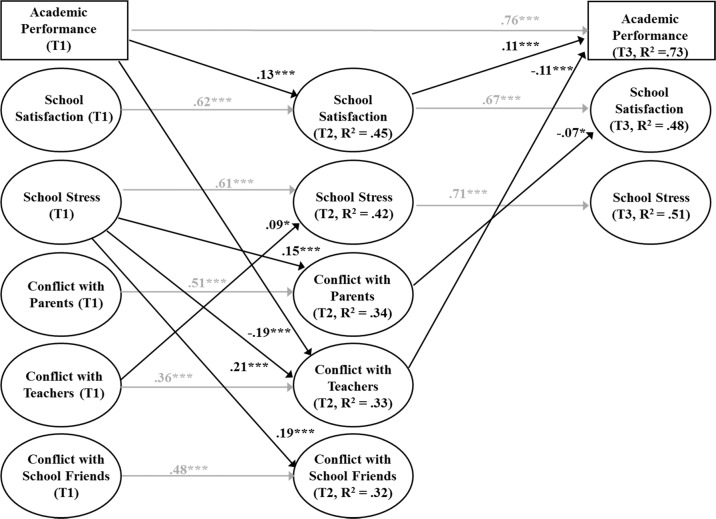
A youth’s ability to adapt during educational transitions has long-term, positive impacts on their academic achievement and mental health. Although supportive relationships with parents, peers, and teachers are protective factors associated with successful educational transitions, little is known about the reciprocal link between the quality of these interpersonal relationships and school well-being, with even less known about how these two constructs affect academic achievement. This longitudinal study examined how the quality of interpersonal relationships and school well-being worked together to affect academic achievement during the transition from primary school to lower secondary school. Data were collected from 848 Finnish adolescents (54% girls, mean age at the outset 12.3 years) over the course of sixth and seventh grade. The results support a transactional model illustrating the reciprocal associations between the quality of interpersonal relationships and school well-being during the transition to lower secondary school. As such, the presence of high quality interpersonal relationships promoted higher academic achievement through increased school well-being, whereas high school well-being promoted higher subsequent academic achievement through increased quality of interpersonal relationships. Overall, the results suggest that promoting learning outcomes and helping adolescents with challenges during educational transitions is a critical part of supporting school well-being and the formation of high-quality interpersonal relationships.
Overview
The claims and statistics of this paper haven’t been checked yet.
Run the check — free, no account needed. It reads the open-access text and checks the sources it cites.
Integrity signals
Registry
Cites
Statistics
Figures
Verification
Claims the paper makes
The claims and statistics of this paper haven’t been checked yet.
Run the check — free, no account needed. It reads the open-access text and checks the sources it cites.
Claims other papers make about this one
Each is checked against this paper’s own text: does it say what the citing paper says it does?
The source backs part of the claim, not all of it — or backs it for a different population, condition or comparison.
In the citing paper
“A high sociometric peer status is a significant predictor of well-being as well as academic success and effective intra- and interpersonal functioning later in life (Lease, Kennedy, Axelrod, 2002; Kiuru i in., 2020; Wentzel, Jablansky, Scalise, 2021).”
From The The effects of cognitive, social, and emotional intelligence on children’s sociometric status in a new peer group (2023) · cites this paper as Kiuru i in., 2020
Experimental — accuracy not yet measured
Self-check
Percentages, sums and reported differences re-computed from the paper’s own numbers.
The self-check needs the paper’s full text.
Citations
Cites
Hu, L., & Bentler, P. M. (1999) · Structural Equation Modeling A Multidisciplinary Journal · doi:10.1080/10705519909540118 · Cited by 108,788
The "what" and "why" of goal pursuits: Human needs and the self-determination of behavior
Deci, E. L., & Ryan, R. M. (2000) · Psychological Inquiry · doi:10.1207/s15327965pli1104_01 · Cited by 34,210
Alternative Ways of Assessing Model Fit
Browne, M. W., & Cudeck, R. (1992) · Sociological Methods & Research · doi:10.1177/0049124192021002005 · Cited by 27,200
Testing Structural Equation Models.
Mueller, C. W., Bollen, K. A., & Long, J. S. (1994) · Contemporary Sociology A Journal of Reviews · doi:10.2307/2074955 · Cited by 14,211
Confidence Limits for the Indirect Effect: Distribution of the Product and Resampling Methods
MacKinnon, D. P., Lockwood, C. M., & Williams, J. (2004) · Multivariate Behavioral Research · doi:10.1207/s15327906mbr3901_4 · Cited by 7,806
Hamre, B. K., & Pianta, R. C. (2001) · Child Development · doi:10.1111/1467-8624.00301 · Cited by 3,307
Steinberg, L., & Morris, A. S. (2001) · Annual Review of Psychology · doi:10.1146/annurev.psych.52.1.83 · Cited by 2,517
Social relationships and motivation in middle school: The role of parents, teachers, and peers.
Wentzel, K. R. (1998) · Journal of Educational Psychology · doi:10.1037/0022-0663.90.2.202 · Cited by 1,828
Schools as Developmental Contexts During Adolescence
Eccles, J. S., & Roeser, R. W. (2011) · Journal of Research on Adolescence · doi:10.1111/j.1532-7795.2010.00725.x · Cited by 1,629 · cited 1×
“The most prominent interpersonal relationships during the adolescent years involve friends and teachers at school and parents at home (Eccles and Roeser 2011; Moore et al. 2018; Wentzel 1998).”
Background
Research works printed but not linked: 2
- Hamm, J. V., & Zhang, L. (2010). The schooling context of adolescents’ peer relations. In J. Meece & J. Eccles (Eds), The handbook of schools and schooling effects on development (pp. 518–554). Mahwah, NJ: Erlbaum.
- Samdal, O., Dür, W., & Freeman, J. (2004). School. In C. Currie, C. Roberts, A. Morgan, R. Smith, W. Settertobulte & O. Samdal et al. (Eds), Young people´s health in context: international report from the HBSC 2001/02 survey. Health policy for children and adolescents (pp. 42–52). Copenhagen: World Health Organization.
Cited by
Sorted by citations
Students’ Well-Being and Academic Achievement: A Meta-Analysis Study
Kaya, M., & Erdem, C. (2021) · Child Indicators Research · doi:10.1007/s12187-021-09821-4 · Cited by 294
Study Demands–Resources Theory: Understanding Student Well-Being in Higher Education
Bakker, A. B., & Mostert, K. (2024) · Educational Psychology Review · doi:10.1007/s10648-024-09940-8 · Cited by 250
What Constitutes Student Well-Being: A Scoping Review Of Students’ Perspectives
Hossain, S., O'Neill, S. C., & Strnadová, I. (2022) · Child Indicators Research · doi:10.1007/s12187-022-09990-w · Cited by 193
Tuominen, H., Niemivirta, M., Lonka, K., & Salmela‐Aro, K. (2020) · Learning and Individual Differences · doi:10.1016/j.lindif.2020.101854 · Cited by 112
Self-citationStudy Demands-Resources Model of Student Engagement and Burnout
Salmela‐Aro, K., Tang, X., & Upadyaya, K. (2022) · Springer eBooks · doi:10.1007/978-3-031-07853-8_4 · Cited by 121
Self-citation
Metadata
- Authors
- Kiuru, N., Wang, M.-T., Salmela-Aro, K., Kannas, L., Ahonen, T., & Hirvonen, R.
- Affiliations
- University of Jyväskylä (FI)
- University of Pittsburgh (US)
- University of Eastern Finland (FI)
- Corresponding author
- Kiuru, Noona
- Venue
- Journal of Youth and Adolescence
- Published
- 2019-12-31
- Volume
- 49
- Issue
- 5
- Pages
- 1057-1072
- ISSN
- 0047-2891 (ISSN-L)
- 1573-6601
- PMC
- PMC7182546
- OpenAlex
- W2997342648
- Cited by
- 235
- References
- 75
- Citations by year
- 2026: 39 · 2025: 50 · 2024: 55 · 2023: 41 · 2022: 31 · 2021: 15 · 2020: 4
- FWCI
- 33.75
- Type
- journal article
- Language
- en
- Open access
- hybrid
- doi.org
- Locations
- Journal of Youth and Adolescence (publishedVersion, cc-by)
- PubMed Central (publishedVersion, cc-by)
- PubMed (publishedVersion)
- Työväentutkimus Vuosikirja (submittedVersion, cc-by)
- Jyväskylä University Digital Archive (University of Jyväskylä) (submittedVersion, cc-by)
- Funders
- Academy of Finland (266851)
- Topics
- Social Sciences › Education › Educational Environments and Student Outcomes
- Social Sciences › Education › Early Childhood Education and Development
- Social Sciences › Psychology › Developmental and Educational Psychology › Psychosocial Factors Impacting Youth
- Keywords
- adolescents, interpersonal relationships, school well-being, academic performance, educational transitions, parent-adolescent relationships, peer relationships, teacher-adolescent relationships, transactional model, bidirectional relationship, youth mental health
- MeSH terms
- Academic Success, Achievement, Adolescent, Child, Female, Humans, Interpersonal Relations, Longitudinal Studies, Male, Parent-Child Relations, Parents, Peer Group, Personality Development, Schools, Parenting
About these checks
Registry, retraction, Cites and statistics results are computed, not judged, with one exception: a printed reference that no index lists is read once by a model before it counts as a citation error. Claims are extracted by a model and kept only when their quote appears verbatim in the text; each cited source is then checked, with a model’s help, for whether it says what the claim relies on. Those verdicts can be wrong — read the claim’s quote and the cited source before relying on one.
Statistics and arithmetic are recomputed, not judged.
Confidence bands are shown only for fields calibrated on our annotated test set. None is calibrated yet, so no band is shown.
What counts as a claim ›How we measure confidence ›How we check this ›
Are you an author, or do you see a problem with this page? Request a review
