

The Logic of Design as a Conceptual Logic of Information
Open accessThe DOI matches its Crossref record; 65 of the 73 references it cites were found in a registry or an index.
Abstract
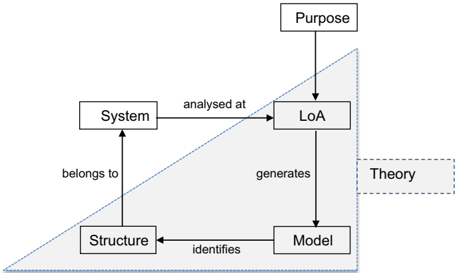
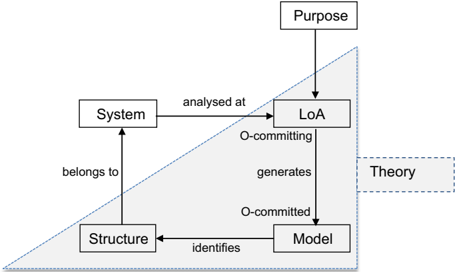
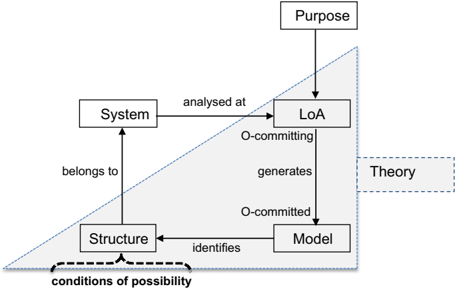
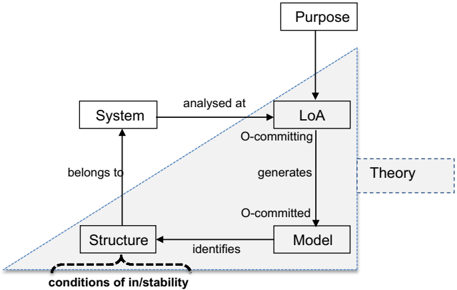
In this article, I outline a logic of design of a system as a specific kind of conceptual logic of the design of the model of a system, that is, the blueprint that provides information about the system to be created. In section two, I introduce the method of levels of abstraction as a modelling tool borrowed from computer science. In section three, I use this method to clarify two main conceptual logics of information (i.e., modelling systems) inherited from modernity: Kant’s transcendental logic of conditions of possibility of a system, and Hegel’s dialectical logic of conditions of in/stability of a system. Both conceptual logics of information analyse structural properties of given systems. Strictly speaking, neither is a conceptual logic of information about (or modelling) the conditions of feasibility of a system, that is, neither is a logic of information as a logic of design. So, in section four, I outline this third conceptual logic of information and then interpret the conceptual logic of design as a logic of requirements , by introducing the relation of “sufficientisation”. In the conclusion, I argue that the logic of requirements is exactly what we need in order to make sense of, and buttress, a constructionist (poietic) approach to knowledge.
Overview
The claims and statistics of this paper haven’t been checked yet.
Free: it reads the open-access text and checks the first 5 claims that cite a source we can check. Create a free account to check every claim.
Integrity signals
Registry
Cites
Statistics
Figures
Verification
Claims the paper makes
The claims and statistics of this paper haven’t been checked yet.
Free: it reads the open-access text and checks the first 5 claims that cite a source we can check. Create a free account to check every claim.
Claims other papers make about this one
Each is checked against this paper’s own text: does it say what the citing paper says it does?
In the citing paper
“The conceptual framework, that is, the Level of Abstraction (LoA) depends on what is being explained and to whom (Floridi 2017).”
From How to Design AI for Social Good: Seven Essential Factors (2020) · cites this paper as Floridi 2017
In the citing paper
“It is possible to design things to be better (Floridi 2017)”
From From What to How: An Initial Review of Publicly Available AI Ethics Tools, Methods and Research to Translate Principles into Practices (2020) · cites this paper as Floridi 2017
Self-check
Percentages, sums and reported differences re-computed from the paper’s own numbers.
The self-check needs the paper’s full text.
Citations
Cites
The Reflective Practitioner: How Professionals Think in Action
Checkoway, B., & Schon, D. A. (1985) · Journal of Policy Analysis and Management · doi:10.2307/3324262 · Cited by 21,268
The reflective practitioner: How professionals think in action
Stewart, C. J. (1984) · Patient Education and Counseling · doi:10.1016/0738-3991(84)90022-3 · Cited by 19,752
A Pattern Language: Towns, Buildings, Construction
Alexander, C., Ishikawa, S., Silverstein, M., Jacobson, M., Fiksdahl-King, I., & Angel, S. (1977) · Cited by 6,814
Norman, D. (2016) · Vahlen eBooks · doi:10.15358/9783800648108 · Cited by 6,374
Camera Lucida: Reflections on Photography
Barthes, R. (2001) · Reading Images · doi:10.1007/978-1-137-08886-4_6 · Cited by 5,456
(1989) · Cited by 4,498
The sciences of the artificial (3rd ed.)
Simon, H. A. (1996) · The MIT Press eBooks · Cited by 4,300
Alexander, C. (1979) · Cited by 3,196
(2014) · Choice Reviews Online · doi:10.5860/choice.51-5559 · Cited by 2,342 · cited 1×
“Of course, the context usually 4 As excellent, indeed now classic examples, see Munari (1971), Arup (2012), Norman (2013).”
BackgroundMimesis: The Representation of Reality in Western Literature
Isenberg, A., Auerbach, E., & Trask, W. R. (1954) · The Journal of Aesthetics and Art Criticism · doi:10.2307/426914 · Cited by 2,024
Notes on the Synthesis of Form
Alexander, C. W. (1964) · Cumulative Index of Computer Aided Architectural Design · Cited by 1,991
Speculative Everything: Design, Fiction, and Social Dreaming
(2014) · Choice Reviews Online · doi:10.5860/choice.51-5390 · Cited by 1,952 · cited 1×
“It is a must read for anyone interested in understanding the conceptual nature of design together with the excellent Dunne and Raby (2013).”
Background(2013) · Cited by 1,951
Mimesis: The Representation of Reality in Western Literature
Auerbach, E. (1953) · Cited by 1,190
Information architecture for the World Wide Web
(2003) · Choice Reviews Online · doi:10.5860/choice.40-3447 · Cited by 1,078
Floridi, L. (2011) · Oxford University Press eBooks · doi:10.1093/acprof:oso/9780199232383.001.0001 · Cited by 993
Self-citationDahl, O., Dijkstra, E., & Hoare, C. A. R. (1972) · UCLA - Biblioteca de Ciencias y Tecnologia Felix Morales Bueno · Cited by 932
An Analysis of Knowledge and Valuation.
Baylis, C. A., & Lewis, C. I. (1947) · Philosophy and Phenomenological Research · doi:10.2307/2102922 · Cited by 921
Floridi, L. (2013) · Oxford University Press eBooks · doi:10.1093/acprof:oso/9780199641321.001.0001 · Cited by 651
Self-citationInformation: A Very Short Introduction
Floridi, L. (2010) · Cited by 558
Self-citationInformation: A Very Short Introduction
Floridi, L. (2010) · Oxford University Press eBooks · doi:10.1093/actrade/9780199551378.001.0001 · Cited by 490
Self-citationAn analysis of knowledge and valuation
Lewis, C. I. (1947) · Medical Entomology and Zoology · Cited by 441
The Method of Levels of Abstraction
Floridi, L. (2008) · Minds and Machines · doi:10.1007/s11023-008-9113-7 · Cited by 349
Self-citationMind and the World-Order: Outline of a Theory of Knowledge.
Baylis, C. A., & Lewis, C. I. (1930) · The Journal of Philosophy · doi:10.2307/2015639 · Cited by 330
Carnap and Twentieth-Century Thought: Explication as Enlightenment
Carus, A. W. (2007) · Cambridge University Press eBooks · doi:10.1017/cbo9780511487132 · Cited by 329
Miller, H., & Lewis, C. I. (1931) · The Philosophical Review · doi:10.2307/2180045 · Cited by 275
Finite transition systems: semantics of communicating systems
Arnold, A., & Plaice, J. (1994) · Prentice Hall International (UK) Ltd. eBooks · Cited by 218
Philosophy and computing: an introduction
(2000) · Choice Reviews Online · doi:10.5860/choice.37-5710 · Cited by 184
The Shape of Things: A Philosophy of Design
Wulf, A. (2000) · Journal of Design History · doi:10.1093/jdh/13.2.161 · Cited by 174
The Ethics of Information Warfare
Floridi, L., & Taddeo, M. (2014) · Law, governance and technology series · doi:10.1007/978-3-319-04135-3 · Cited by 147
Self-citation(1999) · Cited by 144
Self-citationMIND AND THE WORLD ORDER. OUTLINE OF A THEORY OF KNOWLEDGE
Lewis, C. I. (1931) · The Journal of Nervous and Mental Disease · doi:10.1097/00005053-193109000-00044 · Cited by 143
Understanding Arguments: An Introduction to Informal Logic
Fogelin, R. J. (1978) · Informal Logic · doi:10.22329/il.v1i2.2805 · Cited by 131 · cited 1×
“But so would be the use of labels such as “informal logic” (see Sinnott-Armstrong and Fogelin 2015; Walton and Brinton 2016) and “philosophical logic” (see Burgess 2009; Sainsbury 2001), already appropriated by other branches of philosophy.”
BackgroundZeng, Y., & Cheng, G. (1991) · Design Studies · doi:10.1016/0142-694x(91)90022-o · Cited by 131
Quine, W. V. O. (1992) · The Journal of Philosophy · doi:10.2307/2026889 · Cited by 130
Understanding Arguments. An Introduction to Informal Logic.
Dale, A. J., & Fogelin, R. J. (1980) · The Philosophical Quarterly · doi:10.2307/2219285 · Cited by 118
Philosophy and Design: From Engineering to Architecture
Kroes, P., Vermaas, P. E., Light, A., & Moore, S. A. (2007) · Springer eBooks · doi:10.1007/978-1-4020-6591-0 · Cited by 109
Philosophy and Design From Engineering to Architecture
Johnson, D. G. (2009) · Techné Research in Philosophy and Technology · doi:10.5840/techne200913214 · Cited by 108
The Shape of Things: A Philosophy of Design
Flusser, V. (2013) · Medical Entomology and Zoology · Cited by 107
Formal Methods: State of the Art and New Directions
Boca, P., Bowen, J. P., & Siddiqi, J. (2009) · Springer eBooks · doi:10.1007/978-1-84882-736-3 · Cited by 102
Internet Ethics: the Constructionist Values of Homo Poieticus
Floridi, L., & Sanders, J. W. (2003) · PhilPapers (PhilPapers Foundation) · Cited by 89
Self-citationLogical forms: an introduction to philosophical logic
(1992) · Choice Reviews Online · doi:10.5860/choice.29-2666 · Cited by 84 · cited 1×
“But so would be the use of labels such as “informal logic” (see Sinnott-Armstrong and Fogelin 2015; Walton and Brinton 2016) and “philosophical logic” (see Burgess 2009; Sainsbury 2001), already appropriated by other branches of philosophy.”
BackgroundBurgess, J. P. (2009) · Princeton University Press eBooks · doi:10.1515/9781400830497 · Cited by 77
March, L. (2010) · Medical Entomology and Zoology · Cited by 75
ON THE LOGICAL UNSOLVABILITY OF THE GETTIER PROBLEM
Floridi, L. (2004) · Synthese · doi:10.1023/b:synt.0000047709.27594.c4 · Cited by 64
Self-citationWhat a Maker’s Knowledge Could Be
Floridi, L. (2016) · Synthese · doi:10.1007/s11229-016-1232-8 · Cited by 64 · cited 1×
“As I have argued elsewhere Floridi (2016), one important consequence is that, asking whether a logic of design is a priori or a posteriori, means not having grasped the shift from mimesis to poiesis .”
BackgroundSelf-citationParsons, G. (2015) · Cited by 60
Logical Forms: An Introduction to Philosophical Logic.
Champlin, T. S., & Sainsbury, M. (1992) · The Philosophical Quarterly · doi:10.2307/2220221 · Cited by 59
Ammon, S. (2017) · Philosophy & Technology · doi:10.1007/s13347-017-0256-4 · Cited by 53 · cited 1×
“This is why I agree with Ammon (2017) that designing is not an empirical kind of experimenting (contrary to widespread methodological claims) but more an independent epistemic praxis through which one can acquire genuine ab anteriori knowledge.”
BackgroundKroll, E., & Koskela, L. (2015) · Springer eBooks · doi:10.1007/978-3-319-14956-1_19 · Cited by 41
Historical Foundations of Informal Logic
Walton, D., & Brinton, A. (2016) · Routledge eBooks · doi:10.4324/9781315253329 · Cited by 39 · cited 1×
“But so would be the use of labels such as “informal logic” (see Sinnott-Armstrong and Fogelin 2015; Walton and Brinton 2016) and “philosophical logic” (see Burgess 2009; Sainsbury 2001), already appropriated by other branches of philosophy.”
BackgroundWhat is A Philosophical Question?
Floridi, L. (2013) · Metaphilosophy · doi:10.1111/meta.12035 · Cited by 38
Self-citationHeis, J. (2012) · Cambridge University Press eBooks · doi:10.1017/cho9780511975257.008 · Cited by 31
Munari, B. (1971) · Medical Entomology and Zoology · Cited by 30
Towards a formal logic of design rationalization
Galle, P. (1997) · Design Studies · doi:10.1016/s0142-694x(97)85461-0 · Cited by 25 · cited 1×
“This is not to say that Modal Logic cannot be helpful to study patterns of inference in design reasoning and rationalisation, see for example Galle (1997).”
BackgroundComplicating the ‘logic of design’
Goel, V. (1988) · Design Studies · doi:10.1016/0142-694x(88)90008-7 · Cited by 24 · cited 3×
“March (1984) defends a logic of design as a logic of abduction, but in a problem-solving context, see also Goel (1988), who seeks to extend March’s approach. Kroll and Koskela (2015) re-proposes the abductive interpretation but refers only to March (1976) not to March (1984). The Logic of Design as a Conceptual Logic…”
BackgroundInfluentialTHE PRAGMATIC A PRIORI: LEWIS AND DEWEY
Rosenthal, S. B. (1987) · The Southern Journal of Philosophy · doi:10.1111/j.2041-6962.1987.tb01610.x · Cited by 24
Buurman, G. M., & Rölli, M. (2015) · Cited by 18
Goc, M. L., & Vilar, F. (2017) · International Conference on Agents and Artificial Intelligence (ICAART) · doi:10.5220/0006111103640373 · Cited by 18
Philosophy and Design from Engineering to Architecture
Vermaas, P. E. (2008) · Cited by 18
A Plea for Non-naturalism as Constructionism
Floridi, L. (2017) · Minds and Machines · doi:10.1007/s11023-017-9422-9 · Cited by 15 · cited 1×
“As it is clear from Floridi (2017), I am utterly unconvinced by Lewis’ later naturalism as presented in Lewis (1946) because it seems to me to exchange Kant’s logical univocity for a biological, impoverished version that is even more controversial.”
BackgroundSelf-citationAshley, C. M. (1944) · Proceedings of the IRE · doi:10.1109/jrproc.1944.234360 · Cited by 12
Fawcett, W. (1987) · Design Studies · doi:10.1016/0142-694x(87)90005-6 · Cited by 8
Chapter II: Notes on data structuring
Hoare, C. A. R. (1972) · Academic Press Ltd. eBooks · Cited by 7
(2014) · International Linear Collider
Self-citation
Research works printed but not linked: 2
- Kelsen, H. (1967). Pure theory of law (Translation from the second (revised and enlarged) German edition by Max Knight, see also the translation of the first ed.: Introduction to the problems of legal theory. Clarendon Press, 1992. Berkeley: University of California Press.
- March, L. (1984). The logic of design. In Developments in design methodology (pp. 265-276). Chichester: Wiley.
Cited by
The ethics of AI in health care: A mapping review
Morley, J., Machado, C. C. V., Burr, C., Cowls, J., Joshi, I., Taddeo, M., & Floridi, L. (2020) · Social Science & Medicine · doi:10.1016/j.socscimed.2020.113172 · Cited by 1,105
“This changes the affordances and constraints of different governing bodies, regulators, and system agents, under-mining the mechanisms in place to hold those delivering care accoun-table and thus introducing new risks (Floridi, 2017a).”
BackgroundSelf-citationMorley, J., Floridi, L., Kinsey, L., & Elhalal, A. (2020) · Science and Engineering Ethics · doi:10.1007/s11948-019-00165-5 · Cited by 882
“It is possible to design things to be better (Floridi 2017), but this will require more coordinated and sophisticated approaches (Allen et al. 2000) to translating ethical principles into design protocols (Turilli 2007).”
BackgroundSelf-citationThe Ethics of Artificial Intelligence: Principles, Challenges, and Opportunities
Floridi, L. (2023) · doi:10.1093/oso/9780198883098.001.0001 · Cited by 507
Self-citationHow to Design AI for Social Good: Seven Essential Factors
Floridi, L., Cowls, J., King, T. C., & Taddeo, M. (2020) · Science and Engineering Ethics · doi:10.1007/s11948-020-00213-5 · Cited by 430
“The conceptual framework, that is, the Level of Abstraction (LoA) depends on what is being explained and to whom (Floridi 2017).”
BackgroundSelf-citationOperationalising AI Ethics: Barriers, Enablers and next Steps
Morley, J., Kinsey, L., Elhalal, A., Garcia, F., Ziosi, M., & Floridi, L. (2023) · AI & SOCIETY · doi:10.1007/s00146-021-01308-8 · Cited by 215
“However, over time, it has become increasingly clear that whilst these documents’ existence might be necessary for the creation of these much-needed pro-ethical conditions (Floridi 2017), it is far from sufficient (Vidgen et al.”
BackgroundSelf-citation
Metadata
- Authors
- Floridi, L.
- Affiliations
- University of Oxford (GB)
- Corresponding author
- Floridi, Luciano
- ORCID
- Floridi, Luciano
- Venue
- Minds and Machines
- Published
- 2017-06-14
- Volume
- 27
- Issue
- 3
- Pages
- 495-519
- ISSN
- 0924-6495 (ISSN-L)
- 1572-8641
- OpenAlex
- W2624961342
- Cited by
- 76
- References
- 73
- Citations by year
- 2026: 5 · 2025: 4 · 2024: 3 · 2023: 24 · 2022: 7 · 2021: 12 · 2020: 6 · 2019: 12 · 2018: 3
- FWCI
- 10.69
- Type
- journal article
- Language
- en
- Open access
- hybrid
- doi.org
- Locations
- Minds and Machines (publishedVersion, cc-by)
- PhilPapers (PhilPapers Foundation) (submittedVersion, cc-by)
- PhilPapers (PhilPapers Foundation) (submittedVersion)
- Topics
- Social Sciences › Business, Management and Accounting › Management of Technology and Innovation › Scientific Research and Philosophical Inquiry
- Social Sciences › Arts and Humanities › Philosophy › Philosophy and Theoretical Science
- Social Sciences › Arts and Humanities › History and Philosophy of Science › Philosophy of Biology and Scientific Explanation
- Keywords
- levels of abstraction, system modeling, conditions of possibility, constructionism, requirements engineering
About these checks
Registry, retraction, Cites and statistics results are computed, not judged, with one exception: a printed reference that no index lists is read once by a model before it counts as a citation error. Claims are extracted by a model and kept only when their quote appears verbatim in the text; each cited source is then checked, with a model’s help, for whether it says what the claim relies on. Those verdicts can be wrong — read the claim’s quote and the cited source before relying on one.
Statistics and arithmetic are recomputed, not judged.
Confidence bands are shown only for fields calibrated on our annotated test set. None is calibrated yet, so no band is shown.
What counts as a claim ›How we measure confidence ›How we check this ›
Are you an author, or do you see a problem with this page? Request a review
Data sources
Bibliographic data: Semantic Scholar, OpenAlex, Crossref.
Contains information from the Semantic Scholar Academic Graph Datasets, made available under the ODC Attribution License (ODC-BY 1.0).
Semantic Scholar’s data is described in: Kinney, R., et al. (2023). The Semantic Scholar Open Data Platform. arXiv:2301.10140.
