

The Logic of Design as a Conceptual Logic of Information
Open accessThe DOI matches its Crossref record; 65 of the 73 references it cites were found in a registry or an index.
Abstract
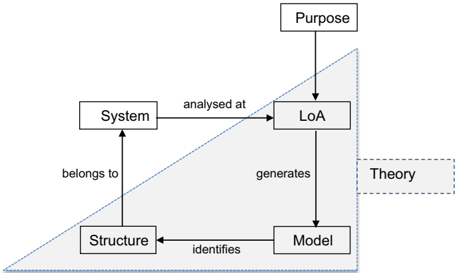
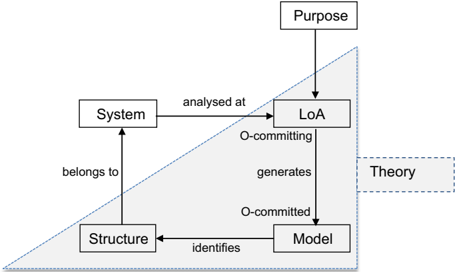
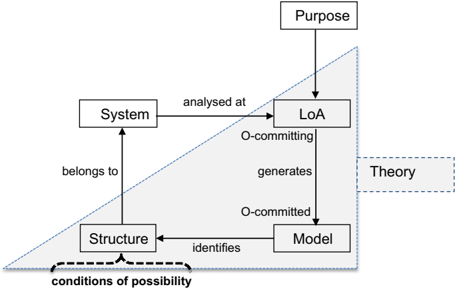
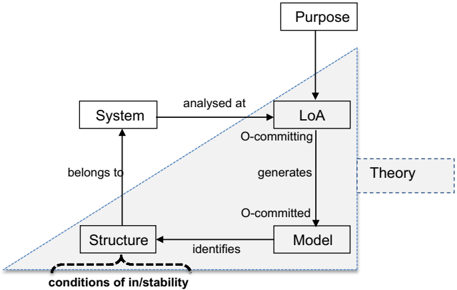
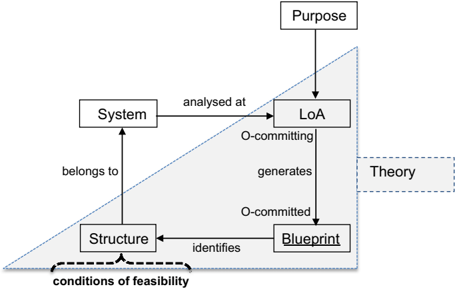
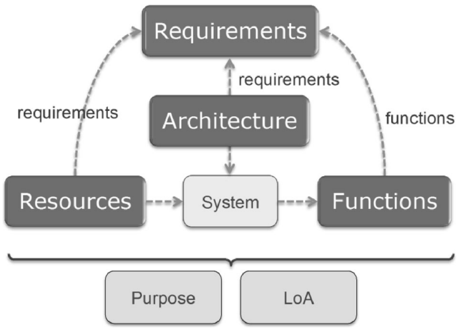
In this article, I outline a logic of design of a system as a specific kind of conceptual logic of the design of the model of a system, that is, the blueprint that provides information about the system to be created. In section two, I introduce the method of levels of abstraction as a modelling tool borrowed from computer science. In section three, I use this method to clarify two main conceptual logics of information (i.e., modelling systems) inherited from modernity: Kant’s transcendental logic of conditions of possibility of a system, and Hegel’s dialectical logic of conditions of in/stability of a system. Both conceptual logics of information analyse structural properties of given systems. Strictly speaking, neither is a conceptual logic of information about (or modelling) the conditions of feasibility of a system, that is, neither is a logic of information as a logic of design. So, in section four, I outline this third conceptual logic of information and then interpret the conceptual logic of design as a logic of requirements , by introducing the relation of “sufficientisation”. In the conclusion, I argue that the logic of requirements is exactly what we need in order to make sense of, and buttress, a constructionist (poietic) approach to knowledge.
Overview
The claims and statistics of this paper haven’t been checked yet.
Free: it reads the open-access text and checks the first 5 claims that cite a source we can check. Create a free account to check every claim.
Integrity signals
Registry
Cites
Statistics
Figures
Verification
Claims the paper makes
The claims and statistics of this paper haven’t been checked yet.
Free: it reads the open-access text and checks the first 5 claims that cite a source we can check. Create a free account to check every claim.
Claims other papers make about this one
Each is checked against this paper’s own text: does it say what the citing paper says it does?
In the citing paper
“The conceptual framework, that is, the Level of Abstraction (LoA) depends on what is being explained and to whom (Floridi 2017).”
From How to Design AI for Social Good: Seven Essential Factors (2020) · cites this paper as Floridi 2017
In the citing paper
“It is possible to design things to be better (Floridi 2017)”
From From What to How: An Initial Review of Publicly Available AI Ethics Tools, Methods and Research to Translate Principles into Practices (2020) · cites this paper as Floridi 2017
Self-check
Percentages, sums and reported differences re-computed from the paper’s own numbers.
The self-check needs the paper’s full text.
Citations
Cites
The Reflective Practitioner: How Professionals Think in Action
Checkoway, B., & Schon, D. A. (1985) · Journal of Policy Analysis and Management · doi:10.2307/3324262 · Cited by 21,268
The reflective practitioner: How professionals think in action
Stewart, C. J. (1984) · Patient Education and Counseling · doi:10.1016/0738-3991(84)90022-3 · Cited by 19,752
A Pattern Language: Towns, Buildings, Construction
Alexander, C., Ishikawa, S., Silverstein, M., Jacobson, M., Fiksdahl-King, I., & Angel, S. (1977) · Cited by 6,814
Norman, D. (2016) · Vahlen eBooks · doi:10.15358/9783800648108 · Cited by 6,374
Camera Lucida: Reflections on Photography
Barthes, R. (2001) · Reading Images · doi:10.1007/978-1-137-08886-4_6 · Cited by 5,456
(1989) · Cited by 4,498
The sciences of the artificial (3rd ed.)
Simon, H. A. (1996) · The MIT Press eBooks · Cited by 4,300
Alexander, C. (1979) · Cited by 3,196
(2014) · Choice Reviews Online · doi:10.5860/choice.51-5559 · Cited by 2,342 · cited 1×
“Of course, the context usually 4 As excellent, indeed now classic examples, see Munari (1971), Arup (2012), Norman (2013).”
BackgroundMimesis: The Representation of Reality in Western Literature
Isenberg, A., Auerbach, E., & Trask, W. R. (1954) · The Journal of Aesthetics and Art Criticism · doi:10.2307/426914 · Cited by 2,024
Research works printed but not linked: 2
- Kelsen, H. (1967). Pure theory of law (Translation from the second (revised and enlarged) German edition by Max Knight, see also the translation of the first ed.: Introduction to the problems of legal theory. Clarendon Press, 1992. Berkeley: University of California Press.
- March, L. (1984). The logic of design. In Developments in design methodology (pp. 265-276). Chichester: Wiley.
Cited by
The ethics of AI in health care: A mapping review
Morley, J., Machado, C. C. V., Burr, C., Cowls, J., Joshi, I., Taddeo, M., & Floridi, L. (2020) · Social Science & Medicine · doi:10.1016/j.socscimed.2020.113172 · Cited by 1,105
“This changes the affordances and constraints of different governing bodies, regulators, and system agents, under-mining the mechanisms in place to hold those delivering care accoun-table and thus introducing new risks (Floridi, 2017a).”
BackgroundSelf-citationMorley, J., Floridi, L., Kinsey, L., & Elhalal, A. (2020) · Science and Engineering Ethics · doi:10.1007/s11948-019-00165-5 · Cited by 882
“It is possible to design things to be better (Floridi 2017), but this will require more coordinated and sophisticated approaches (Allen et al. 2000) to translating ethical principles into design protocols (Turilli 2007).”
BackgroundSelf-citationThe Ethics of Artificial Intelligence: Principles, Challenges, and Opportunities
Floridi, L. (2023) · doi:10.1093/oso/9780198883098.001.0001 · Cited by 507
Self-citationHow to Design AI for Social Good: Seven Essential Factors
Floridi, L., Cowls, J., King, T. C., & Taddeo, M. (2020) · Science and Engineering Ethics · doi:10.1007/s11948-020-00213-5 · Cited by 430
“The conceptual framework, that is, the Level of Abstraction (LoA) depends on what is being explained and to whom (Floridi 2017).”
BackgroundSelf-citationOperationalising AI Ethics: Barriers, Enablers and next Steps
Morley, J., Kinsey, L., Elhalal, A., Garcia, F., Ziosi, M., & Floridi, L. (2023) · AI & SOCIETY · doi:10.1007/s00146-021-01308-8 · Cited by 215
“However, over time, it has become increasingly clear that whilst these documents’ existence might be necessary for the creation of these much-needed pro-ethical conditions (Floridi 2017), it is far from sufficient (Vidgen et al.”
BackgroundSelf-citationEthics-Based Auditing of Automated Decision-Making Systems: Nature, Scope, and Limitations
Mökander, J., Morley, J., Taddeo, M., & Floridi, L. (2021) · Science and Engineering Ethics · doi:10.1007/s11948-021-00319-4 · Cited by 207
“EBA enables moral goodness to be realised, if properly implemented and combined with justifiable values and sincere intentions (Floridi 2017a; Taddeo 2016).”
BackgroundSelf-citationHow to Design AI for Social Good: Seven Essential Factors
Floridi, L., Cowls, J., King, T. C., & Taddeo, M. (2021) · Philosophical Studies Series · doi:10.1007/978-3-030-81907-1_9 · Cited by 161
Self-citationMorley, J., Floridi, L., Kinsey, L., & Elhalal, A. (2021) · Philosophical studies series · doi:10.1007/978-3-030-81907-1_10 · Cited by 235
Self-citationThe explanation game: a formal framework for interpretable machine learning
Watson, D. S., & Floridi, L. (2021) · Synthese · doi:10.1007/s11229-020-02629-9 · Cited by 71
“Inspired by the Formal Methods literature in computer science (Boca et al. 2010), the levelist approach has been extended to conceptualise a wide array of problems in the philosophy of information (Floridi 2008a, 2011, 2017).”
Self-citationThe Debate on the Ethics of AI in Health Care: a Reconstruction and Critical Review
Morley, J., Machado, C., Burr, C., Cowls, J., Taddeo, M., & Floridi, L. (2019) · SSRN Electronic Journal · doi:10.2139/ssrn.3486518 · Cited by 66
Self-citationMökander, J., & Axente, M. (2023) · AI & SOCIETY · doi:10.1007/s00146-021-01286-x · Cited by 62
“Feedback provides pragmatic ways of dealing with this complexity: by shifting the focus from describing the system to designing a blueprint for what success looks like, we can participate proactively in shaping future societies (Floridi 2017b).”
BackgroundThe Ethics of AI in Health Care: A Mapping Review
Morley, J., Machado, C. C. V., Burr, C., Cowls, J., Joshi, I., Taddeo, M., & Floridi, L. (2020) · Philosophical studies series · doi:10.1007/978-3-030-81907-1_18 · Cited by 160
Self-citationThe Explanation Game: A Formal Framework for Interpretable Machine Learning
Watson, D., & Floridi, L. (2021) · Philosophical studies series · doi:10.1007/978-3-030-81907-1_11 · Cited by 55
Self-citationWeaving seams with data: Conceptualizing City APIs as elements of infrastructures
Raetzsch, C., Pereira, G., Vestergaard, L. S., & Brynskov, M. (2019) · Big Data & Society · doi:10.1177/2053951719827619 · Cited by 49
Digital behavioral technology, vulnerability and justice: towards an integrated approach
Herzog, L. M., Kellmeyer, P., & Wild, V. (2021) · Review of Social Economy · doi:10.1080/00346764.2021.1943755 · Cited by 42
“DBTs are of course embedded into a wider ecosystem of digital technologies, as well as the global ‘datasphere’ (Burk, 2008), the realm of collected and curated data, and the ‘infosphere’ (Floridi, 2017), the entire global informational environment.”
BackgroundThe Green and the Blue: Naïve Ideas to Improve Politics in a Mature Information Society
Floridi, L. (2019) · Digital ethics lab yearbook · doi:10.1007/978-3-030-17152-0_12 · Cited by 29
Self-citationDrawing Inferences: Thinking with 6B (and Sketching Paper)
Ammon, S. (2018) · Philosophy & Technology · doi:10.1007/s13347-018-0323-5 · Cited by 23
“The way this relates to a logic of design—recently brought into the philosophical debate by Floridi (2017) and dealing with the products of processes (blueprints) rather than with the process itself—should make for an illuminating debate, which unfortunately cannot be entered into here. resulting…”
BackgroundPhilosophy of Computer Science
Turner, R. J. (2019) · Oxford University Press eBooks · doi:10.1093/obo/9780195396577-0224 · Cited by 19
Privacy in the Age of Neuroscience: Reimagining Law, State and Market
Grant, D. (2021) · Cited by 14
The Debate on the Ethics of AI in Health Care: a Reconstruction and Critical ReviewPreprint
Morley, J. (2019) · OSF Preprints (OSF Preprints) · doi:10.31219/osf.io/n7y2g · Cited by 13
“What these regulations, standards and policies should cover and how they should be developed remain open questions (Floridi, 2017b) which will likely be ‘solved’ multiple times ov er by different healthcare systems operating in different settings.”
BackgroundInfluentialLeveraging Digital Intelligence for Community Well-Being
Narayan, R. (2020) · International Journal of Community Well-Being · doi:10.1007/s42413-020-00085-4 · Cited by 17
“However, as Floridi (2017) argues, a conceptual logic of information that is steeped in analyzing the structural properties of a given system ceases to be a logic for design.”
BackgroundTrancossi, M., Pascoa, J. C., & Mazzacurati, S. (2021) · International Communications in Heat and Mass Transfer · doi:10.1016/j.icheatmasstransfer.2021.105622 · Cited by 13
How to Design a Governable Digital Health Ecosystem
Morley, J., & Floridi, L. (2019) · Digital ethics lab yearbook · doi:10.1007/978-3-030-80083-3_8 · Cited by 15
Self-citationCan AI be a subject like us? A Hegelian speculative-philosophical approach
Plevrakis, E. (2024) · Discover Computing · doi:10.1007/s10791-024-09472-3 · Cited by 10
On the Notion of Information – Info-sphere, the World of Formations
Benczúr, A., & Molnár, B. (2018) · IEEE International Conference on Cognitive Infocommunications · doi:10.1109/coginfocom.2018.8639904 · Cited by 10
“Floridi in [10] introduced a new logic; a conceptual logic of information about (or modeling) the conditions of feasibility of a system, that is, a logic of information as a logic of design.”
BackgroundMethodThe Explanation Game: A Formal Framework for Interpretable Machine LearningPreprint
Watson, D., & Floridi, L. (2020) · SSRN Electronic Journal · doi:10.2139/ssrn.3509737 · Cited by 9
Self-citationTheory languages in designing artificial intelligence
Saariluoma, P. O., & Karvonen, A. (2023) · AI & Society · doi:10.1007/s00146-023-01716-y · Cited by 13
Morley, J., Laitila, J., Ross, J. S., Schamroth, J., Zhang, J., & Floridi, L. (2025) · Minds and Machines · doi:10.1007/s11023-025-09710-7 · Cited by 8
“The sys-tem can then be designed from the ground up to meet these requirements (Floridi, 2017).”
Self-citationA Unified Framework of Ethical Principles for AI
Floridi, L. (2023) · Oxford University Press eBooks · doi:10.1093/oso/9780198883098.003.0004 · Cited by 11
Self-citationCognitive Mimetics for AI Ethics: Tacit Knowledge, Action Ontologies and Problem Restructuring
Karvonen, A. (2020) · Lecture notes in computer science · doi:10.1007/978-3-030-50267-6_8 · Cited by 7
Cattabriga, A., & Joler, V. (2023) · DIID · doi:10.30682/diid8023a · Cited by 7
The Explanation Game: A Formal Framework for Interpretable Machine Learning
Watson, D., & Floridi, L. (2021) · Digital ethics lab yearbook · doi:10.1007/978-3-030-80083-3_11 · Cited by 6
Self-citationPresent: AI as a New Form of Agency, Not Intelligence
Floridi, L. (2023) · Oxford University Press eBooks · doi:10.1093/oso/9780198883098.003.0002 · Cited by 6
Self-citationRuminations on Floridi’s Conjecture
Watson, D., & Sterkenburg, T. F. (2026) · Philosophy & Technology · doi:10.1007/s13347-026-01086-5 · Cited by 3
“Interestingly, our conclusion here is broadly aligned with those found elsewhere in Floridi’s own epistemology, as outlined in numerous papers (2008; 2011; 2017) and a recent monograph (2019 ).”
A logic of efficient and optimal designs
Primiero, G. (2019) · Journal of Logic and Computation · doi:10.1093/logcom/exz014 · Cited by 3
The Green and the Blue: Digital Politics in Philosophical Discussion
Floridi, L., Noller, J. U., & Verlagsgesellschaft, N. (2022) · Verlag Karl Alber eBooks · doi:10.5771/9783495998335 · Cited by 7
Self-citationAddressing Uncertainties in Complex Manufacturing Environments: A Multidisciplinary Approach
Dhiman, H., Plewe, D. A., & Röcker, C. (2018) · Advances in intelligent systems and computing · doi:10.1007/978-3-319-94196-7_10 · Cited by 3
“Since “the model of a system is a function of the available observables” [18], if a system consists of more observables than are chosen, there”
BackgroundMökander, J. (2021) · Digital ethics lab yearbook · doi:10.1007/978-3-030-80083-3_5 · Cited by 5
“To this aim, the “logic of design” puts the model (i.e. a blueprint), as opposed to the characteristics of the system, in the centre of the analytical process (Floridi 2017).”
BackgroundMethodInfluentialTowards a bioinformational understanding of AI
Gautam, R. D., & Devarakonda, B. (2022) · AI & Society · doi:10.1007/s00146-022-01529-5 · Cited by 5
“As every bit of information is morally qualifiable, his relationality relies on an abstract method where these information bits are modelled (2017).”
From Principles to Practices: The Risks of Being Unethical
Floridi, L. (2023) · Oxford University Press eBooks · doi:10.1093/oso/9780198883098.003.0005 · Cited by 2
Self-citationThe Ontological Role of Applied Mathematics in Virtual Worlds
Hoffmann, M. (2022) · Philosophies · doi:10.3390/philosophies7010022 · Cited by 2
“A special advantage of this new model is that it is freely scalable (through the number of iterations) compared to the previous analytical, algebraic surface description methods, depending on what physical display and at what resolution the shape is presented, which is also theoretically important for video games [21].”
MethodSchlussfolgern durch Skizzieren. „Kooperative“ Materialien des zeichnerischen Denkens
Ammon, S. (2019) · Medien der Kooperation · doi:10.1007/978-3-658-20805-9_8 · Cited by 3
Zamberlan, C., Benedetti, F. J., Smeha, L. N., Bär, K. A., Rodrigues, L. F., & Backes, D. S. (2023) · Acta Paulista de Enfermagem · doi:10.37689/acta-ape/2023ar005231 · Cited by 10
“(6) É preciso, no entanto, esforços concretos para instrumentalizar investigadores a desenvolverem a sua capacidade de produzir ao invés de apenas consumir saberes e aplicáveis dissociados das necessidades dos usuários.(24) A CAPES estimula, nessa direção, o desenvolvimento de tecnologias sociais(17) centradas no usuá…”
BackgroundFuture: The Foreseeable Development of AI
Floridi, L. (2023) · Oxford University Press eBooks · doi:10.1093/oso/9780198883098.003.0003 · Cited by 2
Self-citationAI and the UN Sustainable Development Goals
Floridi, L. (2023) · Oxford University Press eBooks · doi:10.1093/oso/9780198883098.003.0012 · Cited by 2
Self-citationTypes of Mimetics for the Design of Intelligent Technologies
Karvonen, A., Kujala, T., & Saariluoma, P. O. (2019) · Advances in intelligent systems and computing · doi:10.1007/978-3-030-27928-8_7 · Cited by 2
Closing the AI benefits gap: Systems design for population health equity
Morley, J., & Floridi, L. (2026) · Public Health · doi:10.1016/j.puhe.2026.106205 · Cited by 3
Self-citationDesign, Malfunction, Validity: Three More Tasks for the Philosophy of Computing
Primiero, G. (2019) · Philosophy & Technology · doi:10.1007/s13347-019-00367-6 · Cited by 1
“has been recently considered in [1], a task reconsidered further in [7], where a blueprint is a formal object composed by a tuple <process, resources, output>, required to instantiate a system.”
BackgroundComputer Science and Philosophy: In Search of a Nexus
Ishaq, U. M. (2019) · IOP Conference Series Materials Science and Engineering · doi:10.1088/1757-899x/662/6/062016 · Cited by 1
Soft Ethics and the Governance of AI
Floridi, L. (2023) · Oxford University Press eBooks · doi:10.1093/oso/9780198883098.003.0006 · Cited by 1
Self-citationČerný, M. (2025) · European Education · doi:10.1080/10564934.2025.2569466 · Cited by 1
“Similar changes can be seen in information retrieval and evaluation (Floridi, 2017; Sudirjo et al., 2023; Xu et al., 2023).”
Floridi, L. (2023) · Oxford University Press eBooks · doi:10.1093/oso/9780198883098.002.0003 · Cited by 1
Self-citationThe Ideal and the Material, the Subjective and the Objective in Systems Research
Тунда, Е. А., & Тунда, В. А. (2022) · Lecture notes in networks and systems · doi:10.1007/978-3-030-98832-6_12
Practice research in social design as a form of inquiry
Kaszynska, P., Knutz, E., & Markussen, T. (2022) · Proceedings of DRS · doi:10.21606/drs.2022.1059
Дом, который построил Кэрролл: регресс и адоптация в формальном обосновании
Драгалина-Черная, Е. Г. (2022) · Logical Investigations · doi:10.21146/2074-1472-2022-28-1-27-49
Misselhorn, C. (2022) · Verlag Karl Alber eBooks · doi:10.5771/9783495998335-139
“However, the concept of a level of abstraction (LoA), which”
Floridi, L. (2023) · Oxford University Press eBooks · doi:10.1093/oso/9780198883098.002.0009
Self-citationFloridi, L. (2023) · Oxford University Press eBooks · doi:10.1093/oso/9780198883098.003.0001
Self-citationFloridi, L. (2023) · Oxford University Press eBooks · doi:10.1093/oso/9780198883098.002.0004
Self-citationMapping the Ethics of Algorithms
Floridi, L. (2023) · Oxford University Press eBooks · doi:10.1093/oso/9780198883098.003.0007
Self-citationHow to Deliver a Good AI Society: Some Recommendations
Floridi, L. (2023) · Oxford University Press eBooks · doi:10.1093/oso/9780198883098.003.0010
Self-citationFloridi, L. (2023) · Oxford University Press eBooks · doi:10.1093/oso/9780198883098.002.0007
Self-citationBad Practices: The Misuse of AI for Social Evil
Floridi, L. (2023) · Oxford University Press eBooks · doi:10.1093/oso/9780198883098.003.0008
Self-citationList of Most Common Abbreviations and Acronyms
Floridi, L. (2023) · Oxford University Press eBooks · doi:10.1093/oso/9780198883098.002.0011
Self-citationThe Gambit: AI Impact on Climate Change
Floridi, L. (2023) · Oxford University Press eBooks · doi:10.1093/oso/9780198883098.003.0011
Self-citationFloridi, L. (2023) · Oxford University Press eBooks · doi:10.1093/oso/9780198883098.002.0010
Self-citationGood Practices: The Proper Use of AI for Social Good
Floridi, L. (2023) · Oxford University Press eBooks · doi:10.1093/oso/9780198883098.003.0009
Self-citationFloridi, L. (2023) · Oxford University Press eBooks · doi:10.1093/oso/9780198883098.002.0005
Self-citationConclusion: The Green and the Blue
Floridi, L. (2023) · Oxford University Press eBooks · doi:10.1093/oso/9780198883098.003.0013
Self-citation(2024) · Advances in educational marketing, administration, and leadership book series · doi:10.4018/979-8-3693-5827-6.ch008
A Critical Analysis of Technological Transformation Education
(2024) · Advances in educational marketing, administration, and leadership book series · doi:10.4018/979-8-3693-5827-6.ch010
Lisanyuk, E. N. (2025) · Slovo ru Baltic accent · doi:10.5922/2225-5346-2025-1-8
Closing the AI Benefits Gap: Systems Design for Population Health EquityPreprint
Morley, J., & Floridi, L. (2025) · SSRN Electronic Journal · doi:10.2139/ssrn.5229016
Self-citationA Monad-Based Clause Architecture for Artificial Age Score (AAS) in Large Language ModelsPreprint
Kayadibi, S. Y. (2026) · Research Square · doi:10.21203/rs.3.rs-8736598/v1
Nejistota jako fenomén filosofie edukace: pedagogika v nejistotě nebo pedagogika nejistoty?
Černý, M. (2026) · Pedagogická orientace · doi:10.5817/pedor2025-41699
Košatka, D., Černý, M., & Sedláková, M. (2026) · Learning Research and Practice · doi:10.1080/23735082.2026.2731922
Metadata
- Authors
- Floridi, L.
- Affiliations
- University of Oxford (GB)
- Corresponding author
- Floridi, Luciano
- ORCID
- Floridi, Luciano
- Venue
- Minds and Machines
- Published
- 2017-06-14
- Volume
- 27
- Issue
- 3
- Pages
- 495-519
- ISSN
- 0924-6495 (ISSN-L)
- 1572-8641
- OpenAlex
- W2624961342
- Cited by
- 76
- References
- 73
- Citations by year
- 2026: 5 · 2025: 4 · 2024: 3 · 2023: 24 · 2022: 7 · 2021: 12 · 2020: 6 · 2019: 12 · 2018: 3
- FWCI
- 10.69
- Type
- journal article
- Language
- en
- Open access
- hybrid
- doi.org
- Locations
- Minds and Machines (publishedVersion, cc-by)
- PhilPapers (PhilPapers Foundation) (submittedVersion, cc-by)
- PhilPapers (PhilPapers Foundation) (submittedVersion)
- Topics
- Social Sciences › Business, Management and Accounting › Management of Technology and Innovation › Scientific Research and Philosophical Inquiry
- Social Sciences › Arts and Humanities › Philosophy › Philosophy and Theoretical Science
- Social Sciences › Arts and Humanities › History and Philosophy of Science › Philosophy of Biology and Scientific Explanation
- Keywords
- levels of abstraction, system modeling, conditions of possibility, constructionism, requirements engineering
About these checks
Registry, retraction, Cites and statistics results are computed, not judged, with one exception: a printed reference that no index lists is read once by a model before it counts as a citation error. Claims are extracted by a model and kept only when their quote appears verbatim in the text; each cited source is then checked, with a model’s help, for whether it says what the claim relies on. Those verdicts can be wrong — read the claim’s quote and the cited source before relying on one.
Statistics and arithmetic are recomputed, not judged.
Confidence bands are shown only for fields calibrated on our annotated test set. None is calibrated yet, so no band is shown.
What counts as a claim ›How we measure confidence ›How we check this ›
Are you an author, or do you see a problem with this page? Request a review
Data sources
Bibliographic data: Semantic Scholar, OpenAlex, Crossref.
Contains information from the Semantic Scholar Academic Graph Datasets, made available under the ODC Attribution License (ODC-BY 1.0).
Semantic Scholar’s data is described in: Kinney, R., et al. (2023). The Semantic Scholar Open Data Platform. arXiv:2301.10140.
