

AI4People—An Ethical Framework for a Good AI Society: Opportunities, Risks, Principles, and Recommendations
Open accessThe DOI matches its Crossref record; 6 of the 8 references it cites were found in a registry or an index; 1 of the 33 sources its claims cite were checked for support.
Abstract
This article reports the findings of AI4People, an Atomium-EISMD initiative designed to lay the foundations for a "Good AI Society". We introduce the core opportunities and risks of AI for society; present a synthesis of five ethical principles that should undergird its development and adoption; and offer 20 concrete recommendations-to assess, to develop, to incentivise, and to support good AI-which in some cases may be undertaken directly by national or supranational policy makers, while in others may be led by other stakeholders. If adopted, these recommendations would serve as a firm foundation for the establishment of a Good AI Society.
Overview
CoChat Summary
## TL;DR
AI4People proposes an ethical framework for a “Good AI Society” by synthesizing AI’s major social opportunities and risks, five guiding principles, and 20 policy recommendations. The paper argues that ethics adds a “dual advantage”: it helps organizations capture socially valuable AI opportunities while avoiding costly harms.
## Key findings
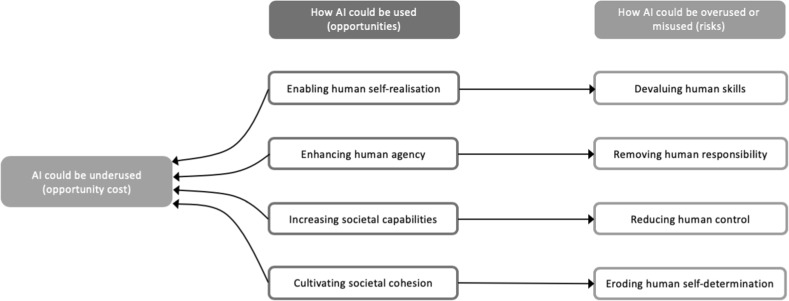
- The authors identify four chief opportunities AI offers society: who we can become, what we can do, what we can achieve, and how we can interact.
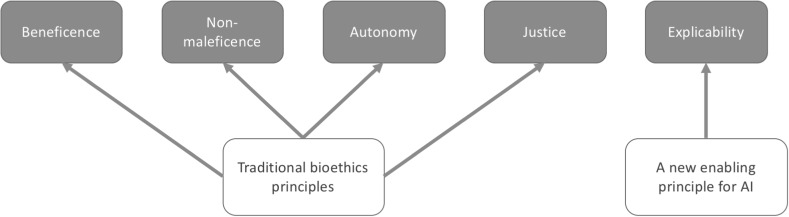
- They synthesize 47 principles from six high-profile AI ethics documents and argue these converge on five principles for AI: beneficence, non-maleficence, autonomy, justice, and explicability.
- The paper argues that AI should be developed to decrease inequality, increase shared benefits, and remain explicable, because explicability is described as critical for public trust and understanding.
- The recommendations section sets out 20 Action Points grouped into assessment, development, incentivisation, and support.
## Methods
- The paper is a conceptual and comparative ethics analysis, not an empirical study.
- It reviews six existing AI ethics documents: Asilomar, Montreal, IEEE, EGE, AIUK, and the Partnership on AI, and compares their principles.
- The authors then synthesize these into a framework and derive 20 recommendations for a Good AI Society.
## Limitations
- The paper states that it presents a European approach meant to be complementary to other approaches, so its recommendations are not claimed to be universally exhaustive or final.
- The text itself makes evident that the analysis is normative and document-based, not based on original empirical data or tested interventions (text-evident limitation).
- The paper also presents the recommendations as a “living document”, implying they are provisional and meant to evolve rather than serve as a definitive endpoint.
Model-written summary. Check it against the paper before relying on it.
Integrity signals
Registry
Cites
Statistics
Figures
Verification
Claims the paper makes
1 Valid · 1 Not valid · 27 Not checked · 35 Own results and interpretations
The cited sources support only part of this claim — read each source’s verdict below.
In the paper
“Everything from email scams to full-scale cyber-warfare may be accelerated or intensified by the malicious use of AI technologies (Taddeo 2018).”
§ AI4People—An Ethical Framework for a Good AI Society: Opportunities, Risks, Principles, and Recommendations > The Opportunities and Risks of AI for Society
What the sources say
- Partly supportedcites Taddeo 2018 matched to “The Limits of Deterrence Theory in Cyberspace” (2018) sourceExperimental — accuracy not yet measured
Section 4.3 (page unavailable) says machine-learning systems deployed for cyber defence can pose risks of unforeseen, disproportionate damage, supporting a narrower concern that AI could intensify harm in cyber conflict. It does not address malicious AI use, email scams, or AI accelerating attacks across that range. (LLM, conf=0.77)
hedgedstates a possible cause- Asserted: passes — The authors put it forward as true.
- Checkable: passes — It can be checked against evidence.
- Load-bearing: unclear — It is unclear whether the paper’s conclusions depend on it.
- Based: passes — The paper gives a reason why it holds.
- Rests on an assumption not shown here.
- Partly supported
None of the sources cited for this claim could be matched to a paper, so there is nothing to check it against.
In the paper
“Taken together, they yield 47 principles.5”
§ AI4People—An Ethical Framework for a Good AI Society: Opportunities, Risks, Principles, and Recommendations > A Unified Framework of Principles for AI in Society
What the sources say
- Not matchedcites Asilomar AI Principles 2017
An author–year citation the paper’s reference list doesn’t settle. We don’t search these by name.
- Not matchedcites Montreal Declaration 2017
An author–year citation the paper’s reference list doesn’t settle. We don’t search these by name.
- Not matchedcites IEEE 2017
An author–year citation the paper’s reference list doesn’t settle. We don’t search these by name.
plainstates a cause- Asserted: passes — The authors put it forward as true.
- Checkable: passes — It can be checked against evidence.
- Load-bearing: passes — The paper’s conclusions depend on it.
- Based: passes — The paper gives a reason why it holds.
- Not matched
A conclusion the paper draws from its own results — it cites no other source for it, so there is none to check. The quote shows it is in the paper.
In the paper
“But they are not exhaustive.”
§ AI4People—An Ethical Framework for a Good AI Society: Opportunities, Risks, Principles, and Recommendations > A Unified Framework of Principles for AI in Society
plain- Asserted: passes — The authors put it forward as true.
- Checkable: passes — It can be checked against evidence.
- Load-bearing: passes — The paper’s conclusions depend on it.
- Based: passes — The paper gives a reason why it holds.
A conclusion the paper draws from its own results — it cites no other source for it, so there is none to check. The quote shows it is in the paper.
In the paper
“On the basis of the following comparative analysis, we argue that one more, new principle is needed in addition: explicability, understood as incorporating both intelligibility and accountability.”
§ AI4People—An Ethical Framework for a Good AI Society: Opportunities, Risks, Principles, and Recommendations > A Unified Framework of Principles for AI in Society
plain- Asserted: passes — The authors put it forward as true.
- Checkable: passes — It can be checked against evidence.
- Load-bearing: passes — The paper’s conclusions depend on it.
- Based: passes — The paper gives a reason why it holds.
A conclusion the paper draws from its own results — it cites no other source for it, so there is none to check. The quote shows it is in the paper.
In the paper
“The four bioethical principles adapt surprisingly well to the fresh ethical challenges posed by artificial intelligence.”
§ AI4People—An Ethical Framework for a Good AI Society: Opportunities, Risks, Principles, and Recommendations > A Unified Framework of Principles for AI in Society
boosted- Asserted: passes — The authors put it forward as true.
- Checkable: passes — It can be checked against evidence.
- Load-bearing: passes — The paper’s conclusions depend on it.
- Based: passes — The paper gives a reason why it holds.
5 more claims
Create a free account to see all 64 claims and every source verdict.
- Probably not a substantial claim. 51
- It may state two separate claims as one. 9
- Not yet classified. 2
- The quote only partly states this claim. 1
Claims other papers make about this one
Each is checked against this paper’s own text: does it say what the citing paper says it does?
The source backs part of the claim, not all of it — or backs it for a different population, condition or comparison.
In the citing paper
“While AI systems can influence learning outcomes through adaptive contributions, they cannot bear responsibility for those outcomes, engage in ethical reflection about educational goals, or possess the experiential understanding that grounds pedagogical wisdom”
From Towards a philosophy of ensemble cognition: Reconceptualising agency and mind in AI-mediated educational environments (2026) · cites this paper as Floridi et al., 2018
Experimental — accuracy not yet measuredThe source backs part of the claim, not all of it — or backs it for a different population, condition or comparison.
In the citing paper
“This trust will be important for the future of AI as a lack of trust could permanently harm the reputation of AI in healthcare, or lead to additional costs through inefficient regulation or repeated amendment (Floridi et al., 2018).”
From Liability for harm caused by AI in healthcare: an overview of the core legal concepts (2023) · cites this paper as Floridi et al., 2018
Experimental — accuracy not yet measuredThe source backs part of the claim, not all of it — or backs it for a different population, condition or comparison.
In the citing paper
“Indeed, the framework played a valuable role in the work of AI 4 People, Europe's first global forum on the social impact of AI, which recently adopted it to propose 20 concrete recommendations for a 'Good AI Society' to the European Commission (Floridi et al., 2018 ).”
From A Unified Framework of Five Principles for AI in Society (2019) · cites this paper as Floridi et al., 2018
Experimental — accuracy not yet measuredThe source backs part of the claim, not all of it — or backs it for a different population, condition or comparison.
In the citing paper
“De manera complementaria, autores como Floridi et al. (2018) abogan por incorporar principios como la justicia, la beneficencia y el respeto por la autonomía en todas las etapas del desarrollo de herramientas basadas en IA [23].”
From Avances, Retos Éticos y Perspectivas de la Inteligencia Artificial (IA) en la Educación de América Latina (2025) · cites this paper as [23]
Experimental — accuracy not yet measuredThe source backs part of the claim, not all of it — or backs it for a different population, condition or comparison.
In the citing paper
“Talos represents ancient human fears about the uncontrollable power of man-made creations, fears that persist into contemporary concerns about AI (Floridi et al., 2018; Sebastian, 2023; Tabassi, 2023b).”
From Delegated agency and moral responsibility in artificial intelligence (2026) · cites this paper as Floridi et al., 2018
Experimental — accuracy not yet measured
30 more claims about this paper
Create a free account to see every claim other papers make about this one.
Citations
Cites
Floridi, L. (2013) · Oxford University Press eBooks · doi:10.1093/acprof:oso/9780199641321.001.0001 · Cited by 651
Self-citationSoft Ethics and the Governance of the Digital
Floridi, L. (2018) · Philosophy & Technology · doi:10.1007/s13347-018-0303-9 · Cited by 325 · cited 2×
“2 The analysis in this and the following two sections is also available in Cowls and Floridi (2018).”
BackgroundSelf-citationArtificial Intelligence Crime: An Interdisciplinary Analysis of Foreseeable Threats and Solutions
King, T. C., Aggarwal, N., Taddeo, M., & Floridi, L. (2020) · Science and Engineering Ethics · doi:10.1007/s11948-018-00081-0 · Cited by 271
Self-citationThe Limits of Deterrence Theory in Cyberspace
Taddeo, M. (2018) · Philosophy & Technology · doi:10.1007/s13347-017-0290-2 · Cited by 98
Prolegomena to a White Paper on an Ethical Framework for a Good AI Society
Cowls, J., & Floridi, L. (2018) · SSRN Electronic Journal · doi:10.2139/ssrn.3198732 · Cited by 76
Self-citationArtificial Intelligence Crime: An Interdisciplinary Analysis of Foreseeable Threats and Solutions
King, T., Aggarwal, N., Taddeo, M., & Floridi, L. (2018) · SSRN Electronic Journal · doi:10.2139/ssrn.3183238 · Cited by 17
Self-citation
Research works printed but not linked: 3
- Asilomar AI Principles. (2017). Principles developed in conjunction with the 2017 Asilomar conference [Benevolent AI 2017]. Retrieved September 18, 2018 from https://futureoflife.org/ai-principles.
- Cowls, J., & Floridi, L. (2018). Prolegomena to a White Paper on Recommendations for the Ethics of AI (June 19, 2018). Available at SSRN: https://ssrn.com/abstract=3198732.
- The IEEE Initiative on Ethics of Autonomous and Intelligent Systems. (2017). Ethically Aligned Design, v2. Retrieved September 18, 2018 from https://ethicsinaction.ieee.org.
Cited by
Items 2,601–2,700 of 4,603
Selke, S. (2023) · Edition transcript · doi:10.14361/9783839469286-053
Selke, S. (2023) · Edition transcript · doi:10.14361/9783839469286-014
Selke, S. (2023) · Edition transcript · doi:10.14361/9783839469286-035
Selke, S. (2023) · Edition transcript · doi:10.14361/9783839469286-033
1.1 KI als ›Star‹ im Drama der Digitalisierung
Selke, S. (2023) · Edition transcript · doi:10.14361/9783839469286-004
Selke, S. (2023) · Edition transcript · doi:10.14361/9783839469286-020
Selke, S. (2023) · Edition transcript · doi:10.14361/9783839469286-016
9.3 Neoreligiöse Lichtgestalten
Selke, S. (2023) · Edition transcript · doi:10.14361/9783839469286-056
Selke, S. (2023) · Edition transcript · doi:10.14361/9783839469286-031
Selke, S. (2023) · Edition transcript · doi:10.14361/9783839469286-015
Selke, S. (2023) · Edition transcript · doi:10.14361/9783839469286-022
Selke, S. (2023) · Edition transcript · doi:10.14361/9783839469286-013
Selke, S. (2023) · Edition transcript · doi:10.14361/9783839469286-023
Selke, S. (2023) · Edition transcript · doi:10.14361/9783839469286-fm
Selke, S. (2023) · Edition transcript · doi:10.14361/9783839469286-011
Hárs, A. (2023) · Pro Publico Bono - Magyar Közigazgatás · doi:10.32575/ppb.2023.2.7 · Cited by 3
Enhancing Cyber Security Using Artificial Intelligence: A Comprehensive Approach
Sangarsu, R. R. (2023) · International Journal of Science and Research (IJSR) · doi:10.21275/sr231029092527
EXPLORING THE HORIZON OF SCIENCE: A BRIEF INTRODUCTION TO AI ETHICS
Stojadinović, M. (2023) · ГОДИШЊАК ЗА ПСИХОЛОГИЈУ · doi:10.46630/gpsi.20.2023.09
Herrera, M. B. G., Reyes, E. J. R., & Acosta, F. A. S. (2023) · Ciencia Latina Revista Científica Multidisciplinar · doi:10.37811/cl_rcm.v7i6.8855 · Cited by 4
Pelleti, K. (2023) · SSRN Electronic Journal · doi:10.2139/ssrn.4645937
On the Ethics of Chatbots in PsychotherapyPreprint
Benosman, M. (2024) · doi:10.31234/osf.io/mdq8v
Buhmann, A. (2023) · Communication et organisation · doi:10.4000/communicationorganisation.13051 · Cited by 3
Ethics in AI and Virtual Reality: Ensuring Responsible Development
Saroha, K., & Jain, V. K. (2024) · Advances in business information systems and analytics book series · doi:10.4018/979-8-3693-2647-3.ch008 · Cited by 1
Sureth, A., & Nachtwei, J. (2024) · PsyArXiv (OSF Preprints) · doi:10.31234/osf.io/gu5jv
Karl, A., & Ried-Wöhrle, E. (2023) · Springer eBooks · doi:10.1007/978-3-662-68012-4_10 · Cited by 1
Inteligencia artificial y emociones: Psicopolítica mediante datos y algoritmos (2015-2022)
Barrios-Tao, H., & Pérez, V. D. (2024) · doi:10.31876/rcs.v30i1.41654 · Cited by 15
Exploring the Impact of AI on Go Education: A Teacher Survey
Trinks, D., & Oh, C.-M. (2023) · Journal of Go Studies · doi:10.62578/689093 · Cited by 3
Computational psychiatry and AI - High hopes: heralded heights or hollow hype?
Şahin, D. (2024) · Developments in neuroethics and bioethics · doi:10.1016/bs.dnb.2024.02.013
INTELIGÊNCIA ARTIFICIAL (IA) E DANO AMBIENTAL
Lemos, P. F. I., & Ferrari, V. P. Z. (2024) · Casa Leiria eBooks · doi:10.29327/5385477.1-5 · Cited by 3
Ethical disagreements in technology and management research
Telkamp, J. B. (2023) · doi:10.31274/td-20240329-291
AI and Cybersecurity in Investigative Journalism: A Literature Review
Ademola, O. E., & Somorin, K. (2024) · Advances in Multidisciplinary & Scientific Research Journal Publication · doi:10.22624/aims/sij/v10n1p2
Albert, Á. K. (2024) · Rendvédelem · doi:10.53793/rv.2024.2.4
Innovation and Artificial Intelligence: Towards A Better Understanding of the Two Strategies
Elkhatibi, Y., & BENABDELOUAHED, R. (2024) · International Journal of Innovative Research in Multidisciplinary Education · doi:10.58806/ijirme.2024.v3i4n09
Ethical Design Framework for Artificial Intelligence Healthcare Technologies
Martínez-Villaseñor, L., & Ponce-Espinosa, H. (2024) · Studies in big data · doi:10.1007/978-3-031-54277-0_9 · Cited by 1
Predictive Power- Leveraging Data Analytics and Mining for Future Trends Forecasting
Agarwal, N., & Tiwari, D. R. (2024) · International Journal of Innovative Research in Engineering & Management · doi:10.55524/ijirem.2024.11.2.15
Managing the AI Period's Confluence of Security and Morality
Pandey, D., Jain, A., Suneetha, A., -, P. R. G., Sriramakrishnan, G. V., Gopi, A., & Pramanik, S. (2024) · Advances in business information systems and analytics book series · doi:10.4018/979-8-3693-2643-5.ch003
Medrado, A. M. L., & Verdegem, P. (2024) · Revista Mídia e Cotidiano · doi:10.22409/rmc.v18i2.63054
Exploring Users’ Perspectives of Mobile Health Privacy and Autonomy
Starks, T., Patil, K., & Martin-Hammond, A. M. (2024) · Lecture notes of the Institute for Computer Sciences, Social Informatics and Telecommunications Engineering · doi:10.1007/978-3-031-59717-6_5
(2024) · Advances in logistics, operations, and management science book series · doi:10.4018/979-8-3693-2695-4.ch003
Prospects and problems in implementing 4AR innovations in relation to 4IR perspectives
Saha, B., Islam, M. M., & Ahmed, M. B. (2024) · International Journal of Agricultural Research Innovation and Technology · doi:10.3329/ijarit.v14i1.74532
Rustambekov, I. R. (2023) · Человеческий капитал. · doi:10.25629/hc.2023.12.42
Hárs, A. (2024) · Acta Humana · doi:10.32566/ah.2024.2.8 · Cited by 1
Trustworthy Artificial Intelligence for Social Governance
Leizhen, Z., Song, X., & Changwu, Y. (2024) · 中国社会科学:英文版 · doi:10.1080/02529203.2024.2367319 · Cited by 1
González, M. J., & Rodríguez, A. L. T. (2024) · Enrahonar An international journal of theoretical and practical reason · doi:10.5565/rev/enrahonar.1575 · Cited by 1
Formal and Relational Outsourcing Governance of Artificial Intelligence and Algorithms
Beulen, E., Plugge, A., & van Hillegersberg, J. (2024) · Technology, work and globalization · doi:10.1007/978-3-031-61022-6_10
Gupta, G. K., Mishra, V. K., Misra, N. K., Ansari, M. S., Imtiaz, M., & Tyagi, M. K. (2024) · International Conference on Knowledge Engineering and Communication Systems (ICKECS) · doi:10.1109/ickecs61492.2024.10616921 · Cited by 1
Algorithms and Administrative Justice in Africa: A Case Study from Nigeria
Adeleke, F., & Razzano, G. (2024) · Development · doi:10.1057/s41301-024-00407-5 · Cited by 3
Kumar, V. S., Bhuvana, J., Gupta, S., Hussain, S. N., Singh, A. B., Pramanik, S., & Gupta, A. (2024) · Practice, progress, and proficiency in sustainability · doi:10.4018/979-8-3693-3985-5.ch012 · Cited by 1
Way Forward—Moving Towards Responsible Artificial Intelligence
Kumar, S., Verma, A. K., & Mirza, A. (2024) · Frontiers of artificial intelligence, ethics and multidisciplinary applications. · doi:10.1007/978-981-97-5656-8_12
Ethics Versus Technological Advancements: Partners in Crime
Nemat, A. T., & Charton, J. E. (2024) · Springer eBooks · doi:10.1007/978-3-031-61593-1_2 · Cited by 3
Bajrami, E., Halili, F., & Idrizi, F. (2024) · Sakarya University Journal of Computer and Information Sciences · doi:10.35377/saucis...1441194
Ho, S. M., & Liu, Y. X. (2023) · ACM SIGCPR Conference on Computer Personnel Research (SIGCPR) · doi:10.1145/3579168.3632724
Implicações éticas da IA no Ensino Superior: um panorama atual
Júnior, J. F. C., Duarte, E. M. D. S., Silva, C. F. D. S., dos Santos, P. F., Freire, K. M. D. A., de Oliveira, L. C. F., Morais, P. O. L., do Nascimento, A. L., & Pereira, E. D. S. H. (2024) · Contribuciones a las Ciencias Sociales · doi:10.55905/revconv.17n.8-455 · Cited by 1
Osama, T. A., Vanleuven, J., & Park, D. J. (2024) · World Neurosurgery · doi:10.1016/j.wneu.2024.06.025
AI for Bathsheba Syndrome: Ethical Implications and Preventative Strategies
Waditwar, P. (2024) · Open Journal of Leadership · doi:10.4236/ojl.2024.133020 · Cited by 34
Kolasani, S., & Singhal, S. (2024) · Communications in computer and information science · doi:10.1007/978-3-031-71729-1_11
Human–Robot Interactions and Legal Narrative
Gless, S., & Whalen-Bridge, H. (2024) · Cambridge University Press eBooks · doi:10.1017/9781009431453.016
The Analytics Paradigm: Balancing Innovation and Ethics in a Data-Centric World
Choudhary, T. (2024) · International Journal of Scientific Research in Computer Science Engineering and Information Technology · doi:10.32628/cseit241051034
Harnessing AI for Political Engagement: Enhancing Participation, Campaigning, and Advertising
Suktam, W., Supsin, J., Lapchit, S., & Kenaphoom, S. (2024) · Practice, progress, and proficiency in sustainability · doi:10.4018/979-8-3693-7989-9.ch008
Conversational Learning in the Age of ChatGPT
Long, F. (2024) · Studies in Philosophy and Education · doi:10.1007/s11217-024-09966-z · Cited by 4
DiMatteo, L. A., Poncibò, C., & Howells, G. G. (2024) · Cambridge University Press eBooks · doi:10.1017/9781009483599.012
A Review on Automated Facial Expression Recognition Using Image Emotion Analysis
Gaurkhede, S., Dhole, A., & Kumar, P. (2024) · doi:10.1109/picet60765.2024.10716066
The Societal Dynamics Unravelling the Impact of Social Media
Chandratreya, A. (2024) · Advances in human and social aspects of technology book series · doi:10.4018/979-8-3693-7914-1.ch002
Towards Trustworthy and Human-Centred AI Explanations
Manresa-Yee, C., Ramis, S., Gaya-Morey, F. X., & Rubio, J. M. B. (2024) · Springer eBooks · doi:10.1007/978-3-031-71697-3_4 · Cited by 2
The Need of Trustworthy Artificial Intelligence
Monreale, A. (2024) · Springer eBooks · doi:10.1007/978-3-031-71371-2_4
Unpacking the Interface: The Impact of Design Choices on Users' Relationship with Raaji
Khan, K. L., & Azhar, F. (2024) · ACM International Conference on Design of Communication (SIGDOC) · doi:10.1145/3641237.3691662 · Cited by 3
Vantagens e desvantagens da inteligência artificial na educação
Ferigato, E., & de Souza, S. M. N. L. (2024) · STUDIES IN MULTIDISCIPLINARY REVIEW · doi:10.55034/smrv5n1-005 · Cited by 6
The Metaverse and Legal Status of Intelligent Agents
Buzu, I. (2024) · Studii Juridice Universitare · doi:10.54481/sju.2023.2.11
Искусственный интеллект и инженерия знаний
Гаврилова, Т. А. (2024) · Логико-философские штудии · doi:10.52119/lphs.2024.22.82.002
AI unleashed: mastering the maze of the EU AI Act
Molnar, D. (2024) · Collection Regional Law Review · doi:10.56461/iup_rlrc.2024.5.ch12 · Cited by 3
Ethics in NDE 4.0: Perspectives and Possibilities
Singh, R. R., & Clifford, T. (2024) · Springer eBooks · doi:10.1007/978-3-030-48200-8_61-2
Islam, M. R. (2024) · Wiley eBooks · doi:10.1002/9781394279326.ref
California, U. A. D. B., & Serrano-Santoyo, A. (2024) · doi:10.61728/ae24001045 · Cited by 1
A Robust Wisdom of the CrowdPreprint
Fershtman, D. (2024) · SSRN Electronic Journal · doi:10.2139/ssrn.4982712
Kotter, E. (2024) · Imaging informatics for healthcare professionals · doi:10.1007/978-3-031-68942-0_3 · Cited by 2
The Future of Risk Management in Healthcare: The Role of Artificial Intelligence
Ganesh, L. (2024) · Advances in computational intelligence and robotics book series · doi:10.4018/979-8-3693-6215-0.ch017
Navigating ethical horizon: A dive into metaverse and analytics of things in healthcare system
Jasrotia, S. S., Kamila, M. K., & Kushwaha, P. S. (2024) · Elsevier eBooks · doi:10.1016/b978-0-443-24049-2.00001-7 · Cited by 1
Human-Machine Communication: Complete Volume. Volume 9
(2024) · Human-Machine Communication · doi:10.30658/hmc.9
Transforming Healthcare Security and Sustainability Through Pioneering Generative AI Solutions
Miran, S., Siraj, M., Mumtaz, M., Khan, N., & Rehman, A. (2024) · Advances in healthcare information systems and administration book series · doi:10.4018/979-8-3693-6577-9.ch018 · Cited by 2
Managing the AI Period's Confluence of Security and Morality
Pramanik, S. (2024) · Advances in marketing, customer relationship management, and e-services book series · doi:10.4018/979-8-3693-3478-2.ch006
AI and IoT Solutions for Food Security and Agriculture
Ali, A., Raza, A., Malik, A., Shabbir, M., Sarwar, N., & Muzammal, H. (2024) · Advances in computational intelligence and robotics book series · doi:10.4018/979-8-3693-6230-3.ch006 · Cited by 4
Effective Continuous Quantitative Measures for End-to-End AI Guardrails
Pittman, J. M. (2024) · Proceedings of the International Conference on AI Research. · doi:10.34190/icair.4.1.3067 · Cited by 1
Security and safety concerns in the age of AI
Ourzik, V. Y. (2024) · Proceedings of the International Conference on AI Research. · doi:10.34190/icair.4.1.3142
Navigating the Ethical and Social Implications of AI
(2024) · Advances in educational marketing, administration, and leadership book series · doi:10.4018/979-8-3693-7190-9.ch011
Value-Based Telehealth Service Model to Realize Patient-Centered Telehealth
Lee, M., Lee, E., & Kwon, Y.-J. (2024) · Journal of Digital Contents Society · doi:10.9728/dcs.2024.25.11.3247
ОТКРЫТЫЕ ДАННЫЕ И ИСКУССТВЕННЫЙ ИНТЕЛЛЕКТ: СРАВНИТЕЛЬНЫЙ АНАЛИЗ США И КИТАЯ
Айтенов, Н. Ж., Куламбаев, Б. О., Zhekenov, D., & Gubina, D. I. (2024) · Habaršy. Fizika-matematikalyķ ġylymdary seriâsy · doi:10.51889/2959-5894.2024.87.3.011
Boubaa, A., Bedj, T. B., & Smaali, D. (2024) · Brazilian Journal of Business · doi:10.34140/bjbv6n4-060 · Cited by 1
Play Therapy, Its Types and Use in Early Childhood
Arıkan, D. S. (2024) · Özgür Yayınları eBooks · doi:10.58830/ozgur.pub534.c2198
Development of 21st Century Skills in the Preschool Period
Demir, B. K., & Öztürk, B. (2024) · Özgür Yayınları eBooks · doi:10.58830/ozgur.pub534.c2211 · Cited by 1
Sustainability and Citizen Science in Early Childhood Education in the 21st Century
Yılmaz, A., Sekecek, G. G., & Atılgan, K. Ş. (2024) · Özgür Yayınları eBooks · doi:10.58830/ozgur.pub534.c2207 · Cited by 1
Generative AI in Modern Healthcare: Benefits, Challenges, and Ethical Implications
Kanwal, M., & Siddiqui, M. S. (2024) · Advances in healthcare information systems and administration book series · doi:10.4018/979-8-3693-7051-3.ch005
Implementing Responsible AI In Healthcare Organizations: Strategies, Challenges, and Best Practices
Joshi, H. (2024) · Advances in healthcare information systems and administration book series · doi:10.4018/979-8-3693-6294-5.ch012 · Cited by 1
AI Technology Utilization Mapping for Small Medium Enterprises: An E-commerce Perspective
Zhu, T., & Rozan, M. Z. A. (2024) · International Journal of Academic Research in Business and Social Sciences · doi:10.6007/ijarbss/v14-i12/24152 · Cited by 2
Analyzing and mitigating the threats & risks of AI voice bots
Dhaliwal, A. K. (2024) · AIP conference proceedings · doi:10.1063/5.0234448
Volume 7 (2024) Artificial Intelligence and Responsibility
Alnajashi, A. A., DeRise, D., Frana, P. L., McGraw, D. K., Sawyer, A. G., Titareva, T., Zaini, R. M., & Zombron, A. (2024) · International Journal on Responsibility · doi:10.62365/2576-0955.1139 · Cited by 1
Hızıroğlu, O. A., & Semiz, T. (2024) · Düzce Üniversitesi Orman fakültesi ormancılık dergisi/Düzce Üniversitesi Orman Fakültesi ormancılık dergisi · doi:10.58816/duzceod.1595847 · Cited by 1
Hussain, M., & Soomro, T. R. (2024) · Global Conference on Wireless and Optical Technologies (GCWOT) · doi:10.1109/gcwot63882.2024.10805696 · Cited by 1
Ethische Dimensionen der Digitalwirtschaft
Frischhut, M. (2024) · Springer eBooks · doi:10.1007/978-3-658-45724-2_5
Pinto, F., & García, A. C. B. (2024) · Conferência Latino-Americana de Ética em Inteligência Artificial (LAAI-Ethics) · doi:10.5753/laai-ethics.2024.32470 · Cited by 1
Daish, P., Roach, M., & Dix, A. J. (2025) · Communications in computer and information science · doi:10.1007/978-3-031-74627-7_25
Metadata
- Authors
- Floridi, L., Cowls, J., Beltrametti, M., Chatila, R., Chazerand, P., Dignum, V., Luetge, C., Madelin, R., Pagallo, U., Rossi, F., Schafer, B., Valcke, P., & Vayena, E.
- Affiliations
- University of Oxford (GB)
- Centre National de la Recherche Scientifique (FR)
- Digital Europe (BE)
- Umeå University (SE)
- University of Turin (IT)
- IBM (United States) (US)
- Bocconi University (IT)
- ETH Zurich (CH)
- Corresponding author
- Floridi, Luciano
- ORCID
- Venue
- Minds and Machines
- Published
- 2018-11-26
- Volume
- 28
- Issue
- 4
- Pages
- 689-707
- ISSN
- 0924-6495 (ISSN-L)
- 1572-8641
- PMC
- PMC6404626
- OpenAlex
- W2902634493
- Cited by
- 4,774
- References
- 8
- Citations by year
- 2026: 1965 · 2025: 1116 · 2024: 523 · 2023: 413 · 2022: 287 · 2021: 255 · 2020: 145 · 2019: 70
- FWCI
- 234.15
- Type
- journal article
- Language
- en
- Open access
- hybrid
- doi.org
- Licence
- cc-by
- creativecommons.org/licenses/by/4.0 (tdm)
- Locations
- Minds and Machines (publishedVersion, cc-by)
- Europe PMC (PubMed Central) (publishedVersion, other-oa)
- PubMed Central (publishedVersion, cc-by)
- PubMed (publishedVersion)
- Institutional Research Information System University of Turin (University of Turin) (submittedVersion, other-oa)
- Lirias (submittedVersion, cc-by)
- Data Archiving and Networked Services (DANS) (submittedVersion, cc-by)
- DiVA at Umeå University (Umeå University) (submittedVersion, other-oa)
- mediaTUM – the media and publications repository of the Technical University Munich (Technical University Munich) (submittedVersion, other-oa)
- mediaTUM – the media and publications repository of the Technical University Munich (Technical University Munich) (submittedVersion)
- PhilPapers (PhilPapers Foundation) (submittedVersion)
- Edinburgh Research Explorer (University of Edinburgh) (submittedVersion, cc-by)
- Research Repository (Delft University of Technology) (submittedVersion)
- Repository for Publications and Research Data (ETH Zurich) (submittedVersion, cc-by)
- ETH Zürich Research Collection (cc-by)
- Funders
- Atomium
- Topics
- Physical Sciences › Computer Science › Artificial Intelligence › Ethics and Social Impacts of AI
- Social Sciences › Law › Digitalization, Law, and Regulation
- Physical Sciences › Environmental Science › Management, Monitoring, Policy and Law › Innovation, Sustainability, Human-Machine Systems
- Keywords
- AI ethics, ethical principles, AI policy recommendations, AI governance, artificial intelligence adoption
About these checks
Registry, retraction, Cites and statistics results are computed, not judged, with one exception: a printed reference that no index lists is read once by a model before it counts as a citation error. Claims are extracted by a model and kept only when their quote appears verbatim in the text; each cited source is then checked, with a model’s help, for whether it says what the claim relies on. Those verdicts can be wrong — read the claim’s quote and the cited source before relying on one.
The claim verdicts this report counts are experimental: their accuracy is not yet measured.
A language model drew the claims from the paper on 2026-09-28, under version 3 of the claim definition (model deepseek-v4.1-flash, prompt extract-v3).
A second model labelled each claim on 2026-09-28 (model jev-1.13-20260917, definition revision gold-guideline-v0.2).
Cited sources are checked with a language model’s help (gpt-6-sol).
Statistics and arithmetic are recomputed, not judged.
Confidence bands are shown only for fields calibrated on our annotated test set. None is calibrated yet, so no band is shown.
What counts as a claim ›How we measure confidence ›How we check this ›
Are you an author, or do you see a problem with this page? Request a review
Data sources
Bibliographic data: Semantic Scholar, OpenAlex, Crossref.
Contains information from the Semantic Scholar Academic Graph Datasets, made available under the ODC Attribution License (ODC-BY 1.0).
Semantic Scholar’s data is described in: Kinney, R., et al. (2023). The Semantic Scholar Open Data Platform. arXiv:2301.10140.
