

AI4People—An Ethical Framework for a Good AI Society: Opportunities, Risks, Principles, and Recommendations
Open accessThe DOI matches its Crossref record; 6 of the 8 references it cites were found in a registry or an index; 1 of the 33 sources its claims cite were checked for support.
Abstract
This article reports the findings of AI4People, an Atomium-EISMD initiative designed to lay the foundations for a "Good AI Society". We introduce the core opportunities and risks of AI for society; present a synthesis of five ethical principles that should undergird its development and adoption; and offer 20 concrete recommendations-to assess, to develop, to incentivise, and to support good AI-which in some cases may be undertaken directly by national or supranational policy makers, while in others may be led by other stakeholders. If adopted, these recommendations would serve as a firm foundation for the establishment of a Good AI Society.
Overview
CoChat Summary
## TL;DR
AI4People proposes an ethical framework for a “Good AI Society” by synthesizing AI’s major social opportunities and risks, five guiding principles, and 20 policy recommendations. The paper argues that ethics adds a “dual advantage”: it helps organizations capture socially valuable AI opportunities while avoiding costly harms.
## Key findings
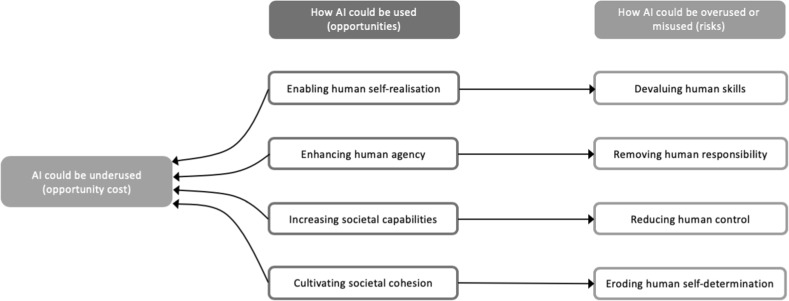
- The authors identify four chief opportunities AI offers society: who we can become, what we can do, what we can achieve, and how we can interact.
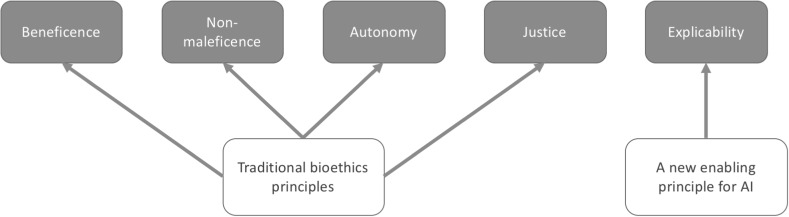
- They synthesize 47 principles from six high-profile AI ethics documents and argue these converge on five principles for AI: beneficence, non-maleficence, autonomy, justice, and explicability.
- The paper argues that AI should be developed to decrease inequality, increase shared benefits, and remain explicable, because explicability is described as critical for public trust and understanding.
- The recommendations section sets out 20 Action Points grouped into assessment, development, incentivisation, and support.
## Methods
- The paper is a conceptual and comparative ethics analysis, not an empirical study.
- It reviews six existing AI ethics documents: Asilomar, Montreal, IEEE, EGE, AIUK, and the Partnership on AI, and compares their principles.
- The authors then synthesize these into a framework and derive 20 recommendations for a Good AI Society.
## Limitations
- The paper states that it presents a European approach meant to be complementary to other approaches, so its recommendations are not claimed to be universally exhaustive or final.
- The text itself makes evident that the analysis is normative and document-based, not based on original empirical data or tested interventions (text-evident limitation).
- The paper also presents the recommendations as a “living document”, implying they are provisional and meant to evolve rather than serve as a definitive endpoint.
Model-written summary. Check it against the paper before relying on it.
Integrity signals
Registry
Cites
Statistics
Figures
Verification
Claims the paper makes
1 Valid · 1 Not valid · 27 Not checked · 35 Own results and interpretations
The cited sources support only part of this claim — read each source’s verdict below.
In the paper
“Everything from email scams to full-scale cyber-warfare may be accelerated or intensified by the malicious use of AI technologies (Taddeo 2018).”
§ AI4People—An Ethical Framework for a Good AI Society: Opportunities, Risks, Principles, and Recommendations > The Opportunities and Risks of AI for Society
What the sources say
- Partly supportedcites Taddeo 2018 matched to “The Limits of Deterrence Theory in Cyberspace” (2018) sourceExperimental — accuracy not yet measured
Section 4.3 (page unavailable) says machine-learning systems deployed for cyber defence can pose risks of unforeseen, disproportionate damage, supporting a narrower concern that AI could intensify harm in cyber conflict. It does not address malicious AI use, email scams, or AI accelerating attacks across that range. (LLM, conf=0.77)
hedgedstates a possible cause- Asserted: passes — The authors put it forward as true.
- Checkable: passes — It can be checked against evidence.
- Load-bearing: unclear — It is unclear whether the paper’s conclusions depend on it.
- Based: passes — The paper gives a reason why it holds.
- Rests on an assumption not shown here.
- Partly supported
None of the sources cited for this claim could be matched to a paper, so there is nothing to check it against.
In the paper
“Taken together, they yield 47 principles.5”
§ AI4People—An Ethical Framework for a Good AI Society: Opportunities, Risks, Principles, and Recommendations > A Unified Framework of Principles for AI in Society
What the sources say
- Not matchedcites Asilomar AI Principles 2017
An author–year citation the paper’s reference list doesn’t settle. We don’t search these by name.
- Not matchedcites Montreal Declaration 2017
An author–year citation the paper’s reference list doesn’t settle. We don’t search these by name.
- Not matchedcites IEEE 2017
An author–year citation the paper’s reference list doesn’t settle. We don’t search these by name.
plainstates a cause- Asserted: passes — The authors put it forward as true.
- Checkable: passes — It can be checked against evidence.
- Load-bearing: passes — The paper’s conclusions depend on it.
- Based: passes — The paper gives a reason why it holds.
- Not matched
A conclusion the paper draws from its own results — it cites no other source for it, so there is none to check. The quote shows it is in the paper.
In the paper
“But they are not exhaustive.”
§ AI4People—An Ethical Framework for a Good AI Society: Opportunities, Risks, Principles, and Recommendations > A Unified Framework of Principles for AI in Society
plain- Asserted: passes — The authors put it forward as true.
- Checkable: passes — It can be checked against evidence.
- Load-bearing: passes — The paper’s conclusions depend on it.
- Based: passes — The paper gives a reason why it holds.
A conclusion the paper draws from its own results — it cites no other source for it, so there is none to check. The quote shows it is in the paper.
In the paper
“On the basis of the following comparative analysis, we argue that one more, new principle is needed in addition: explicability, understood as incorporating both intelligibility and accountability.”
§ AI4People—An Ethical Framework for a Good AI Society: Opportunities, Risks, Principles, and Recommendations > A Unified Framework of Principles for AI in Society
plain- Asserted: passes — The authors put it forward as true.
- Checkable: passes — It can be checked against evidence.
- Load-bearing: passes — The paper’s conclusions depend on it.
- Based: passes — The paper gives a reason why it holds.
A conclusion the paper draws from its own results — it cites no other source for it, so there is none to check. The quote shows it is in the paper.
In the paper
“The four bioethical principles adapt surprisingly well to the fresh ethical challenges posed by artificial intelligence.”
§ AI4People—An Ethical Framework for a Good AI Society: Opportunities, Risks, Principles, and Recommendations > A Unified Framework of Principles for AI in Society
boosted- Asserted: passes — The authors put it forward as true.
- Checkable: passes — It can be checked against evidence.
- Load-bearing: passes — The paper’s conclusions depend on it.
- Based: passes — The paper gives a reason why it holds.
5 more claims
Create a free account to see all 64 claims and every source verdict.
- Probably not a substantial claim. 51
- It may state two separate claims as one. 9
- Not yet classified. 2
- The quote only partly states this claim. 1
Claims other papers make about this one
Each is checked against this paper’s own text: does it say what the citing paper says it does?
The source backs part of the claim, not all of it — or backs it for a different population, condition or comparison.
In the citing paper
“While AI systems can influence learning outcomes through adaptive contributions, they cannot bear responsibility for those outcomes, engage in ethical reflection about educational goals, or possess the experiential understanding that grounds pedagogical wisdom”
From Towards a philosophy of ensemble cognition: Reconceptualising agency and mind in AI-mediated educational environments (2026) · cites this paper as Floridi et al., 2018
Experimental — accuracy not yet measuredThe source backs part of the claim, not all of it — or backs it for a different population, condition or comparison.
In the citing paper
“This trust will be important for the future of AI as a lack of trust could permanently harm the reputation of AI in healthcare, or lead to additional costs through inefficient regulation or repeated amendment (Floridi et al., 2018).”
From Liability for harm caused by AI in healthcare: an overview of the core legal concepts (2023) · cites this paper as Floridi et al., 2018
Experimental — accuracy not yet measuredThe source backs part of the claim, not all of it — or backs it for a different population, condition or comparison.
In the citing paper
“Indeed, the framework played a valuable role in the work of AI 4 People, Europe's first global forum on the social impact of AI, which recently adopted it to propose 20 concrete recommendations for a 'Good AI Society' to the European Commission (Floridi et al., 2018 ).”
From A Unified Framework of Five Principles for AI in Society (2019) · cites this paper as Floridi et al., 2018
Experimental — accuracy not yet measuredThe source backs part of the claim, not all of it — or backs it for a different population, condition or comparison.
In the citing paper
“De manera complementaria, autores como Floridi et al. (2018) abogan por incorporar principios como la justicia, la beneficencia y el respeto por la autonomía en todas las etapas del desarrollo de herramientas basadas en IA [23].”
From Avances, Retos Éticos y Perspectivas de la Inteligencia Artificial (IA) en la Educación de América Latina (2025) · cites this paper as [23]
Experimental — accuracy not yet measuredThe source backs part of the claim, not all of it — or backs it for a different population, condition or comparison.
In the citing paper
“Talos represents ancient human fears about the uncontrollable power of man-made creations, fears that persist into contemporary concerns about AI (Floridi et al., 2018; Sebastian, 2023; Tabassi, 2023b).”
From Delegated agency and moral responsibility in artificial intelligence (2026) · cites this paper as Floridi et al., 2018
Experimental — accuracy not yet measured
30 more claims about this paper
Create a free account to see every claim other papers make about this one.
Citations
Cites
Floridi, L. (2013) · Oxford University Press eBooks · doi:10.1093/acprof:oso/9780199641321.001.0001 · Cited by 651
Self-citationSoft Ethics and the Governance of the Digital
Floridi, L. (2018) · Philosophy & Technology · doi:10.1007/s13347-018-0303-9 · Cited by 325 · cited 2×
“2 The analysis in this and the following two sections is also available in Cowls and Floridi (2018).”
BackgroundSelf-citationArtificial Intelligence Crime: An Interdisciplinary Analysis of Foreseeable Threats and Solutions
King, T. C., Aggarwal, N., Taddeo, M., & Floridi, L. (2020) · Science and Engineering Ethics · doi:10.1007/s11948-018-00081-0 · Cited by 271
Self-citationThe Limits of Deterrence Theory in Cyberspace
Taddeo, M. (2018) · Philosophy & Technology · doi:10.1007/s13347-017-0290-2 · Cited by 98
Prolegomena to a White Paper on an Ethical Framework for a Good AI Society
Cowls, J., & Floridi, L. (2018) · SSRN Electronic Journal · doi:10.2139/ssrn.3198732 · Cited by 76
Self-citationArtificial Intelligence Crime: An Interdisciplinary Analysis of Foreseeable Threats and Solutions
King, T., Aggarwal, N., Taddeo, M., & Floridi, L. (2018) · SSRN Electronic Journal · doi:10.2139/ssrn.3183238 · Cited by 17
Self-citation
Research works printed but not linked: 3
- Asilomar AI Principles. (2017). Principles developed in conjunction with the 2017 Asilomar conference [Benevolent AI 2017]. Retrieved September 18, 2018 from https://futureoflife.org/ai-principles.
- Cowls, J., & Floridi, L. (2018). Prolegomena to a White Paper on Recommendations for the Ethics of AI (June 19, 2018). Available at SSRN: https://ssrn.com/abstract=3198732.
- The IEEE Initiative on Ethics of Autonomous and Intelligent Systems. (2017). Ethically Aligned Design, v2. Retrieved September 18, 2018 from https://ethicsinaction.ieee.org.
Cited by
Items 2,401–2,500 of 4,603
Opening Pandora’s Box: IoT and Cybersecurity Aspects to Consider While Regulating
Danidou, Y. (2021) · Springer eBooks · doi:10.1007/978-3-030-69583-5_17 · Cited by 1
Philosophical issues of artificial intelligence and “smart” algorithms’ trust in medicine
Т.С., Г. (2021) · Медицинская этика · doi:10.24075/medet.2021.019 · Cited by 3
Béranger, J., & Chassang, G. (2021) · Éthique Publique · doi:10.4000/ethiquepublique.6551 · Cited by 1
Ružičková, V. (2021) · doi:10.33542/uip2021-0037-0
Michelfelder, D. P., & Doorn, N. (2020) · Routledge eBooks · doi:10.4324/9781315276502-1 · Cited by 1
Verantwortung im Ingenieurwesen und die Technikfolgenabschätzung
Gatt, M. (2022) · erfolgreich studieren · doi:10.1007/978-3-662-64311-2_4 · Cited by 1
Do We Really Need a New Theory to Understand the Double-Descent?
Oneto, L., Ridella, S., & Anguita, D. (2022) · European Symposium on Artificial Neural Networks, Computational Intelligence and Machine Learning (ESANN) · doi:10.14428/esann/2022.es2022-13 · Cited by 1
Baker-Brunnbauer, J. (2022) · Business guides on the go · doi:10.1007/978-3-031-18275-4_1 · Cited by 1
The P-SAFETY Model: A Unifying Ethical Approach
Sapienza, S. (2022) · Law, governance and technology series · doi:10.1007/978-3-031-09367-8_5 · Cited by 1
The Best of Both Worlds: Mixed Systems with ML and Humans in the Loop to Combat Fake Information
Ximenes, B. H., & Ramalho, G. L. (2022) · Lecture notes in computer science · doi:10.1007/978-3-031-21707-4_42 · Cited by 2
Transparency or Opacity: A Legal Analysis of the Organization of Information in the Digital World
Kuhlmann, S., Gregorio, F. D., Fertmann, M., Ofterdinger, H., & Sefkow, A. (2023) · Nomos Verlagsgesellschaft mbH & Co. KG eBooks · doi:10.5771/9783748936060 · Cited by 1
Defining AI in Policy versus PracticePreprint
Krafft, P. M., Young, M., Katell, M. A., et al. (2019) · arXiv (Cornell University) · doi:10.48550/arxiv.1912.11095 · Cited by 1
An Empathy Imitation Game: Empathy Turing Test for Care‑ and Chat‑botsPreprint
Floridi, L. (2021) · SSRN Electronic Journal · doi:10.2139/ssrn.3826418 · Cited by 1
Self-citationMapping artificial intelligence affordances for the public sector
Fatima, S. (2022) · Queensland University of Technology · doi:10.5204/thesis.eprints.235926 · Cited by 2
CHANCES AND CHALLENGES OF CHATGPT AND SIMILAR MODELS FOR EDUCATION IN M&SPreprint
Scherer, W. T., Tolk, A., Loper, M. L., Barry, P. J., Rabadi, G., & Yılmaz, L. (2023) · doi:10.36227/techrxiv.22773842 · Cited by 1
CHANCES AND CHALLENGES OF CHATGPT AND SIMILAR MODELS FOR EDUCATION IN M&SPreprint
Scherer, W. T., Tolk, A., Loper, M. L., Barry, P. J., Rabadi, G., & Yılmaz, L. (2023) · doi:10.36227/techrxiv.22773842.v1 · Cited by 1
Floridi, L. (2023) · Oxford University Press eBooks · doi:10.1093/oso/9780198883098.002.0003 · Cited by 1
Self-citationSelke, S. (2023) · Edition transcript · doi:10.14361/9783839469286-002 · Cited by 1
Tella, A. (2024) · Elsevier eBooks · doi:10.1016/b978-0-323-95689-5.00060-2 · Cited by 1
Managing Ethical Risks of Artificial Intelligence in Business ApplicationsPreprint
McGrath, Q. P., Hevner, A. R., & de Vreede, G. (2024) · doi:10.36227/techrxiv.170905835.50964792/v1 · Cited by 1
Regulação da inteligência artificial na saúde
Dourado, D. D. A. (2024) · Digital Library of Theses and Dissertations (Universidade de São Paulo) · doi:10.11606/t.5.2024.tde-23042024-111255 · Cited by 11
État de la situation sur les impacts sociétaux de l'intelligence artificielle et du numérique - 2024
Obvia, Langlois, L., Cousineau, M., Gagnon, M.-P., Larnder, C. I., Naffi, N., Garneau, J., Lévesque, C., Brin, C., Guèvremont, V., et al. (2024) · doi:10.61737/cfrt3613 · Cited by 3
I 3 : Innovation Irrationality = ImpactPreprint
Meira, S. R. L. (2024) · SSRN Electronic Journal · doi:10.2139/ssrn.4890826 · Cited by 2
Polycentric Governance of Sentient Artificial General IntelligencePreprint
Cruz, A. F. D. (2024) · Preprints.org · doi:10.20944/preprints202408.1810.v1
Editorial: The ethics of digitalization and emerging corporate responsibilities in the digital age
Schreck, P., Edinger‐Schons, L. M., & Uhl, M. (2024) · Journal of Business Economics · doi:10.1007/s11573-024-01202-x · Cited by 2
Ofem, O. (2024) · Research Square · doi:10.21203/rs.3.rs-5353669/v1 · Cited by 5
Macey-Dare, R. (2024) · SSRN Electronic Journal · doi:10.2139/ssrn.5021240 · Cited by 1
Mendiola, M. S. (2025) · Investigación en Educación Médica · doi:10.22201/fm.20075057e.2025.53.24670 · Cited by 9
Policy, Governance, and Technology: What Drives AI Readiness? An Empirical Study of 155 CountriesPreprint
Thakur, S. (2025) · Research Square · doi:10.21203/rs.3.rs-6576371/v1 · Cited by 1
Integrating Quantum Computing with AI: A Perspective on Time Series ForecastingPreprint
Chou, Y.-C. (2025) · Qeios · doi:10.32388/itvfhf.3 · Cited by 1
Policy and Regulatory Frameworks for Responsible AI Workforce Integration AuthorsPreprint
Oladele, S., Kan, K., & George, L. (2025) · SSRN Electronic Journal · doi:10.2139/ssrn.5226732 · Cited by 3
Cheng, J., & Jia, M. (2025) · SSRN Electronic Journal · doi:10.2139/ssrn.5242155 · Cited by 2
Lex Fiducia: Engineering Trust Through Immutable EthicsPreprint
Mazzocchetti, A. (2025) · SSRN Electronic Journal · doi:10.2139/ssrn.5276785 · Cited by 2
Enhancing Fairness in Diabetes Prediction Systems through Smart User Interface DesignPreprint
Tavangar, A., Arefzadeh, Z., & Asghari, A. N. (2025) · medRxiv · doi:10.1101/2025.06.04.25328959 · Cited by 3
Powers, T. M. (2025) · doi:10.1002/9781394238651.ch11 · Cited by 1
Causal Fairness in Black-Box AI: A Counterfactual Auditing Framework for Deep ModelsPreprint
Asif, N. H. (2025) · Research Square · doi:10.21203/rs.3.rs-7023047/v1 · Cited by 3
Ethics of Cloud-Based AI in Predictive Policing and Surveillance in Authoritarian RegimesPreprint
Idowu, E. (2025) · Preprints.org · doi:10.20944/preprints202507.1358.v1
Multiculturalism and AI Value Alignment
Townsend, B. (2025) · Oxford University Press eBooks · doi:10.1093/9780198945215.003.0178 · Cited by 2
Flourishing-by-Design: A Framework for Embedding Well-Being in AI-Driven InnovationPreprint
Makridis, C. A., Lomas, T., Comiso, G., Brown, R., VanderWeele, T. J., & Johnson, B. R. (2025) · SSRN Electronic Journal · doi:10.2139/ssrn.5357723 · Cited by 2
Enhancing Tourism Experience with Anthropomorphic Virtual Agentsent
Saad, S. B. (2025) · Springer eBooks · doi:10.1007/978-3-031-75316-9_43-1 · Cited by 1
Kwasinski, A., Pattichis, M. S., Bovik, A. C., et al. (2025) · IEEE Signal Processing Magazine · doi:10.1109/msp.2025.3581871 · Cited by 1
Artificial Intelligence and the Transformation of the Media System
Stănescu, G. C. (2026) · Encyclopedia · doi:10.3390/encyclopedia6020045 · Cited by 2
Yaméogo, R. A. (2020) · theses.fr (ABES) · doi:10.70675/f481d9c1z34d9z4b47za4b1zfbccf036fa00 · Cited by 6
From the Field to the Algorithm: Understanding Indian Ethnographers' Perspectives on Responsible AI
Ghoshal, A., & Ghoshal, A. (2026) · CHI Conference on Human Factors in Computing Systems · doi:10.1145/3772318.3791872
“…in novel contexts [60], typically drawing on Western philosophical traditions: consequentialist approaches evaluate systems based on outcomes, deontological frameworks focus on adherence to predefined rules, while virtue ethics emphasizes moral character embedded in design and deployment [31].”
A Taxonomy of Design Futures Processes for Ethical Reflection on Technologies
Mauri, F. M., Bozzon, A., & Colombo, S. (2026) · CHI Conference on Human Factors in Computing Systems · doi:10.1145/3772318.3790525 · Cited by 1
“…challenges, with documented negative effects ranging from discriminatory practices in hiring [1, 20] to the polarization of public discourse through algorithmically curated social media feeds [79], alongside issues of algorithmic opacity and bias [15, 31] and surveillance practices [26, 27].”
Collectively Reimagining Artificial Intelligence With Marginalized Communities
Oluwatuyi, R. F., Pillay, V., Mazwi, J., Castro, A., Farao, J., Srivatsa, S., Bagalkot, N., & Densmore, M. (2026) · CHI Conference on Human Factors in Computing Systems · doi:10.1145/3772318.3791421 · Cited by 2
“As AI technologies and designs advance, with the potential to address systemic inequities and contribute to society and the quality of living [41], yet marginalized communities, such as low-income populations, remain largely excluded from its benefits.”
Ethical Governance of Generative AI in Higher Education in the Absence of Binding LawPreprint
Arsil, I. R. K., & Suryanegara, M. (2026) · Research Square · doi:10.21203/rs.3.rs-9481849/v1 · Cited by 1
Making Things Explainable vs Explaining: Requirements and Challenges Under the GDPR
Sovrano, F., Vitali, F., & Palmirani, M. (2021) · Lecture notes in computer science · doi:10.1007/978-3-030-89811-3_12 · Cited by 30
“As a result, several expert groups, including those acting for the European Commission, have started asking the AI industry to adopt ethics code of conducts as quickly as possible [8, 14], drawing a set of expectations to meet in order to guarantee a right to explanation.”
BackgroundEthics in Designing Intelligent Systems
Saariluoma, P. O., & Leikas, J. (2019) · Advances in intelligent systems and computing · doi:10.1007/978-3-030-25629-6_8
Dobler, G., Bianco, F. B., Sharma, M. S., Karpf, A., Baur, J., Ghandehari, M., Wurtele, J. S., & Koonin, S. E. (2021) · Remote Sensing · doi:10.3390/rs13081426 · Cited by 30
Shared Consciousness: Toward a World of Transhuman Relations
Bloom, P. (2020) · Springer eBooks · doi:10.1007/978-3-030-36181-5_8 · Cited by 2
Making Automation Explicable: A Challenge for Philosophy of Technology
Smith, D. (2019) · New Formations · doi:10.3898/newf:98.05.2019 · Cited by 2
Guerreiro, J. (2020) · Advances in computational intelligence and robotics book series · doi:10.4018/978-1-7998-2874-7.ch014
Ethical living with algorithms
Trifuljesko, S., & Ruckenstein, M. (2019) · Työväentutkimus Vuosikirja
de Oliveira, S. R., & Costa, R. S. (2019) · Revista de Direito Governança e Novas Tecnologias · doi:10.26668/indexlawjournals/2526-0049/2019.v5i2.5777 · Cited by 19
Autonomous Inspection and Maintenance with Artificial Intelligence Infiltration
Galar, D. P., Kumar, U., & Seneviratne, D. (2020) · CRC Press eBooks · doi:10.1201/9780429452260-10
Memory networks for consumer protection:unfairness exposedPreprint
Ruggeri, F., Lagioia, F., Lippi, M., & Torroni, P. (2020) · arXiv (Cornell University) · doi:10.48550/arxiv.2008.07346
Auf dem Weg zu einer ethisch verantwortungsvollen Datennutzung
Schmitz, M. (2020) · Informatik-Spektrum · doi:10.1007/s00287-020-01298-9
Dignum, F. P. M., & Dignum, V. (2020) · DiVA at Umeå University (Umeå University)
Self-citationSovereigns, Viruses, and the Law
Pagallo, U. (2020) · Law in context · doi:10.26826/law-in-context.v37i1.117 · Cited by 3
Self-citationBuying what people like you buy: Personality Homophily and Well-being in Consumer BehaviourPreprint
Lavelle-Hill, R. E., Skatova, A., Goulding, J., Bibby, P. A., & Clarke, D. (2020) · OSF Preprints (OSF Preprints) · doi:10.31219/osf.io/nxsy9 · Cited by 1
Managing cloud resource scarcity
Larsson, L. (2020) · DiVA at Umeå University (Umeå University)
AI and Constitutionalism: The Challenges Ahead
Casonato, C. (2021) · Lecture notes in computer science · doi:10.1007/978-3-030-69128-8_9 · Cited by 4
General Perspectives Toward the Impact of AI on Race and Society
Roberts, A. L., Richardson, B., Alikhademi, K., Drobina, E., & Gilbert, J. E. (2021) · Diversity and inclusion research · doi:10.1007/978-3-030-65417-7_18
An Ethical Framework for Robotics and Children: Vulnerability and Promotion of Autonomy
Payá, M. A., Ferrer, R. M., Martín, M. T., Ausín, T., Astobiza, A. M., & López, D. (2020) · Techno:Phil · doi:10.1007/978-3-476-05673-3_6 · Cited by 1
Reconsidering CO2 emissions from Computer VisionPreprint
Fu, A., Hosseini, M. S., & Plataniotis, K. N. (2021) · arXiv (Cornell University) · doi:10.48550/arxiv.2104.08702
Our Theory: De-Anthropocentrized Externalism
Cappelen, H., & Dever, J. (2021) · Oxford University Press eBooks · doi:10.1093/oso/9780192894724.003.0004
Application: Names and the Mental Files Framework
Cappelen, H., & Dever, J. (2021) · Oxford University Press eBooks · doi:10.1093/oso/9780192894724.003.0006
Application: Predication and Commitment
Cappelen, H., & Dever, J. (2021) · Oxford University Press eBooks · doi:10.1093/oso/9780192894724.003.0007
Application: The Predicate ‘High Risk’
Cappelen, H., & Dever, J. (2021) · Oxford University Press eBooks · doi:10.1093/oso/9780192894724.003.0005
Alfred (the Dismissive Sceptic): Philosophers, Go Away!
Cappelen, H., & Dever, J. (2021) · Oxford University Press eBooks · doi:10.1093/oso/9780192894724.003.0002
Cappelen, H., & Dever, J. (2021) · Oxford University Press eBooks · doi:10.1093/oso/9780192894724.003.0008
Terminology: Aboutness, Representation, and Metasemantics
Cappelen, H., & Dever, J. (2021) · Oxford University Press eBooks · doi:10.1093/oso/9780192894724.003.0003
conexus 4/1 2021: Fremdbestimmung und Selbstbestimmung
Rother, W. (2021) · conexus · doi:10.24445/conexus.2021.04.001
Ngaketcha, A. (2021) · Droit Santé et Société · doi:10.3917/dsso.083.0008 · Cited by 2
Ethics in NDE 4.0: Perspectives and Possibilities
Singh, R., & Clifford, T. (2021) · Springer eBooks · doi:10.1007/978-3-030-48200-8_61-1 · Cited by 1
Designing the Trustworthy Principles of Artificial Intelligence : case: Finnish Police
Lassila, S. (2021) · Theseus (Ammattikorkeakoulujen) · Cited by 2
P4AI: Approaching AI Ethics through PrinciplismPreprint
Fu, A., Ding, E., Hosseini, M. S., & Plataniotis, K. N. (2021) · arXiv (Cornell University) · doi:10.48550/arxiv.2111.14062 · Cited by 2
LBS as Vectors of InfluencePreprint
Gartner, M. (2021) · doi:10.31235/osf.io/s43b5
Algorithmic pragmatism: First steps
Falcão, J. P. D. A., Meira, S. R. D. L., & Ramalho, G. L. (2021) · IEEE International Symposium on Technology and Society (ISTAS) · doi:10.1109/istas52410.2021.9629190 · Cited by 2
Themes: Personal Autonomy, Market Choices and the Presumption of Innocence
Kohl, U., & Eisler, J. (2021) · Cambridge University Press eBooks · doi:10.1017/9781108891325.007
The Challenges Brought by GDPR to the Use of Intelligent Systems
Kajcsa, A., & Dogaru, L. (2022) · Lecture notes in networks and systems · doi:10.1007/978-3-030-93817-8_29
Herrmann, J.-P., Nemoto, Y., Kobelt, D., gGmbH, N. M., Tackenberg, S. M., & Goppold, M. (2021) · Gemeinschaften in Neuen Medien · doi:10.25368/2022.47
Seaborn, K., Miyake, N., Pennefather, P., & Otake, M. (2020) · doi:10.2196/preprints.18778
Cappelen, H., & Dever, J. (2021) · Oxford University Press eBooks · doi:10.1093/oso/9780192894724.003.0001
Leroy, J. B. (2021) · Wiley eBooks · doi:10.1002/9781119831808.refs
Thelisson, E., & Ho-Dac, M. (2021) · SSRN Electronic Journal · doi:10.2139/ssrn.3897287
Norel, R. (2020) · Faculty Opinions – Post-Publication Peer Review of the Biomedical Literature · doi:10.3410/f.738191860.793576953
(2019) · Nature Machine Intelligence · doi:10.1038/s42256-019-0121-5
de Ágreda, Á. G. (2021) · UPM Digital Archive (Technical University of Madrid) · doi:10.20868/upm.thesis.67495 · Cited by 3
(2022) · Quality - Access to Success · doi:10.47750/qas/23.187.11 · Cited by 2
The role of trustworthiness in automated decision-making systems and the law
Wang, B. T. (2022) · Queensland University of Technology · doi:10.5204/thesis.eprints.231388
Conclusion: Migration Research in Times of Ubiquitous Digitization
Rinken, S., & Pötzschke, S. (2022) · IMISCOE research series · doi:10.1007/978-3-031-01319-5_11
Interactive Robotics and Children’s Human Rights
Aparicio, M., Martín, M. T., Morte, R., et al. (2022) · Biosystems & biorobotics · doi:10.1007/978-3-031-04305-5_30
Business Ethics for the Digital Era
Lütge, C. (2022) · Wirtschaftsethik in der globalisierten Welt · doi:10.1007/978-3-662-64094-4_1 · Cited by 2
Self-citationFuchs, M., & Höpken, W. (2022) · Springer eBooks · doi:10.1007/978-3-030-48652-5_107
МОЖЛИВОСТІ ТА ОБМЕЖЕННЯ АЛГОРИТМІЧНОГО ПРИЙНЯТТЯ РІШЕНЬ У ПУБЛІЧНОМУ УПРАВЛІННІ
Buhai, O. (2022) · Investytsiyi praktyka ta dosvid · doi:10.32702/2306-6814.2022.17.144 · Cited by 2
Metadata
- Authors
- Floridi, L., Cowls, J., Beltrametti, M., Chatila, R., Chazerand, P., Dignum, V., Luetge, C., Madelin, R., Pagallo, U., Rossi, F., Schafer, B., Valcke, P., & Vayena, E.
- Affiliations
- University of Oxford (GB)
- Centre National de la Recherche Scientifique (FR)
- Digital Europe (BE)
- Umeå University (SE)
- University of Turin (IT)
- IBM (United States) (US)
- Bocconi University (IT)
- ETH Zurich (CH)
- Corresponding author
- Floridi, Luciano
- ORCID
- Venue
- Minds and Machines
- Published
- 2018-11-26
- Volume
- 28
- Issue
- 4
- Pages
- 689-707
- ISSN
- 0924-6495 (ISSN-L)
- 1572-8641
- PMC
- PMC6404626
- OpenAlex
- W2902634493
- Cited by
- 4,774
- References
- 8
- Citations by year
- 2026: 1965 · 2025: 1116 · 2024: 523 · 2023: 413 · 2022: 287 · 2021: 255 · 2020: 145 · 2019: 70
- FWCI
- 234.15
- Type
- journal article
- Language
- en
- Open access
- hybrid
- doi.org
- Licence
- cc-by
- creativecommons.org/licenses/by/4.0 (tdm)
- Locations
- Minds and Machines (publishedVersion, cc-by)
- Europe PMC (PubMed Central) (publishedVersion, other-oa)
- PubMed Central (publishedVersion, cc-by)
- PubMed (publishedVersion)
- Institutional Research Information System University of Turin (University of Turin) (submittedVersion, other-oa)
- Lirias (submittedVersion, cc-by)
- Data Archiving and Networked Services (DANS) (submittedVersion, cc-by)
- DiVA at Umeå University (Umeå University) (submittedVersion, other-oa)
- mediaTUM – the media and publications repository of the Technical University Munich (Technical University Munich) (submittedVersion, other-oa)
- mediaTUM – the media and publications repository of the Technical University Munich (Technical University Munich) (submittedVersion)
- PhilPapers (PhilPapers Foundation) (submittedVersion)
- Edinburgh Research Explorer (University of Edinburgh) (submittedVersion, cc-by)
- Research Repository (Delft University of Technology) (submittedVersion)
- Repository for Publications and Research Data (ETH Zurich) (submittedVersion, cc-by)
- ETH Zürich Research Collection (cc-by)
- Funders
- Atomium
- Topics
- Physical Sciences › Computer Science › Artificial Intelligence › Ethics and Social Impacts of AI
- Social Sciences › Law › Digitalization, Law, and Regulation
- Physical Sciences › Environmental Science › Management, Monitoring, Policy and Law › Innovation, Sustainability, Human-Machine Systems
- Keywords
- AI ethics, ethical principles, AI policy recommendations, AI governance, artificial intelligence adoption
About these checks
Registry, retraction, Cites and statistics results are computed, not judged, with one exception: a printed reference that no index lists is read once by a model before it counts as a citation error. Claims are extracted by a model and kept only when their quote appears verbatim in the text; each cited source is then checked, with a model’s help, for whether it says what the claim relies on. Those verdicts can be wrong — read the claim’s quote and the cited source before relying on one.
The claim verdicts this report counts are experimental: their accuracy is not yet measured.
A language model drew the claims from the paper on 2026-09-28, under version 3 of the claim definition (model deepseek-v4.1-flash, prompt extract-v3).
A second model labelled each claim on 2026-09-28 (model jev-1.13-20260917, definition revision gold-guideline-v0.2).
Cited sources are checked with a language model’s help (gpt-6-sol).
Statistics and arithmetic are recomputed, not judged.
Confidence bands are shown only for fields calibrated on our annotated test set. None is calibrated yet, so no band is shown.
What counts as a claim ›How we measure confidence ›How we check this ›
Are you an author, or do you see a problem with this page? Request a review
Data sources
Bibliographic data: Semantic Scholar, OpenAlex, Crossref.
Contains information from the Semantic Scholar Academic Graph Datasets, made available under the ODC Attribution License (ODC-BY 1.0).
Semantic Scholar’s data is described in: Kinney, R., et al. (2023). The Semantic Scholar Open Data Platform. arXiv:2301.10140.
