

Mapping the Ethics of Generative AI: A Comprehensive Scoping Review
Open accessThe DOI matches its Crossref record; 147 of the 147 references it cites were found in a registry or an index.
Abstract
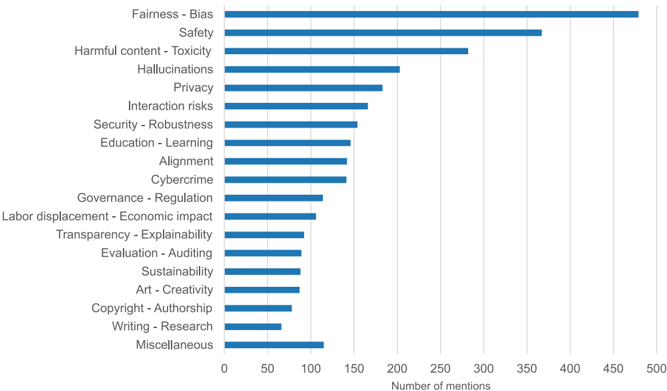
The advent of generative artificial intelligence and the widespread adoption of it in society engendered intensive debates about its ethical implications and risks. These risks often differ from those associated with traditional discriminative machine learning. To synthesize the recent discourse and map its normative concepts, we conducted a scoping review on the ethics of generative artificial intelligence, including especially large language models and text-to-image models. Our analysis provides a taxonomy of 378 normative issues in 19 topic areas and ranks them according to their prevalence in the literature. The study offers a comprehensive overview for scholars, practitioners, or policymakers, condensing the ethical debates surrounding fairness, safety, harmful content, hallucinations, privacy, interaction risks, security, alignment, societal impacts, and others. We discuss the results, evaluate imbalances in the literature, and explore unsubstantiated risk scenarios.
Overview
The claims and statistics of this paper haven’t been checked yet.
Free: it reads the open-access text and checks the first 5 claims that cite a source we can check. Create a free account to check every claim.
Integrity signals
Registry
Cites
Statistics
Figures
Verification
Claims the paper makes
The claims and statistics of this paper haven’t been checked yet.
Free: it reads the open-access text and checks the first 5 claims that cite a source we can check. Create a free account to check every claim.
Claims other papers make about this one
Each is checked against this paper’s own text: does it say what the citing paper says it does?
The source backs part of the claim, not all of it — or backs it for a different population, condition or comparison.
In the citing paper
“These have been summarised in Hagendorff's (2024) recent scoping review, including biases from training data, hallucinations referred to earlier in this section, privacy risks from leakage of sensitive information, interaction risks between workers and AI that could lead to unethical or even illegal activities, and security risks linked to threats to AI systems.”
From Activity theory as framework for analysis of workplace learning technologies: the case of generative AI conversational agents (2025) · cites this paper as Hagendorff's (2024)
Experimental — accuracy not yet measuredThe cited source says what the claim attributes to it.
In the citing paper
“Furthermore, GenAI can create misleading nonsensical content (hallucinations).”
From Activity theory as framework for analysis of workplace learning technologies: the case of generative AI conversational agents (2025) · cites this paper as Hagendorff (2024)
Self-check
Percentages, sums and reported differences re-computed from the paper’s own numbers.
The self-check needs the paper’s full text.
Citations
Cites
The PRISMA 2020 statement: An updated guideline for reporting systematic reviews
Page, M. J., McKenzie, J. E., Bossuyt, P. M., Boutron, I., Hoffmann, T. C., Mulrow, C. D., Shamseer, L., Tetzlaff, J. M., Akl, E. A., Brennan, S. E., et al. (2021) · BMJ · doi:10.1136/bmj.n71 · Cited by 108,283
LeCun, Y., Bengio, Y., & Hinton, G. (2015) · Nature · doi:10.1038/nature14539 · Cited by 84,126
Preferred reporting items for systematic reviews and meta-analyses: The PRISMA statement
Moher, D., Liberati, A., Tetzlaff, J., Altman, D. G., & the PRISMA Group* (2009) · Annals of Internal Medicine · doi:10.7326/0003-4819-151-4-200908180-00135 · Cited by 37,554
Scoping studies: towards a methodological framework
Arksey, H., & O'Malley, L. (2005) · International Journal of Social Research Methodology · doi:10.1080/1364557032000119616 · Cited by 36,742 · cited 1×
“We conducted a scoping review (Arksey & O’Malley, 2005) with the aim of covering a significant proportion of the existing literature on the ethics of generative AI.”
High-Resolution Image Synthesis with Latent Diffusion Models
Rombach, R., Blattmann, A., Lorenz, D., Esser, P., & Ommer, B. (2022) · 2022 IEEE/CVF Conference on Computer Vision and Pattern Recognition (CVPR) · doi:10.1109/cvpr52688.2022.01042 · Cited by 20,302 · cited 1×
“Later, the transformer architecture (Vaswani et al., 2017) as well as diffusion models (Ho et al., 2020) boosted the performance of text and image generation models and made them adaptable to a wide range of downstream tasks.”
The Coding Manual for Qualitative Researchers
Saldana, J. (2025) · SAGE Publications Ltd eBooks · doi:10.4135/9781036235611 · Cited by 17,944
ChatGPT for good? On opportunities and challenges of large language models for education
Kasneci, E., Sessler, K., Küchemann, S., Bannert, M., Dementieva, D., Fischer, F., Gasser, U., Groh, G., Günnemann, S., Hüllermeier, E., et al. (2023) · Learning and Individual Differences · doi:10.1016/j.lindif.2023.102274 · Cited by 15,365 · cited 6×
“However, some papers suggest that generative AI might lead to reduced effort or laziness among learners (Kasneci et al., 2023).”
InfluentialThe Coding Manual for Qualitative Researchers
Lungu, M. (2022) · American Journal of Qualitative Research · doi:10.29333/ajqr/12085 · Cited by 10,826 · cited 2×
“In the initial coding cycle, all relevant paper texts were labelled paragraph by paragraph through a bottom-up approach deriving concepts and themes from the papers using inductive coding (Saldaña, 2021).”
InfluentialMastering the game of Go without human knowledge
Silver, D., Schrittwieser, J., Simonyan, K., Antonoglou, I., Huang, A., Guez, A., Hubert, T., Baker, L., Lai, M., Bolton, A., et al. (2017) · Nature · doi:10.1038/nature24270 · Cited by 9,084 · cited 1×
“…applications (LeCun et al., 2015), to the achievement of superhuman-level performance in complex games with reinforcement learning (RL) algorithms (Silver et al., 2017), and large language models (LLMs) possessing complex reasoning abilities (Bubeck et al., 2023; Minaee et al., 2024), new ethical…”
The PRISMA 2020 statement: an updated guideline for reporting systematic reviews
Page, M. J., McKenzie, J., Bossuyt, P., Boutron, I., Hoffmann, T., mulrow, C., Shamseer, L., Tetzlaff, J., Akl, E., Brennan, S. E., et al. (2020) · doi:10.31222/osf.io/v7gm2_v1 · Cited by 8,090
Research works printed but not linked: 55
- 26. Anderljung, M., Barnhart, J., Korinek, A., Leung, J., O'Keefe, C., Whittlestone, J., Avin, S., Brund- age, M., Bullock, J., Cass-Beggs, D., Chang, B., Collins, T., Fist, T., Hadfield, G., Hayes, A., Ho, L., Hooker, S., Horvitz, E., Kolt, N., Schuett, J., Shavit, Y., Siddarth, D., Trager, R., & Wolf, K. (2023). Frontier AI regulation: Managing emerging risks to public safety. arXiv, 1-51.
- 31. Barnett, J. (2023). The ethical implications of generative audio models: A systematic literature review. In F. Rossi, S. Das, J. Davis, K. Firth-Butterfield, & A. John (Eds.) (pp. 146-161). ACM.
- 37. Bommasani, R., Hudson, D. A., Adeli, E., Altman, R., Arora, S., Arx, S. V., Bernstein, M. S., Bohg, J., Bosselut, A., Brunskill, E., Brynjolfsson, E., Buch, S., Card, D., Castellon, R., Chatterji, N., Chen, A., Creel, K., Davis, J. Q., Demszky, D., Donahue, C., Doumbouya, M., Durmus, E., Ermon, S., Etchemendy, J., Ethayarajh, K., Fei-Fei, L., Finn, C., Gale, T., Gillespie, L., Goel, K., Goodman, N., Grossman, S., Guha, N., Hashimoto, T., Henderson, P., Hewitt, J., Ho, D. E., Hong, J., Hsu, K., Huang, J., Icard, T., Jain, S., Jurafsky, D., Kalluri, P., Karamcheti, S., Keeling, G., Khani, F., Khat- tab, O., Koh, P. W., Krass, M., Krishna, R., Kuditipudi, R., Kumar, A., Ladhak, F., Lee, M., Lee, T., Leskovec, J., Levent, I., Li, X. L., Li, X., Ma, T., Malik, A., Manning, C. D., Mirchandani, S., Mitchell, E., Munyikwa, Z., Nair, S., Narayan, A., Narayanan, D., Newman, B., Nie, A., Niebles, J. C., Nilforoshan, H., Nyarko, J., Ogut, G., Orr, L., Papadimitriou, I., Park, J. S., Piech, C., Por- telance, E., Potts, C., Raghunathan, A., Reich, R., Ren, H., Rong, F., Roohani, Y., Ruiz, C., Ryan, J., Ré, C., Sadigh, D., Sagawa, S., Santhanam, K., Shih, A., Srinivasan, K., Tamkin, A., Taori, R., Thomas, A. W., Tramèr, F., Wang, R. E., Wang, W., Wu, B., Wu, J., Wu, Y., Xie, S. M., Yasunaga, M., You, J., Zaharia, M., Zhang, M., Zhang, T., Zhang, X., Zhang, Y., Zheng, L., Zhou, K., & Liang, P. (2021). On the opportunities and risks of foundation models. arXiv, 1-212.
- 42. Bubeck, S., Chandrasekaran, V., Eldan, R., Gehrke, J., Horvitz, E., Kamar, E., Lee, P., Lee, Y. T., Li, Y., Lundberg, S., Nori, H., Palangi, H., Ribeiro, M. T., & Zhang, Y. (2023). Sparks of artificial general intelligence: Early experiments with GPT-4. arXiv, 1-154.
- 45. Deng, Y., Zhang, W., Pan, S. J., & Bing, L. (2023). Multilingual jailbreak challenges in large language models. arXiv, 1-16.
- 46. Derczynski, L., Kirk, H. R., Balachandran, V., Kumar, S., Tsvetkov, Y., Leiser, & Mohammad, S. (2023). Assessing language model deployment with risk cards. arXiv, 1-18.
- 48. Derner, E., & Batistič, K. (2023). Beyond the safeguards: Exploring the security risks of ChatGPT. arXiv, 1-8.
- 49. Dinan, E., Abercrombie, G., Bergman, A. S., Spruit, S., Hovy, D., Boureau, Y.-L., & Rieser, V. (2023). Anticipating safety issues in E2E conversational AI: Framework and tooling. arXiv, 1-43.
- 60. Fraser, K. C., Kiritchenko, S., & Nejadgholi, I. (2023). A friendly face: Do text-to-image systems rely on stereotypes when the input is under-specified? arXiv, 1-17.
- 62. Gabriel, I., Manzini, A., Keeling, G., Hendricks, L. A., Rieser, V., Iqbal, H., Tomašev, N., Ktena, I., Kenton, Z., Rodriguez, M., El-Sayed, S., Brown, S., Akbulut, C., Trask, A., Hughes, E., Bergman, A. S., Shelby, R., Marchal, N., Griffin, C., Mateos-Garcia, J., Weidinger, L., Street, W., Lange, B., Ingerman, A., Lentz, A., Enger, R., Barakat, A., Krakovna, V., Siy, J. O., Kurth-Nelson, Z., McCroskery, A., Bolina, V., Law, H., Shanahan, M., Alberts, L., Balle, B., Haas, S. D., Ibitoye, Y., Dafoe, A., Goldberg, B., Krier, S., Reese, A., Witherspoon, S., Hawkins, W., Rauh, M., Wallace, D., Franklin, M., Goldstein, J. A., Lehman, J., Klenk, M., Vallor, S., Biles, C., Morris, M. R., King, H., Arcas, B. A. y., Isaac, W., & Manyika, J. (2024). The ethics of advanced AI assistants. arXiv, 1-273.
- 63. Gemini Team, Anil, R., Borgeaud, S., Wu, Y., Alayrac, J.-B., Yu, J., Soricut, R., Schalkwyk, J., Dai, A. M., Hauth, A., Millican, K., Silver, D., Petrov, S., Johnson, M., Antonoglou, I., Schrittwieser, J., Glaese, A., Chen, J., Pitler, E., Lillicrap, T., Lazaridou, A., Firat, O., Molloy, J., Isard, M., Barham, P. R., Hennigan, T., Lee, B., Viola, F., Reynolds, M., Xu, Y., Doherty, R., Collins, E., Meyer, C., Rutherford, E., Moreira, E., Ayoub, K., Goel, M., Tucker, G., Piqueras, E., Krikun, M., Barr, I., Savinov, N., Danihelka, I., Roelofs, B., White, A., Andreassen, A., von Glehn, T., Yagati, L., Kazemi, M., Gonzalez, L., Khalman, M., Sygnowski, J., Frechette, A., Smith, C., Culp, L., Proleev, L., Luan, Y., Chen, X., Lottes, J., Schucher, N., Lebron, F., Rrustemi, A., Clay, N., Crone, P., Kocisky, T., Zhao, J., Perz, B., Yu, D., Howard, H., Bloniarz, A., Rae, J. W., Lu, H., Sifre, L., Mag- gioni, M., Alcober, F., Garrette, D., Barnes, M., Thakoor, S., Austin, J., Barth-Maron, G., Wong, W., Joshi, R., Chaabouni, R., Fatiha, D., Ahuja, A., Liu, R., Li, Y., Cogan, S., Chen, J., Jia, C., Gu, C., Zhang, Q., Grimstad, J., Hartman, A. J., Chadwick, M., Tomar, G. S., Garcia, X., Senter, E., Taropa, E., Pillai, T. S., Devlin, J., Laskin, M., Casas, D. d. L., Valter, D., Tao, C., Blanco, L., Badia, A. P., Reitter, D., Chen, M., Brennan, J., Rivera, C., Brin, S., Iqbal, S., Surita, G., Labanow- ski, J., Rao, A., Winkler, S., Parisotto, E., Gu, Y., Olszewska, K., Zhang, Y., Addanki, R., Miech, A., Louis, A., Shafey, L. E., Teplyashin, D., Brown, G., Catt, E., Attaluri, N., Balaguer, J., Xiang, J., Wang, P., Ashwood, Z., Briukhov, A., Webson, A., Ganapathy, S., Sanghavi, S., Kannan, A., Chang, M.-W., Stjerngren, A., Djolonga, J., Sun, Y., Bapna, A., Aitchison, M., Pejman, P., Michalewski, H., Yu, T., Wang, C., Love, J., Ahn, J., Bloxwich, D., Han, K., Humphreys, P., Sellam, T., Bradbury, J., Godbole, V., Samangooei, S., Damoc, B., Kaskasoli, A., Arnold, S. M. R., Vasudevan, V., Agrawal, S., Riesa, J., Lepikhin, D., Tanburn, R., Srinivasan, S., Lim, H., Hodkin- son, S., Shyam, P., Ferret, J., Hand, S., Garg, A., Le Paine, T., Li, J., Li, Y., Giang, M., Neitz, A., Abbas, Z., York, S., Reid, M., Cole, E., Chowdhery, A., Das, D., Rogozińska, D., Nikolaev, V., Sprechmann, P., Nado, Z., Zilka, L., Prost, F., He, L., Monteiro, M., Mishra, G., Welty, C., Newlan, J., Jia, D., Allamanis, M., Hu, C. H., de Liedekerke, R., Gilmer, J., Saroufim, C., Rijhwani, S., Hou, S., Shrivastava, D., Baddepudi, A., Goldin, A., Ozturel, A., Cassirer, A., Xu, Y., Sohn, D., Sachan, D., Amplayo, R. K., Swanson, C., Petrova, D., Narayan, S., Guez, A., Brahma, S., Landon, J., Patel, M., Zhao, R., Villela, K., Wang, L., Jia, W., Rahtz, M., Giménez, M., Yeung, L., Lin, H., Keeling, J., Georgiev, P., Mincu, D., Wu, B., Haykal, S., Saputro, R., Vodrahalli, K., Qin, J., Can- kara, Z., Sharma, A., Fernando, N., Hawkins, W., Neyshabur, B., Kim, S., Hutter, A., Agrawal, P., Castro-Ros, A., den van Driessche, G., Wang, T., Yang, F., Chang, S., Komarek, P., McIlroy, R., Lučić, M., Zhang, G., Farhan, W., Sharman, M., Natsev, P., Michel, P., Cheng, Y., Bansal, Y., Qiao, S., Cao, K., Shakeri, S., Butterfield, C., Chung, J., Rubenstein, P. K., Agrawal, S., Mensch, A., Soparkar, K., Lenc, K., Chung, T., Pope, A., Maggiore, L., Kay, J., Jhakra, P., Wang, S., Maynez, J., Phuong, M., Tobin, T., Tacchetti, A., Trebacz, M., Robinson, K., Katariya, Y., Riedel, S., Bailey, P., Xiao, K., Ghelani, N., Aroyo, L., Slone, A., Houlsby, N., Xiong, X., Yang, Z., Gribovskaya, E., Adler, J., Wirth, M., Lee, L., Li, M., Kagohara, T., Pavagadhi, J., Bridgers, S., Bortsova, A., Ghe- mawat, S., Ahmed, Z., Liu, T., Powell, R., Bolina, V., Iinuma, M., Zablotskaia, P., Besley, J., Chung, D.-W., Dozat, T., Comanescu, R., Si, X., Greer, J., Su, G., Polacek, M., Kaufman, R. L., Tokumine, S., Hu, H., Buchatskaya, E., Miao, Y., Elhawaty, M., Siddhant, A., Tomasev, N., Xing, J., Greer, C., Miller, H., Ashraf, S., Roy, A., Zhang, Z., Ma, A., Filos, A., Besta, M., Blevins, R., Klimenko, T., Yeh, C.-K., Changpinyo, S., Mu, J., Chang, O., Pajarskas, M., Muir, C., Cohen, V., Le Lan, C., Haridasan, K., Marathe, A., Hansen, S., Douglas, S., Samuel, R., Wang, M., Austin, S., Lan, C., Jiang, J., Chiu, J., Lorenzo, J. A., Sjösund, L. L., Cevey, S., Gleicher, Z., Avrahami, T., Boral, A., Srinivasan, H., Selo, V., May, R., Aisopos, K., Hussenot, L., Soares, L. B., Baumli, K., Chang, M. B., Recasens, A., Caine, B., Pritzel, A., Pavetic, F., Pardo, F., Gergely, A., Frye, J., Ramasesh, V., Horgan, D., Badola, K., Kassner, N., Roy, S., Dyer, E., Campos, V., Tomala, A., Tang, Y., Badawy, D. E., White, E., Mustafa, B., Lang, O., Jindal, A., Vikram, S., Gong, Z., Caelles, S., Hemsley, R., Thornton, G., Feng, F., Stokowiec, W., Zheng, C., Thacker, P., Ünlü, Ç., Zhang, Z., Saleh, M., Svensson, J., Bileschi, M., Patil, P., Anand, A., Ring, R., Tsihlas, K., Vezer, A., Selvi, M., Shevlane, T., Rodriguez, M., Kwiatkowski, T., Daruki, S., Rong, K., Dafoe, A., FitzGerald, N., Gu-Lemberg, K., Khan, M., Hendricks, L. A., Pellat, M., Feinberg, V., Cobon-Kerr, J., Sainath, T., Rauh, M., Hashemi, S. H., Ives, R., Hasson, Y., Li, Y., Noland, E., Cao, Y., Byrd, N., Le Hou, Wang, Q., Sottiaux, T., Paganini, M., Lespiau, J.-B., Moufarek, A., Hassan, S., Shiva- kumar, K., van Amersfoort, J., Mandhane, A., Joshi, P., Goyal, A., Tung, M., Brock, A., Sheahan, H., Misra, V., Li, C., Rakićević, N., Dehghani, M., Liu, F., Mittal, S., Oh, J., Noury, S., Sezener, E., Huot, F., Lamm, M., Cao, N. de, Chen, C., Elsayed, G., Chi, E., Mahdieh, M., Tenney, I., Hua, N., Petrychenko, I., Kane, P., Scandinaro, D., Jain, R., Uesato, J., Datta, R., Sadovsky, A., Bunyan, O., Rabiej, D., Wu, S., Zhang, J., Vasudevan, G., Leurent, E., Alnahlawi, M., Georgescu, I., Wei, N., Zheng, I., Chan, B., Rabinovitch, P. G., Stanczyk, P., Zhang, Y., Steiner, D., Naskar, S., Azzam, M., Johnson, M., Paszke, A., Chiu, C.-C., Elias, J. S., Mohiuddin, A., Muhammad, F., Miao, J., Lee, A., Vieillard, N., Potluri, S., Park, J., Davoodi, E., Zhang, J., Stanway, J., Garmon, D., Kar- markar, A., Dong, Z., Lee, J., Kumar, A., Zhou, L., Evens, J., Isaac, W., Chen, Z., Jia, J., Levskaya, A., Zhu, Z., Gorgolewski, C., Grabowski, P., Mao, Y., Magni, A., Yao, K., Snaider, J., Casagrande, N., Suganthan, P., Palmer, E., Irving, G., Loper, E., Faruqui, M., Arkatkar, I., Chen, N., Shafran, I., Fink, M., Castaño, A., Giannoumis, I., Kim, W., Rybiński, M., Sreevatsa, A., Prendki, J., Soergel, D., Goedeckemeyer, A., Gierke, W., Jafari, M., Gaba, M., Wiesner, J., Wright, D. G., Wei, Y., Vashisht, H., Kulizhskaya, Y., Hoover, J., Le, M., Li, L., Iwuanyanwu, C., Liu, L., Ramirez, K., Khorlin, A., Cui, A., LIN, T., Georgiev, M., Wu, M., Aguilar, R., Pallo, K., Chakladar, A., Repina, A., Wu, X., van der Weide, T., Ponnapalli, P., Kaplan, C., Simsa, J., Li, S., Dousse, O., Piper, J., Ie, N., Lui, M., Pasumarthi, R., Lintz, N., Vijayakumar, A., Thiet, L. N., Andor, D., Valenzuela, P., Paduraru, C., Peng, D., Lee, K., Zhang, S., Greene, S., Nguyen, D. D., Kurylowicz, P., Velury, S., Krause, S., Hardin, C., Dixon, L., Janzer, L., Choo, K., Feng, Z., Zhang, B., Singhal, A., Latkar, T., Zhang, M., Le, Q., Abellan, E. A., Du, D., McKinnon, D., Antropova, N., Bolukbasi, T., Keller, O., Reid, D., Finchelstein, D., Raad, M. A., Crocker, R., Hawkins, P., Dadashi, R., Gaffney, C., Lall, S., Franko, K., Filonov, E., Bulanova, A., Leblond, R., Yadav, V., Chung, S., Askham, H., Cobo, L. C., Xu, K., Fischer, F., Xu, J., Sorokin, C., Alberti, C., Lin, C.-C., Evans, C., Zhou, H., Dimitriev, A., Forbes, H., Banarse, D., Tung, Z., Liu, J., Omernick, M., Bishop, C., Kumar, C., Sterneck, R., Foley, R., Jain, R., Mishra, S., Xia, J., Bos, T., Cideron, G., Amid, E., Piccinno, F., Wang, X., Ban- zal, P., Gurita, P., Noga, H., Shah, P., Mankowitz, D. J., Polozov, A., Kushman, N., Krakovna, V., Brown, S., Bateni, M., Duan, D., Firoiu, V., Thotakuri, M., Natan, T., Mohananey, A., Geist, M., Mudgal, S., Girgin, S., Li, H., Ye, J., Roval, O., Tojo, R., Kwong, M., Lee-Thorp, J., Yew, C., Yuan, Q., Bagri, S., Sinopalnikov, D., Ramos, S., Mellor, J., Sharma, A., Severyn, A., Lai, J., Wu, K., Cheng, H.-T., Miller, D., Sonnerat, N., Vnukov, D., Greig, R., Beattie, J., Caveness, E., Bai, L., Eisenschlos, J., Korchemniy, A., Tsai, T., Jasarevic, M., Kong, W., Dao, P., Zheng, Z., Liu, F., Zhu, R., Geller, M., Teh, T. H., Sanmiya, J., Gladchenko, E., Trdin, N., Sozanschi, A., Toyama, D., Rosen, E., Tavakkol, S., Xue, L., Elkind, C., Woodman, O., Carpenter, J., Papamakarios, G., Kemp, R., Kafle, S., Grunina, T., Sinha, R., Talbert, A., Goyal, A., Wu, D., Owusu-Afriyie, D., Du, C., Thornton, C., Pont-Tuset, J., Narayana, P., Li, J., Fatehi, S., Wieting, J., Ajmeri, O., Uria, B., Zhu, T., Ko, Y., Knight, L., Héliou, A., Niu, N., Gu, S., Pang, C., Tran, D., Li, Y., Levine, N., Stolovich, A., Kalb, N., Santamaria-Fernandez, R., Goenka, S., Yustalim, W., Strudel, R., Elqursh, A., Laksh- minarayanan, B., Deck, C., Upadhyay, S., Lee, H., Dusenberry, M., Li, Z., Wang, X., Levin, K., Hoffmann, R., Holtmann-Rice, D., Bachem, O., Yue, S., Arora, S., Malmi, E., Mirylenka, D., Tan, Q., Koh, C., Yeganeh, S. H., Põder, S., Zheng, S., Pongetti, F., Tariq, M., Sun, Y., Ionita, L., Seyed- hosseini, M., Tafti, P., Kotikalapudi, R., Liu, Z., Gulati, A., Liu, J., Ye, X., Chrzaszcz, B., Wang, L., Sethi, N., Li, T., Brown, B., Singh, S., Fan, W., Parisi, A., Stanton, J., Kuang, C., Koverkathu, V., Choquette-Choo, C. A., Li, Y., Lu, T. J., Ittycheriah, A., Shroff, P., Sun, P., Varadarajan, M., Bahargam, S., Willoughby, R., Gaddy, D., Dasgupta, I., Desjardins, G., Cornero, M., Robenek, B., Mittal, B., Albrecht, B., Shenoy, A., Moiseev, F., Jacobsson, H., Ghaffarkhah, A., Rivière, M., Wal- ton, A., Crepy, C., Parrish, A., Liu, Y., Zhou, Z., Farabet, C., Radebaugh, C., Srinivasan, P., van der Salm, C., Fidjeland, A., Scellato, S., Latorre-Chimoto, E., Klimczak-Plucińska, H., Bridson, D., Cesare, D. de, Hudson, T., Mendolicchio, P., Walker, L., Morris, A., Penchev, I., Mauger, M., Guseynov, A., Reid, A., Odoom, S., Loher, L., Cotruta, V., Yenugula, M., Grewe, D., Petrushkina, A., Duerig, T.,Sanchez, A., Yadlowsky, S., Shen, A., Globerson, A., Kurzrok, A., Webb, L., Dua, S., Li, D., Lahoti, P., Bhupatiraju, S., Hurt, D., Qureshi, H., Agarwal, A., Shani, T., Eyal, M., Khare, A., Belle, S. R., Wang, L., Tekur, C., Kale, M. S., Wei, J., Sang, R., Saeta, B., Liechty, T., Sun, Y., Zhao, Y., Lee, S., Nayak, P., Fritz, D., Vuyyuru, M. R., Aslanides, J., Vyas, N., Wicke, M., Ma, X., Bilal, T., Eltyshev, E., Balle, D., Martin, N., Cate, H., Manyika, J., Amiri, K., Kim, Y., Xiong, X., Kang, K., Luisier, F., Tripuraneni, N., Madras, D., Guo, M., Waters, A., Wang, O., Ain- slie, J., Baldridge, J., Zhang, H., Pruthi, G., Bauer, J., Yang, F., Mansour, R., Gelman, J., Xu, Y., Polovets, G., Liu, J., Cai, H., Chen, W., Sheng, X., Xue, E., Ozair, S., Yu, A., Angermueller, C., Li, X., Wang, W., Wiesinger, J., Koukoumidis, E., Tian, Y., Iyer, A., Gurumurthy, M., Goldenson, M., Shah, P., Blake, M. K., Yu, H., Urbanowicz, A., Palomaki, J., Fernando, C., Brooks, K., Durden, K., Mehta, H., Momchev, N., Rahimtoroghi, E., Georgaki, M., Raul, A., Ruder, S., Redshaw, M., Lee, J., Jalan, K., Li, D., Perng, G., Hechtman, B., Schuh, P., Nasr, M., Chen, M., Milan, K., Miku- lik, V., Strohman, T., Franco, J., Green, T., Hassabis, D., Kavukcuoglu, K., Dean, J., & Vinyals, O. (2023). Gemini: A family of highly capable multimodal models. arXiv, 1-50.
- 64. Ghosh, A., & Lakshmi, D. (2023). Dual governance: The intersection of centralized regulation and crowdsourced safety mechanisms for Generative AI. arXiv, 1-11.
- 67. Goodfellow, I. J., Pouget-Abadie, J., Mirza, M., Xu, B., Warde-Farley, D., Ozair, S., Courville, A., & Bengio, Y. (2014). Generative adversarial networks. arXiv, 1-9.
- 68. Gozalo-Brizuela, R., & Garrido-Merchan, E. C. (2023). ChatGPT is not all you need. A state of the art review of large generative AI models. arXiv, 1-22.
- 70. Grinbaum, A., & Adomaitis, L. (2022). The ethical need for watermarks in machine-generated language. arXiv, 1-8.
- 79. Hendrycks, D., Carlini, N., Schulman, J., & Steinhardt, J. (2022). Unsolved problems in ML safety. arXiv, 1-28.
- 80. Hendrycks, D., Mazeika, M., & Woodside, T. (2023). An overview of catastrophic AI risks. arXiv, 1-54.
- 81. Ho, J., Jain, A., & Abbeel, P. (2020). Denoising diffusion probabilistic models. arXiv, 1-25.
- 82. Holzapfel, A., Jääskeläinen, P., & Kaila, A.-K. (2022). Environmental and social sustainability of crea- tive-Ai. arXiv, 1-4.
- 84. Hou, B. L., & Green, B. P. (2023). A multi-level framework for the AI alignment problem. arXiv, 1-7.
- 87. Ji, J., Qiu, T., Chen, B., Zhang, B., Lou, H., Wang, K., Duan, Y., He, Z., Zhou, J., Zhang, Z., Zeng, F., Ng, K. Y., Dai, J., Pan, X., O'Gara, A., Lei, Y., Xu, H., Tse, B., Fu, J., McAleer, S., Yang, Y., Wang, Y., Zhu, S.-C., Guo, Y., & Gao, W. (2023). AI Alignment: A comprehensive survey. arXiv, 1-95.
- 90. Kasirzadeh, A. (2024). Two types of AI existential risk: Decisive and accumulative. arXiv, 1-31.
- 93. Kenton, Z., Everitt, T., Weidinger, L., Gabriel, I., Mikulik, V., & Irving, G. (2021). Alignment of lan- guage agents. arXiv, 1-18.
- 13. Weidinger, Laura; Uesato, Jonathan; Rauh, Maribeth; Griffin, Conor; Huang, Po-Sen; Mellor, John et al. (2022): Taxonomy of Risks posed by Language Models. In: 2022 ACM Conference on Fairness, Accountability, and Transparency. New York: ACM, pp. 214-229
- 14. Yan, Lixiang; Sha, Lele; Zhao, Linxuan; Li, Yuheng; Martinez-Maldonado, Roberto; Chen, Guanliang et al. (2023): Practical and ethical challenges of large language models in education: A systematic scoping review. In Brit J Educational Tech, pp. 1-23
- 94. Kenwright, B. (2023). Exploring the power of creative AI tools and game-based methodologies for inter- active web-based programming. arXiv, 1-20.
- 97. Kingma, D. P., & Welling, M. (2013). Auto-encoding variational bayes. arXiv, 1-14.
- 100. Koessler, L., & Schuett, J. (2023). Risk assessment at AGI companies: A review of popular risk assess- ment techniques from other safety-critical industries. arXiv, 1-44.
- 102. Latif, E., Mai, G., Nyaaba, M., Wu, X., Liu, N., Lu, G., Li, S., Liu, T., & Zhai, X. (2023). Artificial gen- eral intelligence (AGI) for education. arXiv, 1-30.
- 105. Li, Z. (2023). The dark side of ChatGPT: Legal and ethical challenges from stochastic parrots and hal- lucination. arXiv, 1-3.
- 108. McAleese, S. (2022). How do AI timelines affect existential risk? arXiv, 1-20.
- 111. Minaee, S., Mikolov, T., Nikzad, N., Chenaghlu, M., Socher, R., Amatriain, X., & Gao, J. (2024). Large language models: A survey. arXiv, 1-43.
- 116. Morley, J., Floridi, L., Kinsey, L., & Elhalal, A. (2019). A typology of AI ethics tools, methods and research to translate principles into practices. AI for social good workshop at NeurIPS (2019). Van- couver, 1-8.
- 117. Mozes, M., He, X., Kleinberg, B., & Griffin, L. D. (2023). Use of LLMs for illicit purposes: Threats, pre- vention measures, and vulnerabilities. arXiv, 1-35.
- 119. Nannini, L. (2023). Voluminous yet vacuous? Semantic capital in an age of large language models. arXiv, 1-11.
- 121. Ngo, R., Chan, L., & Mindermann, S. (2022). The alignment problem from a deep learning perspective. arXiv, 1-26.
- 138. Ramesh, A., Pavlov, M., Goh, G., Gray, S., Voss, C., Radford, A., Chen, M., & Sutskever, I. (2021). Zero- shot text-to-image generation. arXiv, 1-20.
- 141. Rezende, D. J., & Mohamed, S. (2015). Variational inference with normalizing flows. arXiv, 1-10.
- 147. Sandbrink, J. B. (2023). Artificial intelligence and biological misuse: Differentiating risks of language models and biological design tools. arXiv, 1-9.
- 153. Shardlow, M., & Przybyła, P. (2022). Deanthropomorphising NLP: Can a language model be conscious? arXiv, 1-20.
- 155. Shen, T., Jin, R., Huang, Y., Liu, C., Dong, W., Guo, Z., Wu, X., Liu, Y., & Xiong, D. (2023). Large lan- guage model alignment: A survey. arXiv, 1-76.
- 156. Shevlane, T., Farquhar, S., Garfinkel, B., Phuong, M., Whittlestone, J., Leung, J., Kokotajlo, D., Marchal, N., Anderljung, M., Kolt, N., Ho, L., Siddarth, D., Avin, S., Hawkins, W., Kim, B., Gabriel, I., Bolina, V., Clark, J., Bengio, Y., Christiano, P., & Dafoe, A. (2023). Model evaluation for extreme risks. arXiv, 1-20.
- 159. Smith, V., Shamsabadi, A. S., Ashurst, C., & Weller, A. (2023). Identifying and mitigating privacy risks stemming from language models: A survey. arXiv, 1-18.
- 161. Solaiman, I., Talat, Z., Agnew, W., Ahmad, L., Baker, D., Blodgett, S. L., Daumé, Hal, III, Dodge, J., Evans, E., Hooker, S., Jernite, Y., Luccioni, A. S., Lusoli, A., Mitchell, M., Newman, J., Png, M.-T., Strait, A., & Vassilev, A. (2023). Evaluating the social impact of generative AI systems in systems and society. arXiv, 1-41.
- 166. Sun, H., Zhang, Z., Deng, J., Cheng, J., & Huang, M. (2023a). Safety assessment of Chinese large lan- guage models. arXiv, 1-10.
- 167. Susnjak, T. (2022). ChatGPT: The end of online exam integrity? arXiv, 1-21.
- 169. Vaswani, A., Shazeer, N., Parmar, N., Uszkoreit, J., Jones, L., Gomez, A. N., Kaiser, L., & Polosukhin, I. (2017). Attention is all you need. arXiv, 1-15.
- 172. Wang, B., Chen, W., Pei, H., Xie, C., Kang, M., Zhang, C., Xu, C., Xiong, Z., Dutta, R., Schaeffer, R., Truong, S. T., Arora, S., Mazeika, M., Hendrycks, D., Lin, Z., Cheng, Y., Koyejo, S., Song, D., & Li, B. (2023a). DecodingTrust: A comprehensive assessment of trustworthiness in GPT models. arXiv, 1-95.
- 174. Wang, W., Tu, Z., Chen, C., Yuan, Y., Huang, J., Jiao, W., & Lyu, M. R. (2023c). All languages matter: On the multilingual safety of large language models. arXiv, 1-12.
- 178. Weidinger, L., Rauh, M., Marchal, N., Manzini, A., Hendricks, L. A., Mateos-Garcia, J., Bergman, S., Kay, J., Griffin, C., Bariach, B., & others. (2023). Sociotechnical Safety evaluation of generative AI systems. arXiv, 1-76.
- 180. Wu, X., Duan, R., & Ni, J. (2023). Unveiling security, privacy, and ethical concerns of ChatGPT. arXiv, 1-12.
- 181. Xi, Z., Chen, W., Guo, X., He, W., Ding, Y., Hong, B., Zhang, M., Wang, J., Jin, S., Zhou, E., Zheng, R., Fan, X., Wang, X., Xiong, L., Zhou, Y., Wang, W., Jiang, C., Zou, Y., Liu, X., Yin, Z., Dou, S., Weng, R., Cheng, W., Zhang, Q., Qin, W., Zheng, Y., Qiu, X., Huang, X., & Gui, T. (2023). The rise and potential of large language model based agents: A survey. arXiv, 1-86.
- 182. Yang, Z., Zhan, F., Liu, K., Xu, M., & Lu, S. (2023). AI-generated images as data source: The dawn of synthetic era. arXiv, 1-20.
- 184. Zhang, C., Zhang, C., Li, C., Qiao, Y., Zheng, S., Dam, S. K., Zhang, M., Kim, J. U., Kim, S. T., Choi, J., Park, G.-M., Bae, S.-H., Lee, L.-H., Hui, P., Kweon, I. S., & Hong, C. S. (2023). One small step for generative AI, one giant leap for AGI: A complete survey on ChatGPT in AIGC era. arXiv, 1-29.
- 186. Zhuo, T. Y., Huang, Y., Chen, C., & Xing, Z. (2023). Red teaming ChatGPT via Jailbreaking: Bias, robustness, reliability and toxicity. arXiv, 12-2.
Cited by
Haltaufderheide, J., & Ranisch, R. (2024) · npj Digital Medicine · doi:10.1038/s41746-024-01157-x · Cited by 396
“17 In their seminal work, Bender et al. anticipated real-world harms that could arise from the deployment of LLMs. 18 Scholars have delineated potential risks across various application domains.”
BackgroundThe AI risk repository: A meta-review, database, and taxonomy of risks from artificial intelligence
Slattery, P., Saeri, A. K., Grundy, E. A. C., Graham, J., Noetel, M., Uuk, R., Dao, J., Pour, S., Casper, S., & Thompson, N. (2026) · Patterns · doi:10.1016/j.patter.2026.101517 · Cited by 264
“136 did not present sufficient information to assess the Entity, Intent, or Timing, and 87 were discarded as they did not fit our definition of risk (e.g., where a previous taxonomy said ‘‘governance - regulation’’ without describing how the regulation itself was a risk 19 ).”
Eger, S., Cao, Y., D'Souza, J., Geiger, A., Greisinger, C., Gross, S., Hou, Y.-F., Krenn, B., Lauscher, A., Li, Y.-Z., et al. (2025) · ACM Computing Surveys · doi:10.1145/3845596 · Cited by 67
Generative AI in Marketing and Principles for Ethical Design and Deployment
Hermann, E., & Puntoni, S. (2025) · Journal of Public Policy & Marketing · doi:10.1177/07439156241309874 · Cited by 136
“…conceptualized the ASSURANCE principles by reviewing the (1) central AI and GenAI ethics principles laid out by prior research (Floridi et al. 2018; Hagendorff 2024b; Jobin, Ienca, and Vayena 2019; Stahl and Eke 2024) and (2) major AI frameworks, guidelines, and regulations established by national…”
Fostering responsible AI literacy: A systematic review of K-12 AI ethics education
Ma, M., Ng, D. T. K., Liu, Z., & Wong, G. K. W. (2025) · Computers and Education Artificial Intelligence · doi:10.1016/j.caeai.2025.100422 · Cited by 133
Advancing materials discovery through artificial intelligence
Otyepka, M., Pykal, M., & Otyepka, M. (2025) · Applied Materials Today · doi:10.1016/j.apmt.2025.102981 · Cited by 105
Hynek, N., Gavurova, B., & Kubak, M. (2025) · Journal of Innovation & Knowledge · doi:10.1016/j.jik.2025.100782 · Cited by 47
Göktaş, P. (2024) · Journal of Decision System · doi:10.1080/12460125.2024.2410042 · Cited by 80
Hagendorff, T., Dasgupta, I., Binz, M., Chan, S. C. Y., Lampinen, A., Wang, J. X., Akata, Z., & Schulz, E. (2023) · arXiv · doi:10.48550/arxiv.2303.13988 · Cited by 68
Self-citationAlgorithmic Literacy, AI Literacy and Responsible Generative AI Literacy
Cox, A. (2024) · Journal of Web Librarianship · doi:10.1080/19322909.2024.2395341 · Cited by 67
“Yet ChatGPT, at least in its early manifestation, also posed many informational and ethical problems (Fergusson et al., 2023; Hagendorff, 2024) so that qualifying AI literacy as ethical or responsible becomes essential: Table 3. ai capabilities (Markauskaite et al., 2022). perspective What ai…”
Preparing Students for an AI-Driven World: Generative AI and Curriculum Reform in Higher Education
Ma, Y., Yufang, S., Ming-da, L., Zhang, Y., Chai, W., Huang, A., & Zhao, X. (2025) · Frontiers of digital education. · doi:10.1007/s44366-025-0067-6 · Cited by 65
“Moreover, the multifaceted ethical implications surrounding AI-generated content, such as spanning issues of bias (Hagendorff, 2024; Hastings, 2024), plagiarism (Dien, 2023; Eke, 2023; Gruenhagen et al., 2024), and intellectual property (Smits & Borghuis, 2022; Thongmeensuk, 2024), demand the…”
Kieslich, K., Diakopoulos, N. A., & Helberger, N. (2024) · AI and Ethics · doi:10.1007/s43681-024-00497-4 · Cited by 66
“…can be highlighted; an issue, while recently addressed by some political decision makers and policy white papers (e.g., [7]), that is still less prominent in current policy debates and in scholarly research on generative AI ethics than other issues (e.g., fairness, safety, or toxicity) [36].”
The AI risk repository: A meta-review, database, and taxonomy of risks from artificial intelligence
Slattery, P., Saeri, A. K., Grundy, E. A. C., Graham, J., Noetel, M., Uuk, R., Dao, J., Pour, S., Casper, S., & Thompson, N. (2024) · arXiv · doi:10.48550/arxiv.2408.12622 · Cited by 51
“136 did not present sufficient information to assess the Entity, Intent, or Timing, and 87 were discarded as they did not fit our definition of risk (e.g., where a previous taxonomy said ‘‘governance - regulation’’ without describing how the regulation itself was a risk 19 ).”
Emerging Drivers of Adoption of Generative AI Technology in Education: A Review
Granić, A. (2025) · Applied Sciences · doi:10.3390/app15136968 · Cited by 53
Governance of Generative Artificial Intelligence for CompaniesPreprint
Schneider, J., Abraham, R., & Meske, C. (2024) · arXiv (Cornell University) · doi:10.48550/arxiv.2403.08802 · Cited by 44
“Consequently, we propose the following research question:”
A Survey of Defenses Against AI-Generated Visual Media: Detection, Disruption, and Authentication
Deng, J., Lin, C., Zhao, Z., Liu, S., Peng, Z., Wang, Q., & Shen, C. Q. (2025) · ACM Computing Surveys · doi:10.1145/3770916 · Cited by 46
“While generative content offers positive impacts, it also poses risks of technology abuse [23], such as misinformation [234], deception [156], and copyright violations [192], raising ethical concerns to society [72, 156].”
Formación Docente en IA Generativa: Impacto Ético y Retos en Educación Superior
López, F., Angulo-Alvarez, M., & Zuñiga, D. I. S. (2025) · Alteridad · doi:10.17163/alt.v20n2.2025.01 · Cited by 65
Hershkovitz, A., Tabach, M., Reich, Y., Lurie, L., & Cholcman, T. (2025) · Systems · doi:10.3390/systems13070518 · Cited by 26
Braga, C. M., Serrano, M., & Fernández‐Medina, E. (2025) · Expert Systems with Applications · doi:10.1016/j.eswa.2025.128034 · Cited by 26
Large reasoning models are autonomous jailbreak agents
Hagendorff, T., Derner, E., & Oliver, N. (2026) · Nature Communications · doi:10.1038/s41467-026-69010-1 · Cited by 39
“I think this is a timely and interesting paper and will be of great interest to that section of the community who are concerned with the use of AI within security sensitive scenarios.”
Self-citationEvaluating the Potential of Generative Artificial Intelligence to Innovate Feedback Processes
Huesca, G., Elizondo-García, M. E., Aguayo-González, R., Aguayo-Hernández, C. H., González-Buenrostro, T., & Verdugo-Jasso, Y. A. (2025) · Education Sciences · doi:10.3390/educsci15040505 · Cited by 25
“Hagendorff (2024) created a taxonomy for 19 ethical topics exposing issues on elements like fairness and bias, regulation, governance, privacy, authorship, and transparency, or in areas like education and learning, sustainability, or arts.”
Ramos, F. (2025) · Laws · doi:10.3390/laws14060084 · Cited by 22
“The need to move beyond algorithmic considerations toward the inclusion of regulatory and normative contexts is underscored in current research (Hagendorff 2024).”
Ranisch, R., & Haltaufderheide, J. (2025) · Digital Society · doi:10.1007/s44206-025-00161-2 · Cited by 21
“The propensity of LLMs to create false, fabricated, or misleading information has been widely discussed in recent literature (Hagendorff, 2024b; Weidinger et al., 2022 ) and must be considered a paramount ethical and regulatory concern as these promising new technologies continue to evolve (Freyer…”
Calderón, R., & Herrera, F. (2025) · Humanities and Social Sciences Communications · doi:10.1057/s41599-025-04650-0 · Cited by 24
“Tendency to oligopoly and excessive power Hao, 2020; Hagendorff, 2024; Ray, 2023; Mannuru et al., 2023; Dwivedi et al. 2023b; Weidinger et al., 2023.”
Tan, Q. (2025) · British Educational Research Journal · doi:10.1002/berj.70059 · Cited by 23
Artificial Intelligence and the academic library
Cox, A. M. (2024) · The Journal of Academic Librarianship · doi:10.1016/j.acalib.2024.102965 · Cited by 18
Machine Learning Applications in Archaeological Practices: A Review
Bellat, M., Figueroa, J. D. O., Reeves, J. S., Taghizadeh-Mehrjardi, R., Tennie, C., & Scholten, T. (2025) · Journal of Computer Applications in Archaeology · doi:10.5334/jcaa.201 · Cited by 17
Responsibility Gaps, LLMs & Organisations: Many Agents, Many Levels, and Many Interactions
Constantinescu, M., & Kaptein, M. (2025) · Science and Engineering Ethics · doi:10.1007/s11948-025-00560-1 · Cited by 23
“However, these AI models also bring new and more diffuse risks of discrimination, misinformation, deception, and environmental as well as socioeconomic harms (Hagendorff, 2024; Weidinger et al., 2022).”
Academic librarian competencies and artificial intelligence
Cox, A. M. (2024) · South African Journal of Libraries and Information Science · doi:10.7553/90-2-2405 · Cited by 24
Intersectional analysis of visual generative AI: the case of stable diffusion
Jääskeläinen, P., Sharma, N. K., Pallett, H., & Åsberg, C. (2025) · AI & Society · doi:10.1007/s00146-025-02207-y · Cited by 27
The Loss of Control Playbook: Degrees, Dynamics, and PreparednessPreprint
Stix, C., Hallensleben, A., Ortega, A., & Pistillo, M. (2025) · arXiv (Cornell University) · doi:10.48550/arxiv.2511.15846 · Cited by 19
Investigating toxicity and Bias in stable diffusion text-to-image models
Schneider, M., & Hagendorff, T. (2025) · Scientific Reports · doi:10.1038/s41598-025-12032-4 · Cited by 20
Self-citationAutonomous artificial intelligence, scientific research, and human values
Resnik, D. B., Hosseini, M., & Hauswald, R. (2026) · AI and Ethics · doi:10.1007/s43681-025-00908-0 · Cited by 15
“…human rights (moral) and protection of human welfare and rights (scientific); and human life, flourishing, knowledge, justice, and environmental stewardship (all moral) and social responsibility (scientific). and principles like those described above (for further discussion, see [89]).”
Zhu, J., & Molnár, A. (2026) · Computers in Human Behavior · doi:10.1016/j.chb.2026.108929 · Cited by 19
Gawlik-Kobylińska, M. (2024) · Education Sciences · doi:10.3390/educsci14101132 · Cited by 14
Krauß, V., McGill, M., Kosch, T., Thiel, Y. M., Schön, D., & Gugenheimer, J. (2025) · Proceedings of the 2025 CHI Conference on Human Factors in Computing Systems · doi:10.1145/3706598.3713083 · Cited by 13
Bratovčić, A., & Tomašić, V. (2026) · Processes · doi:10.3390/pr14121866 · Cited by 13
Lobo, J. L., & Ser, J. D. (2026) · CRC Press eBooks · doi:10.1201/9781003727071 · Cited by 14
Beyond Hallucination: Generative AI as a Catalyst for Human Creativity and Cognitive Evolution
Cai, W.-W., & Gao, M. (2025) · IECE Transactions on Emerging Topics in Artificial Intelligence · doi:10.62762/tetai.2025.657559 · Cited by 7
Wu, X., Tran, T. T. M., Zhou, Q., Sun, J., Wu, H., & Wang, X. (2026) · Education and Information Technologies · doi:10.1007/s10639-026-13914-4 · Cited by 12
“Future cross-cultural comparative studies are needed to examine the extent to which these perspectives recur across contexts, how their underlying motivations vary, and whether culturally specific viewpoints emerge.”
InfluentialEthical Considerations in the Deployment of Generative AI Systems in Academia
Saleem, M., Chawla, C., & Ather, D. (2024) · Studies in computational intelligence · doi:10.1007/978-981-97-8460-8_12 · Cited by 12
Licht, K. D. F. (2025) · Journal of Applied Philosophy · doi:10.1111/japp.70026 · Cited by 16
Hung, P.-K., Huang, Y., Liang, R., & Wensveen, S. S. A. G. (2025) · CHI Conference on Human Factors in Computing Systems · doi:10.1145/3706598.3713137 · Cited by 13
Batool, A., & Hussain, W. (2025) · Computers · doi:10.3390/computers14100418 · Cited by 15
Mazhar, B., Niu, J., Ren, Y., & Haq, I. U. (2026) · Interaction Studies Social Behaviour and Communication in Biological and Artificial Systems · doi:10.1075/is.25116.maz · Cited by 12
Sora as a World Model? A Complete Survey on Text-to-Video Generation
Puspitasari, F. D., Zhang, C., Cho, J., Haider, A., Eman, N. U., Amin, O., Mankowski, A., Umair, M., Zheng, J., Zheng, S., et al. (2024) · arXiv · doi:10.48550/arxiv.2403.05131 · Cited by 10
The Ethics of Artificial Intelligence in Creative Arts: A Comprehensive Review
Das, S., & Kundu, R. (2024) · Interdisciplinary International Journal of Advances in Social Sciences Arts and Humanities · doi:10.62674/iijassah.2024.v1i1.003 · Cited by 11
Bridging the Gap: A Debate on Sustainability Aspects of Digital Media in Education
Spangenberger, P., & Söbke, H. (2025) · Education Sciences · doi:10.3390/educsci15020241 · Cited by 11
Focal points and blind spots of human-centered AI: AI risks in written online media
Sebestyen, M. (2025) · Humanities and Social Sciences Communications · doi:10.1057/s41599-025-04814-y · Cited by 12
Death of the Design Researcher? Creating Knowledge Resources for Designers Using Generative AI
van der Maden, W., van Beek, E., Halperin, B. A., Jääskeläinen, P., Kang, E., Kun, P., Lomas, D., Merritt, T. R., Lindley, J., Muller, M. J., et al. (2024) · Designing Interactive Systems Conference · doi:10.1145/3656156.3658398 · Cited by 18
Daraio, C. C., Leo, S. D., & Ferazzoli, F. (2025) · International Transactions in Operational Research · doi:10.1111/itor.70054 · Cited by 12
Jonnala, S., Thomas, N. M., & Mishra, S. (2025) · Frontiers in Artificial Intelligence · doi:10.3389/frai.2025.1611024 · Cited by 9
“We analyzed previous studies and their limitations (Hagendorff, 2024; Weidinger et al., 2021) with a particular focus on identifying and categorizing AI risks.”
InfluentialTechno-Legal Virtues in Hybrid Adjudication: Judicial Excellence in AI-Augmented Courts
Widłak, T. (2025) · Minds and Machines · doi:10.1007/s11023-025-09756-7 · Cited by 10
“…the examples discussed in the previous section, the integration of algorithmic tools into judicial reasoning and workflow generates a host of norma - tive challenges, many of which are heightened by the proliferation of large language models (LLMs) and other advanced AI systems (Hagendorff, 2024).”
Large language models exhibit speciesist bias against animals
Jotautaite, M., Caviola, L., Brewster, D. A., & Hagendorff, T. (2026) · Nature Communications · doi:10.1038/s41467-026-72297-9 · Cited by 8
“However,the deploymentofthesemodelsalsocomeswithethicalchallenges 2 – 4 .”
Self-citationEthical Games: Toward Evidence-Based Guidance for Safeguarding Players and Developers
Hodent, C., Blumberg, F. C., & Deterding, S. (2024) · Games Research and Practice · doi:10.1145/3685207 · Cited by 10
“As the hype around generative AI has reached the games industry [35, 80], game companies and workers now have to contend with the many ethical concerns regarding the use of artificial intelligence in games [36, 41, 58].”
A Systematic Literature Review of Generative AI Risks and Harms for Youth
Chang, T., & Razi, A. (2026) · CHI Conference Extended Abstracts on Human Factors in Computing Systems (CHI EA) · doi:10.1145/3772363.3798673 · Cited by 8
Detection of Leading CNN Models for AI Image Accuracy and Efficiency
Nayim, M., Mohan, V., Pandey, T. N., Dash, B. B., Dash, B. B., & Patra, S. S. (2024) · International Conference on Intelligent Algorithms for Computational Intelligence Systems (IACIS) · doi:10.1109/iacis61494.2024.10721936 · Cited by 7
“Generative AI image models raise significant concerns across various domains [7].”
BackgroundThe role of generative AI in facilitating social interactions: A scoping review
Arets, T., Perugia, G., Houben, M., & IJsselsteijn, W. A. (2026) · Computers in Human Behavior Reports · doi:10.1016/j.chbr.2026.101300 · Cited by 11
SEE-DPO: Self Entropy Enhanced Direct Preference Optimization
Shekhar, S., Singh, S., & Zhang, T. (2025) · Transactions on machine learning research · doi:10.48550/arxiv.2411.04712 · Cited by 10
On the inevitability of left-leaning political bias in aligned language models
Hagendorff, T. (2026) · AI and Ethics · doi:10.1007/s43681-026-01235-8 · Cited by 8
Self-citationCoordination transparency: governing distributed agency in AI systems
Bohr, J. (2026) · AI & Society · doi:10.1007/s00146-026-02853-w · Cited by 9
“Recent mappings of generative-AI ethics continue to foreground human-centered values and practical risk categories such as fairness, safety, harmful content, hallucinations, privacy, and interaction risks (Hagendorff 2024).”
Generative AI use and advisory performance among agricultural extension agents in Benin
Gouroubera, M. W., Segnon, A. C., Gouthon, M., Moumouni-Moussa, I., & Zougmoré, R. B. (2026) · Frontiers in Artificial Intelligence · doi:10.3389/frai.2026.1763406 · Cited by 8
“…(the generation of inaccurate or misleading information), accountability for AI-assisted recommendations, and the governance of decision processes are especially salient for advisory contexts where risk management and professional judgment are central (Dara et al., 2022; Hagendorff, 2024).”
On Controllability in Agentic AI: A Survey
Nguyen, M. H., Nguyen, D.-H., O’Sullivan, B., & Nguyen, H. D. (2026) · Minds and Machines · doi:10.1007/s11023-026-09783-y · Cited by 11
Principles for the responsible application of Generative AI
Clarke, R. (2025) · Computer law & security review · doi:10.1016/j.clsr.2025.106131 · Cited by 10
Longueville, B. D., Sánchez, I., Kazakova, S., Luoni, S., Zaro, F., Daskalaki, K., & Inchingolo, M. (2025) · AI · doi:10.3390/ai6060128 · Cited by 11
Ethical Boundaries in AI-Generated Imagery: Analysis of Controversial Content Constraints
Florindi, E., Franzoni, V., & Milani, A. (2024) · Lecture notes in computer science · doi:10.1007/978-3-031-65343-8_21 · Cited by 6
From Prompting to Partnering: Personalization Features for Human-LLM InteractionsPreprint
Thu, S., & Kocaballi, A. B. (2025) · arXiv (Cornell University) · doi:10.48550/arxiv.2503.00681 · Cited by 6
“For instance, similar prompts can yield contradictory results, and users often lack the domain knowledge to diagnose failures [5, 27, 42].”
Quince, Z., Nikolic, S., & Goh, S. C.-N. (2025) · International Journal of Mechanical Engineering Education · doi:10.1177/03064190251407621 · Cited by 7
Martinez Marroquin, E., & Senadji, B. (2025) · The International Journal of Information and Learning Technology · doi:10.1108/ijilt-07-2024-0141 · Cited by 4
Bergmann, L., Beckenbach, R., Zach, L., Roth, B., & Tran, U. S. (2025) · Zeitschrift für Psychologie · doi:10.1027/2151-2604/a000609 · Cited by 6
Artificial intelligence in education an educational perspective on personalization equity and ethics
Kotikalapudi, K. B., & Gayatri, S. N. (2026) · Discover Education · doi:10.1007/s44217-026-01226-1 · Cited by 4
Melchior, C., & Farinosi, M. (2026) · Innovation The European Journal of Social Science Research · doi:10.1080/13511610.2026.2636830 · Cited by 5
Can ChatGPT reciprocate impoliteness? The AI moral dilemma
Tantucci, V., & Culpeper, J. (2026) · Journal of Pragmatics · doi:10.1016/j.pragma.2026.03.008 · Cited by 5
Death technologies and digital afterlife: An ethical perspective
Hermann, E., Belk, R. W., & Lima, V. (2026) · AMS Review · doi:10.1007/s13162-026-00329-0 · Cited by 5
“Respect and dignity are underused principles and con - cepts in (Gen)AI ethics (Hagendorff et al., 2024 ; Jobin et al., 2019; Lamberton et al., 2025 ).”
Fritzsche, A. (2026) · AI & Society · doi:10.1007/s00146-026-03143-1 · Cited by 4
“Remarkable efforts are spent not only to transmit factual and procedural knowledge to these successors but also to impart values—ethics, esthetic judgment, and other cultural achievements that are likewise meant to persist within generative AI (e.g., Hagendorff 2024; Laine et al. 2025).”
Ethical issues of large language models: a multi-level thematic synthesis of the academic literature
Pervez, H., Minkkinen, M., Jylhä, H., & Mäntymäki, M. (2026) · AI and Ethics · doi:10.1007/s43681-026-01173-5 · Cited by 5
Reflections on the Future of Statistics Education in a Technological Era
Alexander, C. L., Gaskell, J., & Davies, V. (2026) · Teaching Statistics · doi:10.1002/test.70047 · Cited by 6
“…include the environmental impact of generative AI systems (Rillig et al., 2023), ethical issues such as transparency, bias, and accountability (Hagendorff, 2024), and ongoing concerns around the use of copyrighted material in training data and generated outputs (Buick, 2025), all of which…”
Lim, C. V., & Park, H. W. (2025) · Systems · doi:10.3390/systems13100859 · Cited by 4
Delimiting the Future in the Relationship Between AI and Photographic Pedagogy
Mesquita, H. E. P., Baptista, A., & da Silva, O. M. (2025) · Open Education Studies · doi:10.1515/edu-2025-0065 · Cited by 5
The impacts of artificial intelligence on environmental sustainability and human well-beingPreprint
Carmeno, N. L., Domingos, T., & O'Neill, D. W. (2026) · arXiv (Cornell University) · doi:10.48550/arxiv.2602.24091 · Cited by 6
“…specific impact types (e.g. energy [7], employment [8], health [9]), industries (e.g. construction [10]), or applications (e.g. sustainable plastics [11]), or take a specific disciplinary focus (e.g. ethics [12, 13], economics [14]), leaving an incomplete mapping of topics and unaddressed areas.”
Restructuring the Landscape of Generative AI Research
Edam, S. M. I. (2024) · Advances in educational technologies and instructional design book series · doi:10.4018/979-8-3693-0884-4.ch012 · Cited by 3
Deckker, D., & Sumanasekara, S. (2025) · International Journal of Science and Research Archive · doi:10.30574/ijsra.2025.15.3.1920 · Cited by 4
Sun, Y., Huang, Y., Zhang, R., Chen, H., Ruan, S., Duan, R., & Wei, X. (2025) · ACM International Conference on Multimedia (ACM MM) · doi:10.1145/3746027.3755326 · Cited by 4
“To mitigate the ethical challenges posed by T2I techniques [4, 14], prior research has explored a range of strategies.”
Humble, N., & Cajander, Å. (2025) · International Conference on Education Research · doi:10.34190/icer.2.1.3926 · Cited by 7
Coutinho, M. A., Ashofteh, A., & Alhelaly, Y. (2026) · Lecture notes in networks and systems · doi:10.1007/978-3-032-10721-3_1 · Cited by 4
A Systematic Review of Safety-Driven Approaches in Human–Robot Collaborative Systems
Khan, A., Akhtar, M., Qureshi, S. M., Mustafa, M., Alsaleh, N. A., & Ahmad, I. (2026) · Sensors · doi:10.3390/s26072079 · Cited by 3
“%) are derived exclusively from empirically validated studies—specifically, those employing simulation-based evaluation [44,47] or physical robot experiments [45,48].”
Synergizing Creativity: Human-AI Collaboration in the Creative Industries
Subrahmanyam, S. (2026) · Advances in computational intelligence and robotics book series · doi:10.4018/979-8-3373-8337-8.ch015 · Cited by 3
Assessing teachers’ AI literacy: a systematic review of measurement tools
Zainal, M. A., Matore, M. E. E. M., & Maat, S. M. (2026) · Interactive Learning Environments · doi:10.1080/10494820.2026.2668793 · Cited by 4
Aligning human values and educational technologies with value‐sensitive design
Prieto, L. P., Viberg, O., Yip, J. C., & Topali, P. (2025) · British Journal of Educational Technology · doi:10.1111/bjet.13602 · Cited by 5
Weinstein, S. (2025) · International Review of Law Computers & Technology · doi:10.1080/13600869.2025.2602106 · Cited by 3
Benjilali, K., El-Ibrahimi, A., Moutaouakil, W., Hamida, S., Cherradi, B., & Bouattane, O. (2025) · International Conference on Innovative Research in Applied Science, Engineering and Technology (IRASET) · doi:10.1109/iraset64571.2025.11008162 · Cited by 3
“…datasets [45], exemplified by hiring algorithms that inadvertently discriminate against women, minority groups, and individuals with disabilities [12], [46], along with inaccuracies in medical diagnoses resulting from skewed data, undermine fairness and accountability in these systems [47].”
InfluentialDigital recording and the hazards of unbounded moralized judgment
Kamphorst, B. A., & O’Neill, E. (2024) · Technology in Society · doi:10.1016/j.techsoc.2024.102779 · Cited by 3
ChatGPT as imperfect rhetorical tool in public policy
Becker, M. (2024) · AI & Society · doi:10.1007/s00146-024-02159-9 · Cited by 2
“These hallucinations can occur due to various factors, such as limitations in training data, biases in the model, or the inherent complexity of language (Hagendorf 2024).”
Tassios, A., Tegos, S. D., Bouas, C., Manousaridis, K., Παπουτσόγλου, Μ., Καλτσά, Μ., Dimopoulou, E., Mavropoulos, T., Vrochidis, S., & Μεδίτσκος, Γ. (2025) · Future Internet · doi:10.3390/fi17060235 · Cited by 4
Bryan–Kinns, N., Perry, P., Wilson, E., & Wszeborowska, A. (2025) · Springer eBooks · doi:10.1007/978-981-95-3658-0_86 · Cited by 3
Towards Synthetic Imaginaries: Augmenting Fashion Product, Communication, and Retail Design with GAI
Rizzi, G., & Vandi, A. (2025) · Springer proceedings in business and economics · doi:10.1007/978-3-031-99481-4_16 · Cited by 3
Guy, H. V., Cox, A. M., Bhalla, N., Miltner, K. M., & Newman-Griffis, D. R. (2026) · AI & Society · doi:10.1007/s00146-026-03175-7 · Cited by 2
“In contrast to previous studies, which have sought to characterise the shape of RAI as a whole (Corrêa et al 2023; Hagendorff 2024), we investigate differences in how RAI is represented and understood between different sectors, reflecting the increasing fragmentation of AI use for diverse purposes…”
Laypersons’ perceptions and misconceptions of AI-chatbots: a systematic review
Schneller, M., Seier, J., & Albert, D. (2026) · Universal Access in the Information Society · doi:10.1007/s10209-026-01323-w · Cited by 2
Hu, X., Zhu, C., Hsia, S.-K., Ma, D., Jain, R., & Ramani, K. (2026) · CHI Conference on Human Factors in Computing Systems · doi:10.1145/3772318.3790715 · Cited by 2
Metadata
- Authors
- Hagendorff, T.
- Affiliations
- University of Stuttgart (DE)
- Corresponding author
- Hagendorff, Thilo
- ORCID
- Hagendorff, Thilo
- Venue
- Minds and Machines
- Published
- 2024-09-17
- Volume
- 34
- Issue
- 4
- ISSN
- 0924-6495 (ISSN-L)
- 1572-8641
- OpenAlex
- W4402601985
- Semantic Scholar
- 191df526eb5373215e2767ca0df5b4ec7d8db844
- Cited by
- 141
- References
- 112
- Citations by year
- 2026: 69 · 2025: 56 · 2024: 16
- FWCI
- 58.44
- Type
- journal article
- Language
- en
- Open access
- hybrid
- doi.org
- Licence
- cc-by
- creativecommons.org/licenses/by/4.0 (tdm)
- creativecommons.org/licenses/by/4.0 (vor)
- Locations
- Minds and Machines (publishedVersion, cc-by)
- arXiv (Cornell University) (submittedVersion)
- OPUS Publication Server of the University of Stuttgart (University of Stuttgart) (submittedVersion, cc-by)
- arXiv (Cornell University)
- Universitätsbibliothek Stuttgart (cc-by)
- Funders
- Ministry of Science, Research, and the Arts Baden-Württemberg (Az. 33-7533-9-19/54/5)
- Universität Stuttgart
- Topics
- Physical Sciences › Computer Science › Artificial Intelligence › Ethics and Social Impacts of AI
- Health Sciences › Medicine › Health Informatics › Artificial Intelligence in Healthcare and Education
- Physical Sciences › Computer Science › Artificial Intelligence › Law, AI, and Intellectual Property
- Keywords
- generative AI, AI ethics, large language models, text-to-image models, normative questions, fairness, safety, harmful content, hallucinations, privacy, AI alignment, social impact, risk scenarios
About these checks
Registry, retraction, Cites and statistics results are computed, not judged, with one exception: a printed reference that no index lists is read once by a model before it counts as a citation error. Claims are extracted by a model and kept only when their quote appears verbatim in the text; each cited source is then checked, with a model’s help, for whether it says what the claim relies on. Those verdicts can be wrong — read the claim’s quote and the cited source before relying on one.
Statistics and arithmetic are recomputed, not judged.
Confidence bands are shown only for fields calibrated on our annotated test set. None is calibrated yet, so no band is shown.
What counts as a claim ›How we measure confidence ›How we check this ›
Are you an author, or do you see a problem with this page? Request a review
Data sources
Bibliographic data: Semantic Scholar, OpenAlex, Crossref.
Contains information from the Semantic Scholar Academic Graph Datasets, made available under the ODC Attribution License (ODC-BY 1.0).
Semantic Scholar’s data is described in: Kinney, R., et al. (2023). The Semantic Scholar Open Data Platform. arXiv:2301.10140.
