

Mapping the Ethics of Generative AI: A Comprehensive Scoping Review
Open accessThe DOI matches its Crossref record; 147 of the 147 references it cites were found in a registry or an index.
Abstract
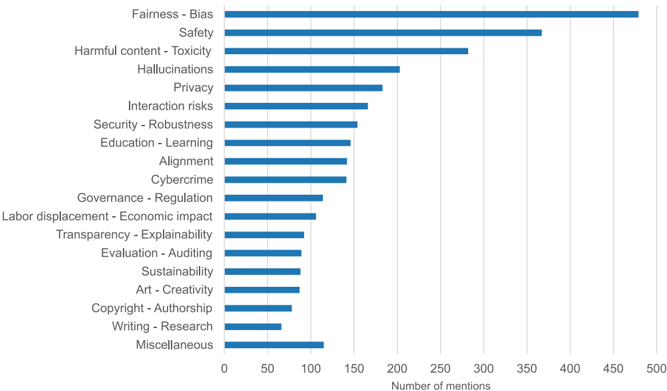
The advent of generative artificial intelligence and the widespread adoption of it in society engendered intensive debates about its ethical implications and risks. These risks often differ from those associated with traditional discriminative machine learning. To synthesize the recent discourse and map its normative concepts, we conducted a scoping review on the ethics of generative artificial intelligence, including especially large language models and text-to-image models. Our analysis provides a taxonomy of 378 normative issues in 19 topic areas and ranks them according to their prevalence in the literature. The study offers a comprehensive overview for scholars, practitioners, or policymakers, condensing the ethical debates surrounding fairness, safety, harmful content, hallucinations, privacy, interaction risks, security, alignment, societal impacts, and others. We discuss the results, evaluate imbalances in the literature, and explore unsubstantiated risk scenarios.
Overview
The claims and statistics of this paper haven’t been checked yet.
Free: it reads the open-access text and checks the first 5 claims that cite a source we can check. Create a free account to check every claim.
Integrity signals
Registry
Cites
Statistics
Figures
Verification
Claims the paper makes
The claims and statistics of this paper haven’t been checked yet.
Free: it reads the open-access text and checks the first 5 claims that cite a source we can check. Create a free account to check every claim.
Claims other papers make about this one
Each is checked against this paper’s own text: does it say what the citing paper says it does?
The source backs part of the claim, not all of it — or backs it for a different population, condition or comparison.
In the citing paper
“These have been summarised in Hagendorff's (2024) recent scoping review, including biases from training data, hallucinations referred to earlier in this section, privacy risks from leakage of sensitive information, interaction risks between workers and AI that could lead to unethical or even illegal activities, and security risks linked to threats to AI systems.”
From Activity theory as framework for analysis of workplace learning technologies: the case of generative AI conversational agents (2025) · cites this paper as Hagendorff's (2024)
Experimental — accuracy not yet measuredThe cited source says what the claim attributes to it.
In the citing paper
“Furthermore, GenAI can create misleading nonsensical content (hallucinations).”
From Activity theory as framework for analysis of workplace learning technologies: the case of generative AI conversational agents (2025) · cites this paper as Hagendorff (2024)
Self-check
Percentages, sums and reported differences re-computed from the paper’s own numbers.
The self-check needs the paper’s full text.
Citations
Cites
The PRISMA 2020 statement: An updated guideline for reporting systematic reviews
Page, M. J., McKenzie, J. E., Bossuyt, P. M., Boutron, I., Hoffmann, T. C., Mulrow, C. D., Shamseer, L., Tetzlaff, J. M., Akl, E. A., Brennan, S. E., et al. (2021) · BMJ · doi:10.1136/bmj.n71 · Cited by 108,283
LeCun, Y., Bengio, Y., & Hinton, G. (2015) · Nature · doi:10.1038/nature14539 · Cited by 84,126
Preferred reporting items for systematic reviews and meta-analyses: The PRISMA statement
Moher, D., Liberati, A., Tetzlaff, J., Altman, D. G., & the PRISMA Group* (2009) · Annals of Internal Medicine · doi:10.7326/0003-4819-151-4-200908180-00135 · Cited by 37,554
Scoping studies: towards a methodological framework
Arksey, H., & O'Malley, L. (2005) · International Journal of Social Research Methodology · doi:10.1080/1364557032000119616 · Cited by 36,742 · cited 1×
“We conducted a scoping review (Arksey & O’Malley, 2005) with the aim of covering a significant proportion of the existing literature on the ethics of generative AI.”
High-Resolution Image Synthesis with Latent Diffusion Models
Rombach, R., Blattmann, A., Lorenz, D., Esser, P., & Ommer, B. (2022) · 2022 IEEE/CVF Conference on Computer Vision and Pattern Recognition (CVPR) · doi:10.1109/cvpr52688.2022.01042 · Cited by 20,302 · cited 1×
“Later, the transformer architecture (Vaswani et al., 2017) as well as diffusion models (Ho et al., 2020) boosted the performance of text and image generation models and made them adaptable to a wide range of downstream tasks.”
The Coding Manual for Qualitative Researchers
Saldana, J. (2025) · SAGE Publications Ltd eBooks · doi:10.4135/9781036235611 · Cited by 17,944
ChatGPT for good? On opportunities and challenges of large language models for education
Kasneci, E., Sessler, K., Küchemann, S., Bannert, M., Dementieva, D., Fischer, F., Gasser, U., Groh, G., Günnemann, S., Hüllermeier, E., et al. (2023) · Learning and Individual Differences · doi:10.1016/j.lindif.2023.102274 · Cited by 15,365 · cited 6×
“However, some papers suggest that generative AI might lead to reduced effort or laziness among learners (Kasneci et al., 2023).”
InfluentialThe Coding Manual for Qualitative Researchers
Lungu, M. (2022) · American Journal of Qualitative Research · doi:10.29333/ajqr/12085 · Cited by 10,826 · cited 2×
“In the initial coding cycle, all relevant paper texts were labelled paragraph by paragraph through a bottom-up approach deriving concepts and themes from the papers using inductive coding (Saldaña, 2021).”
InfluentialMastering the game of Go without human knowledge
Silver, D., Schrittwieser, J., Simonyan, K., Antonoglou, I., Huang, A., Guez, A., Hubert, T., Baker, L., Lai, M., Bolton, A., et al. (2017) · Nature · doi:10.1038/nature24270 · Cited by 9,084 · cited 1×
“…applications (LeCun et al., 2015), to the achievement of superhuman-level performance in complex games with reinforcement learning (RL) algorithms (Silver et al., 2017), and large language models (LLMs) possessing complex reasoning abilities (Bubeck et al., 2023; Minaee et al., 2024), new ethical…”
The PRISMA 2020 statement: an updated guideline for reporting systematic reviews
Page, M. J., McKenzie, J., Bossuyt, P., Boutron, I., Hoffmann, T., mulrow, C., Shamseer, L., Tetzlaff, J., Akl, E., Brennan, S. E., et al. (2020) · doi:10.31222/osf.io/v7gm2_v1 · Cited by 8,090
Research works printed but not linked: 55
- 26. Anderljung, M., Barnhart, J., Korinek, A., Leung, J., O'Keefe, C., Whittlestone, J., Avin, S., Brund- age, M., Bullock, J., Cass-Beggs, D., Chang, B., Collins, T., Fist, T., Hadfield, G., Hayes, A., Ho, L., Hooker, S., Horvitz, E., Kolt, N., Schuett, J., Shavit, Y., Siddarth, D., Trager, R., & Wolf, K. (2023). Frontier AI regulation: Managing emerging risks to public safety. arXiv, 1-51.
- 31. Barnett, J. (2023). The ethical implications of generative audio models: A systematic literature review. In F. Rossi, S. Das, J. Davis, K. Firth-Butterfield, & A. John (Eds.) (pp. 146-161). ACM.
- 37. Bommasani, R., Hudson, D. A., Adeli, E., Altman, R., Arora, S., Arx, S. V., Bernstein, M. S., Bohg, J., Bosselut, A., Brunskill, E., Brynjolfsson, E., Buch, S., Card, D., Castellon, R., Chatterji, N., Chen, A., Creel, K., Davis, J. Q., Demszky, D., Donahue, C., Doumbouya, M., Durmus, E., Ermon, S., Etchemendy, J., Ethayarajh, K., Fei-Fei, L., Finn, C., Gale, T., Gillespie, L., Goel, K., Goodman, N., Grossman, S., Guha, N., Hashimoto, T., Henderson, P., Hewitt, J., Ho, D. E., Hong, J., Hsu, K., Huang, J., Icard, T., Jain, S., Jurafsky, D., Kalluri, P., Karamcheti, S., Keeling, G., Khani, F., Khat- tab, O., Koh, P. W., Krass, M., Krishna, R., Kuditipudi, R., Kumar, A., Ladhak, F., Lee, M., Lee, T., Leskovec, J., Levent, I., Li, X. L., Li, X., Ma, T., Malik, A., Manning, C. D., Mirchandani, S., Mitchell, E., Munyikwa, Z., Nair, S., Narayan, A., Narayanan, D., Newman, B., Nie, A., Niebles, J. C., Nilforoshan, H., Nyarko, J., Ogut, G., Orr, L., Papadimitriou, I., Park, J. S., Piech, C., Por- telance, E., Potts, C., Raghunathan, A., Reich, R., Ren, H., Rong, F., Roohani, Y., Ruiz, C., Ryan, J., Ré, C., Sadigh, D., Sagawa, S., Santhanam, K., Shih, A., Srinivasan, K., Tamkin, A., Taori, R., Thomas, A. W., Tramèr, F., Wang, R. E., Wang, W., Wu, B., Wu, J., Wu, Y., Xie, S. M., Yasunaga, M., You, J., Zaharia, M., Zhang, M., Zhang, T., Zhang, X., Zhang, Y., Zheng, L., Zhou, K., & Liang, P. (2021). On the opportunities and risks of foundation models. arXiv, 1-212.
- 42. Bubeck, S., Chandrasekaran, V., Eldan, R., Gehrke, J., Horvitz, E., Kamar, E., Lee, P., Lee, Y. T., Li, Y., Lundberg, S., Nori, H., Palangi, H., Ribeiro, M. T., & Zhang, Y. (2023). Sparks of artificial general intelligence: Early experiments with GPT-4. arXiv, 1-154.
- 45. Deng, Y., Zhang, W., Pan, S. J., & Bing, L. (2023). Multilingual jailbreak challenges in large language models. arXiv, 1-16.
- 46. Derczynski, L., Kirk, H. R., Balachandran, V., Kumar, S., Tsvetkov, Y., Leiser, & Mohammad, S. (2023). Assessing language model deployment with risk cards. arXiv, 1-18.
- 48. Derner, E., & Batistič, K. (2023). Beyond the safeguards: Exploring the security risks of ChatGPT. arXiv, 1-8.
- 49. Dinan, E., Abercrombie, G., Bergman, A. S., Spruit, S., Hovy, D., Boureau, Y.-L., & Rieser, V. (2023). Anticipating safety issues in E2E conversational AI: Framework and tooling. arXiv, 1-43.
- 60. Fraser, K. C., Kiritchenko, S., & Nejadgholi, I. (2023). A friendly face: Do text-to-image systems rely on stereotypes when the input is under-specified? arXiv, 1-17.
- 62. Gabriel, I., Manzini, A., Keeling, G., Hendricks, L. A., Rieser, V., Iqbal, H., Tomašev, N., Ktena, I., Kenton, Z., Rodriguez, M., El-Sayed, S., Brown, S., Akbulut, C., Trask, A., Hughes, E., Bergman, A. S., Shelby, R., Marchal, N., Griffin, C., Mateos-Garcia, J., Weidinger, L., Street, W., Lange, B., Ingerman, A., Lentz, A., Enger, R., Barakat, A., Krakovna, V., Siy, J. O., Kurth-Nelson, Z., McCroskery, A., Bolina, V., Law, H., Shanahan, M., Alberts, L., Balle, B., Haas, S. D., Ibitoye, Y., Dafoe, A., Goldberg, B., Krier, S., Reese, A., Witherspoon, S., Hawkins, W., Rauh, M., Wallace, D., Franklin, M., Goldstein, J. A., Lehman, J., Klenk, M., Vallor, S., Biles, C., Morris, M. R., King, H., Arcas, B. A. y., Isaac, W., & Manyika, J. (2024). The ethics of advanced AI assistants. arXiv, 1-273.
- 63. Gemini Team, Anil, R., Borgeaud, S., Wu, Y., Alayrac, J.-B., Yu, J., Soricut, R., Schalkwyk, J., Dai, A. M., Hauth, A., Millican, K., Silver, D., Petrov, S., Johnson, M., Antonoglou, I., Schrittwieser, J., Glaese, A., Chen, J., Pitler, E., Lillicrap, T., Lazaridou, A., Firat, O., Molloy, J., Isard, M., Barham, P. R., Hennigan, T., Lee, B., Viola, F., Reynolds, M., Xu, Y., Doherty, R., Collins, E., Meyer, C., Rutherford, E., Moreira, E., Ayoub, K., Goel, M., Tucker, G., Piqueras, E., Krikun, M., Barr, I., Savinov, N., Danihelka, I., Roelofs, B., White, A., Andreassen, A., von Glehn, T., Yagati, L., Kazemi, M., Gonzalez, L., Khalman, M., Sygnowski, J., Frechette, A., Smith, C., Culp, L., Proleev, L., Luan, Y., Chen, X., Lottes, J., Schucher, N., Lebron, F., Rrustemi, A., Clay, N., Crone, P., Kocisky, T., Zhao, J., Perz, B., Yu, D., Howard, H., Bloniarz, A., Rae, J. W., Lu, H., Sifre, L., Mag- gioni, M., Alcober, F., Garrette, D., Barnes, M., Thakoor, S., Austin, J., Barth-Maron, G., Wong, W., Joshi, R., Chaabouni, R., Fatiha, D., Ahuja, A., Liu, R., Li, Y., Cogan, S., Chen, J., Jia, C., Gu, C., Zhang, Q., Grimstad, J., Hartman, A. J., Chadwick, M., Tomar, G. S., Garcia, X., Senter, E., Taropa, E., Pillai, T. S., Devlin, J., Laskin, M., Casas, D. d. L., Valter, D., Tao, C., Blanco, L., Badia, A. P., Reitter, D., Chen, M., Brennan, J., Rivera, C., Brin, S., Iqbal, S., Surita, G., Labanow- ski, J., Rao, A., Winkler, S., Parisotto, E., Gu, Y., Olszewska, K., Zhang, Y., Addanki, R., Miech, A., Louis, A., Shafey, L. E., Teplyashin, D., Brown, G., Catt, E., Attaluri, N., Balaguer, J., Xiang, J., Wang, P., Ashwood, Z., Briukhov, A., Webson, A., Ganapathy, S., Sanghavi, S., Kannan, A., Chang, M.-W., Stjerngren, A., Djolonga, J., Sun, Y., Bapna, A., Aitchison, M., Pejman, P., Michalewski, H., Yu, T., Wang, C., Love, J., Ahn, J., Bloxwich, D., Han, K., Humphreys, P., Sellam, T., Bradbury, J., Godbole, V., Samangooei, S., Damoc, B., Kaskasoli, A., Arnold, S. M. R., Vasudevan, V., Agrawal, S., Riesa, J., Lepikhin, D., Tanburn, R., Srinivasan, S., Lim, H., Hodkin- son, S., Shyam, P., Ferret, J., Hand, S., Garg, A., Le Paine, T., Li, J., Li, Y., Giang, M., Neitz, A., Abbas, Z., York, S., Reid, M., Cole, E., Chowdhery, A., Das, D., Rogozińska, D., Nikolaev, V., Sprechmann, P., Nado, Z., Zilka, L., Prost, F., He, L., Monteiro, M., Mishra, G., Welty, C., Newlan, J., Jia, D., Allamanis, M., Hu, C. H., de Liedekerke, R., Gilmer, J., Saroufim, C., Rijhwani, S., Hou, S., Shrivastava, D., Baddepudi, A., Goldin, A., Ozturel, A., Cassirer, A., Xu, Y., Sohn, D., Sachan, D., Amplayo, R. K., Swanson, C., Petrova, D., Narayan, S., Guez, A., Brahma, S., Landon, J., Patel, M., Zhao, R., Villela, K., Wang, L., Jia, W., Rahtz, M., Giménez, M., Yeung, L., Lin, H., Keeling, J., Georgiev, P., Mincu, D., Wu, B., Haykal, S., Saputro, R., Vodrahalli, K., Qin, J., Can- kara, Z., Sharma, A., Fernando, N., Hawkins, W., Neyshabur, B., Kim, S., Hutter, A., Agrawal, P., Castro-Ros, A., den van Driessche, G., Wang, T., Yang, F., Chang, S., Komarek, P., McIlroy, R., Lučić, M., Zhang, G., Farhan, W., Sharman, M., Natsev, P., Michel, P., Cheng, Y., Bansal, Y., Qiao, S., Cao, K., Shakeri, S., Butterfield, C., Chung, J., Rubenstein, P. K., Agrawal, S., Mensch, A., Soparkar, K., Lenc, K., Chung, T., Pope, A., Maggiore, L., Kay, J., Jhakra, P., Wang, S., Maynez, J., Phuong, M., Tobin, T., Tacchetti, A., Trebacz, M., Robinson, K., Katariya, Y., Riedel, S., Bailey, P., Xiao, K., Ghelani, N., Aroyo, L., Slone, A., Houlsby, N., Xiong, X., Yang, Z., Gribovskaya, E., Adler, J., Wirth, M., Lee, L., Li, M., Kagohara, T., Pavagadhi, J., Bridgers, S., Bortsova, A., Ghe- mawat, S., Ahmed, Z., Liu, T., Powell, R., Bolina, V., Iinuma, M., Zablotskaia, P., Besley, J., Chung, D.-W., Dozat, T., Comanescu, R., Si, X., Greer, J., Su, G., Polacek, M., Kaufman, R. L., Tokumine, S., Hu, H., Buchatskaya, E., Miao, Y., Elhawaty, M., Siddhant, A., Tomasev, N., Xing, J., Greer, C., Miller, H., Ashraf, S., Roy, A., Zhang, Z., Ma, A., Filos, A., Besta, M., Blevins, R., Klimenko, T., Yeh, C.-K., Changpinyo, S., Mu, J., Chang, O., Pajarskas, M., Muir, C., Cohen, V., Le Lan, C., Haridasan, K., Marathe, A., Hansen, S., Douglas, S., Samuel, R., Wang, M., Austin, S., Lan, C., Jiang, J., Chiu, J., Lorenzo, J. A., Sjösund, L. L., Cevey, S., Gleicher, Z., Avrahami, T., Boral, A., Srinivasan, H., Selo, V., May, R., Aisopos, K., Hussenot, L., Soares, L. B., Baumli, K., Chang, M. B., Recasens, A., Caine, B., Pritzel, A., Pavetic, F., Pardo, F., Gergely, A., Frye, J., Ramasesh, V., Horgan, D., Badola, K., Kassner, N., Roy, S., Dyer, E., Campos, V., Tomala, A., Tang, Y., Badawy, D. E., White, E., Mustafa, B., Lang, O., Jindal, A., Vikram, S., Gong, Z., Caelles, S., Hemsley, R., Thornton, G., Feng, F., Stokowiec, W., Zheng, C., Thacker, P., Ünlü, Ç., Zhang, Z., Saleh, M., Svensson, J., Bileschi, M., Patil, P., Anand, A., Ring, R., Tsihlas, K., Vezer, A., Selvi, M., Shevlane, T., Rodriguez, M., Kwiatkowski, T., Daruki, S., Rong, K., Dafoe, A., FitzGerald, N., Gu-Lemberg, K., Khan, M., Hendricks, L. A., Pellat, M., Feinberg, V., Cobon-Kerr, J., Sainath, T., Rauh, M., Hashemi, S. H., Ives, R., Hasson, Y., Li, Y., Noland, E., Cao, Y., Byrd, N., Le Hou, Wang, Q., Sottiaux, T., Paganini, M., Lespiau, J.-B., Moufarek, A., Hassan, S., Shiva- kumar, K., van Amersfoort, J., Mandhane, A., Joshi, P., Goyal, A., Tung, M., Brock, A., Sheahan, H., Misra, V., Li, C., Rakićević, N., Dehghani, M., Liu, F., Mittal, S., Oh, J., Noury, S., Sezener, E., Huot, F., Lamm, M., Cao, N. de, Chen, C., Elsayed, G., Chi, E., Mahdieh, M., Tenney, I., Hua, N., Petrychenko, I., Kane, P., Scandinaro, D., Jain, R., Uesato, J., Datta, R., Sadovsky, A., Bunyan, O., Rabiej, D., Wu, S., Zhang, J., Vasudevan, G., Leurent, E., Alnahlawi, M., Georgescu, I., Wei, N., Zheng, I., Chan, B., Rabinovitch, P. G., Stanczyk, P., Zhang, Y., Steiner, D., Naskar, S., Azzam, M., Johnson, M., Paszke, A., Chiu, C.-C., Elias, J. S., Mohiuddin, A., Muhammad, F., Miao, J., Lee, A., Vieillard, N., Potluri, S., Park, J., Davoodi, E., Zhang, J., Stanway, J., Garmon, D., Kar- markar, A., Dong, Z., Lee, J., Kumar, A., Zhou, L., Evens, J., Isaac, W., Chen, Z., Jia, J., Levskaya, A., Zhu, Z., Gorgolewski, C., Grabowski, P., Mao, Y., Magni, A., Yao, K., Snaider, J., Casagrande, N., Suganthan, P., Palmer, E., Irving, G., Loper, E., Faruqui, M., Arkatkar, I., Chen, N., Shafran, I., Fink, M., Castaño, A., Giannoumis, I., Kim, W., Rybiński, M., Sreevatsa, A., Prendki, J., Soergel, D., Goedeckemeyer, A., Gierke, W., Jafari, M., Gaba, M., Wiesner, J., Wright, D. G., Wei, Y., Vashisht, H., Kulizhskaya, Y., Hoover, J., Le, M., Li, L., Iwuanyanwu, C., Liu, L., Ramirez, K., Khorlin, A., Cui, A., LIN, T., Georgiev, M., Wu, M., Aguilar, R., Pallo, K., Chakladar, A., Repina, A., Wu, X., van der Weide, T., Ponnapalli, P., Kaplan, C., Simsa, J., Li, S., Dousse, O., Piper, J., Ie, N., Lui, M., Pasumarthi, R., Lintz, N., Vijayakumar, A., Thiet, L. N., Andor, D., Valenzuela, P., Paduraru, C., Peng, D., Lee, K., Zhang, S., Greene, S., Nguyen, D. D., Kurylowicz, P., Velury, S., Krause, S., Hardin, C., Dixon, L., Janzer, L., Choo, K., Feng, Z., Zhang, B., Singhal, A., Latkar, T., Zhang, M., Le, Q., Abellan, E. A., Du, D., McKinnon, D., Antropova, N., Bolukbasi, T., Keller, O., Reid, D., Finchelstein, D., Raad, M. A., Crocker, R., Hawkins, P., Dadashi, R., Gaffney, C., Lall, S., Franko, K., Filonov, E., Bulanova, A., Leblond, R., Yadav, V., Chung, S., Askham, H., Cobo, L. C., Xu, K., Fischer, F., Xu, J., Sorokin, C., Alberti, C., Lin, C.-C., Evans, C., Zhou, H., Dimitriev, A., Forbes, H., Banarse, D., Tung, Z., Liu, J., Omernick, M., Bishop, C., Kumar, C., Sterneck, R., Foley, R., Jain, R., Mishra, S., Xia, J., Bos, T., Cideron, G., Amid, E., Piccinno, F., Wang, X., Ban- zal, P., Gurita, P., Noga, H., Shah, P., Mankowitz, D. J., Polozov, A., Kushman, N., Krakovna, V., Brown, S., Bateni, M., Duan, D., Firoiu, V., Thotakuri, M., Natan, T., Mohananey, A., Geist, M., Mudgal, S., Girgin, S., Li, H., Ye, J., Roval, O., Tojo, R., Kwong, M., Lee-Thorp, J., Yew, C., Yuan, Q., Bagri, S., Sinopalnikov, D., Ramos, S., Mellor, J., Sharma, A., Severyn, A., Lai, J., Wu, K., Cheng, H.-T., Miller, D., Sonnerat, N., Vnukov, D., Greig, R., Beattie, J., Caveness, E., Bai, L., Eisenschlos, J., Korchemniy, A., Tsai, T., Jasarevic, M., Kong, W., Dao, P., Zheng, Z., Liu, F., Zhu, R., Geller, M., Teh, T. H., Sanmiya, J., Gladchenko, E., Trdin, N., Sozanschi, A., Toyama, D., Rosen, E., Tavakkol, S., Xue, L., Elkind, C., Woodman, O., Carpenter, J., Papamakarios, G., Kemp, R., Kafle, S., Grunina, T., Sinha, R., Talbert, A., Goyal, A., Wu, D., Owusu-Afriyie, D., Du, C., Thornton, C., Pont-Tuset, J., Narayana, P., Li, J., Fatehi, S., Wieting, J., Ajmeri, O., Uria, B., Zhu, T., Ko, Y., Knight, L., Héliou, A., Niu, N., Gu, S., Pang, C., Tran, D., Li, Y., Levine, N., Stolovich, A., Kalb, N., Santamaria-Fernandez, R., Goenka, S., Yustalim, W., Strudel, R., Elqursh, A., Laksh- minarayanan, B., Deck, C., Upadhyay, S., Lee, H., Dusenberry, M., Li, Z., Wang, X., Levin, K., Hoffmann, R., Holtmann-Rice, D., Bachem, O., Yue, S., Arora, S., Malmi, E., Mirylenka, D., Tan, Q., Koh, C., Yeganeh, S. H., Põder, S., Zheng, S., Pongetti, F., Tariq, M., Sun, Y., Ionita, L., Seyed- hosseini, M., Tafti, P., Kotikalapudi, R., Liu, Z., Gulati, A., Liu, J., Ye, X., Chrzaszcz, B., Wang, L., Sethi, N., Li, T., Brown, B., Singh, S., Fan, W., Parisi, A., Stanton, J., Kuang, C., Koverkathu, V., Choquette-Choo, C. A., Li, Y., Lu, T. J., Ittycheriah, A., Shroff, P., Sun, P., Varadarajan, M., Bahargam, S., Willoughby, R., Gaddy, D., Dasgupta, I., Desjardins, G., Cornero, M., Robenek, B., Mittal, B., Albrecht, B., Shenoy, A., Moiseev, F., Jacobsson, H., Ghaffarkhah, A., Rivière, M., Wal- ton, A., Crepy, C., Parrish, A., Liu, Y., Zhou, Z., Farabet, C., Radebaugh, C., Srinivasan, P., van der Salm, C., Fidjeland, A., Scellato, S., Latorre-Chimoto, E., Klimczak-Plucińska, H., Bridson, D., Cesare, D. de, Hudson, T., Mendolicchio, P., Walker, L., Morris, A., Penchev, I., Mauger, M., Guseynov, A., Reid, A., Odoom, S., Loher, L., Cotruta, V., Yenugula, M., Grewe, D., Petrushkina, A., Duerig, T.,Sanchez, A., Yadlowsky, S., Shen, A., Globerson, A., Kurzrok, A., Webb, L., Dua, S., Li, D., Lahoti, P., Bhupatiraju, S., Hurt, D., Qureshi, H., Agarwal, A., Shani, T., Eyal, M., Khare, A., Belle, S. R., Wang, L., Tekur, C., Kale, M. S., Wei, J., Sang, R., Saeta, B., Liechty, T., Sun, Y., Zhao, Y., Lee, S., Nayak, P., Fritz, D., Vuyyuru, M. R., Aslanides, J., Vyas, N., Wicke, M., Ma, X., Bilal, T., Eltyshev, E., Balle, D., Martin, N., Cate, H., Manyika, J., Amiri, K., Kim, Y., Xiong, X., Kang, K., Luisier, F., Tripuraneni, N., Madras, D., Guo, M., Waters, A., Wang, O., Ain- slie, J., Baldridge, J., Zhang, H., Pruthi, G., Bauer, J., Yang, F., Mansour, R., Gelman, J., Xu, Y., Polovets, G., Liu, J., Cai, H., Chen, W., Sheng, X., Xue, E., Ozair, S., Yu, A., Angermueller, C., Li, X., Wang, W., Wiesinger, J., Koukoumidis, E., Tian, Y., Iyer, A., Gurumurthy, M., Goldenson, M., Shah, P., Blake, M. K., Yu, H., Urbanowicz, A., Palomaki, J., Fernando, C., Brooks, K., Durden, K., Mehta, H., Momchev, N., Rahimtoroghi, E., Georgaki, M., Raul, A., Ruder, S., Redshaw, M., Lee, J., Jalan, K., Li, D., Perng, G., Hechtman, B., Schuh, P., Nasr, M., Chen, M., Milan, K., Miku- lik, V., Strohman, T., Franco, J., Green, T., Hassabis, D., Kavukcuoglu, K., Dean, J., & Vinyals, O. (2023). Gemini: A family of highly capable multimodal models. arXiv, 1-50.
- 64. Ghosh, A., & Lakshmi, D. (2023). Dual governance: The intersection of centralized regulation and crowdsourced safety mechanisms for Generative AI. arXiv, 1-11.
- 67. Goodfellow, I. J., Pouget-Abadie, J., Mirza, M., Xu, B., Warde-Farley, D., Ozair, S., Courville, A., & Bengio, Y. (2014). Generative adversarial networks. arXiv, 1-9.
- 68. Gozalo-Brizuela, R., & Garrido-Merchan, E. C. (2023). ChatGPT is not all you need. A state of the art review of large generative AI models. arXiv, 1-22.
- 70. Grinbaum, A., & Adomaitis, L. (2022). The ethical need for watermarks in machine-generated language. arXiv, 1-8.
- 79. Hendrycks, D., Carlini, N., Schulman, J., & Steinhardt, J. (2022). Unsolved problems in ML safety. arXiv, 1-28.
- 80. Hendrycks, D., Mazeika, M., & Woodside, T. (2023). An overview of catastrophic AI risks. arXiv, 1-54.
- 81. Ho, J., Jain, A., & Abbeel, P. (2020). Denoising diffusion probabilistic models. arXiv, 1-25.
- 82. Holzapfel, A., Jääskeläinen, P., & Kaila, A.-K. (2022). Environmental and social sustainability of crea- tive-Ai. arXiv, 1-4.
- 84. Hou, B. L., & Green, B. P. (2023). A multi-level framework for the AI alignment problem. arXiv, 1-7.
- 87. Ji, J., Qiu, T., Chen, B., Zhang, B., Lou, H., Wang, K., Duan, Y., He, Z., Zhou, J., Zhang, Z., Zeng, F., Ng, K. Y., Dai, J., Pan, X., O'Gara, A., Lei, Y., Xu, H., Tse, B., Fu, J., McAleer, S., Yang, Y., Wang, Y., Zhu, S.-C., Guo, Y., & Gao, W. (2023). AI Alignment: A comprehensive survey. arXiv, 1-95.
- 90. Kasirzadeh, A. (2024). Two types of AI existential risk: Decisive and accumulative. arXiv, 1-31.
- 93. Kenton, Z., Everitt, T., Weidinger, L., Gabriel, I., Mikulik, V., & Irving, G. (2021). Alignment of lan- guage agents. arXiv, 1-18.
- 13. Weidinger, Laura; Uesato, Jonathan; Rauh, Maribeth; Griffin, Conor; Huang, Po-Sen; Mellor, John et al. (2022): Taxonomy of Risks posed by Language Models. In: 2022 ACM Conference on Fairness, Accountability, and Transparency. New York: ACM, pp. 214-229
- 14. Yan, Lixiang; Sha, Lele; Zhao, Linxuan; Li, Yuheng; Martinez-Maldonado, Roberto; Chen, Guanliang et al. (2023): Practical and ethical challenges of large language models in education: A systematic scoping review. In Brit J Educational Tech, pp. 1-23
- 94. Kenwright, B. (2023). Exploring the power of creative AI tools and game-based methodologies for inter- active web-based programming. arXiv, 1-20.
- 97. Kingma, D. P., & Welling, M. (2013). Auto-encoding variational bayes. arXiv, 1-14.
- 100. Koessler, L., & Schuett, J. (2023). Risk assessment at AGI companies: A review of popular risk assess- ment techniques from other safety-critical industries. arXiv, 1-44.
- 102. Latif, E., Mai, G., Nyaaba, M., Wu, X., Liu, N., Lu, G., Li, S., Liu, T., & Zhai, X. (2023). Artificial gen- eral intelligence (AGI) for education. arXiv, 1-30.
- 105. Li, Z. (2023). The dark side of ChatGPT: Legal and ethical challenges from stochastic parrots and hal- lucination. arXiv, 1-3.
- 108. McAleese, S. (2022). How do AI timelines affect existential risk? arXiv, 1-20.
- 111. Minaee, S., Mikolov, T., Nikzad, N., Chenaghlu, M., Socher, R., Amatriain, X., & Gao, J. (2024). Large language models: A survey. arXiv, 1-43.
- 116. Morley, J., Floridi, L., Kinsey, L., & Elhalal, A. (2019). A typology of AI ethics tools, methods and research to translate principles into practices. AI for social good workshop at NeurIPS (2019). Van- couver, 1-8.
- 117. Mozes, M., He, X., Kleinberg, B., & Griffin, L. D. (2023). Use of LLMs for illicit purposes: Threats, pre- vention measures, and vulnerabilities. arXiv, 1-35.
- 119. Nannini, L. (2023). Voluminous yet vacuous? Semantic capital in an age of large language models. arXiv, 1-11.
- 121. Ngo, R., Chan, L., & Mindermann, S. (2022). The alignment problem from a deep learning perspective. arXiv, 1-26.
- 138. Ramesh, A., Pavlov, M., Goh, G., Gray, S., Voss, C., Radford, A., Chen, M., & Sutskever, I. (2021). Zero- shot text-to-image generation. arXiv, 1-20.
- 141. Rezende, D. J., & Mohamed, S. (2015). Variational inference with normalizing flows. arXiv, 1-10.
- 147. Sandbrink, J. B. (2023). Artificial intelligence and biological misuse: Differentiating risks of language models and biological design tools. arXiv, 1-9.
- 153. Shardlow, M., & Przybyła, P. (2022). Deanthropomorphising NLP: Can a language model be conscious? arXiv, 1-20.
- 155. Shen, T., Jin, R., Huang, Y., Liu, C., Dong, W., Guo, Z., Wu, X., Liu, Y., & Xiong, D. (2023). Large lan- guage model alignment: A survey. arXiv, 1-76.
- 156. Shevlane, T., Farquhar, S., Garfinkel, B., Phuong, M., Whittlestone, J., Leung, J., Kokotajlo, D., Marchal, N., Anderljung, M., Kolt, N., Ho, L., Siddarth, D., Avin, S., Hawkins, W., Kim, B., Gabriel, I., Bolina, V., Clark, J., Bengio, Y., Christiano, P., & Dafoe, A. (2023). Model evaluation for extreme risks. arXiv, 1-20.
- 159. Smith, V., Shamsabadi, A. S., Ashurst, C., & Weller, A. (2023). Identifying and mitigating privacy risks stemming from language models: A survey. arXiv, 1-18.
- 161. Solaiman, I., Talat, Z., Agnew, W., Ahmad, L., Baker, D., Blodgett, S. L., Daumé, Hal, III, Dodge, J., Evans, E., Hooker, S., Jernite, Y., Luccioni, A. S., Lusoli, A., Mitchell, M., Newman, J., Png, M.-T., Strait, A., & Vassilev, A. (2023). Evaluating the social impact of generative AI systems in systems and society. arXiv, 1-41.
- 166. Sun, H., Zhang, Z., Deng, J., Cheng, J., & Huang, M. (2023a). Safety assessment of Chinese large lan- guage models. arXiv, 1-10.
- 167. Susnjak, T. (2022). ChatGPT: The end of online exam integrity? arXiv, 1-21.
- 169. Vaswani, A., Shazeer, N., Parmar, N., Uszkoreit, J., Jones, L., Gomez, A. N., Kaiser, L., & Polosukhin, I. (2017). Attention is all you need. arXiv, 1-15.
- 172. Wang, B., Chen, W., Pei, H., Xie, C., Kang, M., Zhang, C., Xu, C., Xiong, Z., Dutta, R., Schaeffer, R., Truong, S. T., Arora, S., Mazeika, M., Hendrycks, D., Lin, Z., Cheng, Y., Koyejo, S., Song, D., & Li, B. (2023a). DecodingTrust: A comprehensive assessment of trustworthiness in GPT models. arXiv, 1-95.
- 174. Wang, W., Tu, Z., Chen, C., Yuan, Y., Huang, J., Jiao, W., & Lyu, M. R. (2023c). All languages matter: On the multilingual safety of large language models. arXiv, 1-12.
- 178. Weidinger, L., Rauh, M., Marchal, N., Manzini, A., Hendricks, L. A., Mateos-Garcia, J., Bergman, S., Kay, J., Griffin, C., Bariach, B., & others. (2023). Sociotechnical Safety evaluation of generative AI systems. arXiv, 1-76.
- 180. Wu, X., Duan, R., & Ni, J. (2023). Unveiling security, privacy, and ethical concerns of ChatGPT. arXiv, 1-12.
- 181. Xi, Z., Chen, W., Guo, X., He, W., Ding, Y., Hong, B., Zhang, M., Wang, J., Jin, S., Zhou, E., Zheng, R., Fan, X., Wang, X., Xiong, L., Zhou, Y., Wang, W., Jiang, C., Zou, Y., Liu, X., Yin, Z., Dou, S., Weng, R., Cheng, W., Zhang, Q., Qin, W., Zheng, Y., Qiu, X., Huang, X., & Gui, T. (2023). The rise and potential of large language model based agents: A survey. arXiv, 1-86.
- 182. Yang, Z., Zhan, F., Liu, K., Xu, M., & Lu, S. (2023). AI-generated images as data source: The dawn of synthetic era. arXiv, 1-20.
- 184. Zhang, C., Zhang, C., Li, C., Qiao, Y., Zheng, S., Dam, S. K., Zhang, M., Kim, J. U., Kim, S. T., Choi, J., Park, G.-M., Bae, S.-H., Lee, L.-H., Hui, P., Kweon, I. S., & Hong, C. S. (2023). One small step for generative AI, one giant leap for AGI: A complete survey on ChatGPT in AIGC era. arXiv, 1-29.
- 186. Zhuo, T. Y., Huang, Y., Chen, C., & Xing, Z. (2023). Red teaming ChatGPT via Jailbreaking: Bias, robustness, reliability and toxicity. arXiv, 12-2.
Cited by
Items 101–200 of 208
Oleribe, O. O., Sabado, P., Begum, K. T., Mutchler, M. G., Piccoli, B., Taylor-Robinson, A. W., Denaro, C. A., Izurieta, R., & Taylor-Robinson, S. D. (2026) · BMC Medical Education · doi:10.1186/s12909-026-09291-8 · Cited by 4
“These include hallucinations, transparency, data ownership, and the appropriate and responsible use of GenAI, as well as resistance to its adoption from some faculty and students [13, 14].”
Yang, Y., Qi, J., & Ji, X. (2026) · International Journal of Human-Computer Interaction · doi:10.1080/10447318.2026.2683905 · Cited by 2
Zuo, Y. (2026) · The Electronic Library · doi:10.1108/el-03-2026-0097 · Cited by 2
The Algorithmic Librarian: AI, Data Curation, and the Future of Research Collaboration
de Leon, L. C. R. (2026) · doi:10.5860/crl.87.4.521 · Cited by 3
From promise to practice: artificial intelligence in mental health care in the MENA region
Hajj, S. E., Nsouli, A., Wehbe, M., Saad, G. A., & Maalouf, F. T. (2026) · Frontiers in Psychiatry · doi:10.3389/fpsyt.2026.1878052 · Cited by 3
“The conversational fl uency of LLMs can foster relationship-like interactions that increase engagement, but also raise the risk of over-trust, misinterpretation, and confusion about the system ’ s role or capabilities (27, 33).”
System level governance of generative AI risks in cross border e-commerce supply chains
Bostan, I. (2026) · Discover Computing · doi:10.1007/s10791-026-10509-y · Cited by 2
“This trend mirrors the widespread diffusion of large language models and other generative architectures into commercial and organizational settings [1–4 , 6].”
AGÊNCIA MATEMÁTICA CRÍTICA NA PRODUÇÃO DE MODELOS MATEMÁTICOS COM IA
Lopes, A. P. C. E., & Borba, M. C. (2025) · Areté. · doi:10.59666/arete.1984-7505.v24.n38.5128 · Cited by 3
ICE: Intercede Concept Erasure in Text-to-Image Diffusion Models
Lin, Y., Huang, N., Huang, K., Liu, H. M., Yan, Y., Guo, J. M., Lee, T., & Li, X. (2025) · ACM International Conference on Multimedia (ACM MM) · doi:10.1145/3746027.3754992 · Cited by 3
Zhu, J., & Molnár, A. (2025) · PsyArXiv (OSF Preprints) · doi:10.31234/osf.io/j8zgv_v1 · Cited by 4
The Ethics of Generative AIPreprint
Klenk, M. (2025) · arXiv (Cornell University) · doi:10.48550/arxiv.2512.04598 · Cited by 2
“8 Empirical work already suggests that generative models can mislead users, sometimes as an emergent property rather than a designed feature (cf. Hagendorff 2024).”
Ma, P., Chen, S., Su, W., Sheng, J., Jia, X., Wei, C., Luo, Y., Xu, J., Song, Y., Yong, L., et al. (2025) · Journal of Agriculture and Food Research · doi:10.1016/j.jafr.2025.102086 · Cited by 2
ETHICOMP 2025 22nd international conference on the ethical and social impacts of ICT Lisbon
Alvarez, I., & Didiu, A. (2025) · doi:10.26619/978-989-9002-62-3 · Cited by 1
SFD-ViT: Spatial-Frequency dual-Stream transformer with patch embedding for face forgery detection
Yang, Y., Deng, Y., Yi, Q., & Yi, J. (2025) · Knowledge-Based Systems · doi:10.1016/j.knosys.2025.114838 · Cited by 1
Harto, B., & Ahida, R. (2025) · El-Rusyd Jurnal Sekolah Tinggi Ilmu Tarbiyah STIT Ahlussunnah Bukittinggi · doi:10.58485/elrusyd.v10i2.486 · Cited by 1
“Additional searches were conducted in the Stanford Encyclopedia of Philosophy and specialized journals such as Philosophy of Science, the British Journal for the Philosophy of Science, and Ethics and Information Technology (Hagendorff, 2024).”
Kim, S. D. (2025) · EPISTÉMÈ · doi:10.38119/cacs.2025.36.1 · Cited by 1
Ethical Judgments in GenAI Environments: A Study of ChatGPT Users
Gupta, P., Hooda, A., Jeyaraj, A., & Dwivedi, Y. K. (2026) · Journal of Computer Information Systems · doi:10.1080/08874417.2025.2610300 · Cited by 1
A teologia e os LLMs. Verdade, viés e mediação
Freitas, T. A. F., Nováis, P., Freitas, P. M., & Marcondes, F. (2026) · Cuestiones teológicas · doi:10.18566/cueteo.v53n119.a08 · Cited by 1
“Focando-nos naquela questão que tem ocupado um lugar de destaque na discussão académica (Hagendorff, 2024, p. 6), a da discriminação e dos vieses, em especial na IA generativa, constata-se que pode contribuir para uma perpetuação e amplificação deste fenómeno (Barfield & Pagallo, 2020, p. 24;…”
What is Safety? Corporate Discourse, Power, and the Politics of Generative AI Safety
De, A., Lima, G., & Zou, Y. (2026) · CHI Conference on Human Factors in Computing Systems · doi:10.1145/3772318.3791632 · Cited by 3
Hybrid Human-AI Intelligence: A Vision for Innovation & Higher Education’s Future
Woodring, D. (2026) · Springer eBooks · doi:10.1007/978-3-032-05205-6_2 · Cited by 1
Exploring attribution bias in LLMs: Social influences and prompt-based mitigation
Jiang, L., Cao, J., Zhu, G., & Wang, Y. (2026) · Technology in Society · doi:10.1016/j.techsoc.2026.103361 · Cited by 1
Theodore, M., & Elezi, E. (2026) · Business Process Management Journal · doi:10.1108/bpmj-12-2025-1946 · Cited by 1
An exploratory review on conceptualizing generative artificial intelligence literacy
Zainal, M. A., Matore, M. E. E. M., & Maat, S. M. (2026) · IAES International Journal of Artificial Intelligence · doi:10.11591/ijai.v15.i2.pp1023-1035 · Cited by 1
Patel, K., Ajith, R., Thapa, S., Adhikari, S., Tanveer, M., & Naseem, U. (2026) · Neural Networks · doi:10.1016/j.neunet.2026.109073 · Cited by 1
Prianto, C., Komaro, M., & Saripudin (2026) · Language, Technology, and Social Media. · doi:10.70211/ltsm.3026-7196.403 · Cited by 1
“1 Multi-stakeholder Governance 23 [1], [4], [5], [6], [7], [9], [11], [15], [16], [17], [24], [26], [27], [28], [30], [31], [34], [35], [37], [38], [41], [42], [43] Africa, Argentina, Australia, Brazil, China, Egypt, El Salvador, Germany, Global, Hong Kong, Ireland, Lithuania, Qatar, South Korea,…”
InfluentialNew Technology and Work: AI and the Coming Struggle to Democratise Work Organisation
Frenkel, S. J. (2026) · Sociology Compass · doi:10.1111/soc4.70212 · Cited by 2
Enhancing situation awareness for disaster policymaking via LLM-generated narratives
Shao, R., & Fan, C. (2026) · Technology in Society · doi:10.1016/j.techsoc.2026.103441 · Cited by 1
Generative AI Ethical Dimensions: Data Privacy Challenges and Future Prospects
Mahboubi, O. E., & Amnai, M. (2025) · IGI Global eBooks · doi:10.4018/979-8-3373-0365-9.ch019 · Cited by 1
NEURAL NETWORK RESPONSES TO USER REQUESTS: INTERPRETATION AND PERCEPTION FEATURES
Sokolov, A., Gabaydulin, R., & Sukhonina, N. A. (2025) · Вестник Пермского университета Политология · doi:10.17072/2218-1067-2025-1-100-111 · Cited by 1
DeGen Artificial Intelligence: Challenges and Opportunities of AI Applications
Marsili, M. (2025) · ARCA (Università Ca' Foscari Venezia) · doi:10.5281/zenodo.15096653 · Cited by 3
Deckker, D., & Sumanasekara, S. (2025) · doi:10.36227/techrxiv.174858078.81326357/v1 · Cited by 1
Sun, T., & Xiao, J. (2024) · International Journal of Advanced Computer Science and Applications · doi:10.14569/ijacsa.2024.0150802
“While DEGREE refines a pre-existing generative language model [27], the output it generates may reflect the characteristics of the corpus from which it was trained.”
BackgroundBerrah, L., Trentesaux, D., & Guerre-Chaley, F. (2025) · Studies in computational intelligence · doi:10.1007/978-3-031-85316-6_3 · Cited by 1
Liu, Y., Dsouza, J. C., Li, Y., & Zhao, T. (2024) · Advances in educational technologies and instructional design book series · doi:10.4018/979-8-3693-7220-3.ch012 · Cited by 3
Ética em Inteligência Artificial: Desenvolvimento de um Instrumento Paradidático
Barone, D. A. C., Malossi, R. M., Ferrugem, A. P., Silveira, D. L. R., França, A. B. C., & Stivelman, T. S. (2024) · Conferência Latino-Americana de Ética em Inteligência Artificial (LAAI-Ethics) · doi:10.5753/laai-ethics.2024.32453
A Taxonomy for the Digital, Environmental, and Socially Just Transition
Castro, G. D. R. (2025) · UPM Digital Archive (Technical University of Madrid) · doi:10.20868/upm.thesis.88337
Ohori, K., Goto, Y., Tahara, K., & Takahashi, S. (2025) · Transactions of the Japanese Society for Artificial Intelligence · doi:10.1527/tjsai.40-3_b-o93
Assess, Adapt, Apply: A3-Approach to Navigate the Writing Center Landscape in the Age of AI
Kallestinova, E. (2025) · IGI Global eBooks · doi:10.4018/979-8-3693-8059-8.ch001
Self-Attention Forged Images Detection Network with Three-Branch Multi-Feature Fusion
Yang, Y., Deng, Y., & Yi, Q. (2025) · IEEE Data Driven Control and Learning Systems Conference (DDCLS) · doi:10.1109/ddcls66240.2025.11064938
“Generative models are the machine learning model that can learn data distributions and generate new samples [2].”
Kato, I., Kasule, A., Nantege, Z., & MUTEBI, B. (2025) · doi:10.58653/nche.v12i2.4
Science Diplomacy and Advocacy in A Changing Geopolitical Era
Nader, H. B. (2025) · Turkish Academy of Sciences eBooks · doi:10.53478/tuba.978-625-6110-39-7.ch06
Peschke, L. (2025) · SocArXiv (OSF Preprints) · doi:10.31235/osf.io/5jhv9_v1
Bruni, F., & Murgia, E. (2025) · Wiley eBooks · doi:10.1002/9781394352821.ch06
Bridging AI Adoption and Governance in Higher Education: A Longitudinal Study on Dual-Use Challenges
López, F., Angulo-Alvarez, M., Navarrete, W. V. L., Ushiña, A. S., & Gutiérrez, H. R. B. (2025) · Information systems engineering and management · doi:10.1007/978-3-032-00202-0_13
Taylor, J. G., & Masuda, Y. (2025) · Procedia Computer Science · doi:10.1016/j.procs.2025.10.072
PRIDE – Parameter-Efficient Reduction of Identity Discrimination for Equality in LLMsPreprint
Menke, M., & Hagendorff, T. (2026) · Research Square · doi:10.21203/rs.3.rs-9356115/v1
Self-citationScholz, R. (2024) · KTH Publication Database DiVA (KTH Royal Institute of Technology)
Navigating Ethical and Practical Challenges in AI-Driven Visual Content Creation
Lehtimäki, M.-L. (2024) · Theseus (Ammattikorkeakoulujen) · Cited by 26
Hacia una propuesta de metodología para el desarrollo de proyectos de IA confiables
Braga, C. M., Serrano, M. A., & Medina, E. F. (2024) · Deposito de Investigacion Universidad de Sevilla (University of Seville)
AI Transparency in Trustworthy AI : From Metaphor to Governance Tool in EU Technology Regulation
Söderlund, K. (2025) · Lund University Publications (Lund University) · Cited by 3
Ethical Use of Generative AI in a Business Management Consulting and Research Case
Isomäki, V. (2024) · UTUPub (University of Turku) · Cited by 3
Impact of Gen AI on Employees within High-Tech Organisations
Al-Rikabi, R., & Hazim, A. (2025) · DiVA (Linkoping University)
Deep Generative Models: From VAEs and GANs to Diffusion Models and Flow-Based ArchitecturesPreprint
Ding, Y., Han, X., Yang, J., Wang, T., Bi, Z., Song, X., Hao, J., Song, J., Ge, E., Peng, B., et al. (2026) · doi:10.36227/techrxiv.176784493.39705653/v1
Dida, J. D., & Akbar, I. A. (2025) · International Conference on Computer Engineering, Network, and Intelligent Multimedia (CENIM) · doi:10.1109/cenim67940.2025.11325812
“However, rapid adoption introduces ethical and security risks, with unauthorized access emerging as a serious concern in clinical, financial, and legal domains [9, 18].”
Castillo, I. H. (2026) · PhilPapers (PhilPapers Foundation) · doi:10.5281/zenodo.18155330
Varga, K. H. (2026) · Communications in computer and information science · doi:10.1007/978-3-032-17272-3_8
AI FOR VISUAL BRAND MANAGEMENT IN PRINT MEDIA
Waghmare, G., Raikwar, R., Kaur, G., Shanthi, P., Shukla, J., & Chaitali (2026) · ShodhKosh Journal of Visual and Performing Arts · doi:10.29121/shodhkosh.v7.i1s.2026.7117
Liu, H.-Y., Jin, Q.-X., & Lee, K.-H. (2026) · SSRN Electronic Journal · doi:10.2139/ssrn.6295268
Krishnasamy, S. K. L. (2025) · International Conference on ICT for Smart Society (ICISS) · doi:10.1109/iciss66954.2025.11389544
“• Ethical Fragility : Others [8] [9] raise concerns that opaque algorithms , poorly defined accountability, or conflicts between human and AI ethical norms may pose serious ethical dilemmas .”
Art Education Reform in the AI Era: Opportunities, Challenges, and Pathways
Jia, N. (2026) · International Journal of Research and Innovation in Social Science · doi:10.47772/ijriss.2026.100300502
Mikhaylova, O. R. (2026) · Life Writing · doi:10.1080/14484528.2026.2655167
“…and re-identification risks, algorithmic bias in representation of diverse identities and experiences, and the potential for AI systems to reproduce and amplify historical biases embedded in training data (Bear Don’t Walk IV et al. 2022; Hagendorff 2024; Kiritchenko, Nejad-gholi, and Fraser 2020).”
The Human Factor: Why People Embrace (or Resist) Generative Artificial Intelligence
Chandna, V., Tiwari, P., & Mendhekar, K. (2026) · Advances in computational intelligence and robotics book series · doi:10.4018/407610
BARREIRAS E PROTOCOLOS DE SEGURANÇA PARA A ÉTICA DA I.A.
Rosato, N., & Filho, J. D. L. (2026) · Revista Interface Tecnológica · doi:10.31510/infa.v22i2.2323
Generative AI Ethics in Open Distance Learning: A Theory of Moral Development Approach
Dipitso, P. O. (2026) · IGI Global eBooks · doi:10.4018/979-8-2600-1443-1.ch009
Kiran, T. V. S., & Shaik, M. A. (2025) · International Conference on Sustainable Computing and Smart Systems (ICSCSS) · doi:10.1109/icscss64956.2025.11501013
“Other techniques that provide transparent recommendation include attention mechanisms [7], explainable embeddings [8] and feature importance mapping [9].”
Responsibility in Machine-Age Warfare
Filler, L. (2026) · doi:10.71236/g14xbakm
Transforming STEM Education with AI: Potential and Pitfalls
Tunga, Y., & Çağıltay, K. (2026) · Springer texts in education · doi:10.1007/978-3-032-18806-9_9
Epoch of wireless: A lightweight GenAI and 6G perspective
Ajmani, P., Gupta, I., Gupta, H., Gupta, S., & Elngar, A. A. (2026) · AIP conference proceedings · doi:10.1063/5.0329095
ÜRETKEN YAPAY ZEKADA SİBER GÜVENLİK VE ETİK: CHATGPT ÖRNEĞİ
Gürsoy, S., & Yalçın, N. (2026) · Güvenlik Bilimleri Dergisi · doi:10.28956/gbd.1707204
Anzano, J. (2025) · Pepperdine Digital Commons (Pepperdine University) · doi:10.5281/zenodo.20350859
Wang, J., Wang, L., Zhang, M., Dong, J., & Xiong, J. (2026) · Education and Information Technologies · doi:10.1007/s10639-026-14044-7
“Emerging scholarship highlights distinct risks of GenAI in human-AI interactions, particularly its conversational nature and generative capabilities, which differ from conventional machine learning models (Hagendorff, 2024).”
Beyond Humans: AI Perceptions of Speciesism in Figurative Language on Social Media
Bhattacherjee, M., & Sinha, S. (2026) · Topoi · doi:10.1007/s11245-026-10389-3
Robotics and ChatGPT: Educational Application
Gudiño-Lau, J., Andrade-Gudiño, K., Charre-Ibarra, S., Durán-Fonseca, M., & Alcalá-Rodríguez, J. A. (2026) · Revista Tecnológica - ESPOL · doi:10.37815/rte.v38n1.1393
Producing Models Without Systemic Inquiry?: A Response to West (2026)
Bürger, K. (2026) · Systemic Practice and Action Research · doi:10.1007/s11213-026-09773-2
“LLMs are shaped by training data and alignment policies implemented by their developers; these design choices can introduce implicit biases or steer responses toward particular normative positions (Weidinger et al. 2022 ; Hagendorff 2024 ).”
LLM-Based Classification and Topic Modeling of Generative AI Ethical Risk Discourse on Social Media
Kim, S., Yoon, C., Kim, S. H., & Lee, B. G. (2026) · Electronics · doi:10.3390/electronics15142994
Artificial intelligence as a new agent of culture: Strategic imperatives of management
ROMANENKO, K., Shevchenko, N., Shevchenko, O., ROMANENKO, M., & ГОРДІЄНКО, О. (2026) · Multidisciplinary Reviews · doi:10.31893/multirev.2026spe002
“These results are consistent with critical observations regarding the limited applied relevance of ethical approaches, as noted in the works of Munn (2023) and Hagendorff (2024), and explain why normative discussions often remain separate from the analysis of real cultural practices.”
InfluentialDetecting abnormal access in generative AI models: A systematic review
Dida, J. D., & Akbar, I. A. (2026) · Procedia Computer Science · doi:10.1016/j.procs.2026.07.044
Leveraging Talent Acquisition With Generative and Responsible AI
Kutty, S. R. S., Pandey, S., & Pandey, A. (2026) · Emerald Group Publishing Limited eBooks · doi:10.1108/978-1-80686-813-120261009
Dawodi, M., Pfeffer, J., Sun, Y., & Baktash, J. A. (2026) · AI & Society · doi:10.1007/s00146-026-03201-8 · Cited by 1
“The most challenging cases involve pragmatic and norm-governed meaning, under-scoring the central role of cultural context and annotation as epistemic processes (Sap et al. 2022; Vidgen and Derczynski 2020; Weidinger et al. 2021; Hagendorff 2024).”
Generative artificial intelligence in engineering design: Between optimisation and imagination
Rasyadi, M. Z. (2026) · Journal of Engineering and High Technology · doi:10.55942/jeht.v2i1.2109
“The ethics literature reinforces the point: a comprehensive scoping review maps hundreds of normative issues across many topic areas — fairness, safety, hallucination, privacy, intellectual property, and accountability — that any responsible deployment must address (Hagendorff, 2024).”
Liu, H.-Y., Jin, Q.-X., & Lee, K.-H. (2026) · Research Square · doi:10.21203/rs.3.rs-10205892/v1
Marín, D. X. L. (2026) · Revista Veritas de Difusão Cientifica. · doi:10.61616/rvdc.v7i2.1685
Alammouri, S. R. A., Hassan, F., & Awais, I. A. (2026) · Ulum Islamiyyah · doi:10.33102/uij.808
AI ethics after generative AI: from consequences to effects
Gianni, R. (2026) · AI & Society · doi:10.1007/s00146-026-03308-y
Nguyen, T., Simoff, S. J., Qu, Z., Adam, R., Catchpoole, D. R., Kennedy, P. J., & Nguyễn, Q. V. (2026) · International Journal of Human-Computer Interaction · doi:10.1080/10447318.2026.2719170
Othman, N. A.-D. A. Q., & Hafiz, A. M. D. (2026) · MEDAAD. · doi:10.70470/medaad/2026/004
“A society needs to achieve what I call epistemic security for democratic self-government to work because it must produce dependable information which people can share and accept for making decisions together [3].”
InfluentialRisk Dimensions of Artificial Intelligence: Navigating the Uncharted Waters of Innovation
Lindeque, E. G. (2026) · Springer eBooks · doi:10.1007/978-981-95-9489-4_1
Muralidhar, L. B., Shilpa, R., & Jayalakshmi, N. A. (2026) · Advances in computational intelligence and robotics book series · doi:10.4018/979-8-2600-0512-5.ch003
Examining the GLAT as a measure of AI literacy
Castleton, H. R. (2026) · JMU Scholoraly Commons (James Madison University)
Hayvon, J. C. (2026) · Qualitative Research in Psychology · doi:10.1080/14780887.2026.2731998
SWT-augmented adaptive spread-spectrum watermarking in diffusion latents
Han, Z., Liew, S.-C., Raffei, A. F. M., Liu, F., & Gao, X.-Z. (2026) · Kuwait Journal of Science · doi:10.1016/j.kjs.2026.100688
Does generative artificial intelligence pose a threat to the humanities?
Rashid, S. R. S., Lee, L. M., & Jandreau, C. B. (2025) · Journal of AI, Humanities and New Ethics · doi:10.5281/zenodo.22861355 · Cited by 3
DWT-Augmented Adaptive Spread-Spectrum Watermarking in Diffusion Latents
Han, Z., Liew, S.-C., Raffei, A. F. M., & Gao, X.-Z. (2026) · IEEE International Conference on Artificial Intelligence Implementation & Applications (ICAIIA) · doi:10.1109/icaiia70172.2026.11691760
Kurzawe, D. (2026) · Springer eBooks · doi:10.1007/978-981-92-2821-8_6
Tuyen, T. T. T., Thanh, V. T. P., & Nhung, L. N. T. (2026) · International Journal of Learning Teaching and Educational Research · doi:10.26803/ijlter.25.9.23
Detecting and Mitigating Bias in AI Systems: A Methodological Approach to Social Inequality
Grimaccia, E. (2026) · Societies · doi:10.3390/soc16100316
Nurhabiba, O., Badal, F., Rahmaniah, R., Ilham, I., Hajar, S., & Endang, S. (2026) · Seminar Nasional Paedagoria
Salam, M. F., Alexandra, H., Nurul Amalia, S., Azzubaidi, M. A., & Irfa, D. A. (2025) · International Journal of Cultural and Social Science.
Metadata
- Authors
- Hagendorff, T.
- Affiliations
- University of Stuttgart (DE)
- Corresponding author
- Hagendorff, Thilo
- ORCID
- Hagendorff, Thilo
- Venue
- Minds and Machines
- Published
- 2024-09-17
- Volume
- 34
- Issue
- 4
- ISSN
- 0924-6495 (ISSN-L)
- 1572-8641
- OpenAlex
- W4402601985
- Semantic Scholar
- 191df526eb5373215e2767ca0df5b4ec7d8db844
- Cited by
- 141
- References
- 112
- Citations by year
- 2026: 69 · 2025: 56 · 2024: 16
- FWCI
- 58.44
- Type
- journal article
- Language
- en
- Open access
- hybrid
- doi.org
- Licence
- cc-by
- creativecommons.org/licenses/by/4.0 (tdm)
- creativecommons.org/licenses/by/4.0 (vor)
- Locations
- Minds and Machines (publishedVersion, cc-by)
- arXiv (Cornell University) (submittedVersion)
- OPUS Publication Server of the University of Stuttgart (University of Stuttgart) (submittedVersion, cc-by)
- arXiv (Cornell University)
- Universitätsbibliothek Stuttgart (cc-by)
- Funders
- Ministry of Science, Research, and the Arts Baden-Württemberg (Az. 33-7533-9-19/54/5)
- Universität Stuttgart
- Topics
- Physical Sciences › Computer Science › Artificial Intelligence › Ethics and Social Impacts of AI
- Health Sciences › Medicine › Health Informatics › Artificial Intelligence in Healthcare and Education
- Physical Sciences › Computer Science › Artificial Intelligence › Law, AI, and Intellectual Property
- Keywords
- generative AI, AI ethics, large language models, text-to-image models, normative questions, fairness, safety, harmful content, hallucinations, privacy, AI alignment, social impact, risk scenarios
About these checks
Registry, retraction, Cites and statistics results are computed, not judged, with one exception: a printed reference that no index lists is read once by a model before it counts as a citation error. Claims are extracted by a model and kept only when their quote appears verbatim in the text; each cited source is then checked, with a model’s help, for whether it says what the claim relies on. Those verdicts can be wrong — read the claim’s quote and the cited source before relying on one.
Statistics and arithmetic are recomputed, not judged.
Confidence bands are shown only for fields calibrated on our annotated test set. None is calibrated yet, so no band is shown.
What counts as a claim ›How we measure confidence ›How we check this ›
Are you an author, or do you see a problem with this page? Request a review
Data sources
Bibliographic data: Semantic Scholar, OpenAlex, Crossref.
Contains information from the Semantic Scholar Academic Graph Datasets, made available under the ODC Attribution License (ODC-BY 1.0).
Semantic Scholar’s data is described in: Kinney, R., et al. (2023). The Semantic Scholar Open Data Platform. arXiv:2301.10140.
