

Long-term follow up of patients with WHO grade 2 oligodendroglioma
Open accessThe DOI matches its Crossref record; 45 of the 45 references it cites were found in a registry or an index.
Abstract
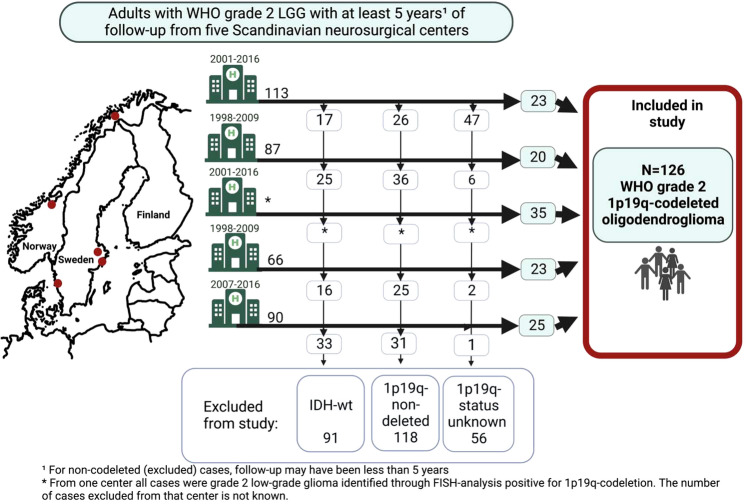
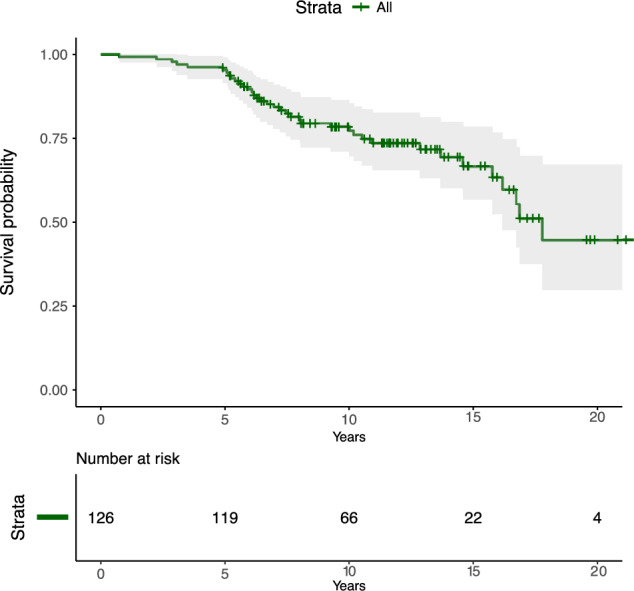
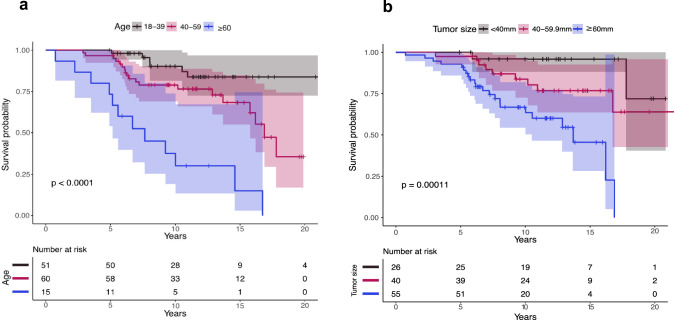
Purpose: Since the introduction of the molecular definition of oligodendrogliomas based on isocitrate dehydrogenase (IDH)-status and the 1p19q-codeletion, it has become increasingly evident how this glioma entity differs much from other diffuse lower grade gliomas and stands out with longer survival and often better responsiveness to adjuvant therapy. Therefore, apart from using a molecular oligodendroglioma definition, an extended follow-up time is necessary to understand the nature of this slow growing, yet malignant condition. The aim of this study was to describe the long-term course of the oligodendroglioma disease in a population-based setting and to determine which factors affect outcome in terms of survival. Methods: All adults with WHO-grade 2 oligodendrogliomas with known 1p19q-codeletion from five Scandinavian neurosurgical centers and with a follow-up time exceeding 5 years, were analyzed regarding survival and factors potentially affecting survival. Results: 126 patients diagnosed between 1998 and 2016 were identified. The median follow-up was 12.0 years, and the median survival was 17.8 years (95% CI 16.0–19.6). Factors associated with shorter survival in multivariable analysis were age (HR 1.05 per year; CI 1.02–1.08, p < 0.001), tumor diameter (HR 1.05 per millimeter; CI 1.02–1.08, p < 0.001) and poor preoperative functional status (KPS < 80) (HR 4.47; CI 1.70–11.78, p = 0.002). In our material, surgical strategy was not associated with survival. Conclusion: Individuals with molecularly defined oligodendrogliomas demonstrate long survival, also in a population-based setting. This is important to consider for optimal timing of therapies that may cause long-term side effects. Advanced age, large tumors and poor function before surgery are predictors of shorter survival. Graphical Abstract:
Overview
The claims and statistics of this paper haven’t been checked yet.
Free: it reads the open-access text and checks the first 5 claims that cite a source we can check. Create a free account to check every claim.
Integrity signals
Registry
Cites
Statistics
Figures
Verification
Claims the paper makes
The claims and statistics of this paper haven’t been checked yet.
Free: it reads the open-access text and checks the first 5 claims that cite a source we can check. Create a free account to check every claim.
Claims other papers make about this one
Each is checked against this paper’s own text: does it say what the citing paper says it does?
The source backs part of the claim, not all of it — or backs it for a different population, condition or comparison.
In the citing paper
“However, the grading criteria in the current classification schema for oligodendrogliomas continues to predominantly rely upon histopathologic examination; the differentiating criterion between grade 2 and grade 3 oligodendrogliomas are the presence of conspicuous microvascular proliferation and/or 6 mitoses per 10 high-power field [3,4,5,6,7,8,9,10,11].”
From BPC 157 Therapy of Myotendinous Junction Injury in Rats (2025) · cites this paper as [8]
Experimental — accuracy not yet measuredThe source backs part of the claim, not all of it — or backs it for a different population, condition or comparison.
In the citing paper
“Recent studies suggest that an older age cutoff (45, >50, or ≥60) is a more reliable indicator for identifying high-risk LGG patients [8,16,31].”
From BPC 157 Therapy of Myotendinous Junction Injury in Rats (2025) · cites this paper as [8]
Experimental — accuracy not yet measured
Self-check
Percentages, sums and reported differences re-computed from the paper’s own numbers.
The self-check needs the paper’s full text.
Citations
Cites
The 2021 WHO classification of tumors of the central nervous system: a summary
Louis, D. N., Perry, A., Wesseling, P., Brat, D. J., Cree, I. A., Figarella-Branger, D., Hawkins, C., Ng, H. K., Pfister, S. M., Reifenberger, G., et al. (2021) · Neuro-Oncology · doi:10.1093/neuonc/noab106 · Cited by 12,273
Comprehensive, Integrative Genomic Analysis of Diffuse Lower-Grade Gliomas
The Cancer Genome Atlas Research Network (2015) · New England Journal of Medicine · doi:10.1056/nejmoa1402121 · Cited by 3,148
A Randomized Trial of Bevacizumab for Newly Diagnosed Glioblastoma
Gilbert, M. R., Dignam, J. J., Armstrong, T. S., Wefel, J. S., Blumenthal, D. T., Vogelbaum, M. A., Colman, H., Chakravarti, A., Pugh, S., Won, M., et al. (2014) · New England Journal of Medicine · doi:10.1056/nejmoa1308573 · Cited by 2,834
Cairncross, J. G., Ueki, K., Zlatescu, M. C., Lisle, D. K., Finkelstein, D. M., Hammond, R. R., Silver, J. S., Stark, P. C., Macdonald, D. R., Ino, Y., et al. (1998) · JNCI: Journal of the National Cancer Institute · doi:10.1093/jnci/90.19.1473 · Cited by 1,610 · cited 2×
“It could also be that these tumors are more responsive to other treatment, affecting the overall surgical impact [21].”
BackgroundResultDouw, L., Klein, M., Fagel, S. S., van den Heuvel, J., Taphoorn, M. J., Aaronson, N. K., Postma, T. J., Vandertop, W. P., Mooij, J. J., Boerman, R. H., et al. (2009) · The Lancet Neurology · doi:10.1016/s1474-4422(09)70204-2 · Cited by 757
Neurosurgical Outcomes in a Modern Series of 400 Craniotomies for Treatment of Parenchymal Tumors
Sawaya, R., Hammoud, M., Schoppa, D., Hess, K. R., Wu, S. Z., Shi, W.-M., & WiIdrick, D. M. (1998) · Neurosurgery · doi:10.1097/00006123-199805000-00054 · Cited by 644
Wijnenga, M. M. J., French, P. J., Dubbink, H. J., Dinjens, W. N. M., Atmodimedjo, P. N., Kros, J. M., Smits, M., Gahrmann, R., Rutten, G.-J., Verheul, J. B., et al. (2018) · Neuro-Oncology · doi:10.1093/neuonc/nox176 · Cited by 334
Progression-Free Survival: Meaningful or Simply Measurable?
Booth, C. M., & Eisenhauer, E. A. (2012) · Journal of Clinical Oncology · doi:10.1200/jco.2011.38.7571 · Cited by 324
Prognostic relevance of genetic alterations in diffuse lower-grade gliomas
Aoki, K., Nakamura, H., Suzuki, H., Matsuo, K., Kataoka, K., Shimamura, T., Motomura, K., Ohka, F., Shiina, S., Yamamoto, T., et al. (2018) · Neuro-Oncology · doi:10.1093/neuonc/nox132 · Cited by 307 · cited 1×
“The strong correlation between Extent of resection (EOR)/Gross total resection (GTR) and survival often found in studies involving astrocytomas, seems to be less apparent (even if sometimes present) for patients with 1p19q-codeleted oligodendrogliomas [7, 10, 14, 17, 19, 26, 28, 29, 32, 39], although contrary results…”
ResultSurgical resection versus watchful waiting in low-grade gliomas
Jakola, A. S., Skjulsvik, A. J., Myrmel, K. S., Sjåvik, K., Unsgård, G., Torp, S. H., Aaberg, K., Berg, T., Dai, H. Y., Johnsen, K., et al. (2017) · Annals of Oncology · doi:10.1093/annonc/mdx230 · Cited by 306 · cited 2×
“For 1p19q detection we accepted fluorescence in situ hybridization (FISH), multiplex ligation-dependent probe amplification (MLPA) and methylation analysis as described earlier [12, 13].”
MethodSelf-citation
Cited by
van den Bent, M. J., French, P. J., Brat, D., Tonn, J. C., Touat, M., Ellingson, B. M., Young, R. J., Pallud, J., von Deimling, A., Sahm, F., et al. (2024) · Neuro-Oncology · doi:10.1093/neuonc/noae107 · Cited by 88
“11,19,20 A study on grade 3 and 4 IDH-mutant glioma found a more pronounced association with age in grade 3 oligodendroglioma patients, using the observed median (49.5 years).”
BackgroundInfluentialvan der Vaart, T., Wijnenga, M. M. J., van Garderen, K. A., Dubbink, H. J., French, P. J., Smits, M., Dirven, C. M. F., Kros, J. M., Vincent, A. J. P. E., & van den Bent, M. J. (2024) · Clinical Cancer Research · doi:10.1158/1078-0432.ccr-24-0901 · Cited by 31
Clinical utility of a blood based assay for the detection of IDH1.R132H-mutant gliomas
Batool, S. M., Escobedo, A. K., Hsia, T., Ekanayake, E., Khanna, S. K., Gamblin, A. S., Zheng, H., Skog, J., Miller, J. J., Stemmer-Rachamimov, A. O., et al. (2024) · Nature Communications · doi:10.1038/s41467-024-51332-7 · Cited by 24
Brat, D. J., Aldape, K., French, P. J., Louis, D. N., Nasrallah, M. P., Reifenberger, G., Reuß, D., Touat, M., van den Bent, M. J., Wesseling, P., et al. (2026) · Neuro-Oncology · doi:10.1093/neuonc/noag108 · Cited by 27
McAlpine, H., Rosier, M., Rozario, J., Wang, X., Wimmer, V. C., Guzulaitis, R., Guan, H., Hu, Y., Chirlov, L., Davey, C. M., et al. (2025) · Nature Neuroscience · doi:10.1038/s41593-025-02149-0 · Cited by 18
Underhill, H. R., Karsy, M. J., Davidson, C. J., Hellwig, S., Stevenson, S., Goold, E. A., Vincenti, S., Sellers, D. L., Dean, C., Harrison, B. E., et al. (2024) · Cancer Research · doi:10.1158/0008-5472.can-23-2557 · Cited by 17
“2, 5, 6).”
Figarella‐Branger, D., Colin, C., Mokhtari, K., Uro‐Coste, E., Idbaïh, A., Appay, R., Tabouret, É., Touat, M., Seyve, A., Carpentier, C., et al. (2024) · Neuro-Oncology · doi:10.1093/neuonc/noae221 · Cited by 15
Byeon, Y., Lee, C., Jeon, J., Kim, G. J., Chong, S., Kim, Y., Cho, Y. H., Hong, S. H., Hong, C., Kim, J. H., et al. (2024) · Discover Oncology · doi:10.1007/s12672-024-01136-4 · Cited by 10
“As detailed in Table 3, the observed median PFS of 6.8 years and median OS of 18.4 years in our cohort are consistent with the favorable prognosis associated with this molecular subtype, consistent with previous studies [6, 14–17].”
BackgroundResultInfluentialSymptom management in isocitrate dehydrogenase mutant glioma
Walbert, T., Avila, E. K., Boele, F. W., Hertler, C., Lu‐Emerson, C., van der Meer, P. B., Peters, K. B., Rooney, A. G., Templer, J. W., & Koekkoek, J. A. F. (2024) · Neuro-Oncology Practice · doi:10.1093/nop/npae088 · Cited by 9
Rincón-Torroella, J., Rakovec, M., Kalluri, A. L., Jiang, K., Weber-Levine, C., Parker, M., Raj, D., Materi, J., Sepehri, S., Ferrés, A., et al. (2024) · Journal of Neuro-Oncology · doi:10.1007/s11060-024-04829-6 · Cited by 7
Mora, A., Girolamo, F., Marzullo, A., Annese, T., Giorgis, M. D., Signorelli, F., Messina, R., Ingravallo, G., Virgintino, D., Errede, M., et al. (2025) · Fluids and Barriers of the CNS · doi:10.1186/s12987-025-00707-z · Cited by 6
Proteomics in IDH-mutated diffuse lower-grade glioma: a scoping review
Kihlstedt, C.-J., Dénes, A., Mansouri, A., Mikolajewicz, N., Skoglund, T. S., Köster, L., Corell, A., Carén, H., Vega, S. F., Bontell, T. O., et al. (2025) · Neuro-Oncology Advances · doi:10.1093/noajnl/vdaf258 · Cited by 6
Self-citationEpidemiology of WHO grade 2 and grade 3 gliomas from 2009 to 2021 in Germany
Weidl, D., Capper, D., Onken, J., Liu, I., Glaser, D., Orben, F., Eberle, K. E., Coburger, J., & Bullinger, L. (2025) · Journal of Neuro-Oncology · doi:10.1007/s11060-025-05068-z · Cited by 5
Matek, D., Pevec, D., Boban-Blagaic, A., & Sikiric, P. (2025) · Biomedicines · doi:10.3390/biomedicines13010201 · Cited by 4
“On the EORTC 22844/5 and RTOG pre-operative neurological deficit Our patient defied survival 24 years from diagnosis, and “wait-and-see” strategy, the anticipated for grade 2 LGGs [10,33].”
Weller, J., de Dios, E., Katzendobler, S., Corell, A., Dénes, A., Schmutzer-Sondergeld, M., Javanmardi, N., Thon, N., Tonn, J. C., & Jakola, A. S. (2024) · Neurosurgery · doi:10.1227/neu.0000000000003069 · Cited by 4
“4,13,26,27 Identifying factors that predict resectability is therefore relevant within this context, and the T1/T2 ratio could provide some clinical guidance.”
Self-citationSurvival prediction with radiomics for patients with IDH mutated lower-grade glioma
Neimantaite, A., Carstam, L., Vecchio, T. G., Häggström, I., Dunås, T., Latini, F., Zetterling, M., Blomstrand, M., Bartek, J., Jensdottir, M., et al. (2025) · Journal of Neuro-Oncology · doi:10.1007/s11060-025-05006-z · Cited by 4
“Thus, clinical variables associ - ated with survival are somewhat heterogeneous in different patient cohorts [3, 6, 9–13 , 16].”
Self-citationNon-coding RNAs (ncRNAs) as therapeutic targets and biomarkers in oligodendroglioma
Imran, M., Altamimi, A. S. A., Babu, M. A., Goyal, K., Kaur, I., Kumar, S., Sharma, N., Kumar, M. R., Alanazi, F. J., Alruwaili, A. N., et al. (2024) · Pathology - Research and Practice · doi:10.1016/j.prp.2024.155708 · Cited by 3
Rydén, I., Latini, F., Munkhammar, Å. A., Hellström, P., Neimantaite, A., Lycett, A., Harba, D., Carstam, L., Blomstrand, M., Zetterling, M., et al. (2025) · Neuro-Oncology · doi:10.1093/neuonc/noaf263 · Cited by 2
Self-citationThe role of a multidisciplinary clinic for management of patients with IDH mutant gliomas
Aucoin, L., Templer, J. W., Tate, M. C., & Dixit, K. (2025) · Frontiers in Oncology · doi:10.3389/fonc.2025.1729589 · Cited by 2
Heggebø, L. C., Fjæra, L. F., Garrote, F. L. B., Borgen, I. M. H., Blakstad, H., Hellebust, T. P., Saxhaug, C., Knutstad, K., Rylander, H., Henry, T., et al. (2026) · Frontiers in Oncology · doi:10.3389/fonc.2026.1803943 · Cited by 2
“Median overall survival varies from 12.5 years for patients with IDH -mutated astrocytoma grade 3 (6) to approximately 18 years for individuals with IDH -mutated oligodendroglioma grade 2 (7).”
InfluentialWerlenius, K., Parcaoglu, F., Zupancic, M., Jakobsson, F., Flejmer, A., Kinhult, S., Bergström, P., Gubanski, M., Nyström, P. W., Dahl, L., et al. (2026) · Radiotherapy and Oncology · doi:10.1016/j.radonc.2026.111569 · Cited by 2
Self-citationExtent of resection for low-grade gliomas – Prognostic or therapeutic?
Kinslow, C. J., Garton, A. L. A., Rae, A. I., Kocakavuk, E., McKhann, G. M., Cheng, S. K., Sisti, M. B., Bruce, J. N., & Wang, T. J. C. (2024) · Clinical Neurology and Neurosurgery · doi:10.1016/j.clineuro.2024.108117 · Cited by 2
Weller, J., Harba, D., Kuschel, L. P., Thiele, F., Katzendobler, S., Corell, A., Dénes, A., Schmutzer-Sondergeld, M., de Dios, E., Ringel, F., et al. (2026) · Journal of neurosurgery · doi:10.3171/2025.9.jns251254 · Cited by 2
Self-citationKim, K., Byeon, Y., Lee, C., Lee, W. S., Hwang, K., Dho, Y., Sung, K. S., Roh, T. H., Chong, K., Park, K.-S., et al. (2026) · Journal of Korean Neurosurgical Society · doi:10.3340/jkns.2026.0113 · Cited by 1
“Low-grade gliomas (LGGs) are slow-growing primary brain tumors that predominantly affect young adults and are ultimately incurable, as they progressively infiltrate adjacent normal brain tissue and inevitably undergo malignant transformation to high-grade gliomas 2, 9, 12, 39 .”
Skouras, P., Giakoumettis, G., Argyros, C., Vavoulis, G., Verigos, E. K., & Giakoumettis, D. (2025) · Pharmaceuticals · doi:10.3390/ph18030349 · Cited by 1
Prisciandaro, J. I., Zoberi, J. E., Cohen, G. N., Kim, Y., Johnson, P. B., Paulson, E. S., Song, W. Y., Hwang, K., Erickson, B. E., Beriwal, S., et al. (2022) · Medical Physics · doi:10.1002/mp.15991
Diffuse Astrocytic and Oligodendroglial Tumors
Atallah, O., Al‐Badri, S. G., Ahmed, M. S., Ahmed, F. O., Al-Zaidy, M. F., Abdulsada, A. M., & Hoz, S. S. (2024) · Springer eBooks · doi:10.1007/978-3-031-53642-7_8
Eidbo, S., Malin, J. H., Blaubach, A., Pappas, A., Rahman, M., Marotta, R., Isaacs, E., Ratnani, A., & Mayo, R. (2025) · Cureus · doi:10.7759/cureus.93151
“The irregular tumor microenvironment is enriched with neurotransmitters that affect neuronal excitation [38,39].”
InfluentialLatini, F., Fahlström, M., Neimantaite, A., Vecchio, T. G., Corell, A., Solheim, O. S., Gulati, S., Milos, P., Sjögren, B., Pedersen, L. K., et al. (2025) · Brain Communications · doi:10.1093/braincomms/fcaf368
“30,34 ,36,42,43 Major reviews of the histopathological incidence on oligodendro-gliomas 44,45 demonstrated a peak incidence of IDH-m oligo-dendrogliomas in patients between ages 30 and 50 years 42,46,47 but may present at even older age, 48 with differences in the outcome that may be subtile.”
Self-citationAprile, M., Nunno, V. D., Gatto, L., Tosoni, A., Balestrini, D., Ramponi, V., Conti, A., Maffei, M., Battaglia, S., Argento, C. M., et al. (2025) · Frontiers in Oncology · doi:10.3389/fonc.2025.1673285
Reddy, S. C., Mao, T., Gendreau, J. L., Ahmed, A. K., & Mukherjee, D. R. (2025) · Clinical Neurology and Neurosurgery · doi:10.1016/j.clineuro.2025.109279
Seizures in WHO grade 2 glioma: semiology and significance
Fairclough, S. (2024) · White Rose eTheses Online (University of Leeds, The University of Sheffield, University of York)
Oligodendroglioma intraventricular occipital
Padín, M. E. S., & Abal, G. V. P. (2026) · Revista cubana de neurología y neurocirugía
Katzendobler, S., Kuschel, L. P., Zieger, N., Thiele, F., Schmutzer-Sondergeld, M., Janković, D., Stürzl, R., Harter, P. N., Stahl, R., Kalasauskas, D., et al. (2026) · Neuro-Oncology Advances · doi:10.1093/noajnl/vdag184
Self-citationKalluri, A. L., Carmichael, A., Rakovec, M., Jiang, K., Parker, M., Weber-Levine, C., Raj, D., Materi, J., Schreck, K. C., Aldecoa, I., et al. (2026) · Journal of Neuro-Oncology · doi:10.1007/s11060-026-05800-3
“In a multi-institutional retrospective study of 126 individuals diagnosed with molecularly defined grade 2 oligodendroglioma from 1998 to 2016, Carstam et al. found a median OS of 17.8 years [26 ].”
InfluentialHeggebø, L. C., Garrote, F. L. B., Fjæra, L. F., Hellebust, T. P., Ottestad, A., Gustafsson, M., Rylander, H., Borgen, I. M. H., Vik-Mo, E. O., Saxhaug, C., et al. (2026) · Clinical and Translational Radiation Oncology · doi:10.1016/j.ctro.2026.101337
Cancers of the Central Nervous System
Pape, J., Forster, M.-T., Ronellenfitsch, M., & von Wolff, M. (2026) · Springer eBooks · doi:10.1007/978-3-032-28679-6_13
Metadata
- Authors
- Carstam, L., Latini, F., Solheim, O., Bartek, J., Pedersen, L. K., Zetterling, M., Beniaminov, S., Sjåvik, K., Ryttlefors, M., Jensdottir, M., Rydenhag, B., Smits, A., & Jakola, A. S.
- Affiliations
- Sahlgrenska University Hospital (SE)
- Uppsala University Hospital (SE)
- Norwegian University of Science and Technology (NO)
- Karolinska University Hospital (SE)
- University Hospital of North Norway (NO)
- Corresponding author
- Carstam, Louise
- ORCID
- Venue
- Journal of Neuro-Oncology
- Published
- 2023-08
- Volume
- 164
- Issue
- 1
- Pages
- 65-74
- ISSN
- 0167-594X (ISSN-L)
- 1573-7373
- PMC
- PMC10462563
- OpenAlex
- W4386019319
- Semantic Scholar
- 0482884408078b3e8e3d7ccde2a4c6ae814aadf5
- Cited by
- 31
- References
- 45
- Citations by year
- 2026: 6 · 2025: 12 · 2024: 12
- FWCI
- 5.18
- Type
- journal article
- Language
- en
- Open access
- hybrid
- doi.org
- Licence
- cc-by
- creativecommons.org/licenses/by/4.0 (tdm)
- creativecommons.org/licenses/by/4.0 (vor, 20 d)
- Locations
- Journal of Neuro-Oncology (publishedVersion, cc-by)
- PubMed Central (publishedVersion, cc-by)
- PubMed (publishedVersion)
- KTH Publication Database DiVA (KTH Royal Institute of Technology) (submittedVersion, cc-by)
- NORA - Norwegian Open Research Archives (submittedVersion, cc-by)
- Funders
- Government and the county councils (Avtal om Läkarutbildning och Forskning (ALF)), the ALF-agreement in the form of ALF-Grant (ALFGBG-965622)
- the Swedish Research Council (2017–00944)
- University of Gothenburg
- Topics
- Health Sciences › Medicine › Oncology › Glioma Diagnosis and Treatment
- Health Sciences › Medicine › Oncology › Ovarian cancer diagnosis and treatment
- Health Sciences › Medicine › Clinical Neurology › Meningioma and schwannoma management
- Keywords
- 1p/19q codeletion, long-term survival, prognostic factors, age, tumor diameter, Karnofsky performance status, surgical strategy
- MeSH terms
- Adult, Combined Modality Therapy, Follow-Up Studies, Glioma, Humans, Oligodendroglioma, World Health Organization
About these checks
Registry, retraction, Cites and statistics results are computed, not judged, with one exception: a printed reference that no index lists is read once by a model before it counts as a citation error. Claims are extracted by a model and kept only when their quote appears verbatim in the text; each cited source is then checked, with a model’s help, for whether it says what the claim relies on. Those verdicts can be wrong — read the claim’s quote and the cited source before relying on one.
Statistics and arithmetic are recomputed, not judged.
Confidence bands are shown only for fields calibrated on our annotated test set. None is calibrated yet, so no band is shown.
What counts as a claim ›How we measure confidence ›How we check this ›
Are you an author, or do you see a problem with this page? Request a review
Data sources
Bibliographic data: Semantic Scholar, OpenAlex, Crossref.
Contains information from the Semantic Scholar Academic Graph Datasets, made available under the ODC Attribution License (ODC-BY 1.0).
Semantic Scholar’s data is described in: Kinney, R., et al. (2023). The Semantic Scholar Open Data Platform. arXiv:2301.10140.
