

Focused ultrasound-mediated enhancement of blood-brain barrier permeability for brain tumor treatment: A systematic review of clinical trials
Open accessThe DOI matches its Crossref record; 59 of the 59 references it cites were found in a registry or an index.
Abstract
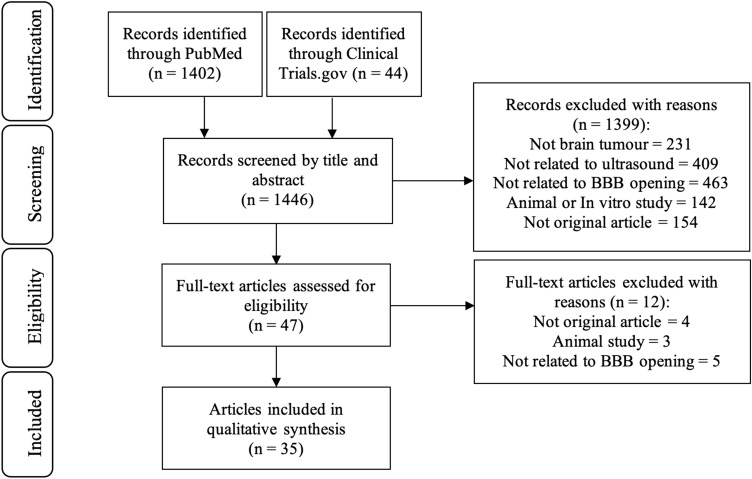
Purpose: Brain tumors, particularly glioblastoma multiforme (GBM), present significant prognostic challenges despite multimodal therapies, including surgical resection, chemotherapy, and radiotherapy. One major obstacle is the limited drug delivery across the blood–brain barrier (BBB). Focused ultrasound (FUS) combined with systemically administered microbubbles has emerged as a non-invasive, targeted, and reversible approach to transiently open the BBB, thus enhancing drug delivery. This review examines clinical trials employing BBB opening techniques to optimise pharmacotherapy for brain tumors, evaluates current challenges, and proposes directions for further research. Methods: A systematic literature search was conducted in PubMed and ClinicalTrials.gov up to November 2023, searching for “ultrasound” AND “brain tumor”. The search yielded 1446 results. After screening by title and abstract, followed by full-text screening (n = 48), 35 studies were included in the analysis. Results: Our analysis includes data from 11 published studies and 24 ongoing trials. The predominant focus of these studies is on glioma, including GMB and astrocytoma. One paper investigated brain metastasis from breast cancer. Evidence indicates that FUS facilitates BBB opening and enhances drug uptake following sonication. Exploration of FUS in the pediatric population is limited, with no published studies and only three ongoing trials dedicated to this demographic. Conclusion: FUS is a promising strategy to safely disrupt the BBB, enabling precise and non-invasive lesion targeting, and enhance drug delivery. However, pharmacokinetic studies are required to quantitatively assess improvements in drug uptake. Most studies are phase I clinical trials, and long-term follow-up investigating patient outcomes is essential to evaluate the clinical benefit of this treatment approach. Further studies involving diverse populations and pathologies will be beneficial.
Overview
The claims and statistics of this paper haven’t been checked yet.
Free: it reads the open-access text and checks the first 5 claims that cite a source we can check. Create a free account to check every claim.
Integrity signals
Registry
Cites
Statistics
Figures
Verification
Claims the paper makes
The claims and statistics of this paper haven’t been checked yet.
Free: it reads the open-access text and checks the first 5 claims that cite a source we can check. Create a free account to check every claim.
Claims other papers make about this one
Each is checked against this paper’s own text: does it say what the citing paper says it does?
The source backs part of the claim, not all of it — or backs it for a different population, condition or comparison.
In the citing paper
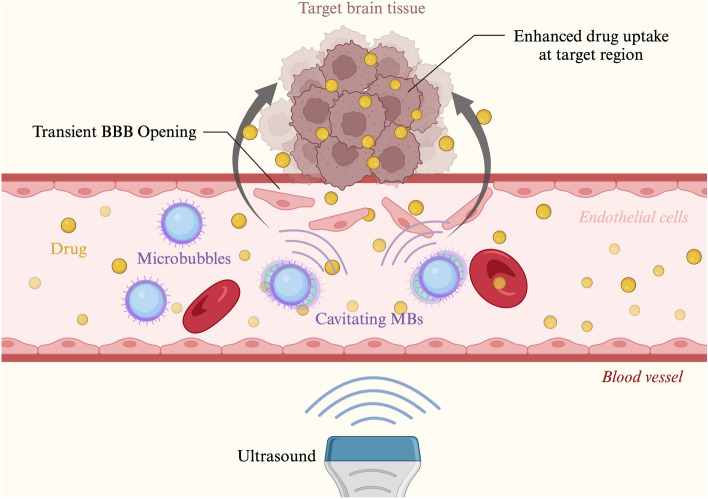
“Therefore, FUS combined with MBs is a method that uses ultrasound waves directed at specific areas of the brain to cause oscillation of the MBs circulating in the blood, producing mechanical forces within blood vessels that temporarily and safely loosen the TJs of the BBB.”
From Advances in Strategies to Transport Nanoparticles Across the Blood–Brain Barrier for Drug Delivery into the Brain for the Treatment of Alzheimer’s Disease (2026) · cites this paper as [81]
Experimental — accuracy not yet measuredThe cited source says what the claim attributes to it.
In the citing paper
“Consequently, the BBB becomes more permeable, allowing therapeutic drugs to pass more easily from the bloodstream into the brain tissue”
From Advances in Strategies to Transport Nanoparticles Across the Blood–Brain Barrier for Drug Delivery into the Brain for the Treatment of Alzheimer’s Disease (2026) · cites this paper as [81]
Self-check
Percentages, sums and reported differences re-computed from the paper’s own numbers.
The self-check needs the paper’s full text.
Citations
Cites
The blood–brain barrier: Structure, regulation and drug delivery
Wu, D., Chen, Q., Chen, X., Han, F., Chen, Z., & Wang, Y. (2023) · Signal Transduction and Targeted Therapy · doi:10.1038/s41392-023-01481-w · Cited by 1,906 · cited 2×
“The BBB, formed by microvascular endothelial cells that regulate molecule and ion transfer from the blood into the brain parenchyma, enables homeostasis and normal neuronal functioning [3].”
BackgroundA blood–brain barrier overview on structure, function, impairment, and biomarkers of integrity
Kadry, H., Noorani, B., & Cucullo, L. (2020) · Fluids and Barriers of the CNS · doi:10.1186/s12987-020-00230-3 · Cited by 1,853 · cited 1×
“Consequently, there is growing interest in research focused on safe and reversible BBB opening (BBBO), which holds promise for enhancing the delivery and efficacy of therapeutic agents [4].”
BackgroundWen, P. Y., Weller, M., Lee, E. Q., Alexander, B. M., Barnholtz-Sloan, J. S., Barthel, F. P., Batchelor, T. T., Bindra, R. S., Chang, S. M., Chiocca, E. A., et al. (2020) · Neuro-Oncology · doi:10.1093/neuonc/noaa106 · Cited by 1,168 · cited 1×
“Brain tumors continue to exhibit a poor prognosis, with less than 20% of patients surviving beyond 5 years post-diagnosis [1].”
BackgroundClinical trial of blood-brain barrier disruption by pulsed ultrasound
Carpentier, A., Canney, M., Vignot, A., Reina, V., Beccaria, K., Horodyckid, C., Karachi, C., Leclercq, D., Lafon, C., Chapelon, J.-Y., et al. (2016) · Science Translational Medicine · doi:10.1126/scitranslmed.aaf6086 · Cited by 757 · cited 3×
“The drugs used following FUS-guided BBBO included paclitaxel [25] and carboplatin [26– 28] for recurrent GBM, and temozolomide (TMZ) for GBM [29, 30] and M e ng e t a l .”
MethodMainprize, T., Lipsman, N., Huang, Y., Meng, Y., Bethune, A., Ironside, S., Heyn, C., Alkins, R., Trudeau, M., Sahgal, A., et al. (2019) · Scientific Reports · doi:10.1038/s41598-018-36340-0 · Cited by 618 · cited 7×
“The contrast extravasation occurred in a grid pattern with ExAblate which resolved within 24 h [24, 31], and in a cylindrical pattern with SonoCloud-9, which resolved within an hour [25].”
BackgroundInfluentialBatchelor, T. T., Mulholland, P., Neyns, B., Nabors, L. B., Campone, M., Wick, A., Mason, W., Mikkelsen, T., Phuphanich, S., Ashby, L. S., et al. (2013) · Journal of Clinical Oncology · doi:10.1200/jco.2012.47.2464 · Cited by 614 · cited 1×
“In a placebo-controlled phase III trial, cediranib, an oral pan-vascular endothelial growth factor (VEGF) receptor tyrosine kinase inhibitor, did not improve progression-free survival in patients with recurrent GBM [54].”
BackgroundMcDannold, N., Arvanitis, C. D., Vykhodtseva, N., & Livingstone, M. S. (2012) · Cancer Research · doi:10.1158/0008-5472.can-12-0128 · Cited by 588
Sheikov, N., McDannold, N., Sharma, S., & Hynynen, K. (2008) · Ultrasound in Medicine & Biology · doi:10.1016/j.ultrasmedbio.2007.12.015 · Cited by 493 · cited 1×
“MRgFUS disrupts the BBB through multiple mechanisms, such as direct disruption of tight junctions and induced transcytosis [44].”
BackgroundAbrahao, A., Meng, Y., Llinas, M., Huang, Y., Hamani, C., Mainprize, T., Aubert, I., Heyn, C., Black, S. E., Hynynen, K., et al. (2019) · Nature Communications · doi:10.1038/s41467-019-12426-9 · Cited by 476 · cited 1×
“Its feasibility has also been explored in amyotrophic lateral sclerosis (ALS) [53].”
BackgroundDynamics of CNS Barriers: Evolution, Differentiation, and Modulation
Abbott, N. J. (2005) · Cellular and Molecular Neurobiology · doi:10.1007/s10571-004-1374-y · Cited by 469 · cited 1×
“These cells interact with astrocytes and pericytes to uphold the barrier’s integrity [5].”
Background
Cited by
Wen, P. Y., Weller, M., Lee, E. Q., Touat, M., Khasraw, M., Rahman, R. M., Platten, M., Lim, M. K., Winkler, F., Horbinski, C., et al. (2025) · Neuro-Oncology · doi:10.1093/neuonc/noaf177 · Cited by 136
Nanotherapy of Glioblastoma—Where Hope Grows
Grzegorzewski, J., Michalak, M., Wołoszczuk, M., Bulicz, M., & Majchrzak‐Celińska, A. (2025) · International Journal of Molecular Sciences · doi:10.3390/ijms26051814 · Cited by 54
Kashkooli, F. M., Bhandari, A., Gu, B., Kolios, M. C., Kohandel, M., & Zhan, W. (2025) · Journal of Controlled Release · doi:10.1016/j.jconrel.2025.114138 · Cited by 35
Costea, D., Dobrin, N., Tătaru, C.-I., Toader, C., Șerban, M., Covache-Busuioc, R.-A., Munteanu, O., & Diaconescu, B. I. (2025) · International Journal of Molecular Sciences · doi:10.3390/ijms262110546 · Cited by 31
Acoustic emissions dose and spatial control of blood-brain barrier opening with focused ultrasound
Woodworth, G. F., Anastasiadis, P., Ozair, A., Chen, C., Gandhi, D., Meng, Y., Abrahão, A., Carpenter, J., Cifarelli, C. P., Eisenberg, H. M., et al. (2025) · Device · doi:10.1016/j.device.2025.100894 · Cited by 21
Metadata
- Authors
- Zhu, H., Allwin, C., Bassous, M. G., & Pouliopoulos, A. N.
- Affiliations
- King's College London (GB)
- Corresponding author
- Pouliopoulos, Antonios N.
- Venue
- Journal of Neuro-Oncology
- Published
- 2024-08-29
- Volume
- 170
- Issue
- 2
- Pages
- 235-252
- ISSN
- 0167-594X (ISSN-L)
- 1573-7373
- PMC
- PMC11538134
- OpenAlex
- W4402005298
- Semantic Scholar
- d3b4161918e04b949992213e6e571a0617e473d7
- Cited by
- 75
- References
- 58
- Citations by year
- 2026: 43 · 2025: 32
- FWCI
- 2.69
- Type
- journal article
- Language
- en
- Open access
- hybrid
- doi.org
- Licence
- cc-by
- creativecommons.org/licenses/by/4.0 (tdm)
- creativecommons.org/licenses/by/4.0 (vor)
- Locations
- Journal of Neuro-Oncology (publishedVersion, cc-by)
- PubMed Central (publishedVersion, cc-by)
- PubMed (publishedVersion)
- Funders
- Children’s Cancer and Leukaemia Group (CCLG) / Little Princess Trust (CCLGA 2022 25)
- Action Medical Research / LifeArc (GN3017)
- Focused Ultrasound Foundation (FUS1050R1)
- Abbie’s Army / Children’s Brain Tumour Drug Delivery Consortium (KCL/G12/22)
- Topics
- Physical Sciences › Engineering › Biomedical Engineering › Ultrasound and Hyperthermia Applications
- Health Sciences › Medicine › Oncology › Glioma Diagnosis and Treatment
- Life Sciences › Neuroscience › Neurology › Barrier Structure and Function Studies
- Keywords
- focused ultrasound, blood-brain barrier opening, brain tumors, glioblastoma, glioma, astrocytoma, brain metastases, breast cancer, microbubbles, drug delivery, clinical trials, pediatric brain tumors
- MeSH terms
- Antineoplastic Agents, Blood-Brain Barrier, Brain Neoplasms, Clinical Trials as Topic, Humans, Permeability, Ultrasonic Therapy, Drug Delivery Systems, Microbubbles
About these checks
Registry, retraction, Cites and statistics results are computed, not judged, with one exception: a printed reference that no index lists is read once by a model before it counts as a citation error. Claims are extracted by a model and kept only when their quote appears verbatim in the text; each cited source is then checked, with a model’s help, for whether it says what the claim relies on. Those verdicts can be wrong — read the claim’s quote and the cited source before relying on one.
Statistics and arithmetic are recomputed, not judged.
Confidence bands are shown only for fields calibrated on our annotated test set. None is calibrated yet, so no band is shown.
What counts as a claim ›How we measure confidence ›How we check this ›
Are you an author, or do you see a problem with this page? Request a review
Data sources
Bibliographic data: Semantic Scholar, OpenAlex, Crossref.
Contains information from the Semantic Scholar Academic Graph Datasets, made available under the ODC Attribution License (ODC-BY 1.0).
Semantic Scholar’s data is described in: Kinney, R., et al. (2023). The Semantic Scholar Open Data Platform. arXiv:2301.10140.
