

Effects of Silicon on High Temperature Corrosion of Fe–Cr and Fe–Cr–Ni Alloys in Carbon Dioxide
Open accessThe DOI matches its Crossref record; 31 of the 31 references it cites were found in a registry or an index; 10 of the 28 sources its claims cite were checked for support.
Abstract
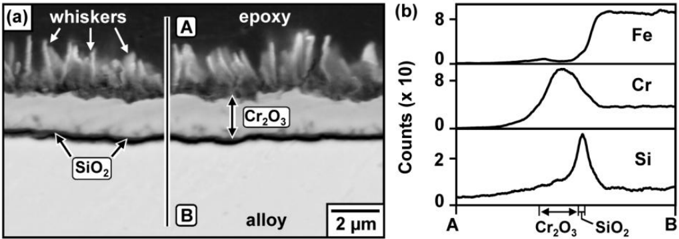
Model alloys Fe–9Cr, Fe–20Cr and Fe–20Cr–20Ni (wt%) with Si (0.1, 0.2 and 0.5 %) were reacted in Ar–20CO2 gas at 818 °C. Undoped Fe–9Cr formed FeO and FeCr2O4, Fe–20Cr formed only Cr2O3, and Fe–20Cr–20Ni formed Fe3O4, FeCr2O4 and FeNi3. Silicon additions suppressed formation of iron oxides on Fe–9Cr and Fe–20Cr–20Ni, and dramatically slowed oxidation of all alloys. Scales on 0.2Si-alloys consisted of an outer layer of Cr2O3 and an inner layer of amorphous SiO2. Carburization occurred in all undoped alloys, but was suppressed in Si-bearing alloys. Wagner’s theory of alloy depletion is shown to provide a successful description of these phenomena.
Overview
CoChat Summary
TL;DR
Silicon additions (0.1–0.5 wt%) markedly improved the wet-CO₂ corrosion resistance of model Fe-20Cr and Fe-20Cr-20Ni alloys at 818 °C by forming a silica layer beneath chromia, suppressing carburization and breakaway oxidation. However, Si-bearing austenitic alloys suffered scale spallation on cooling, and 0.5% Si in Fe-20Cr-20Ni led to local iron-rich nodules in wet CO₂.
Key findings
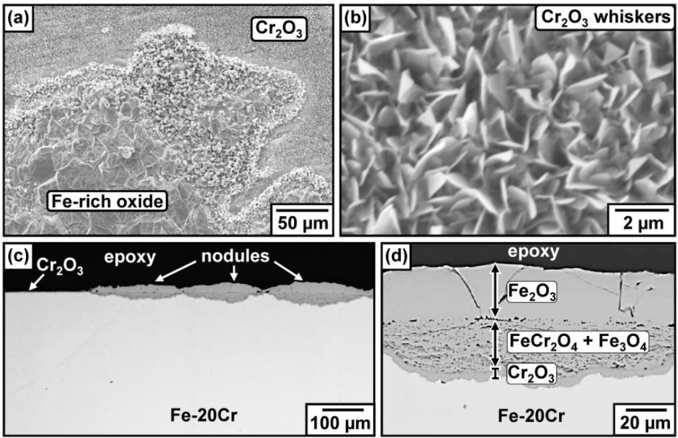
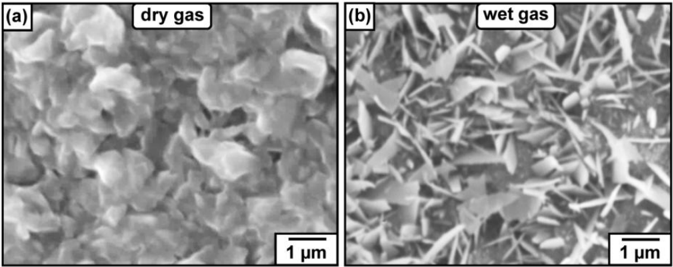
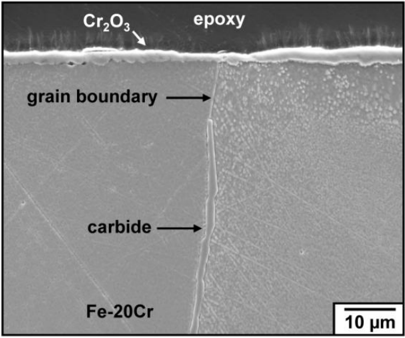
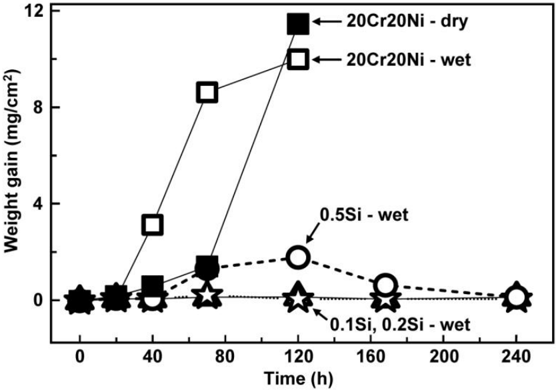
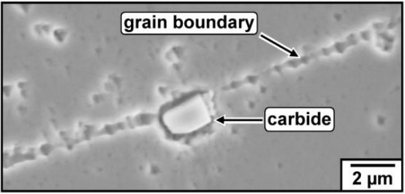
- Undoped Fe-20Cr and Fe-20Cr-20Ni underwent breakaway corrosion in wet CO₂, forming iron-rich oxide scales and internal carbide precipitates; Fe-20Cr was protective in dry CO₂ but failed in wet CO₂.
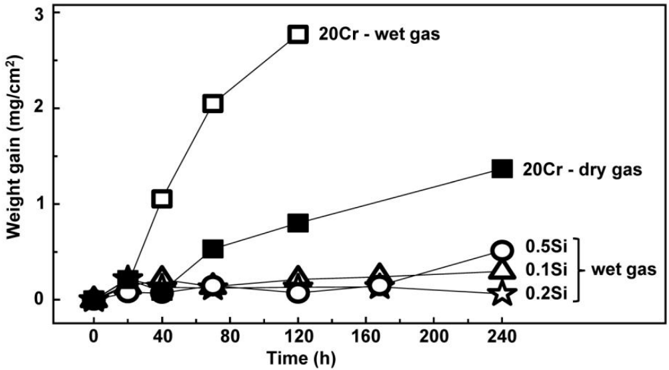
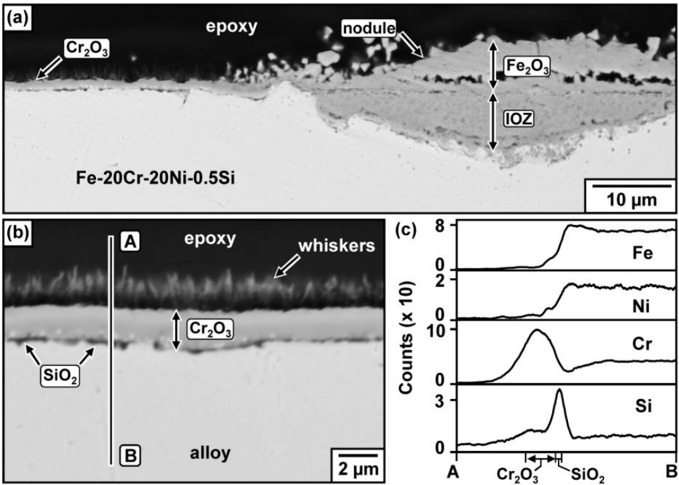
- Si additions markedly improved oxidation and carburization resistance in wet CO₂ by forming a silica layer beneath the chromia scale; no carbides were found in Si-bearing alloys. The solid chromia scale on Fe-20Cr-0.5Si was 1.5 µm thick after 120 h in wet CO₂, compared with 3.4 µm on Fe-20Cr.
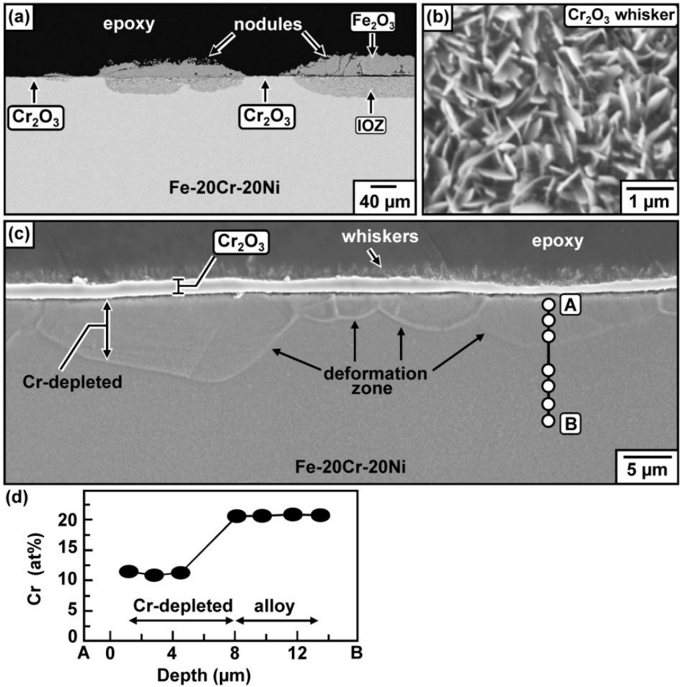
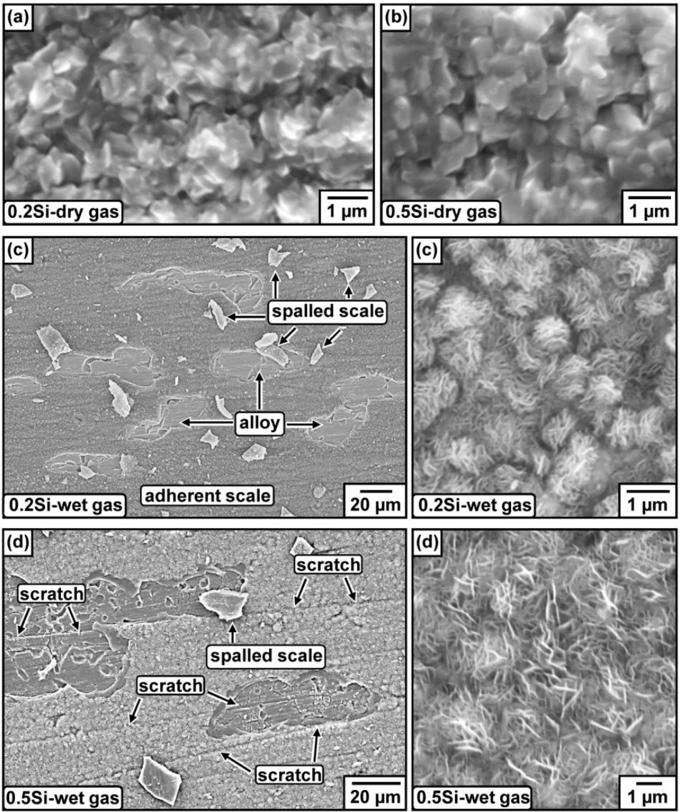
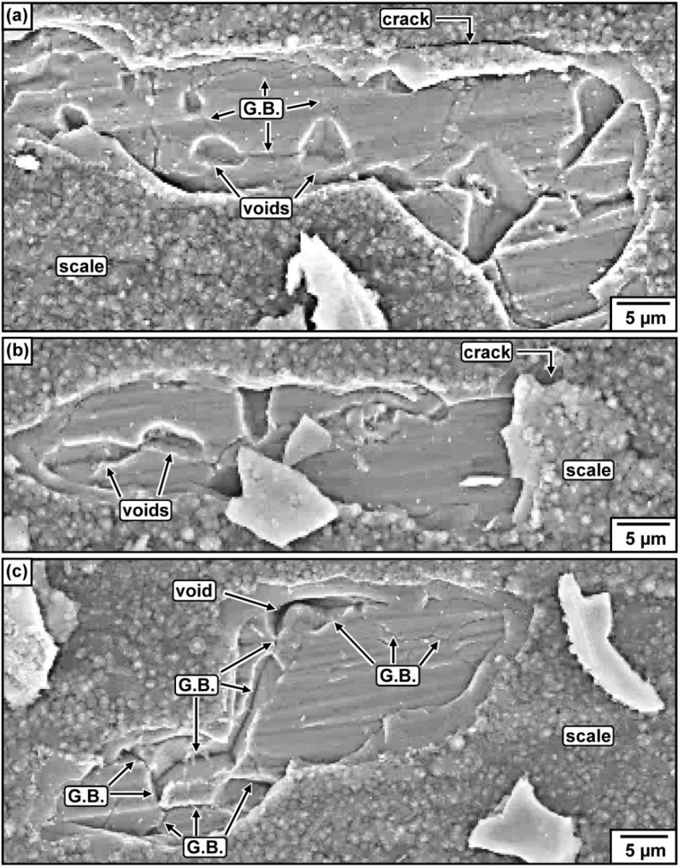
- For austenitic Fe-20Cr-20Ni, 0.1 and 0.2% Si maintained thin protective scales in wet CO₂, but 0.5% Si formed local iron-rich oxide nodules. Si-bearing austenitic alloys underwent scale spallation on cooling after wet CO₂ reaction, while Fe-20Cr alloys did not.
- Mass balance for Fe-20Cr-20Ni after 40 h in wet CO₂ gave Cr in scale = 3.6 × 10⁻⁴ g cm⁻² and alloy Cr depletion = 3.8 × 10⁻⁴ g cm⁻². Breakaway was linked to Cr depletion in a subsurface deformation zone and whisker-growth stresses; spallation required high thermal-expansion mismatch from an austenitic substrate, whisker growth stresses, and silica-formation stresses.
Methods
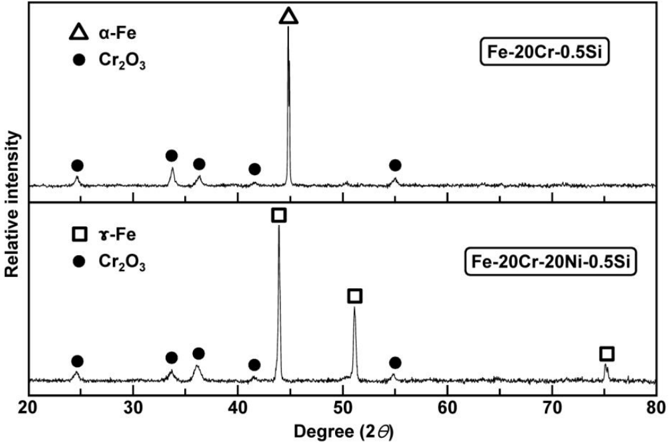
- Eight model alloys of Fe-20Cr and Fe-20Cr-20Ni, with and without 0.1, 0.2, and 0.5 wt% Si, were arc melted, annealed at 1150 °C for 50 h, and confirmed by XRD as ferritic or austenitic.
- Specimens were reacted at 818 °C in Ar-20CO₂-20H₂O (volume %) at a linear flow rate of 2 cm/s and 1 atm total pressure; weight changes were measured with a balance accurate to 0.1 mg, and samples were characterized by XRD, optical microscopy, SEM, and EDX.
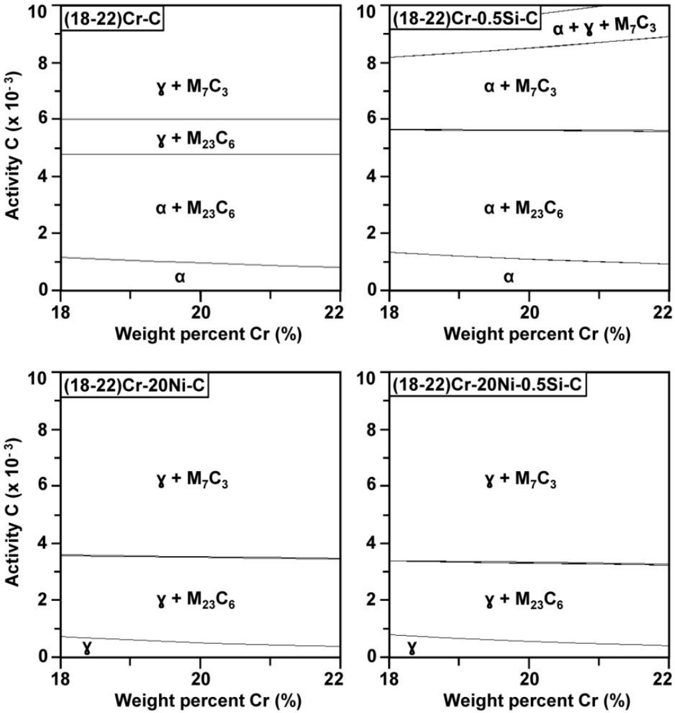
- Analysis used weight-gain kinetics, scale morphology and composition, mass-balance calculations, Thermo-Calc phase diagrams, Wagner’s theory, and stress equations for spallation and breakaway.
Limitations
- Stated in the paper: weight gains for austenitic alloys in wet CO₂ are underestimated because scale spallation occurred during cooling; the growth-stress terms are treated as linearly independent, which the authors call an oversimplification; and growth stresses are assumed not to relax during cooling.
- Evident from the text: the study uses model alloys rather than commercial steels, does not directly measure stress, and relies on qualitative/mechanistic arguments for spallation and breakaway.
Model-written summary. Check it against the paper before relying on it.
Integrity signals
Registry
Cites
Statistics
Figures
Verification
Claims the paper makes
4 Valid · 7 Not valid · 16 Not checked · 90 Own results and interpretations
The cited sources that could be checked couldn’t confirm or dispute this claim.
In the paper
“In contrast, metallographic examination confirmed that no carbides were formed in any Si-containing Fe-20Cr-20Ni alloy in either dry [7] or wet CO 2 gases.”
§ Oxidation of Metals Water Vapor Effects on Corrosion of Fe-Cr and Fe-Cr-Ni Alloys Containing Silicon in CO2 Gas at 818 oC > Corrosion of Fe-20Cr-20Ni-(Si) alloys
What the sources say
- Could not verifycites [7] 9. G. H. Meier, K. Jung, N. Mu, N. M. Yanar, F. S. Pettit, J. P. Abellán, T. Olszewski, L. N. Hierro, W. J. Quadakkers, G. R. Holcomb, Oxidation of Metals 74, 319 (2010). sourceExperimental — accuracy not yet measured
The cited paper’s ‘Effect of Atmosphere on Selective Oxidation’ section discusses carbides in ferritic Fe–Cr alloys exposed to CO₂, not Si-containing Fe-20Cr-20Ni alloys. Its discussion of Si additions concerns other alloys and exposure conditions. Searches for the specified alloy and for carbide absence in dry or wet CO₂ found no passage addressing the claim; page numbers were unavailable in our copy. (LLM, conf=0.76)
boosted- Asserted: passes — The authors put it forward as true.
- Checkable: passes — It can be checked against evidence.
- Load-bearing: passes — The paper’s conclusions depend on it.
- Based: passes — The paper gives a reason why it holds.
- Could not verify
The cited sources support only part of this claim — read each source’s verdict below.
In the paper
“The addition of a small amount of Si to Fe-20Cr-20Ni greatly reduced oxygen uptake in both dry [7] and wet (Fig. 7) CO 2 gases.”
§ Oxidation of Metals Water Vapor Effects on Corrosion of Fe-Cr and Fe-Cr-Ni Alloys Containing Silicon in CO2 Gas at 818 oC > The value of /
What the sources say
- Partly supportedcites [7] 9. G. H. Meier, K. Jung, N. Mu, N. M. Yanar, F. S. Pettit, J. P. Abellán, T. Olszewski, L. N. Hierro, W. J. Quadakkers, G. R. Holcomb, Oxidation of Metals 74, 319 (2010). sourceExperimental — accuracy not yet measured
The citation is attached to the dry-CO₂ result, not the wet-CO₂ result shown in the citing paper’s Fig. 7. In “Effects of Excess Oxygen on Selective Oxidation” (page unavailable), the source reports that small Si additions reduced mass gains for Fe-8Cr in water vapor. It does not establish that Si reduced oxygen uptake for Fe-20Cr-20Ni in dry CO₂, so the cited result is extended to a different alloy and atmosphere. (LLM, conf=0.79)
plainstates a cause- Asserted: passes — The authors put it forward as true.
- Checkable: passes — It can be checked against evidence.
- Load-bearing: passes — The paper’s conclusions depend on it.
- Based: passes — The paper gives a reason why it holds.
- Partly supported
The cited sources that could be checked couldn’t confirm or dispute this claim.
In the paper
“However, weight uptakes of the Si-containing alloys in dry CO 2 [7] and wet CO 2 gas (Fig. 1) were markedly smaller than those of the undoped Fe-20Cr alloy.”
§ Oxidation of Metals Water Vapor Effects on Corrosion of Fe-Cr and Fe-Cr-Ni Alloys Containing Silicon in CO2 Gas at 818 oC > Corrosion of Fe-20Cr-(Si) alloys
What the sources say
- Could not verifycites [7] 9. G. H. Meier, K. Jung, N. Mu, N. M. Yanar, F. S. Pettit, J. P. Abellán, T. Olszewski, L. N. Hierro, W. J. Quadakkers, G. R. Holcomb, Oxidation of Metals 74, 319 (2010). sourceExperimental — accuracy not yet measured
The alloy-composition table (Selective Oxidation of Chromium from Ferritic Fe-Cr Alloys; page unavailable) lists Si-containing Fe-8Cr alloys, but no Si-containing Fe-20Cr alloy. The mass-gain comparison in Effects of Excess Oxygen on Selective Oxidation concerns those Fe-8Cr alloys in water vapor, not dry CO2. The cited paper therefore does not establish the dry-CO2 comparison attributed to it; the wet-CO2 result is attributed to the citing paper’s Fig. 1. (LLM, conf=0.75)
plainstates a cause- Asserted: passes — The authors put it forward as true.
- Checkable: passes — It can be checked against evidence.
- Load-bearing: passes — The paper’s conclusions depend on it.
- Based: passes — The paper gives a reason why it holds.
- Could not verify
The cited sources support only part of this claim — read each source’s verdict below.
In the paper
“Addition of Si to Fe-20Cr and Fe-20Cr-20Ni resulted in the formation of an additional silicon oxide layer beneath the chromia layer during reaction in dry [7] and wet CO 2 (Figs. 5, 11).”
§ Oxidation of Metals Water Vapor Effects on Corrosion of Fe-Cr and Fe-Cr-Ni Alloys Containing Silicon in CO2 Gas at 818 oC > Effects of Si on carburization in dry and wet CO 2
What the sources say
- Partly supportedcites [7] 9. G. H. Meier, K. Jung, N. Mu, N. M. Yanar, F. S. Pettit, J. P. Abellán, T. Olszewski, L. N. Hierro, W. J. Quadakkers, G. R. Holcomb, Oxidation of Metals 74, 319 (2010). sourceExperimental — accuracy not yet measured
In “Effects of Excess Oxygen on Selective Oxidation” (page not available), the paper reports a silica sublayer beneath chromia for Fe–Cr alloys oxidized in steam. It does not establish that Si additions produced such a layer on Fe-20Cr or Fe-20Cr-20Ni in dry or wet CO₂; its Si-addition experiments used Fe-8Cr alloys exposed to water-vapor-containing gas. (LLM, conf=0.82)
plainstates a cause- Asserted: passes — The authors put it forward as true.
- Checkable: passes — It can be checked against evidence.
- Load-bearing: passes — The paper’s conclusions depend on it.
- Based: passes — The paper gives a reason why it holds.
- Partly supported
The cited sources support only part of this claim — read each source’s verdict below.
In the paper
“Reaction in dry [7] and wet CO 2 gases resulted in both oxidation and carburization for the undoped Fe-20Cr-20Ni alloy, as shown in Fig. 12 for the wet case.”
§ Oxidation of Metals Water Vapor Effects on Corrosion of Fe-Cr and Fe-Cr-Ni Alloys Containing Silicon in CO2 Gas at 818 oC > Corrosion of Fe-20Cr-20Ni-(Si) alloys
What the sources say
- Partly supportedcites [7] 9. G. H. Meier, K. Jung, N. Mu, N. M. Yanar, F. S. Pettit, J. P. Abellán, T. Olszewski, L. N. Hierro, W. J. Quadakkers, G. R. Holcomb, Oxidation of Metals 74, 319 (2010). sourceExperimental — accuracy not yet measured
The citation [7] is attached to the dry-CO₂ part of the sentence. In “Effect of Atmosphere on Selective Oxidation” (page unavailable), the source reports an oxide scale and internal carbides after Fe-15Cr was exposed to pure CO₂, supporting oxidation and carburization in dry CO₂. It does not establish that result for the specified undoped Fe-20Cr-20Ni alloy. (LLM, conf=0.84)
plainstates a cause- Asserted: passes — The authors put it forward as true.
- Checkable: passes — It can be checked against evidence.
- Load-bearing: passes — The paper’s conclusions depend on it.
- Based: passes — The paper gives a reason why it holds.
- Partly supported
81 more claims · 2 with their cited sources checked
Create a free account to see all 117 claims and every source verdict.
- It may state two separate claims as one. 27
- Borderline: one of the tests for a substantial claim is unclear. 1
- The quote only partly states this claim. 1
- Probably not a substantial claim. 6
Citations
Cites
Theoretical Analysis of the Diffusion Processes Determining the Oxidation Rate of Alloys
Wagner, C. G. (1952) · Journal of The Electrochemical Society · doi:10.1149/1.2779605 · Cited by 1,249
High Temperature Oxidation and Corrosion of Metals
(2016) · Elsevier eBooks · doi:10.1016/c2014-0-00259-6 · Cited by 957
The Journal of the Iron and Steel Institute
(1898) · Nature · doi:10.1038/058150c0 · Cited by 788
High Temperature Oxidation and Corrosion of Metals
(2008) · Corrosion Series · doi:10.1016/s1875-9491(08)00023-9 · Cited by 738 · cited 5×
“for which standard thermodynamic data was used [19].”
BackgroundMethodInfluentialSelf-citationRapp, R. A. (1961) · Acta Metallurgica · doi:10.1016/0001-6160(61)90103-1 · Cited by 344
Meier, G. H., Jung, K., Mu, N., Yanar, N. M., Pettit, F. S., Pirón Abellán, J., Olszewski, T., Nieto Hierro, L., Quadakkers, W. J., & Holcomb, G. R. (2010) · Oxidation of Metals · doi:10.1007/s11085-010-9215-5 · Cited by 204
Influence of silicon additions on the oxidation resistance of a stainless steel
Evans, H. E., Hilton, D. A., Holm, R. A., & Webster, S. J. (1983) · Oxidation of Metals · doi:10.1007/bf00656225 · Cited by 191
Carburisation of ferritic Fe–Cr alloys by low carbon activity gases
Gheno, T., Monceau, D., Zhang, J., & Young, D. J. (2011) · Corrosion Science · doi:10.1016/j.corsci.2011.05.013 · Cited by 169
Self-citationAsteman, H., Svensson, J.-E., & Johansson, L.-G. (2002) · Corrosion Science · doi:10.1016/s0010-938x(02)00056-2 · Cited by 147
Effects of Silicon on the Oxidation Behavior of Ni-Base Chromia-Forming Alloys
Li, B., & Gleeson, B. (2006) · Oxidation of Metals · doi:10.1007/s11085-006-9003-4 · Cited by 144
Effect of silicon on the oxidation resistance of 9% Cr steels
Huntz, A. M., Bague, V, Beauplé, G., Haut, C., Sévérac, C., Lecour, P., Longaygue, X., & Ropital, F. (2003) · Applied Surface Science · doi:10.1016/s0169-4332(02)01505-2 · Cited by 140
Borg, R. J., & Lai, D. Y. F. (1970) · Journal of Applied Physics · doi:10.1063/1.1658644 · Cited by 116
The diffusion of Fe3+ in amorphous SiO2 and the protective properties of SiO2 layers
Atkinson, A., & Gardner, J. W. (1981) · Corrosion Science · doi:10.1016/0010-938x(81)90063-9 · Cited by 107
Takada, J., Yamamoto, S., Kikuchi, S., & Adachi, M. (1986) · Metallurgical Transactions A · doi:10.1007/bf02643898 · Cited by 101
Pirón Abellán, J., Olszewski, T., Penkalla, H. J., Meier, G. H., Singheiser, L., & Quadakkers, W. J. (2009) · Materials at High Temperatures · doi:10.3184/096034009x438185 · Cited by 100
Takada, J., & Adachi, M. (1986) · Journal of Materials Science · doi:10.1007/bf00547959 · Cited by 99
Internal oxidation and carburisation of heat-resistant alloys
Hänsel, M., Boddington, C. A., & Young, D. J. (2003) · Corrosion Science · doi:10.1016/s0010-938x(02)00182-8 · Cited by 89
Self-citationDiffusion of chromium in α-iron
Braun, R., & Feller‐Kniepmeier, M. (1985) · physica status solidi (a) · doi:10.1002/pssa.2210900219 · Cited by 83
Kumar, A., & Douglass, D. L. (1976) · Oxidation of Metals · doi:10.1007/bf00611695 · Cited by 75
Chemical volume diffusion coefficients for stainless steel corrosion studies
Williams, P., & Faulkner, R. G. (1987) · Journal of Materials Science · doi:10.1007/bf01161455 · Cited by 74
Effects of cerium and manganese on corrosion of Fe–Cr and Fe–Cr–Ni alloys in Ar–20CO2 gas at 818°C
Nguyen, T. D., Zhang, J., & Young, D. J. (2013) · Corrosion Science · doi:10.1016/j.corsci.2013.06.046 · Cited by 74
Self-citationThe development of silicon‐containing oxides during the oxidation of iron‐chromium‐base alloys
Stott, F. H., Gabriel, G. J., Wei, F. I., & Wood, G. C. (1987) · Materials and Corrosion · doi:10.1002/maco.19870380910 · Cited by 68
The Effect of Silicon Addition on the High Temperature Oxidation of a Fe-Cr Alloy
Mikkelsen, L., Linderoth, S., & Bilde-Sørensen, J. B. (2004) · Materials Science Forum · doi:10.4028/www.scientific.net/msf.461-464.117 · Cited by 59
Schütze, M., Renusch, D. P., & Schorr, M. (2004) · Corrosion Engineering Science and Technology The International Journal of Corrosion Processes and Corrosion Control · doi:10.1179/147842204225016921 · Cited by 59
Analytical electron microscopy of a selective oxide scale formed on 20% Cr-25% Ni-Nb stainless steel
Bennett, M. J., Desport, J. A., & Labun, P. A. (1984) · Oxidation of Metals · doi:10.1007/bf00656580 · Cited by 57
Oxidation of stainless steel 304L in carbon dioxide
Goutier, F., Valette, S., Vardelle, A. M., & Lefort, P. (2010) · Corrosion Science · doi:10.1016/j.corsci.2010.03.022 · Cited by 49
The high temperature oxidation behaviour of austenitic stainless steels
Hales, R. (1978) · Materials and Corrosion · doi:10.1002/maco.19780290603 · Cited by 49
Saeki, I., Sugiyama, Y., Hayashi, S., Yamauchi, A., Doi, T., Nishiyama, Y., Kyo, S., Suzuki, S., Sato, M., & Fujimoto, S. (2011) · Corrosion Science · doi:10.1016/j.corsci.2011.10.018 · Cited by 29
Über die innere Oxydation von Eisenlegierungen
Bohnenkamp, K., & Engell, H. (1964) · Archiv für das Eisenhüttenwesen · doi:10.1002/srin.196401702 · Cited by 27
Bennett, M. J., Desport, J. A., & Labun, P. A. (1987) · Proceedings of the Royal Society of London A Mathematical and Physical Sciences · doi:10.1098/rspa.1987.0086 · Cited by 25
Martensite formation in Fe–9Cr alloys exposed to low carbon activity gas
Nguyen, T. D., Zhang, J., & Young, D. J. (2013) · Scripta Materialia · doi:10.1016/j.scriptamat.2013.03.023 · Cited by 15
Self-citation
Research works printed but not linked: 16
- B. Metz, O. Davidson, H. D. Coninck, M. Loos and L. Meyer, Carbon Dioxide Capture and Storage: Special Report of the Intergovernmental Panel on Climate Change. (Cambridge University Press, Cambridge, 2005), p. 122.
- 2. N. Mu, K. Y. Jung, N. M. Yanar, G. H. Meier, F. S. Pettit, G. R. Holcomb, Oxidation of Metals 78, 221 (2012).
- 3. S. Dryepondt, A. Rouaix-Vande Put, B. A. Pint, Oxidation of Metals 79, 627 (2013).
- 22. M. J. Bennett, M. R. Houlton, R. W. M. Hawes, Corrosion Science 22, 111 (1982).
- 13. D. J. Young, T. D. Nguyen, P. Felfer, J. Zhang, J. M. Cairney, Scripta Materialia 77, 29 (2014).
- 14. R. H. Kane, Corrosion 37, 187 (1981).
- 17. N. Mu, K. Y. Jung, N. M. Yanar, F. S. Pettit, G. R. Holcomb, B. H. Howard, G. H. Meier, Oxidation of Metals 79, 461 (2013).
- 18. D. J. Young, B. A. Pint, Oxidation of Metals 66, 137 (2006).
- 19. E. A. Polman, T. Fransen, P. J. Gellings, Oxidation of Metals 32, 433 (1989).
- 20. G. M. Raynaud, R. A. Rapp, Oxidation of Metals 21, 89 (1984).
- 5. T. Gheno, D. Monceau, D. J. Young, Corrosion Science 64, 222 (2012).
- 6. T. Gheno, D. Monceau, D. J. Young, Corrosion Science 77, 246 (2013).
- 7. T. D. Nguyen, J. Zhang and D. J. Young, Oxidation of Metals 81, 549 (2014).
- C. Wagner, Zeitschrift für Elektrochemie 63, 772 (1959).
- 24. G. C. Wood, D. P. Whittle, Corrosion Science 7, 763 (1967).
- 26. S. Daghigh, J. L. Lebrun, A. M. Huntz, Materials Science Forum 251-254, 381 (1997).
Cited by
Oxidation of Metals and Alloys
Hou, P. Y. (2016) · Reference Module in Materials Science and Materials Engineering · doi:10.1016/b978-0-12-803581-8.01570-8 · Cited by 274
Ellingham diagram: A new look at an old tool
Epifano, E., & Monceau, D. (2023) · Corrosion Science · doi:10.1016/j.corsci.2023.111113 · Cited by 177
Col, A., Parry, V., & Pascal, C. (2017) · Corrosion Science · doi:10.1016/j.corsci.2016.10.029 · Cited by 144
Microstructure understanding of high Cr-Ni austenitic steel corrosion in high-temperature steam
Shen, Z., Zhang, J., Wu, S., Luo, X., Jenkins, B. M., Moody, M. P., Lozano‐Perez, S., & Zeng, X. (2022) · Acta Materialia · doi:10.1016/j.actamat.2022.117634 · Cited by 132
Self-citationEffect of Mn on oxide formation by Fe-Cr and Fe-Cr-Ni alloys in dry and wet CO 2 gases at 650 °C
Nguyen, T. D., Zhang, J., & Young, D. J. (2016) · Corrosion Science · doi:10.1016/j.corsci.2016.07.014 · Cited by 92
Self-citation
Metadata
- Authors
- Nguyen, T. D., Zhang, J., & Young, D. J.
- Affiliations
- UNSW Sydney (AU)
- Corresponding author
- Nguyen, Thuan Dinh
- Zhang, Jianqiang
- Young, David J.
- Venue
- Oxidation of Metals
- Published
- 2013-12-25
- Volume
- 81
- Issue
- 5-6
- Pages
- 549-574
- ISSN
- 0030-770X (ISSN-L)
- 1573-4889
- OpenAlex
- W2044094419
- Cited by
- 97
- References
- 31
- Citations by year
- 2025: 9 · 2024: 6 · 2023: 10 · 2022: 11 · 2021: 10 · 2020: 10 · 2019: 7 · 2018: 8 · 2017: 9 · 2016: 9 · 2015: 7 · 2014: 1
- FWCI
- 9.11
- Type
- journal article
- Language
- en
- Open access
- green
- hdl.handle.net
- Licence
- cc-by-nc-nd
- www.springer.com/tdm (tdm)
- Locations
- Oxidation of Metals (publishedVersion)
- UNSWorks (University of New South Wales, Sydney, Australia) (submittedVersion, cc-by-nc-nd)
- UNSWorks (UNSW Sydney) (submittedVersion, cc-by-nc-nd)
- Funders
- Australian Research Council
- Topics
- Physical Sciences › Materials Science › Surfaces, Coatings and Films › High-Temperature Coating Behaviors
- Physical Sciences › Engineering › Mechanical Engineering › High Temperature Alloys and Creep
- Physical Sciences › Engineering › Mechanical Engineering › Intermetallics and Advanced Alloy Properties
- Keywords
- silicon addition, high-temperature corrosion, Fe-Cr alloys, Fe-Cr-Ni alloys, carbon dioxide oxidation, carburizing, Wagner's law, chromium oxide scale, amorphous silica, iron oxide formation
About these checks
Registry, retraction, Cites and statistics results are computed, not judged, with one exception: a printed reference that no index lists is read once by a model before it counts as a citation error. Claims are extracted by a model and kept only when their quote appears verbatim in the text; each cited source is then checked, with a model’s help, for whether it says what the claim relies on. Those verdicts can be wrong — read the claim’s quote and the cited source before relying on one.
The claim verdicts this report counts are experimental: their accuracy is not yet measured.
A language model drew the claims from the paper on 2026-10-10, under version 3 of the claim definition (model deepseek-v4.1-flash, prompt extract-v3).
A second model labelled each claim on 2026-10-10 (model jev-1.13-20260917, definition revision gold-guideline-v0.2).
Cited sources are checked with a language model’s help (gpt-6-sol).
Statistics and arithmetic are recomputed, not judged.
Confidence bands are shown only for fields calibrated on our annotated test set. None is calibrated yet, so no band is shown.
What counts as a claim ›How we measure confidence ›How we check this ›
Are you an author, or do you see a problem with this page? Request a review
Data sources
Bibliographic data: Semantic Scholar, OpenAlex, Crossref.
Contains information from the Semantic Scholar Academic Graph Datasets, made available under the ODC Attribution License (ODC-BY 1.0).
Semantic Scholar’s data is described in: Kinney, R., et al. (2023). The Semantic Scholar Open Data Platform. arXiv:2301.10140.
