

Design of the Novel Protraction Mechanism of Insulin Degludec, an Ultra-long-Acting Basal Insulin
Open accessThe DOI matches its Crossref record; 33 of the 33 references it cites were found in a registry or an index.
Abstract
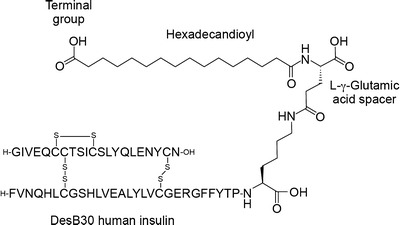
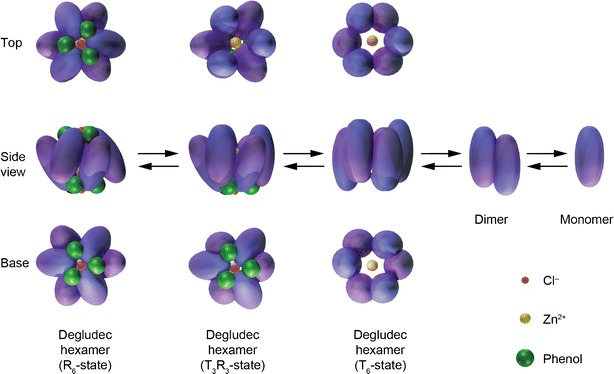
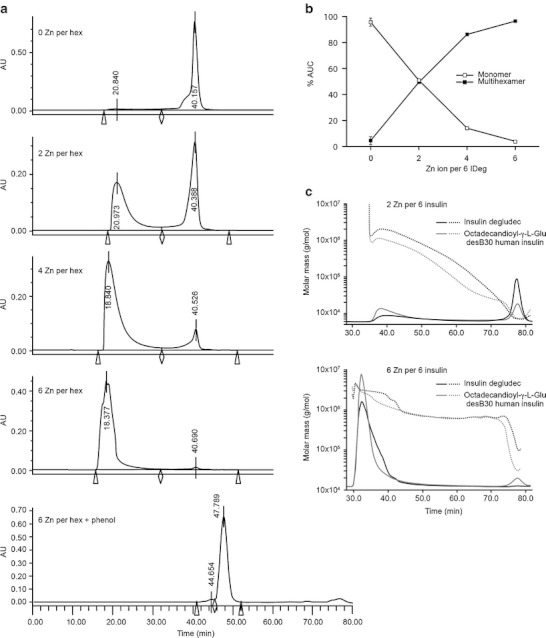
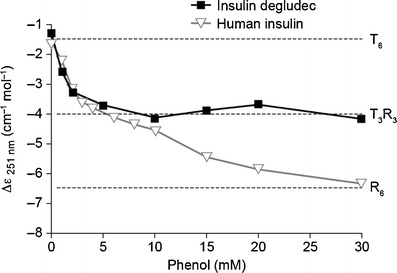
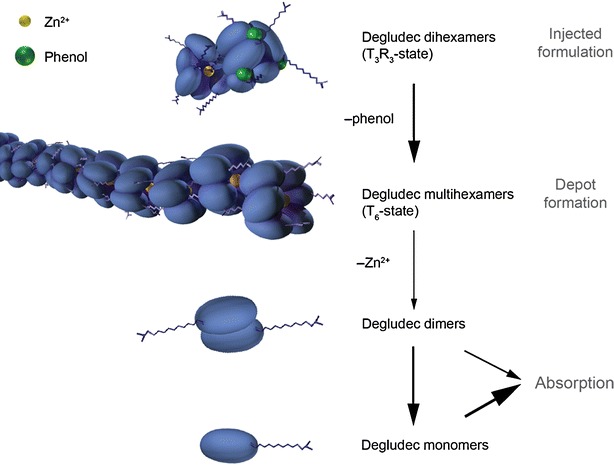
PURPOSE: Basal insulins with improved kinetic properties can potentially be produced using acylation by fatty acids that enable soluble, high-molecular weight complexes to form post-injection. A series of insulins, acylated at B29 with fatty acids via glutamic acid spacers, were examined to deduce the structural requirements. METHODS: Self-association, molecular masses and hexameric conformations of the insulins were studied using size exclusion chromatography monitored by UV or multi-angle light scattering and dynamic light scattering, and circular dichroism spectroscopy (CDS) in environments (changing phenol and zinc concentration) simulating a pharmaceutical formulation and changes following subcutaneous injection. RESULTS: With depletion of phenol, insulin degludec and another fatty diacid-insulin analogue formed high molecular mass filament-like complexes, which disintegrated with depletion of zinc. CDS showed these analogues adopting stable T(3)R(3) conformation in presence of phenol and zinc, changing to T(6) with depletion of phenol. These findings suggest insulin degludec is dihexameric in pharmaceutical formulation becoming multihexameric after injection. The analogues showed weak dimeric association, indicating rapid release of monomers following hexamer disassembly. CONCLUSIONS: Insulins can be engineered that remain soluble but become highly self-associated after injection, slowly releasing monomers; this is critically dependent on the acylation moiety. One such analogue, insulin degludec, has therapeutic potential.
Overview
The claims and statistics of this paper haven’t been checked yet.
Free: it reads the open-access text and checks the first 5 claims that cite a source we can check. Create a free account to check every claim.
Integrity signals
Registry
Cites
Statistics
Figures
Verification
Claims the paper makes
The claims and statistics of this paper haven’t been checked yet.
Free: it reads the open-access text and checks the first 5 claims that cite a source we can check. Create a free account to check every claim.
Claims other papers make about this one
Each is checked against this paper’s own text: does it say what the citing paper says it does?
The source backs part of the claim, not all of it — or backs it for a different population, condition or comparison.
In the citing paper
“In the pharmaceutical formulation, i.e. in the presence of phenol and zinc, the IDeg hexamers adopt a conformation where only one of the ends is available to interact with the side chain of another IDeg hexamer and thus forms stable di-hexamers.”
From A Review of the Pharmacological Properties of Insulin Degludec and Their Clinical Relevance (2014) · cites this paper as [16]
Experimental — accuracy not yet measuredThe source backs part of the claim, not all of it — or backs it for a different population, condition or comparison.
In the citing paper
“With the gradual diffusion of zinc from the ends of the multi-hexamers, terminal IDeg monomers slowly and steadily dissociate, resulting in a slow and gradual delivery of IDeg from the SC injection site into the circulation [16].”
From A Review of the Pharmacological Properties of Insulin Degludec and Their Clinical Relevance (2014) · cites this paper as [16]
Experimental — accuracy not yet measuredThe source backs part of the claim, not all of it — or backs it for a different population, condition or comparison.
In the citing paper
“Upon diffusion of phenol following injection, the IDeg di-hexamers open at both ends and lead to the formation of multi-hexamers [16].”
From A Review of the Pharmacological Properties of Insulin Degludec and Their Clinical Relevance (2014) · cites this paper as [16]
Experimental — accuracy not yet measuredThe source backs part of the claim, not all of it — or backs it for a different population, condition or comparison.
In the citing paper
“To date, IDeg is the only insulin analogue to self-associate into multi-hexamers upon subcutaneous (SC) injection, resulting in a soluble depot from which IDeg is slowly and continuously absorbed into the circulation [15, 16].”
From A Review of the Pharmacological Properties of Insulin Degludec and Their Clinical Relevance (2014) · cites this paper as [16]
Experimental — accuracy not yet measuredThe cited source says what the claim attributes to it.
In the citing paper
“Insulin degludec (IDeg) is a new-generation basal insulin with an ultra-long duration of action developed for once-daily administration [15, 16]”
From A Review of the Pharmacological Properties of Insulin Degludec and Their Clinical Relevance (2014) · cites this paper as [16]
1 more claim about this paper
Create a free account to see every claim other papers make about this one.
Self-check
Percentages, sums and reported differences re-computed from the paper’s own numbers.
The self-check needs the paper’s full text.
Citations
Cites
Effects of protein aggregates: An immunologic perspective
Rosenberg, A. S. (2006) · The AAPS Journal · doi:10.1208/aapsj080359 · Cited by 1,355
Estimation of Molecular Size and Molecular Weights of Biological Compounds by Gel Filtration
Andrew, P. (1970) · Methods of Biochemical Analysis · doi:10.1002/9780470110362.ch1 · Cited by 638
Heise, T., Nosek, L., Rønn, B. B., Endahl, L., Heinemann, L., Kapitza, C., & Draeger, E. (2004) · Diabetes · doi:10.2337/diabetes.53.6.1614 · Cited by 614
Wen, J., Arakawa, T., & Philo, J. S. (1996) · Analytical Biochemistry · doi:10.1006/abio.1996.0345 · Cited by 504
Monomeric insulins obtained by protein engineering and their medical implications
Brange, J., Ribel, U., Hansen, J. F., Dodson, G., Hansen, M. T., Havelund, S., Melberg, S. G., Norris, F., Norris, K., Snel, L., et al. (1988) · Nature · doi:10.1038/333679a0 · Cited by 488
Self-citationThe Mechanism of Protraction of Insulin Detemir, a Long-Acting, Acylated Analog of Human Insulin
Havelund, S., Plum, A., Ribel, U., Jonassen, I., Vølund, A., Markussen, J., & Kurtzhals, P. (2004) · Pharmaceutical Research · doi:10.1023/b:pham.0000036926.54824.37 · Cited by 429
Self-citationHeise, T., Hermanski, L., Nosek, L., Feldman, A., Rasmussen, S., & Haahr, H. (2012) · Diabetes, Obesity and Metabolism · doi:10.1111/j.1463-1326.2012.01627.x · Cited by 397
Immunogenicity of protein therapeutics: The key causes, consequences and challenges
Baker, M., Reynolds, H. M., Lumicisi, B., & Bryson, C. J. (2010) · Self/Nonself · doi:10.4161/self.1.4.13904 · Cited by 372 · cited 1×
“which neutralising antibodies can impact efficacy over time (26).”
BackgroundStrategies for the assessment of protein aggregates in pharmaceutical biotech product development
den Engelsman, J., Garidel, P., Smulders, R., Koll, H., Smith, B., Bassarab, S., Seidl, A., Hainzl, O., & Jiskoot, W. (2011) · Pharmaceutical Research · doi:10.1007/s11095-010-0297-1 · Cited by 348
Kurtzhals, P., Havelund, S., Jonassen, I., Kiehr, B., Larsen, U. D., Ribel, U., & Markussen, J. (1995) · Biochemical Journal · doi:10.1042/bj3120725 · Cited by 334
Self-citation
Research works printed but not linked: 2
- Kruger P Gilge G Cabuk Y Wollmer A Cooperativity and intermediate states in the T;R-structural transformation of insulin Biol Chem Hoppe Seyler 1990 371 669 673 10.1515/bchm3.1990.371.2.669 2206455 · DOI
- Kurzhals P Heise T Strauss HM Bøttcher SG Granhall C Haahr H Jonassen I Multi-hexamer formation is the underlying mechanism behind the ultra-long glucose-lowering effect of insulin degludec Diabetes 2011 60 Suppl. 1 LB12
Cited by
Items 401–475 of 475
Hvid, H., Brand, C. L., Hummelshøj, T., Jensen, S., Bouman, S. D., Bowler, A. N., Poulsen, B. R., Tiainen, P., Åkertröm, T., Demozay, D., et al. (2022) · Diabetologia · doi:10.1007/s00125-022-05828-w · Cited by 1
Insulin degludec in pregestational diabetes: evidence and perspectives
Papaetis, G. S., & Mikellidis, K. C. (2024) · Archives of Medical Science - Atherosclerotic Diseases · doi:10.5114/amsad/188092 · Cited by 1
Ji, L., Gao, L., Cheng, Z., Ma, G., Li, S., Wang, H., Liu, J., Lu, Y., Liu, M., Geng, J., et al. (2024) · Current Medical Research and Opinion · doi:10.1080/03007995.2024.2401096 · Cited by 1
Starting Insulin Treatment in Type 2 Diabetes
Vähätalo, M. (2015) · UTUPub (University of Turku) · Cited by 1
Non-Canonical Amino Acid Mutagenesis of Position B28 In Insulin with Proline Analogs
Lieblich, S. A. (2017) · CaltechTHESIS (California Institute of Technology) · doi:10.7907/z90z71bd · Cited by 1
An update of contemporary insulin therapy
Tsai, Y., Gu, Y., & Jiang, Y. (2024) · Journal of Diabetes Investigation · doi:10.1111/jdi.14212 · Cited by 1
Size-Switching Starch Nanoparticle-based Nanoassemblies for Improving Drug Delivery
Campea, M. A. (2023) · MacSphere (McMaster University) · doi:10.71548/12509 · Cited by 1
Humaninsulin oder Analoga in der Insulintherapie
Pfohl, M. (2014) · Der Diabetologe · doi:10.1007/s11428-013-1149-5
Estado actual del tratamiento farmacológico de la diabetes mellitus. Una aproximación práctica
Gracia, T. R., & Pascual, A. L. C. (2013) · Medicine - Programa de Formación Médica Continuada Acreditado · doi:10.1016/s0304-5412(13)70691-7
Insulin degludec in Type 1 diabetes
Eligar, V. S., & Bain, S. C. (2013) · Clinical Investigation · doi:10.4155/cli.13.80
Recent advances with insulin degludec for the treatment of Type 2 diabetes
Stokes, V. J., & Gough, S. C. L. (2014) · Expert Review of Endocrinology & Metabolism · doi:10.1586/17446651.2014.917045
Soluble co-formulation of insulin degludec and insulin aspart: a new approach to insulin treatment
Franek, E., & Hak, Ł. (2015) · Diabetes Management · doi:10.2217/dmt.15.13
Ideal basal insulin: opportunities from designer proteins.
Shah, S. N., & Das, A. K. (2014) · PubMed
Ernährung, Medikamente und Stoffwechselkontrollen
Danne, T., Kordonouri, O., & Lange, K. (2014) · Springer eBooks · doi:10.1007/978-3-642-24645-6_3
Clinical Use of New Insulins and New Insulin Delivery Systems
Lim, T., & Ko, S. (2015) · Journal of Korean Diabetes · doi:10.4093/jkd.2015.16.4.242
Risk of Insulin Accumulation (Stacking) with use of Novel Ultralong-Acting Insulin Formulation
Bansal, V., Davis, G. M., & Ismail‐Beigi, F. (2014) · Endocrine Practice · doi:10.4158/ep14144.co
Oxidation, aggregation and immunogenicity of therapeutic proteins
Torosantucci, R. (2013) · Leiden Repository (Leiden University)
Horigome, H., Inoue, A., Moriwaki, N., & Sugii, H. (2016) · Drug Delivery System · doi:10.2745/dds.31.423
Les différentes catégories d'insuline
Monnier, L., & Colette, C. (2017) · doi:10.1016/b978-2-294-74646-8.09983-1
Diabète de type1: traitement insulinique detype basal-bolus
Monnier, L., & Colette, C. (2017) · doi:10.1016/b978-2-294-74646-8.00007-9
Greeff, O. B. W., van Tonder, J. J., Naidu, K., McMaster, A., van Tonder, A., & Mothilal, R. (2018) · Journal of Endocrinology Metabolism and Diabetes of South Africa · doi:10.1080/16089677.2017.1407097
Use of degludec insulin in chronic complex patients
Carretero‐Gómez, J., Miramontes‐González, J. P., Aguilar, J. M. V., Ena, J., & Arévalo‐Lorido, J. C. (2018) · European Journal of Internal Medicine · doi:10.1016/j.ejim.2018.03.011
GLOBAL PHARMACEUTICAL OUTSOURCING STRATEGY REPORT FOR SMALL PHARMACEUTICAL COMPANIES
Hu, M. (2016) · OhioLink ETD Center (Ohio Library and Information Network)
Management of Concentrated Insulins in Acute Care Settings
SAYED, N. A. E., Ritter, M. J., & Segal, A. R. (2018) · Wiley eBooks · doi:10.1002/9781119374800.ch34
Chatterjee, S., Khunti, K., & Davies, M. J. (2019) · Drugs · doi:10.1007/s40265-019-01093-1
Peptide Drug Design for Diabetes and Related Metabolic Diseases
Kaarsholm, N. C. (2019) · Springer eBooks · doi:10.1007/978-3-030-11748-1_13
Perotti, M. (2019) · BOA (University of Milano-Bicocca)
Pankiv, V. І. (2019) · Clinical endocrinology and endocrine surgery · doi:10.30978/cees-2019-2-12
Degludek: napjaink ideális bázisinzulinja?
Gerő, L. (2019) · Diabetologia Hungarica · doi:10.24121/dh.2019.5
The Effects of Lipidation on a TAT-Containing Peptide-Based Inhibitor of PSD-95
Fernandes, E. F. A., Haugaard‐Kedström, L. M., & Strømgaard, K. (2019) · Australian Journal of Chemistry · doi:10.1071/ch19392
Seufert, J. (2015) · doi:10.4155/fseb2013.14.419
Greeff, O. B. W., van Tonder, J. J., Naidu, K., McMaster, A., van Tonder, A., & Mothilal, R. (2018) · South African Family Practice · doi:10.4102/safp.v60i4.4903
Thérapeutique des désordres glycémiques
Monnier, L., & Colette, C. (2014) · Elsevier eBooks · doi:10.1016/b978-2-294-73954-5.00007-x
Newer Long-Acting Basal Insulin Preparations
Blonde, L. (2017) · Endocrine Practice · doi:10.1016/s1530-891x(20)43535-9
Semedo, M. I. R. (2021) · Portuguese National Funding Agency for Science, Research and Technology (RCAAP Project by FCT)
Cortinas, A. B. (2018) · DSpace@MIT (Massachusetts Institute of Technology)
Sawamura, T., Karashima, S., Ohbatake, A., Higashitani, T., Katsuda, Y., Yamamoto, R., Aono, D., Kometani, M., Takeda, Y., & Yoneda, T. (2021) · Research Square · doi:10.21203/rs.3.rs-503447/v1
Ligand -mediated Coating of Liposomes with Serum Proteins for Biomedical Applications
佐藤, ひ. (2018) · Institutional Repositories DataBase (IRDB) · doi:10.15017/1931748
Thérapeutique des désordres glycémiques
(2019) · Elsevier eBooks · doi:10.1016/b978-2-294-75889-8.00007-5
Sawamura, T., Karashima, S., Ohbatake, A., Higashitani, T., Katsuda, Y., Yamamoto, R., Aono, D., Kometani, M., Takeda, Y., & Yoneda, T. (2021) · Research Square · doi:10.21203/rs.3.rs-503447/v2
Gruebele, M., & Platkov, M. (2017) · Faculty Opinions – Post-Publication Peer Review of the Biomedical Literature · doi:10.3410/f.727815153.793537355
Furman, B. L. (2017) · Elsevier eBooks · doi:10.1016/b978-0-12-801238-3.97983-2
Ho, R. J. Y., & Gibaldi, M. (2013) · Wiley eBooks · doi:10.1002/9781118660485.ch12
Biopharmaceutical Drug Products: An Overview of Physicochemical Properties and Their Modification
Hasan, M., & Stratford, R. E. (2021) · Springer eBooks · doi:10.1007/978-3-030-51519-5_19-1
Biopharmaceutical Drug Products: An Overview of Physicochemical Properties and Their Modification
Hasan, M., & Stratford, R. E. (2022) · Springer eBooks · doi:10.1007/978-3-030-84860-6_19
Kok, A., Makan, H., Podgorski, G., Joshi, S., Chetty, V., Nojoko, L., Bacus, H. B., Moosa, N., & Khutsoane, D. (2023) · Journal of Endocrinology Metabolism and Diabetes of South Africa · doi:10.1080/16089677.2023.2198348
Emerging need of delivery systems for plant metabolites
Srivastava, A. K., Singh, D., & Singh, R. K. (2024) · Elsevier eBooks · doi:10.1016/b978-0-443-15960-2.00002-7
Diabetes Care in the Oncologic Population
Presswala, L. S., Farooki, A., & Flory, J. (2023) · Contemporary Endocrinology · doi:10.1007/978-3-031-44648-1_24
Groote, R. D., Lefever, E., Charleer, S., Donné, P., Block, C. E. M. D., Mathieu, C., & Gillard, P. (2024) · Diabetes Technology & Therapeutics · doi:10.1089/dia.2023.0616
Colosimo, S., Ruan, Y., Lumb, A. N., Rea, R. D., McDonald, P., Bain, S. C., Abraham, R. R., GALLEN, I. W., & Ryder, R. E. J. (2024) · British Journal of Diabetes · doi:10.15277/bjd.2024.448
Insulin Degludec vs Insulin Glargine for Glycemic Control in Critical Illness Hyperglycemia
Sherif, I. M. E., Haggag, A. M., Abbas, M. H., & Kamel, W. Y. (2024) · Indian Journal of Critical Care Medicine · doi:10.5005/jp-journals-10071-24842
Cerecetto, H. (2024) · Topics in medicinal chemistry · doi:10.1007/7355_2024_167
Pharmacotherapy of type 1 diabetes - part 1: yesterday
Rendell, M. (2025) · Expert Opinion on Pharmacotherapy · doi:10.1080/14656566.2025.2454280
The developmental history of insulin pharmaceuticals
Qian, H., & Kou, B. (2025) · Elsevier eBooks · doi:10.1016/b978-0-443-27402-2.00012-7
GZR101, a Novel Premixed Insulin for the Treatment of Diabetes Mellitus
Chen, W., Cui, C., Xing, W., Zhang, Y., He, A., Wang, Y., Huang, Y., Zhai, N., Shi, Q., Xue, F., et al. (2025) · Naunyn-Schmiedeberg s Archives of Pharmacology · doi:10.1007/s00210-025-04366-7
Wen, M., Song, C.-Y., Wang, R., Qiang, B.-R., & Du, G. (2025) · Therapeutic Advances in Endocrinology and Metabolism · doi:10.1177/20420188251362093
Suplotova, L. A., & Tilkiyan, A. S. (2025) · Endocrinology News Opinions Training · doi:10.33029/2304-9529-2025-14-2-44-52
Beyazıt, Y., Ertekin, Y. H., Kurtkulağı, Ö., & Pek, E. (2024) · doi:10.55094/holistence.237
Insulin in Its Second Century: History, Evolution, and Aspirations
Mayer, J. P., Thalluri, K., Mickelson, E., Stowell, M. H. B., & DiMarchi, R. D. (2025) · Wiley eBooks · doi:10.1002/9781119824701.ch08
Aktuelles: Highlights 2019: LDL-Cholesterin und Basalinsuline der 2. Generation
Metzner, T. (2019) · Journal für Kardiologie (Krause & Pachernegg GmbH)
Chatterjee, S., Chaudhuri, S. R., Majumder, A., & Sanyal, D. (2022)
Graça, O. R. C. (2022) · Portuguese National Funding Agency for Science, Research and Technology (RCAAP Project by FCT) · doi:10.34626/wjk3-tw36
Kaliuzhnaia, O. S., & Khokhlenkova, N. (2025) · ScienceRise Biological Science · doi:10.15587/2519-8025.2025.349033
Zhong, L., Cao, W., Liu, X., Wen, T., & Yan, J. Y. (2026) · Frontiers in Endocrinology · doi:10.3389/fendo.2026.1750408
basal-bolus療法中の糖尿病外来患者におけるCGM(Continuous Glucose Monitoring)を用いたインスリングラルギンとインスリンデグルデクとの効果比較研究
Komuro, M. (2016) · Institutional Repositories DataBase (IRDB)
Trends in the Field of Insulin Drug Design
Høeg-Jensen, T. (2026) · Wiley eBooks · doi:10.1002/9783527845408.ch6
Site-selective acylation of human insulin to engineer a long-acting monovalent insulin–Fc conjugate
Yang, W., Xu, R., & Tai, W. (2026) · RSC Medicinal Chemistry · doi:10.1039/d6md00313c
Insulin degludec — new possibilities and solutions in Diabetes Mellitus patients treatment
Sokolova, L. K., & Ostroverkhova, G. V. (2016) · Endokrynologia
Shafique, E., Raja, U. Y., Saqlain, M., Din, F. U., Ishtiaq, A., Khan, G. M., & Shan, A. (2025) · Journal of Pakistan Endocrine Society
Oligomer-Responsive ThT Derivative for Early Deterioration Evaluation of Insulin Injections
Wang, Y., Li, X., Dong, Z., & Wu, P. (2026) · Analytical Chemistry · doi:10.1021/acs.analchem.6c05164
Lee, J. H., Go, Y. M., 이종화, & Ahn, J. (2026) · Journal of Pharmaceutical Investigation · doi:10.1007/s40005-026-00839-w
Metadata
- Authors
- Jonassen, I., Havelund, S., Hoeg-Jensen, T., Steensgaard, D. B., Wahlund, P.-O., & Ribel, U.
- Affiliations
- Novo Nordisk (Denmark) (DK)
- Corresponding author
- Jonassen, Ib
- Venue
- Pharmaceutical Research
- Published
- 2012-04-07
- Volume
- 29
- Issue
- 8
- Pages
- 2104-2114
- ISSN
- 0724-8741 (ISSN-L)
- 1573-904X
- PMC
- PMC3399081
- OpenAlex
- W1986874694
- Semantic Scholar
- d3839c54097347f226274e4103b43b5c1ea37995
- Cited by
- 448
- References
- 32
- Citations by year
- 2026: 7 · 2025: 19 · 2024: 24 · 2023: 19 · 2022: 28 · 2021: 40 · 2020: 24 · 2019: 33 · 2018: 33 · 2017: 30 · 2016: 35 · 2015: 49 · 2014: 45 · 2013: 45 · 2012: 16
- FWCI
- 19.91
- Type
- journal article
- Language
- en
- Open access
- hybrid
- doi.org
- Licence
- cc-by
- Locations
- Pharmaceutical Research (publishedVersion, cc-by)
- PubMed Central (publishedVersion, cc-by)
- PubMed (publishedVersion)
- Funders
- Novo Nordisk
- Topics
- Life Sciences › Biochemistry, Genetics and Molecular Biology › Molecular Biology › Protein purification and stability
- Health Sciences › Medicine › Endocrinology, Diabetes and Metabolism › Diabetes Management and Research
- Health Sciences › Medicine › Endocrinology, Diabetes and Metabolism › Pancreatic function and diabetes
- Keywords
- insulin degludec, fatty acid acylation, insulin conformation, subcutaneous injection, insulin analogues
- MeSH terms
- Acylation, Amino Acid Sequence, Chromatography, Gel, Circular Dichroism, Fatty Acids, Humans, Hypoglycemic Agents, Insulin, Models, Molecular, Molecular Sequence Data, Protein Binding, Serum Albumin
About these checks
Registry, retraction, Cites and statistics results are computed, not judged, with one exception: a printed reference that no index lists is read once by a model before it counts as a citation error. Claims are extracted by a model and kept only when their quote appears verbatim in the text; each cited source is then checked, with a model’s help, for whether it says what the claim relies on. Those verdicts can be wrong — read the claim’s quote and the cited source before relying on one.
Statistics and arithmetic are recomputed, not judged.
Confidence bands are shown only for fields calibrated on our annotated test set. None is calibrated yet, so no band is shown.
What counts as a claim ›How we measure confidence ›How we check this ›
Are you an author, or do you see a problem with this page? Request a review
Data sources
Bibliographic data: Semantic Scholar, OpenAlex, Crossref.
Contains information from the Semantic Scholar Academic Graph Datasets, made available under the ODC Attribution License (ODC-BY 1.0).
Semantic Scholar’s data is described in: Kinney, R., et al. (2023). The Semantic Scholar Open Data Platform. arXiv:2301.10140.
