

The DOI matches its Crossref record; 60 of the 60 references it cites were found in a registry or an index.
Interventions to Reduce Stigma Related to Mental Illnesses in Educational Institutes: a Systematic Review
Open accessAbstract
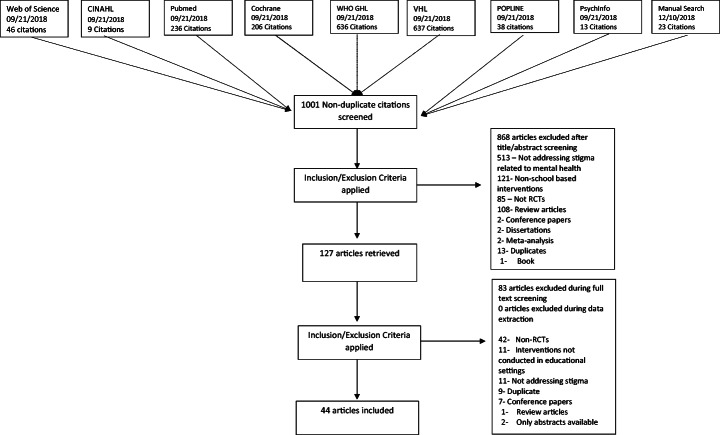
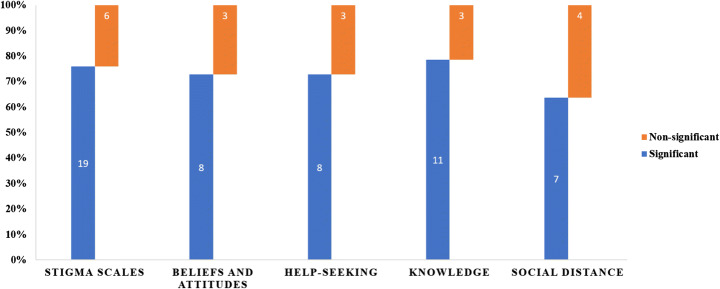
This investigation reviews the effectiveness of anti-stigma interventions employed at educational institutes; to improve knowledge, attitude and beliefs regarding mental health disorders among students. Preferred Reporting Items for Systematic Reviews and Meta-Analysis (PRISMA) checklist guidelines were followed and protocol was registered in PROSPERO (CRD42018114535). Forty four randomized controlled trials were considered eligible after screening of 104 full-text articles against inclusion and exclusion criteria.Several interventions have been employed to tackle stigma toward psychiatric illnesses, including education through lectures and case scenarios, contact-based interventions, and role-plays as strategies to address stigma towards mental illnesses. A high proportion of trials noted that there was a significant improvement for stigma (19/25, 76%), attitude (8/11, 72%), helping-seeking (8/11, 72%), knowledge of mental health including recognition of depression (11/14, 78%), and social distance (4/7, 57%). These interventions also helped in reducing both public and self-stigma. Majority of the studies showed that the anti-stigma interventions were successful in improving mental health literacy, attitude and beliefs towards mental health illnesses.
Overview
The claims and statistics of this paper haven’t been checked yet.
Run the check — free, no account needed. It reads the open-access text and checks the sources it cites.
Integrity signals
Registry
Cites
Statistics
Figures
Verification
Claims the paper makes
The claims and statistics of this paper haven’t been checked yet.
Run the check — free, no account needed. It reads the open-access text and checks the sources it cites.
Claims other papers make about this one
Each is checked against this paper’s own text: does it say what the citing paper says it does?
The cited source says what the claim attributes to it.
In the citing paper
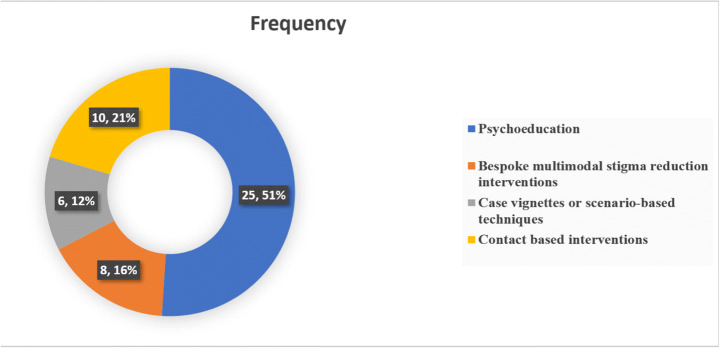
“Psychoeducation was used most often (25 studies) followed by social contact-based interventions (ten studies).”
From The Lancet Commission on ending stigma and discrimination in mental health (2022) · cites this paper as [116]
In the citing paper
“Stigma was directly targeted in 25 studies, of which 19 showed significant improvements.”
From The Lancet Commission on ending stigma and discrimination in mental health (2022) · cites this paper as [116]
In the citing paper
“most studies which assessed attitudes showed positive changes (eight of 11)”
From The Lancet Commission on ending stigma and discrimination in mental health (2022) · cites this paper as [116]
In the citing paper
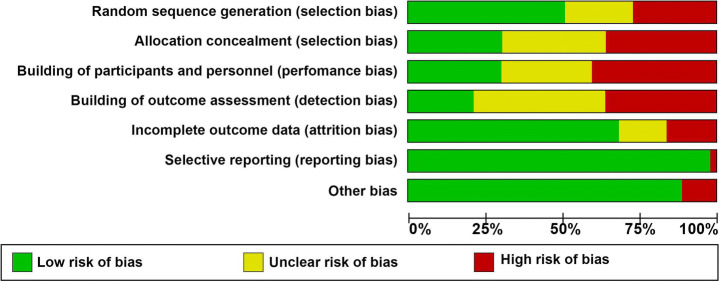
“The overall quality of these studies was quite low, with 35 (80%) showing a high risk of bias.”
From The Lancet Commission on ending stigma and discrimination in mental health (2022) · cites this paper as [116]
In the citing paper
“four of seven that measured social distance also reported improvements.”
From The Lancet Commission on ending stigma and discrimination in mental health (2022) · cites this paper as [116]
In the citing paper
“Waqas and colleagues 116 conducted a systematic review of anti-stigma interventions in educational institutions.”
From The Lancet Commission on ending stigma and discrimination in mental health (2022) · cites this paper as [116]
In the citing paper
“They identified 44 studies, of which 36 (82%) had been published since 2009.”
From The Lancet Commission on ending stigma and discrimination in mental health (2022) · cites this paper as [116]
In the citing paper
“Most of the included trials had been conducted in HICs, with only six studies having been done in MICs including China (n=2), Russia (n=2), Nigeria (n=1), and Brazil (n=1).”
From The Lancet Commission on ending stigma and discrimination in mental health (2022) · cites this paper as [116]
Self-check
Percentages, sums and reported differences re-computed from the paper’s own numbers.
The self-check needs the paper’s full text.
Citations
Cites
Liberati, A., Altman, D. G., Tetzlaff, J., Mulrow, C., Gøtzsche, P. C., Ioannidis, J. P. A., Clarke, M., Devereaux, P. J., Kleijnen, J., & Moher, D. (2009) · PLoS Medicine · doi:10.1371/journal.pmed.1000100 · Cited by 28,164
Liberati, A., Altman, D. G., Tetzlaff, J., Mulrow, C., Gøtzsche, P. C., Ioannidis, J. P. A., Clarke, M., Devereaux, P. J., Kleijnen, J., & Moher, D. (2009) · Annals of Internal Medicine · doi:10.7326/0003-4819-151-4-200908180-00136 · Cited by 10,349
Mental illness stigma: Concepts, consequences, and initiatives to reduce stigma
Rüsch, N., Angermeyer, M. C., & Corrigan, P. W. (2005) · European Psychiatry · doi:10.1016/j.eurpsy.2005.04.004 · Cited by 1,832
Understanding the impact of stigma on people with mental illness.
(2002) · Europe PMC (PubMed Central) · Cited by 1,786
Global Burden of Disease and the Impact of Mental and Addictive Disorders
Rehm, J., & Shield, K. D. (2019) · Current Psychiatry Reports · doi:10.1007/s11920-019-0997-0 · Cited by 1,388
Evidence for effective interventions to reduce mental-health-related stigma and discrimination
Thornicroft, G., Mehta, N., Clement, S., Evans-Lacko, S., Doherty, M., Rose, D., Koschorke, M., Shidhaye, R., O'Reilly, C., & Henderson, C. (2016) · The Lancet · doi:10.1016/s0140-6736(15)00298-6 · Cited by 1,338
Stigma of mental illness and ways of diminishing it
Byrne, P. (2000) · Advances in Psychiatric Treatment · doi:10.1192/apt.6.1.65 · Cited by 503
Interventions to reduce discrimination and stigma: the state of the art
Gronholm, P. C., Henderson, C., Deb, T., & Thornicroft, G. (2017) · Social Psychiatry and Psychiatric Epidemiology · doi:10.1007/s00127-017-1341-9 · Cited by 401
Beliefs and perception about mental health issues: a meta-synthesis
Choudhry, F. R., Mani, V., Ming, L. C., & Khan, T. M. (2016) · Neuropsychiatric Disease and Treatment · doi:10.2147/ndt.s111543 · Cited by 263
Schomerus, G., Stolzenburg, S., Freitag, S., Speerforck, S., Janowitz, D., Evans-Lacko, S., Muehlan, H., & Schmidt, S. (2019) · European Archives of Psychiatry and Clinical Neuroscience · doi:10.1007/s00406-018-0896-0 · Cited by 214
Research works printed but not linked: 1
- National Academies of Sciences, Engineering, and Medicine. Ending discrimination against people with mental and substance use disorders: the evidence for stigma change: National Academies Press; 2016.
Cited by
Sorted by citations
The Lancet Commission on ending stigma and discrimination in mental health
Thornicroft, G., Sunkel, C., Alikhon Aliev, A., Baker, S., Brohan, E., el Chammay, R., Davies, K., Demissie, M., Duncan, J., Fekadu, W., et al. (2022) · The Lancet · doi:10.1016/s0140-6736(22)01470-2 · Cited by 748
Gambling Disorder and Stigma: Opportunities for Treatment and Prevention
Quigley, L. (2022) · Current Addiction Reports · doi:10.1007/s40429-022-00437-4 · Cited by 67
Interventions to Reduce Mental Health Stigma in Young People
Crockett, M. A., Núñez, D., Martínez, P., Borghero, F., Campos, S., Langer, A. I., Madariaga, J. C., & Martínez, V. (2025) · JAMA Network Open · doi:10.1001/jamanetworkopen.2024.54730 · Cited by 79
Motta, M., Liu, Y., & YARNELL, A. (2024) · Scientific Reports · doi:10.1038/s41598-024-56578-1 · Cited by 63
Anti‐stigma initiatives for mental health professionals—A systematic literature review
Sreeram, A., Cross, W. M., & Townsin, L. (2022) · Journal of Psychiatric and Mental Health Nursing · doi:10.1111/jpm.12840 · Cited by 85
Metadata
- Authors
- Waqas, A., Malik, S., Fida, A., Abbas, N., Mian, N., Miryala, S., Amray, A. N., Shah, Z., & Naveed, S.
- Affiliations
- University of Liverpool (GB)
- Hartford Hospital (US)
- King Edward Medical University (PK)
- FMH College of Medicine & Dentistry (PK)
- Dow University of Health Sciences (PK)
- Weiss Memorial Hospital (US)
- University of Kansas Medical Center (US)
- Corresponding author
- Waqas, Ahmed
- Venue
- Psychiatric Quarterly
- Published
- 2020-05-05
- Volume
- 91
- Issue
- 3
- Pages
- 887-903
- ISSN
- 0033-2720 (ISSN-L)
- 1573-6709
- PMC
- PMC7395002
- OpenAlex
- W3022881768
- Cited by
- 176
- References
- 60
- Citations by year
- 2026: 30 · 2025: 46 · 2024: 54 · 2023: 20 · 2022: 18 · 2021: 6 · 2020: 2
- FWCI
- 1.85
- Type
- journal article
- Language
- en
- Open access
- hybrid
- doi.org
- Locations
- Psychiatric Quarterly (publishedVersion, cc-by)
- PubMed Central (publishedVersion, cc-by)
- PubMed (publishedVersion)
- Funders
- University of Liverpool
- Topics
- Health Sciences › Medicine › Psychiatry and Mental health › Mental Health Treatment and Access
- Social Sciences › Psychology › Clinical Psychology › Psychology and Mental Health
- Health Sciences › Medicine › Public Health, Environmental and Occupational Health › School Health and Nursing Education
- Keywords
- mental health stigma, stigma reduction interventions, students, mental health literacy, attitudes toward mental illness, contact-based interventions, role play, case scenarios, public stigma, self-stigma, social distance, depression detection
- MeSH terms
- Psychosocial Intervention, Mental Disorders, Health Education, Humans, Health Knowledge, Attitudes, Practice, Role Playing, Persons with Psychiatric Disorders, Social Stigma
About these checks
Registry, retraction, Cites and statistics results are computed, not judged, with one exception: a printed reference that no index lists is read once by a model before it counts as a citation error. Claims are extracted by a model and kept only when their quote appears verbatim in the text; each cited source is then checked, with a model’s help, for whether it says what the claim relies on. Those verdicts can be wrong — read the claim’s quote and the cited source before relying on one.
Statistics and arithmetic are recomputed, not judged.
Confidence bands are shown only for fields calibrated on our annotated test set. None is calibrated yet, so no band is shown.
What counts as a claim ›How we measure confidence ›How we check this ›
Are you an author, or do you see a problem with this page? Request a review
