

Benchmarking the performance of portfolio optimization with QAOA
Open accessThe DOI matches its Crossref record; 28 of the 28 references it cites were found in a registry or an index.
Abstract
We present a detailed study of portfolio optimization using different versions of the quantum approximate optimization algorithm (QAOA). For a given list of assets, the portfolio optimization problem is formulated as quadratic binary optimization constrained on the number of assets contained in the portfolio. QAOA has been suggested as a possible candidate for solving this problem (and similar combinatorial optimization problems) more efficiently than classical computers in the case of a sufficiently large number of assets. However, the practical implementation of this algorithm requires a careful consideration of several technical issues, not all of which are discussed in the present literature. The present article intends to fill this gap and thereby provides the reader with a useful guide for applying QAOA to the portfolio optimization problem (and similar problems). In particular, we will discuss several possible choices of the variational form and of different classical algorithms for finding the corresponding optimized parameters. Viewing at the application of QAOA on error-prone NISQ hardware, we also analyse the influence of statistical sampling errors (due to a finite number of shots) and gate and readout errors (due to imperfect quantum hardware). Finally, we define a criterion for distinguishing between ‘easy’ and ‘hard’ instances of the portfolio optimization problem.
Overview
The claims and statistics of this paper haven’t been checked yet.
Free: it reads the open-access text and checks the first 5 claims that cite a source we can check. Create a free account to check every claim.
Integrity signals
Registry
Cites
Statistics
Figures
Verification
Claims the paper makes
The claims and statistics of this paper haven’t been checked yet.
Free: it reads the open-access text and checks the first 5 claims that cite a source we can check. Create a free account to check every claim.
Self-check
Percentages, sums and reported differences re-computed from the paper’s own numbers.
The self-check needs the paper’s full text.
Citations
Cites
Polynomial-time algorithms for prime factorization and discrete logarithms on a quantum computer
Shor, P. W. (1997) · SIAM Journal on Computing · doi:10.1137/s0097539795293172 · Cited by 8,472 · cited 2×
“This expectation is based upon the fact the quantum circuits required for QAOA are shorter than those of other algorithms, e.g the Shor [3] or HHL [4] algorithm, for which an exponential advantage compared to classical algorithms can be proven (under the assumption that quantum computers with sufficiently many error-cor…”
BackgroundCoherence in Spontaneous Radiation Processes
Dicke, R. H. (1954) · Physical Review · doi:10.1103/physrev.93.99 · Cited by 7,445 · cited 2×
“Another reason for aworsening performance ofXY -mixers under higher noise levels in terms of both approximation ratio and ground state probability is their reliance on Dicke states [22] (see Sect.”
BackgroundQuantum Algorithm for Linear Systems of Equations
Harrow, A. W., Hassidim, A., & Lloyd, S. (2009) · Physical Review Letters · doi:10.1103/physrevlett.103.150502 · Cited by 3,325 · cited 2×
“This expectation is based upon the fact the quantum circuits required for QAOA are shorter than those of other algorithms, e.g the Shor [3] or HHL [4] algorithm, for which an exponential advantage compared to classical algorithms can be proven (under the assumption that quantum computers with sufficiently many error-cor…”
BackgroundA Quantum Approximate Optimization Algorithm
Farhi, E., Goldstone, J., & Gutmann, S. (2014) · arXiv · doi:10.48550/arxiv.1411.4028 · Cited by 1,789 · cited 4×
“In the originally proposed [1] version of QAOA (M = standard), the mixing operation is realized by single-qubit rotations applied to each qubit:”
BackgroundMethodInfluentialPowell, M. J. D. (1994) · Advances in Optimization and Numerical Analysis · doi:10.1007/978-94-015-8330-5_4 · Cited by 1,369 · cited 1×
“The classical optimizer COBYLA [23] was used.”
Zhou, L., Wang, S.-T., Choi, S., Pichler, H., & Lukin, M. D. (2020) · Physical Review X · doi:10.1103/physrevx.10.021067 · Cited by 913 · cited 6×
“Of crucial importance are the initial values of the circuit parameters γ and β fed into the classical optimization routine: similarly to [7], we perform the optimization for increasing values of the QAOA depth p, using an extrapolation method to deduce initial values from the optimized values of γ and β obtained previ…”
BackgroundMethodInfluentialNoise-Induced Barren Plateaus in Variational Quantum Algorithms
Wang, S., Fontana, E., Cerezo, M., Sharma, K., Sone, A., Cincio, L., & Coles, P. J. (2020) · arXiv · doi:10.48550/arxiv.2007.14384 · Cited by 791 · cited 1×
“These effects impair the ability of the classical optimization algorithms to converge to the global minimum of the expectation value, eventually leading to a noise-induced barren plateau that incurs an exponential runtime overhead [22].”
BackgroundNoise-induced barren plateaus in variational quantum algorithms
Wang, S., Fontana, E., Cerezo, M., Sharma, K., Sone, A., Cincio, L., & Coles, P. J. (2021) · Nature Communications · doi:10.1038/s41467-021-27045-6 · Cited by 773 · cited 1×
“These effects impair the ability of the classical optimization algorithms to converge to the global minimum of the expectation value, eventually leading to a noise-induced barren plateau that incurs an exponential runtime overhead [22].”
BackgroundFrom the Quantum Approximate Optimization Algorithm to a Quantum Alternating Operator Ansatz
Hadfield, S., Wang, Z., O’Gorman, B., Rieffel, E. G., Venturelli, D., & Biswas, R. (2019) · Algorithms · doi:10.3390/a12020034 · Cited by 772 · cited 3×
“(2), are populated during the algorithm [2, 16].”
BackgroundMethodTraining Variational Quantum Algorithms Is NP-Hard
Bittel, L., & Kliesch, M. (2021) · Physical Review Letters · doi:10.1103/physrevlett.127.120502 · Cited by 398 · cited 1×
“Since QAOA involves a numerical classical optimization of variational circuit parameters (which, in itself, is an NP-hard problem [5]), analytical results concerning the performance of QAOA for a large number of qubits are not available.”
Background
Research works printed but not linked: 2
- Markowitz, H.: Portfolio selection. J. Finance 7, 77 (1952)
- Nielsen, M.A., Chuang, I.L.: Quantum Computation and Quantum Information: 10th Anniversary Edition. Cambridge University Press, Cambridge (2010)
Cited by
Quantum Computational Finance: Quantum Algorithm for Portfolio Optimization
Rebentrost, P., & Lloyd, S. (2024) · KI - Künstliche Intelligenz · doi:10.1007/s13218-024-00870-9 · Cited by 94
“[52] discusses sampling and device errors.”
Best practices for portfolio optimization by quantum computing, experimented on real quantum devices
Buonaiuto, G., Gargiulo, F., Pietro, G. D., Esposito, M., & Pota, M. (2023) · Scientific Reports · doi:10.1038/s41598-023-45392-w · Cited by 121
“Quantum Approximate Optimization algorithms (QAOA) employ two types of quantum gates, a mixer Hamiltonian that facilitates parameterized mixing of quantum states, and a cost Hamiltonian that entails the optimization problem 18,19 .”
MethodNaik, A. S., Yeniaras, E., Hellstern, G., Prasad, G., & Vishwakarma, S. (2025) · Financial Innovation · doi:10.1186/s40854-025-00751-6 · Cited by 106
Self-citationQuantum Optimization: Potential, Challenges, and the Path Forward
Abbas, A., (NNSA), U. N. N. S. A., Ambainis, A., Augustino, B., Bärtschi, A., Buhrman, H., Coffrin, C., Cortiana, G., Dunjko, V., Egger, D., et al. (2023) · OSTI OAI (U.S. Department of Energy Office of Scientific and Technical Information) · doi:10.2172/2229681 · Cited by 67
Alignment between initial state and mixer improves QAOA performance for constrained optimization
He, Z., Shaydulin, R., Chakrabarti, S., Herman, D., Li, C., Sun, Y., & Pistoia, M. (2023) · npj Quantum Information · doi:10.1038/s41534-023-00787-5 · Cited by 48
“[25, 34, 69].”
BackgroundParameter Setting in Quantum Approximate Optimization of Weighted Problems
Sureshbabu, S. H., Herman, D., Shaydulin, R., Basso, J., Chakrabarti, S., Sun, Y., & Pistoia, M. (2024) · Quantum · doi:10.22331/q-2024-01-18-1231 · Cited by 41
“The non-integer weights lead to the optimization landscape becoming non-periodic and in general hard to optimize [9–11].”
BackgroundAn expressive ansatz for low-depth quantum approximate optimisation
Vijendran, V., Das, A., Koh, D. E., Assad, S. M., & Lam, P. K. (2024) · Quantum Science and Technology · doi:10.1088/2058-9565/ad200a · Cited by 66
“For example, QAOA and its variants have already found numerous potential uses in solving various optimisation problems beyond MaxCut, including problems in graph theory [111–113], finance [114], chemistry [115, 116], and others [15, 117].”
BackgroundState preparation by shallow circuits using feed forward
Buhrman, H., Folkertsma, M., Loff, B., & Neumann, N. M. P. (2024) · Quantum · doi:10.22331/q-2024-12-09-1552 · Cited by 114
“Dicke states have been used as a starting state for variational optimization algorithms, most notably Quantum Alternating Operator Ansatz (QAOA) [22], to find solutions to problems such as Maximum k-vertex Cover [10, 14].”
Experimental implementation of quantum-walk-based portfolio optimization
Qu, D., Matwiejew, E., Wang, K., Wang, J. B., & Xue, P. (2024) · Quantum Science and Technology · doi:10.1088/2058-9565/ad27e9 · Cited by 35
Quantum-Assisted Solution Paths for the Capacitated Vehicle Routing Problem
Palackal, L., Poggel, B., Wulff, M., Ehm, H., Lorenz, J. M., & Mendl, C. B. (2023) · IEEE International Conference on Quantum Computing and Engineering (QCE) · doi:10.1109/qce57702.2023.00080 · Cited by 54
“From a practical standpoint, a certain separation between the optimal state and infeasible ones is desirable, but the penalty should not be chosen too high to avoid very rugged loss landscapes getting in the way of the optimization process.”
BackgroundMultilevel Leapfrogging Initialization Strategy for Quantum Approximate Optimization Algorithm
Ni, X., Cai, B., Liu, H., Qin, S., Gao, F., & Wen, Q. (2024) · Advanced Quantum Technologies · doi:10.1002/qute.202300419 · Cited by 30
A quantum online portfolio optimization algorithm
Lim, D., & Rebentrost, P. (2024) · Quantum Information Processing · doi:10.1007/s11128-024-04256-6 · Cited by 36
“[44] on portfolio optimization uses different versions of the Quantum Approximate Optimization Algorithm.”
Quantum‐Based Combinatorial Optimization for Optimal Sensor Placement in Civil Structures
Martín, G. S., & Droguett, E. L. (2024) · Structural Control and Health Monitoring · doi:10.1155/2024/6681342 · Cited by 30
“As expected, the terms in 𝐻 :; commute with each other and therefore its associated unitary operation can be written as [37]: When an XY Hamiltonian is used instead of the Traditional Hamiltonian 𝐻 H presented in section 4.3, the initial state needs to change to fulfill the requirement of being a…”
BackgroundMethodInfluentialQuantum Approximate Bayesian Optimization Algorithms With Two Mixers and Uncertainty Quantification
Kim, J. E., & Wang, Y. (2023) · IEEE Transactions on Quantum Engineering · doi:10.1109/tqe.2023.3327055 · Cited by 21
“The two mixers have been compared in solving different problems, such as k-vertex cover [10], portfolio optimization [19], and extractive text summarization [20].”
MethodFrozenQubits: Boosting Fidelity of QAOA by Skipping Hotspot Nodes
Ayanzadeh, R., Alavisamani, N., Das, P., & Qureshi, M. K. (2023) · International Conference on Architectural Support for Programming Languages and Operating Systems (ASPLOS) · doi:10.1145/3575693.3575741 · Cited by 32
Recommending Solution Paths for Solving Optimization Problems with Quantum Computing
Poggel, B., Quetschlich, N., Burgholzer, L., Wille, R., & Lorenz, J. M. (2023) · IEEE International Conference on Quantum Software (QSW) · doi:10.1109/qsw59989.2023.00017 · Cited by 22
Quantum Approximate Optimization Algorithm for Test Case Optimization
Wang, X., Ali, S., Yue, T., & Arcaini, P. (2024) · IEEE Transactions on Software Engineering · doi:10.1109/tse.2024.3479421 · Cited by 30
“QAOA applications have increasingly emerged and demonstrated the capability of solving optimization problems, such as scheduling [8], portfolio optimization [9], and optimization in power systems [10].”
Huot, C., Kea, K., Kim, T.-K., & Han, Y. (2024) · IEEE Access · doi:10.1109/access.2024.3506981 · Cited by 31
“In [35], the Markowitz models of portfolio optimization were converted into binary knapsacks.”
Application of quantum-inspired tensor networks to optimize federated learning systems
Bhatia, A. S., Saggi, M. K., & Kais, S. (2025) · Quantum Machine Intelligence · doi:10.1007/s42484-025-00243-x · Cited by 15
“…can enable secureandefficientcollaborativelearningforfrauddetection, credit scoring, portfolio optimization, risk assessment, and financial predictions, where client data must remain private due to stringent regulatory requirements (Orús et al. 2019; Paquet et al. 2022; Brandhofer et al. 2022).”
Self-citationOptimizing quantum algorithms on bipotent architectures
Ji, Y., Koenig, K. F., & Polian, I. (2023) · Physical Review A · doi:10.1103/physreva.108.022610 · Cited by 19
“The five-asset PortOpt instance that runs on five qubits (5Q) is taken from [44], and its first three and four assets are used for the three- (3Q) and four-qubit (4Q) instances, respectively.”
BackgroundMethodSelf-citationFederated quantum machine learning for drug discovery and healthcare
Saggi, M. K., Bhatia, A. S., & Kais, S. (2024) · Annual reports in computational chemistry · doi:10.1016/bs.arcc.2024.10.007 · Cited by 16
Self-citationQuantum Computing for Stochastic Economic Dispatch in Renewables-Rich Power Systems
Han, X., Li, Z., Gu, W., & Shahidehpour, M. (2025) · IEEE Transactions on Smart Grid · doi:10.1109/tsg.2025.3573395 · Cited by 12
“Only a few studies (e.g., [15], [23]) note the appropriateness of penalty factors but there still lacks general and provable set criteria.”
Xiao, J., Sukulthanasorn, N., Nomura, R., Moriguchi, S., & Terada, K. (2025) · Advanced Modeling and Simulation in Engineering Sciences · doi:10.1186/s40323-025-00298-2 · Cited by 14
“Brandhofe et al. [9] conducted a benchmarking test of portfolio optimization problems utilizing quantum optimization algorithms[9].”
Algorithm-oriented qubit mapping for variational quantum algorithms
Ji, Y., Chen, X., Polian, I., & Ban, Y. (2025) · Physical Review Applied · doi:10.1103/physrevapplied.23.034022 · Cited by 19
“These strategies encompass routing on subtopologies, circuit decomposition, and optimization, all aimed at minimizing the number of CNOT gates and circuit depth, and enhancing overall circuit performance.”
Self-citationQuantum computer based feature selection in machine learning
Hellstern, G., Dehn, V., & Zaefferer, M. (2024) · IET Quantum Communication · doi:10.1049/qtc2.12086 · Cited by 17
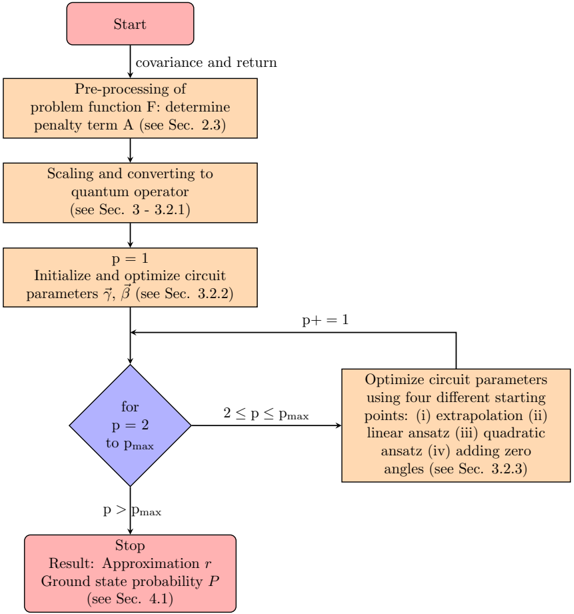
“The QAOA routine as proposed in [5] and which is used here to solve the feature selection problem is depicted in particularity is to find suitable candidates for initial values of the circuit parameters using four heuristic methods described in [5] In Fig.”
BackgroundMethodInfluentialSelf-citationQuantum Computing Approach to Realistic ESG-Friendly Stock Portfolios
Catalano, F., Nasello, L., & Guterding, D. (2024) · Risks · doi:10.3390/risks12040066 · Cited by 16
“Meanwhile, quantum annealers have been shown to provide quantum advantage for certain classically intractable problems [30] and seem to provide a promising platform for solving quadratic binary optimization and integer quadratic optimization, even in the presence of hard and weak constraints.”
BackgroundVariational-quantum-eigensolver–inspired optimization for spin-chain work extraction
Medina, I., Drinko, A., Correr, G. I., Azado, P. C., & Soares-Pinto, D. O. (2024) · Physical Review A · doi:10.1103/physreva.110.012443 · Cited by 14
Ji, Y., & Polian, I. (2024) · Entropy · doi:10.3390/e26070586 · Cited by 16
“The cost Hamiltonian, which describes the portfolio optimization problem for n available assets, is expressed as [47] The parameters c i , j and k i in Equation (1) depend on factors specific to the portfolio optimization problem, such as the covariance matrix and the return vector.”
BackgroundSelf-citationCadavid, A. G., Montalban, I., Dalal, A., Solano, E., & Hegade, N. N. (2024) · Physical Review Applied · doi:10.1103/physrevapplied.22.054037 · Cited by 22
Approaching Collateral Optimization for NISQ and Quantum-Inspired Computing (May 2023)
Giron, M. C., Korpas, G., Parvaiz, W., Malik, P., & Aspman, J. (2023) · IEEE Transactions on Quantum Engineering · doi:10.1109/tqe.2023.3314839 · Cited by 15
“…into three sections: stochastic modeling (for example, quantum alternatives to Monte Carlo simulations) [17], [18], [19], [20], machine learning [17], [18], [21], [22], [23], [24], and optimization [22], [25], [26], [27], [28], [29], [30], [31], all of which have had a recent gain in interest.”
BackgroundJi, Y., Koenig, K. F., & Polian, I. (2024) · Physical Review A · doi:10.1103/physreva.110.032421 · Cited by 12
“We now investigate the application of QAOA and DC-QAOA to solve the portfolio optimization problem that involves finding a portfolio that maximizes expected return while minimizing risk, subject to certain constraints [17, 57].”
BackgroundMethodSelf-citationTask-Driven Device Fingerprinting for Quantum Cloud Platforms via Modeling QNN Outcomes Under Noise
Li, T.-T., Zhao, Z.-M., & Yin, J.-W. (2025) · IEEE Transactions on Information Forensics and Security · doi:10.1109/tifs.2025.3620985 · Cited by 11
“(ii) Portfolio QAOA [62] is a variational hybrid quantum-classical algorithm that optimizes its output by alternating between mixing and cost unitaries.”
Machine learning of reduced quantum channels on noisy intermediate-scale quantum devices
Cemin, G., Cech, M., Weiss, E., Sołtan, S., Braun, D., Lesanovsky, I., & Carollo, F. (2024) · Physical Review A · doi:10.1103/physreva.110.052418 · Cited by 17
Self-citationA Layerwise-Multi-Angle Approach to Fine-Tuning the Quantum Approximate Optimization Algorithm
Lavagna, L., Ceschini, A., Rosato, A., & Panella, M. (2024) · International Joint Conference on Neural Networks (IJCNN) · doi:10.1109/ijcnn60899.2024.10650075 · Cited by 6
Wu, Q., Liu, W., Li, X., Su, Z., & Lei, J. (2025) · Engineering Applications of Artificial Intelligence · doi:10.1016/j.engappai.2025.111705 · Cited by 12
The Quantum Optimization Benchmarking Library
Koch, T., Neira, D. E. B., Chen, Y., Cortiana, G., Egger, D. J., Heese, R., Hegade, N. N., Cadavid, A. G., Huang, R. S., Itoko, T., et al. (2026) · Nature Computational Science · doi:10.1038/s43588-026-00991-1 · Cited by 82
“Another line of research has investigated how we may approach simple portfolio optimization instances with near-term compatible quantum algorithms 129–131 .”
Singamsetty, S., & Sanakkayala, S. (2026) · Multimedia Systems · doi:10.1007/s00530-025-02131-7 · Cited by 9
Demonstration of hardware efficient photonic variational quantum algorithm
Agresti, I., Paul, K., Schiansky, P., Steiner, S., Yin, Z., Pentangelo, C., Piacentini, S., Crespi, A., Ban, Y., Ceccarelli, F., et al. (2025) · Physical Review Research · doi:10.1103/d7bb-ybfh · Cited by 15
FrozenQubits: Boosting Fidelity of QAOA by Skipping Hotspot NodesPreprint
Ayanzadeh, R., Alavisamani, N., Das, P., & Qureshi, M. K. (2022) · Research Square · doi:10.21203/rs.3.rs-2252963/v1 · Cited by 6
Quantum Optimization Benchmarking Library - The Intractable Decathlon
Koch, T., Neira, D. E. B., Chen, Y., Cortiana, G., Egger, D. J., Heese, R., Hegade, N. N., Cadavid, A. G., Huang, R., Itoko, T., et al. (2025) · arXiv · doi:10.48550/arxiv.2504.03832 · Cited by 5
“Another line of research has investigated how we may approach simple portfolio optimization instances with near-term compatible quantum algorithms 129–131 .”
Inductive Construction of Variational Quantum Circuit for Constrained Combinatorial Optimization
Nakada, H., Tanahashi, K., & Tanaka, S. (2025) · IEEE Access · doi:10.1109/access.2025.3563960 · Cited by 7
“For example, several studies on QAOA have reported that mixer gates are modified so that transitions occur only between the states of feasible solutions [25]–[28].”
Quantum Computing Optimization: Application and Benchmark in Critical Infrastructure Assessment
Silva, G. S. M., & Droguett, E. L. (2024) · Annual Reliability and Maintainability Symposium (RAMS) · doi:10.1109/rams51492.2024.10457821 · Cited by 4
“For the unitary operation 𝑈 (cid:2869) , a common approach is to apply an 𝑅𝑋 gate parameterized by 𝜃 (cid:3404) 2 𝛽 (cid:3037) to each qubit in the system [8], as shown in Figure 1.”
MethodPulse-based variational quantum optimization and metalearning in superconducting circuits
Wang, Y., Ding, Y., Cárdenas-López, F. A., & Chen, X. (2024) · Physical Review Applied · doi:10.1103/physrevapplied.22.024009 · Cited by 9
Recompiling QAOA Circuits on Various Rotational Directions
Jang, E., Ha, D., Choi, S., Kim, Y., Kwon, J., Lee, Y., Ahn, S., Kim, H. J., & Ro, W. W. (2024) · International Conference on Parallel Architectures and Compilation Techniques (PACT) · doi:10.1145/3656019.3676899 · Cited by 8
LX-mixers for QAOA: Optimal mixers restricted to subspaces and the stabilizer formalism
Fuchs, F. G., & Bassa, R. P. (2024) · Quantum · doi:10.22331/q-2024-11-25-1535 · Cited by 17
“Applications of this approach include graph coloring problems, the traveling salesper-son problem [11], the Max-k-cut problem [8], portfolio optimization [2], and the tail-assignment problem [21].”
Hamiltonian-Based Quantum Reinforcement Learning for Neural Combinatorial Optimization
Kruse, G., Coelho, R., Roßkopf, A., Wille, R., & Lorenz, J. M. (2024) · IEEE International Conference on Quantum Computing and Engineering (QCE) · doi:10.1109/qce60285.2024.00189 · Cited by 9
“QAOA has been extensively studied in this context, particularly how to design cost and mixer Hamiltonians and its effect on solution quality [4].”
BackgroundSmall graph perturbations, QAOA, and the MaxCut problem
Lavagna, L., Piperno, S., Ceschini, A., & Panella, M. (2025) · AVS Quantum Science · doi:10.1116/5.0253160 · Cited by 3
Higher-Order Portfolio Optimization with Quantum Approximate Optimization Algorithm
Uotila, V., Ripatti, J., & Zhao, B. (2025) · IEEE International Conference on Quantum Computing and Engineering (QCE) · doi:10.1109/qce65121.2025.00244 · Cited by 16
“We assume that w ≥ 0 , which means that short selling is not allowed, which is a common assumption [2].”
Restricted global optimization for QAOA
Gleißner, P., Kruse, G., & Roßkopf, A. (2024) · APL Quantum · doi:10.1063/5.0189374 · Cited by 5
Time Series Forecasting Using Quantum Machine Learning Algorithms
Latheef, F. N., & Rubell Marion Lincy, G. (2025) · Algorithms for intelligent systems · doi:10.1007/978-981-97-6957-5_16 · Cited by 4
Choco-Q: Commute Hamiltonian-based QAOA for Constrained Binary Optimization
Xiang, D., Jiang, Q., Lu, L., Tan, S., & Yin, J. (2025) · IEEE International Symposium on High-Performance Computer Architecture (HPCA) · doi:10.1109/hpca61900.2025.00031 · Cited by 7
“In particular, the penalty-based method is a natural idea that inserts the constraint into the objective function as penalty terms [5], [10], [44].”
Zhang, Y., Zhao, J., Jia, Y., & Shen, X. (2025) · Quantum Information Processing · doi:10.1007/s11128-025-04776-9 · Cited by 7
“Moreover, many researchers have employed gra-123 dient methods such as Broyden-Fletcher-Goldfarb-Shanno (BFGS) [17], Sequential Least SQuares Programming (SLSQP) [18], on noiseless quantum simulators as classical optimizers for QAOA problem-solving tasks.”
Wei, H., Wang, Y. J., Yang, H., Yang, X., Cao, M., Xu, Q., Cai, M., Wang, Y., Mao, Z., Cao, X., et al. (2025) · Computational Economics · doi:10.1007/s10614-025-11061-5 · Cited by 3
“Additionally, QC exhibits significant advantages in address - ing Combinatorial Optimization Problems (COPs), which involve discrete vari - ables (Nielsen & Chuang, 2011; Brandhofer et al., 2022; Lu & Yang, 2024; Woerner & Egger, 2019; Orús et al., 2019).”
Dehn, V., Zaefferer, M., Hellstern, G., Jayadevan, K., Reiter, F., & Wellens, T. (2026) · Physical Review A · doi:10.1103/l5r4-zcqv · Cited by 12
“[23].”
Self-citationThe impact of optimization approximation algorithms on the performance of the BHT-QAOA
Al-Bayaty, A., & Perkowski, M. A. (2025) · Academia quantum. · doi:10.20935/acadquant7996 · Cited by 5
Fourier Analysis of Parameterized Quantum Circuits and the Barren Plateau Problem
Okumura, S., & Ohzeki, M. (2026) · Journal of the Physical Society of Japan · doi:10.7566/jpsj.95.033002 · Cited by 10
“Parameterized quantum circuits (PQCs) serve as their core, forming the basis of the variational quantum eigensolver (VQE), 5) quantum approximate optimization algorithm (QAOA), 6) and quantum neural networks (QNNs), 7,8) applied across fields such as finance 9,10) and quantum chemistry.”
Quantifying the advantages of applying quantum approximate algorithms to portfolio optimisation
Yuan, H., Long, C. K., Lepage, H. V., & Barnes, C. H. W. (2026) · Quantum Science and Technology · doi:10.1088/2058-9565/ae4a48 · Cited by 15
Constraint-aware quantum optimization via Hamming weight operators
Hao, Y., Ding, Q., Yuan, X., & Wang, X. (2026) · Science China Physics Mechanics and Astronomy · doi:10.1007/s11433-025-2895-4 · Cited by 6
Wang, A., & Zhou, Q. (2025) · International Conference on Intelligent Computing and Robotics (ICICR) · doi:10.1109/icicr65456.2025.00119 · Cited by 2
“For the portfolio optimization problem, Brandhofer et al. [6] tested the portfolio optimization performance with QAOA, defining a standard that distinguishes between "simple" and "difficult" examples of portfolio optimization problems.”
Neurodynamic Approaches to Cardinality-Constrained Portfolio Optimization
Leung, M.-F., & Wang, J. (2024) · Intelligent systems reference library · doi:10.1007/978-3-031-61037-0_3 · Cited by 2
Algorithm-Aware Qubit MappingPreprint
Ji, Y., & Polian, I. (2023) · doi:10.36227/techrxiv.21786146 · Cited by 1
Self-citationHa, H. P. N., Nguyễn, V. H., & Ta, A. S. (2024) · Lecture notes in computer science · doi:10.1007/978-3-031-62912-9_24 · Cited by 1
Conditional diffusion-based parameter generation for quantum approximate optimization algorithm
Meng, F., Zhou, X., Zhu, P., & Luo, Y. (2025) · EPJ Quantum Technology · doi:10.1140/epjqt/s40507-025-00397-4 · Cited by 12
Mooney, G. J., Villanueva, J., Bardhan, B. R., Ghosh, J., Hill, C. D., & Hollenberg, L. C. L. (2026) · Physical Review Research · doi:10.1103/xv79-w3rs · Cited by 4
“Optimisation problems are generally broadly applicable and often difficult to solve exactly, in many cases they can be efficiently mapped to quantum algorithms [2–5].”
Multiclass portfolio optimization via variational quantum Eigensolver with Dicke state ansatz
Scursulim, J. V. S., Langeloh, G. M., Beltran, V. L., & Brito, S. (2026) · Scientific Reports · doi:10.1038/s41598-026-36333-4 · Cited by 6
Thomassin, P., Guérard, G., Djebali, S., & Lambert, V. M. (2025) · Quantum Machine Intelligence · doi:10.1007/s42484-025-00330-z · Cited by 3
“This research introduces a quantum framework that integrates the Markowitz port-folio theory with the Quantum Approximate Optimization Algorithm (QAOA) [7].”
Approximate quadratization of high-order Hamiltonians for combinatorial quantum optimization
Drăgoi, S., Baiardi, A., & Egger, D. J. (2026) · Physical Review Research · doi:10.1103/9rc4-vj11 · Cited by 10
Beevi, L. S., Bhama, P. R. K. S., Prathap, P. M. J., Mosses, A., & Dani, W. V. (2025) · International Conference on Computing and Communications (COMPUTINGCON) · doi:10.1109/computingcon64838.2025.11377746 · Cited by 1
“This collaboration offers not only better optimization, but also increased security and accountability in inventory operations [7].”
Iterative Interpolation Schedules for Quantum Approximate Optimization Algorithm
Apte, A., Sureshbabu, S. H., Shaydulin, R., Boulebnane, S., He, Z., Herman, D., Sud, J., & Pistoia, M. (2026) · ACM Transactions on Quantum Computing · doi:10.1145/3815778 · Cited by 17
“This contrasts with most other combinatorial optimization problems such as the traveling salesman problem, where instances depend on additional details like the structure of a graph.”
Mayaluri, Z. L., & Mishra, S. (2026) · Quantum Economics and Finance · doi:10.1177/29767032261470810 · Cited by 1
Quantum computing in finance: a literature review and future directions for trustworthy financial AI
Muzzioli, S., Raheem, F., Ferrara, M., Giudici, P., & Siciliano, R. (2026) · Frontiers in Artificial Intelligence · doi:10.3389/frai.2026.1929828 · Cited by 1
“Brandhofer et al. (2023) provided rigorous benchmarking, concluding that at current qubit counts the method functions as a heuristic competitive with classical heuristics on small instances but performance improves systematically with circuit depth.”
Compressed sensing enhanced by a quantum approximate optimization algorithm
Chevalier, B., Roga, W., & Takeoka, M. (2024) · Physical Review A · doi:10.1103/physreva.110.062410 · Cited by 4
Wang, Z., He, Y., Long, Y., & Luan, T. (2025) · Entropy · doi:10.3390/e27030240 · Cited by 1
“For the QAOA module, we set the Dicked state which satisfies the budget constraints as the initial state [8].”
Progressive quantum algorithm for maximum independent set with quantum alternating operator ansatz
Ni, X., 李, L.-X. 凌. L., Song, Y., 金, Z.-P. 正. J., Qin, S., & Gao, F. (2025) · Chinese Physics B · doi:10.1088/1674-1056/addd83 · Cited by 12
Algorithm-Aware Qubit MappingPreprint
Ji, Y., & Polian, I. (2022) · doi:10.36227/techrxiv.21786146.v1 · Cited by 2
Self-citationAlgorithm-Aware Qubit MappingPreprint
Ji, Y., & Polian, I. (2023) · doi:10.36227/techrxiv.21786146.v2
Self-citationImprove the Quantum Approximate Optimization Algorithm with Genetic Algorithm
Phuc, N. H. H., Ta, A. S., & Nguyễn, V. H. (2023) · International Symposium on Information and Communication Technology · doi:10.1145/3628797.3628818 · Cited by 1
Hamiltonian Minimization in the NISQ EraPreprint
da Silva, R. P. (2023) · SSRN Electronic Journal · doi:10.2139/ssrn.4652979
Redesign of the Last Mile Delivery Network Using Quantum Alternating Operator Ansatz
Malviya, G., Agarwal, P., & Sinha, S. K. (2024) · International Conference on Communication Systems & Networks (COMSNETS) · doi:10.1109/comsnets59351.2024.10427505 · Cited by 2
“A few examples of QAOA applications to planning problems are flight-gate assignment [8] and port-folio optimization [9].”
BackgroundMethodA hybrid quantum-classical approach to warm-starting optimization
Dehn, V., & Wellens, T. (2024) · Quantum Computing, Communication, and Simulation · doi:10.1117/12.3002220 · Cited by 4
“The solution of the relaxed problem, which is used to initialize the warm-start QAOA, is obtained using a gradient-based optimizer, whereas a gradient-free optimizer was chosen for the classical subroutine of QAOA (see [19] for details).”
BackgroundMethodSelf-citationJi, Y., & Polian, I. (2024) · OPUS Publication Server of the University of Stuttgart (University of Stuttgart) · doi:10.18419/opus-14924
Self-citationDrinko, A., Correr, G. I., Medina, I., Azado, P. C., Canabarro, A., & Soares-Pinto, D. O. (2024) · Research Square · doi:10.21203/rs.3.rs-4803120/v1 · Cited by 1
Drinko, A., Correr, G. I., Medina, I., Azado, P. C., Canabarro, A., & Soares-Pinto, D. O. (2025) · AVS Quantum Science · doi:10.1116/5.0247631 · Cited by 2
Langfitt, Q., Tate, R., & Eidenbenz, S. (2025) · International Conference on Quantum Communications, Networking, and Computing (QCNC) · doi:10.1109/qcnc64685.2025.00016 · Cited by 4
“Also, the global optimum will on average occur near zero for non-periodic functions [4], [5], [19].”
Difference of Convex Algorithm for Warm‐Start Quantum Approximate Optimization Algorithm
Huy, P. N. H., Nguyễn, V. H., & Ta, A. S. (2025) · Advanced Quantum Technologies · doi:10.1002/qute.202400253
Quantum optimization techniques and applications
Lee, E., & Kim, S. (2025) · Advances in computers · doi:10.1016/bs.adcom.2025.06.001 · Cited by 1
Data-efficient quantum noise modeling via machine learning
Ji, Y., Roth, M., Kreplin, D. A., Polian, I., & Wilhelm, F. K. (2026) · Physical Review Applied · doi:10.1103/5r9m-y6z6 · Cited by 6
“…[1], variational algorithms exemplified by the quantum approximate optimization algorithm (QAOA) [2] and the variational quantum eigensolver (VQE) [3] have been explored for diverse applications, including portfolio optimization [4], unit commitment in power systems [5], and quantum chemistry [6].”
Self-citationQuantum Optimization of Currency Arbitrage via Graph-Informed Entanglement Strategies
Moreign, V., & Chan, M. (2025) · ACM International Conference on AI in Finance (ICAIF) · doi:10.1145/3768292.3770352
Retracted: Quantum Computing-Enhanced Portfolio Optimization System for Financial Risk Management
Prabha, C., Kumar, S., Kumar, A., Singh, R., Gupta, V., & Gupta, V. K. (2025) · International Conference on Recent Innovation in Science Engineering and Technology (ICRISET) · doi:10.1109/icriset64803.2025.11253599
RetractedTowards Solving Large QUBO Problems Using Quantum Algorithms: Improving the LogQ Scheme
Chatterjee, Y., & Messud, J. (2025) · IEEE International Conference on Quantum Computing and Engineering (QCE) · doi:10.1109/qce65121.2025.00218 · Cited by 2
“In practice, p is chosen heuristically (often linearly in n [16], [17]) and Θ ∗ is found by classical optimization, hoping that the highest probability measurement of | φ (Θ ∗ ) ⟩ gives the solution to the MaxCut problem.”
Probing entanglement and parameter sensitivity in QAOA via Quantum Fisher Information
Sarmina, B. G., Benavides, J. S., Sun, G.-H., & Dong, S. (2025) · Quantum Review Letters · doi:10.1016/j.qrl.2025.12.001 · Cited by 4
Jiang, Q., Lu, L., Xiang, D., Chu, T., Zhu, T., Leng, J., Liang, Y. E., Sun, X., & Yin, J. (2025) · IEEE/ACM International Symposium on Microarchitecture (MICRO) · doi:10.1145/3725843.3756107 · Cited by 1
Aggarwal, A., Shrivastava, P., Kler, R., & Agarwal, P. (2025) · IEEE Uttar Pradesh Section Women in Engineering International Conference on Electrical, Electronics and Computer Engineering (UPWIECON) · doi:10.1109/upwiecon67212.2025.11390104
“Within that space, one algorithm, QAOA, stands out because it has a hybrid nature—classical parameter optimization and quantum state evolution [17],. Binary combinatorial problems are a domain where QAOA is particularly effective at solving and it runs natively on QUBO formulations of these…”
Quantum approximate optimization algorithm for the tactical clustering and grouping problems
Xiaoting, H., Kouquan, Z., Feng, J., Manhong, H., & Yijun, Z. (2026) · Acta Physica Sinica · doi:10.7498/aps.75.20251690
QAOA-Driven PMU placement optimization with graph learning-based parameter initialization refinement
Jiang, Y., Wang, X., Liang, Z., Li, Y., Morstyn, T., Lopes, P. L. S., & Brandsema, M. J. (2026) · Quantum Machine Intelligence · doi:10.1007/s42484-026-00354-z · Cited by 1
“…remains instance-specific, which underscores the need for clear use cases and tailored benchmarks to guide the co-evolution of quantum hardware and algo-rithm design (Mandelbaum et al. 2025; Wurtz et al. 2023; Arute et al. 2019; Blekos et al. 2024; Brandhofer et al. 2023; Bucher et al. 2024).”
Enhancing QAOA Ansatz via Multi-Parameterized Layer and Blockwise Optimization
Falco, F. D., Lavagna, L., Ceschini, A., Rosato, A., & Panella, M. (2026) · IEEE International Conference on Acoustics, Speech, and Signal Processing · doi:10.1109/icassp55912.2026.11461345 · Cited by 2
Quantum machine learning for complex systems: paradigms, applications, and challenges
Singh, V., Bhatia, A. S., Saggi, M. K., Sajjan, M., & Kais, S. (2026) · Academia quantum. · doi:10.20935/acadquant8243 · Cited by 5
“As a result, QML is now being explored across diverse domains, including drug discovery [12], healthcare [5, 7, 36], life-science [35, 52, 55], semiconductor [8], cybersecurity[51], and Finance Portfolio optimization [16].”
Self-citationSuresh, S., & Anand, G. P. (2026) · Quantum Machine Intelligence · doi:10.21203/rs.3.rs-9533781/v1
Linear-optical schemes to postselect high-dimensional Dicke states
Bhatti, D., Munro, W. J., & Chin, S. (2026) · Physical Review A · doi:10.1103/xlzr-7qvz
“Recently, Dicke states have received attention in the context of variational quantum computing [20].”
Large-scale portfolio optimization with variational neural annealing
Ranabhat, N., Javanparast, B., Goerz, D., & Inack, E. (2025) · Physical Review E · doi:10.1103/p22k-x7p6 · Cited by 1
Metadata
- Authors
- Brandhofer, S., Braun, D., Dehn, V., Hellstern, G., Hüls, M., Ji, Y., Polian, I., Bhatia, A. S., & Wellens, T.
- Affiliations
- University of Stuttgart (DE)
- University of Tübingen (DE)
- Fraunhofer Institute for Applied Solid State Physics (DE)
- Ravensburg University of Cooperative Education (DE)
- Corresponding author
- Dehn, Vanessa
- ORCID
- Venue
- Quantum Information Processing
- Published
- 2022-12-16
- Volume
- 22
- Issue
- 1
- ISSN
- 1570-0755 (ISSN-L)
- 1573-1332
- OpenAlex
- W4313293044
- Semantic Scholar
- 27585eba1bf58fcb75b0c170f4e9ec08868f2d40
- Cited by
- 106
- References
- 26
- Citations by year
- 2026: 27 · 2025: 32 · 2024: 32 · 2023: 12 · 2022: 3
- FWCI
- 6.50
- Type
- journal article
- Language
- en
- Open access
- hybrid
- doi.org
- Licence
- cc-by
- creativecommons.org/licenses/by/4.0 (tdm)
- creativecommons.org/licenses/by/4.0 (vor)
- Locations
- Quantum Information Processing (publishedVersion, cc-by)
- arXiv (Cornell University) (submittedVersion)
- Fraunhofer-Publica (Fraunhofer-Gesellschaft) (submittedVersion)
- arXiv (Cornell University) (cc-by)
- Funders
- Ministerium für Wirtschaft, Arbeit und Wohnungsbau Baden-Württemberg (QORA)
- Topics
- Physical Sciences › Computer Science › Artificial Intelligence › Quantum Computing Algorithms and Architecture
- Social Sciences › Decision Sciences › Management Science and Operations Research › Risk and Portfolio Optimization
- Physical Sciences › Physics and Astronomy › Atomic and Molecular Physics, and Optics › Quantum Information and Cryptography
- Keywords
- portfolio optimization, quantum approximate optimization algorithm, variational formulation, parameter optimization, NISQ devices, shot noise, benchmarking
About these checks
Registry, retraction, Cites and statistics results are computed, not judged, with one exception: a printed reference that no index lists is read once by a model before it counts as a citation error. Claims are extracted by a model and kept only when their quote appears verbatim in the text; each cited source is then checked, with a model’s help, for whether it says what the claim relies on. Those verdicts can be wrong — read the claim’s quote and the cited source before relying on one.
Statistics and arithmetic are recomputed, not judged.
Confidence bands are shown only for fields calibrated on our annotated test set. None is calibrated yet, so no band is shown.
What counts as a claim ›How we measure confidence ›How we check this ›
Are you an author, or do you see a problem with this page? Request a review
Data sources
Bibliographic data: Semantic Scholar, OpenAlex, Crossref.
Contains information from the Semantic Scholar Academic Graph Datasets, made available under the ODC Attribution License (ODC-BY 1.0).
Semantic Scholar’s data is described in: Kinney, R., et al. (2023). The Semantic Scholar Open Data Platform. arXiv:2301.10140.
