

Benchmarking the performance of portfolio optimization with QAOA
Open accessThe DOI matches its Crossref record; 28 of the 28 references it cites were found in a registry or an index.
Abstract
We present a detailed study of portfolio optimization using different versions of the quantum approximate optimization algorithm (QAOA). For a given list of assets, the portfolio optimization problem is formulated as quadratic binary optimization constrained on the number of assets contained in the portfolio. QAOA has been suggested as a possible candidate for solving this problem (and similar combinatorial optimization problems) more efficiently than classical computers in the case of a sufficiently large number of assets. However, the practical implementation of this algorithm requires a careful consideration of several technical issues, not all of which are discussed in the present literature. The present article intends to fill this gap and thereby provides the reader with a useful guide for applying QAOA to the portfolio optimization problem (and similar problems). In particular, we will discuss several possible choices of the variational form and of different classical algorithms for finding the corresponding optimized parameters. Viewing at the application of QAOA on error-prone NISQ hardware, we also analyse the influence of statistical sampling errors (due to a finite number of shots) and gate and readout errors (due to imperfect quantum hardware). Finally, we define a criterion for distinguishing between ‘easy’ and ‘hard’ instances of the portfolio optimization problem.
Overview
The claims and statistics of this paper haven’t been checked yet.
Free: it reads the open-access text and checks the first 5 claims that cite a source we can check. Create a free account to check every claim.
Integrity signals
Registry
Cites
Statistics
Figures
Verification
Claims the paper makes
The claims and statistics of this paper haven’t been checked yet.
Free: it reads the open-access text and checks the first 5 claims that cite a source we can check. Create a free account to check every claim.
Self-check
Percentages, sums and reported differences re-computed from the paper’s own numbers.
The self-check needs the paper’s full text.
Citations
Cites
Polynomial-time algorithms for prime factorization and discrete logarithms on a quantum computer
Shor, P. W. (1997) · SIAM Journal on Computing · doi:10.1137/s0097539795293172 · Cited by 8,472 · cited 2×
“This expectation is based upon the fact the quantum circuits required for QAOA are shorter than those of other algorithms, e.g the Shor [3] or HHL [4] algorithm, for which an exponential advantage compared to classical algorithms can be proven (under the assumption that quantum computers with sufficiently many error-cor…”
BackgroundCoherence in Spontaneous Radiation Processes
Dicke, R. H. (1954) · Physical Review · doi:10.1103/physrev.93.99 · Cited by 7,445 · cited 2×
“Another reason for aworsening performance ofXY -mixers under higher noise levels in terms of both approximation ratio and ground state probability is their reliance on Dicke states [22] (see Sect.”
BackgroundQuantum Algorithm for Linear Systems of Equations
Harrow, A. W., Hassidim, A., & Lloyd, S. (2009) · Physical Review Letters · doi:10.1103/physrevlett.103.150502 · Cited by 3,325 · cited 2×
“This expectation is based upon the fact the quantum circuits required for QAOA are shorter than those of other algorithms, e.g the Shor [3] or HHL [4] algorithm, for which an exponential advantage compared to classical algorithms can be proven (under the assumption that quantum computers with sufficiently many error-cor…”
BackgroundA Quantum Approximate Optimization Algorithm
Farhi, E., Goldstone, J., & Gutmann, S. (2014) · arXiv · doi:10.48550/arxiv.1411.4028 · Cited by 1,789 · cited 4×
“In the originally proposed [1] version of QAOA (M = standard), the mixing operation is realized by single-qubit rotations applied to each qubit:”
BackgroundMethodInfluentialPowell, M. J. D. (1994) · Advances in Optimization and Numerical Analysis · doi:10.1007/978-94-015-8330-5_4 · Cited by 1,369 · cited 1×
“The classical optimizer COBYLA [23] was used.”
Zhou, L., Wang, S.-T., Choi, S., Pichler, H., & Lukin, M. D. (2020) · Physical Review X · doi:10.1103/physrevx.10.021067 · Cited by 913 · cited 6×
“Of crucial importance are the initial values of the circuit parameters γ and β fed into the classical optimization routine: similarly to [7], we perform the optimization for increasing values of the QAOA depth p, using an extrapolation method to deduce initial values from the optimized values of γ and β obtained previ…”
BackgroundMethodInfluentialNoise-Induced Barren Plateaus in Variational Quantum Algorithms
Wang, S., Fontana, E., Cerezo, M., Sharma, K., Sone, A., Cincio, L., & Coles, P. J. (2020) · arXiv · doi:10.48550/arxiv.2007.14384 · Cited by 791 · cited 1×
“These effects impair the ability of the classical optimization algorithms to converge to the global minimum of the expectation value, eventually leading to a noise-induced barren plateau that incurs an exponential runtime overhead [22].”
BackgroundNoise-induced barren plateaus in variational quantum algorithms
Wang, S., Fontana, E., Cerezo, M., Sharma, K., Sone, A., Cincio, L., & Coles, P. J. (2021) · Nature Communications · doi:10.1038/s41467-021-27045-6 · Cited by 773 · cited 1×
“These effects impair the ability of the classical optimization algorithms to converge to the global minimum of the expectation value, eventually leading to a noise-induced barren plateau that incurs an exponential runtime overhead [22].”
BackgroundFrom the Quantum Approximate Optimization Algorithm to a Quantum Alternating Operator Ansatz
Hadfield, S., Wang, Z., O’Gorman, B., Rieffel, E. G., Venturelli, D., & Biswas, R. (2019) · Algorithms · doi:10.3390/a12020034 · Cited by 772 · cited 3×
“(2), are populated during the algorithm [2, 16].”
BackgroundMethodTraining Variational Quantum Algorithms Is NP-Hard
Bittel, L., & Kliesch, M. (2021) · Physical Review Letters · doi:10.1103/physrevlett.127.120502 · Cited by 398 · cited 1×
“Since QAOA involves a numerical classical optimization of variational circuit parameters (which, in itself, is an NP-hard problem [5]), analytical results concerning the performance of QAOA for a large number of qubits are not available.”
BackgroundQuantum Computing for Finance: State-of-the-Art and Future Prospects
Egger, D. J., Gambella, C., Marecek, J., McFaddin, S., Mevissen, M., Raymond, R., Simonetto, A., Woerner, S., & Yndurain, E. (2020) · IEEE Transactions on Quantum Engineering · doi:10.1109/tqe.2020.3030314 · Cited by 366
QAOA for Max-Cut requires hundreds of qubits for quantum speed-up
Guerreschi, G. G., & Matsuura, A. Y. (2019) · Scientific Reports · doi:10.1038/s41598-019-43176-9 · Cited by 337 · cited 2×
“Nevertheless, extrapolations of results obtained for small numbers of qubits towards larger numbers suggest that a quantum speed-up (for the Max-Cut problem) could be expected with several hundred qubits [6].”
BackgroundHeuristic algorithms for the portfolio selection problem with minimum transaction lots
Mansini, R., & Speranza, M. G. (1999) · European Journal of Operational Research · doi:10.1016/s0377-2217(98)00252-5 · Cited by 272 · cited 1×
“Whereas [7] contains an in-depth study of the performance of QAOA on rather abstract MaxCut problems, the present paper provides a similar analysis for the use case of portfolio optimization, which constitutes one of the most discussed problems in finance [8–11].”
MethodXY mixers: Analytical and numerical results for the quantum alternating operator ansatz
Wang, Z., Rubin, N. C., Dominy, J. M., & Rieffel, E. G. (2020) · Physical Review A · doi:10.1103/physreva.101.012320 · Cited by 190 · cited 1×
“(2), are populated during the algorithm [2, 16].”
Kalayci, C. B., Ertenlice, O., & Akbay, M. A. (2019) · Expert Systems with Applications · doi:10.1016/j.eswa.2019.02.011 · Cited by 182 · cited 1×
“Whereas [7] contains an in-depth study of the performance of QAOA on rather abstract MaxCut problems, the present paper provides a similar analysis for the use case of portfolio optimization, which constitutes one of the most discussed problems in finance [8–11].”
MethodMugel, S., Kuchkovsky, C., Sánchez, E., Fernández-Lorenzo, S., Luis-Hita, J., Lizaso, E., & Orús, R. (2022) · Physical Review Research · doi:10.1103/physrevresearch.4.013006 · Cited by 124
Constraint Preserving Mixers for the Quantum Approximate Optimization Algorithm
Fuchs, F. G., Lye, K. O., Nilsen, H. M., Stasik, A. J., & Sartor, G. (2022) · Algorithms · doi:10.3390/a15060202 · Cited by 121 · cited 1×
“The superiority of the full XY mixer (and its variant QAMPA) as compared to the ring mixers can be traced back to their higher degree of symmetry [20].”
BackgroundPortfolio rebalancing experiments using the Quantum Alternating Operator AnsatzPreprint
Hodson, M. J., Ruck, B., Ong, H., Garvin, D., & Dulman, S. (2019) · arXiv (Cornell University) · doi:10.48550/arxiv.1911.05296 · Cited by 101 · cited 3×
“In addition to previous works on portfolio optimization by QAOA [12–14], the present paper therefore focuses on a number of technical issues relevant for the practical implementation of QAOA, not all of which are discussed in the present literature.”
BackgroundMethodPortfolio Optimisation Using the D-Wave Quantum Annealer
Phillipson, F., & Bhatia, H. S. (2021) · Lecture notes in computer science · doi:10.1007/978-3-030-77980-1_4 · Cited by 96
Linear and Mixed Integer Programming for Portfolio Optimization
Mansini, R., Ogryczak, W., & Speranza, M. G. (2015) · EURO advanced tutorials on operational research · doi:10.1007/978-3-319-18482-1 · Cited by 85
Parameterized Hamiltonian Learning With Quantum Circuit
Shi, J., Wang, W., Lou, X., Zhang, S., & Li, X. (2022) · IEEE Transactions on Pattern Analysis and Machine Intelligence · doi:10.1109/tpami.2022.3203157 · Cited by 75
Preparing Dicke States on a Quantum Computer
Mukherjee, C. S., Maitra, S., Gaurav, V., & Roy, D. (2020) · IEEE Transactions on Quantum Engineering · doi:10.1109/tqe.2020.3041479 · Cited by 63 · cited 1×
“for XY -mixers must be prepared by more complex gate sequences, including multiple layers of two-qubit gates [29].”
BackgroundDetemple, J. B. (2012) · Journal of Optimization Theory and Applications · doi:10.1007/s10957-012-0208-1 · Cited by 56
The Quantum Alternating Operator Ansatz on Maximum k-Vertex Cover
Cook, J., Eidenbenz, S., & Bartschi, A. (2020) · 2020 IEEE International Conference on Quantum Computing and Engineering (QCE) · doi:10.1109/qce49297.2020.00021 · Cited by 55 · cited 2×
“This can simply be explained by the fact that, in the case of the XY -mixers, the optimization is restricted to a smaller space [24], since, in contrast to the standard mixer, all unfeasible portfolios (i.”
BackgroundQuantum walk-based portfolio optimisation
Slate, N., Matwiejew, E., Marsh, S., & Wang, J. B. (2021) · Quantum · doi:10.22331/q-2021-07-28-513 · Cited by 54
Baker, J. S., & Radha, S. K. (2022) · RePEc: Research Papers in Economics · doi:10.48550/arxiv.2202.06782 · Cited by 43 · cited 3×
“In addition to previous works on portfolio optimization by QAOA [12–14], the present paper therefore focuses on a number of technical issues relevant for the practical implementation of QAOA, not all of which are discussed in the present literature.”
BackgroundMethodQuantum Circuit Learning with Parameterized Boson Sampling
Shi, J., Tang, Y., Lu, Y., Feng, Y., Shi, R., & Zhang, S. (2021) · IEEE Transactions on Knowledge and Data Engineering · doi:10.1109/tkde.2021.3095103 · Cited by 37 · cited 1×
“Similar approaches, where optimized parameters of a quantum circuit are found in a hybrid quantum classical process, are also used in other fields such as quantum circuit learning [19] or Hamiltonian learning [20].”
MethodMixer-phaser Ansätze for quantum optimization with hard constraints
LaRose, R., Rieffel, E. G., & Venturelli, D. (2022) · Quantum Machine Intelligence · doi:10.1007/s42484-022-00069-x · Cited by 23 · cited 14×
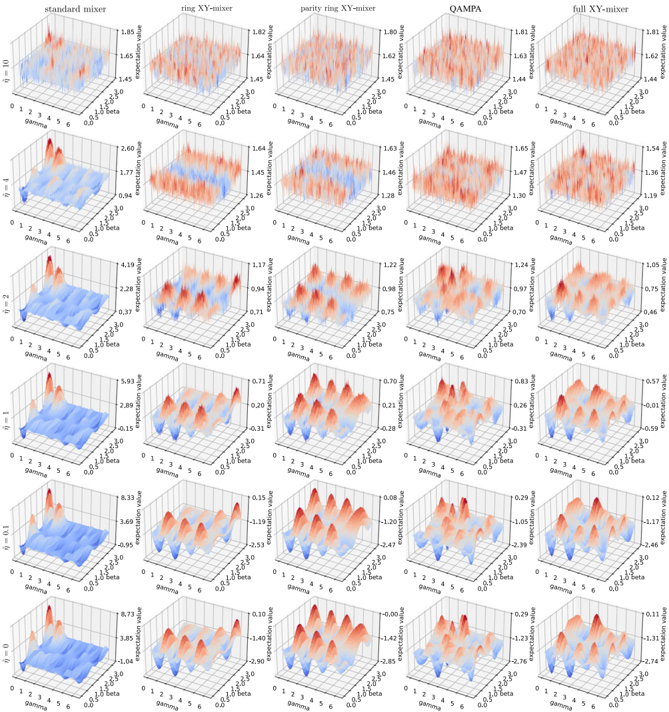
“5 Expectation value of the investigated QAOA instance for the standard mixer, the ring XY-mixer, the parity ring XY-mixer, the QAMPA, and the full XY-mixer (from left to right) and noise strength ˜ η ∈ { 0 , 0 .”
MethodInfluential
Research works printed but not linked: 2
- Markowitz, H.: Portfolio selection. J. Finance 7, 77 (1952)
- Nielsen, M.A., Chuang, I.L.: Quantum Computation and Quantum Information: 10th Anniversary Edition. Cambridge University Press, Cambridge (2010)
Cited by
Quantum Computational Finance: Quantum Algorithm for Portfolio Optimization
Rebentrost, P., & Lloyd, S. (2024) · KI - Künstliche Intelligenz · doi:10.1007/s13218-024-00870-9 · Cited by 94
“[52] discusses sampling and device errors.”
Best practices for portfolio optimization by quantum computing, experimented on real quantum devices
Buonaiuto, G., Gargiulo, F., Pietro, G. D., Esposito, M., & Pota, M. (2023) · Scientific Reports · doi:10.1038/s41598-023-45392-w · Cited by 121
“Quantum Approximate Optimization algorithms (QAOA) employ two types of quantum gates, a mixer Hamiltonian that facilitates parameterized mixing of quantum states, and a cost Hamiltonian that entails the optimization problem 18,19 .”
MethodNaik, A. S., Yeniaras, E., Hellstern, G., Prasad, G., & Vishwakarma, S. (2025) · Financial Innovation · doi:10.1186/s40854-025-00751-6 · Cited by 106
Self-citationQuantum Optimization: Potential, Challenges, and the Path Forward
Abbas, A., (NNSA), U. N. N. S. A., Ambainis, A., Augustino, B., Bärtschi, A., Buhrman, H., Coffrin, C., Cortiana, G., Dunjko, V., Egger, D., et al. (2023) · OSTI OAI (U.S. Department of Energy Office of Scientific and Technical Information) · doi:10.2172/2229681 · Cited by 67
Alignment between initial state and mixer improves QAOA performance for constrained optimization
He, Z., Shaydulin, R., Chakrabarti, S., Herman, D., Li, C., Sun, Y., & Pistoia, M. (2023) · npj Quantum Information · doi:10.1038/s41534-023-00787-5 · Cited by 48
“[25, 34, 69].”
Background
Metadata
- Authors
- Brandhofer, S., Braun, D., Dehn, V., Hellstern, G., Hüls, M., Ji, Y., Polian, I., Bhatia, A. S., & Wellens, T.
- Affiliations
- University of Stuttgart (DE)
- University of Tübingen (DE)
- Fraunhofer Institute for Applied Solid State Physics (DE)
- Ravensburg University of Cooperative Education (DE)
- Corresponding author
- Dehn, Vanessa
- ORCID
- Venue
- Quantum Information Processing
- Published
- 2022-12-16
- Volume
- 22
- Issue
- 1
- ISSN
- 1570-0755 (ISSN-L)
- 1573-1332
- OpenAlex
- W4313293044
- Semantic Scholar
- 27585eba1bf58fcb75b0c170f4e9ec08868f2d40
- Cited by
- 106
- References
- 26
- Citations by year
- 2026: 27 · 2025: 32 · 2024: 32 · 2023: 12 · 2022: 3
- FWCI
- 6.50
- Type
- journal article
- Language
- en
- Open access
- hybrid
- doi.org
- Licence
- cc-by
- creativecommons.org/licenses/by/4.0 (tdm)
- creativecommons.org/licenses/by/4.0 (vor)
- Locations
- Quantum Information Processing (publishedVersion, cc-by)
- arXiv (Cornell University) (submittedVersion)
- Fraunhofer-Publica (Fraunhofer-Gesellschaft) (submittedVersion)
- arXiv (Cornell University) (cc-by)
- Funders
- Ministerium für Wirtschaft, Arbeit und Wohnungsbau Baden-Württemberg (QORA)
- Topics
- Physical Sciences › Computer Science › Artificial Intelligence › Quantum Computing Algorithms and Architecture
- Social Sciences › Decision Sciences › Management Science and Operations Research › Risk and Portfolio Optimization
- Physical Sciences › Physics and Astronomy › Atomic and Molecular Physics, and Optics › Quantum Information and Cryptography
- Keywords
- portfolio optimization, quantum approximate optimization algorithm, variational formulation, parameter optimization, NISQ devices, shot noise, benchmarking
About these checks
Registry, retraction, Cites and statistics results are computed, not judged, with one exception: a printed reference that no index lists is read once by a model before it counts as a citation error. Claims are extracted by a model and kept only when their quote appears verbatim in the text; each cited source is then checked, with a model’s help, for whether it says what the claim relies on. Those verdicts can be wrong — read the claim’s quote and the cited source before relying on one.
Statistics and arithmetic are recomputed, not judged.
Confidence bands are shown only for fields calibrated on our annotated test set. None is calibrated yet, so no band is shown.
What counts as a claim ›How we measure confidence ›How we check this ›
Are you an author, or do you see a problem with this page? Request a review
Data sources
Bibliographic data: Semantic Scholar, OpenAlex, Crossref.
Contains information from the Semantic Scholar Academic Graph Datasets, made available under the ODC Attribution License (ODC-BY 1.0).
Semantic Scholar’s data is described in: Kinney, R., et al. (2023). The Semantic Scholar Open Data Platform. arXiv:2301.10140.
