

Is it all hype? ChatGPT’s performance and disruptive potential in the accounting and auditing industries
Open accessThe DOI matches its Crossref record; 92 of the 96 references it cites were found in a registry or an index, and 4 are not checked yet; 9 of the 52 sources its claims cite were checked for support.
Abstract
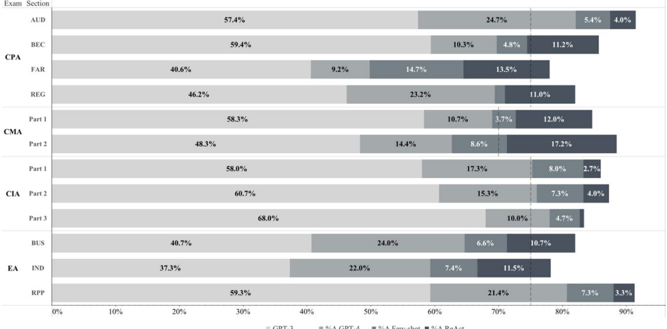
ChatGPT frequently appears in the media, with many predicting significant disruptions, especially in the fields of accounting and auditing. Yet research has demonstrated relatively poor performance of ChatGPT on student assessment questions. We extend this research to examine whether more recent ChatGPT models and capabilities can pass major accounting certification exams including the Certified Public Accountant (CPA), Certified Management Accountant (CMA), Certified Internal Auditor (CIA), and Enrolled Agent (EA) certification exams. We find that the ChatGPT 3.5 model cannot pass any exam (average score across all assessments of 53.1%). However, with additional enhancements, ChatGPT can pass all sections of each tested exam: moving to the ChatGPT 4 model improved scores by an average of 16.5%, providing 10-shot training improved scores an additional 6.6%, and allowing the model to use reasoning and acting (e.g., allow ChatGPT to use a calculator and other resources) improved scores an additional 8.9%. After all these improvements, ChatGPT passed all exams with an average score of 85.1%. This high performance indicates that ChatGPT has sufficient capabilities to disrupt the accounting and auditing industries, which we discuss in detail. This research provides practical insights for accounting professionals, investors, and stakeholders on how to adapt and mitigate the potential harms of this technology in accounting and auditing firms.
Verified 2026-11-25 · 4 references not checked yet
Overview
CoChat Summary
TL;DR
ChatGPT 3.5 could not pass any major accounting certification exam (average 53.1%), but ChatGPT 4 with 10-shot training and ReAct agents passed all tested sections with an average score of 85.1%. The authors argue this performance indicates ChatGPT has sufficient capability to disrupt accounting and auditing, while cautioning that hype and limitations remain.
Key findings
- ChatGPT 3.5 averaged 53.1% across all tested exam sections and did not pass any section; scores ranged from 37.3% on EA Individuals to 68.0% on CIA Part 3.
- Moving to ChatGPT 4 improved scores by an average of 16.5%, allowing the model to pass 5 sections, including all CIA sections, but it still did not fully pass the CPA, CMA, or EA exams.
- Adding 10-shot training improved scores by an additional 6.6%, letting the model pass both CMA sections; adding ReAct (reasoning and acting, e.g., calculator and web search) improved scores by an additional 8.9%, so ChatGPT passed all sections of each exam with an overall average of 85.1%.
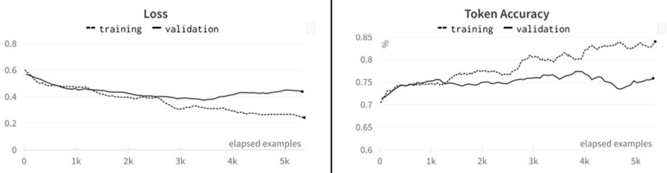
- ReAct had a more pronounced effect on application questions than on remembering-and-understanding questions; a sensitivity test with older models found validation token accuracy increased about 6% up to roughly 4,000 training examples, with possible overfitting beyond that.
Methods
- The authors tested OpenAI’s GPT-3.5-turbo-0301 and GPT-4-0314 models on multiple-choice questions from CPA, CMA, CIA, and EA practice exams, excluding questions with images/tables and workout-type questions.
- Sample sizes varied by exam and testing phase; Table 1 reports CPA 2,000/1,200/200, CMA 300, CIA 150, and EA 150 questions across ChatGPT 3.5 zero-shot, ChatGPT 4 zero-shot, and ChatGPT 4 10-shot conditions.
- They compared percentage correct against pass thresholds (CPA/CIA/EA 75%, CMA 70%; EA uses a scaled 75% benchmark), set temperature to zero, used 10-shot prompting, and added ReAct agents with calculator and web-search tools plus chain-of-thought reasoning.
Limitations
- Stated: the study omits questions requiring greater cognitive ability, such as interpreting situations/contexts and visualizations; it tests practice exams rather than actual exams; and it does not test actual accounting tasks such as bank reconciliations, tax preparation, or closing the books.
- Evident: sample sizes differ by exam and phase because of available review material and the higher cost of advanced models; testing is limited to multiple-choice questions without images or tables.
- Evident: fine-tuning was not available for GPT-3.5 and GPT-4 at the time, and the discussion sections include normative statements, conjectures, and authors’ experiences rather than empirical tests.
Model-written summary. Check it against the paper before relying on it.
Integrity signals
Registry
Cites
Statistics
Figures


Verification
Claims the paper makes
7 Valid · 5 Not valid · 43 Not checked · 95 Own results and interpretations
Every source the paper cites for this claim was checked and supports it.
In the paper
“They found that a one-standard-deviation increase in AI investments is associated with a reduction in accounting employees that reaches 3.6% after three years and 7.1% after four years.”
What the sources say
- Supportedcites Fedyk et al. (2022) matched to “Is artificial intelligence improving the audit process?” (2022) source
The “Growth accounting employees” section reports that a one-standard-deviation increase in the share of AI workers over the prior three years corresponds to 3.6% fewer accounting employees three years later and 7.1% fewer four years later. The Introduction reports the same figures for the total number of accounting employees at the firm. The claim’s “AI investments” paraphrases the paper’s measure of the share of AI workers. (LLM, conf=0.94)
plainstates an association- Asserted: passes — The authors put it forward as true.
- Checkable: passes — It can be checked against evidence.
- Load-bearing: unclear — It is unclear whether the paper’s conclusions depend on it.
- Based: passes — The paper gives a reason why it holds.
- Supported
In the paper
“Our results show that the original ChatGPT 3.5 model performs like the Wood et al. (2023) tests using accounting assessment questions. The average across all parts of exams was 53.1%, compared to Wood et al.'s (2023) overall average of 55%.”
What the sources say
- Not checked — no full text of the sourcecites Wood et al. (2023) matched to “The ChatGPT Artificial Intelligence Chatbot: How Well Does It Answer Accounting Assessment Questions?” (2023) source
plain- Asserted: passes — The authors put it forward as true.
- Checkable: passes — It can be checked against evidence.
- Load-bearing: passes — The paper’s conclusions depend on it.
- Based: passes — The paper gives a reason why it holds.
- Rests on 3 assumptions not shown here.
A result the paper reports from its own data — it cites no other source for it, so there is none to check. The quote shows it is in the paper.
In the paper
“allowing the model to use reasoning and acting (e.g., allow ChatGPT to use a calculator and other resources) improved scores an additional 8.9%”
- Also stated in: § 1 Introduction · p. 4 · plain
“allowing ChatGPT to react and reason improves scores by an additional 8.9%”
plainstates a cause- Asserted: passes — The authors put it forward as true.
- Checkable: passes — It can be checked against evidence.
- Load-bearing: passes — The paper’s conclusions depend on it.
- Based: passes — The paper gives a reason why it holds.
- Rests on 6 assumptions not shown here.
- Also stated in: § 1 Introduction · p. 4 · plain
A result the paper reports from its own data — it cites no other source for it, so there is none to check. The quote shows it is in the paper.
In the paper
“moving to the ChatGPT 4 model improved scores by an average of 16.5%”
- Also stated in: § 1 Introduction · p. 4 · boosted
“Using the new ChatGPT 4 model markedly improves scores by an average of 16.5%.”
boostedstates a cause- Asserted: passes — The authors put it forward as true.
- Checkable: passes — It can be checked against evidence.
- Load-bearing: passes — The paper’s conclusions depend on it.
- Based: passes — The paper gives a reason why it holds.
- Rests on 6 assumptions not shown here.
- Also stated in: § 1 Introduction · p. 4 · boosted
A result the paper reports from its own data — it cites no other source for it, so there is none to check. The quote shows it is in the paper.
In the paper
“After all these improvements, ChatGPT passed all exams with an average score of 85.1%.”
- Also stated in: § 1 Introduction · p. 4 · plain
“The results are that ChatGPT 4, with few-shot training and the ability to react and reason, results in an overall average score of 85.1% across all content tested.”
plainstates a cause- Asserted: passes — The authors put it forward as true.
- Checkable: passes — It can be checked against evidence.
- Load-bearing: passes — The paper’s conclusions depend on it.
- Based: passes — The paper gives a reason why it holds.
- Rests on 6 assumptions not shown here.
- Also stated in: § 1 Introduction · p. 4 · plain
38 more claims
Create a free account to see all 150 claims and to verify the 4 references still open.
- Probably not a substantial claim. 88
- It may state two separate claims as one. 42
- The quote only partly states this claim. 2
Claims other papers make about this one
Each is checked against this paper’s own text: does it say what the citing paper says it does?
The source backs part of the claim, not all of it — or backs it for a different population, condition or comparison.
In the citing paper
“AI models have long passed the profession's certification exams: in 2023, GPT-4 with 10-shot prompting averaged 85.1% across the CPA, CMA, CIA, and Enrolled Agent exams (Eulerich et al., 2024).”
From APEX-Accounting (2026) · cites this paper as Eulerich et al., 2024
Experimental — accuracy not yet measured
Self-check
Percentages, sums and reported differences re-computed from the paper’s own numbers.
Each contradiction between two passages listed here was confirmed by an independent check.
Rated minor: it would not touch a result — a value no result rests on, a p-value that stays on the same side of the significance level, or a conflict that is clerical, resolved elsewhere in the paper, or outside its own findings.
In the paper
§ 3 Methodology · p. 13
“Given our sample sizes are all above 150 for each section of each exam, this choice is unlikely to bias our results.”
§ 4 Results · p. 14
“| CIA | 75% | 150 | 150 | 150 |”
Rated minor: it would not touch a result — a value no result rests on, a p-value that stays on the same side of the significance level, or a conflict that is clerical, resolved elsewhere in the paper, or outside its own findings.
In the paper
§ 1 Introduction · p. 4
“We take a random sample of 150 to 300 questions for each part of each exam for these tests.”
§ 4 Results · p. 14
“| CPA | 75% | 2,000 | 1,200 | 200 |”
Citations
Cites
Chain-Of-Thought Prompting Elicits Reasoning in Large Language Models
Wei, J., Wang, X., Schuurmans, D., Bosma, M., Ichter, B., Xia, F., Chi, E., Le, Q. V., & Zhou, D. (2022) · Advances in Neural Information Processing Systems 35 · doi:10.52202/068431-1800 · Cited by 4,505
Chain-of-Thought Prompting Elicits Reasoning in Large Language Models
Wei, J., Wang, X., Schuurmans, D., Bosma, M., Ichter, B., Xia, F., Chi, E., Le, Q., & Zhou, D. (2022) · arXiv · doi:10.48550/arxiv.2201.11903 · Cited by 4,263
Generalizing from a Few Examples: A Survey on Few-shot Learning
Wang, Y., Yao, Q., Kwok, J. T., & Ni, L. M. (2021) · ACM Computing Surveys · doi:10.1145/3386252 · Cited by 3,165 · cited 1×
“Few-shot training is a method in which the model is provided a few examples before submitting questions for testing (Wang et al. 2020).”
GPTs are GPTs: An Early Look at the Labor Market Impact Potential of Large Language Models
Eloundou, T., Manning, S., Mishkin, P., & Rock, D. (2023) · arXiv · doi:10.48550/arxiv.2303.10130 · Cited by 2,330
Experimental Evidence on the Productivity Effects of Generative Artificial Intelligence
Noy, S., & Zhang, W. (2023) · doi:10.2139/ssrn.4375283 · Cited by 2,157
Experimental evidence on the productivity effects of generative artificial intelligence
Noy, S., & Zhang, W. (2023) · Science · doi:10.1126/science.adh2586 · Cited by 2,150
Dell’Acqua, F., McFowland, E., Mollick, E., Lifshitz, H., Kellogg, K. C., Rajendran, S., Krayer, L., Candelon, F., & Lakhani, K. R. (2026) · Organization Science · doi:10.1287/orsc.2025.21838 · Cited by 1,189
Toolformer: Language Models Can Teach Themselves to Use Tools
Schick, T., Dwivedi-Yu, J., Dessì, R., Raileanu, R., Lomeli, M., Zettlemoyer, L., Cancedda, N., & Scialom, T. (2023) · arXiv · doi:10.48550/arxiv.2302.04761 · Cited by 1,150
Toward Blockchain-Based Accounting and Assurance
Dai, J., & Vasarhelyi, M. A. (2017) · Journal of Information Systems · doi:10.2308/isys-51804 · Cited by 881 · cited 4×
“…offers an array of possible benefits in these sectors, such as enhanced transparency, data immutability, smart controls, and transactional security as well as close-to-real time audits based on the increased auditability (e.g., Dai and Vasarhelyi 2017; Nordgren et al. 2019; Kwilinski 2019).”
InfluentialDell'Acqua, F., McFowland III, E., Mollick, E. R., Lifshitz-Assaf, H., Kellogg, K., Rajendran, S., Krayer, L., Candelon, F., & Lakhani, K. R. (2023) · SSRN Electronic Journal · doi:10.2139/ssrn.4573321 · Cited by 794
Research works printed but not linked: 9
- Appelbaum, D., and R. A. Nehmer. 2017b. The Coming Disruption of Drones, Robots, and Bots: How Will It Affect CPAs and Accounting Practice? CPA Journal 87, no. 6. https:// www. cpajo urnal. com/ 2017/ 07/ 03/ coming- disru ption- drones- robots- bots/. Accessed 8 Apr 2024.
- Haas, C., and A. Gilmore. 2023. Introducing BloombergGPT, Bloomberg's 50-Billion Parameter Large Language Model, Purpose-Built from Scratch for Finance. Bloomberg . https:// www. bloom berg. com/ compa ny/ press/ bloom bergg pt- 50- billi on- param eter- llm- tuned- finan ce. Accessed 8 Apr 2024.
- Loten, A. 2023. PricewaterhouseCoopers to pour $1 billion into generative AI. The Wall Street Journal . https:// www. wsj. com/ artic les/ price water house coope rs- to- pour-1- billi on- into- gener ative- ai- cac2c edd.
- PWC. 2023a. PwC US Makes $1 Billion Investment to Expand and Scale AI Capabilities. https:// www. pwc. com/ us/ en/ about- us/ newsr oom/ press- relea ses/ pwc- us- makes- billi on- inves tment- in- ai- capab iliti es. html. Accessed 8 Apr 2024. https://www.pwc.com/us/en/about-us/newsroom/press-releases/pwc-us-makes-billion-investment-in-ai-capabilities.html
- PWC. 2023b. PwC Announces Strategic Alliance with Harvey, Positioning PwC's Legal Business Solutions at the Forefront of Legal Generative AI. https:// www. pwc. com/ gx/ en/ news- room/ press- relea ses/ 2023/ pwc- annou nces- strat egic- allia nce- with- harvey- posit ioning- pwcs- legal- busin ess- solut ions- at- the- foref ront- of- legal- gener ative- ai. html. Accessed 8 Apr 2024. https://www.pwc.com/gx/en/news-room/press-releases/2023/pwc-announces-strategic-alliance-with-harvey-positioning-pwcs-legal-business-solutions-at-the-forefront-of-legal-generative-ai.html
- Rozario, A., and C. Zhang. 2023. The Effect of Artificial Intelligence on the Accuracy of Management Earnings Forecasts. SSRN Electronic Journal . https:// papers. ssrn. com/ sol3/ papers. cfm? abstr act\_ id= 38508 23. Accessed 8 Apr 2024.
- Sanatizadeh, A., Y. Lu, K. Zhao, and Y. Hu. 2023. Exploring the Effect of Large Language Models on Knowledge Seeking and Contribution in Online Knowledge Exchange Platforms. SSRN Electronic Journal . https:// papers. ssrn. com/ sol3/ papers. cfm? abstr act\_ id= 44597 29. Accessed 8 Apr 2024.
- Wall Street Journal (WSJ). 2023a. KPMG Plans $2 Billion Investment in AI and Cloud Services. Accessed from https:// www. wsj. com/ artic les/ kpmg- plans-2- billi on- inves tment- in- ai- and- cloudservi ces- e4fd0 dd5. Accessed 8 Apr 2024.
- Wall Street Journal (WSJ). 2023b. EY Unveils Fruits of $1.4 Billion Artificial-Intelligence Investment. Accessed from https:// www. wsj. com/ artic les/ ey- unvei ls- fruits- of-1- 4- billi on- artificial- intel ligen ceinves tment- ab8d5 b5a. Accessed 8 Apr 2024.
Cited by
Pursnani, V., Sermet, Y., Kurt, M., & Demir, I. (2023) · Computers and Education: Artificial Intelligence · doi:10.1016/j.caeai.2023.100183 · Cited by 106
Li, H., Xi, J., Hsu, C. H. C., Yu, B. X. B., & Zheng, X. (2025) · Tourism Management · doi:10.1016/j.tourman.2025.105179 · Cited by 107
The impact of generative AI on information processing: Evidence from the ban of ChatGPT in Italy
Bertomeu, J., Lin, Y., Liu, Y., & Ni, Z. (2025) · Journal of Accounting and Economics · doi:10.1016/j.jacceco.2025.101782 · Cited by 129
Zhang, S., Wang, H., & Yi, X. (2025) · Proceedings of the ACM on Human-Computer Interaction · doi:10.1145/3757594 · Cited by 36
Generative AI in Financial Reporting
Blankespoor, E., deHaan, E., & Li, Q. (2026) · Journal of Accounting Research · doi:10.1111/1475-679x.70050 · Cited by 68
Artificial intelligence and accounting research: a framework and agenda
Stratopoulos, T. C., & Wang, V. X. (2025) · International Journal of Accounting Information Systems · doi:10.1016/j.accinf.2025.100760 · Cited by 51
“These models have achieved remarkable capabilities, including answering accounting questions (Wood et al., 2023), passing professional certification exams such as the CPA and CMA (Eulerich et al., 2024), performing various tasks such as classification, summarization, and prediction at high proficiency (Wang and Wang,…”
Chen, L., Tophel, A., Hettiyadura, U., & Kodikara, J. K. (2024) · Geotechnics · doi:10.3390/geotechnics4020026 · Cited by 30
“Eulerich et al. [35] expanded the scope of ChatGPT’s evaluation to accounting certification exams.”
BackgroundTeaching accounting in the era of ChatGPT – The student perspective
Sundkvist, C. H., & Kulset, E. M. (2024) · Journal of Accounting Education · doi:10.1016/j.jaccedu.2024.100932 · Cited by 81
Ali, H., Zafar, M. B., & Aysan, A. F. (2025) · Finance research letters · doi:10.1016/j.frl.2025.108797 · Cited by 32
Cognitive Computing and Business Intelligence Applications in Accounting, Finance and Management
Ao, S. I., Hurwitz, M., & Palade, V. (2025) · Big Data and Cognitive Computing · doi:10.3390/bdcc9030054 · Cited by 36
Emett, S. A., Eulerich, M., Lipinski, E., Prien, N., & Wood, D. A. (2024) · Accounting Horizons · doi:10.2308/horizons-2023-111 · Cited by 60
Self-citationN.A., A. A. T. (2024) · Future Business Journal · doi:10.1186/s43093-024-00368-8 · Cited by 32
“[4, 16].”
Voshaar, J., Wecks, J. O., Plate, B. J., & Zimmermann, J. (2024) · Issues in Accounting Education · doi:10.2308/issues-2023-091 · Cited by 27
Exploring the impact of generative AI on student learning in accounting
Zhou, A., & Luo, Y. (2025) · Journal of Accounting Education · doi:10.1016/j.jaccedu.2025.100982 · Cited by 61
Sanatizadeh, A., Lu, Y., Zhao, K., & Hu, Y. (2025) · Information & Management · doi:10.1016/j.im.2025.104178 · Cited by 26
Self-citationImproving the Production and Reviewing of Design Science Research in AccountingPreprint
Myers, N. M., Snow, M. C., Waddoups, N. J., et al. (2024) · SSRN Electronic Journal · doi:10.2139/ssrn.4823240 · Cited by 11
Self-citationExploring ChatGPT’s capabilities in solving accounting standards problems: the case of IAS 37
Albuquerque, F., & dos Santos, P. G. (2024) · Cogent Education · doi:10.1080/2331186x.2024.2412492 · Cited by 16
“…impacted several industries, including the auditing and accounting profession (P. Cheng et al., 2024; Eisikovits et al., 2024; Emett et al., 2023; Eulerich et al., 2024; Eulerich & Wood, 2023; Kayser & Telukdarie, 2024; Ross & Zhang, 2024), where tools have been improved through the integration…”
A Demonstration of How ChatGPT and Generative AI Can be Used in the Internal Auditing Process
Eulerich, M., & Wood, D. A. (2025) · Journal of Emerging Technologies in Accounting · doi:10.2308/jeta-2023-041 · Cited by 63
Self-citationThe impact of large language models on accounting and future application scenarios
Li, W., Liu, W., Deng, M., Liu, X., & Feng, L.-B. (2025) · Journal of Accounting Literature · doi:10.1108/jal-12-2024-0357 · Cited by 10
Coyne, J. G., Summers, S. L., & Wood, D. A. (2024) · Issues in Accounting Education · doi:10.2308/issues-2023-037 · Cited by 9
Self-citationChatGPT is Ready for the Profession—But is the Profession Ready for ChatGPT?
Ross, M., & Zhang, Y. (2024) · Accounting Horizons · doi:10.2308/horizons-2023-087 · Cited by 17
Artificial Intelligence and White-Collar Work: Evidence from the Accounting ProfessionPreprint
Böke, J., la Parra, D. D., Gallemore, J., & Glaeser, S. (2025) · SSRN Electronic Journal · doi:10.2139/ssrn.5039640 · Cited by 15
Implications of generative AI technology on auditing practice and research – a commentary
Zhang, D., & Zhou, J. (2025) · Managerial Auditing Journal · doi:10.1108/maj-03-2025-4730 · Cited by 13
Auditor Automation Usage and Professional SkepticismPreprint
Peters, C. (2022) · SSRN Electronic Journal · doi:10.2139/ssrn.4309348 · Cited by 13
Corporate Responses to Generative AI: Early Evidence from Conference CallsPreprint
Jia, N., Li, N., Ma, G., et al. (2024) · SSRN Electronic Journal · doi:10.2139/ssrn.4736295 · Cited by 7
In the wake of ChatGPT: early reflections on marking open-book online accounting assessments
Dosumu, O. E., Porumb, V., Stafford, A., & Zimmer, A. (2025) · Accounting Education · doi:10.1080/09639284.2025.2487487 · Cited by 16
“…further opportunities of how students’ learning can be improved through using digital technology, for example, the publisher Pearson’s plan to integrate GenAI tools into online textbooks (Hughes-Morgan, 2023) and the introduction of bespoke chatbots into teaching modules (Eulerich et al., 2024).”
InfluentialConstruction of a Japanese Financial Benchmark for Large Language ModelsPreprint
Hirano, M. (2024) · SSRN Electronic Journal · doi:10.2139/ssrn.4769124 · Cited by 10
Using Large Language Models for Financial AdvicePreprint
Fieberg, C., Hornuf, L., & Streich, D. J. (2024) · SSRN Electronic Journal · doi:10.2139/ssrn.4850039 · Cited by 21
Jang, J., & Xiao-ying, W. (2025) · Journal of Contemporary Accounting & Economics · doi:10.1016/j.jcae.2025.100524 · Cited by 5
Using Large Language Models for Financial AdvicePreprint
Fieberg, C., Hornuf, L., Meiler, M., & Streich, D. (2025) · SSRN Electronic Journal · doi:10.2139/ssrn.5133294 · Cited by 21
The Relationship Between AI and Audit Planning in Emerging Economies: Does Audit Firm Size Matter?
Abouelela, O., Diab, A., & Saleh, S. A. M. (2025) · SAGE Open · doi:10.1177/21582440251381155 · Cited by 8
“…of generative AI, exemplified by models like ChatGPT, has introduced capabilities for automated report generation, intelligent querying, and even high-level cognitive tasks relevant to auditing, demonstrating disruptive potential in the industry (Eulerich & Wood, 2025; Eulerich et al., 2024).”
Blondeel, E., Bullock, T., Gaskin, J. E., Schuetzler, R. M., Serre, R., Steffen, J., Wells, T., & Wood, D. A. (2025) · Journal of Accounting Education · doi:10.1016/j.jaccedu.2025.100987 · Cited by 29
Self-citationCorporate responses to generative AI: early evidence from conference calls
Jia, N., Li, N., Ma, G., & Xu, D. (2025) · Review of Accounting Studies · doi:10.1007/s11142-025-09916-1 · Cited by 27
Coyne, J. G., Summers, S. L., Villanueva, B., & Wood, D. A. (2024) · Accounting Horizons · doi:10.2308/horizons-2023-061 · Cited by 11
Self-citationThe Development of a RAG-Based Artificial Intelligence Research Assistant (AIRA)
Vakilzadeh, H., & Wood, D. A. (2026) · Journal of Information Systems · doi:10.2308/isys-2024-041 · Cited by 14
Self-citationGenerative AI and Finance: A Multi-level Machine Learning Based AnalysisPreprint
Ali, H., Zafar, M. B., & Aysan, A. F. (2025) · SSRN Electronic Journal · doi:10.2139/ssrn.5129013 · Cited by 5
Al-Atraqchi, O. M. A., Abdulmuhsin, A. A., Taha, A. A. D., Ramo, W. M., & Alharasis, E. E. (2025) · Lecture notes in networks and systems · doi:10.1007/978-3-031-96622-4_23 · Cited by 3
Is ChatGPT an Accurate Source of Information for Uninformed Taxpayers?
Antinozzi, H. S., & Cooper, L. A. (2025) · Journal of Emerging Technologies in Accounting · doi:10.2308/jeta-2023-072 · Cited by 8
Information Foraging in the Era of AI: Exploring the Effect of ChatGPT on Digital Q&A PlatformsPreprint
Sanatizadeh, A., Lu, Y., Zhao, K., & Hu, Y. (2023) · Social Science Research Network · doi:10.2139/ssrn.4459729 · Cited by 3
Self-citationZacher, W., & Kuppannagari, S. R. (2024) · SSRN Electronic Journal · doi:10.2139/ssrn.4788096 · Cited by 3
Albuquerque, F., & dos Santos, P. G. (2025) · Journal of Accounting Education · doi:10.1016/j.jaccedu.2025.101000 · Cited by 5
Elawadly, H. S. H. (2026) · Journal of financial reporting & accounting · doi:10.1108/jfra-01-2025-0002 · Cited by 7
van Zijl, W., Greenslade, K., & Ecim, D. (2026) · Meditari Accountancy Research · doi:10.1108/medar-07-2025-3160 · Cited by 13
Tsiligkiris, V., Kéri, A., & Bowyer, D. M. (2026) · Accounting Education · doi:10.1080/09639284.2026.2688988 · Cited by 5
Artificial Intelligence in Accounting: Implications for Practices and Education
Srirejeki, K., & Liang, J. (2024) · SAR (Soedirman Accounting Review) Journal of Accounting and Business · doi:10.32424/1.sar.2024.9.01.12512 · Cited by 8
ChatGPT-4: Can It Handle Real-World Accounting Cases?
Henry, T. F., Rosenthal, D. A., & Weitz, R. R. (2025) · Journal of Emerging Technologies in Accounting · doi:10.2308/jeta-2024-028 · Cited by 7
Zheng, J., Zheng, R., & Zang, A. Y. (2024) · SSRN Electronic Journal · doi:10.2139/ssrn.4764707 · Cited by 4
Building the TechHub.training Website for Training Accountants in Data Analytics
Wood, D. A., Summers, S. L., Albrechtsen, M., Booth, T., Barlow, T., Brimhall, M., Carlson, S., Chappell, B., Dutton, J., Ellsworth, M., et al. (2025) · Accounting Horizons · doi:10.2308/horizons-2023-062 · Cited by 1
Self-citationFlórez, B. E. S., Suárez, C. A. H., & Díaz, M. C. C. (2025) · Mundo FESC · doi:10.61799/2216-0388.1781 · Cited by 4
Can LLMs help students learn accounting? A performance analysis across models and prompts
Llacay, B., & Vilá, M. P. C. (2026) · Journal of Accounting Education · doi:10.1016/j.jaccedu.2026.101037 · Cited by 2
Future Potential of Intelligent Systems in Fiscal Oversight: A Systematic Review
Quijano-Cabezas, P. A., Escobar, C. A., Restrepo-Carmona, J. A., & Builes, J. A. J. (2025) · Human Behavior and Emerging Technologies · doi:10.1155/hbe2/5770257 · Cited by 1
Alliemoun, S. H., & Al‐Hajaya, K. (2025) · Higher Education Skills and Work-based Learning · doi:10.1108/heswbl-04-2025-0153 · Cited by 2
Harjanto, C., Kristin, D. M., & Andrian, T. (2025) · International Conference on Information Management and Technology (ICIMTech) · doi:10.1109/icimtech67074.2025.11265440 · Cited by 1
“Educators Professionals [17], [18], [19], [20], [21], [22], [23], [25], [28], [32], [33], [34], [35], [36], [38], [39], [40] [4], [5], [21], [29], [32], [34], [36] [24], [26], [27], [29], [30], [31], [32], [33], [34], [37] Students, as the most frequent users of GAI, are of great interest.”
Redefining Audit Practices in the Digital Era: A Systematic Review on Blockchain Integration
Nurmalita, S., Anugrah, S., Zairin, G. M., Sudiati, R., Puspa, E. S., Suyono, W. P., & Khairunnia, H. (2026) · Lecture notes in networks and systems · doi:10.1007/978-3-032-12990-1_26 · Cited by 4
Bin‐Nashwan, S. A., Alyafai, N., Ismaiel, A. E. A., & Ma’aji, M. M. (2026) · Journal of Information Communication and Ethics in Society · doi:10.1108/jices-09-2025-0235 · Cited by 6
Qinjie, S. (2026) · Computers and Education Artificial Intelligence · doi:10.1016/j.caeai.2026.100601 · Cited by 6
Schafer, B. A., & CIA (2026) · Journal of Accounting and Public Policy · doi:10.1016/j.jaccpubpol.2026.107464 · Cited by 1
Exploring the Role of AI in Improving VAT Reporting Quality: Experimental Study in Emerging Markets
Najjar, M. A., Mahboub, R., Nakhal, B., & Ghanem, M. G. (2024) · Journal of risk and financial management · doi:10.3390/jrfm17110477 · Cited by 7
Optimization Of Accounting Recording Process Using RPA Technology in Multifinance Companies
Chen, R., Wiryawan, D., & Mulyawan, A. N. (2025) · International Conference on Innovative Research in Applied Science, Engineering and Technology (IRASET) · doi:10.1109/iraset64571.2025.11008161 · Cited by 1
Peecher, M. E., Pietsch, C. P. R., Stirnkorb, S., & Yamoah, I. L. (2023) · SSRN Electronic Journal · doi:10.2139/ssrn.4409843 · Cited by 1
A Comparison of Artificial Intelligence and Human Responses in Audit ExperimentsPreprint
MacKenzie, N. L., Moon, J., Rykowski, S., Swanquist, Q. T., & Whited, R. L. (2025) · SSRN Electronic Journal · doi:10.2139/ssrn.5036687 · Cited by 6
Analysts’ Use of Md&A Sentiment in Earnings ForecastingPreprint
Jang, J., & Wu, X. (2025) · SSRN Electronic Journal · doi:10.2139/ssrn.5123384 · Cited by 1
Investor Reactions to Generative AI Usage in MD&A DisclosuresPreprint
Plate, B. J., Voshaar, J., & Zimmermann, J. (2025) · SSRN Electronic Journal · doi:10.2139/ssrn.5068116 · Cited by 1
Benchek, J., Bennett, A., Kern, J., Stevens, R., Sultan, R., Ching, C., Popiel, H., Mittal, V., Mercier, F., Foody, B., et al. (2026) · arXiv · doi:10.48550/arxiv.2607.27189 · Cited by 4
“1% across the CPA, CMA, CIA, and Enrolled Agent exams (Eulerich et al., 2024).”
Is ChatGPT an Accurate Source of Information for Uninformed Taxpayers?Preprint
Antinozzi, H. S., & Cooper, L. A. (2024) · SSRN Electronic Journal · doi:10.2139/ssrn.4871852
Campbell, J. L., & Evans, M. E. (2024) · SSRN Electronic Journal · doi:10.2139/ssrn.5000488
Strategic Orientation and CEO Risk-Taking IncentivesPreprint
Huang, R., Li, W., Li, X., & Wang, Y. (2025) · SSRN Electronic Journal · doi:10.2139/ssrn.5224311 · Cited by 1
Topic Labeling Using Large Language ModelsPreprint
Bogachek, O. (2025) · SSRN Electronic Journal · doi:10.2139/ssrn.5369321 · Cited by 1
Barna, L., Gorea, C.-C. H., & Ionescu, B. Ș. (2025) · Proceedings of the ... International Conference on Business Excellence · doi:10.2478/picbe-2025-0027
“According to Eulerich et al. (2024) and Georgiu et al. (2024), technology is changing traditional accounting as a result of the digitalization of repetitive processes performed daily by accounting professionals.”
A Blueprint for Agile Audit Standard Setting in a Fast-Moving WorldPreprint
Christensen, B. E., Emett, S. A., Ho, C. C., & Wood, D. A. (2025) · SSRN Electronic Journal · doi:10.2139/ssrn.5372900
Self-citationNelson, M. W. (2025) · SSRN Electronic Journal · doi:10.2139/ssrn.5397187
Jang, J., & Wu, X. (2025) · SSRN Electronic Journal · doi:10.2139/ssrn.5401063
Seeing Green: AI-Assisted Colour Analysis in Sustainability Reporting ResearchPreprint
Dimes, R., Cui, C., Harrison, J. A., & Ji, J. (2025) · SSRN Electronic Journal · doi:10.2139/ssrn.5551195
Are ESG narratives financially informative? The role of LLM summaries and sentiment
Jhan, Y.-T., & Hsieh, S.-F. (2026) · International Journal of Accounting Information Systems · doi:10.1016/j.accinf.2026.100778 · Cited by 2
d’Arcy, A., Haas, C. S., & Wallner, N. (2025) · SSRN Electronic Journal · doi:10.2139/ssrn.5611629
Artificial Intelligence and Accounting Research: A Framework and AgendaPreprint
Stratopoulos, T. C., & Wang, V. X. (2025) · SSRN Electronic Journal · doi:10.2139/ssrn.5605630
Factors Affecting the Adoption of ChatGPT Among Tax Professionals
Patricia, F., Venecia, & Prabowo, I. C. (2025) · IEEE International Symposium on Future Telecommunication Technologies (SOFTT) · doi:10.1109/softt67007.2025.11213066
“Companies that provide training and integrate ChatGPT may encourage higher adoption rates among professionals [37].”
Fotoh, L. E., Mugwira, T., & Lorentzon, J. (2025) · SSRN Electronic Journal · doi:10.2139/ssrn.5875406 · Cited by 1
AI-Driven Automation: The Role of Neural Networks in Next-Gen RPA
Mahendran, P. K. R. (2025) · Artificial intelligence · doi:10.5772/intechopen.1013993
인공지능은 회계업무에 (얼마나) 적합한가?: 공인회계사 자격시험을 중심으로*
김, 태., Sunwoo, H., & Lee, W. (2025) · Korean Accounting Journal · doi:10.24056/kaj.2025.07.002
Work from home and firm narrative disclosurePreprint
Qi, C., & Bilinski, P. (2026) · SSRN Electronic Journal · doi:10.2139/ssrn.6004695
Custom GPT Tutors in Managerial and Cost Accounting: An Instructional CasePreprint
Felski, E. A. (2026) · SSRN Electronic Journal · doi:10.2139/ssrn.6056736
Ram, A. J., & van Zijl, W. (2026) · South African Journal of Economic and Management Sciences · doi:10.4102/sajems.v29i1.6348
“This refers to an AI model’s ability to be given an entirely new task in which it has not been specifically trained (Eulerich et al. 2024).”
The Economics of AI Overuse: Hidden Costs and Externalities of a "Free" TechnologyPreprint
Zhong, Z., & Zhong, X. (2026) · SSRN Electronic Journal · doi:10.2139/ssrn.5948794
Le Doctorate of Business Administration "expertise comptable"
Casta, J., & Ouattara, A. (2025) · doi:10.3917/ems.bensa.2025.01.0055
Improving the production and reviewing of design science research in accounting
Myers, N., Snow, M. C., Waddoups, N. J., & Wood, D. A. (2026) · Review of Accounting Studies · doi:10.1007/s11142-026-09933-8 · Cited by 16
“Instead, a series of papers may progress as follows: • An initial paper motivates the importance of applying GenAI and avatars to accounting through surveys, interviews, and other observations (Problem Identification and Motivation).”
InfluentialSelf-citationPeecher, M. E., Pietsch, C., Stirnkorb, S., & Yamoah, I. L. (2026) · Contemporary Accounting Research · doi:10.1111/1911-3846.70040 · Cited by 5
Harnessing ChatGPT’s potential: A comprehensive guide for professors
DeRoy, T., Edmonds, M. A., & Messina, M. (2026) · Journal of Accounting Education · doi:10.1016/j.jaccedu.2026.101007 · Cited by 1
Dou, Y., & Fu, Q. (2026) · SSRN Electronic Journal · doi:10.2139/ssrn.6484841 · Cited by 3
The new era in financial evolution: a review of applications of generative AI in finance
Feng, S.-S., Yeo, E. X. Y., Ong, R., Ren, J. S. J., Tan, Y.-Q., Xie, M., Wang, J., & Li, F. (2026) · Memetic Computing · doi:10.1007/s12293-026-00512-7
Ghozi, H. S. A. (2024) · Decision Making Applications in Management and Engineering · doi:10.31181/dmame7220241372 · Cited by 11
“Audit fraud detection can be significantly improved, a nd AI’s application of AI in auditing can enhance audit quality and financial analysis [4].”
Swift, O. (2026) · Journal of Education for Business · doi:10.1080/08832323.2026.2692489
“Several studies document that general-purpose models now rival or exceed the performance of trained professionals in tasks such as tax question answering, financial ratio interpretation, and disclosure drafting (Blankespoor et al., 2026; Choi et al., 2023; Eulerich et al., 2024).”
Shifting Skills or Losing Them? How Algorithmic Systems Are Reshaping Expertise in AuditPreprint
Chu, M. K., Perdana, A., Lee, E., & Yeap, L. H. (2026) · SSRN Electronic Journal · doi:10.2139/ssrn.7156599
Evaluating Large Language Models on the Certified Internal Auditor Exam
Żytniewski, M., & Pankowska, M. B. (2026) · Applied Sciences · doi:10.3390/app16168106 · Cited by 1
Modugu, K. P. (2026) · SSRN Electronic Journal · doi:10.2139/ssrn.7287958
Between mirrors and walls: symbolic disputes and algorithmic reconfiguration in accounting
Takamatsu, R. T. (2026) · Cadernos EBAPE BR · doi:10.1590/1679-395120250083
Ma, X. (2026) · Research Square · doi:10.21203/rs.3.rs-10584858/v1
Exploring the Potential of Retrieval-Augmented Generation in Internal Audit Practice
Saluschke, M., & Gómez, J. M. (2026) · Progress in IS · doi:10.1007/978-3-032-14099-9_35
Metadata
- Authors
- Eulerich, M., Sanatizadeh, A., Vakilzadeh, H., & Wood, D. A.
- Affiliations
- University of Duisburg-Essen (DE)
- Northern Illinois University (US)
- University of Wisconsin–Whitewater (US)
- Brigham Young University (US)
- Corresponding author
- Eulerich, Marc
- Venue
- Review of Accounting Studies
- Published
- 2024-06-27
- Volume
- 29
- Issue
- 3
- Pages
- 2318-2349
- ISSN
- 1380-6653 (ISSN-L)
- 1573-7136
- OpenAlex
- W4400091704
- Semantic Scholar
- 55be7ebc150e23c0a374c044713074624c521269
- Cited by
- 195
- References
- 69
- Citations by year
- 2026: 55 · 2025: 64 · 2024: 33
- FWCI
- 43.52
- Type
- journal article
- Language
- en
- Open access
- hybrid
- doi.org
- Licence
- cc-by
- creativecommons.org/licenses/by/4.0 (tdm)
- creativecommons.org/licenses/by/4.0 (vor)
- Locations
- Review of Accounting Studies (publishedVersion, cc-by)
- SSRN Electronic Journal (submittedVersion)
- Econstor (Econstor) (submittedVersion, cc-by)
- ScholarsArchive (Brigham Young University) (submittedVersion)
- RePEc: Research Papers in Economics (submittedVersion)
- Minerva Access (University of Melbourne) (submittedVersion, cc-by)
- Funders
- Universität Duisburg-Essen
- Topics
- Social Sciences › Business, Management and Accounting › Management Information Systems › Robotic Process Automation Applications
- Social Sciences › Business, Management and Accounting › Accounting › Accounting Education and Careers
- Physical Sciences › Computer Science › Artificial Intelligence › Artificial Intelligence Applications
- Keywords
- ChatGPT, large language models, auditing, disruptive technologies, CPA exam, ChatGPT-4, accounting education, future of accounting profession
About these checks
Registry, retraction, Cites and statistics results are computed, not judged, with one exception: a printed reference that no index lists is read once by a model before it counts as a citation error. Claims are extracted by a model and kept only when their quote appears verbatim in the text; each cited source is then checked, with a model’s help, for whether it says what the claim relies on. Those verdicts can be wrong — read the claim’s quote and the cited source before relying on one.
The claim verdicts this report counts are experimental: their accuracy is not yet measured.
A language model drew the claims from the paper on 2026-10-05, under version 3 of the claim definition (model deepseek-v4.1-flash, prompt extract-v3).
A second model labelled each claim on 2026-10-05 (model jev-1.13-20260917, definition revision gold-guideline-v0.2).
Cited sources are checked with a language model’s help (gpt-6-sol).
Statistics and arithmetic are recomputed, not judged.
Confidence bands are shown only for fields calibrated on our annotated test set. None is calibrated yet, so no band is shown.
What counts as a claim ›How we measure confidence ›How we check this ›
Are you an author, or do you see a problem with this page? Request a review
Data sources
Bibliographic data: Semantic Scholar, OpenAlex, Crossref.
Contains information from the Semantic Scholar Academic Graph Datasets, made available under the ODC Attribution License (ODC-BY 1.0).
Semantic Scholar’s data is described in: Kinney, R., et al. (2023). The Semantic Scholar Open Data Platform. arXiv:2301.10140.
