

Is it all hype? ChatGPT’s performance and disruptive potential in the accounting and auditing industries
Open accessThe DOI matches its Crossref record; 92 of the 96 references it cites were found in a registry or an index, and 4 are not checked yet; 9 of the 52 sources its claims cite were checked for support.
Abstract
ChatGPT frequently appears in the media, with many predicting significant disruptions, especially in the fields of accounting and auditing. Yet research has demonstrated relatively poor performance of ChatGPT on student assessment questions. We extend this research to examine whether more recent ChatGPT models and capabilities can pass major accounting certification exams including the Certified Public Accountant (CPA), Certified Management Accountant (CMA), Certified Internal Auditor (CIA), and Enrolled Agent (EA) certification exams. We find that the ChatGPT 3.5 model cannot pass any exam (average score across all assessments of 53.1%). However, with additional enhancements, ChatGPT can pass all sections of each tested exam: moving to the ChatGPT 4 model improved scores by an average of 16.5%, providing 10-shot training improved scores an additional 6.6%, and allowing the model to use reasoning and acting (e.g., allow ChatGPT to use a calculator and other resources) improved scores an additional 8.9%. After all these improvements, ChatGPT passed all exams with an average score of 85.1%. This high performance indicates that ChatGPT has sufficient capabilities to disrupt the accounting and auditing industries, which we discuss in detail. This research provides practical insights for accounting professionals, investors, and stakeholders on how to adapt and mitigate the potential harms of this technology in accounting and auditing firms.
Verified 2026-11-22 · 4 references not checked yet
Overview
CoChat Summary
TL;DR
ChatGPT 3.5 could not pass any major accounting certification exam (average 53.1%), but ChatGPT 4 with 10-shot training and ReAct agents passed all tested sections with an average score of 85.1%. The authors argue this performance indicates ChatGPT has sufficient capability to disrupt accounting and auditing, while cautioning that hype and limitations remain.
Key findings
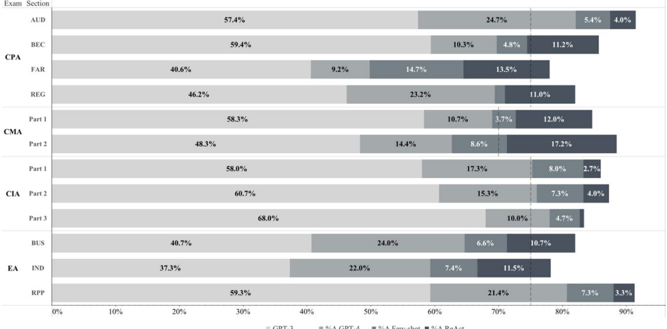
- ChatGPT 3.5 averaged 53.1% across all tested exam sections and did not pass any section; scores ranged from 37.3% on EA Individuals to 68.0% on CIA Part 3.
- Moving to ChatGPT 4 improved scores by an average of 16.5%, allowing the model to pass 5 sections, including all CIA sections, but it still did not fully pass the CPA, CMA, or EA exams.
- Adding 10-shot training improved scores by an additional 6.6%, letting the model pass both CMA sections; adding ReAct (reasoning and acting, e.g., calculator and web search) improved scores by an additional 8.9%, so ChatGPT passed all sections of each exam with an overall average of 85.1%.
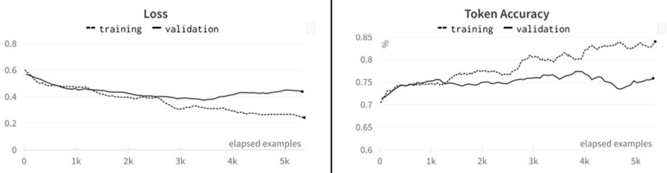
- ReAct had a more pronounced effect on application questions than on remembering-and-understanding questions; a sensitivity test with older models found validation token accuracy increased about 6% up to roughly 4,000 training examples, with possible overfitting beyond that.
Methods
- The authors tested OpenAI’s GPT-3.5-turbo-0301 and GPT-4-0314 models on multiple-choice questions from CPA, CMA, CIA, and EA practice exams, excluding questions with images/tables and workout-type questions.
- Sample sizes varied by exam and testing phase; Table 1 reports CPA 2,000/1,200/200, CMA 300, CIA 150, and EA 150 questions across ChatGPT 3.5 zero-shot, ChatGPT 4 zero-shot, and ChatGPT 4 10-shot conditions.
- They compared percentage correct against pass thresholds (CPA/CIA/EA 75%, CMA 70%; EA uses a scaled 75% benchmark), set temperature to zero, used 10-shot prompting, and added ReAct agents with calculator and web-search tools plus chain-of-thought reasoning.
Limitations
- Stated: the study omits questions requiring greater cognitive ability, such as interpreting situations/contexts and visualizations; it tests practice exams rather than actual exams; and it does not test actual accounting tasks such as bank reconciliations, tax preparation, or closing the books.
- Evident: sample sizes differ by exam and phase because of available review material and the higher cost of advanced models; testing is limited to multiple-choice questions without images or tables.
- Evident: fine-tuning was not available for GPT-3.5 and GPT-4 at the time, and the discussion sections include normative statements, conjectures, and authors’ experiences rather than empirical tests.
Model-written summary. Check it against the paper before relying on it.
Integrity signals
Registry
Cites
Statistics
Figures


Verification
Claims the paper makes
7 Valid · 5 Not valid · 43 Not checked · 95 Own results and interpretations
Every source the paper cites for this claim was checked and supports it.
In the paper
“They found that a one-standard-deviation increase in AI investments is associated with a reduction in accounting employees that reaches 3.6% after three years and 7.1% after four years.”
What the sources say
- Supportedcites Fedyk et al. (2022) matched to “Is artificial intelligence improving the audit process?” (2022) source
The “Growth accounting employees” section reports that a one-standard-deviation increase in the share of AI workers over the prior three years corresponds to 3.6% fewer accounting employees three years later and 7.1% fewer four years later. The Introduction reports the same figures for the total number of accounting employees at the firm. The claim’s “AI investments” paraphrases the paper’s measure of the share of AI workers. (LLM, conf=0.94)
plainstates an association- Asserted: passes — The authors put it forward as true.
- Checkable: passes — It can be checked against evidence.
- Load-bearing: unclear — It is unclear whether the paper’s conclusions depend on it.
- Based: passes — The paper gives a reason why it holds.
- Supported
In the paper
“Our results show that the original ChatGPT 3.5 model performs like the Wood et al. (2023) tests using accounting assessment questions. The average across all parts of exams was 53.1%, compared to Wood et al.'s (2023) overall average of 55%.”
What the sources say
- Not checked — no full text of the sourcecites Wood et al. (2023) matched to “The ChatGPT Artificial Intelligence Chatbot: How Well Does It Answer Accounting Assessment Questions?” (2023) source
plain- Asserted: passes — The authors put it forward as true.
- Checkable: passes — It can be checked against evidence.
- Load-bearing: passes — The paper’s conclusions depend on it.
- Based: passes — The paper gives a reason why it holds.
- Rests on 3 assumptions not shown here.
A result the paper reports from its own data — it cites no other source for it, so there is none to check. The quote shows it is in the paper.
In the paper
“allowing the model to use reasoning and acting (e.g., allow ChatGPT to use a calculator and other resources) improved scores an additional 8.9%”
- Also stated in: § 1 Introduction · p. 4 · plain
“allowing ChatGPT to react and reason improves scores by an additional 8.9%”
plainstates a cause- Asserted: passes — The authors put it forward as true.
- Checkable: passes — It can be checked against evidence.
- Load-bearing: passes — The paper’s conclusions depend on it.
- Based: passes — The paper gives a reason why it holds.
- Rests on 6 assumptions not shown here.
- Also stated in: § 1 Introduction · p. 4 · plain
A result the paper reports from its own data — it cites no other source for it, so there is none to check. The quote shows it is in the paper.
In the paper
“moving to the ChatGPT 4 model improved scores by an average of 16.5%”
- Also stated in: § 1 Introduction · p. 4 · boosted
“Using the new ChatGPT 4 model markedly improves scores by an average of 16.5%.”
boostedstates a cause- Asserted: passes — The authors put it forward as true.
- Checkable: passes — It can be checked against evidence.
- Load-bearing: passes — The paper’s conclusions depend on it.
- Based: passes — The paper gives a reason why it holds.
- Rests on 6 assumptions not shown here.
- Also stated in: § 1 Introduction · p. 4 · boosted
A result the paper reports from its own data — it cites no other source for it, so there is none to check. The quote shows it is in the paper.
In the paper
“After all these improvements, ChatGPT passed all exams with an average score of 85.1%.”
- Also stated in: § 1 Introduction · p. 4 · plain
“The results are that ChatGPT 4, with few-shot training and the ability to react and reason, results in an overall average score of 85.1% across all content tested.”
plainstates a cause- Asserted: passes — The authors put it forward as true.
- Checkable: passes — It can be checked against evidence.
- Load-bearing: passes — The paper’s conclusions depend on it.
- Based: passes — The paper gives a reason why it holds.
- Rests on 6 assumptions not shown here.
- Also stated in: § 1 Introduction · p. 4 · plain
38 more claims
Create a free account to see all 150 claims and to verify the 3 references still open.
- Probably not a substantial claim. 88
- It may state two separate claims as one. 42
- The quote only partly states this claim. 2
Claims other papers make about this one
Each is checked against this paper’s own text: does it say what the citing paper says it does?
The source backs part of the claim, not all of it — or backs it for a different population, condition or comparison.
In the citing paper
“AI models have long passed the profession's certification exams: in 2023, GPT-4 with 10-shot prompting averaged 85.1% across the CPA, CMA, CIA, and Enrolled Agent exams (Eulerich et al., 2024).”
From APEX-Accounting (2026) · cites this paper as Eulerich et al., 2024
Experimental — accuracy not yet measured
Self-check
Percentages, sums and reported differences re-computed from the paper’s own numbers.
Each contradiction between two passages listed here was confirmed by an independent check.
Rated minor: it would not touch a result — a value no result rests on, a p-value that stays on the same side of the significance level, or a conflict that is clerical, resolved elsewhere in the paper, or outside its own findings.
In the paper
§ 3 Methodology · p. 13
“Given our sample sizes are all above 150 for each section of each exam, this choice is unlikely to bias our results.”
§ 4 Results · p. 14
“| CIA | 75% | 150 | 150 | 150 |”
Rated minor: it would not touch a result — a value no result rests on, a p-value that stays on the same side of the significance level, or a conflict that is clerical, resolved elsewhere in the paper, or outside its own findings.
In the paper
§ 1 Introduction · p. 4
“We take a random sample of 150 to 300 questions for each part of each exam for these tests.”
§ 4 Results · p. 14
“| CPA | 75% | 2,000 | 1,200 | 200 |”
Citations
Cites
Chain-Of-Thought Prompting Elicits Reasoning in Large Language Models
Wei, J., Wang, X., Schuurmans, D., Bosma, M., Ichter, B., Xia, F., Chi, E., Le, Q. V., & Zhou, D. (2022) · Advances in Neural Information Processing Systems 35 · doi:10.52202/068431-1800 · Cited by 4,505
Chain-of-Thought Prompting Elicits Reasoning in Large Language Models
Wei, J., Wang, X., Schuurmans, D., Bosma, M., Ichter, B., Xia, F., Chi, E., Le, Q., & Zhou, D. (2022) · arXiv · doi:10.48550/arxiv.2201.11903 · Cited by 4,263
Generalizing from a Few Examples: A Survey on Few-shot Learning
Wang, Y., Yao, Q., Kwok, J. T., & Ni, L. M. (2021) · ACM Computing Surveys · doi:10.1145/3386252 · Cited by 3,165 · cited 1×
“Few-shot training is a method in which the model is provided a few examples before submitting questions for testing (Wang et al. 2020).”
GPTs are GPTs: An Early Look at the Labor Market Impact Potential of Large Language Models
Eloundou, T., Manning, S., Mishkin, P., & Rock, D. (2023) · arXiv · doi:10.48550/arxiv.2303.10130 · Cited by 2,330
Experimental Evidence on the Productivity Effects of Generative Artificial Intelligence
Noy, S., & Zhang, W. (2023) · doi:10.2139/ssrn.4375283 · Cited by 2,157
Experimental evidence on the productivity effects of generative artificial intelligence
Noy, S., & Zhang, W. (2023) · Science · doi:10.1126/science.adh2586 · Cited by 2,150
Dell’Acqua, F., McFowland, E., Mollick, E., Lifshitz, H., Kellogg, K. C., Rajendran, S., Krayer, L., Candelon, F., & Lakhani, K. R. (2026) · Organization Science · doi:10.1287/orsc.2025.21838 · Cited by 1,189
Toolformer: Language Models Can Teach Themselves to Use Tools
Schick, T., Dwivedi-Yu, J., Dessì, R., Raileanu, R., Lomeli, M., Zettlemoyer, L., Cancedda, N., & Scialom, T. (2023) · arXiv · doi:10.48550/arxiv.2302.04761 · Cited by 1,150
Toward Blockchain-Based Accounting and Assurance
Dai, J., & Vasarhelyi, M. A. (2017) · Journal of Information Systems · doi:10.2308/isys-51804 · Cited by 881 · cited 4×
“…offers an array of possible benefits in these sectors, such as enhanced transparency, data immutability, smart controls, and transactional security as well as close-to-real time audits based on the increased auditability (e.g., Dai and Vasarhelyi 2017; Nordgren et al. 2019; Kwilinski 2019).”
InfluentialDell'Acqua, F., McFowland III, E., Mollick, E. R., Lifshitz-Assaf, H., Kellogg, K., Rajendran, S., Krayer, L., Candelon, F., & Lakhani, K. R. (2023) · SSRN Electronic Journal · doi:10.2139/ssrn.4573321 · Cited by 794
ReAct: Synergizing Reasoning and Acting in Language Models
Yao, S., Zhao, J., Yu, D., Du, N., Shafran, I., Narasimhan, K., & Cao, Y. (2022) · arXiv · doi:10.48550/arxiv.2210.03629 · Cited by 608
Tong, S., Jia, N., Luo, X., & Fang, Z. (2021) · Strategic Management Journal · doi:10.1002/smj.3322 · Cited by 531 · cited 1×
“Other studies focus on the potential improvements in efficiency and effectiveness when using AI within a company (e.g., Jain et al. 2021; Choudhury et al. 2020; Tong et al. 2021).”
Is artificial intelligence improving the audit process?
Fedyk, A., Hodson, J., Khimich, N., & Fedyk, T. (2022) · Review of Accounting Studies · doi:10.1007/s11142-022-09697-x · Cited by 461 · cited 3×
“Fedyk et al. (2022) show pre-ChatGPT AI reduces the number of accounting employees, but the time it takes to reduce headcount and the number of employees displaced are relatively modest in size.”
Generative artificial intelligence, human creativity, and art
Zhou, E., & Lee, D. (2024) · PNAS Nexus · doi:10.1093/pnasnexus/pgae052 · Cited by 459
Can ChatGPT Forecast Stock Price Movements? Return Predictability and Large Language Models
Lopez-Lira, A., & Tang, Y. (2023) · arXiv · Cited by 426
Can ChatGPT forecast stock price movements? Return predictability and large language models
Lopez-Lira, A., & Tang, Y. (2026) · Journal of Financial Economics · doi:10.1016/j.jfineco.2026.104335 · Cited by 425
Robotic Process Automation for Auditing
Moffitt, K. C., Rozario, A. M., & Vasarhelyi, M. A. (2018) · Journal of Emerging Technologies in Accounting · doi:10.2308/jeta-10589 · Cited by 417 · cited 1×
“However, research and practice have started to discuss the limitations of RPA, including failure rates sometimes as high as 50% (EY 2020; Moffitt et al. 2018), significant internal control and governance problems (Bakarich and O’Brien 2021; Eulerich et al. 2022, 2023a, c), and a short-term focus…”
Going digital: implications for firm value and performance
Chen, W., & Srinivasan, S. (2024) · Review of Accounting Studies · doi:10.1007/s11142-023-09753-0 · Cited by 412
Harnessing the power of AI in qualitative research: Exploring, using and redesigning ChatGPT
Zhang, H., Wu, C., Xie, J., Lyu, Y., Cai, J., & Carroll, J. M. (2025) · Computers in Human Behavior Artificial Humans · doi:10.1016/j.chbah.2025.100144 · Cited by 402
BloombergGPT: A Large Language Model for Finance
Wu, S., Irsoy, O., Lu, S., Dabravolski, V., Dredze, M., Gehrmann, S., Kambadur, P., Rosenberg, D., & Mann, G. (2023) · arXiv · Cited by 357
Blockchain: Emergent Industry Adoption and Implications for Accounting
Kokina, J., Mancha, R., & Pachamanova, D. (2017) · Journal of Emerging Technologies in Accounting · doi:10.2308/jeta-51911 · Cited by 352 · cited 2×
“While research shows there are large investments in this technology and potential use cases for accountants and auditors (e.g., Kokina et al. 2017), others show that a full transfer to blockchains is infeasible (e.g., Coyne and McMickle 2017).”
Robotic Process Automation in Public Accounting
Cooper, L., Holderness, D. K., Sorensen, T., & Wood, D. A. (2018) · SSRN Electronic Journal · doi:10.2139/ssrn.3193222 · Cited by 341 · cited 2×
“Robotic process automation (RPA) software is the use of low-code or no-code software to automate repetitive, routine business processes (Cooper et al. 2019).”
InfluentialSelf-citationAn Analysis of the Automatic Bug Fixing Performance of ChatGPT
Sobania, D., Briesch, M., Hanna, C., & Petke, J. (2023) · 2023 IEEE/ACM International Workshop on Automated Program Repair (APR) · doi:10.1109/apr59189.2023.00012 · Cited by 338 · cited 1×
“…by humans (Sanatizadeh et al. 2023; Zhou and Lee 2023); ChatGPT performs better than previous tools at automatic bug fixing in computer programming (Sobania et al. 2023) and can significantly outperform sentiment analysis methods for forecasting stock market returns (Lopez-Lira and Tang 2023).”
Applying robotic process automation (RPA) in auditing: A framework
Huang, F., & Vasarhelyi, M. A. (2019) · International Journal of Accounting Information Systems · doi:10.1016/j.accinf.2019.100433 · Cited by 315 · cited 1×
“(See additional discussion by Huang and Vasarhelyi 2019.)”
Early evidence of digital labor in accounting: Innovation with Robotic Process Automation
Kokina, J., & Blanchette, S. (2019) · International Journal of Accounting Information Systems · doi:10.1016/j.accinf.2019.100431 · Cited by 314 · cited 1×
“8 Research does provide evidence of the benefits of RPA, such as greater efficiency, effectiveness, and auditor satisfaction (Kokina and Blanchette 2019; Cooper et al. 2022; Coyne et al. 2023a; Coyne et al. 2023a, b).”
Machine learning and human capital complementarities: Experimental evidence on bias mitigation
Choudhury, P., Starr, E., & Agarwal, R. (2020) · Strategic Management Journal · doi:10.1002/smj.3152 · Cited by 293 · cited 1×
“Other studies focus on the potential improvements in efficiency and effectiveness when using AI within a company (e.g., Jain et al. 2021; Choudhury et al. 2020; Tong et al. 2021).”
Auditing Large Language Models: A Three-Layered Approach
Mökander, J., Schuett, J., Kirk, H. R., & Floridi, L. (2023) · doi:10.2139/ssrn.4361607 · Cited by 292
Auditing large language models: a three-layered approach
Mökander, J., Schuett, J., Kirk, H. R., & Floridi, L. (2023) · arXiv · doi:10.48550/arxiv.2302.08500 · Cited by 292
Can Blockchains Serve an Accounting Purpose?
Coyne, J. G., & McMickle, P. L. (2017) · Journal of Emerging Technologies in Accounting · doi:10.2308/jeta-51910 · Cited by 291 · cited 1×
“While research shows there are large investments in this technology and potential use cases for accountants and auditors (e.g., Kokina et al. 2017), others show that a full transfer to blockchains is infeasible (e.g., Coyne and McMickle 2017).”
Auditing large language models: a three-layered approach
Mökander, J., Schuett, J., Kirk, H. R., & Floridi, L. (2024) · AI and Ethics · doi:10.1007/s43681-023-00289-2 · Cited by 289
Liu, X., Glocker, B., McCradden, M. M., Ghassemi, M., Denniston, A. K., & Oakden-Rayner, L. (2022) · The Lancet Digital Health · doi:10.1016/s2589-7500(22)00003-6 · Cited by 266
A design science research methodology and its application to accounting information systems research
Geerts, G. L. (2011) · International Journal of Accounting Information Systems · doi:10.1016/j.accinf.2011.02.004 · Cited by 254
Artificial muses: Generative artificial intelligence chatbots have risen to human-level creativity
Haase, J., & Hanel, P. H. P. (2023) · Journal of Creativity · doi:10.1016/j.yjoc.2023.100066 · Cited by 233 · cited 1×
“…is no qualitative difference in the creativity of humans and AI, with only 9.4% of humans being more creative than the most creative AI tested (Haase and Hanel 2023); Overall large language models, especially ChatGPT, have led to an increase in the quality, novelty, and creativity of content…”
InfluentialAuditing Partisan Audience Bias within Google Search
Robertson, R. E., Jiang, S., Joseph, K., Friedland, L., Lazer, D., & Wilson, C. (2018) · Proceedings of the ACM on Human-Computer Interaction · doi:10.1145/3274417 · Cited by 209 · cited 1×
“For instance, researchers have created procedures for auditing AI systems used in recruitment (Kazim et al. 2021), online search (Robertson et al. 2018), and medical diagnostics (Liu et al. 2022).”
A Field Study on the Use of Process Mining of Event Logs as an Analytical Procedure in Auditing
Jans, M., Alles, M. G., & Vasarhelyi, M. A. (2014) · The Accounting Review · doi:10.2308/accr-50807 · Cited by 201 · cited 1×
“…like the use of drones for auditing (e.g., Appelbaum and Nehmer 2017a, b; Christ et al. 2021), the implementation of process mining for auditing (e.g., Jans et al. 2014; Jans and Eulerich 2022), or using virtual avatars for interviewing in auditing (Pickard et al. 2016, 2020; CTStrategies 2018).”
Multiple‐Choice Tests and Student Understanding: What Is the Connection?
Simkin, M. G., & Kuechler, W. L. (2005) · Decision Sciences Journal of Innovative Education · doi:10.1111/j.1540-4609.2005.00053.x · Cited by 199
Estep, C., Griffith, E. E., & MacKenzie, N. L. (2023) · Review of Accounting Studies · doi:10.1007/s11142-023-09771-y · Cited by 191 · cited 1×
“…earnings forecasts (Rozario and Zhang 2023); increases firm value and performance (Chen and Srinivasan 2023); causes managers to be less aggressive (Estep et al. 2023); and improves internal and external audit quality (Christ et al. 2021; Fedyk et al. 2022; Emett et al. 2023a; Eulerich and Wood…”
Pickard, M. D., Roster, C. A., & Chen, Y. (2016) · Computers in Human Behavior · doi:10.1016/j.chb.2016.08.004 · Cited by 190 · cited 1×
“…like the use of drones for auditing (e.g., Appelbaum and Nehmer 2017a, b; Christ et al. 2021), the implementation of process mining for auditing (e.g., Jans et al. 2014; Jans and Eulerich 2022), or using virtual avatars for interviewing in auditing (Pickard et al. 2016, 2020; CTStrategies 2018).”
(2019) · Academy of Accounting and Financial Studies journal · Cited by 188
Bakarich, K. M., & O'Brien, P. E. (2021) · Journal of Emerging Technologies in Accounting · doi:10.2308/jeta-19-11-20-47 · Cited by 174 · cited 1×
“…the limitations of RPA, including failure rates sometimes as high as 50% (EY 2020; Moffitt et al. 2018), significant internal control and governance problems (Bakarich and O’Brien 2021; Eulerich et al. 2022, 2023a, c), and a short-term focus that hurts long-term success (Zhang et al. 2023a, b, c).”
Eisfeldt, A., Schubert, G., Zhang, M. B., & Taska, B. (2026) · doi:10.37214/jofdata.36 · Cited by 173 · cited 1×
“Finally, Eisfeldt et al. (2023) create portfolios of companies that have high and low exposure to generative AI like ChatGPT and find that higher-exposure firms earned excess returns that are 0.4% higher on a daily basis (which equates to over 100% on an annualized basis) than lower-exposure…”
InfluentialThe Data Analytics Journey: Interactions Among Auditors, Managers, Regulation, and Technology*
Austin, A. A., Carpenter, T. D., Christ, M. H., & Nielson, C. S. (2021) · Contemporary Accounting Research · doi:10.1111/1911-3846.12680 · Cited by 172
Wood, D. A., Achhpilia, M. P., Adams, M. T., Aghazadeh, S., Akinyele, K., Akpan, M., Allee, K. D., Allen, A. M., Almer, E. D., Ames, D., et al. (2023) · Issues in Accounting Education · doi:10.2308/issues-2023-013 · Cited by 166
Self-citationChrist, M. H., Emett, S. A., Summers, S. L., & Wood, D. A. (2019) · Review of Accounting Studies · doi:10.1007/s11142-020-09574-5 · Cited by 164 · cited 2×
“…discussion about other technologies with strong disruption potential, like the use of drones for auditing (e.g., Appelbaum and Nehmer 2017a, b; Christ et al. 2021), the implementation of process mining for auditing (e.g., Jans et al. 2014; Jans and Eulerich 2022), or using virtual avatars for…”
Self-citationA Framework for Using Robotic Process Automation for Audit Tasks*
Eulerich, M., Pawlowski, J., Waddoups, N. J., & Wood, D. A. (2022) · Contemporary Accounting Research · doi:10.1111/1911-3846.12723 · Cited by 148
Self-citationGoing Digital: Implications for Firm Value and PerformancePreprint
Chen, W., & Srinivasan, S. (2022) · SSRN Electronic Journal · doi:10.2139/ssrn.4177947 · Cited by 133
Cooper, L. A., Holderness, D. K., Sorensen, T. L., & Wood, D. A. (2019) · Journal of Emerging Technologies in Accounting · doi:10.2308/jeta-2020-085 · Cited by 132 · cited 1×
“8 Research does provide evidence of the benefits of RPA, such as greater efficiency, effectiveness, and auditor satisfaction (Kokina and Blanchette 2019; Cooper et al. 2022; Coyne et al. 2023a; Coyne et al. 2023a, b).”
Self-citationThe Dark Side of Robotic Process Automation (RPA): Understanding Risks and Challenges with RPA
Eulerich, M., Waddoups, N. J., Wagener, M., & Wood, D. A. (2023) · Accounting Horizons · doi:10.2308/horizons-2022-019 · Cited by 132
Self-citationJain, H., Padmanabhan, B., Pavlou, P. A., & Raghu, T. S. (2021) · Information Systems Research · doi:10.1287/isre.2021.1046 · Cited by 127 · cited 1×
“Other studies focus on the potential improvements in efficiency and effectiveness when using AI within a company (e.g., Jain et al. 2021; Choudhury et al. 2020; Tong et al. 2021).”
Jukiewicz, M. (2024) · Thinking Skills and Creativity · doi:10.1016/j.tsc.2024.101522 · Cited by 126
Using Drones in Internal and External Audits: An Exploratory Framework
Appelbaum, D., & Nehmer, R. A. (2017) · Journal of Emerging Technologies in Accounting · doi:10.2308/jeta-51704 · Cited by 120 · cited 1×
“There is an ongoing discussion about other technologies with strong disruption potential, like the use of drones for auditing (e.g., Appelbaum and Nehmer 2017a, b; Christ et al. 2021), the implementation of process mining for auditing (e.g., Jans et al. 2014; Jans and Eulerich 2022), or using…”
Integrating Practice into Accounting Research
Rajgopal, S. (2019) · Management Science · doi:10.1287/mnsc.2020.3590 · Cited by 119
The Business Value of IT: A Synthesis and Framework of Archival Research
Masli, A., Richardson, V. J., Sanchez, J. M., & Smith, R. E. (2011) · Journal of Information Systems · doi:10.2308/isys-10117 · Cited by 98 · cited 1×
“Technological advancements continue to have a significant impact on business and accounting (Masli et al. 2011; Moffitt et al. 2016; Austin et al. 2021; Richardson and Watson 2021; Eulerich et al. 2023a, b, c).”
Cheng, X., Dunn, R. T., Holt, T. P., Inger, K. K., Jenkins, J. G., Jones, J. P., Long, J. H., Loraas, T. M., Mathis, M. E., Stanley, J. D., et al. (2023) · Issues in Accounting Education · doi:10.2308/issues-2023-032 · Cited by 91
Self-citationWood, D. A. (2016) · Accounting Horizons · doi:10.2308/acch-51443 · Cited by 89
Self-citationEulerich, M., Masli, A., Pickerd, J., & Wood, D. A. (2023) · Contemporary Accounting Research · doi:10.1111/1911-3846.12847 · Cited by 89 · cited 3×
“More recently, research shows that greater use of technology is associated with many benefits in accounting (e.g., Cardinaels et al. 2019; Chen and Srinivasan 2023; Eulerich et al. 2023a, b, c; Rozario and Zhang 2023).”
Self-citationZhang, C., Issa, H., Rozario, A., & Soegaard, J. S. (2023) · Accounting Horizons · doi:10.2308/horizons-2021-084 · Cited by 82
Meta Self-training for Few-shot Neural Sequence Labeling
Wang, Y., Mukherjee, S., Chu, H., Tu, Y., Wu, M., Gao, J., & Awadallah, A. H. (2021) · ACM SIGKDD Conference on Knowledge Discovery and Data Mining (KDD) · doi:10.1145/3447548.3467235 · Cited by 80 · cited 1×
“Few-shot training usually ranges from submitting two to five examples, but it can also use up to 100 examples (Wang et al. 2021).”
QualiGPT: GPT as an easy-to-use tool for qualitative codingPreprint
Zhang, H., Wu, C., Xie, J., Kim, C., & Carroll, J. M. (2023) · arXiv (Cornell University) · doi:10.48550/arxiv.2310.07061 · Cited by 78
Large Language Models for Education: Grading Open-Ended Questions Using ChatGPT
Pinto, G., Cardoso-Pereira, I., Monteiro, D., Lucena, D., Souza, A., & Gama, K. (2023) · Proceedings of the XXXVII Brazilian Symposium on Software Engineering · doi:10.1145/3613372.3614197 · Cited by 76 · cited 1×
“Professors are experimenting with using generative AI to provide feedback and to grade student submissions (Pinto et al. 2023; Chen et al. 2024; Jukiewicz 2023).”
A Demonstration of How ChatGPT and Generative AI Can be Used in the Internal Auditing Process
Eulerich, M., & Wood, D. A. (2025) · Journal of Emerging Technologies in Accounting · doi:10.2308/jeta-2023-041 · Cited by 63
Self-citationSystematizing Audit in Algorithmic Recruitment
Kazim, E., Koshiyama, A. S., Hilliard, A., & Polle, R. (2021) · Journal of Intelligence · doi:10.3390/jintelligence9030046 · Cited by 60 · cited 1×
“For instance, researchers have created procedures for auditing AI systems used in recruitment (Kazim et al. 2021), online search (Robertson et al. 2018), and medical diagnostics (Liu et al. 2022).”
Emett, S. A., Eulerich, M., Lipinski, E., Prien, N., & Wood, D. A. (2024) · Accounting Horizons · doi:10.2308/horizons-2023-111 · Cited by 60
Self-citationChen, T. C., Kaminski, E., Koduri, L., Singer, A., Singer, J., Couldwell, M., Delashaw, J., Dumont, A., & Wang, A. (2023) · World Neurosurgery · doi:10.1016/j.wneu.2023.08.088 · Cited by 59 · cited 1×
“To the extent workout type questions resemble university case studies, research suggests that ChatGPT 4 can perform reasonably well on most of these types of assessments (Chen et al. 2023).”
The Impact of Shadow IT Systems on Perceived Information Credibility and Managerial Decision Making
Myers, N., Starliper, M., Summers, S. L., & Wood, D. A. (2017) · Accounting Horizons · doi:10.2308/acch-51737 · Cited by 58 · cited 1×
“This raises concerns of whether ChatGPT is being used as shadow IT, meaning employees using unsanctioned IT to perform their tasks, which can introduce unnecessary risks to the organization (Myers et al. 2017).”
Self-citationAutomatic summarization of earnings releases: attributes and effects on investors’ judgments
Cardinaels, E., Hollander, S., & White, B. J. (2019) · Review of Accounting Studies · doi:10.1007/s11142-019-9488-0 · Cited by 57 · cited 1×
“More recently, research shows that greater use of technology is associated with many benefits in accounting (e.g., Cardinaels et al. 2019; Chen and Srinivasan 2023; Eulerich et al. 2023a, b, c; Rozario and Zhang 2023).”
Do We Matter? Attention the General Public, Policymakers, and Academics Give to Accounting Research
Burton, F. G., Summers, S. L., Wilks, T. J., & Wood, D. A. (2020) · Issues in Accounting Education · doi:10.2308/issues-2020-017 · Cited by 48
Self-citationACRN Journal of Finance and Risk Perspectives
(2019) · ACRN Journal of Finance and Risk Perspectives · doi:10.35944/jofrp · Cited by 48
Innovative Accounting Interviewing: A Comparison of Real and Virtual Accounting Interviewers
Pickard, M. D., Schuetzler, R., Valacich, J. S., & Wood, D. A. (2020) · The Accounting Review · doi:10.2308/tar-2017-0235 · Cited by 44 · cited 1×
“…like the use of drones for auditing (e.g., Appelbaum and Nehmer 2017a, b; Christ et al. 2021), the implementation of process mining for auditing (e.g., Jans et al. 2014; Jans and Eulerich 2022), or using virtual avatars for interviewing in auditing (Pickard et al. 2016, 2020; CTStrategies 2018).”
Self-citationAct or Be Acted Upon: Revolutionizing Accounting Curriculums with Data Analytics
Richardson, V. J., & Watson, M. W. (2021) · Accounting Horizons · doi:10.2308/horizons-19-020 · Cited by 44 · cited 1×
“Technological advancements continue to have a significant impact on business and accounting (Masli et al. 2011; Moffitt et al. 2016; Austin et al. 2021; Richardson and Watson 2021; Eulerich et al. 2023a, b, c).”
Eulerich, M., Waddoups, N. J., Wagener, M., & Wood, D. A. (2024) · Journal of Information Systems · doi:10.2308/isys-2023-067 · Cited by 42
Self-citationGenerative AI and Firm ValuesPreprint
Eisfeldt, A. L., Schubert, G., & Zhang, M. B. (2023) · SSRN Electronic Journal · doi:10.2139/ssrn.4440717 · Cited by 41
Burton, F. G., Summers, S. L., Wilks, T. J., & Wood, D. A. (2021) · Accounting Horizons · doi:10.2308/horizons-2020-147 · Cited by 39
Self-citationA Demonstration of How ChatGPT Can be Used in the Internal Auditing ProcessPreprint
Eulerich, M., & Wood, D. A. (2023) · SSRN Electronic Journal · doi:10.2139/ssrn.4519583 · Cited by 39 · cited 1×
“…forecasts (Rozario and Zhang 2023); increases firm value and performance (Chen and Srinivasan 2023); causes managers to be less aggressive (Estep et al. 2023); and improves internal and external audit quality (Christ et al. 2021; Fedyk et al. 2022; Emett et al. 2023a; Eulerich and Wood 2023).”
Self-citationThe Economic Consequences of Disrupted Generative AI AdoptionPreprint
Bertomeu, J., Lin, Y., Liu, Y., & Ni, Z. (2023) · SSRN Electronic Journal · doi:10.2139/ssrn.4452670 · Cited by 36 · cited 1×
“Bertomeu et al. (2023) show that the ban of ChatGPT in Italy had a negative effect on the capital market and the valuation of Italian companies.”
Perspectives on Past and Future AIS Research as the Journal of Information Systems Turns Thirty
Moffitt, K. C., Richardson, V. J., Snow, N. M., Weisner, M. M., & Wood, D. A. (2016) · Journal of Information Systems · doi:10.2308/isys-51495 · Cited by 28 · cited 1×
“Technological advancements continue to have a significant impact on business and accounting (Masli et al. 2011; Moffitt et al. 2016; Austin et al. 2021; Richardson and Watson 2021; Eulerich et al. 2023a, b, c).”
Self-citationA NEW PERSPECTIVE ON THE EVOLUTION OF DOUBLE-ENTRY BOOKKEEPING
Williams, J. J. (1978) · Accounting Historians Journal · doi:10.2308/0148-4184.5.1.29 · Cited by 21
Process Mining for Financial Auditing
Jans, M. J., & Eulerich, M. (2022) · Lecture notes in business information processing · doi:10.1007/978-3-031-08848-3_15 · Cited by 21
Self-citationEmett, S. A., Eulerich, M., Lipinski, E., Prien, N., & Wood, D. A. (2023) · doi:10.2139/ssrn.4514238 · Cited by 21 · cited 4×
“25 Emett et al. (2023b) find that board members, senior management, and heads of internal audit agree that any savings in assurance work from automation (of any kind) will not be redeployed into increasing the amount of assurance but rather allocated to non-assurance (i.e., consulting) activities.”
InfluentialSelf-citationGenerative AI, Human Creativity, and Art
Zhou, E., & Lee, D. (2023) · doi:10.2139/ssrn.4594824 · Cited by 19 · cited 1×
“…models, especially ChatGPT, have led to an increase in the quality, novelty, and creativity of content generated by humans (Sanatizadeh et al. 2023; Zhou and Lee 2023); ChatGPT performs better than previous tools at automatic bug fixing in computer programming (Sobania et al. 2023) and can…”
Perceptions of Accounting Academics on the Review and Publication Process: An Update and Commentary
Burton, F. G., Heninger, W. G., Summers, S. L., et al. (2023) · Issues in Accounting Education · doi:10.2308/issues-2021-085 · Cited by 18
Self-citationPerceptions of Robotic Process Automation in Public AccountingPreprint
Cooper, L. A., Holderness, D. K., Sorensen, T. L., & Wood, D. A. (2019) · SSRN Electronic Journal · doi:10.2139/ssrn.3445005 · Cited by 17
Self-citationThe Unintended Consequences of Censoring Digital Technology - Evidence from Italy's ChatGPT Ban
Kreitmeir, D., & Raschky, P. A. (2023) · doi:10.31235/osf.io/v3cgs · Cited by 15
The Dark Side of Robotic Process AutomationPreprint
Eulerich, M., Waddoups, N. J., Wagener, M., et al. (2022) · SSRN Electronic Journal · doi:10.2139/ssrn.4026996 · Cited by 14
Self-citationCoyne, J. G., Summers, S. L., Villanueva, B., & Wood, D. A. (2024) · Accounting Horizons · doi:10.2308/horizons-2023-061 · Cited by 11
Self-citationEulerich, M., Waddoups, N. J., Wagener, M., et al. (2022) · SSRN Electronic Journal · doi:10.2139/ssrn.4311271 · Cited by 7 · cited 1×
“…the limitations of RPA, including failure rates sometimes as high as 50% (EY 2020; Moffitt et al. 2018), significant internal control and governance problems (Bakarich and O’Brien 2021; Eulerich et al. 2022, 2023a, c), and a short-term focus that hurts long-term success (Zhang et al. 2023a, b, c).”
Self-citationEmett, S. A., Eulerich, M., Pickerd, J. S., & Wood, D. A. (2026) · Journal of Information Systems · doi:10.2139/ssrn.4744611 · Cited by 5
Self-citationCoyne, J. G., Summers, S. L., Villanueva, B., et al. (2023) · SSRN Electronic Journal · doi:10.2139/ssrn.4520670 · Cited by 3 · cited 1×
“8 Research does provide evidence of the benefits of RPA, such as greater efficiency, effectiveness, and auditor satisfaction (Kokina and Blanchette 2019; Cooper et al. 2022; Coyne et al. 2023a; Coyne et al. 2023a, b).”
Self-citationThe Unintended Consequences of Censoring Digital Technology -- Evidence from Italy's ChatGPT BanPreprint
Kreitmeir, D., & Raschky, P. A. (2023) · RePEc: Research Papers in Economics · doi:10.48550/arxiv.2304.09339 · Cited by 3
Jukiewicz, M. (2023) · Unpublished · doi:10.13140/rg.2.2.22103.85924 · Cited by 2
Can ChatGPT Forecast Stock Price Movements? Return Predictability and Large Language Models
Lopez-Lira, A., & Tang, Y. (2023) · doi:10.2139/ssrn.4412788 · cited 1×
“…by humans (Sanatizadeh et al. 2023; Zhou and Lee 2023); ChatGPT performs better than previous tools at automatic bug fixing in computer programming (Sobania et al. 2023) and can significantly outperform sentiment analysis methods for forecasting stock market returns (Lopez-Lira and Tang 2023).”
OpenAI, Achiam, J., Adler, S., Agarwal, S., Ahmad, L., Akkaya, I., Aleman, F. L., Almeida, D., Altenschmidt, J., Altman, S., et al. (2023) · arXiv · doi:10.48550/arxiv.2303.08774
Artificial muses: Generative Artificial Intelligence Chatbots Have Risen to Human-Level Creativity
Haase, J., & Hanel, P. H. P. (2023) · arXiv · doi:10.48550/arxiv.2303.12003
Perspectives on Past and Future AIS Research as the Journal of Information Systems Turns Thirty
Moffitt, K., Richardson, V. J., Snow, N. M., et al. (2016) · doi:10.2139/ssrn.2734940
Initial Evidence of Digital Labor in Accounting: Innovation With Robotic Process Automation
Kokina, J., & Blanchette, S. (2019) · SSRN Electronic Journal · doi:10.2139/ssrn.3409268
Research works printed but not linked: 9
- Appelbaum, D., and R. A. Nehmer. 2017b. The Coming Disruption of Drones, Robots, and Bots: How Will It Affect CPAs and Accounting Practice? CPA Journal 87, no. 6. https:// www. cpajo urnal. com/ 2017/ 07/ 03/ coming- disru ption- drones- robots- bots/. Accessed 8 Apr 2024.
- Haas, C., and A. Gilmore. 2023. Introducing BloombergGPT, Bloomberg's 50-Billion Parameter Large Language Model, Purpose-Built from Scratch for Finance. Bloomberg . https:// www. bloom berg. com/ compa ny/ press/ bloom bergg pt- 50- billi on- param eter- llm- tuned- finan ce. Accessed 8 Apr 2024.
- Loten, A. 2023. PricewaterhouseCoopers to pour $1 billion into generative AI. The Wall Street Journal . https:// www. wsj. com/ artic les/ price water house coope rs- to- pour-1- billi on- into- gener ative- ai- cac2c edd.
- PWC. 2023a. PwC US Makes $1 Billion Investment to Expand and Scale AI Capabilities. https:// www. pwc. com/ us/ en/ about- us/ newsr oom/ press- relea ses/ pwc- us- makes- billi on- inves tment- in- ai- capab iliti es. html. Accessed 8 Apr 2024. https://www.pwc.com/us/en/about-us/newsroom/press-releases/pwc-us-makes-billion-investment-in-ai-capabilities.html
- PWC. 2023b. PwC Announces Strategic Alliance with Harvey, Positioning PwC's Legal Business Solutions at the Forefront of Legal Generative AI. https:// www. pwc. com/ gx/ en/ news- room/ press- relea ses/ 2023/ pwc- annou nces- strat egic- allia nce- with- harvey- posit ioning- pwcs- legal- busin ess- solut ions- at- the- foref ront- of- legal- gener ative- ai. html. Accessed 8 Apr 2024. https://www.pwc.com/gx/en/news-room/press-releases/2023/pwc-announces-strategic-alliance-with-harvey-positioning-pwcs-legal-business-solutions-at-the-forefront-of-legal-generative-ai.html
- Rozario, A., and C. Zhang. 2023. The Effect of Artificial Intelligence on the Accuracy of Management Earnings Forecasts. SSRN Electronic Journal . https:// papers. ssrn. com/ sol3/ papers. cfm? abstr act\_ id= 38508 23. Accessed 8 Apr 2024.
- Sanatizadeh, A., Y. Lu, K. Zhao, and Y. Hu. 2023. Exploring the Effect of Large Language Models on Knowledge Seeking and Contribution in Online Knowledge Exchange Platforms. SSRN Electronic Journal . https:// papers. ssrn. com/ sol3/ papers. cfm? abstr act\_ id= 44597 29. Accessed 8 Apr 2024.
- Wall Street Journal (WSJ). 2023a. KPMG Plans $2 Billion Investment in AI and Cloud Services. Accessed from https:// www. wsj. com/ artic les/ kpmg- plans-2- billi on- inves tment- in- ai- and- cloudservi ces- e4fd0 dd5. Accessed 8 Apr 2024.
- Wall Street Journal (WSJ). 2023b. EY Unveils Fruits of $1.4 Billion Artificial-Intelligence Investment. Accessed from https:// www. wsj. com/ artic les/ ey- unvei ls- fruits- of-1- 4- billi on- artificial- intel ligen ceinves tment- ab8d5 b5a. Accessed 8 Apr 2024.
Cited by
Pursnani, V., Sermet, Y., Kurt, M., & Demir, I. (2023) · Computers and Education: Artificial Intelligence · doi:10.1016/j.caeai.2023.100183 · Cited by 106
Li, H., Xi, J., Hsu, C. H. C., Yu, B. X. B., & Zheng, X. (2025) · Tourism Management · doi:10.1016/j.tourman.2025.105179 · Cited by 104
The impact of generative AI on information processing: Evidence from the ban of ChatGPT in Italy
Bertomeu, J., Lin, Y., Liu, Y., & Ni, Z. (2025) · Journal of Accounting and Economics · doi:10.1016/j.jacceco.2025.101782 · Cited by 129
Zhang, S., Wang, H., & Yi, X. (2025) · Proceedings of the ACM on Human-Computer Interaction · doi:10.1145/3757594 · Cited by 36
Generative AI in Financial Reporting
Blankespoor, E., deHaan, E., & Li, Q. (2026) · Journal of Accounting Research · doi:10.1111/1475-679x.70050 · Cited by 68
Metadata
- Authors
- Eulerich, M., Sanatizadeh, A., Vakilzadeh, H., & Wood, D. A.
- Affiliations
- University of Duisburg-Essen (DE)
- Northern Illinois University (US)
- University of Wisconsin–Whitewater (US)
- Brigham Young University (US)
- Corresponding author
- Eulerich, Marc
- Venue
- Review of Accounting Studies
- Published
- 2024-06-27
- Volume
- 29
- Issue
- 3
- Pages
- 2318-2349
- ISSN
- 1380-6653 (ISSN-L)
- 1573-7136
- OpenAlex
- W4400091704
- Cited by
- 195
- References
- 69
- Citations by year
- 2026: 55 · 2025: 64 · 2024: 33
- FWCI
- 43.52
- Type
- journal article
- Language
- en
- Open access
- hybrid
- doi.org
- Licence
- cc-by
- creativecommons.org/licenses/by/4.0 (tdm)
- creativecommons.org/licenses/by/4.0 (vor)
- Locations
- Review of Accounting Studies (publishedVersion, cc-by)
- SSRN Electronic Journal (submittedVersion)
- Econstor (Econstor) (submittedVersion, cc-by)
- ScholarsArchive (Brigham Young University) (submittedVersion)
- RePEc: Research Papers in Economics (submittedVersion)
- Minerva Access (University of Melbourne) (submittedVersion, cc-by)
- Funders
- Universität Duisburg-Essen
- Topics
- Social Sciences › Business, Management and Accounting › Management Information Systems › Robotic Process Automation Applications
- Social Sciences › Business, Management and Accounting › Accounting › Accounting Education and Careers
- Physical Sciences › Computer Science › Artificial Intelligence › Artificial Intelligence Applications
- Keywords
- ChatGPT, large language models, auditing, disruptive technologies, CPA exam, ChatGPT-4, accounting education, future of accounting profession
About these checks
Registry, retraction, Cites and statistics results are computed, not judged, with one exception: a printed reference that no index lists is read once by a model before it counts as a citation error. Claims are extracted by a model and kept only when their quote appears verbatim in the text; each cited source is then checked, with a model’s help, for whether it says what the claim relies on. Those verdicts can be wrong — read the claim’s quote and the cited source before relying on one.
The claim verdicts this report counts are experimental: their accuracy is not yet measured.
A language model drew the claims from the paper on 2026-10-05, under version 3 of the claim definition (model deepseek-v4.1-flash, prompt extract-v3).
A second model labelled each claim on 2026-10-05 (model jev-1.13-20260917, definition revision gold-guideline-v0.2).
Cited sources are checked with a language model’s help (gpt-6-sol).
Statistics and arithmetic are recomputed, not judged.
Confidence bands are shown only for fields calibrated on our annotated test set. None is calibrated yet, so no band is shown.
What counts as a claim ›How we measure confidence ›How we check this ›
Are you an author, or do you see a problem with this page? Request a review
Data sources
Bibliographic data: Semantic Scholar, OpenAlex, Crossref.
Contains information from the Semantic Scholar Academic Graph Datasets, made available under the ODC Attribution License (ODC-BY 1.0).
Semantic Scholar’s data is described in: Kinney, R., et al. (2023). The Semantic Scholar Open Data Platform. arXiv:2301.10140.
