

The DOI matches its Crossref record; 30 of the 30 references it cites were found in a registry or an index.
Online interventions to help college students to improve the degree of integration of their argumentative synthesis
Open accessAbstract
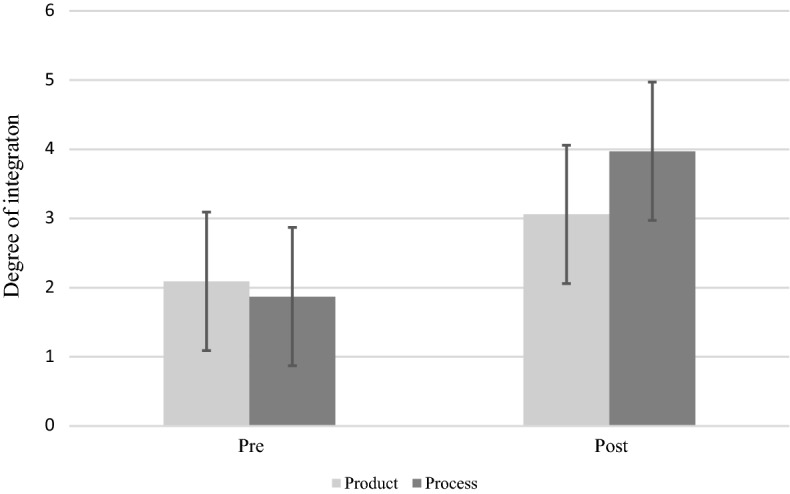
Writing an argumentative synthesis is a common but demanding task, consequently undergraduates require some instruction. The objective of this study was to test the effectiveness of two interventions on integrative argumentation: one of them was focused on the product features of argumentative texts; and the other one on the processes involved in the written argumentation. Sixty-six undergraduate students participated voluntarily. As an academic task, they were asked to write a pre-test synthesis after reading two sources which presented contradictory positions about an educational issue, then to read two new texts about a different but equivalent issue, and write a post-test synthesis following one of two types of instructional virtual environments. The instructions, implemented in Moodle, presented similar tools, employing videos, graphic organizers, and exercises. The first condition (n = 33) focused on the linguistic features while the second (n = 33), focused on the process, including explicit instruction and a script with critical questions to guide the reading and writing processes. In this study we have also analyzed how the students in the process condition answered some of the critical questions. The results show that the level of integration of the written products improved in both conditions, although this improvement was more pronounced in the process intervention. Nonetheless, the products that achieved medium and maximum integration were still limited. Despite the lack of a relationship between how students answered the critical questions and the level of integration in their post-test, the case analysis highlights certain educational implications and further research.
Overview
The claims and statistics of this paper haven’t been checked yet.
Run the check — free, no account needed. It reads the open-access text and checks the sources it cites.
Integrity signals
Registry
Cites
Statistics
Figures
Verification
Claims the paper makes
The claims and statistics of this paper haven’t been checked yet.
Run the check — free, no account needed. It reads the open-access text and checks the sources it cites.
Claims other papers make about this one
Each is checked against this paper’s own text: does it say what the citing paper says it does?
In the citing paper
“These findings align with previous research indicating that the effectiveness of guides is enhanced when synthesis writing strategies are explicitly taught.”
From How to improve argumentative syntheses written by undergraduates using guides and instructional rubrics (2024) · cites this paper as Luna et al., 2023
In the citing paper
“These results are consistent with those obtained (a) in face-to-face teaching contexts (Granado-Peinado et al., 2023;Mateos et al., 2018), and (b) in virtual contexts (Luna et al., 2023).”
From How to improve argumentative syntheses written by undergraduates using guides and instructional rubrics (2024) · cites this paper as Luna et al., 2023
Self-check
Percentages, sums and reported differences re-computed from the paper’s own numbers.
The self-check needs the paper’s full text.
Citations
Cites
Wiley, J., & Voss, J. F. (1999) · Journal of Educational Psychology · doi:10.1037/0022-0663.91.2.301 · Cited by 473
Best practices in writing instruction
(2007) · Choice Reviews Online · doi:10.5860/choice.45-2158 · Cited by 462
‘Argument!’ helping students understand what essay writing is about
Wingate, U. (2011) · Journal of English for Academic Purposes · doi:10.1016/j.jeap.2011.11.001 · Cited by 392
Digital support for academic writing: A review of technologies and pedagogies
Strobl, C., Ailhaud, E., Benetos, K., Devitt, A., Kruse, O., Proske, A., & Rapp, C. (2019) · Computers & Education · doi:10.1016/j.compedu.2018.12.005 · Cited by 298
Anmarkrud, Ø., Bråten, I., & Strømsø, H. I. (2013) · Learning and Individual Differences · doi:10.1016/j.lindif.2013.01.007 · Cited by 240
Nussbaum, E. M., & Edwards, O. V. (2011) · Journal of the Learning Sciences · doi:10.1080/10508406.2011.564567 · Cited by 224
Theoretical foundations of learning environments
Panaou, P., Vrasidas, C., & Aravi, C. (2012) · Educational Media International · doi:10.1080/09523987.2012.703429 · Cited by 222
Paz, S. D. L., & Felton, M. K. (2010) · Contemporary Educational Psychology · doi:10.1016/j.cedpsych.2010.03.001 · Cited by 220
Promoting Integration of Multiple Texts: a Review of Instructional Approaches and Practices
Barzilai, S., Zohar, A. R., & Mor-Hagani, S. (2018) · Educational Psychology Review · doi:10.1007/s10648-018-9436-8 · Cited by 176
Summary versus argument tasks when working with multiple documents: Which is better for whom?
Gil, L., Bråten, I., Vidal‐Abarca, E., & Strømsø, H. I. (2009) · Contemporary Educational Psychology · doi:10.1016/j.cedpsych.2009.11.002 · Cited by 155
Nussbaum, E. M. (2008) · Journal of Educational Psychology · doi:10.1037/0022-0663.100.3.549 · Cited by 121 · cited 1×
“Following Nussbaum (2008) this can be done by writing a persuasive or a reflective text.”
Investigating Instruction for Improving Revision of Argumentative Essays
Butler, J. A., & Britt, M. A. (2011) · Written Communication · doi:10.1177/0741088310387891 · Cited by 92
Vandermeulen, N., van den Broek, B., Steendam, E. V., & Rijlaarsdam, G. (2019) · Reading and Writing · doi:10.1007/s11145-019-09958-3 · Cited by 78
Cognitive Processes in Discourse Synthesis: The Case of Intertextual Processing Strategies
Segev-Miller, R. (2010) · Studies in writing · doi:10.1108/s1572-6304(2007)0000020016 · Cited by 76
Improving university argumentative writing through an online training
Luna, M., Villalón, R., Mateos, M., & Martín, E. (2020) · Journal of Writing Research · doi:10.17239/jowr-2020.12.01.08 · Cited by 72
Self-citationLectura, escritura y adquisición de conocimientos en Educación Secundaria y Educación Universitaria
Solé, I., Mateos, M., Miras, M., Martín, E., Castells, N., Cuevas, I., & Gràcia, M. (2005) · Infancia y Aprendizaje · doi:10.1174/0210370054740241 · Cited by 70
Self-citationMateos, M., Martín, E., Cuevas, I., Villalón, R., Martínez, I., & González-Lamas, J. (2018) · Cognition and Instruction · doi:10.1080/07370008.2018.1425300 · Cited by 70
Self-citationResearching and writing based on multiple texts
Du, H., & List, A. (2019) · Learning and Instruction · doi:10.1016/j.learninstruc.2019.101297 · Cited by 62
Learning to write synthesis texts in secondary education: a review of intervention studies
Van Ockenburg, L., Van Weijen, D., & Rijlaarsdam, G. (2019) · Journal of Writing Research · doi:10.17239/jowr-2019.10.03.01 · Cited by 57
Academic Writing Practices in Spanish Universities
Castelló, M., Mateos, M., Castells, N., et al. (2017) · Electronic Journal of Research in Educational Psychology · doi:10.25115/ejrep.v10i27.1517 · Cited by 46
Self-citationChallenges in Argumentation and Paraphrasing Among Beginning Students in Educational Sciences
Hyytinen, H., Löfstrôm, E., & Lindblom‐Ylänne, S. (2016) · Scandinavian Journal of Educational Research · doi:10.1080/00313831.2016.1147072 · Cited by 38
González-Lamas, J., Cuevas, I., & Mateos, M. (2016) · Infancia y Aprendizaje · doi:10.1080/02103702.2015.1111606 · Cited by 32
Self-citationReporting Design Principles for Effective Instruction of Writing: Interventions as Constructs
Rijlaarsdam, G., Janssen, T., Rietdijk, S., & van Weijen, D. (2017) · BRILL eBooks · doi:10.1163/9789004270480_013 · Cited by 28
Nussbaum, E. M., & Putney, L. G. (2020) · Journal of Educational Psychology · doi:10.1037/edu0000412 · Cited by 26
How do students integrate multiple texts? An investigation of top-down processing
List, A., Du, H., & Lee, H. Y. (2021) · European Journal of Psychology of Education · doi:10.1007/s10212-020-00497-y · Cited by 21
Soaring to Successful Synthesis Writing
Luo, L., & Kiewra, K. A. (2019) · Journal of Writing Research · doi:10.17239/jowr-2019.11.01.06 · Cited by 18
Writing to Argue: Writing as a Tool for Oral and Written Argumentation
Longo, S. D., & Lerida, C. (2014) · BRILL eBooks · doi:10.1163/9789004265011_003 · Cited by 13
Limpo, T., Nunes, A., & Coelho, A. F. (2020) · Journal of Writing Research · doi:10.17239/jowr-2020.12.01.01 · Cited by 13
Kobayashi, K. (2015) · Reading Psychology · doi:10.1080/02702711.2014.926304 · Cited by 12
Argumentation and Student-Centered Learning Environments
Land, S. M., & Jonassen, D. H. (2012) · doi:10.4324/9780203813799-11 · Cited by 7
Research works printed but not linked: 2
- Lehmann, T. (2020). Investigating the relation between preservice teachers’ argumentative writing and knowledge integration when learning when learning with multiple texts. Journal of Psychological & Educational Research, 28(2), 75–106.
- Vandermeulen, N., De Maeyer, S., Van Steendam, E., Lesterhuis, M., Van den Bergh, H., & Rijlaarsdam, G. (2020). Mapping synthesis writing in various levels of Dutch upper-secondary education A national baseline study on text quality, writing process and students’ perspectives on writing. Pedagogische Studiën, 97(3), 187–236.
Cited by
Sorted by citations
Cuevas, I., Mateos, M., Casado-Ledesma, L., Olmos, R., Granado-Peinado, M., Luna, M., Núñez, J. A., & Martín, E. (2024) · European Journal of Psychology of Education · doi:10.1007/s10212-024-00890-x · Cited by 1
“their integration of arguments and counterarguments throughout their texts and, most especially, in their conclusions may be a necessity (cf. Luna et al., 2023).”
Self-citation
Metadata
- Authors
- Luna, M., Villalón, R., Martínez-Álvarez, I., & Mateos, M.
- Affiliations
- Universidad de Cantabria (ES)
- Universidad Autónoma de Madrid (ES)
- Corresponding author
- Villalón, Ruth
- Venue
- Reading and Writing
- Published
- 2022-01-11
- Volume
- 36
- Issue
- 4
- Pages
- 937-963
- ISSN
- 0922-4777 (ISSN-L)
- 1573-0905
- PMC
- PMC8749917
- OpenAlex
- W4206072598
- Cited by
- 19
- References
- 30
- Citations by year
- 2026: 6 · 2025: 3 · 2024: 4 · 2023: 4 · 2022: 2
- FWCI
- 4.95
- Type
- journal article
- Language
- en
- Open access
- hybrid
- doi.org
- Locations
- Reading and Writing (publishedVersion, cc-by)
- PubMed Central (publishedVersion, cc-by)
- PubMed (publishedVersion)
- Biblos-e Archivo (Universidad Autónoma de Madrid) (submittedVersion, cc-by)
- UCrea (University of Cantabria) (submittedVersion, cc-by)
- Hispana (submittedVersion)
- Funders
- Ministerio de Ciencia e Innovacion (PID2019-105250RB-I00)
- Universidad de Cantabria
- Topics
- Social Sciences › Psychology › Developmental and Educational Psychology › Educational Strategies and Epistemologies
- Social Sciences › Education › Linguistics and Education Research
- Social Sciences › Linguistics and Language › Discourse Analysis in Language Studies
- Keywords
- online writing instruction, university students, Moodle, critical questions, graphic organizers, academic writing, argumentation processes
About these checks
Registry, retraction, Cites and statistics results are computed, not judged, with one exception: a printed reference that no index lists is read once by a model before it counts as a citation error. Claims are extracted by a model and kept only when their quote appears verbatim in the text; each cited source is then checked, with a model’s help, for whether it says what the claim relies on. Those verdicts can be wrong — read the claim’s quote and the cited source before relying on one.
Statistics and arithmetic are recomputed, not judged.
Confidence bands are shown only for fields calibrated on our annotated test set. None is calibrated yet, so no band is shown.
What counts as a claim ›How we measure confidence ›How we check this ›
Are you an author, or do you see a problem with this page? Request a review
