

Software sensors in the monitoring of microalgae cultivations
Open accessThe DOI matches its Crossref record; 159 of the 161 references it cites were found in a registry or an index, and 1 are not checked yet; 22 of the 71 sources its claims cite were checked for support.
Abstract
Review of software sensors, input measurements, and model-driven versus data-driven estimators for microalgae cultivation monitoring.
Verified 2026-11-25 · 1 reference not checked yet
Overview
CoChat Summary
TL;DR
This review surveys software sensors for monitoring microalgae cultivation, covering biochemical targets, model-driven/data-driven/hybrid estimators, and applications grouped by optical, non-optical, combined, or simulated inputs. It concludes that software sensors can estimate otherwise hard-to-measure biological variables in near real time, but microalgae applications remain early-stage and mostly laboratory-scale.
Key findings
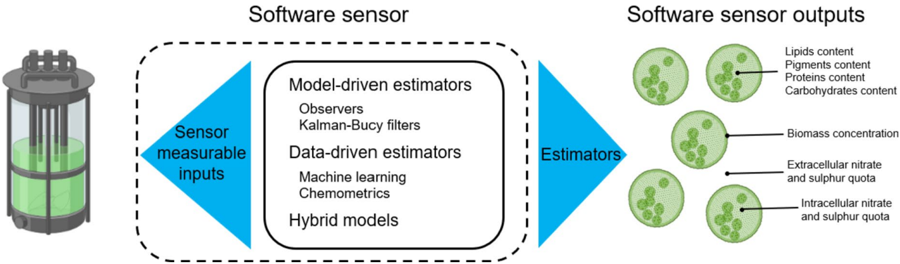
- Software sensors combine hardware sensor inputs with a model to indirectly estimate process variables; main approaches are model-driven (e.g., Luenberger observers, Kalman filters) and data-driven (e.g., ANN, PCA/PLS), with hybrid “grey-box” models also described.
- Optical methods dominate reported microalgae applications, especially fluorescence/2D fluorescence and chemometrics; examples report R² values such as 0.66 for cell concentration, 0.78 for chlorophyll, 0.78 for total fatty acids, 0.81 for saturated fatty acids, and 0.74 for unsaturated fatty acids in *Nannochloropsis oceanica* (Sá et al. 2020a).
- Other reported estimates include *D. salina* cell number R²=0.8 and viability R²=0.9, with orange-phase cell damage R²=0.95 training/0.87 validation (Sá et al. 2017); *T. lutea*/*P. tricornutum* biomass R²=0.96 individually and 0.93 combined, fucoxanthin R²=0.63/0.64 individually and 0.77 combined (Gao et al. 2021); and *C. reinhardtii* cell counts R²=0.99 with GA-ANN vs 0.98 ANN alone (Liu et al. 2020a).
- Non-optical/combined/simulated examples include pH prediction with nonlinear polynomial model RMSE=1.29% and R²=0.975 (Paladino et al. 2022), pH in raceway ponds with fit 71.3% and 73.75% and MSE 0.02 and 0.01 (Otálora et al. 2023), and LASSO image-based density RMSE=1.54 vs 2.16 and 3.68 for other methods (Nguyen et al. 2023).
Methods
- Narrative review; no primary experiments. It first describes microalgal biochemical components of interest (biomass, lipids, pigments, vitamins, proteins, carbohydrates) and their spectroscopic characteristics, then overviews software sensor methodologies and tools.
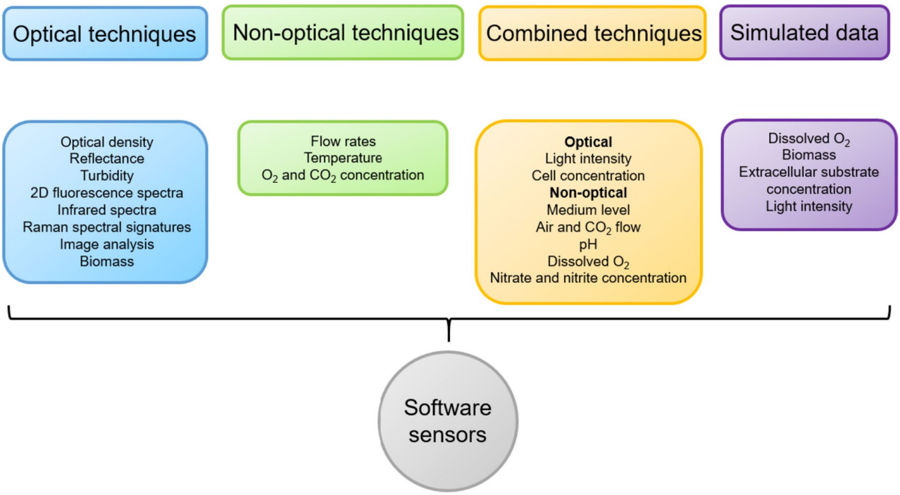
- The literature on software sensors in microalgae cultivation is grouped by measurement method used as sensor input: optical, non-optical, combined optical/non-optical, and simulated data; simulated-data examples are further grouped as model-driven or data-driven estimators. Table 1 summarizes input, sensor type, estimated variables, and references.
- No systematic search strategy, inclusion criteria, or quantitative meta-analysis is reported.
Limitations
- Stated: software sensor application to microalgal processes is in early stages, investigated under laboratory conditions, and relatively few compared with other engineering branches; challenges include variable process lengths, multiple process phases, faults of physical sensors used as inputs, and selection of process outputs/sensors with observability.
- Stated: many biological variables still require sampling and offline/atline analysis; preferred future inputs are noninvasive optical methods, and some reviewed examples use offline calibration or simulated data, limiting demonstrated real-time implementation.
- Evident: as a narrative review, it does not provide a systematic search protocol, risk-of-bias assessment, or meta-analysis; performance numbers are drawn from heterogeneous studies and are not directly comparable.
Model-written summary. Check it against the paper before relying on it.
Integrity signals
Registry
Cites
Statistics
Figures
Verification
Claims the paper makes
19 Valid · 0 Not valid · 33 Not checked · 19 Own results and interpretations
Every source the paper cites for this claim was checked and supports it.
In the paper
“On the other hand, integral proportional observers have demonstrated in multiple applications a higher robustness to system input disturbances compared to high-gain and adaptive observers (Flores et al. 2020).”
What the sources say
- Supportedcites Flores et al. 2020 matched to “A turbidity sensor development based on NL-PI observers: Experimental application to the control of a Sinaloa’s River Spirulina maxima cultivation” (2020) source
Section 2 (Overview) identifies integral proportional observers and says they have diverse applications and are considerably more robust to system input disturbances than the previously cited observers. That discussion previously identifies high-gain and adaptive observers. (LLM, conf=0.93)
boostedstates a cause- Asserted: passes — The authors put it forward as true.
- Checkable: passes — It can be checked against evidence.
- Load-bearing: unclear — It is unclear whether the paper’s conclusions depend on it.
- Based: passes — The paper gives a reason why it holds.
- Supported
The sources with a verdict support this claim; the rest weren’t checked yet, have no full text we could read, or their verdicts aren’t rated yet.
In the paper
“The Luenberger observer and high gain observers have also been applied to microalgae cultivation (Benavides et al. 2015; Flores et al. 2020).”
What the sources say
- Not checked — no full text of the sourcecites Benavides et al. 2015 matched to “Robust Luenberger observers for microalgal cultures” (2015) source
- Supportedcites Flores et al. 2020 matched to “A turbidity sensor development based on NL-PI observers: Experimental application to the control of a Sinaloa’s River Spirulina maxima cultivation” (2020) source
Flores et al. supports the high-gain-observer part of the sentence: Section 5.2 describes using a robust high-gain observer in microalgae-growth experiments. The cited sentence also names Benavides et al. for the Luenberger-observer part; this verdict does not assess that separate source. (LLM, conf=0.92)
plain- Asserted: passes — The authors put it forward as true.
- Checkable: passes — It can be checked against evidence.
- Load-bearing: unclear — It is unclear whether the paper’s conclusions depend on it.
- Based: passes — The paper gives a reason why it holds.
Every source the paper cites for this claim was checked and supports it.
In the paper
“Essentially, this technique allows the estimation of process variables without the requirement of a process model (Noll and Henkel 2020).”
What the sources say
- Supportedcites Noll and Henkel 2020 matched to “History and Evolution of Modeling in Biotechnology: Modeling & Simulation, Application and Hardware Performance” (2020) source
The “Neural networks” section says ANNs were used to predict process variables independently of a process model, using historical cultivation data. This directly supports the attributed claim. (LLM, conf=0.94)
plainstates a cause- Asserted: passes — The authors put it forward as true.
- Checkable: passes — It can be checked against evidence.
- Load-bearing: unclear — It is unclear whether the paper’s conclusions depend on it.
- Based: passes — The paper gives a reason why it holds.
- Supported
Every source the paper cites for this claim was checked and supports it.
In the paper
“Biomass measurement is not only important for its association with valuable compounds but also for estimating culture metabolic state variables (e.g., specific growth rate) necessary in fedbatch strategies (Wechselberger et al. 2013).”
What the sources say
- Supportedcites Wechselberger et al. 2013 matched to “Real-time estimation of biomass and specific growth rate in physiologically variable recombinant fed-batch processes” (2013) source
The Introduction (Motivation) states that biomass concentration is required to calculate variables describing the culture’s metabolic state, including specific growth rate, and places this need in the context of fed-batch feeding strategies. It also links the strategy to product yield and quality. (LLM, conf=0.95)
plainstates an association- Asserted: passes — The authors put it forward as true.
- Checkable: passes — It can be checked against evidence.
- Load-bearing: passes — The paper’s conclusions depend on it.
- Based: passes — The paper gives a reason why it holds.
- Supported
Every source the paper cites for this claim was checked and supports it.
In the paper
“High-gain observers, whose structure does not depend primarily on the input, have demonstrated satisfactory performance in nonlinear systems, especially in systems with biological and environmental processes, when estimating variables and disturbances with uncertainties.”
What the sources say
- Supportedcites Flores et al. 2020 matched to “A turbidity sensor development based on NL-PI observers: Experimental application to the control of a Sinaloa’s River Spirulina maxima cultivation” (2020) source
The Overview (§2; page not supplied) says high-gain observers estimate states and uncertainties in nonlinear systems and have shown excellent performance despite uncertain parameters and disturbances, particularly in biological and environmental processes. (LLM, conf=0.95)
boostedstates an association- Asserted: passes — The authors put it forward as true.
- Checkable: passes — It can be checked against evidence.
- Load-bearing: unclear — It is unclear whether the paper’s conclusions depend on it.
- Based: passes — The paper gives a reason why it holds.
- Supported
23 more claims · 2 with their cited sources checked
Create a free account to see all 71 claims and to verify the 3 references still open.
- It may state two separate claims as one. 20
- Probably not a substantial claim. 29
Claims other papers make about this one
Each is checked against this paper’s own text: does it say what the citing paper says it does?
The source backs part of the claim, not all of it — or backs it for a different population, condition or comparison.
In the citing paper
“This enables real-time process monitoring and allows a rapid response to fluctuations, directly improving cultivation performance [19].”
From Multi-Sensing Monitoring of the Microalgae Biomass Cultivation Systems for Biofuels and Added Value Products Synthesis—Challenges and Opportunities (2025) · cites this paper as [19]
Experimental — accuracy not yet measuredThe source backs part of the claim, not all of it — or backs it for a different population, condition or comparison.
In the citing paper
“For industrial-scale systems, especially for large-scale operations, the use of online monitoring is recommended.”
From Multi-Sensing Monitoring of the Microalgae Biomass Cultivation Systems for Biofuels and Added Value Products Synthesis—Challenges and Opportunities (2025) · cites this paper as [19]
Experimental — accuracy not yet measured
Self-check
Percentages, sums and reported differences re-computed from the paper’s own numbers.
Each contradiction between two passages listed here was confirmed by an independent check.
Rated minor: it would not touch a result — a value no result rests on, a p-value that stays on the same side of the significance level, or a conflict that is clerical, resolved elsewhere in the paper, or outside its own findings.
In the paper
§ 4.1.1 UV-VIS spectroscopy · p. 12
“Flores et al. (2020) used a turbidity sensor that allowed them to estimate biomass and substrate (glucose) after using a high-gain, robust nonlinear observer in mixotrophic cultures with the cyanobacterium A. platensis .”
§ References · p. 22
“A turbidity sensor development based on NL-PI observers: experimental application to the control of a Sinaloa's River Spirulina maxima cultivation.”
Cited works that were retracted
Works this paper cites that were later retracted, from the retraction notices publishers deposit. Major when the notice came out before this paper was published.
A note, not an issue: for example, a cited work that was retracted only after this paper was published, which its authors could not have known.
In the paper
“…compounds (e.g., pigments, lipids, carbohydrates, proteins, and vitamins) (Jacob-Lopes et al. 2020), as food sources (e.g., Chlorella sp. and Arthrospira sp.) or in environmental applications, e.g., wastewater treatment (Martínez-Roldán and Cañizares-Villanueva 2020; Tan et al. 2020).”
Cited work 10.1080/21655979.2020.1711626 · retracted 2026-01-19 · notice 10.1080/21655979.2026.2614863 · this paper published 2024-01-10
Citations
Cites
1 retracted
Tan, J. S., Lee, S. Y., Chew, K. W., Lam, M. K., Lim, J. W., Ho, S.-H., & Show, P. L. (2020) · Bioengineered · doi:10.1080/21655979.2020.1711626 · Cited by 524 · cited 2×
“…compounds (e.g., pigments, lipids, carbohydrates, proteins, and vitamins) (Jacob-Lopes et al. 2020), as food sources (e.g., Chlorella sp. and Arthrospira sp.) or in environmental applications, e.g., wastewater treatment (Martínez-Roldán and Cañizares-Villanueva 2020; Tan et al. 2020).”
RetractedA New Approach to Linear Filtering and Prediction Problems
Kalman, R. E. (1960) · Journal of Basic Engineering · doi:10.1115/1.3662552 · Cited by 31,751 · cited 1×
“The Kalman filter, originally developed in the 1960s, is a model-driven estimator used to improve the reliability of estimated data and noise filtering (Kalman 1960; Kalman and Bucy 1961; Noll and Henkel 2020).”
The FAIR Guiding Principles for scientific data management and stewardship
Wilkinson, M. D., Dumontier, M., Aalbersberg, I. J., Appleton, G., Axton, M., Baak, A., Blomberg, N., Boiten, J.-W., da Silva Santos, L. B., Bourne, P. E., et al. (2016) · Scientific Data · doi:10.1038/sdata.2016.18 · Cited by 18,423 · cited 1×
“In this respect, the FAIR concept (Findable, Acces-sible, Interoperable, Reusable) for archiving suitably structured scholarly data on (bio)processes in order to facilitate data access by data mining and learning tools should be mentioned (Wilkinson et al. 2016).”
Approximation by superpositions of a sigmoidal function
Cybenko, G. (1989) · Mathematics of Control, Signals, and Systems · doi:10.1007/bf02551274 · Cited by 13,883
PLS-regression: a basic tool of chemometrics
Wold, S., Sjöström, M., & Eriksson, L. (2001) · Chemometrics and Intelligent Laboratory Systems · doi:10.1016/s0169-7439(01)00155-1 · Cited by 10,084 · cited 2×
“PLS regression is a quantitative method using a linear multivariate algorithm, that relates and models two data matrices, X and Y (Wold et al. 2001).”
New Results in Linear Filtering and Prediction Theory
Kalman, R. E., & Bucy, R. S. (1961) · Journal of Basic Engineering · doi:10.1115/1.3658902 · Cited by 6,387 · cited 1×
“The Kalman filter, originally developed in the 1960s, is a model-driven estimator used to improve the reliability of estimated data and noise filtering (Kalman 1960; Kalman and Bucy 1961; Noll and Henkel 2020).”
What is principal component analysis?
Ringnér, M. (2008) · Nature Biotechnology · doi:10.1038/nbt0308-303 · Cited by 2,407 · cited 2×
“A brief explanation of PCA and PLS, two commonly used chemometric tools, is given below: The PCA is a mathematical algorithm that reduces the dimensionality of the data while retaining most of the variation in the data set (Ringnér 2008).”
Micro-algae as a source of protein
Becker, E. W. (2007) · Biotechnology Advances · doi:10.1016/j.biotechadv.2006.11.002 · Cited by 2,311 · cited 2×
“Carbohydrates comprise between 12 and 64% of microalgal biomass (Becker 2007; Markou et al. 2012).”
Data-driven Soft Sensors in the process industry
Kadlec, P., Gabrys, B., & Strandt, S. (2009) · Computers & Chemical Engineering · doi:10.1016/j.compchemeng.2008.12.012 · Cited by 1,845 · cited 1×
“Vol.: (0123456789) In general, the development of software sensors can be carried out using two different types of methodologies: model-driven estimators and data-driven estimators, which are terms generally accepted in the literature (Kadlec et al. 2009; Luttmann et al. 2012).”
A simple observer for nonlinear systems applications to bioreactors
Gauthier, J. P., Hammouri, H., & Othman, S. (1992) · IEEE Transactions on Automatic Control · doi:10.1109/9.256352 · Cited by 1,801 · cited 1×
“Several types of observers are described in the literature, including the integral proportional observer, adaptive observer, interval observer, high gain observer, and asymptotic observer (AO) (Gauthier et al. 1992; Ploix et al. 1997; Noll and Henkel 2020; Flores et al. 2020).”
Research works printed but not linked: 5
- Appl C, Moser A, Baganz F, Hass VC (2021) Digital Twins for bioprocess control strategy development and realisation. In: Herwig C, Pörtner R, Möller J (eds) Digital Twins: applications to the design and optimization of bioprocesses. Springer International Publishing, Cham, pp 63-94
- Avagyan A (2018) Algae to energy and sustainable development technologies, resources, economics and system analyses. New design of global environmental policy and live conserve industry. First edition. CreateSpace, p 196
- Gerón A (2019) Hands-On Machine Learning with ScikitLearn, Keras, and TensorFlow. Second edition. O'Reilly Media, Sebastopol
- Jacob-Lopes E, Maroneze MM, Queiroz MI, Zepka LQ (eds) (2020) Handbook of microalgae-based processes and products, First edition. Elsevier Academic Press
- Papageorgiou GC, Govindjee, (eds) (2004) Chlorophyll a fluorescence: a signature of photosynthesis, 1st edn. Springer, Netherlands, Dordrecht
Cited by
Recent advancements in photo-bioreactors for microalgae cultivation: a brief overview
Penloglou, G., Pavlou, A., & Kiparissides, C. (2024) · Processes · doi:10.3390/pr12061104 · Cited by 166
“…trends in lab-scale PBRs may include the integration of advanced sensors and monitoring systems for real-time data collection and process control [80]; the utilization of novel materials and coatings to improve light transmission, heat dissipation and nutrient absorption [81]; the development of…”
BackgroundDębowski, M., Kazimierowicz, J., & Zieliński, M. (2025) · Applied Sciences · doi:10.3390/app15137324 · Cited by 30
Patella, B., Lima, S., Spinoso, A., Moukri, N., Cosenza, A., Aiello, G., Caputo, G., Scargiali, F., & Inguanta, R. (2025) · Sensors and Actuators B Chemical · doi:10.1016/j.snb.2025.137463 · Cited by 16
Jayabal, R. (2025) · Algal Research · doi:10.1016/j.algal.2025.104228 · Cited by 15
Biological contaminants analysis in microalgae culture by UV–vis spectroscopy and machine learning
Paiva, E. M., Hyttinen, E., Dönsberg, T., & Barth, D. (2025) · Spectrochimica Acta Part A Molecular and Biomolecular Spectroscopy · doi:10.1016/j.saa.2024.125690 · Cited by 16
Exploiting microalgal diversity for sterol production
Abdel-Karim, O. H., Wijffels, R. H., & Barbosa, M. J. (2025) · Frontiers in Plant Science · doi:10.3389/fpls.2025.1616863 · Cited by 17
Advanced imaging for microalgal biotechnology
Plouviez, M., Bhatia, N., Shurygin, B., & Solovchenko, A. E. (2024) · Algal Research · doi:10.1016/j.algal.2024.103649 · Cited by 12
The need for smart microalgal bioprospecting
Tirado, J. L., Herdean, A., & Ralph, P. J. (2025) · Natural Products and Bioprospecting · doi:10.1007/s13659-024-00487-3 · Cited by 12
“…practically unknown to microalgal bioprospecting, is highly adaptable and allows the monitoring of as many culture parameters as sensors exist [148–151] and, as seen in Nguyen, et al. (2018) [150], the adoption of cheap sensor-culturing set-ups will reduce processing time and costs,…”
Recent Advances in the Application of Artificial Intelligence in Microalgal Cultivation
Rayamajhi, V., Hussain, M., Shin, H., & Jung, S.-M. (2025) · Processes · doi:10.3390/pr13123764 · Cited by 12
A Tool for On‐Line Monitoring Microalgal Bioprocesses Based on Gas Balance Analysis
Cogne, G., Ballestas, F. R. F., Titica, M., & Legrand, J. (2025) · Biotechnology and Bioengineering · doi:10.1002/bit.28983 · Cited by 8
“Monitoring microalgae cultivation typically involves tracking three primary groups of parameters: physical, chemical, and biological (Havlik et al. 2016; Biechele et al. 2015; Havlik et al. 2013; Porras Reyes et al. 2024).”
Integration of Fluorescence Spectroscopy into a Photobioreactor for the Monitoring of Cyanobacteria
García, B. G., Fernández-Manteca, M. G., Gómez-Galdós, C., Álvarez, S. D., Monteoliva, A., Higuera, J. M. L., Algorri, J. F., Ocampo-Sosa, A. A., Cobo, L. R., & Cobo, A. (2025) · Biosensors · doi:10.3390/bios15030128 · Cited by 8
Reynolds-Brandão, P., Quintas-Nunes, F., Bertrand, C., Martins, R. M., Crespo, M. T. B., Galinha, C. F., & Nascimento, F. X. (2024) · Bioresource Technology · doi:10.1016/j.biortech.2024.131988 · Cited by 8
Recent Advances in Microalgae Cultivation Systems: Toward Autonomous Architecture
Sangregorio‐Soto, V., Mayorga, E. Y., & Perafán, R. D. L. H. (2026) · Fermentation · doi:10.3390/fermentation12030147 · Cited by 12
Venkatrayalu, G., Choudhary, S., & Poluri, K. M. (2026) · Springer eBooks · doi:10.1007/978-981-95-5378-5_9 · Cited by 9
Enhancing the sustainability of microalgae cultivation through biosensing technology
Ugya, A. Y., Chen, H., & Wang, Q. (2025) · Materials Today Sustainability · doi:10.1016/j.mtsust.2025.101139 · Cited by 5
González-Delgado, Á. D., Rojas-Flores, S., & Alviz-Meza, A. (2025) · Processes · doi:10.3390/pr13103134 · Cited by 6
Ballestas, F. R. F., Marec, H., Legrand, J., Titica, M., & Cogne, G. (2025) · Algal Research · doi:10.1016/j.algal.2025.104066 · Cited by 4
Ringleben, L., & Pfaff, M. (2025) · Algal Research · doi:10.1016/j.algal.2025.104230 · Cited by 4
di Cicco, M. R., Altieri, S., Spagnuolo, A., Ciniglia, C., Germinario, C., Bove, S., Masiello, A., Vetromile, C., Galante, I., & Lubritto, C. (2025) · Applied Sciences · doi:10.3390/app15095220 · Cited by 6
Cartin-Caballero, C., Collet, C., Gapes, D. J., Gostomski, P. A., Stott, M. B., & Carere, C. R. (2025) · Bioengineering · doi:10.3390/bioengineering12091000 · Cited by 3
“Broader bioprocess monitoring technologies, including software sensors, machine learning algorithms, and multi-spectral probes, have advanced in photobioreactor systems, yet their application to complex cocultures remains underdevel-oped [26,28,29].”
Microalgae Density Measurement Using Quantum-Dot-Integrated Sensing and Communication System
Xiao, H., Wang, W., Zhang, K., Li, F., & Sun, C. (2025) · IEEE Transactions on Instrumentation and Measurement · doi:10.1109/tim.2025.3595231 · Cited by 1
“Among the various indices of microalgae growth, density is the most direct indicator of biomass and growth rate [4].”
Cosenza, B., Kusianovich, A., Lutzu, G. A., Concas, A., Martínez, C. A., Torres-Aravena, Á., Messineo, A., Volpe, M., Picone, A., Denaro, G., et al. (2026) · Computers & Chemical Engineering · doi:10.1016/j.compchemeng.2026.109611 · Cited by 3
Choong, X. Y., Lam, M. K., Chai, Y. H., Raviadaran, R., Tan, I. S., Kansedo, J., Kiew, P. L., & Loy, A. C. M. (2026) · Biomass and Bioenergy · doi:10.1016/j.biombioe.2026.109358 · Cited by 1
Bioprocess Design and Optimization for Pharmaceutical Production Using Microalgae and Cyanobacteria
Barajas-Solano, A. F., Zuorro, A., Lavecchia, R., Garcia-Martinez, J. B., & Contreras-Ropero, J. E. (2026) · Processes · doi:10.3390/pr14071141 · Cited by 2
Biological contaminants in large-scale microalgae cultures
Plouviez, M., Copedo, J. S., Ingebrigtsen, R. A., & Muir, E. (2026) · Elsevier eBooks · doi:10.1016/b978-0-443-34082-6.00013-1 · Cited by 2
Recent innovations in sustainable algal biofuel production: a comprehensive review
Mohapatra, A., Guliani, E., Nandal, V., Solanki, M., Pathak, V. V., Banga, S., & Sharma, D. K. (2025) · Brazilian Journal of Chemical Engineering · doi:10.1007/s43153-025-00598-5 · Cited by 5
“Algal growth is dynamic and for effective real time control, efficient online sensors are needed (Porras Reyes et al. 2024).”
Zhang, R., Kieffer, J. R. N., Saggiomo, V., Kazbar, A., Olivieri, G., Hunyadkürti, J., Barbosa, M. J., Eppink, M. H. M., Wijffels, R. H., & Boboescu, I. Z. (2025) · Open Research Europe · doi:10.12688/openreseurope.20473.1 · Cited by 1
Semi-supervised anomaly detection from Chlorella vulgaris cultivations using hyperspectral imaging
Pääkkönen, S., Pölönen, I., & Salmi, P. (2025) · Smart Agricultural Technology · doi:10.1016/j.atech.2025.101121 · Cited by 1
Yang, P., Yao, S., Zhou, H., et al. (2025) · Research Square · doi:10.21203/rs.3.rs-6781945/v1 · Cited by 1
Biology-aware scaling of microalgal biofuels: bioprocess constraints and data-centric digital twins
Correa-Aguado, H. C., Cerrillo-Rojas, G. V., Arzate-Cárdenas, M. A., Jaramillo-Martínez, R., Galván-Tejada, J. I., Galvan-Tejada, C. E., García-Domínguez, A., Gonzalez-Curiel, I. E., & Vazquez, K. T. (2026) · Frontiers in Microbiology · doi:10.3389/fmicb.2026.1899560 · Cited by 2
León, H. R. H.-D., Martinez-Morgan, J. C., Fragoso-Mandujano, J. A., Rodriguez-Rangel, H., Amábilis-Sosa, L. E., & Flores-Guirao, S.-K. (2025) · Data in Brief · doi:10.1016/j.dib.2025.112003 · Cited by 1
“Monitoring using sensors facilitates the acquisition of high-resolution data, but it is necessary to maintain the calibration of the two positives to ensure measurement reliability [ 10 , 11 ].”
Alg-Flex, an Open-Source Raspberry Pi Acquisition System for a Photobioreactor
Zúñiga-Peña, N. S., Harnden, A., Hernández-Romero, N., Saldivar, A., Garcia-Nava, S., & Zúñiga, C. (2026) · Phycology · doi:10.3390/phycology6030096
Johnson, F. A., Patel, B., & Ikotun, B. D. (2026) · Scientific African · doi:10.1016/j.sciaf.2026.e03577
Bleisch, R., Komiskey, M. D., Poudel, S., Porras-Reyes, L., Beutel, S., Walther, T., Streif, S., & Krujatz, F. (2026) · Sensors · doi:10.3390/s26154913
“Typically, the determination of biological parameters relies on sampling followed by laborious offline analyses, commonly employing time-consuming wet-chemical techniques [12].”
Self-citationA mathematical model of microalgae growth in a pilot scale thin-layer photobioreactor
Gargano, G., Concas, A., Cao, G., & Acién, F. G. (2026) · Algal Research · doi:10.1016/j.algal.2026.104871
Lopez, A., Savage, S., & Zhou, Z. (2026) · Bioresource Technology · doi:10.1016/j.biortech.2026.135143 · Cited by 1
Wang, Y., Li, L., Huang, Q., Zhou, W., Chen, L., Liu, T., & Lu, X. (2026) · Algal Research · doi:10.1016/j.algal.2026.104697
Ang, M. J. T., Tan, T. Y. B., Baldovino, R. G., Concepcion, R. S., Culaba, A. B., & Mayol, A. P. (2026) · IEEE International Conference on Consumer Technology (ICCT-Pacific) · doi:10.1109/icct-pacific69083.2026.11518697
Beigbeder, J., Parsy, A., Leca, M.-A., Sambusiti, C., & Monlau, F. (2026) · Bioresource Technology Reports · doi:10.1016/j.biteb.2026.102594
Microalgal cultivation systems for wastewater treatment and carbon sequestration
Hidalgo, D., Martín-Marroquín, J. M., Garrote, L., & Corona, F. (2026) · Elsevier eBooks · doi:10.1016/b978-0-443-29269-9.00012-5
Peng, Y., Yao, S., Zhou, H., Chen, Y., Zheng, Z., Gong, X., & Meng, F. (2025) · Journal of Applied Phycology · doi:10.1007/s10811-025-03739-y · Cited by 1
Platform Chemicals and Biofuels from Microalgae
Delrue, F., Marinič, D., & Likozar, B. (2025) · Royal Society of Chemistry eBooks · doi:10.1039/9781837678198-00299
Harnessing microalgae for sustainable nitrogen pollution mitigation in wastewater
Vieira, K. R., & Severo, I. A. (2025) · Elsevier eBooks · doi:10.1016/b978-0-443-27352-0.00023-9
Trends in cyanobacterial Phycobiliproteins - structure, function, and applications: A review
Mikkili, I., Borugadda, S., & Kanaparthy, A. (2025) · International Journal of Biological Macromolecules · doi:10.1016/j.ijbiomac.2025.148517 · Cited by 4
Label-free monitoring and characterization of microalgal cultures by impedance flow cytometry
Filseker, T., Gimeno, A., Andosch, A., Pertl-Obermeyer, H., & Obermeyer, G. (2025) · Applied Phycology · doi:10.1080/26388081.2025.2515425 · Cited by 1
“…well as cheap technique, which enables analysing the physiological state of microalgae to control the cultivation progress, preferably automated and in real time, can make the production process more efficient (Havlik et al., 2016; Lim et al., 2022; Porras Reyes et al., 2024; Zheng et al., 2024).”
Bioremediation of Effluents in Pilot-Scale Microalgae Cultivation Systems: A Case Study
Sánchez‐Zurano, A., Nordio, R., López, E. I., Rodríguez‐Miranda, E., Hernández-Fernández, F. J., Guzmán, J. L., & Acién, F. G. (2025) · Grand challenges in biology and biotechnology · doi:10.1007/978-3-031-84282-5_16 · Cited by 1
Biological Contaminants Analysis in Microalgae Culture by Uv-Vis Spectroscopy and Machine LearningPreprint
Paiva, E. M., Hyttinen, E., Dönsberg, T., et al. (2024) · SSRN Electronic Journal · doi:10.2139/ssrn.4850391
Metadata
- Authors
- Porras Reyes, L., Havlik, I., & Beutel, S.
- Affiliations
- Leibniz University Hannover (DE)
- Corresponding author
- Havlik, Ivo
- Beutel, Sascha
- ORCID
- Beutel, Sascha
- Venue
- Reviews in Environmental Science and Bio/Technology
- Published
- 2024-01-10
- Volume
- 23
- Issue
- 1
- Pages
- 67-92
- ISSN
- 1569-1705 (ISSN-L)
- 1572-9826
- OpenAlex
- W4390699920
- Semantic Scholar
- e86cf769c7439242defb36b4e352a35c1f10c3aa
- Cited by
- 48
- References
- 147
- Citations by year
- 2026: 18 · 2025: 27 · 2024: 3
- FWCI
- 3.21
- Type
- journal article
- Language
- en
- Open access
- hybrid
- doi.org
- Licence
- cc-by
- creativecommons.org/licenses/by/4.0 (tdm)
- creativecommons.org/licenses/by/4.0 (vor)
- Locations
- Reviews in Environmental Science and Bio/Technology (publishedVersion, cc-by)
- PUBLISSO (German National Library of Medicine) (submittedVersion, cc-by)
- Institutional Repository of Leibniz Universität Hannover (Leibniz Universität Hannover) (submittedVersion, cc-by-nc-nd)
- Institutional Repository of Leibniz Universität Hannover (Leibniz Universität Hannover) (submittedVersion, cc-by)
- Leibniz Universität Hannover (cc-by)
- Funders
- H2020 Marie Skłodowska-Curie Actions (955520)
- Gottfried Wilhelm Leibniz Universität Hannover
- Topics
- Physical Sciences › Energy › Renewable Energy, Sustainability and the Environment › Algal biology and biofuel production
- Physical Sciences › Engineering › Control and Systems Engineering › Fault Detection and Control Systems
- Physical Sciences › Engineering › Control and Systems Engineering › Control Systems and Identification
- Keywords
- soft sensors, microalgae cultivation, bioprocess monitoring, real-time process monitoring, data-driven estimation, optical metrology, Industry 4.0, bioprocess automation
About these checks
Registry, retraction, Cites and statistics results are computed, not judged, with one exception: a printed reference that no index lists is read once by a model before it counts as a citation error. Claims are extracted by a model and kept only when their quote appears verbatim in the text; each cited source is then checked, with a model’s help, for whether it says what the claim relies on. Those verdicts can be wrong — read the claim’s quote and the cited source before relying on one.
The claim verdicts this report counts are experimental: their accuracy is not yet measured.
A language model drew the claims from the paper on 2026-10-10, under version 3 of the claim definition (model deepseek-v4.1-flash, prompt extract-v3).
A second model labelled each claim on 2026-10-10 (model jev-1.13-20260917, definition revision gold-guideline-v0.2).
Cited sources are checked with a language model’s help (gpt-6-sol).
Statistics and arithmetic are recomputed, not judged.
Confidence bands are shown only for fields calibrated on our annotated test set. None is calibrated yet, so no band is shown.
What counts as a claim ›How we measure confidence ›How we check this ›
Are you an author, or do you see a problem with this page? Request a review
Data sources
Bibliographic data: Semantic Scholar, OpenAlex, Crossref.
Contains information from the Semantic Scholar Academic Graph Datasets, made available under the ODC Attribution License (ODC-BY 1.0).
Semantic Scholar’s data is described in: Kinney, R., et al. (2023). The Semantic Scholar Open Data Platform. arXiv:2301.10140.
