

Consequences of school closure on access to education: Lessons from the 2013–2016 Ebola pandemic
Open accessThe DOI matches its Crossref record; 50 of the 50 references it cites were found in a registry or an index.
Abstract
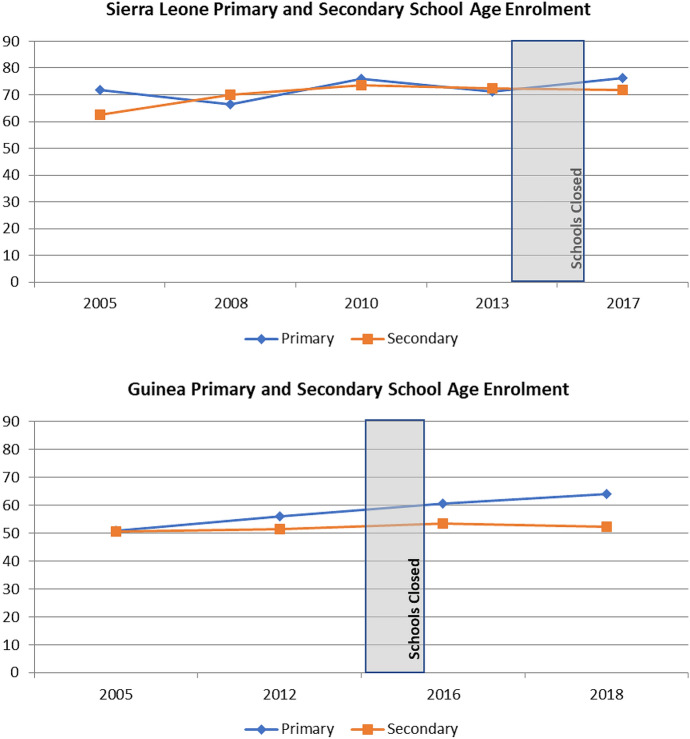
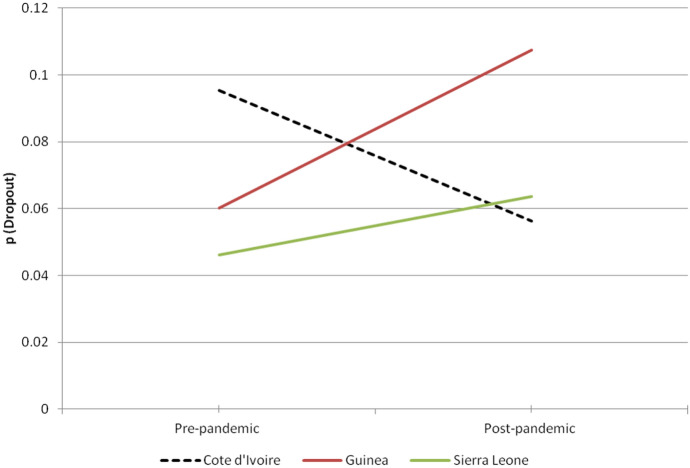
The COVID-19 pandemic has seen an unprecedented shutdown of society. Among the various safety measures taken, much attention has been given to school closure as a non-pharmaceutical mitigation tool to curb the spread of the disease through ensuring “social” (physical) distancing. Nearly 1.725 billion children in over 95% of countries worldwide have been affected by school closures implemented in April 2020 as the virus continued to spread. In the field of education, policymakers’ attention has been directed at keeping students on board through remote learning and addressing the immediate needs of schools upon reopening. The study presented in this article focuses on who remains absent after schools resume. Using publicly available survey data from the USAID Demographic Health Surveys Program and the UNICEF Multiple Indicator Cluster Survey from before and after the 2013–2016 Ebola pandemic in Guinea and Sierra Leone in West Africa, the author examined changes in school enrolment and dropout patterns, with targeted consideration given to traditionally marginalised groups. At the time, schools closed for between seven to nine months in the two countries; this length and intensity makes this Ebola pandemic the only health crisis in the recent past to come close to the pandemic-related school closures experienced in 2020. The author’s findings suggest that post-Ebola, youth in the poorest households saw the largest increase in school dropout. Exceeding expected pre-Ebola dropout rates, an additional 17,400 of the poorest secondary-age youth were out of school. This evidence is important for minimising the likely post-COVID-19 expansion in inequality. The author’s findings point to the need for sustainable planning that looks beyond the reopening of educational institutions to include comprehensive financial support packages for groups most likely to be affected.
Overview
The claims and statistics of this paper haven’t been checked yet.
Free: it reads the open-access text and checks the first 5 claims that cite a source we can check. Create a free account to check every claim.
Integrity signals
Registry
Cites
Statistics
Figures
Verification
Claims the paper makes
The claims and statistics of this paper haven’t been checked yet.
Free: it reads the open-access text and checks the first 5 claims that cite a source we can check. Create a free account to check every claim.
Claims other papers make about this one
Each is checked against this paper’s own text: does it say what the citing paper says it does?
The cited source says what the claim attributes to it.
In the citing paper
“Existing research on the development of learning gaps during summer vacations 17,18 , disruptions to schooling during the Ebola outbreak in Sierra Leone and Guinea 19 , and the 2005 earthquake in Pakistan 20 shows that the suspension of face-to-face teaching can increase educational inequality between children from different socio-economic backgrounds.”
From A systematic review and meta-analysis of the evidence on learning during the COVID-19 pandemic (2023) · cites this paper as [19]
Self-check
Percentages, sums and reported differences re-computed from the paper’s own numbers.
The self-check needs the paper’s full text.
Citations
Cites
The epidemiology and pathogenesis of coronavirus disease (COVID-19) outbreak
Rothan, H. A., & Byrareddy, S. N. (2020) · Journal of Autoimmunity · doi:10.1016/j.jaut.2020.102433 · Cited by 5,840 · cited 1×
“The virus is transmitted through direct contact with infected persons and through droplets expelled when coughing, sneezing or talking (Rothan and Byrareddy 2020), allowing it to spread rapidly.”
BackgroundViner, R. M., Russell, S. J., Croker, H., Packer, J., Ward, J., Stansfield, C., Mytton, O., Bonell, C., & Booy, R. (2020) · The Lancet Child & Adolescent Health · doi:10.1016/s2352-4642(20)30095-x · Cited by 2,213
Porta, M. (2026) · doi:10.1093/acref/9780197663639.001.0001 · Cited by 2,175
Age-dependent effects in the transmission and control of COVID-19 epidemics
Davies, N. G., Klepac, P., Liu, Y., Prem, K., Jit, M., CMMID COVID-19 working group, Pearson, C. A. B., Quilty, B. J., Kucharski, A. J., Gibbs, H., et al. (2020) · Nature Medicine · doi:10.1038/s41591-020-0962-9 · Cited by 1,759
Understanding logistic regression analysis
Sperandei, S. (2014) · Biochemia Medica · doi:10.11613/bm.2014.003 · Cited by 1,384
Roberton, T., Carter, E. D., Chou, V. B., Stegmuller, A. R., Jackson, B. D., Tam, Y., Sawadogo-Lewis, T., & Walker, N. (2020) · The Lancet Global Health · doi:10.1016/s2214-109x(20)30229-1 · Cited by 1,379
Nonpharmaceutical Interventions Implemented by US Cities During the 1918-1919 Influenza Pandemic
Markel, H., Lipman, H. B., Navarro, J. A., Sloan, A., Michalsen, J. R., Stern, A. M., & Cetron, M. S. (2007) · JAMA · doi:10.1001/jama.298.6.644 · Cited by 777
Methods matter improving causal inference in educational and social science research
Murnane, R. J., & Willett, J. B. (2011) · Cited by 620
Craig, P., Katikireddi, S. V., Leyland, A., & Popham, F. (2017) · Annual Review of Public Health · doi:10.1146/annurev-publhealth-031816-044327 · Cited by 570
Closure of schools during an influenza pandemic
Cauchemez, S., Ferguson, N. M., Wachtel, C., Tegnell, A., Saour, G., Duncan, B., & Nicoll, A. (2009) · The Lancet Infectious Diseases · doi:10.1016/s1473-3099(09)70176-8 · Cited by 545
Cited by
A systematic review and meta-analysis of the evidence on learning during the COVID-19 pandemic
Betthäuser, B. A., Bach-Mortensen, A. M., & Engzell, P. (2023) · Nature Human Behaviour · doi:10.1038/s41562-022-01506-4 · Cited by 568
COVID-19 learning losses: Early grade reading in South Africa
Ardington, C., Wills, G., & Kotze, J. (2021) · International Journal of Educational Development · doi:10.1016/j.ijedudev.2021.102480 · Cited by 164
“…(Cygan-Rehm 2018 and Hampf 2019), children who missed school during World War II (Ichino and Winter-Ebmer 2004) the 2005 earthquake in Pakistan (Andrabi et al 2020), the 2014-2015 Ebola epidemic in West Africa (Bandiera et al 2020 and Smith 2021) and Hurricane Katrina in the US (Sacerdote 2012).”
BackgroundZulaika, G., Bulbarelli, M., Nyothach, E., van Eijk, A. M., Mason, L., Fwaya, E., Obor, D., Kwaro, D., Wang, D., Mehta, S. D., et al. (2022) · BMJ Global Health · doi:10.1136/bmjgh-2021-007666 · Cited by 180
Child education in the time of pandemic: Learning loss and dropout
Khan, M. J., & Ahmed, J. (2021) · Children and Youth Services Review · doi:10.1016/j.childyouth.2021.106065 · Cited by 137
Parental Involvement and Student Engagement: A Review of the Literature
Yang, D., Chen, P., Wang, K., Li, Z., Zhang, C., & Huang, R. (2023) · Sustainability · doi:10.3390/su15075859 · Cited by 236
Measures implemented in the school setting to contain the COVID-19 pandemic
Krishnaratne, S., Littlecott, H., Sell, K., Burns, J., Rabe, J. E., Stratil, J. M., Litwin, T., Kreutz, C., Coenen, M., Geffert, K., et al. (2022) · Cochrane Database of Systematic Reviews · doi:10.1002/14651858.cd015029 · Cited by 81
Editorial Perspective: The mental health impact of school closures during the COVID‐19 pandemic
Almeida, M., Challa, M., Ribeiro, M., Harrison, A. M., & Castro, M. C. (2021) · Journal of Child Psychology and Psychiatry · doi:10.1111/jcpp.13535 · Cited by 79
Returning to school after COVID-19 closures: Who is missing in Malawi?
Kidman, R. C., Breton, E., Behrman, J. R., & Kohler, H. (2022) · International Journal of Educational Development · doi:10.1016/j.ijedudev.2022.102645 · Cited by 45
Nolte, K., Sipangule, K., & Wendt, N. (2022) · Journal of Land Use Science · doi:10.1080/1747423x.2021.2020922 · Cited by 41
Afrin, S., & Shammi, M. (2023) · Heliyon · doi:10.1016/j.heliyon.2023.e14680 · Cited by 33
Savio, A. A. D., Velarde, K. G., & Pachas, A. (2021) · Heliyon · doi:10.1016/j.heliyon.2022.e09504 · Cited by 39
Tülübaş, T., Demirkol, M., Özdemir, T. Y., Polat, H., Karakose, T., & Yirci, R. (2023) · Educational Process International Journal · doi:10.22521/edupij.2023.122.6 · Cited by 28
Yao, H., Memon, A. S., Amaro, D., Rigole, A., & Abdou, Y. D. (2021) · International Journal of Educational Development · doi:10.1016/j.ijedudev.2021.102457 · Cited by 28
Ebola disease: bridging scientific discoveries and clinical application
Rojek, A. M., Fieggen, J., Apiyo, P., Caluwaerts, S., Fowler, R., Kaleebu, P., Kojan, R., Lado, M., Lambe, T., Dunning, J. W., et al. (2024) · The Lancet Infectious Diseases · doi:10.1016/s1473-3099(24)00673-x · Cited by 20
Do the Benefits of School Closure Outweigh Its Costs?
Raffetti, E., & Baldassarre, G. D. (2022) · International Journal of Environmental Research and Public Health · doi:10.3390/ijerph19052500 · Cited by 18
Factors associated with adolescent pregnancy in Maharashtra, India: a mixed-methods study
Shukla, S., Torres, A. F. C., Satish, R. V., Shenderovich, Y., Abejirinde, I. O., & Steinert, J. (2023) · Sexual and Reproductive Health Matters · doi:10.1080/26410397.2023.2249284 · Cited by 25
Klein, E. K., Bond, L., McLean, K. E., Feika, M., Bah, A. J., & Betancourt, T. S. (2023) · SSM - Qualitative Research in Health · doi:10.1016/j.ssmqr.2023.100227 · Cited by 9
“Children were not allowed to go to school, play with friends, or leave the house for nearly two years, and schools were closed for nine months (Smith, 2021).”
Acero, A., Ramírez-Cajiao, M. C., & Baillie, C. A. (2024) · Frontiers in Education · doi:10.3389/feduc.2024.1386729 · Cited by 15
Secondary Education and COVID-19
Siakalli, M., Mousoulidou, M., Christodoulou, A., Savvidou, A., & Kouppa, K. (2022) · Encyclopedia · doi:10.3390/encyclopedia2010025 · Cited by 10
The Impact of COVID-19 on Student Reading Development
Gray, J. S., Powell‐Smith, K. A., & Good, R. H. (2023) · The Elementary School Journal · doi:10.1086/723301 · Cited by 9
Factors Influencing Site Selection for Higher Education Institutes: A Meta-Analysis
Lou, Y., Azadi, H., & Witlox, F. (2024) · Land · doi:10.3390/land13122123 · Cited by 7
COVID‐19, school closures and the retreat from educational aspirations
Glick, J. E., Alcaraz, M., Randrianasolo, A., & Yabiku, S. T. (2024) · Journal of Adolescence · doi:10.1002/jad.12406 · Cited by 7
Shanmugam, S. K. S., Veloo, A., & Yusoff, Y. J. (2023) · Diaspora Indigenous and Minority Education · doi:10.1080/15595692.2023.2212823 · Cited by 9
Inclusive Learning for Children in Northeast Nigeria: Radio School Response During a Global Pandemic
Ebubedike, M., Boampong, M., James, K., Shuaibu, H. O., & Monyeh, T. (2022) · Social Inclusion · doi:10.17645/si.v10i2.5171 · Cited by 9
Effect of COVID-19 on future education: Reimagining tomorrow’s lessons
Suzylily, L., & Lim, S. A. (2022) · Elsevier eBooks · doi:10.1016/b978-0-323-91307-2.00009-2 · Cited by 6
Educating during a Health Emergency: An Integrative Review of the Literature from 1990 to 2020
Elliott, K. E., Mathew, K. A., Fan, Y., & Mattson, D. (2022) · Journal on Education in Emergencies · doi:10.33682/85qf-kr51 · Cited by 3
The Effect of Google Classroom-Assisted Learning on Self-Efficacy among Form Six Economics Students
Sari, N. M., & Yin, K. Y. (2021) · International Journal of Academic Research in Business and Social Sciences · doi:10.6007/ijarbss/v11-i11/11527 · Cited by 8
Sari, N. M., Yin, K. Y., & Zakariya, Z. (2021) · International Journal of Advanced Research in Education and Society · doi:10.55057/ijares.2021.3.4.3 · Cited by 6
Savio, A. A. D., Velarde, K. G., & Pachas, A. (2021) · SSRN Electronic Journal · doi:10.2139/ssrn.3969247 · Cited by 3
Log in or out of online schooling: the case of Romania
Marín, M. (2022) · SN Social Sciences · doi:10.1007/s43545-022-00450-4 · Cited by 2
¿Qué pasó con el rendimiento académico en Ingeniería Química?: un estudio en tiempos de COVID-19
Monsalve-Silva, S., & Vera-Monroy, S. P. (2022) · Ingenieria y Universidad · doi:10.11144/javeriana.iued26.whaa · Cited by 2
Garcia, M. B. (2024) · Educational Research for Policy and Practice · doi:10.1007/s10671-024-09366-7 · Cited by 3
Lee, H., Rauktis, M. E., Mulzet, M., & Sgourakis, A. (2023) · Child and Adolescent Social Work Journal · doi:10.1007/s10560-023-00922-3 · Cited by 3
Gaofeng, Z. (2021) · SSRN Electronic Journal · doi:10.2139/ssrn.3945380 · Cited by 2
The Learning Crisis: Three Years After COVID-19Preprint
Gajderowicz, T. J., Jakubowski, M., Kennedy, A., Kjeldsen, C. C., Patrinos, H. A., & Strietholt, R. (2025) · SSRN Electronic Journal · doi:10.2139/ssrn.5059328 · Cited by 11
Østby, G., Gjerløw, H., Karim, S., & Dunlop, E. (2023) · Journal on Education in Emergencies · doi:10.33682/a1zn-5nda · Cited by 2
Does Education Budget Influence School Dropout?
Dahliana, D., & Huda, N. (2024) · KnE Social Sciences · doi:10.18502/kss.v9i19.16477 · Cited by 1
Assessing Financial Well-being of Undergraduate University Students during COVID-19 Pandemic
Al‐Labadi, L., Hur, J., Lim, K., & Srivastava, N. (2023) · Higher Education Studies · doi:10.5539/hes.v13n1p24 · Cited by 3
The Right to Education in a Digital Era
Kraljić, S. (2024) · Law, governance and technology series · doi:10.1007/978-3-031-51067-0_8 · Cited by 1
Lifelong Learning Policies in Latin America
Valdés-Cotera, R., & Denham, S. C. (2023) · Springer international handbooks of education · doi:10.1007/978-3-031-19592-1_29 · Cited by 1
Aide internationale et gouvernances éducatives en situation de pandémie : la Covid-19 au Cameroun
Lefort-Rieu, C., & Ngodji, F. (2023) · Cahiers d études africaines · doi:10.4000/etudesafricaines.41816 · Cited by 1
The Impact of COVID-19 on Education in India: Paving the Way for Greater Digitalisation
Mandal, M. (2022) · Advances in educational marketing, administration, and leadership book series · doi:10.4018/978-1-7998-8402-6.ch012 · Cited by 1
Communication Phenomena of COVID-19: A Longitudinal Study of Mainstream Indo-Pak English Newspapers
(2021) · PAKISTAN LANGUAGES AND HUMANITIES REVIEW · doi:10.47205/plhr.2021(5-ii)2.46
Qader, M. A. (2022) · Utamax Journal of Ultimate Research and Trends in Education · doi:10.31849/utamax.v4i2.8432
Raub, A., & Heymann, J. S. (2022) · Global Social Policy · doi:10.1177/14680181221123800 · Cited by 1
Lifelong Learning Policies in Latin America
Valdés-Cotera, R., & Cárdenas, S. (2022) · Springer international handbooks of education · doi:10.1007/978-3-030-67930-9_29-1
The impact of the COVID-19 pandemic on youth and families
Mazzeo, S. E., Corona, R., Everhart, R. S., & Jones, H. A. (2022) · Elsevier eBooks · doi:10.1016/b978-0-12-818872-9.00133-3
Elliott, K. E., Mathew, K. A., Fan, Y., & Mattson, D. (2022) · Journal on Education in Emergencies · doi:10.33682/fxy4-5awf · Cited by 1
The Intervention of Technology in Education Under Isolation: Intuitions from Covid
Afriyie, S. O., Nkyi, J. A., Amoakohene, G., Musah, M., & Lartey, P. Y. (2023) · Lecture notes in networks and systems · doi:10.1007/978-981-19-9858-4_25 · Cited by 1
COVID-19 and Children’s Mental Health
Phelps, C. M., Liner, A., Sperry, L. L., Amakye, R., & Austin, Z. (2023) · Autism and child psychopathology series · doi:10.1007/978-3-031-24926-6_46
Journal on Education in Emergencies: Volume 9, Number 1 (Complete)
Thompson, N., Colón, S., Burde, D., Arlini, S. M., Chefchaouni, N. C., Chia, J., Gordon, M., Shrestha, N., Østby, G., Gjerløw, H., et al. (2023) · Journal on Education in Emergencies · doi:10.33682/kbsk-pke2
Pedagogy and Curriculum Practices Pre Covid
Sinha, A. (2024) · Springer eBooks · doi:10.1007/978-3-031-37974-1_1
Ohlig, L., & Timm, S. (2024) · International Journal of Educational Development · doi:10.1016/j.ijedudev.2024.103056 · Cited by 6
School Closures and Parental Mental Health
Gupta, S., Salcedo, D., & Simon, K. I. (2024) · National Bureau of Economic Research · doi:10.3386/w32516
The Good, Bad, and Ugly of School Closures and Virtual Learning
Colvin, M. K., Reesman, J. L., & Glen, T. (2024) · Oxford University Press eBooks · doi:10.1093/9780197762660.003.0002
Kano, T., & Ishikawa, K. (2024) · IFIP advances in information and communication technology · doi:10.1007/978-3-031-66982-8_16 · Cited by 1
Kızıltaş, Y., & GÖNÜLAL, H. (2025) · Rural Society · doi:10.1080/10371656.2025.2477389 · Cited by 2
Schipper, M., Morssinkhof, M. W. L., Kreukels, B. P. C., T'Sjoen, G. G., Fisher, A. D., Greenman, Y., van der Tuuk, K., den Heijer, M., Doyle, D. M., & Broekman, B. F. P. (2026) · Anxiety Stress & Coping · doi:10.1080/10615806.2026.2728703 · Cited by 1
Reliability and Validity of a Daily Activity Evaluation Questionnaire for Adolescents
Göktaş, A., & Türkmen, V. (2025) · SAGE Open · doi:10.1177/21582440251378363
Agbevanu, W. K., Abreh, M., Bosu, R., Ansah, F., Alhassan, A., Nyame, G., Mills, C. A., & Minardi, A. (2026) · SN Social Sciences · doi:10.1007/s43545-026-01364-1
SAIMSARA (2026) · SAIMSARA Journal · doi:10.62487/saimsara976931fc
Lim, J., Ostry, A. M., Elshabrawy, Y., Brogno, S., ANICET, N. N., Hermann, A. K. P. E., Tanoh, F., Brice, H., Ogan, A., & Jasińska, K. K. (2026) · Research in Comparative and International Education · doi:10.1177/17454999261453153
Education lost, labor gained: A systematic review of COVID-19's impact on children in South Asia
Muromba, P., & Keeni, M. (2026) · Social Sciences & Humanities Open · doi:10.1016/j.ssaho.2026.102949
Jackson, M. M., Sondah, B., Baek, J., & Raja, R. (2026) · Educational Management Administration & Leadership · doi:10.1177/17411432261467696
Skaik, S. I. (2026) · IGI Global eBooks · doi:10.4018/979-8-3373-8602-7.ch002
Metadata
- Authors
- Smith, W. C.
- Affiliations
- University of Edinburgh (GB)
- Corresponding author
- Smith, William C.
- ORCID
- Smith, William C.
- Venue
- International Review of Education
- Published
- 2021-04
- Volume
- 67
- Issue
- 1-2
- Pages
- 53-78
- ISSN
- 0020-8566 (ISSN-L)
- 1573-0638
- PMC
- PMC8074702
- OpenAlex
- W3158696668
- Semantic Scholar
- 6e3edf6e860e9f7182a7b4e849e70a48f41263f2
- Cited by
- 65
- References
- 49
- Citations by year
- 2026: 7 · 2025: 3 · 2024: 12 · 2023: 16 · 2022: 18 · 2021: 9
- FWCI
- 17.19
- Type
- journal article
- Language
- en
- Open access
- hybrid
- doi.org
- Licence
- cc-by
- creativecommons.org/licenses/by/4.0 (tdm)
- creativecommons.org/licenses/by/4.0 (vor, 25 d)
- Locations
- International Review of Education (publishedVersion, cc-by)
- PubMed Central (publishedVersion, cc-by)
- PubMed (publishedVersion)
- Edinburgh Research Explorer (University of Edinburgh) (submittedVersion, cc-by)
- Funders
- United States Agency for International Development
- UNICEF
- Topics
- Social Sciences › Development › Poverty, Education, and Child Welfare
- Social Sciences › Education › Education during COVID-19 pandemic
- Social Sciences › Education › African Education and Politics
- Keywords
- school closures, school dropout, school enrolment, access to education, COVID-19 pandemic, educational inequality, poverty and education, marginalised groups, school reopening, distance education, Guinea, Sierra Leone
About these checks
Registry, retraction, Cites and statistics results are computed, not judged, with one exception: a printed reference that no index lists is read once by a model before it counts as a citation error. Claims are extracted by a model and kept only when their quote appears verbatim in the text; each cited source is then checked, with a model’s help, for whether it says what the claim relies on. Those verdicts can be wrong — read the claim’s quote and the cited source before relying on one.
Statistics and arithmetic are recomputed, not judged.
Confidence bands are shown only for fields calibrated on our annotated test set. None is calibrated yet, so no band is shown.
What counts as a claim ›How we measure confidence ›How we check this ›
Are you an author, or do you see a problem with this page? Request a review
Data sources
Bibliographic data: Semantic Scholar, OpenAlex, Crossref.
Contains information from the Semantic Scholar Academic Graph Datasets, made available under the ODC Attribution License (ODC-BY 1.0).
Semantic Scholar’s data is described in: Kinney, R., et al. (2023). The Semantic Scholar Open Data Platform. arXiv:2301.10140.
