

An analysis of the titles of papers submitted to the UK REF in 2014: authors, disciplines, and stylistic details
Open accessThe DOI matches its Crossref record; 37 of the 38 references it cites were found in a registry or an index.
Abstract
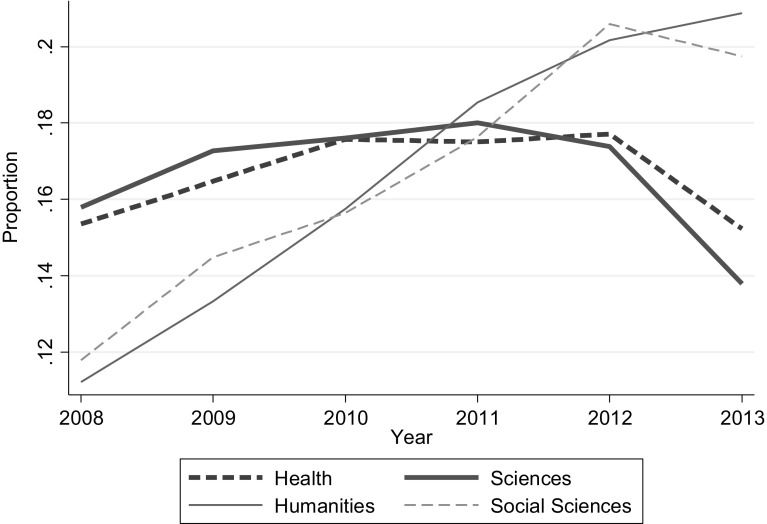
In 2014 over 52,000 academics submitted >155,500 journal articles in 36 different disciplines for assessment in the UK's four-year Research Evaluation Framework (the REF). In this paper the characteristics of the titles of these papers are assessed. Although these varied considerably between the disciplines, the main findings were that: (i) the lengths of the titles increased with the number of authors in almost all disciplines, (ii) the use of colons and question marks tended to decline with increasing author numbers-although there were a few disciplines, such as economics, where the reverse was evident, (iii) papers published later on in the 4-year period tended to have more authors than those published earlier, and (iv), in some disciplines, the numbers of subsequent citations to papers were higher when the titles were shorter and when they employed colons but lower when they used question marks.
Overview
The claims and statistics of this paper haven’t been checked yet.
Free: it reads the open-access text and checks the first 5 claims that cite a source we can check. Create a free account to check every claim.
Integrity signals
Registry
Cites
Statistics
Figures
Verification
Claims the paper makes
The claims and statistics of this paper haven’t been checked yet.
Free: it reads the open-access text and checks the first 5 claims that cite a source we can check. Create a free account to check every claim.
Claims other papers make about this one
Each is checked against this paper’s own text: does it say what the citing paper says it does?
The source backs part of the claim, not all of it — or backs it for a different population, condition or comparison.
In the citing paper
“Although longer titles may provide more information regarding the content, they reduce the interest generated (39).”
From The Principles of Biomedical Scientific Writing: Title (2019) · cites this paper as [39]
Experimental — accuracy not yet measured
Self-check
Percentages, sums and reported differences re-computed from the paper’s own numbers.
The self-check needs the paper’s full text.
Citations
Cites
What is research collaboration?
Katz, J. S., & Martin, B. R. (1997) · Research Policy · doi:10.1016/s0048-7333(96)00917-1 · Cited by 2,972 · cited 1×
“Katz and Martin (1997) focus specifically on coauthorship and the extent to which it coincides with collaboration.”
BackgroundCollaborative Research Across Disciplinary and Organizational Boundaries
Cummings, J. N., & Kiesler, S. (2005) · Social Studies of Science · doi:10.1177/0306312705055535 · Cited by 759 · cited 1×
“Cummings and Kiesler (2005) analyse the coordination costs with respect to researchers in multi-university collaborations, mainly in the sciences and engineering but also psychology and mathematics.”
BackgroundGroups That Work (And Those That Don't): Creating Conditions for Effective Teamwork
Mathiasen, D. G., & Hackman, J. R. (1991) · Journal of Policy Analysis and Management · doi:10.2307/3325003 · Cited by 567
Reflections on Scientific Collaboration (and its study): Past, Present, and Future
Beaver, D. D. (2001) · Scientometrics · doi:10.1023/a:1014254214337 · Cited by 526
Cronin, B. (2001) · Journal of the American Society for Information Science and Technology · doi:10.1002/asi.1097 · Cited by 500 · cited 1×
“Indeed it may be, as suggested by Cronin (2001), that not all authors contribute to the writing of the paper rather than the research.”
BackgroundPersson, O., Glänzel, W., & Danell, R. (2004) · Scientometrics · doi:10.1023/b:scie.0000034384.35498.7d · Cited by 494 · cited 1×
“10 Thus, for example Persson et al. (2004) find the number of references to increase with the number of authors, which of course has implications for the text of the paper itself. the whole of scientific work the results from a partial analysis.”
BackgroundArticle title type and its relation with the number of downloads and citations
Jamali, H. R., & Nikzad, M. (2011) · Scientometrics · doi:10.1007/s11192-011-0412-z · Cited by 332 · cited 1×
“However seeming to contradict this, Jamali and Nikzad (2011) detected a negative, although insignificant, correlation between citations and title length.”
ResultTrends in Multi-Authored Papers in Economics
Hudson, J. (1996) · Journal of Economic Perspectives · doi:10.1257/jep.10.3.153 · Cited by 289 · cited 1×
“There is also evidence to link the structure and style of the title to the number of authors, which in itself has tended to increase over time (Hudson 1996).”
BackgroundSelf-citationJacques, T. S., & Sebire, N. J. (2010) · JRSM Short Reports · doi:10.1258/shorts.2009.100020 · Cited by 220
Co-authorship and the output of academic economists
Hollis, A. (2001) · Labour Economics · doi:10.1016/s0927-5371(01)00041-0 · Cited by 206 · cited 2×
“Katz and Martin (1997) focus specifically on coauthorship and the extent to which it coincides with collaboration.”
Background
Cited by
How do authors select keywords? A preliminary study of author keyword selection behavior
Lu, W. P., Liu, Z., Huang, Y., Bu, Y., Li, X., & Cheng, Q. (2020) · Journal of Informetrics · doi:10.1016/j.joi.2020.101066 · Cited by 141
Hyland, K., & Zou, H. (2022) · Journal of English for Academic Purposes · doi:10.1016/j.jeap.2022.101094 · Cited by 106
“In the largest study to date, Hudson (2016) examined the impact of multiple authorship on the titles of papers submitted to the UK ’ s four-yearly Research Evaluation Framework (the REF) in 2014.”
BackgroundInfluentialAcademic publishing and the attention economy
Hyland, K. (2023) · Journal of English for Academic Purposes · doi:10.1016/j.jeap.2023.101253 · Cited by 95
The Principles of Biomedical Scientific Writing: Title
Bahadoran, Z., Mirmiran, P., Kashfi, K., & Ghasemi, A. (2019) · International Journal of Endocrinology and Metabolism · doi:10.5812/ijem.98326 · Cited by 61
Milojević, S. (2017) · Frontiers in Research Metrics and Analytics · doi:10.3389/frma.2017.00002 · Cited by 62
“This trend has naturally led some researchers to examine whether the change in authorship had an effect on title construction (e.g., Hudson, 2016).”
BackgroundInfluentialThe Core-Periphery Problem in Communication Research: A Network Analysis of Leading Publication
Demeter, M. (2017) · Publishing Research Quarterly · doi:10.1007/s12109-017-9535-2 · Cited by 54
“Jon Hudson, for example, analyzed bias in scientific journals as regards authors, disciplines, stylistic details, title length, and even the usage of question marks [10].”
BackgroundTitles in research articles: Changes across time and discipline
Jiang, F. K., & Hyland, K. (2022) · Learned Publishing · doi:10.1002/leap.1498 · Cited by 59
“Hudson (2016), for example, suggests using short titles since long ones are ‘more difficult to digest and may reduce the attraction factor’ (p. 878), while question titles have been found to produce more downloads but less citations than other forms (Jamali & Nikzad, 2011).”
BackgroundResultInfluentialComplexity aversion when Seeking Alpha
Umar, T. (2022) · Journal of Accounting and Economics · doi:10.1016/j.jacceco.2021.101477 · Cited by 44
Factors affecting the citations of papers in tribology journals
Liskiewicz, T. W., Liśkiewicz, G., & Paczesny, J. (2021) · Scientometrics · doi:10.1007/s11192-021-03870-w · Cited by 38
“2014; Hudson 2016).”
BackgroundZong, Q., Xie, Y., Tuo, R., Huang, J., & Yang, Y. (2019) · Scientometrics · doi:10.1007/s11192-019-03108-w · Cited by 34
“2019; Hudson 2016; Jamali and Nikzad 2011).”
Which social media posts generate the most buzz? Evidence from WeChat
She, J., Zhang, T., Chen, Q., Zhang, J., Fan, W., Wang, H., & Chang, Q. (2021) · Internet Research · doi:10.1108/intr-12-2019-0534 · Cited by 35
Appiah, K. R., Ankomah, C., Osei, H. Y., & Hattoh-Ahiaduvor, T. (2019) · Advances in Language and Literary Studies · doi:10.7575/aiac.alls.v.10n.3p.145 · Cited by 22
“This finding is largely in line with a lot of studies that have investigated the syntactic structures of titles (e.g., Alcaraz & Mendez, 2016; Fumani et al., 2015; Hartley, 2007; Hudson, 2016).”
BackgroundResultInfluentialEmpirical analysis of the text structure of original research articles in medical journals
Heßler, N., Rottmann, M., & Ziegler, A. (2020) · PLoS ONE · doi:10.1371/journal.pone.0240288 · Cited by 25
Avoiding obscure topics and generalising findings produces higher impact research
Thelwall, M. A. (2016) · Scientometrics · doi:10.1007/s11192-016-2159-z · Cited by 21
Chen, X., & Liu, H. (2023) · Journal of English for Academic Purposes · doi:10.1016/j.jeap.2023.101306 · Cited by 18
CiteTracked: A Longitudinal Dataset of Peer Reviews and Citations.
Plank, B., & van Dalen, R. (2019) · IT University Of Copenhagen (IT University of Copenhagen) · Cited by 36
Online Health Information Wants of Caregivers for Persons With Dementia in Social Media
Tang, A., Kwak, J., Xiao, L., Xie, B., Lahiri, S., Flynn, O., & Murugadass, A. (2023) · SAGE Open · doi:10.1177/21582440231205367 · Cited by 14
“For instance, She et al. (2022) and Hudson (2016) found that the longer the post the less attractive to the readers and speculated that the comprehension challenge being an important reason.”
BackgroundMéndez, D. I., & Alcaraz, M. Á. (2017) · Advances in Language and Literary Studies · doi:10.7575/aiac.alls.v.8n.5p.128 · Cited by 12
“…of authors mentioned in the bylines of both genres in order to see whether our results are in line with those previously obtained by authors such as, for instance, Kuch (1978), White (1991), Yitzhaki (1994) and Hudson (2016), although their studies were conducted in fields other than astrophysics.”
BackgroundResultPeuter, S. D., Reck, J., Bellekens, S., & Storms, G. (2024) · Research Ethics · doi:10.1177/17470161241262244 · Cited by 12
“Although we can only speculate, one potential explanation for the distinction is that research papers in (bio)medicine mention on average more authors on the byline (Hudson, 2016).”
Title analysis of (systematic) scoping review studies: Chaos or consistency?
Chrastina, J. (2020) · Nursing and Health Sciences · doi:10.1111/nhs.12694 · Cited by 10
The impact of headline features on the attraction of online financial articles
She, J., & Zhang, T. (2019) · International Journal of Web Information Systems · doi:10.1108/ijwis-11-2018-0084 · Cited by 9
Anderson, O. S., & August, E. T. (2020) · Journal of Public Health · doi:10.1093/pubmed/fdaa034 · Cited by 9
Identifying economics’ place amongst academic disciplines: a science or a social science?
Hudson, J. (2017) · Scientometrics · doi:10.1007/s11192-017-2519-3 · Cited by 14
“…the median. information on different title characteristics across disciplines, it is also worth noting that characteristics such as title length, use of colons and question marks have been found to impact on citations (Haslam et al. 2008; Jamali and Nikzad 2011; Van Wesel et al. 2014; Hudson 2016).”
BackgroundInfluentialSelf-citationDeconstructing applied linguistics conference paper titles: A syntactic analysis
Afful, J. B. A., & Ankomah, C. (2020) · Journal of Language and Linguistic Studies · doi:10.17263/jlls.803669 · Cited by 7
“However, longer titles tend to increase the content of information they carry though they can preclude academics from reading them (Hudson, 2016).”
BackgroundResultInfluentialTitles and keywords: ‘Great love isn’t two people finding the perfect match in one another!’
Diao, J. (2023) · Journal of Information Science · doi:10.1177/01655515231156097 · Cited by 6
“…on title construction among authors can be settled by including every collaborator’s ideas; the structural coordination of colonic titles could be a potential problem that makes the agreement more troublesome to achieve because there are two sub titles calling for collective consent [30].”
Syntactic structures of Turkish research article titles in medicine and engineering
Demir, D. (2023) · African Educational Research Journal · doi:10.30918/aerj.113.23.068 · Cited by 6
“In the literature, the importance of titles is so well documented that they are called the “face” (Annesley, 2010) and “highway billboard” (Belcher, 2021) of the article; “texts in miniature” (Haggan, 2004), “labels” (Gastel and Day, 2022), “mini abstracts” (Hudson, 2016), “abstract of the abstract” (Diao, 2021), “the…”
BackgroundBratičević, M. N., Babić, I., Abramović, I., Jokić, A., & Horvat, M. (2020) · Biochemia Medica · doi:10.11613/bm.2020.010708 · Cited by 5
“In concordance with results from our study, Hudson elaborates based on his study on 155,500 journal articles in 36 different disciplines that more authors are characteristic of a field of science in comparison to the field of social sciences, arts and humanities and that there is a positive impact of increasing author…”
ResultWang, J. (2024) · Scientometrics · doi:10.1007/s11192-024-05123-y · Cited by 4
“In the domain of informatics, it is commonly acknowledged that the higher the citation of a research article is, the less likely it appears as interrogatives (Buter & van Raan, 2011; Hudson, 2016; Rostami et al., 2014; Subotic & Mukherjee, 2014).”
Analysis of citation rate of papers with titles containing a country name
Moradi, S., & Asnafi, A. R. (2016) · E-LIS Repository (University of Naples Federico II) · Cited by 4
Martín, P. A. M., & León-Pérez, I. (2024) · Journal of English for Research Publication Purposes · doi:10.1075/jerpp.00027.mar · Cited by 4
Identifying the Characteristics and Differences between Titles in Nursing Research Articles
Ichiyama, Y. (2021) · Open Journal of Modern Linguistics · doi:10.4236/ojml.2021.111005 · Cited by 3
Corpus-Based Discourse Analysis: Titles in Civil Engineering Research Articles
Roldán-Riejos, A. (2021) · Springer eBooks · doi:10.1007/978-3-030-87476-6_15 · Cited by 3
Apriani, N., & Arsyad, S. (2022) · ENGLISH FRANCA Academic Journal of English Language and Education · doi:10.29240/ef.v6i2.5445 · Cited by 3
“Likewise, Bavdekar (2016) and Hudson (2016) assert that the JA that has a very long title avert readers from reading it in full because readers 234 | ENGLISH FRANCA, Vol. 6, No. 2, 2022 tend to lose the information focus of the title when they read the title.”
BackgroundCharacteristics of papers that affect citations in the Journal of Fish Biology
Fenton, M., Fennell, H., & Kaiser, M. J. (2023) · Journal of Fish Biology · doi:10.1111/jfb.15565 · Cited by 3
“A notable exception to this rule, however, is titles containing questions, which are less frequently cited (Hudson, 2016).”
BackgroundMethodInfluentialLinguistic Characteristics of Research Article Titles in National and International ELT Journals
Jasrial, D., Ramadhan, S., Mukhaiyar, M., & Afful, J. B. A. (2024) · Journal of Languages and Language Teaching · doi:10.33394/jollt.v12i1.9608 · Cited by 6
“Furthermore, research by Bavdekar (2015) and Hudson (2016) suggests that overly long titles may cause readers to lose sight of the main message.”
BackgroundStructural Patterns of Research Article Titles: An Exploratory Study in Five Branches of Linguistics
Surapongraktrakool, N. (2023) · Thoughts · doi:10.58837/chula.thts.2023.2.3 · Cited by 3
Titles in archaeology research articles: a corpus-based comparison with other disciplines
Brett, D. (2025) · Journal of English for Academic Purposes · doi:10.1016/j.jeap.2025.101545 · Cited by 3
‘What’s in a name?’ Writing an effective and engaging article title
Cleland, J. (2025) · Medical Teacher · doi:10.1080/0142159x.2025.2488697 · Cited by 3
Choosing a Topic: Focus and Title
Jalongo, M. R. (2023) · Springer texts in education · doi:10.1007/978-3-031-39516-1_5 · Cited by 2
Strategies to boost citations in maxillofacial surgery literature: A meta-data science analysis
Grillo, R., Barretto, M. D. D. A., Brozoski, M. A., Elias, F. M., & Deboni, M. C. Z. (2025) · Journal of Cranio-Maxillofacial Surgery · doi:10.1016/j.jcms.2025.04.007 · Cited by 2
Writing Energy Economics Research for Impact
Dowling, M., Hammami, H., Tawil, D., & Zreik, O. (2020) · The Energy Journal · doi:10.5547/01956574.42.3.mdow · Cited by 2
“Previous research on title length has shown higher citations for shorter titles (Hudson, 2016), although, as noted in the introduction, there can be discipline-specific differences.”
BackgroundTitle Features in Research Articles: A Disciplinary Study of Law
Pan, P., Hao, Y., & Chen, H. (2024) · Journal of Education and Educational Research · doi:10.54097/2t6pg104 · Cited by 2
“Over the past years, articles generally analyzed and discussed both common title features like the proper length (Hudson, 2016; Lewison & Hartley, 2005), the use of questions (Hartley, 2005; Hyland, 2002), and structure like the use of colonies (Milojevic, 2017), and so on.”
BackgroundA Scoping Review of Hispanic-Serving Institutions Literature in STEM
Rujimora, J., Campbell, L. O., & Butler, S. (2024) · Journal of Latinos and Education · doi:10.1080/15348431.2024.2304568 · Cited by 1
“More than half of the STEM-related titles used colons, contradicting prior research suggesting STEM-related titles use colons the least (Hudson, 2016).”
Disciplinary variation in scholarly impact from two article title elements
Donovan, J. M. (2025) · Journal of Librarianship and Information Science · doi:10.1177/09610006241311576 · Cited by 1
Schmidt, W. (2021) · FEBS Letters · doi:10.1002/1873-3468.14198 · Cited by 1
All together now: disentangling Beatles’ song titles in medical research articlesPreprint
Maci, S. M., Lorenzo, C. D., & Vollono, C. (2023) · Research Square · doi:10.21203/rs.3.rs-2652299/v1 · Cited by 1
Frančíková, D., & Rosolová, K. E. (2021) · doi:10.31490/9788024845555
Barbeiro, L. F., Carvalho, J. A. B., & Barbeiro, C. (2023) · Diacrítica · doi:10.21814/diacritica.785 · Cited by 1
“…dos títulos têm também estado em foco, em textos de diversos campos (Coimbra 1999, para o campo jornalístico; Barbeiro et al. 2020, Calil 2020; Pereira, Coimbra, & Calil 2017, para as histórias das crianças), incluindo o campo da escrita académica (Hudson 2016; Soler 2007; Whissel 2012).”
BackgroundMarcuzzo, P., & Cervo, N. C. (2022) · Fórum Linguístico · doi:10.5007/1984-8412.2022.e79856
Coocorrência de Palavras em Títulos de Publicações da Comunidade Acadêmica de ArtesPreprint
Werner, R., Pinto, T., Loula, Â., & Queiroz, J. (2025) · doi:10.1590/scielopreprints.10957
Topaloğlu, M. E. İ., Gürbüz, N. E., Çağıltay, N. E., & Göktaş, Y. (2025) · TED EĞİTİM VE BİLİM · doi:10.15390/eb.2025.13121
Differences in Journal Paper Titles between Natural Sciences and Humanities: A Corpus-based Analysis
Yang, Y., Zhang, W., & Liao, S. (2025) · Corpus-based Studies across Humanities · doi:10.1515/csh-2025-0001
A cross-disciplinary comparison of article titles: length, form and content
Li, Z., & Yangfan, S. U. (2025) · Scientometrics · doi:10.1007/s11192-025-05507-8
“Despite this, longer titles are “more difficult to digest and may reduce the attraction factor” (Hudson, 2016, p. 878) and shorter ones may display a more specific scope and thus attract a larger number of readings and citations (Paiva et al., 2012).”
InfluentialWang, Z. (2024) · Universiti Putra Malaysia Institutional Repository (Universiti Putra Malaysia)
Shrivastava, S. (2026) · SSRN Electronic Journal · doi:10.2139/ssrn.6659258
Colon in the Title of an Academic Text: A Linguistic Trend or a Fluctuation?
Dymova, A. V., & Zolotaiko, A. I. (2026) · Izvestia of the Ural federal university Series 2 Humanities and Arts · doi:10.15826/izv2.2026.28.1.006
Jie, R., Chu, C., Geng, R., Jia, D., Lu, T., Guan, G., & Wang, Z. (2026) · Research Square · doi:10.21203/rs.3.rs-9861817/v1
Perhaps You Should Use a Colon: Predicting Citation Counts of U.S. Higher Education Journal Articles
Bowman, N. A., Hung, S. L., & Trolian, T. L. (2026) · The Journal of Higher Education · doi:10.1080/00221546.2026.2706433
Bibliometric Analysis of Thesis Title Trends in Language Teaching in Mexico
Mosqueda, H. C. (2025) · CIEX JOURNAL · Cited by 1
Semantic Study on the Unique Naming of PTKIN Library and Information Journals
Ahwan, M. A., & Kardi, K. (2021) · PAROLE Journal of Linguistics and Education · doi:10.14710/parole.v11i2.224-230 · Cited by 1
Metadata
- Authors
- Hudson, J.
- Affiliations
- University of Bath (GB)
- Corresponding author
- Hudson, John
- ORCID
- Hudson, John
- Venue
- Scientometrics
- Published
- 2016-07-29
- Volume
- 109
- Issue
- 2
- Pages
- 871-889
- ISSN
- 0138-9130 (ISSN-L)
- 1588-2861
- PMC
- PMC5065898
- OpenAlex
- W2500177191
- Cited by
- 54
- References
- 38
- Citations by year
- 2026: 2 · 2025: 7 · 2024: 6 · 2023: 8 · 2022: 7 · 2021: 6 · 2020: 7 · 2019: 5 · 2017: 4 · 2016: 2
- FWCI
- 3.42
- Type
- journal article
- Language
- en
- Open access
- hybrid
- doi.org
- Locations
- Scientometrics (publishedVersion, cc-by)
- PubMed Central (publishedVersion, cc-by)
- PubMed (publishedVersion)
- RePEc: Research Papers in Economics (submittedVersion)
- Topics
- Social Sciences › Library and Information Sciences › scientometrics and bibliometrics research
- Social Sciences › Library and Information Sciences › Academic Writing and Publishing
- Social Sciences › Psychology › Experimental and Cognitive Psychology › Psychology Research and Bibliometrics
- Keywords
- research paper titles, title length, authorship, disciplinary differences, punctuation, colon, question marks, citation impact, Research Excellence Framework, journal articles
About these checks
Registry, retraction, Cites and statistics results are computed, not judged, with one exception: a printed reference that no index lists is read once by a model before it counts as a citation error. Claims are extracted by a model and kept only when their quote appears verbatim in the text; each cited source is then checked, with a model’s help, for whether it says what the claim relies on. Those verdicts can be wrong — read the claim’s quote and the cited source before relying on one.
Statistics and arithmetic are recomputed, not judged.
Confidence bands are shown only for fields calibrated on our annotated test set. None is calibrated yet, so no band is shown.
What counts as a claim ›How we measure confidence ›How we check this ›
Are you an author, or do you see a problem with this page? Request a review
Data sources
Bibliographic data: Semantic Scholar, OpenAlex, Crossref.
Contains information from the Semantic Scholar Academic Graph Datasets, made available under the ODC Attribution License (ODC-BY 1.0).
Semantic Scholar’s data is described in: Kinney, R., et al. (2023). The Semantic Scholar Open Data Platform. arXiv:2301.10140.
