

An analysis of the titles of papers submitted to the UK REF in 2014: authors, disciplines, and stylistic details
Open accessThe DOI matches its Crossref record; 37 of the 38 references it cites were found in a registry or an index.
Abstract
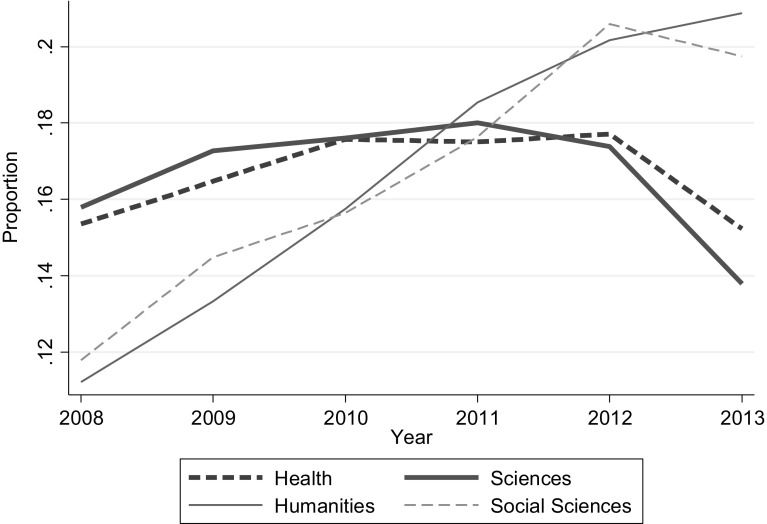
In 2014 over 52,000 academics submitted >155,500 journal articles in 36 different disciplines for assessment in the UK's four-year Research Evaluation Framework (the REF). In this paper the characteristics of the titles of these papers are assessed. Although these varied considerably between the disciplines, the main findings were that: (i) the lengths of the titles increased with the number of authors in almost all disciplines, (ii) the use of colons and question marks tended to decline with increasing author numbers-although there were a few disciplines, such as economics, where the reverse was evident, (iii) papers published later on in the 4-year period tended to have more authors than those published earlier, and (iv), in some disciplines, the numbers of subsequent citations to papers were higher when the titles were shorter and when they employed colons but lower when they used question marks.
Overview
The claims and statistics of this paper haven’t been checked yet.
Free: it reads the open-access text and checks the first 5 claims that cite a source we can check. Create a free account to check every claim.
Integrity signals
Registry
Cites
Statistics
Figures
Verification
Claims the paper makes
The claims and statistics of this paper haven’t been checked yet.
Free: it reads the open-access text and checks the first 5 claims that cite a source we can check. Create a free account to check every claim.
Claims other papers make about this one
Each is checked against this paper’s own text: does it say what the citing paper says it does?
The source backs part of the claim, not all of it — or backs it for a different population, condition or comparison.
In the citing paper
“Although longer titles may provide more information regarding the content, they reduce the interest generated (39).”
From The Principles of Biomedical Scientific Writing: Title (2019) · cites this paper as [39]
Experimental — accuracy not yet measured
Self-check
Percentages, sums and reported differences re-computed from the paper’s own numbers.
The self-check needs the paper’s full text.
Citations
Cites
What is research collaboration?
Katz, J. S., & Martin, B. R. (1997) · Research Policy · doi:10.1016/s0048-7333(96)00917-1 · Cited by 2,972 · cited 1×
“Katz and Martin (1997) focus specifically on coauthorship and the extent to which it coincides with collaboration.”
BackgroundCollaborative Research Across Disciplinary and Organizational Boundaries
Cummings, J. N., & Kiesler, S. (2005) · Social Studies of Science · doi:10.1177/0306312705055535 · Cited by 759 · cited 1×
“Cummings and Kiesler (2005) analyse the coordination costs with respect to researchers in multi-university collaborations, mainly in the sciences and engineering but also psychology and mathematics.”
BackgroundGroups That Work (And Those That Don't): Creating Conditions for Effective Teamwork
Mathiasen, D. G., & Hackman, J. R. (1991) · Journal of Policy Analysis and Management · doi:10.2307/3325003 · Cited by 567
Reflections on Scientific Collaboration (and its study): Past, Present, and Future
Beaver, D. D. (2001) · Scientometrics · doi:10.1023/a:1014254214337 · Cited by 526
Cronin, B. (2001) · Journal of the American Society for Information Science and Technology · doi:10.1002/asi.1097 · Cited by 500 · cited 1×
“Indeed it may be, as suggested by Cronin (2001), that not all authors contribute to the writing of the paper rather than the research.”
BackgroundPersson, O., Glänzel, W., & Danell, R. (2004) · Scientometrics · doi:10.1023/b:scie.0000034384.35498.7d · Cited by 494 · cited 1×
“10 Thus, for example Persson et al. (2004) find the number of references to increase with the number of authors, which of course has implications for the text of the paper itself. the whole of scientific work the results from a partial analysis.”
BackgroundArticle title type and its relation with the number of downloads and citations
Jamali, H. R., & Nikzad, M. (2011) · Scientometrics · doi:10.1007/s11192-011-0412-z · Cited by 332 · cited 1×
“However seeming to contradict this, Jamali and Nikzad (2011) detected a negative, although insignificant, correlation between citations and title length.”
ResultTrends in Multi-Authored Papers in Economics
Hudson, J. (1996) · Journal of Economic Perspectives · doi:10.1257/jep.10.3.153 · Cited by 289 · cited 1×
“There is also evidence to link the structure and style of the title to the number of authors, which in itself has tended to increase over time (Hudson 1996).”
BackgroundSelf-citationJacques, T. S., & Sebire, N. J. (2010) · JRSM Short Reports · doi:10.1258/shorts.2009.100020 · Cited by 220
Co-authorship and the output of academic economists
Hollis, A. (2001) · Labour Economics · doi:10.1016/s0927-5371(01)00041-0 · Cited by 206 · cited 2×
“Katz and Martin (1997) focus specifically on coauthorship and the extent to which it coincides with collaboration.”
BackgroundWhat makes an article influential? Predicting impact in social and personality psychology
Haslam, N., Ban, L., Kaufmann, L., Loughnan, S., Peters, K., Whelan, J., & Wilson, S. (2008) · Scientometrics · doi:10.1007/s11192-007-1892-8 · Cited by 180 · cited 3×
“In persuading academics to read a paper, devices such as informative titles, question marks and colons may also stimulate impact as, for example, measured by the number of citations (Haslam et al. 2008).”
BackgroundInfluentialCitations to scientific articles: Its distribution and dependence on the article features
Vieira, E. S., & Gomes, J. A. N. F. (2010) · Journal of Informetrics · doi:10.1016/j.joi.2009.06.002 · Cited by 179 · cited 1×
“…and Thijs 2004) that citations increase with the number of authors in a number of disciplines, e.g. evolutionary psychology (Webster et al. 2009), biology and biochemistry, chemistry, mathematics and physics (Vieira and Gomes 2010) and information science and technology (Levitt and Thelwall 2009).”
BackgroundFrenken, K., Hölzl, W., & de Vor, F. (2005) · Journal of Engineering and Technology Management · doi:10.1016/j.jengtecman.2004.11.002 · Cited by 161 · cited 1×
“It may also expand the network of the authors (Frenken et al. 2005).”
BackgroundThe Regime of Excellence and the Erosion of Ethos in Critical Management Studies
Butler, N., & Spoelstra, S. (2014) · British Journal of Management · doi:10.1111/1467-8551.12053 · Cited by 155 · cited 1×
“There is also a literature on the impact exercises like the REF and the RAE have on academics, their mode of working and their publications (Butler and Spoelstra 2014).”
BackgroundWhat's in a title? Numbers of words and the presence of colons
Lewison, G., & Hartley, J. R. (2005) · Scientometrics · doi:10.1007/s11192-005-0216-0 · Cited by 145 · cited 3×
“Lewison and Hartley (2005), as well as Hartley (2007), also find that in most disciplines single authors more commonly use colons in the title than is the case with multiple authors.”
BackgroundAcademic Writing and Publishing
Hartley, J., & Hartley, J. (2008) · Routledge eBooks · doi:10.4324/9780203927984 · Cited by 141 · cited 1×
“Hartley (2008) lists thirteen different types of title, including those that state findings and those that ‘bid for attention’.”
BackgroundAcademic Writing and Publishing: A Practical Handbook
Hartley, J. R. (2008) · Cited by 136
Planning that title: Practices and preferences for titles with colons in academic articles
Hartley, J. R. (2007) · Library & Information Science Research · doi:10.1016/j.lisr.2007.05.002 · Cited by 136 · cited 3×
“Lewison and Hartley (2005), as well as Hartley (2007), also find that in most disciplines single authors more commonly use colons in the title than is the case with multiple authors.”
BackgroundResultAuthor collaboration and impact: A note on citation rates of single and multiple authored articles
Smart, J. C., & Bayer, A. E. (1986) · Scientometrics · doi:10.1007/bf02016776 · Cited by 134 · cited 1×
“However in clinical psychology, educational measurement, and management science, Smart and Bayer (1986) found little effect.”
BackgroundDoes co-authorship inflate the share of self-citations?
Glänzel, W., & Thijs, B. (2004) · Scientometrics · doi:10.1023/b:scie.0000045117.13348.b1 · Cited by 110 · cited 1×
“It has also been argued (Glanzel and Thijs 2004) that citations increase with the number of authors in a number of disciplines, e.g. evolutionary psychology (Webster et al. 2009), biology and biochemistry, chemistry, mathematics and physics (Vieira and Gomes 2010) and information science and…”
BackgroundWhat a difference a colon makes: how superficial factors influence subsequent citation
van Wesel, M., Wyatt, S., & ten Haaf, J. (2013) · Scientometrics · doi:10.1007/s11192-013-1154-x · Cited by 108 · cited 2×
“But in the process, the title tends to become both longer and more complex (van Wesel et al. 2014) and in some, but not all, circumstances this may lead authors to shorten the title and in the process reduce its readability and attractiveness.1 Ball (2009) argues that question marks can be used to…”
BackgroundBall, R. (2009) · Scientometrics · doi:10.1007/s11192-007-1984-5 · Cited by 105 · cited 3×
“He also argues that they may also facilitate the rapid publication of results about which the authors are not fully confident (Ball 2009, p. 677).”
BackgroundInfluentialWebster, G. D., Jonason, P. K., & Schember, T. O. (2009) · Evolutionary Psychology · doi:10.1177/147470490900700301 · Cited by 101 · cited 1×
“…been argued (Glanzel and Thijs 2004) that citations increase with the number of authors in a number of disciplines, e.g. evolutionary psychology (Webster et al. 2009), biology and biochemistry, chemistry, mathematics and physics (Vieira and Gomes 2010) and information science and technology…”
BackgroundResearch Article Titles and Disciplinary Conventions: A Corpus Study of Eight Disciplines
Nagano, R. L. (2015) · Journal of Academic Writing · doi:10.18552/joaw.v5i1.168 · Cited by 73
Citation levels and collaboration within library and information science
Levitt, J. M., & Thelwall, M. A. (2008) · Journal of the American Society for Information Science and Technology · doi:10.1002/asi.21000 · Cited by 63 · cited 1×
“…and Thijs 2004) that citations increase with the number of authors in a number of disciplines, e.g. evolutionary psychology (Webster et al. 2009), biology and biochemistry, chemistry, mathematics and physics (Vieira and Gomes 2010) and information science and technology (Levitt and Thelwall 2009).”
BackgroundRelation of title length of journal articles to number of authors
Yitzhaki, M. (1994) · Scientometrics · doi:10.1007/bf02017231 · Cited by 57 · cited 1×
“Finally, there is evidence of a positive relationship between the number of authors and the length of a paper’s title (White 1991), with this being more common among science, than social science or humanities, journals (Yitzhaki 1994).”
BackgroundThe distribution of partnership returns: Evidence from co-authorships in economics journals
Bidault, F., & Hildebrand, T. (2014) · Research Policy · doi:10.1016/j.respol.2014.01.008 · Cited by 50
Accountants divided: research selectivity and academic accounting labour in UK universities
Harley, S. (2000) · Critical Perspectives on Accounting · doi:10.1006/cpac.1999.0405 · Cited by 49 · cited 2×
“There is evidence for both of these possibilities in addition to the observations made by Harley (2000).”
BackgroundResultGroups that work (and those that don't) creating conditions for effective teamwork
Hackman, J. R. (1990) · Cited by 47
Hodder, A. P. W., & Hodder, C. (2010) · Scientometrics · doi:10.1007/s11192-010-0201-0 · Cited by 33 · cited 2×
“…albeit one which is consistent with other research such as 11 It is also possible that any drop off in the number of papers for 2013 were affected by the REF submissions having to be submitted by the end of November 2013, but this had little impact on panels C and D. Hodder and Hodder (2010).”
BackgroundResultThomas, K. T. (2011) · London review of books · Cited by 20
Wellington, J. (2003) · Routledge eBooks · doi:10.4324/9780203380789 · Cited by 19 · cited 1×
“Firstly, for example, with people rushing the publication of edited books in order to fit within the (RAE) timeframe (Thomas 2011) and trying to persuade journals to publish their paper rapidly (Wellington 2003).”
BackgroundIncreasing field complexity revealed through article title analyses
White, A. J., & Hernandez, N. R. (1991) · Journal of the American Society for Information Science · doi:10.1002/(sici)1097-4571(199112)42:10<731::aid-asi6>3.0.co;2-w · Cited by 15
A further exploration of title size and author number
White, A. J. (1991) · Journal of the American Society for Information Science · doi:10.1002/(sici)1097-4571(199106)42:5<384::aid-asi9>3.0.co;2-g · Cited by 13
Getting Published: A Guide for Lecturers and Researchers
Wellington, J. (2003) · Cited by 12
The Distribution of Partnerships Benefits: Evidence from Co-Authorships in Economics JournalsPreprint
Bidault, F., & Hildebrand, T. (2012) · SSRN Electronic Journal · doi:10.2139/ssrn.2187948 · Cited by 7 · cited 1×
“Bidault and Hildebrand (2014) also suggest that the costs may increase as the size of the team increases.”
BackgroundComplex authorships: intellectual coproduction as a strategy for the times
Johnson, R. (1998) · Angelaki · doi:10.1080/09697259808572009 · Cited by 3 · cited 1×
“This is in part consistent with the need for multiple authors to negotiate differences of opinion to a consensus (Johnson 1998).”
Background
Cited by
How do authors select keywords? A preliminary study of author keyword selection behavior
Lu, W. P., Liu, Z., Huang, Y., Bu, Y., Li, X., & Cheng, Q. (2020) · Journal of Informetrics · doi:10.1016/j.joi.2020.101066 · Cited by 141
Hyland, K., & Zou, H. (2022) · Journal of English for Academic Purposes · doi:10.1016/j.jeap.2022.101094 · Cited by 106
“In the largest study to date, Hudson (2016) examined the impact of multiple authorship on the titles of papers submitted to the UK ’ s four-yearly Research Evaluation Framework (the REF) in 2014.”
BackgroundInfluentialAcademic publishing and the attention economy
Hyland, K. (2023) · Journal of English for Academic Purposes · doi:10.1016/j.jeap.2023.101253 · Cited by 95
The Principles of Biomedical Scientific Writing: Title
Bahadoran, Z., Mirmiran, P., Kashfi, K., & Ghasemi, A. (2019) · International Journal of Endocrinology and Metabolism · doi:10.5812/ijem.98326 · Cited by 61
Milojević, S. (2017) · Frontiers in Research Metrics and Analytics · doi:10.3389/frma.2017.00002 · Cited by 62
“This trend has naturally led some researchers to examine whether the change in authorship had an effect on title construction (e.g., Hudson, 2016).”
BackgroundInfluential
Metadata
- Authors
- Hudson, J.
- Affiliations
- University of Bath (GB)
- Corresponding author
- Hudson, John
- ORCID
- Hudson, John
- Venue
- Scientometrics
- Published
- 2016-07-29
- Volume
- 109
- Issue
- 2
- Pages
- 871-889
- ISSN
- 0138-9130 (ISSN-L)
- 1588-2861
- PMC
- PMC5065898
- OpenAlex
- W2500177191
- Cited by
- 54
- References
- 38
- Citations by year
- 2026: 2 · 2025: 7 · 2024: 6 · 2023: 8 · 2022: 7 · 2021: 6 · 2020: 7 · 2019: 5 · 2017: 4 · 2016: 2
- FWCI
- 3.42
- Type
- journal article
- Language
- en
- Open access
- hybrid
- doi.org
- Locations
- Scientometrics (publishedVersion, cc-by)
- PubMed Central (publishedVersion, cc-by)
- PubMed (publishedVersion)
- RePEc: Research Papers in Economics (submittedVersion)
- Topics
- Social Sciences › Library and Information Sciences › scientometrics and bibliometrics research
- Social Sciences › Library and Information Sciences › Academic Writing and Publishing
- Social Sciences › Psychology › Experimental and Cognitive Psychology › Psychology Research and Bibliometrics
- Keywords
- research paper titles, title length, authorship, disciplinary differences, punctuation, colon, question marks, citation impact, Research Excellence Framework, journal articles
About these checks
Registry, retraction, Cites and statistics results are computed, not judged, with one exception: a printed reference that no index lists is read once by a model before it counts as a citation error. Claims are extracted by a model and kept only when their quote appears verbatim in the text; each cited source is then checked, with a model’s help, for whether it says what the claim relies on. Those verdicts can be wrong — read the claim’s quote and the cited source before relying on one.
Statistics and arithmetic are recomputed, not judged.
Confidence bands are shown only for fields calibrated on our annotated test set. None is calibrated yet, so no band is shown.
What counts as a claim ›How we measure confidence ›How we check this ›
Are you an author, or do you see a problem with this page? Request a review
Data sources
Bibliographic data: Semantic Scholar, OpenAlex, Crossref.
Contains information from the Semantic Scholar Academic Graph Datasets, made available under the ODC Attribution License (ODC-BY 1.0).
Semantic Scholar’s data is described in: Kinney, R., et al. (2023). The Semantic Scholar Open Data Platform. arXiv:2301.10140.
