

The DOI matches its Crossref record; 38 of the 38 references it cites were found in a registry or an index.
Post retraction citations in context: a case study
Open accessAbstract
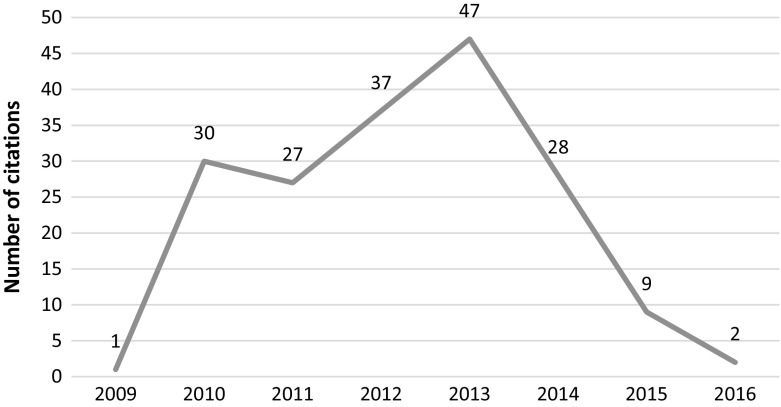
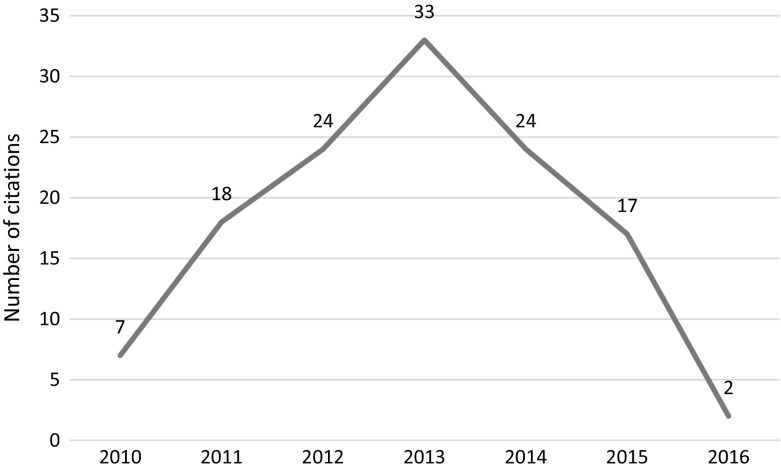
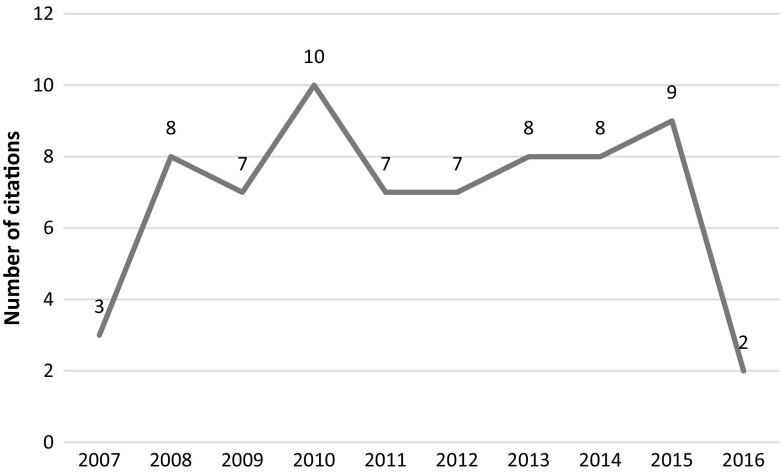
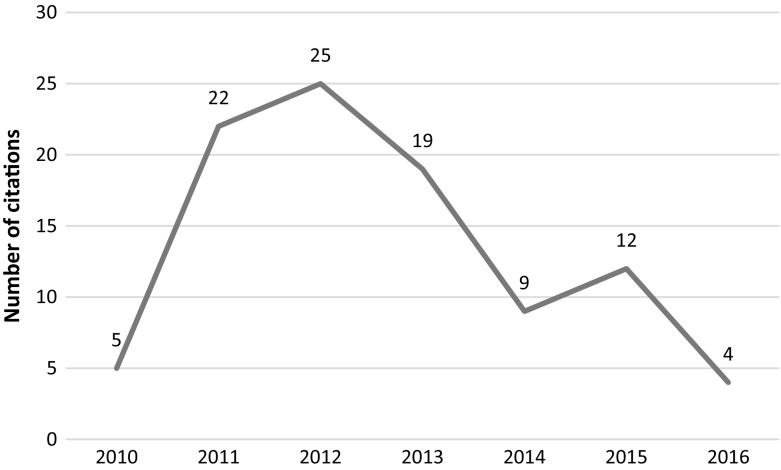
This study examines the nature of citations to articles that were retracted in 2014. Out of 987 retracted articles found in ScienceDirect, an Elsevier full text database, we selected all articles that received more than 10 citations between January 2015 and March 2016. Since the retraction year was known for only about 83% of the retracted articles, we chose to concentrate on recent citations, that for certain appeared after the cited paper was retracted. Overall, we analyzed 238 citing documents and identified the context of each citation as positive, negative or neutral. Our results show that the vast majority of citations to retracted articles are positive despite of the clear retraction notice on the publisher's platform and regardless of the reason for retraction. Positive citations can be also seen to articles that were retracted due to ethical misconduct, data fabrication and false reports. In light of these results, we listed some recommendations for publishers that could potentially minimize the referral to retracted studies as valid.
Overview
The claims and statistics of this paper haven’t been checked yet.
Free: it reads the open-access text and checks the first 5 claims that cite a source we can check. Create a free account to check every claim.
Integrity signals
Registry
Cites
Statistics
Figures



Verification
Claims the paper makes
The claims and statistics of this paper haven’t been checked yet.
Free: it reads the open-access text and checks the first 5 claims that cite a source we can check. Create a free account to check every claim.
Claims other papers make about this one
Each is checked against this paper’s own text: does it say what the citing paper says it does?
The source backs part of the claim, not all of it — or backs it for a different population, condition or comparison.
In the citing paper
“Within the digital publishing era, the longest documented instance of positive post-retraction citation we are aware of is 9years: Bar-Ilan and Halevi documented an article both published and retracted in 2007 receiving only positive post-retraction citations in 2015 and 2016 (Bar-Ilan and Halevi 2017)”
From Continued post-retraction citation of a fraudulent clinical trial report, 11 years after it was retracted for falsifying data (2020) · cites this paper as Bar-Ilan and Halevi 2017
Experimental — accuracy not yet measuredThe source backs part of the claim, not all of it — or backs it for a different population, condition or comparison.
In the citing paper
“These results align well with literature on case studies [7, 8], specific disciplines [9] and the broader literature [10], which identify that at least 80% of retracted articles receive positive post-retraction citations.”
From Media and social media attention to retracted articles according to Altmetric (2021) · cites this paper as [7]
Experimental — accuracy not yet measuredThe cited source says what the claim attributes to it.
In the citing paper
“Although retraction is intended to remove published research from the citable literature, retraction does not stop the diffusion of the retracted paper. Empirical studies have shown that papers continue to be cited after being retracted”
From Continued use of retracted papers: Temporal trends in citations and (lack of) awareness of retractions shown in citation contexts in biomedicine (2021) · cites this paper as Bar-Ilan & Halevi, 2017
The cited source says what the claim attributes to it.
In the citing paper
“Several studies indicate that retracted articles remain to be actively cited even after published retraction, with most citing articles including a positive overview of retracted research. 12-16”
From Manuscript Referencing Errors and Their Impact on Shaping Current Evidence (2020) · cites this paper as [15]
Self-check
Percentages, sums and reported differences re-computed from the paper’s own numbers.
The self-check needs the paper’s full text.
Citations
Cites
1 retracted
Retraction rates are on the rise
Cokol, M., Ozbay, F., & Rodriguez‐Esteban, R. (2008) · The EMBO Reports · doi:10.1038/sj.embor.7401143 · Cited by 149 · cited 1×
“Recent studies on retracted articles show that the number of retracted articles is increasing in relative measure to the overall growth in scientific publications (Cokol et al. 2008; Marcus and Oransky 2014).”
BackgroundRetractedMisconduct accounts for the majority of retracted scientific publications
Fang, F. C., Steen, R. G., & Casadevall, A. (2012) · Proceedings of the National Academy of Sciences · doi:10.1073/pnas.1212247109 · Cited by 1,232 · cited 3×
“and error (Fang et al. 2012; Steen 2011a).”
BackgroundMayne, S. T. (2003) · The Journal of Nutrition · doi:10.1093/jn/133.3.933s · Cited by 568
Why has the number of scientific retractions increased?
Steen, R. G., Casadevall, A., & Fang, F. C. (2013) · PLoS ONE · doi:10.1371/journal.pone.0068397 · Cited by 415 · cited 1×
“Temporal aspects were also studied, for example by Fanelli (2013) and Steen et al. (2013).”
BackgroundRetractions in the scientific literature: is the incidence of research fraud increasing?
Steen, R. G. (2011) · Journal of Medical Ethics · doi:10.1136/jme.2010.040923 · Cited by 405 · cited 4×
“and error (Fang et al. 2012; Steen 2011a).”
BackgroundInfluentialWernersson, A.-S., Carere, M., Maggi, C., Tusil, P., Soldan, P., James, A., Sanchez, W., Dulio, V., Broeg, K., Reifferscheid, G., et al. (2015) · Environmental Sciences Europe · doi:10.1186/s12302-015-0039-4 · Cited by 353
Why Growing Retractions Are (Mostly) a Good Sign
Fanelli, D. (2013) · PLoS Medicine · doi:10.1371/journal.pmed.1001563 · Cited by 272
Why and how do journals retract articles? An analysis of Medline retractions 1988–2008
Wager, E., & Williams, P. (2011) · Journal of Medical Ethics · doi:10.1136/jme.2010.040964 · Cited by 263 · cited 1×
“Another study by Wager and Williams (2011) was also based on biomedical retracted articles, and like Steen (2011a) found that error was most prevalent.”
BackgroundThe effects of authentic leadership and organizational commitment on turnover intention
Ausar, K., Kang, H. J. A., & Kim, J. S. (2016) · Leadership & Organization Development Journal · doi:10.1108/lodj-05-2014-0090 · Cited by 190
The Continued Use of Retracted, Invalid Scientific Literature
Pfeifer, M. P. (1990) · JAMA: The Journal of the American Medical Association · doi:10.1001/jama.1990.03440100140020 · Cited by 188 · cited 1×
“Other early studies include works by Pfeifer and Snodgrass (1990) and by Garfield and Welljams-Dorof (1990).”
Research works printed but not linked: 2
- Halevi, G., & Bar-Ilan, J. (2016). Post retraction citations in context. In: Proceedings of the joint workshop on bibliometric-enhanced information retrieval and natural language processing for digital libraries (BIRNDL2016) (pp. 23–29). http://ceur-ws.org/Vol-1610/paper3.pdf .
- Retraction Watch (2014). Leadership journal to retract five papers from FIU scholar. Retraction Watch. http://retractionwatch.com/2014/02/07/leadership-journal-to-retract-five-papers-from-fiu-scholar/ .
Cited by
Vuong, Q. (2020) · Learned Publishing · doi:10.1002/leap.1282 · Cited by 126
Temporal characteristics of retracted articles
Bar-Ilan, J., & Halevi, G. (2018) · Scientometrics · doi:10.1007/s11192-018-2802-y · Cited by 107
“Acknowledgements The present study is an extended version of an article presented at the 16th International Conference on Scientometrics and Informetrics, Wuhan (China), 16–20 October 2017 (Bar-Ilan and Halevi 2017b).”
BackgroundSelf-citationHsiao, T.-K., & Schneider, J. (2021) · Quantitative Science Studies · doi:10.1162/qss_a_00155 · Cited by 98
Schneider, J., Ye, D., Hill, A. M., & Whitehorn, A. S. (2020) · Scientometrics · doi:10.1007/s11192-020-03631-1 · Cited by 88
Ishizumi, A., Kolis, J., Abad, N., Prybylski, D., Brookmeyer, K. A., Voegeli, C., Wardle, C., & Chiou, H. (2024) · The Lancet Public Health · doi:10.1016/s2468-2667(24)00031-8 · Cited by 79
“2,58 Moreover, transparency from social media platforms can facilitate the creation of scientific evidence, especially in the realm of infodemic management.”
Metadata
- Authors
- Bar-Ilan, J., & Halevi, G.
- Affiliations
- Icahn School of Medicine at Mount Sinai (US)
- Corresponding author
- Halevi, Gali
- ORCID
- Halevi, Gali
- Venue
- Scientometrics
- Published
- 2017-03-03
- Volume
- 113
- Issue
- 1
- Pages
- 547-565
- ISSN
- 0138-9130 (ISSN-L)
- 1588-2861
- PMC
- PMC5629243
- OpenAlex
- W2594541205
- Cited by
- 191
- References
- 38
- Citations by year
- 2026: 27 · 2025: 20 · 2024: 11 · 2023: 23 · 2022: 27 · 2021: 23 · 2020: 20 · 2019: 25 · 2018: 15
- FWCI
- 14.71
- Type
- journal article
- Language
- en
- Open access
- hybrid
- doi.org
- Locations
- Scientometrics (publishedVersion, cc-by)
- Europe PMC (PubMed Central) (publishedVersion, cc-by)
- PubMed Central (publishedVersion, cc-by)
- PubMed (publishedVersion)
- RePEc: Research Papers in Economics (submittedVersion)
- Topics
- Social Sciences › Library and Information Sciences › scientometrics and bibliometrics research
- Social Sciences › Education › Academic integrity and plagiarism
- Social Sciences › Library and Information Sciences › Academic Publishing and Open Access
- Keywords
- retracted article, citation behavior, citation context, retraction reasons, research misconduct, data fabrication, false reporting, ScienceDirect
About these checks
Registry, retraction, Cites and statistics results are computed, not judged, with one exception: a printed reference that no index lists is read once by a model before it counts as a citation error. Claims are extracted by a model and kept only when their quote appears verbatim in the text; each cited source is then checked, with a model’s help, for whether it says what the claim relies on. Those verdicts can be wrong — read the claim’s quote and the cited source before relying on one.
Statistics and arithmetic are recomputed, not judged.
Confidence bands are shown only for fields calibrated on our annotated test set. None is calibrated yet, so no band is shown.
What counts as a claim ›How we measure confidence ›How we check this ›
Are you an author, or do you see a problem with this page? Request a review
How to cite
Cite CoChat for the checks on this page, and the paper for its own findings.
- This page
- CoChat. (2026). Citation check: Post retraction citations in context: a case study. https://app.cochat.ai/papers/10.1007/s11192-017-2242-0
- The paper
- Bar-Ilan, J., & Halevi, G. (2017). Post retraction citations in context: a case study. Scientometrics. https://doi.org/10.1007/s11192-017-2242-0
Data sources
Bibliographic data: Semantic Scholar, OpenAlex, Crossref.
Contains information from the Semantic Scholar Academic Graph Datasets, made available under the ODC Attribution License (ODC-BY 1.0).
Semantic Scholar’s data is described in: Kinney, R., et al. (2023). The Semantic Scholar Open Data Platform. arXiv:2301.10140.
