

Beyond misinformation: developing a public health prevention framework for managing information ecosystems
Open accessThe DOI matches its Crossref record; 89 of the 90 references it cites were found in a registry or an index.
Abstract
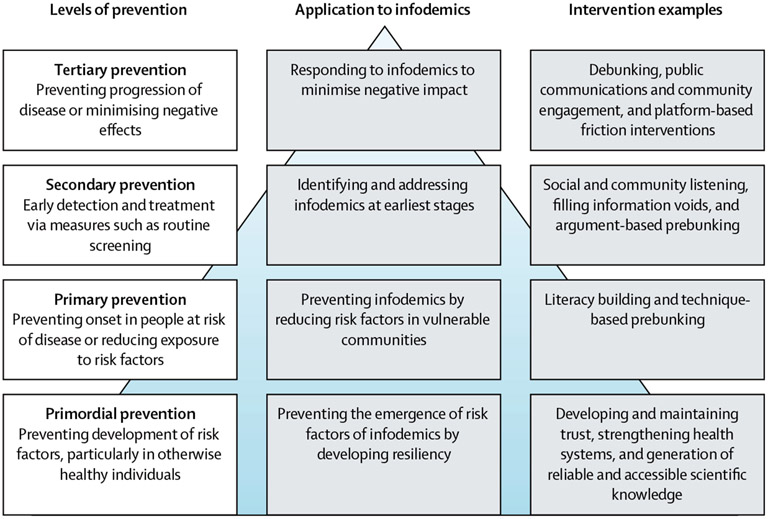
The COVID-19 pandemic has highlighted how infodemics (defined as an overabundance of information, including misinformation and disinformation) pose a threat to public health and could hinder individuals from making informed health decisions. Although public health authorities and other stakeholders have implemented measures for managing infodemics, existing frameworks for infodemic management have been primarily focused on responding to acute health emergencies rather than integrated in routine service delivery. We review the evidence and propose a framework for infodemic management that encompasses upstream strategies and provides guidance on identifying different interventions, informed by the four levels of prevention in public health: primary, secondary, tertiary, and primordial prevention. On the basis of a narrative review of 54 documents (peer-reviewed and grey literature published from 1961 to 2023), we present examples of interventions that belong to each level of prevention. Adopting this framework requires proactive prevention and response through managing information ecosystems, beyond reacting to misinformation or disinformation.
Overview
The claims and statistics of this paper haven’t been checked yet.
Free: it reads the open-access text and checks the first 5 claims that cite a source we can check. Create a free account to check every claim.
Integrity signals
Registry
Cites
Statistics
Figures
Verification
Claims the paper makes
The claims and statistics of this paper haven’t been checked yet.
Free: it reads the open-access text and checks the first 5 claims that cite a source we can check. Create a free account to check every claim.
Claims other papers make about this one
Each is checked against this paper’s own text: does it say what the citing paper says it does?
The source backs part of the claim, not all of it — or backs it for a different population, condition or comparison.
In the citing paper
“The consequences of health misinformation are not confined to the pandemic context; rather, they persistently permeate the entire continuum of prevention, diagnosis, and treatment (10).”
From Health misinformation, digital health literacy, and attitudes toward science among university students: an exploratory cross-sectional survey (2026) · cites this paper as [10]
Experimental — accuracy not yet measured
Self-check
Percentages, sums and reported differences re-computed from the paper’s own numbers.
The self-check needs the paper’s full text.
Citations
Cites
The spread of true and false news online
Vosoughi, S., Roy, D., & Aral, S. (2018) · Science · doi:10.1126/science.aap9559 · Cited by 8,847
The COVID-19 social media infodemic
Cinelli, M., Quattrociocchi, W., Galeazzi, A., Valensise, C. M., Brugnoli, E., Schmidt, A. L., Zola, P., Zollo, F., & Scala, A. (2020) · Scientific Reports · doi:10.1038/s41598-020-73510-5 · Cited by 2,313
The echo chamber effect on social media
Cinelli, M., De Francisci Morales, G., Galeazzi, A., Quattrociocchi, W., & Starnini, M. (2021) · Proceedings of the National Academy of Sciences · doi:10.1073/pnas.2023301118 · Cited by 2,092
Measuring the impact of COVID-19 vaccine misinformation on vaccination intent in the UK and USA
Loomba, S., de Figueiredo, A., Piatek, S. J., de Graaf, K., & Larson, H. J. (2021) · Nature Human Behaviour · doi:10.1038/s41562-021-01056-1 · Cited by 1,800
Pennycook, G., McPhetres, J., Zhang, Y., Lu, J. G., & Rand, D. G. (2020) · Psychological Science · doi:10.1177/0956797620939054 · Cited by 1,715 · cited 1×
“91 92-94 Visual cues to signal verified accounts has also been proposed as a strategy to highlight domain-specific expertise and, consequently, prevent pseudoscientific claims on social media.”
Shifting attention to accuracy can reduce misinformation online
Pennycook, G., Epstein, Z., Mosleh, M., Arechar, A. A., Eckles, D., & Rand, D. G. (2021) · Nature · doi:10.1038/s41586-021-03344-2 · Cited by 1,155 · cited 1×
“91 92-94 Visual cues to signal verified accounts has also been proposed as a strategy to highlight domain-specific expertise and, consequently, prevent pseudoscientific claims on social media.”
Countering Misinformation and Fake News Through Inoculation and Prebunking
Lewandowsky, S., & van der Linden, S. (2021) · European Review of Social Psychology · doi:10.1080/10463283.2021.1876983 · Cited by 773 · cited 3×
“66 66-68 For example, short videos can be used to inoculate individuals against commonly used persuasion techniques, such as presentation of false dichotomies or use of emotionally evocative content.”
Predatory journals: no definition, no defence
Grudniewicz, A., Moher, D., Cobey, K. D., Bryson, G. L., Cukier, S., Allen, K., Ardern, C., Balcom, L., Barros, T., Berger, M., et al. (2019) · Nature · doi:10.1038/d41586-019-03759-y · Cited by 726
International encyclopedia of public health
(2009) · Choice Reviews Online · doi:10.5860/choice.46-3012 · Cited by 651
Tangcharoensathien, V., Calleja, N., Nguyen, T., Purnat, T., D’Agostino, M., Garcia-Saiso, S., Landry, M., Rashidian, A., Hamilton, C., AbdAllah, A., et al. (2020) · Journal of Medical Internet Research · doi:10.2196/19659 · Cited by 561 · cited 1×
“1 Scales and colleagues applied epidemiological models to outline a process for managing the COVID-19 infodemic through real-time surveillance and rapid response to misinformation.”
Cited by
An ecological framework for population health and well-being
Pronk, N. P., Woodard, C., Zimmerman, F. J., & Arena, R. A. (2025) · Progress in Cardiovascular Diseases · doi:10.1016/j.pcad.2025.03.013 · Cited by 31
Purnat, T. D., Wilhelm, E., Scales, D. A., Wardle, C., Bastien, S., Ganatra, B., Lavelanet, A. F., Mburu, G., Tamrat, T., & Nihlén, Å. (2025) · JMIR Infodemiology · doi:10.2196/83747 · Cited by 23
“Scholars and public health leaders increasingly recognize that interventions focused solely on individual knowledge, fact-checking, or improved digital marketing are insufficient in addressing the structural and systemic nature of the problem [3,9,14-17].”
Self-citationRai, S., Kornides, M. L., Morgan, J. C., Kumar, A., Cappella, J. N., & Guntuku, S. C. (2024) · Scientific Reports · doi:10.1038/s41598-024-64703-3 · Cited by 16
Taba, M., Ayre, J., McCaffery, K. J., Vassilenko, D., Ma, I. C. K., Haynes, T., Leask, J., Wilson, A. J., & Bonner, C. (2025) · Health Expectations · doi:10.1111/hex.70203 · Cited by 12
The Role of Social Media for Health Communication During COVID-19: A Scoping Review
Wella, K., Mtambo, J., Lazaro, M., & Mapulanga, P. (2025) · Journal of Consumer Health on the Internet · doi:10.1080/15398285.2025.2463047 · Cited by 11
Metadata
- Authors
- Ishizumi, A., Kolis, J., Abad, N., Prybylski, D., Brookmeyer, K. A., Voegeli, C., Wardle, C., & Chiou, H.
- Affiliations
- Centers for Disease Control and Prevention (US)
- Brown University (US)
- Corresponding author
- Kolis, Jessica
- ORCID
- Venue
- The Lancet Public Health
- Publisher
- Elsevier BV
- Published
- 2024-06
- Volume
- 9
- Issue
- 6
- Pages
- e397-e406
- ISSN
- 2468-2667 (ISSN-L)
- PMC
- PMC11369959
- OpenAlex
- W4394980099
- Cited by
- 79
- References
- 90
- Citations by year
- 2026: 34 · 2025: 36 · 2024: 9
- FWCI
- 8.25
- Type
- journal article
- Language
- en
- Open access
- gold
- doi.org
- Licence
- cc-by-nc-nd
- www.elsevier.com/tdm/userlicense/1.0/ (tdm)
- www.elsevier.com/legal/tdmrep-license (tdm)
- creativecommons.org/licenses/by-nc-nd/4.0/ (vor)
- Locations
- The Lancet Public Health (publishedVersion, cc-by-nc-nd)
- PubMed (publishedVersion)
- PubMed Central (acceptedVersion, cc-by-nc-nd)
- DOAJ (DOAJ: Directory of Open Access Journals) (submittedVersion, cc-by-sa)
- Funders
- U.S. Department of Health and Human Services
- Brown University
- National Institutes of Health (CC999999)
- Centers for Disease Control and Prevention
- Topics
- Social Sciences › Sociology and Political Science › Misinformation and Its Impacts
- Social Sciences › Communication › Communication and COVID-19 Impact
- Social Sciences › Communication › Public Relations and Crisis Communication
- Keywords
- infodemic, misinformation, disinformation, infodemic management, levels of prevention, primordial prevention, primary prevention, secondary prevention, tertiary prevention, information ecosystem, COVID-19 pandemic, public health communication, health decision-making
- MeSH terms
- COVID-19, Communication, Humans, Public Health
About these checks
Registry, retraction, Cites and statistics results are computed, not judged, with one exception: a printed reference that no index lists is read once by a model before it counts as a citation error. Claims are extracted by a model and kept only when their quote appears verbatim in the text; each cited source is then checked, with a model’s help, for whether it says what the claim relies on. Those verdicts can be wrong — read the claim’s quote and the cited source before relying on one.
Statistics and arithmetic are recomputed, not judged.
Confidence bands are shown only for fields calibrated on our annotated test set. None is calibrated yet, so no band is shown.
What counts as a claim ›How we measure confidence ›How we check this ›
Are you an author, or do you see a problem with this page? Request a review
How to cite
Cite CoChat for the checks on this page, and the paper for its own findings.
- This page
- CoChat. (2026). Citation check: Beyond misinformation: developing a public health prevention framework for managing information ecosystems. https://app.cochat.ai/papers/10.1016/s2468-2667(24)00031-8
- The paper
- Ishizumi, A., Kolis, J., Abad, N., Prybylski, D., Brookmeyer, K. A., Voegeli, C., Wardle, C., & Chiou, H. (2024). Beyond misinformation: developing a public health prevention framework for managing information ecosystems. The Lancet Public Health. https://doi.org/10.1016/s2468-2667(24)00031-8
Data sources
Bibliographic data: Semantic Scholar, OpenAlex, Crossref.
Contains information from the Semantic Scholar Academic Graph Datasets, made available under the ODC Attribution License (ODC-BY 1.0).
Semantic Scholar’s data is described in: Kinney, R., et al. (2023). The Semantic Scholar Open Data Platform. arXiv:2301.10140.
