

Gaming the metrics: bibliometric anomalies in global university rankings and the research integrity risk index (RI2)
Open accessThe DOI matches its Crossref record; 97 of the 98 references it cites were found in a registry or an index.
Abstract
The expansion of university rankings has intensified competition among institutions and reshaped research priorities worldwide. Bibliometric indicators underpin many of these rankings, and their growing influence has raised concerns about systemic distortions in scholarly behavior. This study investigates publication and authorship patterns among the world’s 88 fastest-growing research universities across two periods (2018–2019 and 2023–2024) to assess whether rapid rank mobility coincides with bibliometric anomalies indicative of metric-driven practices. The analysis identified 21 institutions with trajectories sharply diverging from global and regional norms, characterized by steep declines in first and corresponding authorship, disproportionate surges in STEM output, rising numbers of hyper-prolific authors, and elevated exposure to integrity-related risks. To systematically identify and quantify such risks, the study introduces the Research Integrity Risk Index (RI 2 ). This field-normalized composite metric integrates publications in delisted journals, retractions, and self-citation shares, and classifies institutions across five integrity-risk tiers. Applied to the study cohort, RI 2 clearly distinguishes high-risk from benchmark institutions, providing a transparent framework for detecting systemic vulnerabilities, strengthening accountability in global research evaluation, and shifting the focus from performance maximization to integrity-sensitive assessment and governance.
Overview
The claims and statistics of this paper haven’t been checked yet.
Free: it reads the open-access text and checks the first 5 claims that cite a source we can check. Create a free account to check every claim.
Integrity signals
Registry
Cites
Statistics
Figures
Verification
Claims the paper makes
The claims and statistics of this paper haven’t been checked yet.
Free: it reads the open-access text and checks the first 5 claims that cite a source we can check. Create a free account to check every claim.
Claims other papers make about this one
Each is checked against this paper’s own text: does it say what the citing paper says it does?
The cited source says what the claim attributes to it.
In the citing paper
“The parallel Research Integrity Risk Index uses similar signal categories”
From Artificial intelligence to enhance research integrity in evidence-based medicine: toward scalable trustworthiness assessment (2026) · cites this paper as Meho, 2025
Self-check
Percentages, sums and reported differences re-computed from the paper’s own numbers.
The self-check needs the paper’s full text.
Citations
Cites
3 retracted
Abalkina, A. (2023) · Learned Publishing · doi:10.1002/leap.1574 · Cited by 101 · cited 3×
“…2024; Li et al., 2019; Silva et al., 2020) to authorship abuses, such as gift, guest, ghost, and sold authorship and multi-affiliation inflation (Abalkina, 2023; Chirico & Bramstedt, 2023; Halevi et al., 2023; Hottenrott et al., 2021; Kuan et al., 2024; Morreim & Winer, 2023; Pruschak & Hopp,…”
RetractedCandal-Pedreira, C., Guerra-Tort, C., Ruano-Ravina, A., Freijedo-Farinas, F., Rey-Brandariz, J., Ross, J. S., & Pérez-Ríos, M. (2024) · Journal of Clinical Epidemiology · doi:10.1016/j.jclinepi.2024.111397 · Cited by 33 · cited 3×
“Measures the proportion of an institution’s research output that has been retracted, serving as a critical marker of research integrity (Candal-Pedreira et al., 2024; Fang et al., 2012; Feng et al., 2024; Gedik et al., 2024; Ioannidis et al., 2025).”
RetractedSebo, P., & Sebo, M. (2025) · Accountability in Research · doi:10.1080/08989621.2025.2465621 · Cited by 7 · cited 1×
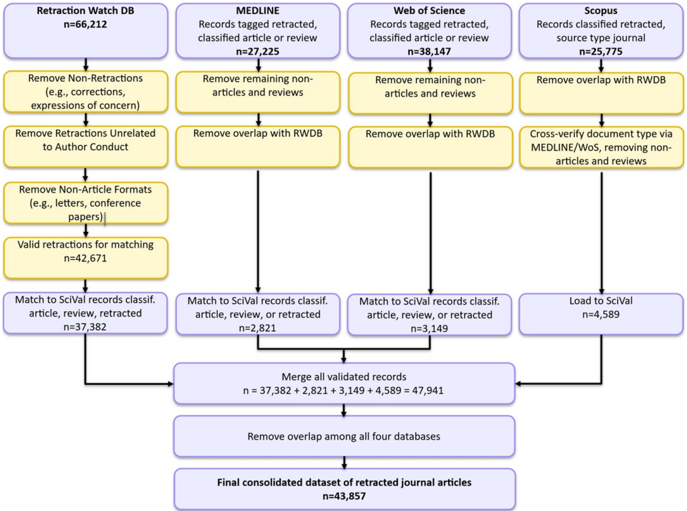
“• Retraction Watch Database (Crossref) was the principal source for identifying retracted publications (Sebo & Sebo, 2025a, 2025b).”
RetractedDiMaggio, P. J., & Powell, W. W. (1983) · American Sociological Review · doi:10.2307/2095101 · Cited by 38,435 · cited 1×
“This tendency is reinforced by institutional isomorphism (DiMaggio & Powell, 1983), whereby institutions emulate perceived leaders even when such strategies conflict with local missions or capacities.”
Web of Science (WoS) and Scopus: The Titans of Bibliographic Information in Today’s Academic World
Pranckutė, R. (2021) · Publications · doi:10.3390/publications9010012 · Cited by 2,696 · cited 2×
“Metadata deficiencies such as missing affiliation and DOI data further undermine reliability (Chinchilla-Rodríguez et al., 2024; Culbert et al., 2025; Liu & Wang, 2025; Pranckutė, 2021; Singh et al., 2024).”
The Journal Coverage of Web of Science, Scopus and Dimensions: A Comparative Analysis
Singh, V. K., Singh, P., Karmakar, M., Leta, J., & Mayr, P. (2021) · Scientometrics · doi:10.1007/s11192-021-03948-5 · Cited by 2,342 · cited 2×
“…and Web of Science—exhibit well-documented asymmetries by coverage, document type, discipline, and language, with database choice considerably altering publication counts, field distributions, and national shares (Alshrai-deh & Abdelgawad, 2025; Li, 2025; Singh et al., 2021; Visser et al., 2021).”
Baas, J., Schotten, M., Plume, A., Côté, G., & Karimi, R. (2020) · Quantitative Science Studies · doi:10.1162/qss_a_00019 · Cited by 2,093 · cited 1×
“• Scopus and Web of Science served as primary sources for publication and citation data, retractions, and publications in delisted journals (Baas et al., 2020; Birkle et al., 2020; Pranckutė, 2021).”
Web of Science as a Data Source for Research on Scientific and Scholarly Activity
Birkle, C., Pendlebury, D. A., Schnell, J., & Adams, J. (2020) · Quantitative Science Studies · doi:10.1162/qss_a_00018 · Cited by 1,283 · cited 1×
“• Scopus and Web of Science served as primary sources for publication and citation data, retractions, and publications in delisted journals (Baas et al., 2020; Birkle et al., 2020; Pranckutė, 2021).”
Misconduct accounts for the majority of retracted scientific publications
Fang, F. C., Steen, R. G., & Casadevall, A. (2012) · Proceedings of the National Academy of Sciences · doi:10.1073/pnas.1212247109 · Cited by 1,232 · cited 2×
“Measures the proportion of an institution’s research output that has been retracted, serving as a critical marker of research integrity (Candal-Pedreira et al., 2024; Fang et al., 2012; Feng et al., 2024; Gedik et al., 2024; Ioannidis et al., 2025).”
Visser, M., van Eck, N. J., & Waltman, L. (2021) · Quantitative Science Studies · doi:10.1162/qss_a_00112 · Cited by 865 · cited 1×
“…and Web of Science—exhibit well-documented asymmetries by coverage, document type, discipline, and language, with database choice considerably altering publication counts, field distributions, and national shares (Alshrai-deh & Abdelgawad, 2025; Li, 2025; Singh et al., 2021; Visser et al., 2021).”
Research works printed but not linked: 2
- 37. Fauzi, M. A., Tan, C. N. L., Daud, M., & Awalludin, M. M. N. (2020). University rankings: A review of methodological flaws. Issues in Educational Research, 30(1), 79-96.
- 91. Stack, M. (2021). Global university rankings and the politics of knowledge [Book]. University of Toronto Press. https:// www. scopus. com/ inward/ record. uri? eid=2-s2.0-85116 04791 6& partn erID= 40& md5= 9bcce 848c8 b033b 600d8 084dc a1c30 c7
Cited by
Eltaybani, S. (2026) · Intensive and Critical Care Nursing · doi:10.1016/j.iccn.2026.104387 · Cited by 5
Jiménez, R. S., Rodríguez, J., Guerrero‐Bote, V. P., & de Moya-Anegon, F. (2026) · Journal of Informetrics · doi:10.1016/j.joi.2026.101803 · Cited by 3
Makhmetov, A., & Yessenbekova, K. (2026) · Asian Education and Development Studies · doi:10.1108/aeds-08-2025-0424 · Cited by 3
Beyond Retractions: A Topic-Based Analysis of the Impact and Lifespan of Retracted Papers
Lou, Y., Zhou, Z., & Li, M. (2026) · Journal of Data and Information Science · doi:10.1515/jdis-2026-0064 · Cited by 2
“Retraction count and retraction rate have thus emerged as primary indicators for assessing research integrity (Fang et al. 2012; Van Noorden 2023; Li and Shen 2024; Zhou et al. 2026; Meho 2025; Lou et al. 2026b).”
Mo, M., Arora, R., Cao, C., Tricco, A. C., & Moher, D. (2026) · Frontiers in Research Metrics and Analytics · doi:10.3389/frma.2026.1833223
“The parallel Research Integrity Risk Index uses similar signal categories (Meho, 2025).”
Multi-dimensional taxonomic metrics for researcher evaluation
Ghavidel, S., Riahinia, N., Danesh, F., & Chakoli, A. N. (2026) · Quality & Quantity · doi:10.1007/s11135-025-02550-8
Building trust in science: International Research Integrity Index
Ibáñez, N. C., Bueno‐Cavanillas, A., & Khan, K. S. (2026) · Medicina de Familia SEMERGEN · doi:10.1016/j.semerg.2025.102681
Internationalization Embodied by a Filipino Scholar in Thai Higher Education
Lemana, H. I. E. (2026) · IGI Global eBooks · doi:10.4018/979-8-3373-6856-6.ch015
On the pursuit of the true impact of our actions in science
Martínez-Cortés, M. S., & Medina‐Franco, J. L. (2026) · Frontiers in Research Metrics and Analytics · doi:10.3389/frma.2026.1783120
“Although grades and metrics are valuable, important, and often motivating, they should not become the primary objective of scientific activity (Meho, 2025).”
Єрмаков, С. (2026) · Pedagogy of Health · doi:10.15561/health.2026.0201
Academics’ mobility revisited: validating dimensions and unpacking inequalities
Wei, Y., Zhang, X., Ho, A. T., & Wang, X. J. (2026) · Scientometrics · doi:10.1007/s11192-026-05641-x
“Prior research often treats research productivity and citation impact as observable signals of academic standing, and such signals are widely used in studies of institutions and scientific careers (Meho, 2025; Mendes, 2025).”
Asymmetry of academic output: Evaluating research distribution and collaboration in LIS faculties
Singson, M., Kanagasabai, K., & Sampath, T. (2026) · Journal of Librarianship and Information Science · doi:10.1177/09610006261449846
Gao, F., Hao, W., Wu, Y., & Yang, S. (2026) · Entropy · doi:10.3390/e28060652
“This mismatch suggests that advancement toward the ESI Top 1‰ is not a simple linear accumulation process, but rather a dynamic competitive process shaped by a moving external benchmark [9–11].”
Önder, Ç., & Erdil, S. E. (2026) · Studies in Higher Education · doi:10.1080/03075079.2026.2691273
Remizov, A., Sadykova, S., & Memon, S. A. (2026) · Scientometrics · doi:10.1007/s11192-026-05683-1
“Based on the findings of Lokman (Meho, 2025), it will focus on institutions with a mismatch between faculty size and publication growth, which translated into significant upward movement in global output rankings.”
InfluentialJiménez, R. S., Guerrero‐Bote, V. P., Halevi, G., Anegón, F. D. M., & Gómez, D. (2026) · Research Integrity and Peer Review · doi:10.1186/s41073-026-00233-y · Cited by 1
“Tools like the RI 2 Index [1, 35] have advanced the field by offering composite measures of institutional vulnerability, though critics caution that raw metrics must always be contex-tualized [26].”
El índice de riesgo de la integridad científica de las universidades españolas en el entorno europeo
Dal‐Ré, R. (2026) · Medicina Clínica · doi:10.1016/j.medcli.2026.107512
Kirichek, A. V., Spasennikov, V., & Логвинов, Д. В. (2026) · Automation and modeling in design and management of · doi:10.30987/2658-6436-2026-2-63-70
Gangurde, R. D., & Bharadwaj, S. (2026) · Advances in computational intelligence and robotics book series · doi:10.4018/979-8-3373-8525-9.ch009
The landscape of problematic papers in the field of non-coding RNA
Lou, Y., Zhou, Z., Wang, G., Shen, Z., & Li, M. (2026) · Journal of Informetrics · doi:10.1016/j.joi.2026.101851 · Cited by 1
“While the existing research framework sheds light on the harms associated with retractions [35, 31, 19], it does not thoroughly explore the characteristics of problematic papers or provide effective mechanisms for identifying potential issues.”
Subaveerapandiyan, A., & Mishra, A. (2026) · Information Development · doi:10.1177/02666669261473250
Al-Kattan, W., Terkawi, A., Bakir, M. A., Mufti, M. A., & Hamweyah, K. (2026) · Frontiers in Research Metrics and Analytics · doi:10.3389/frma.2026.1829439
“Recent (cid:277)ndings additionally highlight more pronounced metric-responsive conduct at certain rapidly ascending colleges, encompassing authorship irregularities and heightened integrity-related threats (Meho, 2025) (Figure 1).”
Multiple Authors in a Scientific Article: Friends and Foes
Mestres, C. A., Obeso, A., & Göbölös, L. (2026) · Interdisciplinary CardioVascular and Thoracic Surgery · doi:10.1093/icvts/ivag224
The research integrity risk index for Spanish universities in the European context
Dal‐Ré, R. (2026) · Medicina Clínica (English Edition) · doi:10.1016/j.medcle.2026.107512
Kohus, Z., & Lendvai, G. F. (2026) · Scientometrics · doi:10.1007/s11192-026-05824-6
“These could take multiple forms (Sauder & Espeland, 2009), from seemingly unorthodox ranking changes of certain HEIs or ranking manipulation techniques to large-scale amendments to ranking calculations that may effectively redefine institutional incentives (see: Meho, 2025).”
Ioannidis, J. P. A., Baas, J., Boverhof, R., & Voyant, C. (2026) · Royal Society Open Science · doi:10.1098/rsos.260870 · Cited by 4
Hameed, A., Omar, M., Bokhari, R. H., & Park, H. W. (2026) · Online Information Review · doi:10.1108/oir-07-2025-0513
Metadata
- Authors
- Meho, L. I.
- Affiliations
- American University of Beirut (LB)
- Corresponding author
- Meho, Lokman I.
- ORCID
- Meho, Lokman I.
- Venue
- Scientometrics
- Published
- 2025-11
- Volume
- 130
- Issue
- 11
- Pages
- 6683-6726
- ISSN
- 0138-9130 (ISSN-L)
- 1588-2861
- OpenAlex
- W4416199265
- Semantic Scholar
- 3a519ccc055ec1666d37a47269c8f00c97013329
- Cited by
- 27
- References
- 95
- Citations by year
- 2026: 27
- FWCI
- 17.36
- Type
- journal article
- Language
- en
- Open access
- hybrid
- doi.org
- Licence
- cc-by
- creativecommons.org/licenses/by/4.0 (tdm)
- creativecommons.org/licenses/by/4.0 (vor, 11 d)
- Locations
- Scientometrics (publishedVersion, cc-by)
- Topics
- Social Sciences › Library and Information Sciences › scientometrics and bibliometrics research
- Social Sciences › Education › Academic integrity and plagiarism
- Physical Sciences › Computer Science › Information Systems › Web visibility and informetrics
- Keywords
- university rankings, research integrity, publication metrics, authorship patterns, retraction, self-citation, research evaluation, research governance
About these checks
Registry, retraction, Cites and statistics results are computed, not judged, with one exception: a printed reference that no index lists is read once by a model before it counts as a citation error. Claims are extracted by a model and kept only when their quote appears verbatim in the text; each cited source is then checked, with a model’s help, for whether it says what the claim relies on. Those verdicts can be wrong — read the claim’s quote and the cited source before relying on one.
Statistics and arithmetic are recomputed, not judged.
Confidence bands are shown only for fields calibrated on our annotated test set. None is calibrated yet, so no band is shown.
What counts as a claim ›How we measure confidence ›How we check this ›
Are you an author, or do you see a problem with this page? Request a review
Data sources
Bibliographic data: Semantic Scholar, OpenAlex, Crossref.
Contains information from the Semantic Scholar Academic Graph Datasets, made available under the ODC Attribution License (ODC-BY 1.0).
Semantic Scholar’s data is described in: Kinney, R., et al. (2023). The Semantic Scholar Open Data Platform. arXiv:2301.10140.
