

Does Gender Equality Cause Gender Differences in Values? Reassessing the Gender-Equality-Personality Paradox
Open accessThe DOI matches its Crossref record; 44 of the 44 references it cites were found in a registry or an index.
Abstract
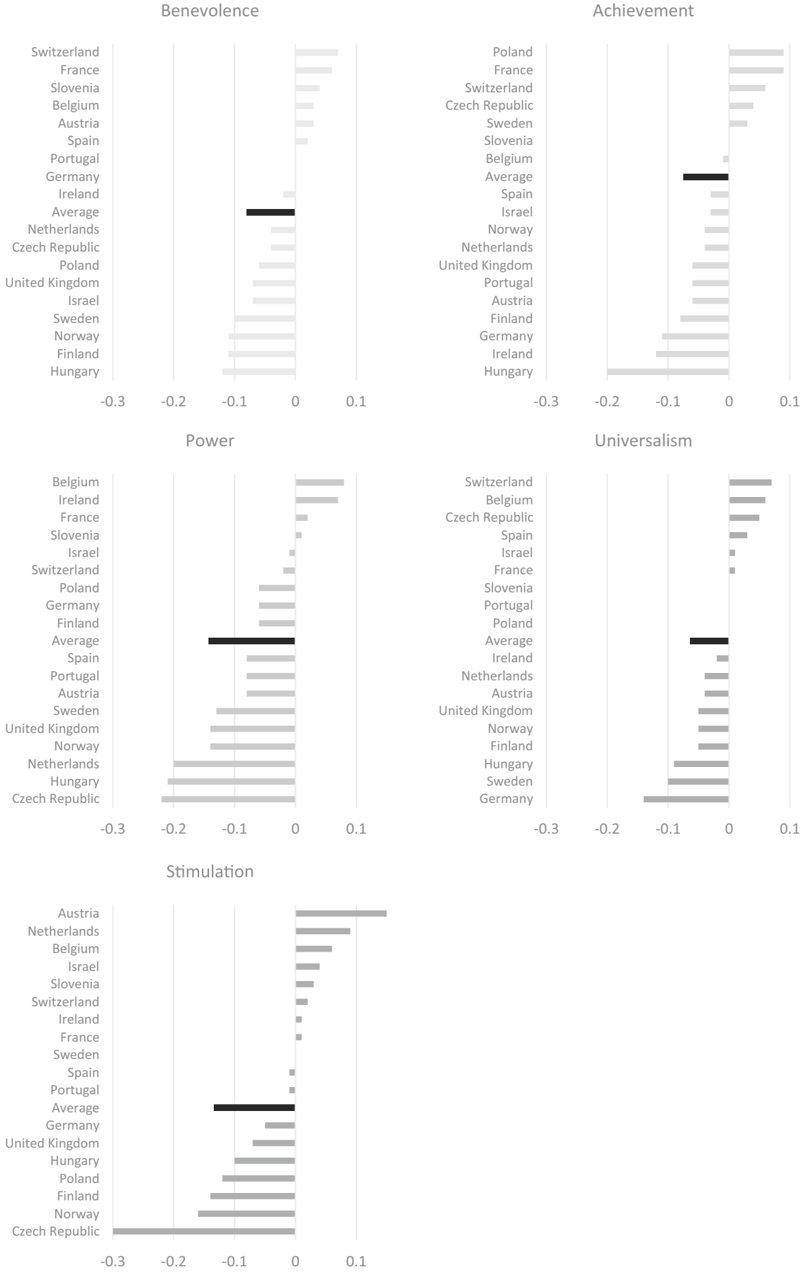
The Gender-Equality-Personality Paradox (GEPP) is the finding that gender differences in personality are at their largest in the most gender equal countries. Previous known studies have not examined this relationship over time. Examining this linkage is crucial to our understanding of gender differences and personality development. In the present study, we contrast evolutionary perspectives predicting a gender divergence in personality due to progression in gender equality against biosocial perspectives predicting convergence. Using data from all eight rounds of the European Social Survey ( n = 235,339) across 32 European countries, we report three findings. First, in accordance with the evolutionary perspective, country-level gender equality is positively associated with gender differences in basic human values. Second, in accordance with the biosocial perspective, we find evidence supporting gender convergence in basic human values. Third, contradicting both evolutionary and biosocial assumptions, we find no evidence that gender equality causes gender differences in values. We argue that there is a need to explore alternative explanations to the observed cross-sectional association between gender equality and personality differences, as well as gender convergence in personality over time.
Overview
The claims and statistics of this paper haven’t been checked yet.
Free: it reads the open-access text and checks the first 5 claims that cite a source we can check. Create a free account to check every claim.
Integrity signals
Registry
Cites
Statistics
Figures
Verification
Claims the paper makes
The claims and statistics of this paper haven’t been checked yet.
Free: it reads the open-access text and checks the first 5 claims that cite a source we can check. Create a free account to check every claim.
Claims other papers make about this one
Each is checked against this paper’s own text: does it say what the citing paper says it does?
The cited source says what the claim attributes to it.
In the citing paper
“The few longitudinal GEP preference studies that have examined gender differences (in values, as in ref. 32, and occupational expectations) as a function of gender equality have not found the paradox (and rather point to decreased differences with time) 33, 34”
From Simpson’s gender-equality paradox (2025) · cites this paper as [33]
The cited source says what the claim attributes to it.
In the citing paper
“However, there is little such evidence. The few longitudinal GEP preference studies that have examined gender differences (in values, as in ref. 32, and occupational expectations) as a function of gender equality have not found the paradox (and rather point to decreased differences with time) 33, 34”
From Simpson’s gender-equality paradox (2025) · cites this paper as [33]
The cited source says what the claim attributes to it.
In the citing paper
“This further supports other research that has found GEP results to replicate poorly across time (33, 34), and within countries (52).”
From Simpson’s gender-equality paradox (2025) · cites this paper as [33]
The cited source says what the claim attributes to it.
In the citing paper
“For the European Social Survey data (64), used both in ref. 32 Study 1 and in ref. 33, we had to make some additional judgment calls, as the authors originally did not focus on one overall difference score, and had some differences in procedure.”
From Simpson’s gender-equality paradox (2025) · cites this paper as [33]
Self-check
Percentages, sums and reported differences re-computed from the paper’s own numbers.
The self-check needs the paper’s full text.
Citations
Cites
Advances In Experimental Social Psychology
(2022) · Advances in Experimental Social Psychology · doi:10.1016/s0065-2601(22)x0002-6 · Cited by 22,259
Schwartz, S. H. (1992) · Advances in Experimental Social Psychology · doi:10.1016/s0065-2601(08)60281-6 · Cited by 14,619 · cited 1×
“Following Schwartz (1992), we define values as broad, trans-situational goals, which vary in importance and that act as guiding principles in people ’ s lives.”
(1996) · Institutional Research Information System University of Turin (University of Turin) · doi:10.1111/j · Cited by 5,486
An overview of the Schwartz theory of basic values
Schwartz, S. H. (2012) · Online Readings in Psychology and Culture · doi:10.9707/2307-0919.1116 · Cited by 4,147 · cited 1×
“Because values are critical motivators of behaviors and preferences (Schwartz 2012), values can mediate the relationship between gender and different outcomes (such as educational and occupational choice).”
BackgroundThe Developmental Social Psychology of Gender
(2012) · Psychology Press eBooks · doi:10.4324/9781410605245 · Cited by 1,602
Schmitt, D. P., Realo, A., Voracek, M., & Allik, J. (2008) · Journal of Personality and Social Psychology · doi:10.1037/0022-3514.94.1.168 · Cited by 1,391
Wang, M.-T., & Degol, J. L. (2017) · Educational Psychology Review · doi:10.1007/s10648-015-9355-x · Cited by 1,188
Sex differences in value priorities: Cross-cultural and multimethod studies.
Schwartz, S. H., & Rubel, T. (2005) · Journal of Personality and Social Psychology · doi:10.1037/0022-3514.89.6.1010 · Cited by 1,159
The Gender-Equality Paradox in Science, Technology, Engineering, and Mathematics Education
Stoet, G., & Geary, D. C. (2018) · Psychological Science · doi:10.1177/0956797617741719 · Cited by 1,054
Egos inflating over time: A cross-temporal meta-analysis of the Narcissistic Personality Inventory
Twenge, J. M., Konrath, S., Foster, J. D., Keith Campbell, W., & Bushman, B. J. (2008) · Journal of Personality · doi:10.1111/j.1467-6494.2008.00507.x · Cited by 972 · cited 1×
“Traits, such as narcissism, which are connected to leadership positions, display mixed evidence over time, with both evidence of convergence (Twenge et al. 2008) as well as stability (Grijalva et al. 2015).”
Cited by
Men, women and STEM: Why the differences and what should be done?
Stewart-Williams, S., & Halsey, L. G. (2021) · European Journal of Personality · doi:10.1177/0890207020962326 · Cited by 117
“This freedom may, in turn, result in larger psychological sex differences (Schmitt et al., 2008; although see Fors Connolly et al., 2019; Kaiser, 2019).”
BackgroundEchavarren, J. M. (2023) · Sex Roles · doi:10.1007/s11199-023-01397-3 · Cited by 134
Froehlich, L., Olsson, M. I. T., Dorrough, A. R., & Martiny, S. E. (2020) · Journal of Social Issues · doi:10.1111/josi.12390 · Cited by 100
Gendered Self-Views Across 62 Countries: A Test of Competing Models
Kosakowska‐Berezecka, N., Bosson, J. K., Jurek, P., Besta, T., Olech, M., Vandello, J. A., Bender, M., Dandy, J., Hoorens, V., Jasinskaja‐Lahti, I., et al. (2022) · Social Psychological and Personality Science · doi:10.1177/19485506221129687 · Cited by 67
“This pattern is consistent with evolutionary approaches, and adds to accruing research on the Gender Equality Paradox (GEP; Connolly et al., 2019; Stoet & Geary, 2019), or the tendency for sex differences in psychological variables to increase in countries characterized by more gender parity.”
BackgroundBalducci, M. (2023) · Frontiers in Psychology · doi:10.3389/fpsyg.2023.1105234 · Cited by 64
García, L. F., Aluja, A., Rossier, J., Ostendorf, F., Glicksohn, J., Barry, O., Bellaj, T., Ruch, W., Wang, W., Kövi, Z., et al. (2021) · Journal of Personality · doi:10.1111/jopy.12664 · Cited by 51
Agustina, R. P., & Barokah, Z. (2024) · Corporate Governance · doi:10.1108/cg-10-2023-0415 · Cited by 53
Emotional Intelligence & ICTs for Women and Equality
Papoutsi, C., Chaidi, I., Drigas, A. S., Skianis, C. A., & Karagiannidis, C. (2022) · Technium Social Sciences Journal · doi:10.47577/tssj.v27i1.5561 · Cited by 34
Gender, Gaming Motives, and Genre: Comparing Singaporean, German, and American Players
Ratan, R., Chen, V. H. H., Grove, F. D., Breuer, J., Quandt, T., & Williams, J. P. (2021) · IEEE Transactions on Games · doi:10.1109/tg.2021.3116077 · Cited by 29
de Boer, J., & Aiking, H. (2022) · Appetite · doi:10.1016/j.appet.2022.106350 · Cited by 27
The Gender-Equality Paradox in Intraindividual Academic Strengths: A Cross-Temporal Analysis
Balducci, M., Larose, M., Stoet, G., & Geary, D. C. (2024) · Psychological Science · doi:10.1177/09567976241271330 · Cited by 27
“In the fourth component, we assessed temporal changes in the relation between the GGGI, wealth, and sex differences in intraindividual strengths (Fors Connolly et al., 2020).”
Teacher judgements and gender achievement gaps in primary education in England, Germany, and the US
Olczyk, M., Gentrup, S., Schneider, T., Volodina, A., Casoni, V. P., Washbrook, E., Kwon, S. J., & Waldfogel, J. (2023) · Social Science Research · doi:10.1016/j.ssresearch.2023.102938 · Cited by 31
Pawliczek, A., Chlopecký, J., Oberreiterová, O., & Moravec, L. (2021) · Studies on entrepreneurship, structural change and industrial dynamics · doi:10.1007/978-3-030-75714-4_10 · Cited by 17
Simpson’s gender-equality paradox
Berggren, M., & Bergh, R. (2025) · Proceedings of the National Academy of Sciences · doi:10.1073/pnas.2422247122 · Cited by 17
Deconstructing the gender-equality paradox.
Ilmarinen, V., & Lönnqvist, J. (2024) · Journal of Personality and Social Psychology · doi:10.1037/pspp0000508 · Cited by 23
Sex differences and occupational choice Theorizing for policy informed by behavioral science✰
Stern, C., & Madison, G. (2022) · Journal of Economic Behavior & Organization · doi:10.1016/j.jebo.2022.08.032 · Cited by 21
Fathoni, A. F., Hanafi, M. M., & Tandelilin, E. (2025) · Banks and Bank Systems · doi:10.21511/bbs.20(2).2025.01 · Cited by 14
Are Gender Differences in Vocational Interests Universal?: Moderating Effects of Cultural Dimensions
Tao, C., Glösenberg, A., Tracey, T. J. G., Blustein, D. L., & Thompson, L. F. (2022) · Sex Roles · doi:10.1007/s11199-022-01318-w · Cited by 28
“However, other research has indicated equivocal or more complex results (Charles & Bradley, 2009; Connolly et al., 2020; Lippa, 2010; Richardson et al., 2020).”
BackgroundResultErdmann, M., Marques Hill, A., Helbig, M., & Leuze, K. (2023) · Frontiers in Sociology · doi:10.3389/fsoc.2023.1175651 · Cited by 12
Birkeland, S., Linkhorst, T., Haakonsson, A. K., Barry, M. J., & Möller, S. (2020) · BMC Health Services Research · doi:10.1186/s12913-020-05717-1 · Cited by 13
Polarization of gender role attitudes across Europe
Lomazzi, V., & Soboleva, N. (2024) · Journal of Contemporary European Studies · doi:10.1080/14782804.2024.2327846 · Cited by 14
“A few studies discussed the polarization of GRAs by gender, providing evidence that in more gender-equal countries, gender differences in basic human values (Connolly, Filip, and Hjerm 2020) and moral judgments (Mohammad, Lai, and Dehghani 2020) are larger.”
Gender Equality Training for Students in Higher Education: Scoping Review
Condron, C. M., Power, M., Mathew, M., Lucey, S., Henn, P., Dean, T., Scott, M. K., Eppich, W., & Lucey, S. M. (2025) · JMIR Medical Education · doi:10.2196/60061 · Cited by 14
“Connolly et al [12] highlight the necessity of training to raise awareness and develop competencies in student leaders, enabling them to proactively tackle gender inequality.”
Uunk, W. (2023) · Frontiers in Education · doi:10.3389/feduc.2023.1155492 · Cited by 9
Das, S., Mishra, U. S., Das, M., & Das, P. (2022) · Children and Youth Services Review · doi:10.1016/j.childyouth.2022.106388 · Cited by 13
Global Perspectives on Women and Work
Folberg, A. M. (2020) · Journal of Social Issues · doi:10.1111/josi.12396 · Cited by 14
Masuda, A. D., Sortheix, F. M., Holtschlag, C., & Morales, C. (2023) · Applied Psychology · doi:10.1111/apps.12467 · Cited by 9
Bass, V., Bratel, S., Bulyk, I. L., & Liakh, N. V. (2021) · Cuestiones Políticas · doi:10.46398/cuestpol.3970.32 · Cited by 4
Klyuchko, O. I. (2022) · Social Psychology and Society · doi:10.17759/sps.2022130402 · Cited by 7
Youth AI designs meet eternal values: responsible digital technology design and innovation education
Haarjärvi, T., Norouzi, B., Kinnula, M., Ventä-Olkkonen, L., Hartikainen, H., & Sharma, S. (2026) · Behaviour and Information Technology · doi:10.1080/0144929x.2026.2615036 · Cited by 4
“While it is acknowledged that gender and sex differences can influence values (Atari, Lai, and Dehghani 2020; Connolly et al. 2020; Schwartz and Rubel 2005), these aspects were not pertinent to the goals of our current study.”
Personality traits and job performance among public sector managers: The role of gender
López, A. R., Balluerka, N., Gorostiaga, A., & Ulacia, I. (2022) · Current Psychology · doi:10.1007/s12144-022-03634-6 · Cited by 3
“Fors Connolly et al. (2020) labeled this positive association between gender equality and gender differences in personality the gender equality-personality paradox .”
Rahman, T. U., Jan, Z., Alam, A., & Ali, R. (2024) · Digital Health · doi:10.1177/20552076241295797 · Cited by 9
Generational differences in narcissism and value orientation
Katedra psychológie, F. F., & Urukovičová, N. (2022) · Ceskoslovenska psychologie · doi:10.51561/cspsych.66.3.315 · Cited by 4
Berggren, M. (2022) · Social Psychological and Personality Science · doi:10.1177/19485506221134353 · Cited by 8
The Gender Gap in Preferences: Evidence from 45,397 Facebook Interests
Cuevas, √., Cuevas, R., Desmet, K., & Ortuño-Ortín, I. (2021) · National Bureau of Economic Research · doi:10.3386/w29451 · Cited by 15
Minding the gap(s): The uneven gendering of engineering and computing work across Europe
Charles, M. (2025) · International Journal of Comparative Sociology · doi:10.1177/00207152251372850 · Cited by 2
Muñoz-Muñoz, P., Puché, S. M., & Molina, J. O. (2024) · Educação & Sociedade · doi:10.1590/es.276942 · Cited by 9
Zinkina, J. V., Butovskaya, M., Shulgin, S. G., & Korotayev, A. (2024) · Social Evolution & History · doi:10.30884/seh/2024.01.04 · Cited by 6
“…that differences in behavior between men and women are weakly associated with a set of socially assimilated gender stereotypes (Costa Jr, Terracciano and McCrae 2001; Connolly, Goossen and Hjerm 2020; Haines, Deaux and Lofaro 2014; Hyde 2014; Prentice and Carranza 2002; Beutel and Marini 1995).”
BackgroundGang, H., Anderson, M. H., & Summers, J. K. (2025) · Personality and Individual Differences · doi:10.1016/j.paid.2025.113121 · Cited by 5
Providing Women Equality in Kyrgyzstan: Legal and Historical Analysis
Kuldysheva, G., Paraidinuulu, S., Atantaev, A., Mirzaeva, A., Паизбековна, Ш. Д., Zhusupov, B. A., Tanatarova, F., Abdullaeva, Z. D., & Patiev, N. (2021) · Open Journal of Social Sciences · doi:10.4236/jss.2021.91024 · Cited by 2
“Gender equality cannot be simultaneously the cause of both convergence and divergence, although empirical evidence of a positive equality correlation between men and women, gender differences in personality are overwhelming (Connolly et al., 2020).”
BackgroundThe Gender Policy of Ukraine: Considering the EU Experience
Lukianets-Shakhova, V., Ganus, L., Bryl, K. I., Nehoda, Y., & Rega, I. (2023) · Revista de Gestão Social e Ambiental · doi:10.24857/rgsa.v17n4-030 · Cited by 2
The Gender Gap in Preferences: Evidence from 45,397 Facebook InterestsPreprint
Cuevas, √., Cuevas, R., Klaus Desmet, A., & Ortuño-Ortı́n, I. (2021) · SSRN Electronic Journal · doi:10.2139/ssrn.3958638 · Cited by 2
BENEVOLENCE AND CONFORMITY: MILLENNIALS WORKERS’ BASIC VALUES
Bramanwidyantari, M., & Widhianingtanti, L. T. (2021) · Social Values and Society · doi:10.26480/svs.02.2021.65.69 · Cited by 2
Bidirectional Relationship between Adolescent Gender Egalitarianism and Prosocial Behavior
Fu, X., Fu, R., Chang, Y., & Yang, Z. (2024) · Behavioral Sciences · doi:10.3390/bs14010033 · Cited by 1
Pratama, A. T., & Assidik, G. K. (2024) · AIP conference proceedings · doi:10.1063/5.0183635 · Cited by 1
Can Gender Stereotypes Explain the Gender‐Equality Paradox? A Reassessment
Uunk, W. J. G. (2025) · Sociology Compass · doi:10.1111/soc4.70117 · Cited by 1
Majoros, E. (2026) · Studies In Educational Evaluation · doi:10.1016/j.stueduc.2026.101568 · Cited by 1
Does Societal Affluence Increase the Gender Gap in STEM Graduation? A Longitudinal Assessment
Uunk, W. J. G., & Li, M. (2026) · Sex Roles · doi:10.1007/s11199-026-01654-1 · Cited by 1
“The doubts are substantiated by studies that find no longi - tudinal association between national gender equality and gender differences in values (Fors Connolly et al., 2020) or even a negative longitudinal association between national gender equality and gender differences in occupational…”
Gender gaps in patience, risk-taking, trust, and prosociality are smaller among younger cohorts
Kotschy, R., & Sunde, U. (2026) · PNAS Nexus · doi:10.1093/pnasnexus/pgag255
“For instance, with labor markets ’ diminishing reliance on physical and biological factors and increasing gender equality, gender differences in personality tend to weaken over time (16, 40).”
InfluentialGender differences in values among representatives of the millennial generation
Rzhanova, I. E., Alekseeva, O. A., Albov, A., & Burdukova, Y. A. (2022) · Vestnik of Saint Petersburg University Psychology · doi:10.21638/spbu16.2022.302 · Cited by 3
Eley, D. S., Bansal, V., Cloninger, C. R., & Leung, J. (2023) · PeerJ · doi:10.7717/peerj.15342 · Cited by 5
Osterloh, M., & Rost, K. (2024) · Routledge Open Research · doi:10.12688/routledgeopenres.17975.2 · Cited by 1
Sortheix, F. M., Ilmarinen, V., Mannerström, R., & Salmela‐Aro, K. (2025) · European Journal of Personality · doi:10.1177/08902070251332098 · Cited by 2
“In turn, low male typicality (thus, high female typicality) should display a high importance of typically female values: be-nevolence, universalism and, to a lesser extent, conformity, security and tradition (Fors Connolly et al., 2020; Schwartz & Rubel, 2005).”
Measurement Bias, Sex Differences, and the Implications of Substantial TheoriesPreprint
Lasker, J. (2021) · PsyArXiv (OSF Preprints) · doi:10.31234/osf.io/r35h8
How is the Emotional Intelligence and Personality of Students in Following the Learning Process?
Tambaip, B., Riyanto, P., Rediani, N. N., & Syahruddin, S. (2022) · Journal of Education Research and Evaluation · doi:10.23887/jere.v6i4.54073 · Cited by 1
Hypatia of Alexandria: Feminisme dan Peran Simbolis Perempuan dalam Mengembangkan Ilmu Pengetahuan
Fitria, F. (2024) · Jurnal Filsafat Indonesia · doi:10.23887/jfi.v7i2.72458
Measurement invariance of short-form measures of the Dark Triad across gender
Ock, J. (2024) · Personality and Individual Differences · doi:10.1016/j.paid.2024.112929 · Cited by 1
Advancing Gender Equity in Engineering: Innovative Talent Management Strategies
Ngobeni, E. K., Swarts, I., & Lessing, K. F. (2024) · Journal of Public Administration and Development Alternatives · doi:10.55190/jpada.2024.332 · Cited by 2
Arowolo, D. E. (2024) · JISR management and social sciences & economics · doi:10.31384/jisrmsse/2024.22.3.2
The gender gap in preferences: Evidence from 45,397 Facebook interests
Cuevas, √., Cuevas, R., Desmet, K., & Ortuño-Ortín, I. (2025) · Journal of Economic Behavior & Organization · doi:10.1016/j.jebo.2025.107165 · Cited by 4
Connolly, F. F., & Goossen, M. (2025) · Journal of Research in Personality · doi:10.1016/j.jrp.2025.104674 · Cited by 1
Self-citationWomen on boards and ESG washing behavior: global evidence from the banking sector
Fathoni, A. F., Hanafi, M. M., Tandelilin, E., & Usman, B. (2025) · Journal of Global Responsibility · doi:10.1108/jgr-08-2024-0141 · Cited by 1
Gender Equality as Self-Determination
Wängnerud, L. (2026) · Political corruption and governance · doi:10.1007/978-3-032-18838-0_3
Mariam, E., Ahmed, N., Hossain, N., Khatun, R., Begum, T., & Tasnim, S. (2024) · Journal of Gender and Power · doi:10.14746/jpg.2024.22.2.11
Vibes over salary? How post-materialistic values shape teenagers’ STEM aspirations
Arnold, L., & Uunk, W. J. G. (2026) · International Journal of Sociology · doi:10.1080/00207659.2026.2726777
Metadata
- Authors
- Fors Connolly, F., Goossen, M., & Hjerm, M.
- Affiliations
- Umeå University (SE)
- Venue
- Sex Roles
- Published
- 2019-12-04
- Volume
- 83
- Issue
- 1-2
- Pages
- 101-113
- ISSN
- 0360-0025 (ISSN-L)
- 1573-2762
- OpenAlex
- W2993243351
- Semantic Scholar
- beeb26c60874f005ebd6b8fc20fd9568fd5c1d3f
- Cited by
- 65
- References
- 43
- Citations by year
- 2026: 6 · 2025: 11 · 2024: 15 · 2023: 8 · 2022: 12 · 2021: 10 · 2020: 3
- FWCI
- 7.86
- Type
- journal article
- Language
- en
- Open access
- hybrid
- doi.org
- Licence
- cc-by
- creativecommons.org/licenses/by/4.0 (tdm)
- creativecommons.org/licenses/by/4.0 (vor)
- Locations
- Sex Roles (publishedVersion, cc-by)
- DiVA at Umeå University (Umeå University) (submittedVersion, other-oa)
- Funders
- Umea University
- Topics
- Social Sciences › Psychology › Social Psychology › Cultural Differences and Values
- Social Sciences › Psychology › Experimental and Cognitive Psychology › Evolutionary Psychology and Human Behavior
- Social Sciences › Gender Studies › Gender and Feminist Studies
- Keywords
- gender equality, gender differences in personality, gender convergence, basic human values, evolutionary perspective, biosocial perspective, cross-national comparison, personality development
About these checks
Registry, retraction, Cites and statistics results are computed, not judged, with one exception: a printed reference that no index lists is read once by a model before it counts as a citation error. Claims are extracted by a model and kept only when their quote appears verbatim in the text; each cited source is then checked, with a model’s help, for whether it says what the claim relies on. Those verdicts can be wrong — read the claim’s quote and the cited source before relying on one.
Statistics and arithmetic are recomputed, not judged.
Confidence bands are shown only for fields calibrated on our annotated test set. None is calibrated yet, so no band is shown.
What counts as a claim ›How we measure confidence ›How we check this ›
Are you an author, or do you see a problem with this page? Request a review
Data sources
Bibliographic data: Semantic Scholar, OpenAlex, Crossref.
Contains information from the Semantic Scholar Academic Graph Datasets, made available under the ODC Attribution License (ODC-BY 1.0).
Semantic Scholar’s data is described in: Kinney, R., et al. (2023). The Semantic Scholar Open Data Platform. arXiv:2301.10140.
