

Does Gender Equality Cause Gender Differences in Values? Reassessing the Gender-Equality-Personality Paradox
Open accessThe DOI matches its Crossref record; 44 of the 44 references it cites were found in a registry or an index.
Abstract
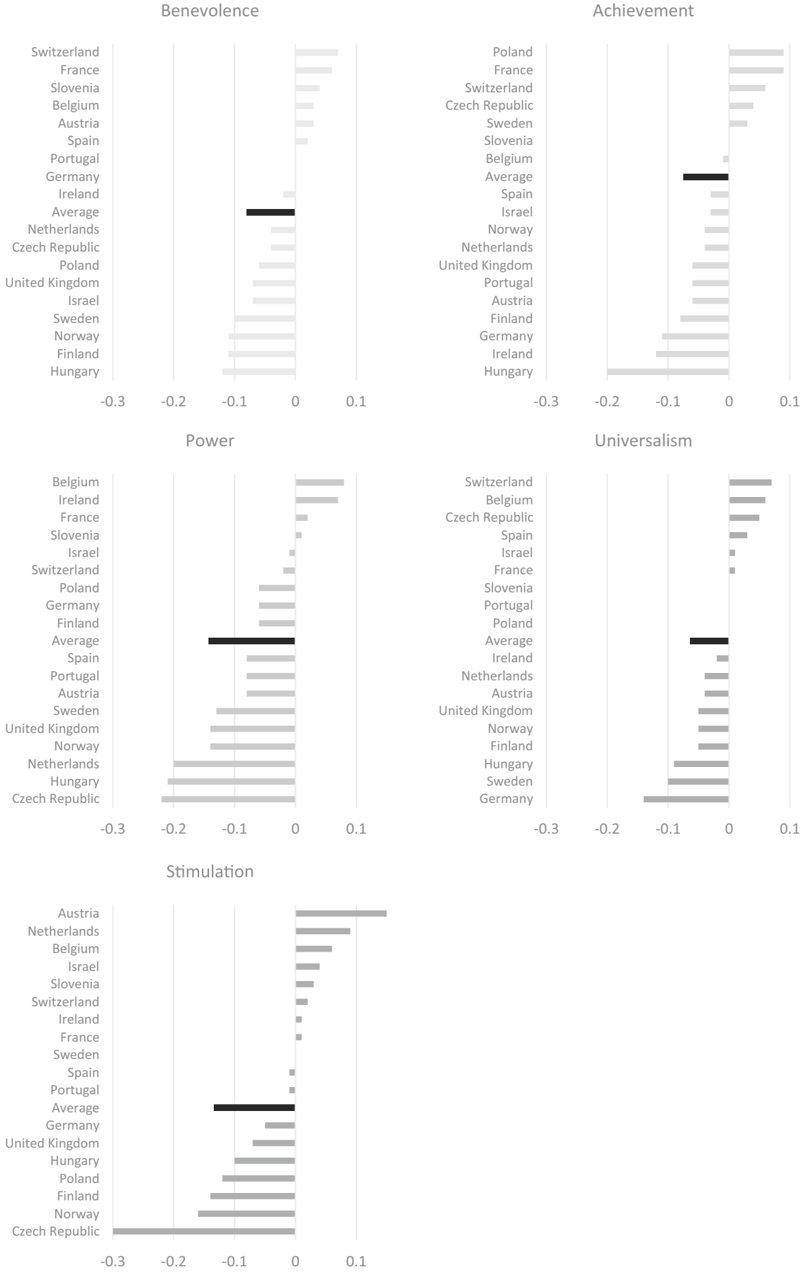
The Gender-Equality-Personality Paradox (GEPP) is the finding that gender differences in personality are at their largest in the most gender equal countries. Previous known studies have not examined this relationship over time. Examining this linkage is crucial to our understanding of gender differences and personality development. In the present study, we contrast evolutionary perspectives predicting a gender divergence in personality due to progression in gender equality against biosocial perspectives predicting convergence. Using data from all eight rounds of the European Social Survey ( n = 235,339) across 32 European countries, we report three findings. First, in accordance with the evolutionary perspective, country-level gender equality is positively associated with gender differences in basic human values. Second, in accordance with the biosocial perspective, we find evidence supporting gender convergence in basic human values. Third, contradicting both evolutionary and biosocial assumptions, we find no evidence that gender equality causes gender differences in values. We argue that there is a need to explore alternative explanations to the observed cross-sectional association between gender equality and personality differences, as well as gender convergence in personality over time.
Overview
The claims and statistics of this paper haven’t been checked yet.
Free: it reads the open-access text and checks the first 5 claims that cite a source we can check. Create a free account to check every claim.
Integrity signals
Registry
Cites
Statistics
Figures
Verification
Claims the paper makes
The claims and statistics of this paper haven’t been checked yet.
Free: it reads the open-access text and checks the first 5 claims that cite a source we can check. Create a free account to check every claim.
Claims other papers make about this one
Each is checked against this paper’s own text: does it say what the citing paper says it does?
The cited source says what the claim attributes to it.
In the citing paper
“The few longitudinal GEP preference studies that have examined gender differences (in values, as in ref. 32, and occupational expectations) as a function of gender equality have not found the paradox (and rather point to decreased differences with time) 33, 34”
From Simpson’s gender-equality paradox (2025) · cites this paper as [33]
The cited source says what the claim attributes to it.
In the citing paper
“However, there is little such evidence. The few longitudinal GEP preference studies that have examined gender differences (in values, as in ref. 32, and occupational expectations) as a function of gender equality have not found the paradox (and rather point to decreased differences with time) 33, 34”
From Simpson’s gender-equality paradox (2025) · cites this paper as [33]
The cited source says what the claim attributes to it.
In the citing paper
“This further supports other research that has found GEP results to replicate poorly across time (33, 34), and within countries (52).”
From Simpson’s gender-equality paradox (2025) · cites this paper as [33]
The cited source says what the claim attributes to it.
In the citing paper
“For the European Social Survey data (64), used both in ref. 32 Study 1 and in ref. 33, we had to make some additional judgment calls, as the authors originally did not focus on one overall difference score, and had some differences in procedure.”
From Simpson’s gender-equality paradox (2025) · cites this paper as [33]
Self-check
Percentages, sums and reported differences re-computed from the paper’s own numbers.
The self-check needs the paper’s full text.
Citations
Cites
Advances In Experimental Social Psychology
(2022) · Advances in Experimental Social Psychology · doi:10.1016/s0065-2601(22)x0002-6 · Cited by 22,259
Schwartz, S. H. (1992) · Advances in Experimental Social Psychology · doi:10.1016/s0065-2601(08)60281-6 · Cited by 14,619 · cited 1×
“Following Schwartz (1992), we define values as broad, trans-situational goals, which vary in importance and that act as guiding principles in people ’ s lives.”
(1996) · Institutional Research Information System University of Turin (University of Turin) · doi:10.1111/j · Cited by 5,486
An overview of the Schwartz theory of basic values
Schwartz, S. H. (2012) · Online Readings in Psychology and Culture · doi:10.9707/2307-0919.1116 · Cited by 4,147 · cited 1×
“Because values are critical motivators of behaviors and preferences (Schwartz 2012), values can mediate the relationship between gender and different outcomes (such as educational and occupational choice).”
BackgroundThe Developmental Social Psychology of Gender
(2012) · Psychology Press eBooks · doi:10.4324/9781410605245 · Cited by 1,602
Schmitt, D. P., Realo, A., Voracek, M., & Allik, J. (2008) · Journal of Personality and Social Psychology · doi:10.1037/0022-3514.94.1.168 · Cited by 1,391
Wang, M.-T., & Degol, J. L. (2017) · Educational Psychology Review · doi:10.1007/s10648-015-9355-x · Cited by 1,188
Sex differences in value priorities: Cross-cultural and multimethod studies.
Schwartz, S. H., & Rubel, T. (2005) · Journal of Personality and Social Psychology · doi:10.1037/0022-3514.89.6.1010 · Cited by 1,159
The Gender-Equality Paradox in Science, Technology, Engineering, and Mathematics Education
Stoet, G., & Geary, D. C. (2018) · Psychological Science · doi:10.1177/0956797617741719 · Cited by 1,054
Egos inflating over time: A cross-temporal meta-analysis of the Narcissistic Personality Inventory
Twenge, J. M., Konrath, S., Foster, J. D., Keith Campbell, W., & Bushman, B. J. (2008) · Journal of Personality · doi:10.1111/j.1467-6494.2008.00507.x · Cited by 972 · cited 1×
“Traits, such as narcissism, which are connected to leadership positions, display mixed evidence over time, with both evidence of convergence (Twenge et al. 2008) as well as stability (Grijalva et al. 2015).”
Gender and the emergence of leaders: A meta-analysis.
Eagly, A. H., & Karau, S. J. (1991) · Journal of Personality and Social Psychology · doi:10.1037//0022-3514.60.5.685 · Cited by 829
Biosocial construction of sex differences and similarities in behavior
Wood, W., & Eagly, A. H. (2012) · Advances in experimental social psychology · doi:10.1016/b978-0-12-394281-4.00002-7 · Cited by 770 · cited 6×
“The biosocial perspective predicts that progression in gender equality leads to altered gender roles, with life patterns and expectations overlapping to a greater extent, thus driving a process of convergence in values (Wood and Eagly 2012).”
InfluentialValue Orientations: Measurement, Antecedents and Consequences Across Nations
Schwartz, S. H. (2007) · Measuring Attitudes Cross-Nationally · doi:10.4135/9781849209458.n9 · Cited by 757 · cited 1×
“Furthermore, studies have shown that the Portrait Values Questionnaire has good predictive validity because the measures correlate in the expected directions with behaviors such as voluntary memberships and political activism (see Schwartz 2007).”
BackgroundChanges in masculine and feminine traits over time: A meta-analysis
Twenge, J. M. (1997) · Sex Roles · doi:10.1007/bf02766650 · Cited by 695 · cited 1×
“In addition, when studying the development of gender differences in personality, some studies point to a convergence rather than a divergence (Donnelly and Twenge 2017; Twenge 1997).”
BackgroundGender differences in narcissism: A meta-analytic review.
Grijalva, E., Newman, D. A., Tay, L., Donnellan, M. B., Harms, P. D., Robins, R. W., & Yan, T. (2015) · Psychological Bulletin · doi:10.1037/a0038231 · Cited by 654
Sex differences and similarities in job attribute preferences: A meta-analysis.
Konrad, A. M., Ritchie, J. E., Lieb, P., & Corrigall, E. (2000) · Psychological Bulletin · doi:10.1037/0033-2909.126.4.593 · Cited by 627
Self-Esteem and Socioeconomic Status: A Meta-Analytic Review
Twenge, J. M., & Campbell, W. K. (2002) · Personality and Social Psychology Review · doi:10.1207/s15327957pspr0601_3 · Cited by 573
European Institute for Gender Equality
Anderson, M. (2014) · European Union regulations | European Encyclopedia of law · Cited by 527
Basic Personal Values and the Meaning of Left‐Right Political Orientations in 20 Countries
Piurko, Y., Schwartz, S. H., & Davidov, E. (2011) · Political Psychology · doi:10.1111/j.1467-9221.2011.00828.x · Cited by 472
Evaluating gender similarities and differences using metasynthesis.
Zell, E., Krizan, Z., & Teeter, S. R. (2015) · American Psychologist · doi:10.1037/a0038208 · Cited by 434
Donnelly, K., & Twenge, J. M. (2017) · Sex Roles · doi:10.1007/s11199-016-0625-y · Cited by 405 · cited 3×
“Men ’ s masculinity and femininity scores on the Bem Sex Role Inventory scale remained stable whereas women ’ s androgyny scores increased significantly from 1974 to 1993 (Donnelly and Twenge 2017).”
Cross-national variation in the size of sex differences in values: Effects of gender equality.
Schwartz, S. H., & Rubel-Lifschitz, T. (2009) · Journal of Personality and Social Psychology · doi:10.1037/a0015546 · Cited by 395
Relationship of gender differences in preferences to economic development and gender equality
Falk, A., & Hermle, J. (2018) · Science · doi:10.1126/science.aas9899 · Cited by 378
Personality and gender differences in global perspective
Schmitt, D. P., Long, A. E., McPhearson, A., O'Brien, K., Remmert, B., & Shah, S. H. (2017) · International Journal of Psychology · doi:10.1002/ijop.12265 · Cited by 369
Mac Giolla, E., & Kajonius, P. J. (2019) · International Journal of Psychology · doi:10.1002/ijop.12529 · Cited by 217
Differences in Parental Investment Contribute to Important Differences Between Men and Women
Bjorklund, D. F., & Shackelford, T. K. (1999) · Current Directions in Psychological Science · doi:10.1111/1467-8721.00020 · Cited by 212
Odysseus Wandered for 10, I Wondered for 50 Years
Triandis, H. C. (2002) · Online Readings in Psychology and Culture · doi:10.9707/2307-0919.1007 · Cited by 198
Motivational Basis of Personality Traits: A Meta‐Analysis of Value‐Personality Correlations
Fischer, R., & Boer, D. (2015) · Journal of Personality · doi:10.1111/jopy.12125 · Cited by 196 · cited 3×
“Value priorities, being correlated with higher-order personality traits (Fischer and Boer 2015), also display gender differentiation and cross-cultural variations similar to those found for traits and preferences (Schwartz and Rubel-Lifschitz 2009; Falk and Hermle 2018).”
The Sex Difference in Depression Across 29 Countries
Hopcroft, R. L., & Bradley, D. B. (2007) · Social Forces · doi:10.1353/sof.2007.0071 · Cited by 164
When men and women differ in self-esteem and when they don’t: A meta-analysis
Zuckerman, M., Li, C., & Hall, J. A. (2016) · Journal of Research in Personality · doi:10.1016/j.jrp.2016.07.007 · Cited by 161 · cited 1×
“…choices (i.e., number of men/women within STEM [Science, Technology, Engineering, and Math] and EHW [Education, Health and Welfare] fields (Stoet and Geary 2018), self-esteem (Zuckerman et al. 2016), subjective well-being (Zuckerman et al. 2017), and depression (Hopcroft and Bradley 2007).”
Societal Conditions and the Gender Difference in Well-Being: Testing a Three-Stage Model
Zuckerman, M., Li, C., & Diener, E. F. (2017) · Personality and Social Psychology Bulletin · doi:10.1177/0146167216684133 · Cited by 122
Values in Middle Childhood: Social and Genetic Contributions
Uzefovsky, F., Döring, A. K., & Knafo‐Noam, A. (2015) · Social Development · doi:10.1111/sode.12155 · Cited by 109
Kajonius, P. J., & Johnson, J. (2018) · Personality and Individual Differences · doi:10.1016/j.paid.2018.03.026 · Cited by 107 · cited 1×
“…of respondents in relation to non-respondents are generally good in ESS, but as in most large surveys, there tends to be some underrepresentation of young people, non-nationals, men, and single households to varying degree in different countries (e.g., see Koch 2018, for ESS round 7).”
European Social Survey (ESS), Cumulative Data Wizard
ERIC), E. S. S. E. (. (2016) · NSD – Norsk senter for forskningsdata · doi:10.21338/nsd-ess-cumulative · Cited by 96
Response to Comment on “The earliest modern humans outside Africa”
Hershkovitz, I., Duval, M., Grün, R., Mercier, N., Valladas, H., Ayalon, A., Bar-Matthews, M., Weber, G. W., Quam, R., Zaidner, Y., et al. (2018) · Science · doi:10.1126/science.aat8964 · Cited by 70
Measuring Mate Preferences: A Replication and Extension
Boxer, C. F., Noonan, M. C., & Whelan, C. B. (2013) · Journal of Family Issues · doi:10.1177/0192513x13490404 · Cited by 54
Schmitt, D. P., Realo, A., Voracek, M., & Allïk, J. (2009) · Journal of Personality and Social Psychology · doi:10.1037/a0014651 · Cited by 49
Women in Parliament, 1945-2003: Cross-National Dataset
Paxton, P. M., Green, J., & Hughes, M. (2008) · ICPSR Data Holdings · doi:10.3886/icpsr24340 · Cited by 48
Kaiser, T. (2019) · Personality and Individual Differences · doi:10.1016/j.paid.2019.05.011 · Cited by 38 · cited 4×
“For example, a recent study by Kaiser (2019) indicates that cultural individualism, food consumption, and historical levels of pathogen prevalence may be such confounding factors.”
InfluentialWomen in Parliament, 1945-2003: Cross-National Dataset
Paxton, P. M., Green, J., & Hughes, M. (2008) · ICPSR Data Holdings · doi:10.3886/icpsr24340.v1 · Cited by 26
International Social Survey Programme: Work Orientations IV - ISSP 2015
ISSP Research Group (2017) · VBN Forskningsportal (Aalborg Universitet) · doi:10.4232/1.12848 · Cited by 22
International Social Survey Programme: Work Orientations III - ISSP 2005
ISSP Research Group (2013) · GESIS Data Archive · doi:10.4232/1.11648 · Cited by 15
Vahey, N. A., & Whelan, R. (2015) · International Journal of Psychology · doi:10.1002/ijop.12183 · Cited by 8
International Social Survey Programme: Work Orientations II - ISSP 1997
ISSP Research Group (2010) · GESIS Data Archive · doi:10.4232/1.3090 · Cited by 7
Cited by
Men, women and STEM: Why the differences and what should be done?
Stewart-Williams, S., & Halsey, L. G. (2021) · European Journal of Personality · doi:10.1177/0890207020962326 · Cited by 117
“This freedom may, in turn, result in larger psychological sex differences (Schmitt et al., 2008; although see Fors Connolly et al., 2019; Kaiser, 2019).”
BackgroundEchavarren, J. M. (2023) · Sex Roles · doi:10.1007/s11199-023-01397-3 · Cited by 134
Froehlich, L., Olsson, M. I. T., Dorrough, A. R., & Martiny, S. E. (2020) · Journal of Social Issues · doi:10.1111/josi.12390 · Cited by 100
Gendered Self-Views Across 62 Countries: A Test of Competing Models
Kosakowska‐Berezecka, N., Bosson, J. K., Jurek, P., Besta, T., Olech, M., Vandello, J. A., Bender, M., Dandy, J., Hoorens, V., Jasinskaja‐Lahti, I., et al. (2022) · Social Psychological and Personality Science · doi:10.1177/19485506221129687 · Cited by 67
“This pattern is consistent with evolutionary approaches, and adds to accruing research on the Gender Equality Paradox (GEP; Connolly et al., 2019; Stoet & Geary, 2019), or the tendency for sex differences in psychological variables to increase in countries characterized by more gender parity.”
BackgroundBalducci, M. (2023) · Frontiers in Psychology · doi:10.3389/fpsyg.2023.1105234 · Cited by 64
Metadata
- Authors
- Fors Connolly, F., Goossen, M., & Hjerm, M.
- Affiliations
- Umeå University (SE)
- Venue
- Sex Roles
- Published
- 2019-12-04
- Volume
- 83
- Issue
- 1-2
- Pages
- 101-113
- ISSN
- 0360-0025 (ISSN-L)
- 1573-2762
- OpenAlex
- W2993243351
- Semantic Scholar
- beeb26c60874f005ebd6b8fc20fd9568fd5c1d3f
- Cited by
- 65
- References
- 43
- Citations by year
- 2026: 6 · 2025: 11 · 2024: 15 · 2023: 8 · 2022: 12 · 2021: 10 · 2020: 3
- FWCI
- 7.86
- Type
- journal article
- Language
- en
- Open access
- hybrid
- doi.org
- Licence
- cc-by
- creativecommons.org/licenses/by/4.0 (tdm)
- creativecommons.org/licenses/by/4.0 (vor)
- Locations
- Sex Roles (publishedVersion, cc-by)
- DiVA at Umeå University (Umeå University) (submittedVersion, other-oa)
- Funders
- Umea University
- Topics
- Social Sciences › Psychology › Social Psychology › Cultural Differences and Values
- Social Sciences › Psychology › Experimental and Cognitive Psychology › Evolutionary Psychology and Human Behavior
- Social Sciences › Gender Studies › Gender and Feminist Studies
- Keywords
- gender equality, gender differences in personality, gender convergence, basic human values, evolutionary perspective, biosocial perspective, cross-national comparison, personality development
About these checks
Registry, retraction, Cites and statistics results are computed, not judged, with one exception: a printed reference that no index lists is read once by a model before it counts as a citation error. Claims are extracted by a model and kept only when their quote appears verbatim in the text; each cited source is then checked, with a model’s help, for whether it says what the claim relies on. Those verdicts can be wrong — read the claim’s quote and the cited source before relying on one.
Statistics and arithmetic are recomputed, not judged.
Confidence bands are shown only for fields calibrated on our annotated test set. None is calibrated yet, so no band is shown.
What counts as a claim ›How we measure confidence ›How we check this ›
Are you an author, or do you see a problem with this page? Request a review
Data sources
Bibliographic data: Semantic Scholar, OpenAlex, Crossref.
Contains information from the Semantic Scholar Academic Graph Datasets, made available under the ODC Attribution License (ODC-BY 1.0).
Semantic Scholar’s data is described in: Kinney, R., et al. (2023). The Semantic Scholar Open Data Platform. arXiv:2301.10140.
