

A Phase-Partitioning Model for CO2–Brine Mixtures at Elevated Temperatures and Pressures: Application to CO2-Enhanced Geothermal Systems
Open accessThe DOI matches its Crossref record; 63 of the 63 references it cites were found in a registry or an index.
Abstract
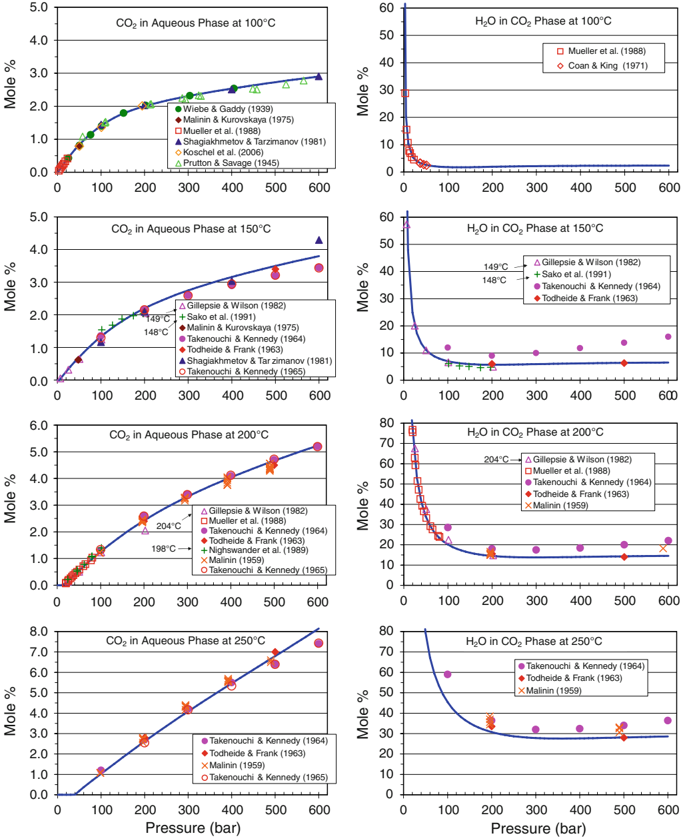
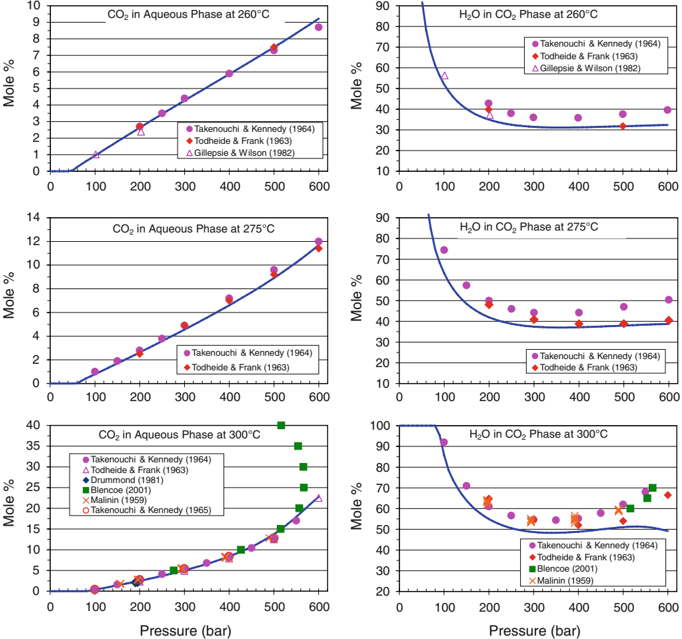
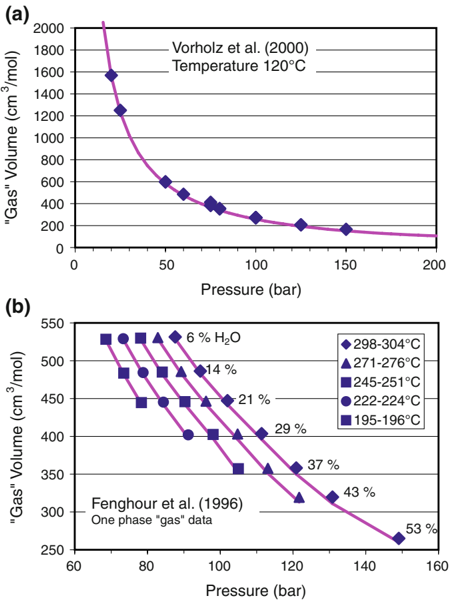
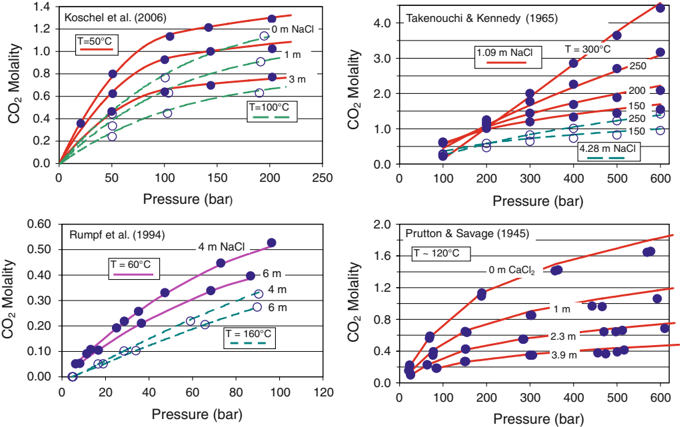
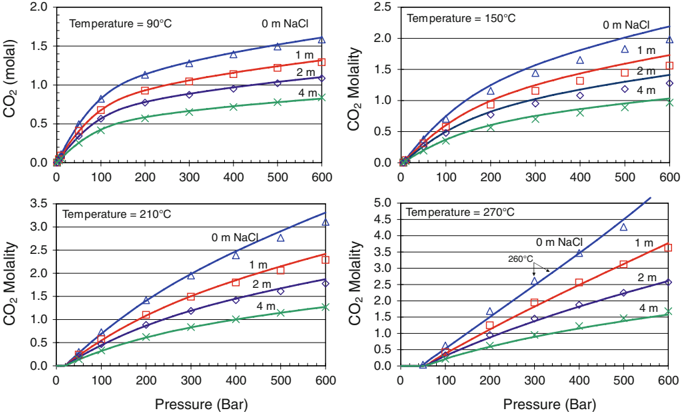
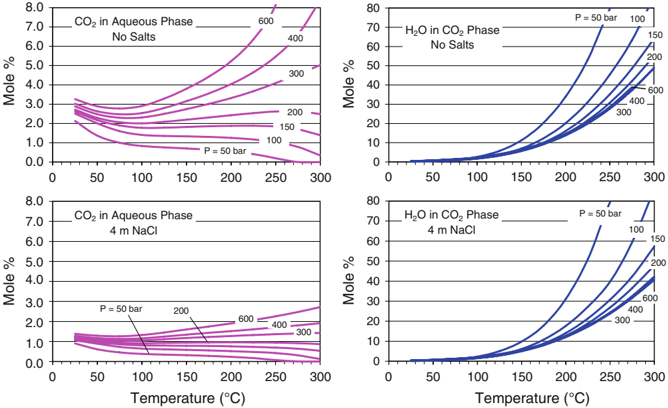
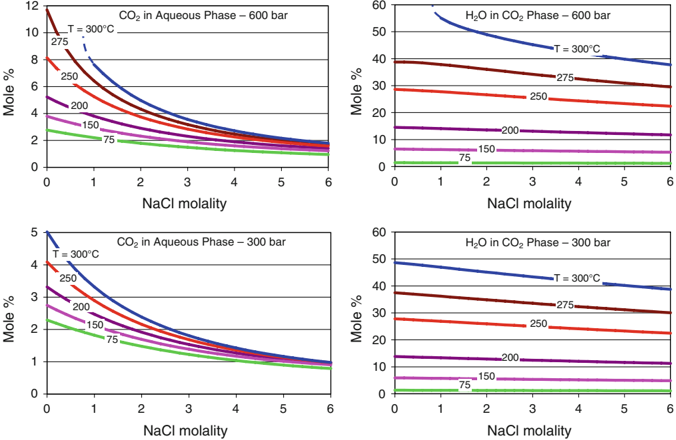
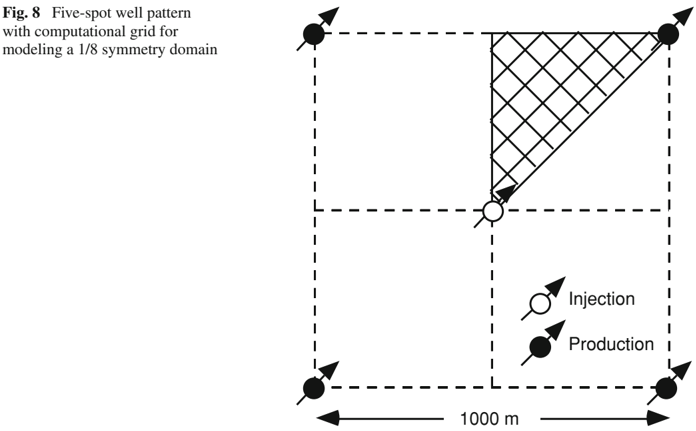
Correlations are presented to compute the mutual solubilities of CO 2 and chloride brines at temperatures 12–300°C, pressures 1–600 bar (0.1–60 MPa), and salinities 0–6 m NaCl. The formulation is computationally efficient and primarily intended for numerical simulations of CO 2 -water flow in carbon sequestration and geothermal studies. The phase-partitioning model relies on experimental data from literature for phase partitioning between CO 2 and NaCl brines, and extends the previously published correlations to higher temperatures. The model relies on activity coefficients for the H 2 O-rich (aqueous) phase and fugacity coefficients for the CO 2 -rich phase. Activity coefficients are treated using a Margules expression for CO 2 in pure water, and a Pitzer expression for salting-out effects. Fugacity coefficients are computed using a modified Redlich–Kwong equation of state and mixing rules that incorporate asymmetric binary interaction parameters. Parameters for the calculation of activity and fugacity coefficients were fitted to published solubility data over the P – T range of interest. In doing so, mutual solubilities and gas-phase volumetric data are typically reproduced within the scatter of the available data. An example of multiphase flow simulation implementing the mutual solubility model is presented for the case of a hypothetical, enhanced geothermal system where CO 2 is used as the heat extraction fluid. In this simulation, dry supercritical CO 2 at 20°C is injected into a 200°C hot-water reservoir. Results show that the injected CO 2 displaces the formation water relatively quickly, but that the produced CO 2 contains significant water for long periods of time. The amount of water in the CO 2 could have implications for reactivity with reservoir rocks and engineered materials.
Overview
The claims and statistics of this paper haven’t been checked yet.
Free: it reads the open-access text and checks the first 5 claims that cite a source we can check. Create a free account to check every claim.
Integrity signals
Registry
Cites
Statistics
Figures
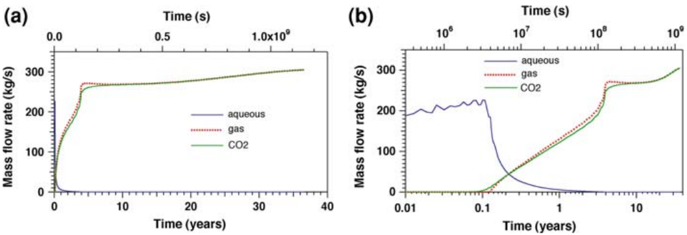
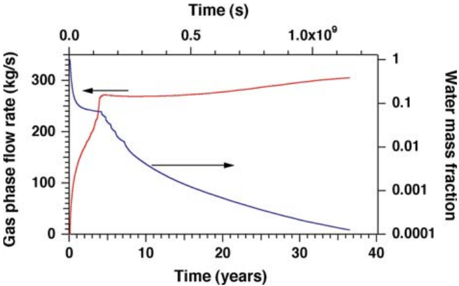
Verification
Claims the paper makes
The claims and statistics of this paper haven’t been checked yet.
Free: it reads the open-access text and checks the first 5 claims that cite a source we can check. Create a free account to check every claim.
Self-check
Percentages, sums and reported differences re-computed from the paper’s own numbers.
The self-check needs the paper’s full text.
Citations
Cites
A Closed‐form Equation for Predicting the Hydraulic Conductivity of Unsaturated Soils
van Genuchten, M. T. (1980) · Soil Science Society of America Journal · doi:10.2136/sssaj1980.03615995004400050002x · Cited by 27,578
Climate change 2001: synthesis report
(2003) · Choice Reviews Online · doi:10.5860/choice.40-4660 · Cited by 5,272
Span, R., & Wagner, W. (1996) · Journal of Physical and Chemical Reference Data · doi:10.1063/1.555991 · Cited by 5,049 · cited 1×
“Redlich–Kwong parameters were fitted using compressibility factors from Span and Wagner (1996) for pure CO2, and Wagner and Pruss (2002) for pure H2O.”
MethodWagner, W., & Pruß, A. (2002) · Journal of Physical and Chemical Reference Data · doi:10.1063/1.1461829 · Cited by 4,884
The interrelation between gas and oil relative permeabilities
Corey, A. T. (1954) · Medical Entomology and Zoology · Cited by 1,803
Duan, Z., & Sun, R. (2003) · Chemical Geology · doi:10.1016/s0009-2541(02)00263-2 · Cited by 1,728 · cited 3×
“We also pointed out that the activity coefficient model of Duan and Sun (2003) does not yield “true” activity coefficients (because of model simplifications regarding the gas phase), but instead gives the ratio of CO2 concentrations in pure and saline water.”
BackgroundMethodResultSpycher, N., Pruess, K., & Ennis-King, J. (2003) · Geochimica et Cosmochimica Acta · doi:10.1016/s0016-7037(03)00273-4 · Cited by 991 · cited 12×
“2.1 Model Formulation (CO2–H2O System) Our original model (Spycher et al. 2003) was intended for temperatures ≤100◦C, at which two assumptions held reasonably well when calculating activity and fugacity coefficients: unit activity coefficients for liquid water and aqueous CO2 in pure water, and…”
InfluentialSelf-citationA Practical Method for Modeling Fluid and Heat Flow in Fractured Porous Media
Pruess, K., & Narasimhan, T. N. (1985) · Society of Petroleum Engineers Journal · doi:10.2118/10509-pa · Cited by 863 · cited 1×
“The MINC approach is used to represent fluid and heat exchange between fractures and rock matrix (Pruess and Narasimhan 1985).”
MethodSelf-citationPruess, K. (2006) · Geothermics · doi:10.1016/j.geothermics.2006.08.002 · Cited by 758 · cited 7×
“The studies (Pruess 2006, 2008) had compared all-water with all-CO2 EGS, but had not addressed how an initially water-based system could be converted to operate with CO2.”
BackgroundMethodInfluentialSelf-citationThe binary system H 2 O-CO 2 at high temperatures and pressures
Takenouchi, S., & Kennedy, G. C. (1964) · American Journal of Science · doi:10.2475/ajs.262.9.1055 · Cited by 610 · cited 3×
“Note that at 300◦C and pressures above 500 bar, the CO2 solubilities measured by Blencoe et al. (2001) agree well with those determined by Takenouchi and Kennedy (1964), but differ significantly from the measurements of Tödheide and Frank (1963).”
BackgroundMethod
Research works printed but not linked: 10
- 5. Brown, D.W.: A hot dry rock geothermal energy concept utilizing supercritical CO 2 instead of water. Proceed- ings, twenty-fifth workshop on geothermal reservoir engineering, Stanford University, January 2000, pp. 233-238
- 11. Denbigh, K.: The principles of chemical equilibrium, 4th ed. Cambridge University Press, 494 pp. (1983)
- 13. Drummond, S.E.: Boiling and mixing of hydrothermal fluids: chemical effects on mineral precipitation. Ph.D. thesis, Pennsylvania State University (1981)
- 17. Fouillac, C., Sanjuan, B., Gentier, S., Czernichowski-Lauriol, I.: Could sequestration of CO 2 be combined with the development of enhanced geothermal systems? In: Paper presented at the Third Annual Conference on Carbon Capture and Sequestration, Alexandria, Virginia, May 3-6, 2004
- 25. IPCC: Carbon dioxide capture and storage In: Metz, B., Davidson, O., de Coninck, H., Loos, M., Meyer, L. (eds.) Prepared by Working Group III of the Intergovernmental Panel on Climate Change, Cambridge University Press, 431 pp. (2005)
- 27. Pachauri, R.K., Reisinger, A. (eds.) Intergovernmental Panel on Climate Change, c/o World Meteoro- logical Organization, Geneva, Switzerland, 104 pp. (2008)
- 32. Malinin, S.D., Kurovskaya, N.A.: Investigations of CO 2 solubility in a solution of chlorides at elevated tem- peratures and pressures of CO 2 . Geokhimiya 4, 547-551 (1975)
- 33. Malinin, S.D., Savelyeva, N.I.: The solubility of CO 2 in NaCl and CaCl 2 solutions at 25, 50, and 75 • C under elevated CO 2 pressures. Geokhimiya 6, 643-653 (1972)
- 34. Malinin, S.D.: The system water-carbon dioxide at high temperatures and pressures. Geokhimiya 3, 235- 245 (1959)
- 37. MIT (ed.): The Future of Geothermal Energy. (Massachusetts Institute of Technology, Cambridge, MA 2006)
Cited by
Items 301–342 of 342
A Review on Different Generations of Geo-Thermal Energy and Power Plants
Gaddam, R. S., & Sharma, S. (2019) · Journal of Science and Technology · doi:10.46243/jstj.2019.v4.i6.81 · Cited by 1
Ways to Minimize Water Usage in Engineered Geothermal Systems
USDOE Office of Energy Efficiency and Renewable Energy (EERE), R. P. O. G. T. O., McFarlane, J., Qualls, K. J., Qualls, A. L., Sabau, A. S., Yin, H., Anovitz, L. M., Kercher, A. K., & Wright, S. (2012) · OSTI OAI (U.S. Department of Energy Office of Scientific and Technical Information) · doi:10.2172/1050888 · Cited by 1
Zucatelli, P. J., Meneguelo, A. P., Silva, C. A. M., & Giuriatto, J. L. (2013) · doi:10.1190/sbgf2013-207 · Cited by 1
Development of Mechanistic Models and Numerical Methods for Corrosion Prediction in Oil Industry
Li, Q. (2017) · Libraries and Cultural Resources (University of Calgary) · doi:10.11575/prism/25681 · Cited by 1
MODELING THE DYNAMICS OF CARBON SEQUESTRATION: INJECTION STRATEGIES, REMOBILIZATION, AND CAVITATION
Huber, E. J. (2017) · eCommons (Cornell University) · doi:10.7298/x4df6pdd · Cited by 1
The impact of grid cell size and fluid modeling on CO 2 plume distribution numerical simulationPreprint
Nosherwani, S. A., Pinto, M. G., & Azevedo, L. (2026) · Research Square · doi:10.21203/rs.3.rs-7991282/v1 · Cited by 1
Low-Temperature Enhanced Geothermal System using Carbon Dioxide as the Heat-Transfer Fluid
GreenFire Energy, E., Eastman, A., & Geothermal Technologies Office (EE-4G) USDOE Office of Energy Efficiency and Renewable Energy (EERE) (2014) · OSTI OAI (U.S. Department of Energy Office of Scientific and Technical Information) · doi:10.2172/1164240
A numerical analysis of supercritical CO2 injection into geological formations
Khudaida, K. J., & Das, D. B. (2015) · Loughborough University Research Repository (Loughborough University)
García-Borreguero, J. A., Pons-Esparver, R. R., & López, A. I. (2015) · BOLETÍN GEOLÓGICO Y MINERO · doi:10.21701/bolgeomin.126.4.001
Arumugam, S., Tajallipour, N., & Teevens, P. J. (2015) · NACE CORROSION Conference · doi:10.5006/c2015-05983
Ghorbani, Z. (2017) · University Libraries (University of Maryland) · doi:10.13016/m2x921n4r
“Because the density variation between the fully saturated CO2–brine mixture and pure brine in typical aquifer is around 2%, [26, 35, 97], we assume that density, ρ, varies linearly with the concentration: ρ = ρ0 + ∆ρc where ∆ρ is the density difference between the saturated CO2–brine mixture and pure brine.”
BackgroundGeneral Concepts on Porous-Media Flow on Mars—Thermal H2O-CO2-fers–
Borgia, A., Oldenburg, C. M., Calcara, M., Gonzaga, A. C., & Leone, G. (2021) · Springer eBooks · doi:10.1007/978-3-030-84103-4_6
Measurement of CO2 Solubility and Swelling Factor in Water/Brine for CO2 Sequestration
Fayazi, A., Maaref, S., Esmaeili, S., & Kantzas, A. (2023) · SPE Latin American and Caribbean Petroleum Engineering Conference · doi:10.2118/213145-ms
Fluidos de trabajo aplicables en los sistemas geotérmicos mejorados (EGS)
Olasolo, P., Juárez Castelló Manuel, C., Pilar, M. O. M., Alonso, A. O., & Sierra, S. G. (2024) · Congreso Nacional de Ingeniería Termodinámica (CNIT) · doi:10.31428/10317/9814
Nole, M. A. (2024) · Geoscientific model development · doi:10.5194/gmd-2024-162-ac1
Use of Cubic Equations of State with Association Terms in Dynamic Modeling
Yu., B. K., Kosmodemyansky, D. V., Milyutin, S. V., & R., P. A. (2025) · doi:10.2118/225399-ms
Mineralization Reaction Behavior during CO2 Flooding in Reservoirs
Han, W., Zhang, D., & Zheng, W. (2025) · International Journal of Applied Science · doi:10.30560/ijas.v8n4p132
“It is caused by the evaporation effect of formation water, where more CO 2 dissolves into the formation water, resulting in abnormal solubility of CO 2[15] .”
Vafaie, A. (2023) · Dipòsit Digital de la Universitat de Barcelona (Universitat de Barcelona)
Methodologies to detect leakages from geological carbon storage sites
González‐Nicolás, A., Baù, D., Fontane, D., Ronayne, M., & Sale, T. (2007) · Digital Collections of Colorado (Colorado State University) · doi:10.25675/3.023654
Merbecks, T., Alfani, D., Bombarda, P., & Paolo, S. (2024) · Virtual Community of Pathological Anatomy (University of Castilla La Mancha)
Sonic velocity discontinuity for CO2 brine mixtures in the context of carbon storage in aquifers
Norouzi, A. M., Paydayesh, M., Ireland, M., & Babaei, M. (2026) · Frontiers in Earth Science · doi:10.3389/feart.2025.1758092
dos Santos, P. F. (2021) · theses.fr (ABES) · doi:10.70675/10d86763zbf3fz4b8czae14ze2ba5a2c471c
Convective Dissolution of CO2 in Saturated Transparent Porous Media
Imuetinyan, H. (2025) · theses.fr (ABES) · doi:10.70675/9e48d9a9zbdbdz4246zb573zb8fbade7f375
Research Progress on Corrosion Prediction Models of Supercritical CO2 Injection Wellbores
鲁佳伟 (2026) · Mine Engineering · doi:10.12677/me.2026.143052
Kim, K., Kim, D., Kim, D., Yoo, S., & Wang, J. (2026) · SSRN Electronic Journal · doi:10.2139/ssrn.6875044
Reservoir damage impact on developing deep geothermal energy with carbon dioxide
Sun, Y., Zhang, X., Zhang, L., Zhang, Q., Liu, B., & An, Q. (2026) · Applied Thermal Engineering · doi:10.1016/j.applthermaleng.2026.131969
Turkarslan, G., & Erdogan, M. (2026) · EAGE Conference and Exhibition incorporating SPE EUROPEC · doi:10.2118/233249-ms
Chen, R., Li, Y. Y., Chen, Y., & Shi, P. (2026) · Energy & Fuels · doi:10.1021/acs.energyfuels.6c01290
Магомедович, А. И., Хайрутдинов, В. Ф., & Khabriev, I. S. (2026) · Elsevier eBooks · doi:10.1016/b978-0-443-36340-5.00007-8
Refreshed Søreide–Whitson framework for gas solubility in water and brine with extension to hydrogen
Burgoyne, M., & Nielsen, M. H. (2026) · Fluid Phase Equilibria · doi:10.1016/j.fluid.2026.114824
東京湾CO2地中貯留プロジェクトにおける2次元モデルの主要パラメータに対する感度解析 : 貯留容量と長期安定性への影響
Zhang, M. (2025) · Institutional Repositories DataBase (IRDB)
Yang, H., Li, D., Qin, K., Luo, K., Dang, J., Huang, C., Xu, H., & Shi, Y. (2026) · SSRN Electronic Journal · doi:10.2139/ssrn.7417390
Xiong, W., Zhao, Y.-L., Zhang, L., Wen, S., Hu, Y., Liang, H., Huang, X., Wang, Y.-C., Liu, X.-Y., Cao, C., et al. (2026) · Sustainable Earth Resources Communications · doi:10.46690/serc.2026.03.01
Dideriksen, K., Holmslykke, H. D., Zhen-Wu, B. Y., Molander, J., & Kjøller, C. (2026) · Applied Geochemistry · doi:10.1016/j.apgeochem.2026.107087
Jia, B., Wang, Q., & Huang, Z. (2026) · Renewable Energy · doi:10.1016/j.renene.2026.126452
An efficient multicomponent gas-brine equilibrium model for CO2 storage simulation with impurities
Wang, Z., Smith, S. A. M., Stenby, E. H., & Yan, W. (2026) · International journal of greenhouse gas control · doi:10.1016/j.ijggc.2026.104784
Shokri, J., Babaei, M., Farajzadeh, R., & Niasar, V. (2026) · International journal of greenhouse gas control · doi:10.1016/j.ijggc.2026.104791
Numerical Simulation of non-isothermal Complex Fluid Mixtures in Deep Geothermal Systems
Esmaeilpour, M. (2023) · Repository KITopen (Karlsruhe Institute of Technology) · doi:10.5445/ir/1000159240
Akai, T. (2025) · Journal of the Japanese Association for Petroleum Technology · doi:10.3720/japt.90.183
Moortgat, J., Coelho, F. M., & Firoozabadi, A. (2026) · Energy & Fuels · doi:10.1021/acs.energyfuels.6c04569
Wang, Z. (2015) · KiltHub Repository · doi:10.1184/r1/6715076
Metadata
- Authors
- Spycher, N., & Pruess, K.
- Affiliations
- Lawrence Berkeley National Laboratory (US)
- Corresponding author
- Spycher, Nicolas
- Venue
- Transport in Porous Media
- Published
- 2009-07-17
- Volume
- 82
- Issue
- 1
- Pages
- 173-196
- ISSN
- 0169-3913 (ISSN-L)
- 1573-1634
- OpenAlex
- W2166451257
- Semantic Scholar
- 84bfab3d7481b52e396a9adb8961d7120593ffa1
- Cited by
- 315
- References
- 62
- Citations by year
- 2026: 22 · 2025: 24 · 2024: 30 · 2023: 24 · 2022: 26 · 2021: 22 · 2020: 19 · 2019: 19 · 2018: 14 · 2017: 15 · 2016: 23 · 2015: 22 · 2014: 16 · 2013: 19 · 2012: 9
- FWCI
- 4.00
- Type
- journal article
- Language
- en
- Open access
- hybrid
- doi.org
- Licence
- cc-by-nc
- Locations
- Transport in Porous Media (publishedVersion, cc-by-nc)
- eScholarship (California Digital Library) (submittedVersion, other-oa)
- eScholarship (California Digital Library) (submittedVersion)
- Funders
- U.S. Department of Energy (-AC02-05CH11231, Contract No. DE-AC02-05-CH11231, 05CH11231, No. DE-AC02-05-CH11231, DE AC02 05CH11231, DE-AC02-)
- Office of Science (No. DE-AC02- 05-CH11231, DEAC02–05CH11231, AC02-05CH11231, DE-AC02, 05CH11231, Contract No. DE-AC02-05CH11231)
- Lawrence Berkeley National Laboratory (AC02‐05CH11231, DE-AC02-05CH11231, No. DE-AC02-05CH11231, Contract No. DE-AC02-05CH11231, 05CH11231)
- Topics
- Physical Sciences › Chemistry › Physical and Theoretical Chemistry › Phase Equilibria and Thermodynamics
- Physical Sciences › Environmental Science › Environmental Engineering › CO2 Sequestration and Geologic Interactions
- Physical Sciences › Chemical Engineering › Filtration and Separation › Chemical and Physical Properties in Aqueous Solutions
- Keywords
- chloride brines, phase partitioning, supercritical carbon dioxide, carbon sequestration, activity coefficients, fugacity coefficients, salting-out, Margules model, Pitzer model, Redlich-Kwong equation of state, binary interaction parameters, multiphase flow
About these checks
Registry, retraction, Cites and statistics results are computed, not judged, with one exception: a printed reference that no index lists is read once by a model before it counts as a citation error. Claims are extracted by a model and kept only when their quote appears verbatim in the text; each cited source is then checked, with a model’s help, for whether it says what the claim relies on. Those verdicts can be wrong — read the claim’s quote and the cited source before relying on one.
Statistics and arithmetic are recomputed, not judged.
Confidence bands are shown only for fields calibrated on our annotated test set. None is calibrated yet, so no band is shown.
What counts as a claim ›How we measure confidence ›How we check this ›
Are you an author, or do you see a problem with this page? Request a review
Data sources
Bibliographic data: Semantic Scholar, OpenAlex, Crossref.
Contains information from the Semantic Scholar Academic Graph Datasets, made available under the ODC Attribution License (ODC-BY 1.0).
Semantic Scholar’s data is described in: Kinney, R., et al. (2023). The Semantic Scholar Open Data Platform. arXiv:2301.10140.
