

A Phase-Partitioning Model for CO2–Brine Mixtures at Elevated Temperatures and Pressures: Application to CO2-Enhanced Geothermal Systems
Open accessThe DOI matches its Crossref record; 63 of the 63 references it cites were found in a registry or an index.
Abstract
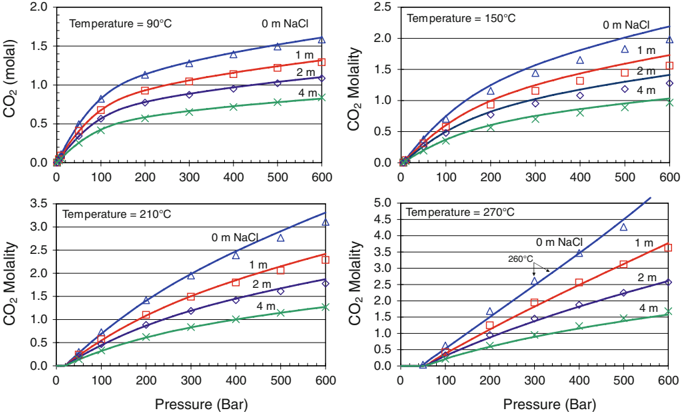
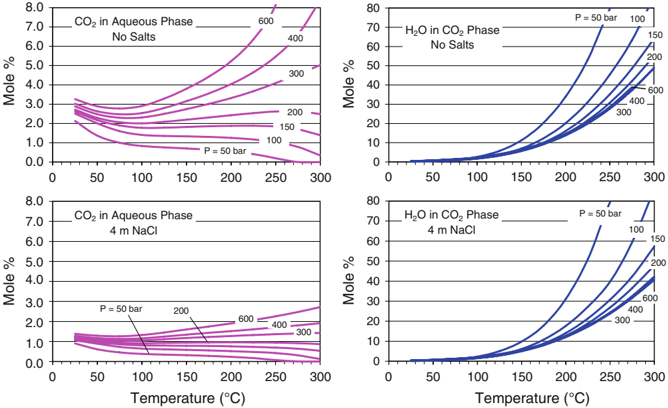
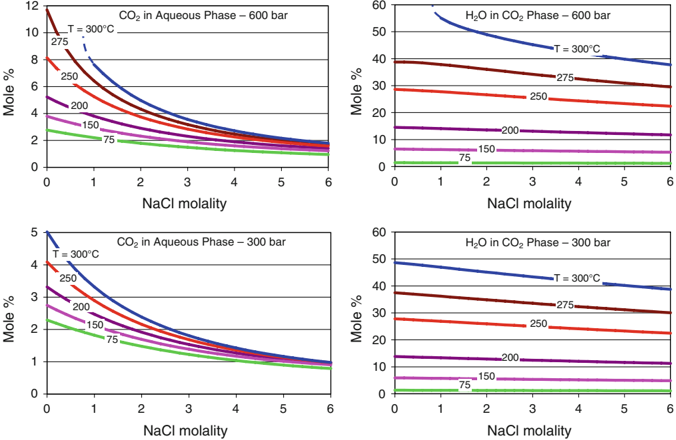
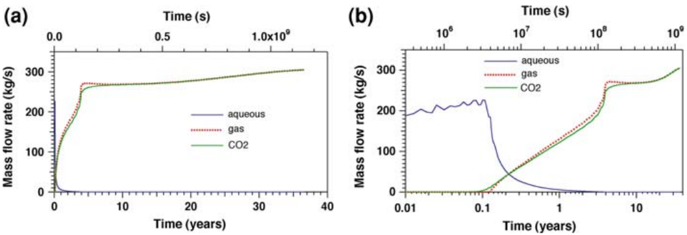
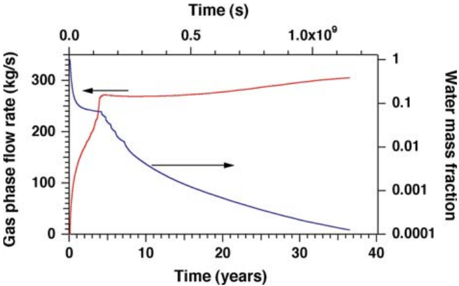
Correlations are presented to compute the mutual solubilities of CO 2 and chloride brines at temperatures 12–300°C, pressures 1–600 bar (0.1–60 MPa), and salinities 0–6 m NaCl. The formulation is computationally efficient and primarily intended for numerical simulations of CO 2 -water flow in carbon sequestration and geothermal studies. The phase-partitioning model relies on experimental data from literature for phase partitioning between CO 2 and NaCl brines, and extends the previously published correlations to higher temperatures. The model relies on activity coefficients for the H 2 O-rich (aqueous) phase and fugacity coefficients for the CO 2 -rich phase. Activity coefficients are treated using a Margules expression for CO 2 in pure water, and a Pitzer expression for salting-out effects. Fugacity coefficients are computed using a modified Redlich–Kwong equation of state and mixing rules that incorporate asymmetric binary interaction parameters. Parameters for the calculation of activity and fugacity coefficients were fitted to published solubility data over the P – T range of interest. In doing so, mutual solubilities and gas-phase volumetric data are typically reproduced within the scatter of the available data. An example of multiphase flow simulation implementing the mutual solubility model is presented for the case of a hypothetical, enhanced geothermal system where CO 2 is used as the heat extraction fluid. In this simulation, dry supercritical CO 2 at 20°C is injected into a 200°C hot-water reservoir. Results show that the injected CO 2 displaces the formation water relatively quickly, but that the produced CO 2 contains significant water for long periods of time. The amount of water in the CO 2 could have implications for reactivity with reservoir rocks and engineered materials.
Overview
The claims and statistics of this paper haven’t been checked yet.
Free: it reads the open-access text and checks the first 5 claims that cite a source we can check. Create a free account to check every claim.
Integrity signals
Registry
Cites
Statistics
Figures
Verification
Claims the paper makes
The claims and statistics of this paper haven’t been checked yet.
Free: it reads the open-access text and checks the first 5 claims that cite a source we can check. Create a free account to check every claim.
Self-check
Percentages, sums and reported differences re-computed from the paper’s own numbers.
The self-check needs the paper’s full text.
Citations
Cites
A Closed‐form Equation for Predicting the Hydraulic Conductivity of Unsaturated Soils
van Genuchten, M. T. (1980) · Soil Science Society of America Journal · doi:10.2136/sssaj1980.03615995004400050002x · Cited by 27,578
Climate change 2001: synthesis report
(2003) · Choice Reviews Online · doi:10.5860/choice.40-4660 · Cited by 5,272
Span, R., & Wagner, W. (1996) · Journal of Physical and Chemical Reference Data · doi:10.1063/1.555991 · Cited by 5,049 · cited 1×
“Redlich–Kwong parameters were fitted using compressibility factors from Span and Wagner (1996) for pure CO2, and Wagner and Pruss (2002) for pure H2O.”
MethodWagner, W., & Pruß, A. (2002) · Journal of Physical and Chemical Reference Data · doi:10.1063/1.1461829 · Cited by 4,884
The interrelation between gas and oil relative permeabilities
Corey, A. T. (1954) · Medical Entomology and Zoology · Cited by 1,803
Duan, Z., & Sun, R. (2003) · Chemical Geology · doi:10.1016/s0009-2541(02)00263-2 · Cited by 1,728 · cited 3×
“We also pointed out that the activity coefficient model of Duan and Sun (2003) does not yield “true” activity coefficients (because of model simplifications regarding the gas phase), but instead gives the ratio of CO2 concentrations in pure and saline water.”
BackgroundMethodResultSpycher, N., Pruess, K., & Ennis-King, J. (2003) · Geochimica et Cosmochimica Acta · doi:10.1016/s0016-7037(03)00273-4 · Cited by 991 · cited 12×
“2.1 Model Formulation (CO2–H2O System) Our original model (Spycher et al. 2003) was intended for temperatures ≤100◦C, at which two assumptions held reasonably well when calculating activity and fugacity coefficients: unit activity coefficients for liquid water and aqueous CO2 in pure water, and…”
InfluentialSelf-citationA Practical Method for Modeling Fluid and Heat Flow in Fractured Porous Media
Pruess, K., & Narasimhan, T. N. (1985) · Society of Petroleum Engineers Journal · doi:10.2118/10509-pa · Cited by 863 · cited 1×
“The MINC approach is used to represent fluid and heat exchange between fractures and rock matrix (Pruess and Narasimhan 1985).”
MethodSelf-citationPruess, K. (2006) · Geothermics · doi:10.1016/j.geothermics.2006.08.002 · Cited by 758 · cited 7×
“The studies (Pruess 2006, 2008) had compared all-water with all-CO2 EGS, but had not addressed how an initially water-based system could be converted to operate with CO2.”
BackgroundMethodInfluentialSelf-citationThe binary system H 2 O-CO 2 at high temperatures and pressures
Takenouchi, S., & Kennedy, G. C. (1964) · American Journal of Science · doi:10.2475/ajs.262.9.1055 · Cited by 610 · cited 3×
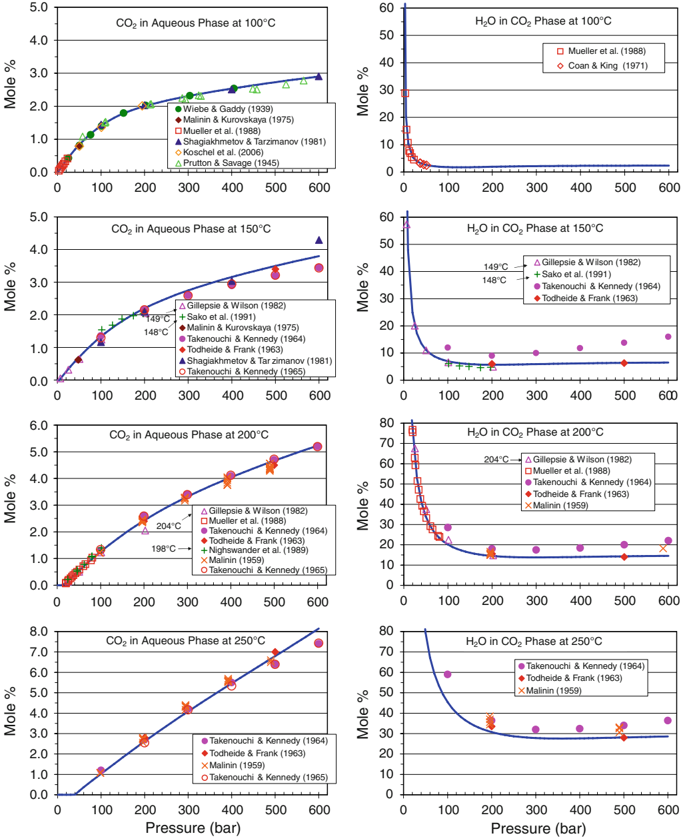
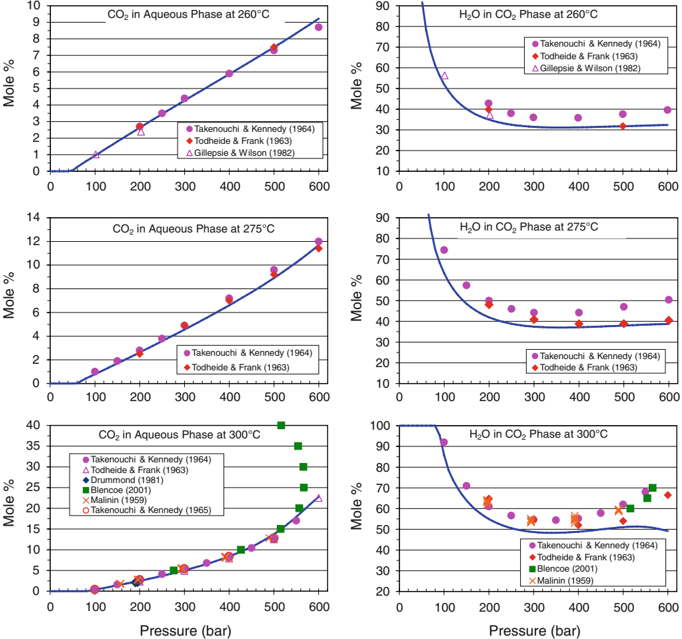
“Note that at 300◦C and pressures above 500 bar, the CO2 solubilities measured by Blencoe et al. (2001) agree well with those determined by Takenouchi and Kennedy (1964), but differ significantly from the measurements of Tödheide and Frank (1963).”
BackgroundMethodSpycher, N., & Pruess, K. (2005) · Geochimica et Cosmochimica Acta · doi:10.1016/j.gca.2005.01.015 · Cited by 566 · cited 7×
“As before, the effect of salt on water activity is treated by assuming equality of water activity and mole fraction, which is a reasonable approximation up to halite saturation (Spycher and Pruess 2005).”
BackgroundMethodInfluentialSelf-citationTödheide, K., & Franck, E. U. (1963) · Zeitschrift für Physikalische Chemie · doi:10.1524/zpch.1963.37.5_6.387 · Cited by 464
CO2/water interfacial tensions under pressure and temperature conditions of CO2 geological storage
Chiquet, P., Daridon, J.-L., Broseta, D., & Thibeau, S. (2007) · Energy Conversion and Management · doi:10.1016/j.enconman.2006.09.011 · Cited by 462 · cited 5×
“only for temperatures below 125◦C (Bachu and Bennion 2008; Chiquet et al. 2007). For the simulations performed here, we base the strength coefficient P0 of capillary pressure (Table 4) on a CO2-water interfacial tension of γ = 0.028 N/m, as measured for T = 50◦C, P = 200 bar (Chiquet et al. 2007). Due to continuous in…”
BackgroundMethodInfluentialPruess, K. (2004) · Vadose Zone Journal · doi:10.2136/vzj2004.0738 · Cited by 411 · cited 1×
“The simulations are performed with our general-purpose simulator TOUGH2 (Pruess 2004), using a version of the ECO2N fluid property module for brine–CO2 mixtures (Pruess and Spycher 2007) that was modified to incorporate the new correlation for brine–CO2 phase partitioning developed in this article.”
MethodSelf-citationA new approach to solving the cubic: Cardan’s solution revealed
Nickalls, R. W. D. (1993) · The Mathematical Gazette · doi:10.2307/3619777 · Cited by 393 · cited 1×
“A-2) is solved directly (Nickalls 1993).”
Geochimica et cosmochimica acta
(2003) · Geochimica et Cosmochimica Acta · doi:10.1016/s0016-7037(03)00281-3 · Cited by 349
Kaszuba, J. P., Janecky, D. R., & Snow, M. G. (2003) · Applied Geochemistry · doi:10.1016/s0883-2927(02)00239-1 · Cited by 348 · cited 1×
“The solubility of CO2 in water has obvious implications for long-term carbon sequestration and water–rock interactions (e.g., Gilfillan 2008; Moore et al. 2005; Rosenbauer et al. 2005; Palandri et al. 2005; Kaszuba et al. 2003).”
BackgroundRosenbauer, R. J., Koksalan, T., & Palandri, J. L. (2005) · Fuel Processing Technology · doi:10.1016/j.fuproc.2005.01.011 · Cited by 330 · cited 1×
“The solubility of CO2 in water has obvious implications for long-term carbon sequestration and water–rock interactions (e.g., Gilfillan 2008; Moore et al. 2005; Rosenbauer et al. 2005; Palandri et al. 2005; Kaszuba et al. 2003).”
BackgroundThe solubility of carbon dioxide in nacl solutions at high temperatures and pressures
Takenouchi, S., & Kennedy, G. C. (1965) · American Journal of Science · doi:10.2475/ajs.263.5.445 · Cited by 329 · cited 5×
“The computed water solubilities in compressed CO2 yield a larger RMSD of about 17%, in large part due to the noticeable divergence between the gas-phase data reported by Tödheide and Frank (1963) and Takenouchi and Kennedy (1964, 1965) (right side of Figs.”
ResultInfluentialThe Solubility in Water of Carbon Dioxide at 50, 75 and 100°, at Pressures to 700 Atmospheres
Wiebe, R., & Gaddy, V. L. (1939) · Journal of the American Chemical Society · doi:10.1021/ja01871a025 · Cited by 328
Effects of in-situ conditions on relative permeability characteristics of CO2-brine systems
Bachu, S., & Bennion, B. (2008) · Environmental Geology · doi:10.1007/s00254-007-0946-9 · Cited by 325 · cited 1×
“Information on interfacial tension and capillary pressures between CO2 and water is available Production Injection 1000 m only for temperatures below 125◦C (Bachu and Bennion 2008; Chiquet et al. 2007).”
BackgroundUSDOE Office of Energy Efficiency and Renewable Energy (EERE), R. P. O. G. T. O., Kubik, M., Massachusetts Inst. of Technology (MIT), C., & Idaho National Laboratory (INL), I. F. (2006) · doi:10.2172/1220063 · Cited by 318
Modeling Vapor-Liquid Equilibria: Cubic Equations of State and their Mixing Rules
Orbey, H., & Sandler, S. I. (1998) · Medical Entomology and Zoology · Cited by 311
On production behavior of enhanced geothermal systems with CO2 as working fluid
Pruess, K. (2008) · Energy Conversion and Management · doi:10.1016/j.enconman.2007.12.029 · Cited by 308 · cited 4×
“The use of CO2 instead of water as the heat transmission fluid in EGS has been proposed as a means not only to produce “clean” energy, but also to potentially sequester CO2 through fluid losses at depth, which typically occur in any type of EGS (Brown 2000; Fouillac et al. 2004; Pruess 2006, 2008).”
BackgroundInfluentialSelf-citationHeterogeneous porosity distribution in Portland cement exposed to CO2-rich fluids
Rimmelé, G., Barlet-Gouédard, V., Porcherie, O., Goffé, B., & Brunet, F. (2008) · Cement and Concrete Research · doi:10.1016/j.cemconres.2008.03.022 · Cited by 307 · cited 1×
“The solubility of water into CO2 is also of importance, because it affects the reactivity of CO2 with surrounding rocks (e.g., Regnault et al. 2005; Rimmelé et al. 2008; Lin et al. 2008; Suto et al. 2007) and determines the capacity of injected CO2 to dry the rock formations adjacent to injection…”
BackgroundECO2N – A fluid property module for the TOUGH2 code for studies of CO2 storage in saline aquifers
Pruess, K., & Spycher, N. (2007) · Energy Conversion and Management · doi:10.1016/j.enconman.2007.01.016 · Cited by 301 · cited 1×
“The simulations are performed with our general-purpose simulator TOUGH2 (Pruess 2004), using a version of the ECO2N fluid property module for brine–CO2 mixtures (Pruess and Spycher 2007) that was modified to incorporate the new correlation for brine–CO2 phase partitioning developed in this article.”
MethodSelf-citationPruess, K. (2004) · Vadose Zone Journal · doi:10.2113/3.3.738 · Cited by 287
Self-citation(2004) · Fuel and Energy Abstracts · doi:10.1016/s0140-6701(04)91707-9 · Cited by 285
Audigane, P., Gaus, I., Czernichowski-Lauriol, I., Pruess, K., & Xu, T. (2007) · American Journal of Science · doi:10.2475/07.2007.02 · Cited by 284 · cited 1×
“…numbers in perspective, consider the first industrial-scale CO2 geologic storage project at the Sleipner Vest field in the Norwegian sector of the North sea, which has injected approximately 1 million tons of CO2 per year (31.7 kg/s) into a saline aquifer for over 10 years (Audigane et al. 2007).”
BackgroundInfluentialSelf-citationKoschel, D., Coxam, J.-Y., Rodier, L., & Majer, V. (2006) · Fluid Phase Equilibria · doi:10.1016/j.fluid.2006.06.006 · Cited by 270
King, A. D., & Coan, C. R. (1971) · Journal of the American Chemical Society · doi:10.1021/ja00737a004 · Cited by 269
Gilfillan, S. M. V., Ballentine, C. J., Holland, G., Blagburn, D., Lollar, B. S., Stevens, S., Schoell, M., & Cassidy, M. (2008) · Geochimica et Cosmochimica Acta · doi:10.1016/j.gca.2007.10.009 · Cited by 260
Rumpf, B., Nicolaisen, H., �cal, C., & Maurer, G. (1994) · Journal of Solution Chemistry · doi:10.1007/bf00973113 · Cited by 242 · cited 8×
“…′ CO2 KCO2 (17) We have previously reviewed several activity coefficient models to compute values of γ ′CO2 (Spycher and Pruess 2005), and highlighted the Pitzer models adopted by Rumpf et al. (1994) and Duan and Sun (2003), which are essentially similar although formulated somewhat differently.”
MethodInfluentialNighswander, J. A., Kalogerakis, N., & Mehrotra, A. K. (1989) · Journal of Chemical & Engineering Data · doi:10.1021/je00057a027 · Cited by 220
Kiepe, J., Horstmann, S., Fischer, K., & Gmehling, J. (2002) · Industrial & Engineering Chemistry Research · doi:10.1021/ie020154i · Cited by 215
The deep EGS (Enhanced Geothermal System) project at Soultz-sous-Forêts (Alsace, France)
Gérard, A., Genter, A., Kohl, T., Lutz, P., Rose, P., & Rummel, F. (2006) · Geothermics · doi:10.1016/j.geothermics.2006.12.001 · Cited by 214 · cited 6×
“Table 2 Experimental studies used for the parameterization of the high-temperature CO2–H2O mutual solubility model Authors Fitted T range (◦C) Fitted P range (bar) Wiebe and Gaddy (1939) 100 25–405 Gillepsie and Wilson (1982) 93–260 7–203 Sako et al. (1991) 148 102–197 Malinin and Kurovskaya (1975) 100,150 48 Müller e…”
MethodInfluentialMoore, J., Adams, M., Allis, R., Lutz, S., & Rauzi, S. (2005) · Chemical Geology · doi:10.1016/j.chemgeo.2004.12.019 · Cited by 213 · cited 1×
“The solubility of CO2 in water has obvious implications for long-term carbon sequestration and water–rock interactions (e.g., Gilfillan 2008; Moore et al. 2005; Rosenbauer et al. 2005; Palandri et al. 2005; Kaszuba et al. 2003).”
BackgroundPruess, K., & Müller, N. (2009) · Water Resources Research · doi:10.1029/2008wr007101 · Cited by 199
Self-citationNew Mixing Rule for Cubic Equations of State for Highly Polar, Asymmetric Systems
Panagiotopoulos, A. Z., & Reid, R. C. (1986) · ACS Symposium Series · doi:10.1021/bk-1986-0300.ch028 · Cited by 191
Solubility of CO2 in Aqueous Solutions of NaCl at (30 to 60) °C and (10 to 20) MPa
Bando, S., Takemura, F., Nishio, M., Hihara, E., & Akai, M. (2003) · Journal of Chemical & Engineering Data · doi:10.1021/je0255832 · Cited by 178
The Solubility of Carbon Dioxide and Nitrous Oxide in Aqueous Salt Solutions
Markham, A. E., & Kobe, K. A. (1941) · Journal of the American Chemical Society · doi:10.1021/ja01847a027 · Cited by 171
Prutton, C. F., & Savage, R. L. (1945) · Journal of the American Chemical Society · doi:10.1021/ja01225a047 · Cited by 168
Lin, H., Fujii, T., Takisawa, R., Takahashi, T., & Hashida, T. (2008) · Journal of Materials Science · doi:10.1007/s10853-007-2029-4 · Cited by 165 · cited 1×
“…into CO2 is also of importance, because it affects the reactivity of CO2 with surrounding rocks (e.g., Regnault et al. 2005; Rimmelé et al. 2008; Lin et al. 2008; Suto et al. 2007) and determines the capacity of injected CO2 to dry the rock formations adjacent to injection wells (Giorgis et al.…”
Background2D modeling of salt precipitation during the injection of dry CO2 in a depleted gas reservoir
Giorgis, T., Carpita, M., & Battistelli, A. (2007) · Energy Conversion and Management · doi:10.1016/j.enconman.2007.01.012 · Cited by 163 · cited 1×
“…the reactivity of CO2 with surrounding rocks (e.g., Regnault et al. 2005; Rimmelé et al. 2008; Lin et al. 2008; Suto et al. 2007) and determines the capacity of injected CO2 to dry the rock formations adjacent to injection wells (Giorgis et al. 2007; Hurter et al. 2007; Pruess and Müller 2009).”
BackgroundA simple extension of two‐phase characteristic curves to include the dry region
Webb, S. (2000) · Water Resources Research · doi:10.1029/2000wr900057 · Cited by 161 · cited 1×
“We use the approach proposed by Webb (2000) to modify the van Genuchten (1980) capillary pressure function in the dry region, imposing a limiting strength of Pcap = −1, 000 bar as S1 −→ 0.”
MethodVapor-Liquid Equilibria of Nonideal Solutions
Carlson, H. C., & Colburn, A. P. (1942) · Industrial & Engineering Chemistry · doi:10.1021/ie50389a013 · Cited by 159 · cited 1×
“This is done here using Margules expressions that were modified after Carlson and Colburn (1942) to yield unit activity coefficients for pure water (γH2O → 1 as xH2O → 1) and for pure CO2 at infinite dilution (γCO2 → 1 as xCO2 → 0).”
MethodMüller, G., Bender, E., & Maurer, G. (1988) · Berichte der Bunsengesellschaft für physikalische Chemie · doi:10.1002/bbpc.198800036 · Cited by 159 · cited 1×
“At and below 260◦C, the data of Todheide and Frank display a good continuity with the water solubilities measured at lower pressures by Müller et al. (1988) and Gillepsie and Wilson (1982).”
MethodVorholz, J., Harismiadis, V. I., Rumpf, B., Panagiotopoulos, A. Z., & Maurer, G. (2000) · Fluid Phase Equilibria · doi:10.1016/s0378-3812(00)00315-0 · Cited by 158 · cited 2×
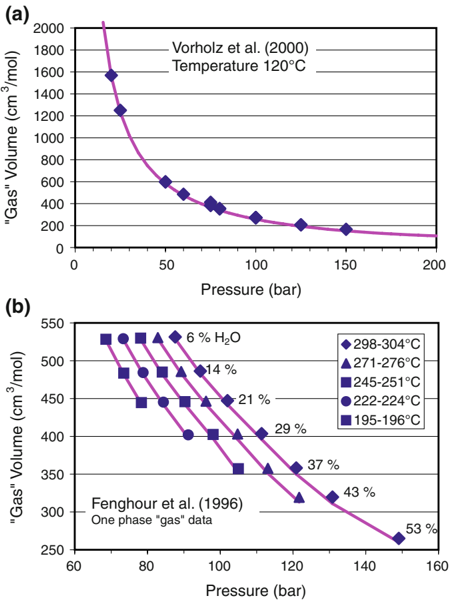
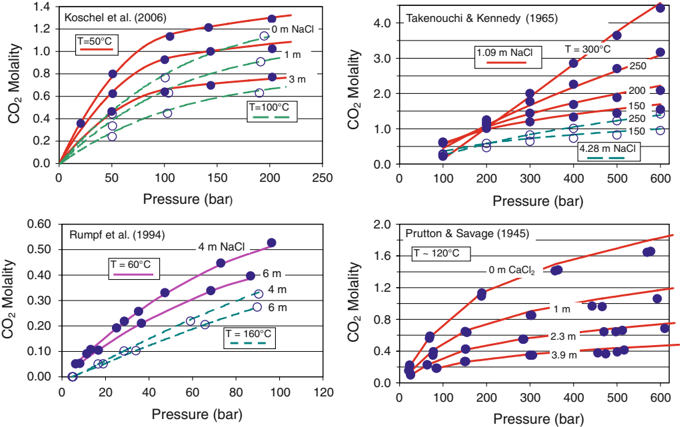
“184 N. Spycher, K. Pruess 200 400 600 800 1000 1200 1400 1600 1800 2000 "G as " V ol um e (c m 3 / m ol ) Vorholz et al. (2000) Temperature 120°C (a) For saline solutions, the experimental CO2 solubility data in Table 3 are reproduced with an RMSD value of about 7% (Fig.”
MethodHu, J., Duan, Z., Zhu, C., & Chou, I. (2007) · Chemical Geology · doi:10.1016/j.chemgeo.2006.11.011 · Cited by 124 · cited 1×
“Several models have been proposed to compute the aqueous solubility of CO2, with or without consideration of the water solubility in the CO2 phase (see reviews by Hu et al. 2007; Spycher et al. 2003; Spycher and Pruess 2005 and references therein).”
MethodThe System Water—Carbon Dioxide—Sodium Chloride to 773 K and 300 MPa
Gehrig, M., Lentz, H., & Franck, E. U. (1986) · Berichte der Bunsengesellschaft für physikalische Chemie · doi:10.1002/bbpc.19860900606 · Cited by 106 · cited 2×
“Note that we could not reproduce the high-CO2 concentration data of Gehrig et al. (1986) (close to critical compositions), and consequently, excluded these data from our fits.”
BackgroundResultFerric iron in sediments as a novel CO2 mineral trap: CO2–SO2 reaction with hematite
Palandri, J. L., Rosenbauer, R. J., & Kharaka, Y. K. (2005) · Applied Geochemistry · doi:10.1016/j.apgeochem.2005.06.005 · Cited by 103 · cited 2×
“The solubility of CO2 in water has obvious implications for long-term carbon sequestration and water–rock interactions (e.g., Gilfillan 2008; Moore et al. 2005; Rosenbauer et al. 2005; Palandri et al. 2005; Kaszuba et al. 2003).”
BackgroundMethodSako, T., Sugeta, T., Nakazawa, N., Okubo, T., Sato, M., Taguchi, T., & Hiaki, T. (1991) · JOURNAL OF CHEMICAL ENGINEERING OF JAPAN · doi:10.1252/jcej.24.449 · Cited by 102 · cited 2×
“0 100 200 300 400 500 600 M ol e % Gillepsie & Wilson (1982) Sako et al. (1991) Takenouchi & Kennedy (1964) Todheide & Frank (1963) 148°C 149°C H2O in CO2 Phase at 150°C”
BackgroundRegnault, O., Lagneau, V., Catalette, H., & Schneider, H. (2005) · Comptes Rendus. Géoscience · doi:10.1016/j.crte.2005.07.012 · Cited by 68 · cited 1×
“The solubility of water into CO2 is also of importance, because it affects the reactivity of CO2 with surrounding rocks (e.g., Regnault et al. 2005; Rimmelé et al. 2008; Lin et al. 2008; Suto et al. 2007) and determines the capacity of injected CO2 to dry the rock formations adjacent to injection…”
BackgroundFenghour, A., Wakeham, W. A., & Watson, J. T. R. (1996) · The Journal of Chemical Thermodynamics · doi:10.1006/jcht.1996.0043 · Cited by 67
Initial behavior of granite in response to injection of CO2-saturated fluid
Suto, Y., Liu, L., Yamasaki, N., & Hashida, T. (2006) · Applied Geochemistry · doi:10.1016/j.apgeochem.2006.09.005 · Cited by 56 · cited 4×
“and Frank (1963) and Takenouchi and Kennedy (1964, 1965) (right side of Figs. 1 and 2). The latter are not reproduced very well, and the model appears in much better agreement with the water solubilities determined by Tödheide and Frank (1963). At and below 260◦C, the data of Todheide and Frank display a good continui…”
BackgroundResultInfluentialBlencoe, J. G., Naney, M. T., & Anovitz, L. M. (2001) · American Mineralogist · doi:10.2138/am-2001-8-918 · Cited by 51 · cited 5×
“…EGS, the same two-phase behavior persists, although the amount of water in the CO2-rich phase increases significantly, reaching values of up to about 40–50 mol% at temperatures ∼275◦C and pressures between 200 and 600 bar (Takenouchi and Kennedy 1964, Todheide and Frank, 1964; Blencoe et al. 2001).”
BackgroundMethodResultInfluentialCarbon dioxide in water and aqueous electrolyte solutions
Scharlin, P., & Cargill, R. W. (1996) · Oxford University Press eBooks · Cited by 50
Numerical simulation of `multiphase tracer transport in fractured geothermal reservoirs
Pruess, K. (2002) · Geothermics · doi:10.1016/s0375-6505(02)00007-x · Cited by 42 · cited 1×
“The unfractured matrix rock has small but finite porosity and permeability, as appropriate for tight reservoir rocks such as graywacke or granite (Pruess 2002).”
BackgroundSelf-citationThe Santa Rosa -- Geysers Recharge Project, Geysers Geothermal Field, California, USA
Stark, M. A., Box, W. T., Beall, J. J., Goyal, K., & Pingol, A. (2005) · Cited by 39
Solubility of methane, carbon dioxide, and oxygen in brines from 0/sup 0/ to 300/sup 0/C
Cramer, S. D. (1982) · International Conference on Multimedia Information Networking and Security · Cited by 21
Injection recovery factors in various areas of the southeast Geysers, California
Goyal, K. (1995) · Geothermics · doi:10.1016/0375-6505(95)91146-b · Cited by 11 · cited 1×
“With these systems, the recovery of heat from the subsurface is enhanced by water injection (e.g., Goyal 1995; Stark et al. 2005) and in some cases, water is injected, circulated, and recovered from areas that originally are dry or contain very little water (e.g., MIT 2006).”
BackgroundSimulations of dry-out and halite precipitation due to CO2 injection
Hurter, S. J., Labregere, D., & Berge, J. W. (2007) · AGUFM · Cited by 7
(2008) · IIASA PURE (International Institute of Applied Systems Analysis)
Research works printed but not linked: 10
- 5. Brown, D.W.: A hot dry rock geothermal energy concept utilizing supercritical CO 2 instead of water. Proceed- ings, twenty-fifth workshop on geothermal reservoir engineering, Stanford University, January 2000, pp. 233-238
- 11. Denbigh, K.: The principles of chemical equilibrium, 4th ed. Cambridge University Press, 494 pp. (1983)
- 13. Drummond, S.E.: Boiling and mixing of hydrothermal fluids: chemical effects on mineral precipitation. Ph.D. thesis, Pennsylvania State University (1981)
- 17. Fouillac, C., Sanjuan, B., Gentier, S., Czernichowski-Lauriol, I.: Could sequestration of CO 2 be combined with the development of enhanced geothermal systems? In: Paper presented at the Third Annual Conference on Carbon Capture and Sequestration, Alexandria, Virginia, May 3-6, 2004
- 25. IPCC: Carbon dioxide capture and storage In: Metz, B., Davidson, O., de Coninck, H., Loos, M., Meyer, L. (eds.) Prepared by Working Group III of the Intergovernmental Panel on Climate Change, Cambridge University Press, 431 pp. (2005)
- 27. Pachauri, R.K., Reisinger, A. (eds.) Intergovernmental Panel on Climate Change, c/o World Meteoro- logical Organization, Geneva, Switzerland, 104 pp. (2008)
- 32. Malinin, S.D., Kurovskaya, N.A.: Investigations of CO 2 solubility in a solution of chlorides at elevated tem- peratures and pressures of CO 2 . Geokhimiya 4, 547-551 (1975)
- 33. Malinin, S.D., Savelyeva, N.I.: The solubility of CO 2 in NaCl and CaCl 2 solutions at 25, 50, and 75 • C under elevated CO 2 pressures. Geokhimiya 6, 643-653 (1972)
- 34. Malinin, S.D.: The system water-carbon dioxide at high temperatures and pressures. Geokhimiya 3, 235- 245 (1959)
- 37. MIT (ed.): The Future of Geothermal Energy. (Massachusetts Institute of Technology, Cambridge, MA 2006)
Cited by
Carbon capture and storage (CCS): the way forward
Bui, M., Adjiman, C. S., Bardow, A., Anthony, E. J., Boston, A., Brown, S., Fennell, P. S., Fuss, S., Galindo, A., Hackett, L. A., et al. (2018) · Energy & Environmental Science · doi:10.1039/c7ee02342a · Cited by 4,374
Geochemical aspects of CO2 sequestration in deep saline aquifers: A review
De Silva, G. P. D., Ranjith, P. G., & Perera, M. S. A. (2015) · Fuel · doi:10.1016/j.fuel.2015.03.045 · Cited by 408
Salt precipitation during CO 2 storage—A review
Miri, R., & Hellevang, H. (2016) · International journal of greenhouse gas control · doi:10.1016/j.ijggc.2016.05.015 · Cited by 296
Performance of geothermal energy extraction in a horizontal well by using CO2 as the working fluid
Sun, F., Yao, Y., Li, G., & Li, X. (2018) · Energy Conversion and Management · doi:10.1016/j.enconman.2018.06.092 · Cited by 210
Cui, G., Ren, S. R., Rui, Z., Ezekiel, J., Zhang, L., & Wang, H. (2017) · Applied Energy · doi:10.1016/j.apenergy.2017.10.114 · Cited by 205
Metadata
- Authors
- Spycher, N., & Pruess, K.
- Affiliations
- Lawrence Berkeley National Laboratory (US)
- Corresponding author
- Spycher, Nicolas
- Venue
- Transport in Porous Media
- Published
- 2009-07-17
- Volume
- 82
- Issue
- 1
- Pages
- 173-196
- ISSN
- 0169-3913 (ISSN-L)
- 1573-1634
- OpenAlex
- W2166451257
- Semantic Scholar
- 84bfab3d7481b52e396a9adb8961d7120593ffa1
- Cited by
- 315
- References
- 62
- Citations by year
- 2026: 22 · 2025: 24 · 2024: 30 · 2023: 24 · 2022: 26 · 2021: 22 · 2020: 19 · 2019: 19 · 2018: 14 · 2017: 15 · 2016: 23 · 2015: 22 · 2014: 16 · 2013: 19 · 2012: 9
- FWCI
- 4.00
- Type
- journal article
- Language
- en
- Open access
- hybrid
- doi.org
- Licence
- cc-by-nc
- Locations
- Transport in Porous Media (publishedVersion, cc-by-nc)
- eScholarship (California Digital Library) (submittedVersion, other-oa)
- eScholarship (California Digital Library) (submittedVersion)
- Funders
- U.S. Department of Energy (-AC02-05CH11231, Contract No. DE-AC02-05-CH11231, 05CH11231, No. DE-AC02-05-CH11231, DE AC02 05CH11231, DE-AC02-)
- Office of Science (No. DE-AC02- 05-CH11231, DEAC02–05CH11231, AC02-05CH11231, DE-AC02, 05CH11231, Contract No. DE-AC02-05CH11231)
- Lawrence Berkeley National Laboratory (AC02‐05CH11231, DE-AC02-05CH11231, No. DE-AC02-05CH11231, Contract No. DE-AC02-05CH11231, 05CH11231)
- Topics
- Physical Sciences › Chemistry › Physical and Theoretical Chemistry › Phase Equilibria and Thermodynamics
- Physical Sciences › Environmental Science › Environmental Engineering › CO2 Sequestration and Geologic Interactions
- Physical Sciences › Chemical Engineering › Filtration and Separation › Chemical and Physical Properties in Aqueous Solutions
- Keywords
- chloride brines, phase partitioning, supercritical carbon dioxide, carbon sequestration, activity coefficients, fugacity coefficients, salting-out, Margules model, Pitzer model, Redlich-Kwong equation of state, binary interaction parameters, multiphase flow
About these checks
Registry, retraction, Cites and statistics results are computed, not judged, with one exception: a printed reference that no index lists is read once by a model before it counts as a citation error. Claims are extracted by a model and kept only when their quote appears verbatim in the text; each cited source is then checked, with a model’s help, for whether it says what the claim relies on. Those verdicts can be wrong — read the claim’s quote and the cited source before relying on one.
Statistics and arithmetic are recomputed, not judged.
Confidence bands are shown only for fields calibrated on our annotated test set. None is calibrated yet, so no band is shown.
What counts as a claim ›How we measure confidence ›How we check this ›
Are you an author, or do you see a problem with this page? Request a review
Data sources
Bibliographic data: Semantic Scholar, OpenAlex, Crossref.
Contains information from the Semantic Scholar Academic Graph Datasets, made available under the ODC Attribution License (ODC-BY 1.0).
Semantic Scholar’s data is described in: Kinney, R., et al. (2023). The Semantic Scholar Open Data Platform. arXiv:2301.10140.
