

How preparation-for-learning with a worked versus an open inventing problem affect subsequent learning processes in pre-service teachers
Open accessThe DOI matches its Crossref record; 57 of the 59 references it cites were found in a registry or an index.
Abstract
A worked-out or an open inventing problem with contrasting cases can prepare learners for learning from subsequent instruction differently regarding motivation and cognition. In addition, such activities potentially initiate different learning processes during the subsequent (“future”) learning phase. In this experiment (N = 45 pre-service teachers), we aimed to replicate effects of earlier studies on learning outcomes and, on this basis, to analyze respective learning processes during the future-learning phase via think-aloud protocols. The inventing group invented criteria to assess learning strategies in learning journals while the worked-example group studied the same problem in a solved version. Afterwards, the pre-service teachers thought aloud during learning in a computer-based learning environment. We did not find substantial motivational differences (interest, self-efficacy), but the worked-example group clearly outperformed their counterparts in transfer (BF+0 > 313). We found moderate evidence for the hypothesis that their learning processes during the subsequent learning phase was deepened: the example group showed more elaborative processes, more spontaneous application of the canonical, but also of sub-optimal solutions than the inventing group (BF s around 4), and it tended to focus more on the most relevant learning contents. Explorative analyses suggest that applying canonical solutions to examples is one of the processes explaining why working through the solution leads to higher transfer. In conclusion, a worked-out inventing problem seems to prepare future learning more effectively than an open inventing activity by deepening and focusing subsequent learning processes.
Overview
The claims and statistics of this paper haven’t been checked yet.
Free: it reads the open-access text and checks the first 5 claims that cite a source we can check. Create a free account to check every claim.
Integrity signals
Registry
Cites
Statistics
Figures
Verification
Claims the paper makes
The claims and statistics of this paper haven’t been checked yet.
Free: it reads the open-access text and checks the first 5 claims that cite a source we can check. Create a free account to check every claim.
Claims other papers make about this one
Each is checked against this paper’s own text: does it say what the citing paper says it does?
The source backs part of the claim, not all of it — or backs it for a different population, condition or comparison.
In the citing paper
“Prior knowledge activation – the process of prompting learners to retrieve and apply relevant knowledge before engaging with new instructional content – is a key strategy for mitigating ECL and optimizing learning efficiency (Glogger-Frey et al., 2022; Schwartz and Martin, 2004).”
From Rethinking pre-training: cognitive load implications for learners with varying prior knowledge (2025) · cites this paper as Glogger-Frey et al., 2022
Experimental — accuracy not yet measured
Self-check
Percentages, sums and reported differences re-computed from the paper’s own numbers.
The self-check needs the paper’s full text.
Citations
Cites
(2013) · Cited by 44,563
Preacher, K. J., & Hayes, A. F. (2008) · Behavior Research Methods · doi:10.3758/brm.40.3.879 · Cited by 34,117 · cited 1×
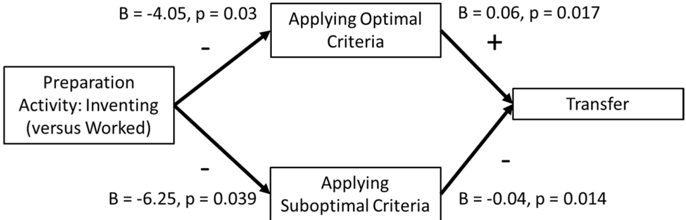
“If, as expected, the different preparation activities caused a change in learning processes that in turn caused changes in transfer, the indirect (mediation) effects via the learningprocess variables should have confidence intervals not containing zero (Preacher & Hayes, 2008).”
BackgroundA Theory of Cognitive Dissonance
Festinger, L. (1957) · doi:10.1515/9781503620766 · Cited by 24,241
Kirschner, P. A., Sweller, J., & Clark, R. E. (2006) · Educational Psychologist · doi:10.1207/s15326985ep4102_1 · Cited by 7,776 · cited 2×
“In contrast, protagonists of direct instruction argue that especially learners with low prior knowledge should be directly guided to the canonical solutions and key concepts, avoiding erroneous learning paths that cost valuable time and cognitive resources (Kirschner et al., 2006; Sweller et al., 2007).”
BackgroundResultProtocol Analysis: Verbal Reports as Data
Ericsson, K. A., & Simon, H. A. (1993) · doi:10.7551/mitpress/5657.001.0001 · Cited by 3,537
Dunlosky, J., Rawson, K. A., Marsh, E. J., Nathan, M. J., & Willingham, D. T. (2013) · Psychological Science in the Public Interest · doi:10.1177/1529100612453266 · Cited by 3,138
Quantifying Qualitative Analyses of Verbal Data: A Practical Guide
Chi, M. T. H. (1997) · Journal of the Learning Sciences · doi:10.1207/s15327809jls0603_1 · Cited by 1,764 · cited 1×
“Some categories were specified bottomup, based on the data in an iterative, qualitative process (see Chi, 1997).”
BackgroundInterest, Learning, and Motivation
Schiefele, U. (1991) · Educational Psychologist · doi:10.1080/00461520.1991.9653136 · Cited by 1,444
The Teaching of Learning Strategies.
Weinstein, C. E., & Mayer, R. E. (1983) · Cited by 1,163
The IKEA effect: When labor leads to love
Norton, M. I., Mochon, D., & Ariely, D. (2012) · Journal of Consumer Psychology · doi:10.1016/j.jcps.2011.08.002 · Cited by 1,049 · cited 1×
“Second, two effects could reduce learners’ application of canonical solutions after inventing their own solutions: According to the IKEA effect, self-made products (Norton et al., 2012) are valued higher than given products.”
Background
Research works printed but not linked: 5
- Bandura, A. (1997). Self-efficacy. The exercise of control. W.H. Freeman. Bandura, A. (2006). Guide for constructing self-efficacy scales. In F. Pajares & T. C. Urdan (Eds.), Self- efficacy beliefs of adolescents (pp. 307-337). Information Age Publishing.
- Bandura, A. (2006). Guide for constructing self-efficacy scales. In F. Pajares & T. C. Urdan (Eds.), Self-efficacy beliefs of adolescents (pp. 307–337). Information Age Publishing.
- diSessa, A.A. (2013). A bird's-eye view of the "pieces" vs "coherence" controversy (from the "pieces" side of the fence"). In S. Vosniadou (Ed.), International Handbook of Research on Conceptual Change. Educational psychology handbook series (pp. 31-48). New York: Routledge.
- Hidi, S. & Berndorff, D. (1998). Situational interest and learning. In L. Hoffman, A. Krapp, K. Ren- ninger, & J. Baumert (Eds.), Interest and learning (pp. 74-90).
- Jeffreys, H. (1961). Theory of probability (3rd ed.). Oxford University Press.
Cited by
CID: a framework for the cognitive analysis of composite instructional designs
Loibl, K., Leuders, T., Glogger‐Frey, I., & Rummel, N. (2024) · Instructional Science · doi:10.1007/s11251-024-09665-9 · Cited by 44
“For example, working through a worked solution to a problem as compared to solving the problem in the first phase can alter the depth of knowledge acquired during this phase, which in turn also affects the learning processes in the second phase (Glogger-Frey et al., 2022).”
Self-citationAre Inductive Teaching Methods Compatible with Cognitive Load Theory?
Gorbunova, A., van Merriënboer, J. J. G., & Costley, J. (2023) · Educational Psychology Review · doi:10.1007/s10648-023-09828-z · Cited by 31
“In these situations, activation of prior knowledge may help students new to the topic prepare for future learning (Glogger-Frey et al., 2022; Schwartz & Martin, 2004; Steenhof et al., 2019), and thus methods that specifically aim at the activation of prior knowledge may become valuable.”
BackgroundProductive versus vicarious failure: Do students need to fail themselves in order to learn?
Hartmann, C., van Gog, T., & Rummel, N. (2022) · Applied Cognitive Psychology · doi:10.1002/acp.4004 · Cited by 23
alharbi, A. A. (2025) · Journal of Radiation Research and Applied Sciences · doi:10.1016/j.jrras.2024.101283 · Cited by 22
Rethinking pre-training: cognitive load implications for learners with varying prior knowledge
Gorbunova, A., Kapuza, A., Chen, O., & Costley, J. (2025) · Frontiers in Psychology · doi:10.3389/fpsyg.2025.1628047 · Cited by 14
Safadi, R., & Hawa, N. (2023) · Instructional Science · doi:10.1007/s11251-023-09648-2 · Cited by 11
“…of research has examined whether studying worked examples to novel problems prior to the instruction phase, as opposed to solving these same problems, better prepares students to benefit from the subsequent instruction phase (e.g., Glogger-Frey et al., 2015, 2017, 2022; Newman & DeCaro, 2019).”
Meier, J., Hesse, P., Abele, S., Renkl, A., & Glogger‐Frey, I. (2024) · Journal of Computer Assisted Learning · doi:10.1111/jcal.12991 · Cited by 11
Self-citationBraas, T. C., Hartmann, C., Hoogerheide, V., Rummel, N., & van Gog, T. (2025) · Instructional Science · doi:10.1007/s11251-025-09706-x · Cited by 8
“This assumption would be consistent with studies showing that preparatory effects can also be empirically demonstrated when working with already developed (correct) solution approaches prior to instruction (cf. Glogger-Frey et al., 2015, 2022 ; Likourezos & Kalyuga, 2017 ; Newman & DeCaro, 2019 ).”
Damayanti, S., Rahmatan, H., Pada, A. U. T., Nurmaliah, C., & Samingan (2026) · Jurnal Penelitian Pendidikan IPA · doi:10.29303/jppipa.v12i3.14155 · Cited by 6
Zeeb, H., Bürgermeister, A., Saalbach, H., Renkl, A., & Glogger‐Frey, I. (2023) · Unterrichtswissenschaft · doi:10.1007/s42010-023-00184-z · Cited by 5
“At the end of the study, we measured how well the students could assess learning strategies in a learning journal and how they justified their assessment (see Glogger-Frey et al. 2018b, 2022).”
Self-citationTannert, S., Karlen, Y., Ader, E., Hertel, S., & Glogger‐Frey, I. (2026) · Metacognition and Learning · doi:10.1007/s11409-026-09455-3 · Cited by 4
Self-citationWedde, S., Busse, A., Bosse, D., & Gold, B. (2023) · Frontiers in Education · doi:10.3389/feduc.2023.1257681 · Cited by 4
Ganaiem, E., & Roll, I. (2025) · Instructional Science · doi:10.1007/s11251-025-09750-7 · Cited by 3
“…load during skill acquisition, compared to problem solving alone, and empirical evidence confirms that studying WE promotes better learning and transfer while requiring less mental effort (Glogger-Frey et al., 2022; Sweller et al., 2011; Van Gerven et al., 2002; Van Gog et al., 2006, 2011).”
Mechanisms to prepare for future learning: A think-aloud study
Ockl, K., & Glogger‐Frey, I. (2025) · Learning and Instruction · doi:10.1016/j.learninstruc.2025.102309 · Cited by 1
Self-citationWedde, S., Busse, A., & Bosse, D. (2022) · International Journal of Modern Education Studies · doi:10.51383/ijonmes.2022.245 · Cited by 1
“…the studies investigated, for example, the matching number of items in the task solution with the canonical solution (Loibl & Rummel, 2014), the appropriateness of the task solutions (Glogger-Frey et al., 2022) or the students’ answers depending on the topic to be learned (Wiedmann et al., 2012).”
BackgroundMethodStapp, A. C., & SHANE, A. (2023) · Journal of Teacher Education and Lifelong Learning · doi:10.51535/tell.1323302
Gutowski, R., Großmann, N., & Großschedl, J. (2025) · International Journal of Science Education · doi:10.1080/09500693.2025.2574522
The Role of Field Excursions in Linking Theoretical Knowledge with Real-World Geographical Phenomena
Nonkula, Z. (2025) · Journal of Ecohumanism · doi:10.62754/joe.v4i4.6997
Treier, A.-K. (2023) · Kölner Universitäts PublikationsServer (Universität zu Köln)
Self-citationZeeb, H., Witte, F., Voss, T., & Glogger‐Frey, I. (2026) · Social Psychology of Education · doi:10.1007/s11218-026-10226-w
“In the sense of preparation for learning (Glogger-Frey et al., 2022; Schwartz & Brans-ford, 1998 ), such a refutation text could serve as a first step by making the problem salient and thereby laying a foundation from which participants engage with the subsequent intervention more thoroughly.”
Self-citationWorked Examples and Transfer: An Integrative Review, Design Framework, and Practitioner Checklist
Bourgaux, L., Tricot, A., & PAAS, F. G. W. C. (2026) · Educational Psychology Review · doi:10.1007/s10648-026-10206-8
“Far transfer, by contrast, requires extending knowledge beyond trained tasks and has also been the focus of empirical inquiry for several decades (Ashman et al., 2020; Carroll, 1994; Cooper & Sweller, 1987; Glogger-Frey et al., 2015, 2022; van Gog et al., 2006).”
Metadata
- Authors
- Glogger-Frey, I., Treier, A.-K., & Renkl, A.
- Affiliations
- University of Freiburg (DE)
- Venue
- Instructional Science
- Published
- 2022-03-16
- Volume
- 50
- Issue
- 3
- Pages
- 451-473
- ISSN
- 0020-4277 (ISSN-L)
- 1573-1952
- OpenAlex
- W4220715441
- Cited by
- 19
- References
- 59
- Citations by year
- 2026: 3 · 2025: 6 · 2024: 3 · 2023: 5 · 2022: 2
- FWCI
- 3.69
- Type
- journal article
- Language
- en
- Open access
- hybrid
- doi.org
- Licence
- cc-by
- creativecommons.org/licenses/by/4.0 (tdm)
- creativecommons.org/licenses/by/4.0 (vor)
- Locations
- Instructional Science (publishedVersion, cc-by)
- Kölner Universitäts PublikationsServer (Universität zu Köln) (publishedVersion)
- Common Library Network (Der Gemeinsame Bibliotheksverbund) (submittedVersion, cc-by)
- Funders
- Universität Erfurt
- Topics
- Social Sciences › Psychology › Experimental and Cognitive Psychology › Visual and Cognitive Learning Processes
- Social Sciences › Psychology › Developmental and Educational Psychology › Innovative Teaching and Learning Methods
- Social Sciences › Education › Science Education and Pedagogy
- Keywords
- worked examples, pre-service teachers, transfer of learning, think-aloud, learning process, self-efficacy, motivation, elaborative processing, canonical solutions, learning journals, computer-based learning environments
About these checks
Registry, retraction, Cites and statistics results are computed, not judged, with one exception: a printed reference that no index lists is read once by a model before it counts as a citation error. Claims are extracted by a model and kept only when their quote appears verbatim in the text; each cited source is then checked, with a model’s help, for whether it says what the claim relies on. Those verdicts can be wrong — read the claim’s quote and the cited source before relying on one.
Statistics and arithmetic are recomputed, not judged.
Confidence bands are shown only for fields calibrated on our annotated test set. None is calibrated yet, so no band is shown.
What counts as a claim ›How we measure confidence ›How we check this ›
Are you an author, or do you see a problem with this page? Request a review
Data sources
Bibliographic data: Semantic Scholar, OpenAlex, Crossref.
Contains information from the Semantic Scholar Academic Graph Datasets, made available under the ODC Attribution License (ODC-BY 1.0).
Semantic Scholar’s data is described in: Kinney, R., et al. (2023). The Semantic Scholar Open Data Platform. arXiv:2301.10140.
