

An adaptive decision-making system supported on user preference predictions for human–robot interactive communication
Open accessThe DOI matches its Crossref record; 72 of the 72 references it cites were found in a registry or an index.
Abstract
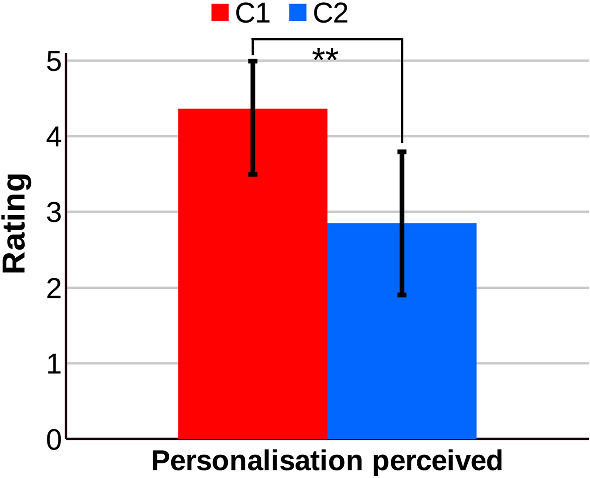
Adapting to dynamic environments is essential for artificial agents, especially those aiming to communicate with people interactively. In this context, a social robot that adapts its behaviour to different users and proactively suggests their favourite activities may produce a more successful interaction. In this work, we describe how the autonomous decision-making system embedded in our social robot Mini can produce a personalised interactive communication experience by considering the preferences of the user the robot interacts with. We compared the performance of Top Label as Class and Ranking by Pairwise Comparison, two promising algorithms in the area, to find the one that best predicts the user preferences. Although both algorithms provide robust results in preference prediction, we decided to integrate Ranking by Pairwise Comparison since it provides better estimations. The method proposed in this contribution allows the autonomous decision-making system of the robot to work on different modes, balancing activity exploration with the selection of the favourite entertaining activities. The operation of the preference learning system is shown in three real case studies where the decision-making system works differently depending on the user the robot is facing. Then, we conducted a human–robot interaction experiment to investigate whether the robot users perceive the personalised selection of activities more appropriate than selecting the activities at random. The results show how the study participants found the personalised activity selection more appropriate, improving their likeability towards the robot and how intelligent they perceive the system. query Please check the edit made in the article title.
Overview
The claims and statistics of this paper haven’t been checked yet.
Free: it reads the open-access text and checks the first 5 claims that cite a source we can check. Create a free account to check every claim.
Integrity signals
Registry
Cites
Statistics
Figures
Verification
Claims the paper makes
The claims and statistics of this paper haven’t been checked yet.
Free: it reads the open-access text and checks the first 5 claims that cite a source we can check. Create a free account to check every claim.
Claims other papers make about this one
Each is checked against this paper’s own text: does it say what the citing paper says it does?
The cited source says what the claim attributes to it.
In the citing paper
“This was previously suggested by the developers of the MINI robot [23,24] regarding personalisation of human–robot interaction.”
Self-check
Percentages, sums and reported differences re-computed from the paper’s own numbers.
The self-check needs the paper’s full text.
Citations
Cites
Breiman, L. (2001) · Machine Learning · doi:10.1023/a:1010933404324 · Cited by 133,538 · cited 3×
“Nonetheless, this survey does not contain any reference to LR in combination with random forest (Breiman 2001).”
BackgroundMethodIntroduction to Information Retrieval
Manning, C. D., Raghavan, P., & Schütze, H. (2008) · doi:10.1017/cbo9780511809071 · Cited by 11,288
Correlation Coefficients: Appropriate Use and Interpretation
Schober, P., Boer, C., & Schwarte, L. A. (2018) · Anesthesia & Analgesia · doi:10.1213/ane.0000000000002864 · Cited by 10,986 · cited 1×
“7 moderate, and weak otherwise (Corder and Foreman 2011; Schober et al. 2018).”
Bartneck, C., Kulić, D., Croft, E., & Zoghbi, S. (2009) · International Journal of Social Robotics · doi:10.1007/s12369-008-0001-3 · Cited by 3,193 · cited 1×
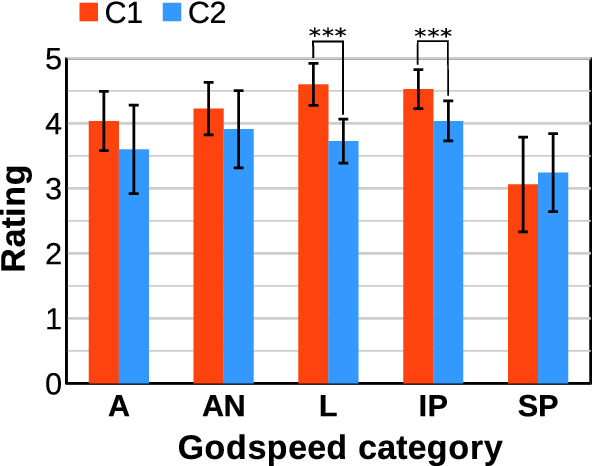
“Following the ad hoc questions, the second questionnaire consisted of the well-known Godspeed questionnaire (Bartneck et al. 2008), used for evaluating different attributes of social robots.”
MethodBobadilla, J., Ortega, F., Hernando, A., & Gutiérrez, A. (2013) · Knowledge-Based Systems · doi:10.1016/j.knosys.2013.03.012 · Cited by 3,158 · cited 1×
“LR applications range from information retrieval (Schütze et al. 2008) to search engines and recommender systems (Burke et al. 2011; Bobadilla et al. 2013).”
BackgroundDuan, Y., Edwards, J. S., & Dwivedi, Y. K. (2019) · International Journal of Information Management · doi:10.1016/j.ijinfomgt.2019.01.021 · Cited by 2,628 · cited 1×
“Autonomous decision-making is an emerging field that is gaining importance in applications such as military (Prelipcean et al. 2010; Goztepe 2015), economics (Parkes and Wellman 2015), or artificial intelligence (Duan et al. 2019).”
BackgroundImproved Use of Continuous Attributes in C4.5
Quinlan, J. R. (1996) · Journal of Artificial Intelligence Research · doi:10.1613/jair.279 · Cited by 1,846
The proof and measurement of association between two things
Spearman, C. (2010) · International Journal of Epidemiology · doi:10.1093/ije/dyq191 · Cited by 1,681 · cited 8×
“Table 2d shows the results obtained for Spearman’s ρ rank correlation.”
BackgroundMethodInfluentialSocial Robots for Long-Term Interaction: A Survey
Leite, I., Martinho, C., & Paiva, A. (2013) · International Journal of Social Robotics · doi:10.1007/s12369-013-0178-y · Cited by 871 · cited 1×
“AsLeiteetal.”
THE TREATMENT OF TIES IN RANKING PROBLEMS
KENDALL, M. G. (1945) · Biometrika · doi:10.1093/biomet/33.3.239 · Cited by 809 · cited 3×
“Kendall’s τ -b (Kendall 1945) developed this nonparametric measure of correlation between two rankingsπ andπ ′, like Eq.”
Method
Research works printed but not linked: 13
- Aiolli, F., Sperduti, A.: Learning preferences for multiclass problems. Adv. Neural Info. Process. Syst., pp 17–24 (2005)
- Brinker, K., Hüllermeier, E.: Case-based multilabel ranking. In: IJCAI, pp 702–707 (2007)
- Burke R Felfernig A Göker MH Recommender systems: an overview Ai Mag. 2011 32 3 13 18
- Chen, Y., Zhang, J., Guo, M., Cao, J.: Learning user preference from heterogeneous information for store-type recommendation. IEEE Trans. Serv. Comput. (2017)
- Cohen, W.W., Schapire, R.E., Singer, Y.: Learning to order things. Adv. Neural Info. Process. Syst., pp 451–457 (1998)
- Dery, L.: Multi-label ranking: Mining multi-label and label ranking data. arXiv preprint arXiv:210100583 (2021)
- Efron B Student’s t-test under symmetry conditions J. Am. Stat. Assoc. 1969 64 328 1278 1302
- Goztepe K New directions in military and security studies: artificial intelligence and military decision making process Int. J. Info. Security Sci. 2015 4 2 69 80
- Olaronke I Oluwaseun O Rhoda I State of the art: a study of human-robot interaction in healthcare Int. J. Info. Eng. Elect. Bus. 2017 9 3 43
- Prelipcean, G., Boscoianu, M., Moisescu, F.: New ideas on the artificial intelligence support in military applications. In: Proceedings of the 9th WSEAS international conference on Artificial intelligence, knowledge engineering and data bases, World Scientific and Engineering Academy and Society (WSEAS), pp 34–39 (2010)
- Woodworth, B., Ferrari, F., Zosa, T.E., Riek, L.D.: Preference learning in assistive robotics: Observational repeated inverse reinforcement learning. In: Machine learning for healthcare conference, PMLR, pp 420–439 (2018)
- You R Zhang Z Wang Z Dai S Mamitsuka H Zhu S Attentionxml: label tree-based attention-aware deep model for high-performance extreme multi-label text classification Adv. Neural Info. Process. Syst. 2019 32 5820 5830
- Zheng, Z., Zha, H., Zhang, T., Chapelle, O., Chen, K., Sun, G.: A general boosting method and its application to learning ranking functions for web search. Adv. Neural Info. Process. Syst., pp 1697–1704 (2008)
Cited by
Remote Sensing Image Classification: A Comprehensive Review and Applications
Mehmood, M., Shahzad, A., Zafar, B., Shabbir, A., & Ali, N. (2022) · Mathematical Problems in Engineering · doi:10.1155/2022/5880959 · Cited by 253
Gómez, M. M., Alonso-Martín, F., Malfáz, M., Castro‐González, Á., Castillo, J. C., & Salichs, M. A. (2023) · International Journal of Social Robotics · doi:10.1007/s12369-023-00977-3 · Cited by 84
Self-citationGenerative Artificial Intelligence: Fundamentals
Corchado, J. M., Sebastian López, F., V., J., Raul Garcia, S., & Chamoso, P. (2023) · ADCAIJ ADVANCES IN DISTRIBUTED COMPUTING AND ARTIFICIAL INTELLIGENCE JOURNAL · doi:10.14201/adcaij.31704 · Cited by 64
Chang, W.-C., & Hasanzadeh, S. (2025) · Advanced Engineering Informatics · doi:10.1016/j.aei.2025.103110 · Cited by 25
Llama 2: Early Adopters' Utilization of Meta's New Open-Source Pretrained ModelPreprint
Roumeliotis, K. I., Tselikas, N. D., & Nasiopoulos, D. Κ. (2023) · Preprints.org · doi:10.20944/preprints202307.2142.v1 · Cited by 40
Personalizing Activity Selection in Assistive Social Robots from Explicit and Implicit User Feedback
Gómez, M. M., Malfáz, M., Castillo, J. C., Castro‐González, Á., & Salichs, M. A. (2024) · International Journal of Social Robotics · doi:10.1007/s12369-024-01124-2 · Cited by 21
Self-citationA biologically inspired decision-making system for the autonomous adaptive behavior of social robots
Maroto-Gómez, M., Castro-González, Á., Malfaz, M., & Salichs, M. Á. (2023) · Complex & Intelligent Systems · doi:10.1007/s40747-023-01077-5 · Cited by 14
Self-citationMahmoudi Asl, A., Toribio-Guzmán, J. M., Castro-González, Á., Malfaz, M., Salichs, M. A., & Franco Martín, M. (2024) · Sensors · doi:10.3390/s24227180 · Cited by 13
Self-citationUsing a LLM-Based Conversational Agent in the Social Robot Mini
Esteban-Lozano, I., Castro‐González, Á., & Martínez, P. (2024) · Lecture notes in computer science · doi:10.1007/978-3-031-60615-1_2 · Cited by 23
Self-citationVoice-enabled human-robot interaction: adaptive self-learning systems for enhanced collaboration
Kishor, I., Mamodiya, U., Saini, S., & Bossoufi, B. (2025) · Robotica · doi:10.1017/s0263574725000438 · Cited by 16
“These models yield very high accuracies in controlled environments [4, 5].”
Redefining User Expectations: The Impact of Adjustable Social Autonomy in Human–Robot Interaction
Cantucci, F., Falcone, R., & Marini, M. (2023) · Electronics · doi:10.3390/electronics13010127 · Cited by 8
Real-time Engagement Detection from Facial Features
Marqués-Villarroya, S., Gamboa‐Montero, J. J., Bernardino, A. J. M., Gómez, M. M., Castillo, J. C., & Salichs, M. A. (2022) · IEEE International Conference on Development and Learning (ICDL) · doi:10.1109/icdl53763.2022.9962228 · Cited by 11
Self-citationGómez, M. M., Malfáz, M., Castro‐González, Á., Álvarez-Arias, S., & Salichs, M. A. (2024) · IEEE Access · doi:10.1109/access.2024.3508139 · Cited by 8
Self-citationAl-Hussaini, S., Guan, Y., Gregory, J. M., Pollard, K. A., Khooshabeh, P., & Gupta, S. K. (2024) · ACM Transactions on Human-Robot Interaction · doi:10.1145/3689828 · Cited by 9
“Maroto-Gomez [76] present an adaptive decision-making system supported by user preference predictions for human–robot interactive communication.”
Carrasco-Martínez, S., Gamboa‐Montero, J. J., Gómez, M. M., Alonso-Martín, F., & Salichs, M. A. (2023) · Revista Iberoamericana de Automática e Informática Industrial RIAI · doi:10.4995/riai.2023.18739 · Cited by 11
Self-citationGómez, M. M., Álvarez-Arias, S., Rodríguez-Huelves, J., Segura-Bencomo, A., & Malfáz, M. (2025) · Electronics · doi:10.3390/electronics14183711 · Cited by 5
Implementation of a Biologically Inspired Responsive Joint Attention System for a Social Robot
García, J., Gamboa‐Montero, J. J., Castillo, J. C., Castro‐González, Á., & Salichs, M. A. (2025) · Advanced Intelligent Systems · doi:10.1002/aisy.202400650 · Cited by 5
Self-citationAI preference prediction and policy making
Lim, J., & Savulescu, J. (2025) · AI & Society · doi:10.1007/s00146-025-02474-9 · Cited by 10
Gómez, M. M., Carrasco-Martínez, S., Marqués-Villarroya, S., Malfáz, M., Castro‐González, Á., & Salichs, M. A. (2023) · IEEE RO-MAN · doi:10.1109/ro-man57019.2023.10309525 · Cited by 3
“When the robot autonomously selects the following activity, the DMS employs the user preferences stored in the robot’s memory and a Preference and Reinforcement Learning method [7] to select those preferred more often by the user using a probabilistic Boltzmann rule [13].”
BackgroundMethodSelf-citationAdaptive Circadian Rhythms for Autonomous and Biologically Inspired Robot Behavior
Gómez, M. M., Malfáz, M., Castro‐González, Á., Carrasco-Martínez, S., & Salichs, M. A. (2023) · Biomimetics · doi:10.3390/biomimetics8050413 · Cited by 4
Self-citationReal-time emotion detection and customized interaction analysis in broadcast hosting
Zhang, C. (2024) · Journal of Computational Methods in Sciences and Engineering · doi:10.1177/14727978241298476 · Cited by 2
Active Object Learning for intelligent social robots
García, J., Castillo, J. C., Marqués-Villarroya, S., & Salichs, M. A. (2023) · Engineering Applications of Artificial Intelligence · doi:10.1016/j.engappai.2023.107329 · Cited by 2
Self-citationAdaptive Multimodal Learning for Robot Decision-Making in Dynamic Environments
Shinde, R. K., Sodhi, A., Mane, P. B., & Mehta, H. (2025) · International Conference on Control, Automation and Robotics (ICCAR) · doi:10.1109/iccar64901.2025.11073004 · Cited by 1
“Adaptive decision-making paradigms, as proposed by Maroto-G´omez et al. [4], predict human requirements and actions to enable natural and intuitive interaction.”
Artificial autonomy and algorithmic paternalism: AI shaping human autonomy and decision-making
Hofmann, B. (2026) · Frontiers in Artificial Intelligence · doi:10.3389/frai.2026.1860239 · Cited by 8
Interactive and Explainable Robot Learning: A Comprehensive Review
Seraj, E., Lee, K. M., Zaidi, Z., Xiao, Q., Li, Z., Nascimento, A., van Waveren, S., Tambwekar, P., Paleja, R., Das, D., et al. (2024) · Foundations and Trends in Robotics · doi:10.1561/2300000081 · Cited by 7
A Dialogue System That Models User Opinions Based on Information Content
Ohira, Y., Uchida, T., Minato, T., & Ishiguro, H. (2022) · Multimodal Technologies and Interaction · doi:10.3390/mti6100091 · Cited by 1
“[20] solved these problems by using the label ranking method [21], a type of ranking method.”
MethodArquitectura para la monitorización de la frecuencia cardiaca en tiempo real desde un robot social
Martínez‐Rodrigo, A., Castillo, J. C., Carrasco-Martínez, S., & Costa, Â. (2024) · Revista Iberoamericana de Automática e Informática Industrial RIAI · doi:10.4995/riai.2024.21584
Self-citationSistema de aprendizaje cooperativo para enjambre de robots sociales
Álvarez-Arias, S., Gómez, M. M., Carrasco-Martínez, S., Malfáz, M., & Salichs, M. A. (2024) · Jornadas de Automática · doi:10.17979/ja-cea.2024.45.10865 · Cited by 1
Self-citationModalities of AI Operations and Their Impact on Users’ Attitude Towards AI
Liebherr, M. (2024) · Studies in neuroscience, psychology and behavioral economics · doi:10.1007/978-3-031-70355-3_3 · Cited by 1
Robots as Coaches: Exploring User Expectations, Ethics, and Design Guidelines
Ahmed, M. S., Giuliani, M., Leonards, U., Higgins, A., & Bremner, P. (2025) · Lecture notes in computer science · doi:10.1007/978-981-96-3522-1_13
Los hilos del aprendizaje: tejiendo conexiones entre máquinas y mentes humanas
Rochambrun-Flores, J., Rivas-Alvarez, A., & Neyra-Rivera, C. (2025) · DYNA · doi:10.15446/dyna.v92n237.118489
The Power of Persuasion: How Social Robots Influence Our Decisions in Collaborative Activities
Gómez, M. M., Carrasco-Martínez, S., Álvarez-Arias, S., Fernández‐Rodicio, E., & Malfáz, M. (2025) · IEEE Transactions on Robotics · doi:10.1109/tro.2025.3644350
A User-Guided Framework for Visual Odometry Algorithm Selection and Composition
Jiao, Y., Zhiming, S., Yunfeng, L., Xiumei, L., Zhaowen, X., Wang, Y., & Rong, X. (2026) · IEEE Transactions on Cognitive and Developmental Systems · doi:10.1109/tcds.2026.3667590
“…this limitation, unmanned systems need self-regulation and adaptive capabilities to evaluate the suitability of different visual odometry algorithms based on external environments and task requirements, and to autonomously learn and adjust optimal strategies during operation [8], [9], [10].”
“I Know You’re Capable, but Are You Willing?”: Allocating Tasks in Human–Machine Teams
Jorge, C. C., Jonker, C. M., Robert, L., de Visser, E. J., & Tielman, M. L. (2026) · ACM Transactions on Human-Robot Interaction · doi:10.1145/3834773
Álvarez-Arias, S., Gómez, M. M., Carrasco-Martínez, S., Malfáz, M., & Salichs, M. A. (2026) · International Journal of Social Robotics · doi:10.1007/s12369-026-01427-6
“Maroto et al. [30] DRL for biologically inspired physiological processes.”
InfluentialSelf-citationRoy, S., Peretz, I., Sayfeld, L., & Edan, Y. (2026) · Frontiers in Neurorobotics · doi:10.3389/fnbot.2026.1222566
An Interactive Game Board for Cognitive and Physical Stimulation with Social Robots
Rodríguez-Huelves, J., Gómez, M. M., Álvarez-Arias, S., García, J., Segura-Bencomo, A., Castro‐González, Á., del Castillo, J. C., & Malfáz, M. (2026) · Biosystems & biorobotics · doi:10.1007/978-3-032-18746-8_61
Self-citation
Metadata
- Authors
- Maroto-Gómez, M., Castro-González, Á., Castillo, J. C., Malfaz, M., & Salichs, M. Á.
- Affiliations
- Universidad Carlos III de Madrid (ES)
- ORCID
- Venue
- User Modeling and User-Adapted Interaction
- Published
- 2022-04-09
- Volume
- 33
- Issue
- 2
- Pages
- 359-403
- ISSN
- 0924-1868 (ISSN-L)
- 1573-1391
- PMC
- PMC8994572
- OpenAlex
- W4224292998
- Cited by
- 37
- References
- 72
- Citations by year
- 2026: 6 · 2025: 9 · 2024: 10 · 2023: 9 · 2022: 3
- FWCI
- 7.32
- Type
- journal article
- Language
- en
- Open access
- hybrid
- doi.org
- Licence
- cc-by
- creativecommons.org/licenses/by/4.0 (tdm)
- creativecommons.org/licenses/by/4.0 (vor)
- Locations
- User Modeling and User-Adapted Interaction (publishedVersion, cc-by)
- PubMed Central (publishedVersion, cc-by)
- PubMed (publishedVersion)
- e-Archivo (Carlos III University of Madrid) (submittedVersion, cc-by)
- e-Archivo (Carlos III University of Madrid) (submittedVersion, cc-by-nc-nd)
- Funders
- Ministerio de Ciencia, Innovación y Universidades
- Topics
- Social Sciences › Psychology › Social Psychology › Social Robot Interaction and HRI
- Physical Sciences › Computer Science › Information Systems › Recommender Systems and Techniques
- Physical Sciences › Computer Science › Artificial Intelligence › Speech and dialogue systems
- Keywords
- user preference prediction, social robots, human-robot interaction, adaptive decision-making, preference learning, robot likeability, small robots
About these checks
Registry, retraction, Cites and statistics results are computed, not judged, with one exception: a printed reference that no index lists is read once by a model before it counts as a citation error. Claims are extracted by a model and kept only when their quote appears verbatim in the text; each cited source is then checked, with a model’s help, for whether it says what the claim relies on. Those verdicts can be wrong — read the claim’s quote and the cited source before relying on one.
Statistics and arithmetic are recomputed, not judged.
Confidence bands are shown only for fields calibrated on our annotated test set. None is calibrated yet, so no band is shown.
What counts as a claim ›How we measure confidence ›How we check this ›
Are you an author, or do you see a problem with this page? Request a review
Data sources
Bibliographic data: Semantic Scholar, OpenAlex, Crossref.
Contains information from the Semantic Scholar Academic Graph Datasets, made available under the ODC Attribution License (ODC-BY 1.0).
Semantic Scholar’s data is described in: Kinney, R., et al. (2023). The Semantic Scholar Open Data Platform. arXiv:2301.10140.
