

The DOI matches its Crossref record; 367 of the 367 references it cites were found in a registry or an index; 17 of the 301 sources its claims cite were checked for support.
Deep Learning for Generic Object Detection: A Survey
Open accessAbstract
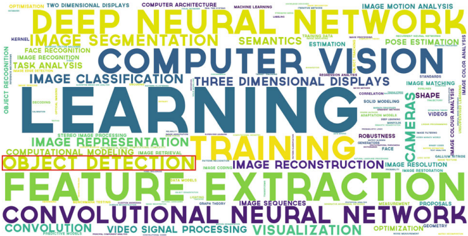
Object detection, one of the most fundamental and challenging problems in computer vision, seeks to locate object instances from a large number of predefined categories in natural images. Deep learning techniques have emerged as a powerful strategy for learning feature representations directly from data and have led to remarkable breakthroughs in the field of generic object detection. Given this period of rapid evolution, the goal of this paper is to provide a comprehensive survey of the recent achievements in this field brought about by deep learning techniques. More than 300 research contributions are included in this survey, covering many aspects of generic object detection: detection frameworks, object feature representation, object proposal generation, context modeling, training strategies, and evaluation metrics. We finish the survey by identifying promising directions for future research.
Overview
CoChat Summary
TL;DR
This survey reviews deep learning for generic object detection, covering more than 300 research contributions across detection frameworks, feature representation, proposal generation, context modeling, training strategies, and evaluation metrics. It organizes the field into two-stage and one-stage detectors, summarizes datasets and benchmarks, and identifies open challenges such as small-object detection, context reasoning, weak/few-shot learning, and open-world detection.
Key findings
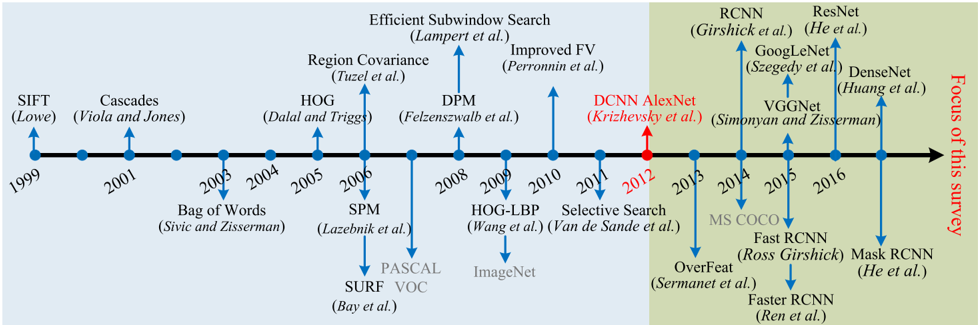
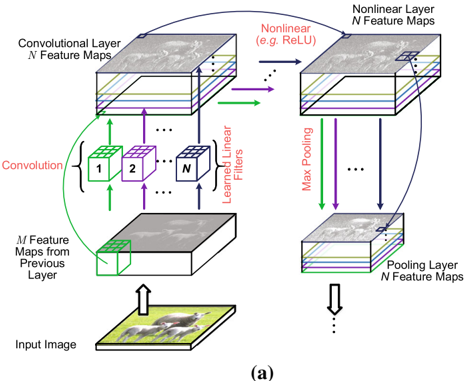
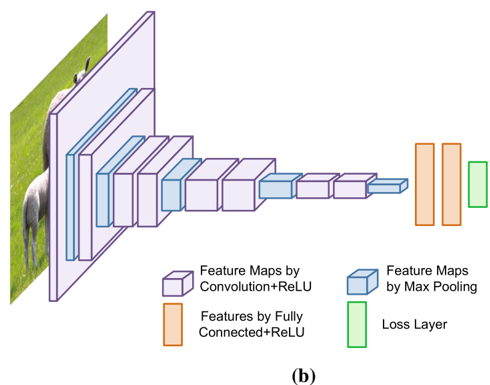
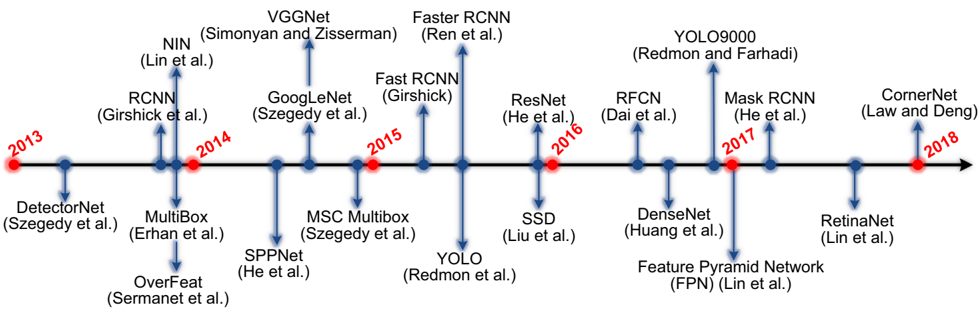
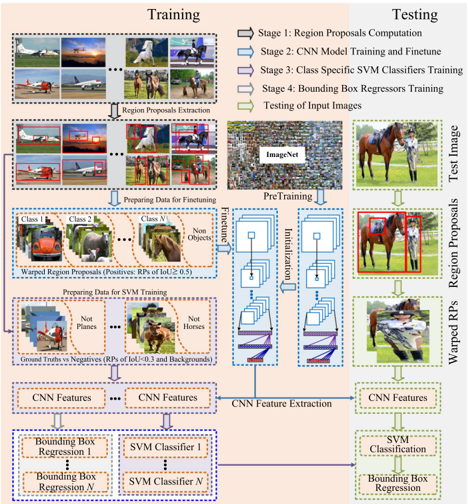
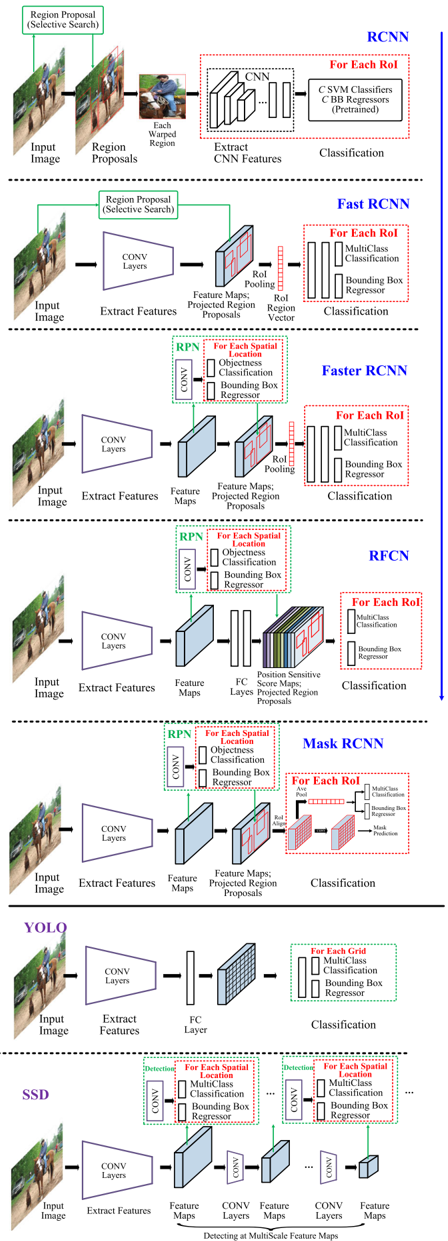
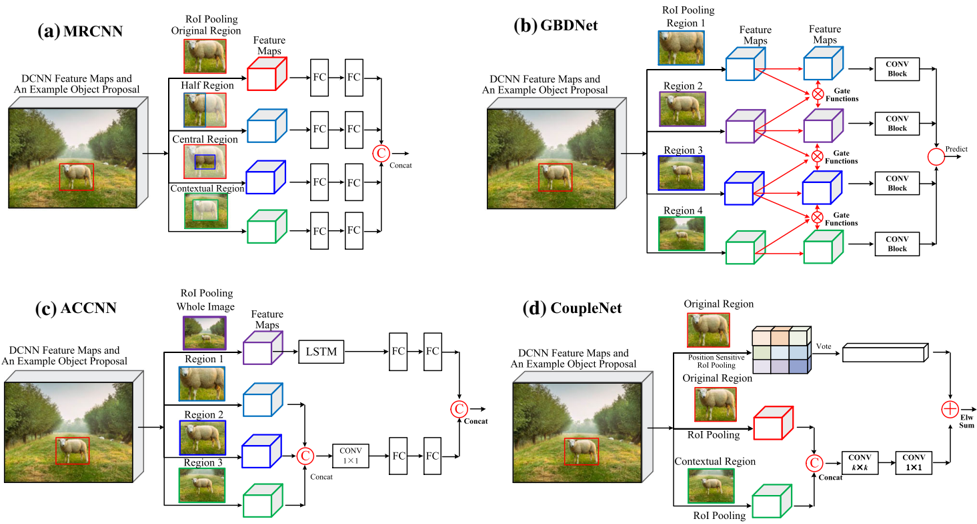
- The survey provides a taxonomy of deep learning based generic object detection, including region-based/two-stage frameworks (RCNN, Fast RCNN, Faster RCNN, RFCN, Mask RCNN) and unified/one-stage frameworks (YOLO, SSD), plus backbone CNN architectures, multiscale feature fusion, context modeling, detection proposals, and training strategies.
- Two-stage detectors generally achieve higher accuracy when large computation is allowed, while one-stage detectors are generally faster but weaker on small objects; for example, SSD achieves 74.3% mAP on VOC2007 test at 59 FPS versus Faster RCNN at 7 FPS / 73.2% mAP and YOLO at 45 FPS / 63.4% mAP. YOLO runs at 45 FPS and Fast YOLO at 155 FPS.
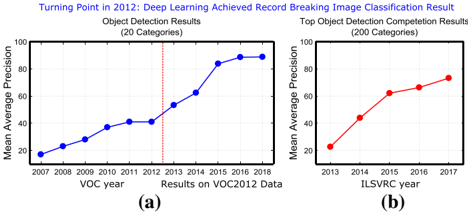
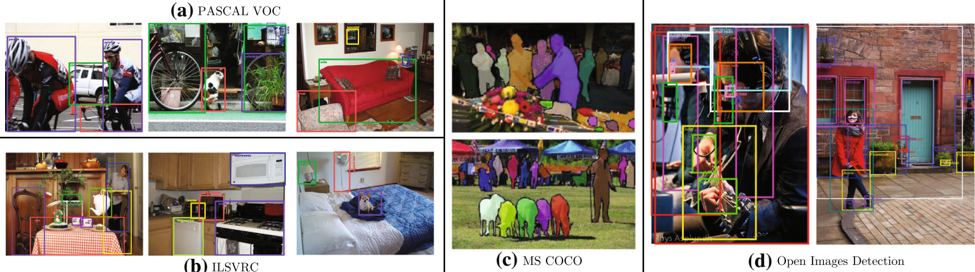
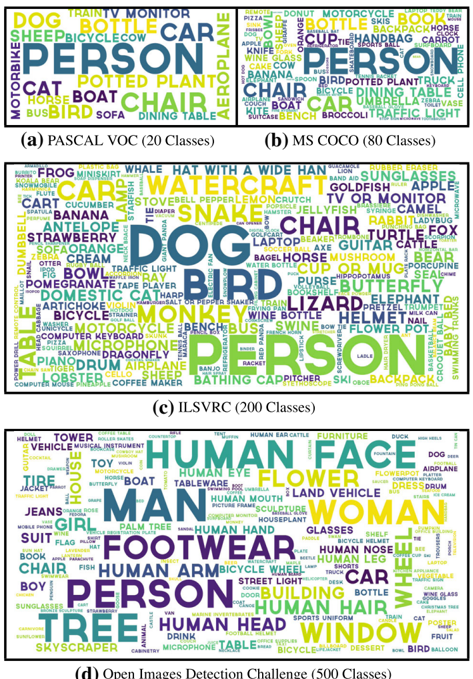
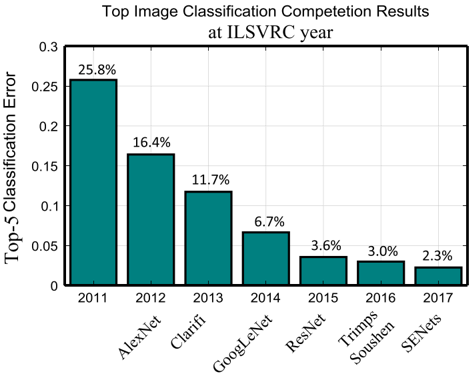
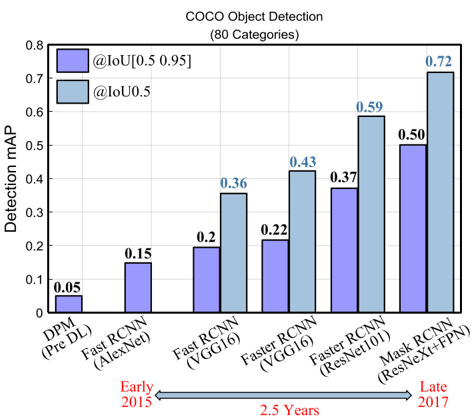
- The main datasets are PASCAL VOC, ImageNet/ILSVRC, MS COCO, and Open Images; COCO contains 41% small and 24% large objects, and the best COCO detector trained on 80 classes reaches only 73% mAP even at 0.5 IoU, while ImageNet Top-5 classification error dropped from 16% to 2% in less than five years. The Open Images challenge winner achieved 61.71% mAP on the public leaderboard and 58.66% mAP on the private leaderboard.
- Future directions include open-world learning, better and more efficient detection frameworks, compact CNN features, automatic neural architecture search, object instance segmentation, weakly supervised detection, few/zero-shot detection, other modalities, and universal object detection.
Methods
- Design: a comprehensive literature survey of deep learning based generic object detection, focusing on major progress of the last 5 years, restricted to still pictures and to top journal and conference papers, with more than 300 research contributions included.
- Organization: the survey presents a taxonomy covering detection frameworks, object feature representation, object proposal generation, context modeling, training strategies, and evaluation metrics, and summarizes popular datasets and evaluation criteria such as AP/mAP and IOU thresholds.
- Analysis: no new experiments are reported; the paper synthesizes and compares reported results across PASCAL VOC, ILSVRC, MS COCO, and Open Images, and discusses representative methods in tables and figures.
Limitations
- Stated: the survey limits its focus to top journal and conference papers, covers mainly the last 5 years, restricts attention to still pictures, and leaves video object detection for separate future consideration; the authors apologize to authors whose works are not included.
- Stated: comparing detectors by their originally reported performance may be misleading because methods differ in meta-frameworks, backbone networks, pretraining datasets, proposal methods, augmentation, and ensembling; there has been very limited unified comparison work.
- Evident: the survey is not exhaustive given the breadth of the field, and it excludes extensive work on specific object detection such as face, pedestrian, vehicle, and traffic sign detection; the provided text also contains fragmented tables and figures, which limits some detail.
Model-written summary. Check it against the paper before relying on it.
Integrity signals
Registry
Cites
Statistics
Figures


Verification
Claims the paper makes
14 Valid · 16 Not valid · 154 Not checked · 108 Own results and interpretations
The cited sources support only part of this claim — read each source’s verdict below.
In the paper
“To the best of our knowledge, for the evaluation of generic object detection algorithms, it is bounding boxes which are most widely used in the current literature (Everingham et al. 2010;Russakovsky et al. 2015), and therefore this is also the approach we adopt in this survey.”
§ Deep Learning for Generic Object Detection: A Survey > 2.1 The Problem
What the sources say
- Partly supportedcites Everingham et al. 2010 sourceExperimental — accuracy not yet measured
Section 2.2 (Detection) and “Bounding box evaluation” show that the VOC challenge evaluated object detections using predicted bounding boxes and their overlap with ground truth. The paper does not establish the broader comparative claim that bounding boxes were the most widely used evaluation approach in the literature. (LLM, conf=0.84)
- Not checked yetcites Russakovsky et al. 2015 source
hedged- Asserted: passes — The authors put it forward as true.
- Checkable: passes — It can be checked against evidence.
- Load-bearing: passes — The paper’s conclusions depend on it.
- Based: passes — The paper gives a reason why it holds.
- Partly supported
The sources with a verdict support this claim; the rest weren’t checked yet, have no full text we could read, or their verdicts aren’t rated yet.
In the paper
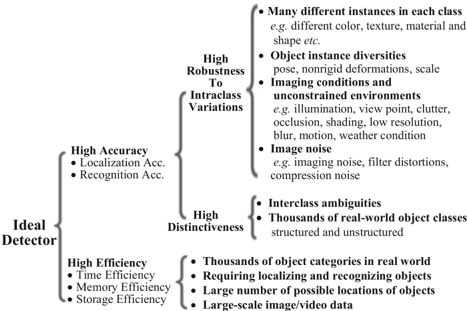
“In practice, current detectors focus mainly on structured object categories, such as the 20, 200 and 91 object classes in PASCAL VOC (Everingham et al. 2010), ILSVRC (Russakovsky et al. 2015) and MS COCO (Lin et al. 2014) respectively.”
§ Deep Learning for Generic Object Detection: A Survey > 2.2.1 Accuracy Related Challenges
What the sources say
- Supportedcites Everingham et al. 2010 source
The citation is offered for the identification of PASCAL VOC as the benchmark with 20 object classes. Our copy states this repeatedly: Sect. 3.2 'Choice of Classes' says 'Fig. 2 shows the 20 classes selected for annotation in the VOC2007 dataset' and that the count rose from 4 (VOC2005) to 10 (VOC2006) to 20 (VOC2007); Sect. 3.1 refers to 'each of the 20 object classes to be annotated'; Sect. 3.5 notes 'the number of classes doubled from 10 to 20'. The surrounding framing about detectors focusing on structured categories is the citing authors' own conclusion, not attributed to this source. (LLM, conf=0.90)
- Not checked yetcites Russakovsky et al. 2015 source
- Not checked yetcites Lin et al. 2014
plain- Asserted: passes — The authors put it forward as true.
- Checkable: passes — It can be checked against evidence.
- Load-bearing: unclear — It is unclear whether the paper’s conclusions depend on it.
- Based: passes — The paper gives a reason why it holds.
- Supported
The sources with a verdict support this claim; the rest weren’t checked yet, have no full text we could read, or their verdicts aren’t rated yet.
In the paper
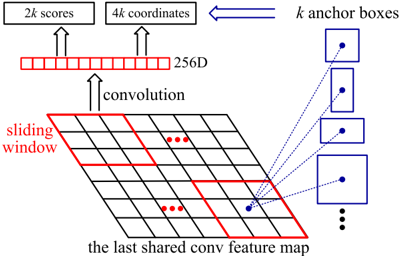
“The Faster RCNN framework proposed by Ren et al. (2015Ren et al. ( , 2017) ) offered an efficient and accurate Region Proposal Network (RPN) for generating region proposals.”
§ Deep Learning for Generic Object Detection: A Survey > 5.1 Region Based (Two Stage) Frameworks
What the sources say
- Not checked yetcites Ren et al. 2015
- Supportedcites Ren et al. 2017 source
The Abstract (p. 1) states the paper introduces an RPN that shares full-image convolutional features, enabling 'nearly cost-free region proposals' trained end-to-end 'to generate high-quality region proposals', and the Introduction (p. 1) gives the marginal cost as ~10ms per image. Efficiency and accuracy are both borne out: Section 3 (p. 3) defines the RPN as the proposal module of Faster R-CNN, and p. 2 reports it beats the Selective Search baseline in detection accuracy while waiving nearly all of its computational burden. The paraphrase matches the source at the same level of specificity. (LLM, conf=0.92)
plain- Asserted: passes — The authors put it forward as true.
- Checkable: passes — It can be checked against evidence.
- Load-bearing: unclear — It is unclear whether the paper’s conclusions depend on it.
- Based: passes — The paper gives a reason why it holds.
The sources with a verdict support this claim; the rest weren’t checked yet, have no full text we could read, or their verdicts aren’t rated yet.
In the paper
“In contrast, deep learning methods (especially deep CNNs) can learn powerful feature representations with multiple levels of abstraction directly from raw images (Bengio et al. 2013;LeCun et al. 2015).”
§ Deep Learning for Generic Object Detection: A Survey > 6 Object Representation
What the sources say
- Supportedcites Bengio et al. 2013 source
Section 3.4 (pp. 4-5) states that deep architectures 'can potentially lead to progressively more abstract features at higher layers' and that in the convolutional neural network this abstraction is built in explicitly via pooling, making representations 'generally highly non-linear functions of the raw input'. The Introduction (p. 1) frames the whole point as reducing dependence on labor-intensive feature engineering so that algorithms can extract discriminative information from low-level sensory data, and Section 11.2 (p. 24) applies this to the 2D layout of pixels in images via local receptive fields, convolution and pooling. Section 10.1 (p. 22-23) reinforces the 'powerful' element with the ImageNet deep convolutional result. Together these support the paraphrased claim, including the CNN emphasis and the multiple-levels-of-abstraction-from-raw-images core. (LLM, conf=0.90)
- Not checked yetcites LeCun et al. 2015 source
plainstates a cause- Asserted: passes — The authors put it forward as true.
- Checkable: passes — It can be checked against evidence.
- Load-bearing: passes — The paper’s conclusions depend on it.
- Based: passes — The paper gives a reason why it holds.
- Supported
The cited sources support only part of this claim — read each source’s verdict below.
In the paper
“Furthermore, the relationship between the source and target datasets plays a critical role, for example that ImageNet based CNN features show better performance for object detection than for human action (Zhou et al. 2015;Azizpour et al. 2016).”
§ Deep Learning for Generic Object Detection: A Survey > 6.1 Popular CNN Architectures
What the sources say
- Not checked yetcites Zhou et al. 2015
- Partly supportedcites Azizpour et al. 2016 sourceExperimental — accuracy not yet measured
The Introduction (p. 2) and Table I say that optimal transfer settings depend on the distance between the ImageNet source task and the target task, supporting the general point. The paper does not establish the citing sentence’s specific comparison that ImageNet-based features perform better for object detection than for human action recognition; its discussion of object detection in the Closing Discussion (p. 11) does not make that comparison. (LLM, conf=0.84)
plainstates an association- Asserted: passes — The authors put it forward as true.
- Checkable: passes — It can be checked against evidence.
- Load-bearing: unclear — It is unclear whether the paper’s conclusions depend on it.
- Based: passes — The paper gives a reason why it holds.
98 more claims · 5 with their cited sources checked
Create a free account to see all 292 claims and to verify the 284 references still open.
- Probably not a substantial claim. 108
- It may state two separate claims as one. 121
- The quote only partly states this claim. 2
Claims other papers make about this one
Each is checked against this paper’s own text: does it say what the citing paper says it does?
The cited source says what the claim attributes to it.
In the citing paper
“Modern object detectors employ many hand-crafted components (Liu et al., 2020), e.g., anchor generation, rule-based training target assignment, non-maximum suppression (NMS) post-processing.”
From Deformable DETR: Deformable Transformers for End-to-End Object Detection (2020) · cites this paper as Liu et al., 2020
The check wasn’t confident either way, so it gives no verdict — never disputed.
In the citing paper
“Over the last few decades, most deep learning-based object tracking systems have been based on CNN architectures [84, 139].”
From A survey on deep multimodal learning for computer vision: advances, trends, applications, and datasets (2022) · cites this paper as [84]
Experimental — accuracy not yet measuredIn the citing paper
“Fortunately, advanced imaging techniques and emerging machine learning methods jointly resist the challenges of unsatisfactory imaging environments and quasi real-time requirements [5], forcefully driving the progress of defect recognition, especially in learning classification [8].”
From Automated Visual Defect Classification for Flat Steel Surface: A Survey (2020) · cites this paper as [8]
Self-check
Percentages, sums and reported differences re-computed from the paper’s own numbers.
Rated minor: it would not touch a result — a value no result rests on, a p-value that stays on the same side of the significance level, or a conflict that is clerical, resolved elsewhere in the paper, or outside its own findings.
In the paper
“| VOC10 | 20 | 4998 | 5105 | 9637 | 11,577(13,339) 11,797(13,352) 10,103 | 23,374 | 2.4 | | |”
§ Deep Learning for Generic Object Detection: A Survey > 10.3 Research Directions
Reported 2.4 · recomputed 2.31357
Rated minor: it would not touch a result — a value no result rests on, a p-value that stays on the same side of the significance level, or a conflict that is clerical, resolved elsewhere in the paper, or outside its own findings.
In the paper
“| VOC09 | 20 | 3473 | 3581 | 6650 | 8505(9760) | 8713(9779) | 7054 | 17,218 | 2.3 |”
§ Deep Learning for Generic Object Detection: A Survey > 10.3 Research Directions
Reported 2.3 · recomputed 2.440885
Citations
Cites
Deep Residual Learning for Image Recognition
He, K., Zhang, X., Ren, S., & Sun, J. (2016) · 2016 IEEE Conference on Computer Vision and Pattern Recognition (CVPR) · doi:10.1109/cvpr.2016.90 · Cited by 235,474 · cited 5×
“GNet. Similarly, ResNet demonstrated the effectiveness of skip connections for learning extremely deep networks with hundreds of layers, winning the ILSVRC 2015 classification task. Inspired by ResNet [101], InceptionResNets [265] combined the Inception networks with shortcut connections, on the basis that shortcut con…”
BackgroundMethodInfluentialVaswani, A., Shazeer, N., Parmar, N., Uszkoreit, J., Jones, L., Gomez, A. N., Kaiser, L., & Polosukhin, I. (2017) · arXiv · doi:10.48550/arxiv.1706.03762 · Cited by 120,404 · cited 1×
“ning architecture where image and memory are processed in parallel to obtain detections which further update memory. Inspired by the recent success of attention modules in natural language processing [274], ORN processes a set of objects simultaneously through the interaction between their appearance 22 Li Liu et al.…”
BackgroundVery Deep Convolutional Networks for Large-Scale Image Recognition
Simonyan, K., & Zisserman, A. (2014) · arXiv · doi:10.48550/arxiv.1409.1556 · Cited by 114,148 · cited 1×
“including the following choices: Meta detection frameworks, such as RCNN [85], Fast RCNN [84], Faster RCNN [229], RFCN [50], Mask RCNN [102], YOLO [227] and SSD [175]; Backbone networks such as VGG [248], Inception [263,125, 264], ResNet [101], ResNeXt [291], and Xception [45] etc. listed in Table6; Innovations such a…”
MethodImageNet classification with deep convolutional neural networks
Krizhevsky, A., Sutskever, I., & Hinton, G. E. (2017) · Communications of the ACM · doi:10.1145/3065386 · Cited by 112,155
Hochreiter, S., & Schmidhuber, J. (1997) · Neural Computation · doi:10.1162/neco.1997.9.8.1735 · Cited by 102,318 · cited 1×
“Noting that message passing is not always helpful but dependent on individual samples, Zeng et al. used gated functions to control message transmission, like in Long Short Term Memory (LSTM) networks [83]. Concurrent with GBDNet, Li et al. [123] presented ACCNN (Fig.13(c)) to utilize both global and local contextual i…”
MethodLeCun, Y., Bengio, Y., & Hinton, G. (2015) · Nature · doi:10.1038/nature14539 · Cited by 84,126
Faster R-CNN: Towards Real-Time Object Detection with Region Proposal Networks
Ren, S., He, K., Girshick, R., & Sun, J. (2017) · IEEE Transactions on Pattern Analysis and Machine Intelligence · doi:10.1109/tpami.2016.2577031 · Cited by 73,472 · cited 5×
“Ren ら [229, 230] により提案された Faster RCNN フ レームワークは,物体領域候補(領域提案)生成用に効率的で Input Image Region Proposals Extract CNN Features Each Warped Region”
InfluentialFaster R-CNN: Towards Real-Time Object Detection with Region Proposal Networks
Ren, S., He, K., Girshick, R., & Sun, J. (2015) · arXiv · doi:10.48550/arxiv.1506.01497 · Cited by 70,812 · cited 5×
“Ren ら [229, 230] により提案された Faster RCNN フ レームワークは,物体領域候補(領域提案)生成用に効率的で Input Image Region Proposals Extract CNN Features Each Warped Region”
InfluentialImageNet: A large-scale hierarchical image database
Deng, J., Dong, W., Socher, R., Li, L.-J., Li, K., & Fei-Fei, L. (2009) · 2009 IEEE Conference on Computer Vision and Pattern Recognition · doi:10.1109/cvpr.2009.5206848 · Cited by 65,333 · cited 4×
“pretrained network is typically finetuned11 on a given detection dataset [58,83,85]. Several large scale image classification datasets are used for CNN pretraining. Among them the ImageNet1000 dataset [52,230] with 1.2 million images of 1000 object categories, or the Places dataset [311] which is much larger than ImageN…”
BackgroundMethodInfluentialGradient-based learning applied to document recognition
Lecun, Y., Bottou, L., Bengio, Y., & Haffner, P. (1998) · Proceedings of the IEEE · doi:10.1109/5.726791 · Cited by 58,805
Research works printed but not linked: 7
- Biederman, I. (1987b). Recognition by components: A theory of human image understanding. Psychological Review, 94(2), 115. · DOI · Paper page
- Chen, G., Choi, W., Yu, X., Han, T., & Chandraker M. (2017a). Learning efficient object detection models with knowledge distillation. In NIPS.
- Krizhevsky, A., Sutskever, I., & Hinton, G. (2012b). ImageNet classification with deep convolutional neural networks. In NIPS (pp. 1097–1105).
- Murase, H., & Nayar, S. (1995b). Visual learning and recognition of 3d objects from appearance. IJCV, 14(1), 5–24. · DOI · Paper page
- Ren, M., Triantafillou, E., Ravi, S., Snell, J., Swersky, K., Tenenbaum, J. B., Larochelle, H., & Zemel R. S. (2018). Meta learning for semisupervised few shot classification. In ICLR.
- Wan, L., Eigen, D., & Fergus, R. (2015). End to end integration of a convolution network, deformable parts model and nonmaximum suppression. In CVPR (pp. 851–859).
- Yosinski, J., Clune, J., Bengio, Y., & Lipson, H. (2014). How transferable are features in deep neural networks? In NIPS (pp. 3320–3328).
Cited by
SwinIR: Image Restoration Using Swin Transformer
Liang, J., Cao, J., Sun, G., Zhang, K., Van Gool, L., & Timofte, R. (2021) · 2021 IEEE/CVF International Conference on Computer Vision Workshops (ICCVW) · doi:10.1109/iccvw54120.2021.00210 · Cited by 4,734
“When used in vision problems such as image classification [66, 19, 84, 56, 45, 55, 75], object detection [6, 53, 74, 56], segmentation [84, 99, 56, 4] and crowd counting [47, 69], it learns to attend to important image regions by exploring the global interactions between different regions.”
MethodDeep Learning for 3D Point Clouds: A Survey
Guo, Y., Wang, H., Hu, Q., Liu, H., Liu, L., & Bennamoun, M. (2021) · IEEE Transactions on Pattern Analysis and Machine Intelligence · doi:10.1109/tpami.2020.3005434 · Cited by 2,398
Self-citationObject detection in optical remote sensing images: A survey and a new benchmark
Li, K., Wan, G., Cheng, G., Meng, L., & Han, J. (2020) · ISPRS Journal of Photogrammetry and Remote Sensing · doi:10.1016/j.isprsjprs.2019.11.023 · Cited by 2,317
“…learning based object detection approaches have achieved great success in natural scene images (Agarwal et al., 2018; Dai et al., 2016; Girshick, 2015; Girshick et al., 2014; Han et al., 2018; Liu et al., 2018a; Liu et al., 2016a; Redmon et al., 2016; Redmon and Farhadi, 2017; Ren et al., 2017).”
BackgroundA Survey of Autonomous Driving: Common Practices and Emerging Technologies
Yurtsever, E., Lambert, J., Carballo, A., & Takeda, K. (2020) · IEEE Access · doi:10.1109/access.2020.2983149 · Cited by 1,889
“There exists a number of extensive surveys on general image-based object detection [133]–[135].”
BackgroundDeformable DETR: Deformable Transformers for End-to-End Object Detection
Zhu, X., Su, W., Lu, L., Li, B., Wang, X., & Dai, J. (2020) · arXiv · doi:10.48550/arxiv.2010.04159 · Cited by 6,027
“Modern object detectors employ many hand-crafted components (Liu et al., 2020), e.g., anchor generation, rule-based training target assignment, non-maximum suppression (NMS) post-processing.”
BackgroundSelf-citation
Metadata
- Authors
- Liu, L., Ouyang, W., Wang, X., Fieguth, P., Chen, J., Liu, X., & Pietikäinen, M.
- Affiliations
- National University of Defense Technology (CN)
- The University of Sydney (AU)
- Chinese University of Hong Kong (HK)
- University of Waterloo (CA)
- University of Oulu (FI)
- Corresponding author
- Liu, Li
- Venue
- International Journal of Computer Vision
- Published
- 2019-10-31
- Volume
- 128
- Issue
- 2
- Pages
- 261-318
- ISSN
- 0920-5691 (ISSN-L)
- 1573-1405
- OpenAlex
- W2988916019
- Cited by
- 2,965
- References
- 349
- Citations by year
- 2026: 217 · 2025: 362 · 2024: 396 · 2023: 485 · 2022: 538 · 2021: 544 · 2020: 319 · 2019: 92
- FWCI
- 166.93
- Type
- journal article
- Language
- en
- Open access
- hybrid
- doi.org
- Licence
- cc-by
- creativecommons.org/licenses/by/4.0 (tdm)
- creativecommons.org/licenses/by/4.0 (vor)
- Locations
- International Journal of Computer Vision (publishedVersion, cc-by)
- arXiv (Cornell University) (submittedVersion)
- arXiv (Cornell University)
- Funders
- NSFC China (61872379)
- Topics
- Physical Sciences › Computer Science › Computer Vision and Pattern Recognition › Advanced Neural Network Applications
- Physical Sciences › Computer Science › Computer Vision and Pattern Recognition › Advanced Image and Video Retrieval Techniques
- Physical Sciences › Computer Science › Computer Vision and Pattern Recognition › Visual Attention and Saliency Detection
- Keywords
- generic object detection, instance segmentation, object proposal generation, context modeling, training strategies, evaluation metrics, detection framework, deep learning
About these checks
Registry, retraction, Cites and statistics results are computed, not judged, with one exception: a printed reference that no index lists is read once by a model before it counts as a citation error. Claims are extracted by a model and kept only when their quote appears verbatim in the text; each cited source is then checked, with a model’s help, for whether it says what the claim relies on. Those verdicts can be wrong — read the claim’s quote and the cited source before relying on one.
The claim verdicts this report counts are experimental: their accuracy is not yet measured.
A language model drew the claims from the paper on 2026-09-28, under version 3 of the claim definition (prompt extract-v3).
A second model labelled each claim on 2026-09-28 (model jev-1.13-20260917, definition revision gold-guideline-v0.2).
Cited sources are checked with a language model’s help (gpt-6-sol and qwen3.8-omni-flash).
Statistics and arithmetic are recomputed, not judged.
Confidence bands are shown only for fields calibrated on our annotated test set. None is calibrated yet, so no band is shown.
What counts as a claim ›How we measure confidence ›How we check this ›
Are you an author, or do you see a problem with this page? Request a review
How to cite
Cite CoChat for the checks on this page, and the paper for its own findings.
- This page
- CoChat. (2026). Citation check: Deep Learning for Generic Object Detection: A Survey. https://app.cochat.ai/papers/10.1007/s11263-019-01247-4
- The paper
- Liu, L., Ouyang, W., Wang, X., Fieguth, P., Chen, J., Liu, X., & Pietikäinen, M. (2020). Deep Learning for Generic Object Detection: A Survey. International Journal of Computer Vision. https://doi.org/10.1007/s11263-019-01247-4
Data sources
Bibliographic data: Semantic Scholar, OpenAlex, Crossref.
Contains information from the Semantic Scholar Academic Graph Datasets, made available under the ODC Attribution License (ODC-BY 1.0).
Semantic Scholar’s data is described in: Kinney, R., et al. (2023). The Semantic Scholar Open Data Platform. arXiv:2301.10140.
