

Deep Learning for Generic Object Detection: A Survey
Open accessThe DOI matches its Crossref record; 365 of the 368 references it cites were found in a registry or an index; 17 of the 301 sources its claims cite were checked for support.
Abstract
Object detection, one of the most fundamental and challenging problems in computer vision, seeks to locate object instances from a large number of predefined categories in natural images. Deep learning techniques have emerged as a powerful strategy for learning feature representations directly from data and have led to remarkable breakthroughs in the field of generic object detection. Given this period of rapid evolution, the goal of this paper is to provide a comprehensive survey of the recent achievements in this field brought about by deep learning techniques. More than 300 research contributions are included in this survey, covering many aspects of generic object detection: detection frameworks, object feature representation, object proposal generation, context modeling, training strategies, and evaluation metrics. We finish the survey by identifying promising directions for future research.
Overview
CoChat Summary
TL;DR
This survey reviews deep learning for generic object detection, covering more than 300 research contributions across detection frameworks, feature representation, proposal generation, context modeling, training strategies, and evaluation metrics. It organizes the field into two-stage and one-stage detectors, summarizes datasets and benchmarks, and identifies open challenges such as small-object detection, context reasoning, weak/few-shot learning, and open-world detection.
Key findings
- The survey provides a taxonomy of deep learning based generic object detection, including region-based/two-stage frameworks (RCNN, Fast RCNN, Faster RCNN, RFCN, Mask RCNN) and unified/one-stage frameworks (YOLO, SSD), plus backbone CNN architectures, multiscale feature fusion, context modeling, detection proposals, and training strategies.
- Two-stage detectors generally achieve higher accuracy when large computation is allowed, while one-stage detectors are generally faster but weaker on small objects; for example, SSD achieves 74.3% mAP on VOC2007 test at 59 FPS versus Faster RCNN at 7 FPS / 73.2% mAP and YOLO at 45 FPS / 63.4% mAP. YOLO runs at 45 FPS and Fast YOLO at 155 FPS.
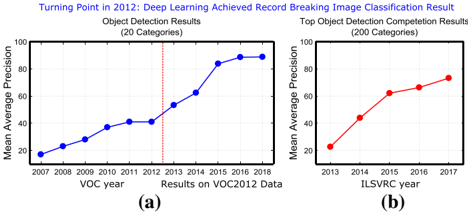
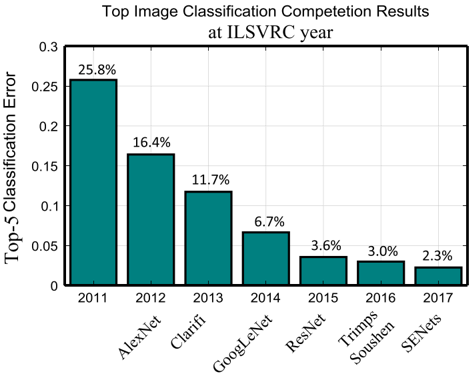
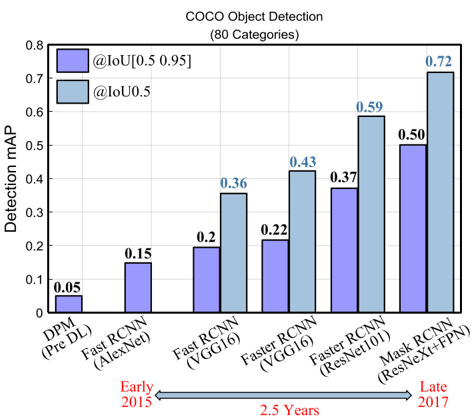
- The main datasets are PASCAL VOC, ImageNet/ILSVRC, MS COCO, and Open Images; COCO contains 41% small and 24% large objects, and the best COCO detector trained on 80 classes reaches only 73% mAP even at 0.5 IoU, while ImageNet Top-5 classification error dropped from 16% to 2% in less than five years. The Open Images challenge winner achieved 61.71% mAP on the public leaderboard and 58.66% mAP on the private leaderboard.
- Future directions include open-world learning, better and more efficient detection frameworks, compact CNN features, automatic neural architecture search, object instance segmentation, weakly supervised detection, few/zero-shot detection, other modalities, and universal object detection.
Methods
- Design: a comprehensive literature survey of deep learning based generic object detection, focusing on major progress of the last 5 years, restricted to still pictures and to top journal and conference papers, with more than 300 research contributions included.
- Organization: the survey presents a taxonomy covering detection frameworks, object feature representation, object proposal generation, context modeling, training strategies, and evaluation metrics, and summarizes popular datasets and evaluation criteria such as AP/mAP and IOU thresholds.
- Analysis: no new experiments are reported; the paper synthesizes and compares reported results across PASCAL VOC, ILSVRC, MS COCO, and Open Images, and discusses representative methods in tables and figures.
Limitations
- Stated: the survey limits its focus to top journal and conference papers, covers mainly the last 5 years, restricts attention to still pictures, and leaves video object detection for separate future consideration; the authors apologize to authors whose works are not included.
- Stated: comparing detectors by their originally reported performance may be misleading because methods differ in meta-frameworks, backbone networks, pretraining datasets, proposal methods, augmentation, and ensembling; there has been very limited unified comparison work.
- Evident: the survey is not exhaustive given the breadth of the field, and it excludes extensive work on specific object detection such as face, pedestrian, vehicle, and traffic sign detection; the provided text also contains fragmented tables and figures, which limits some detail.
Model-written summary. Check it against the paper before relying on it.
Integrity signals
Registry
Cites
Statistics
Figures


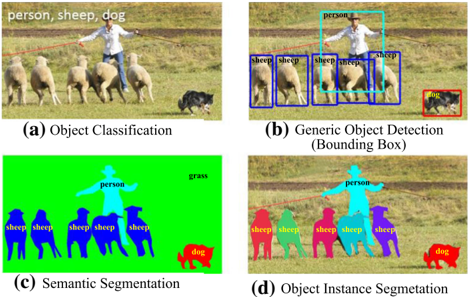
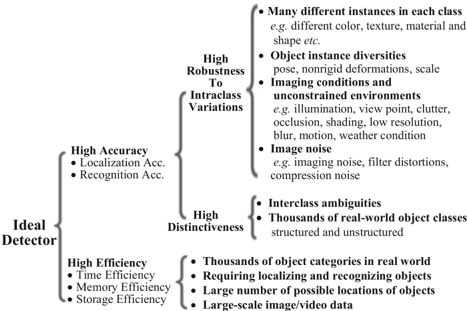
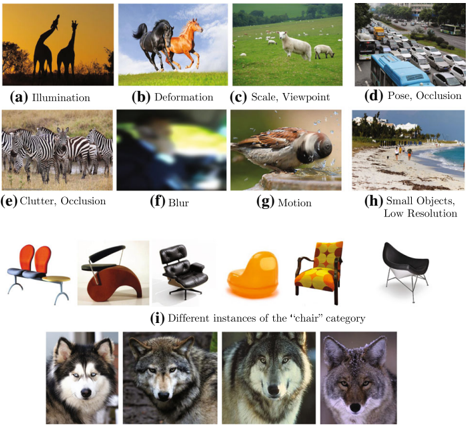
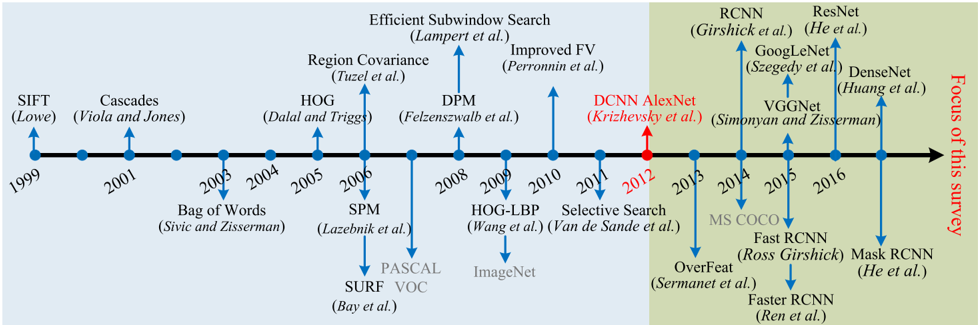

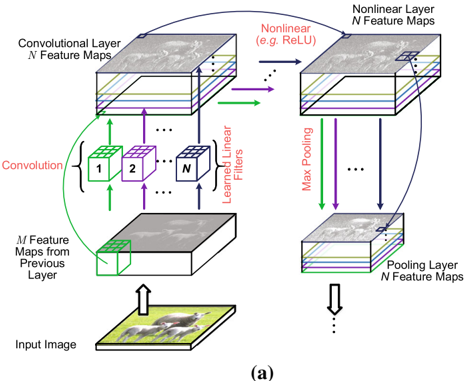
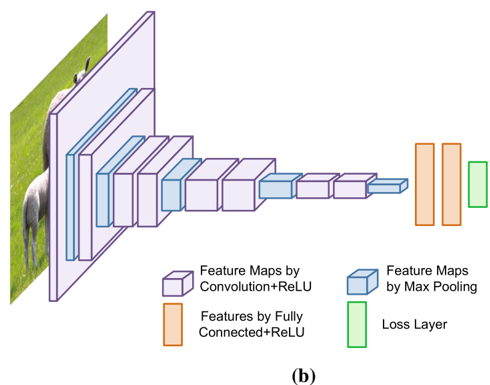
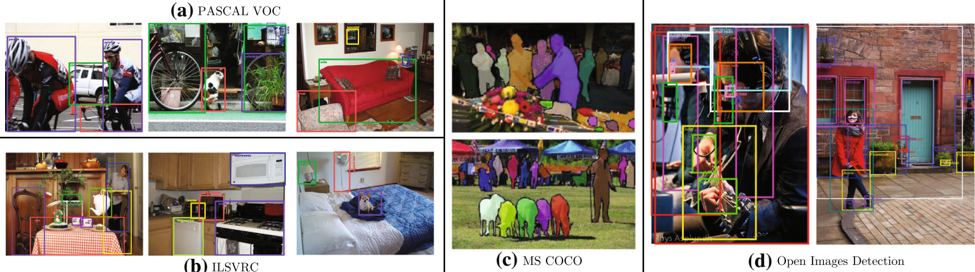
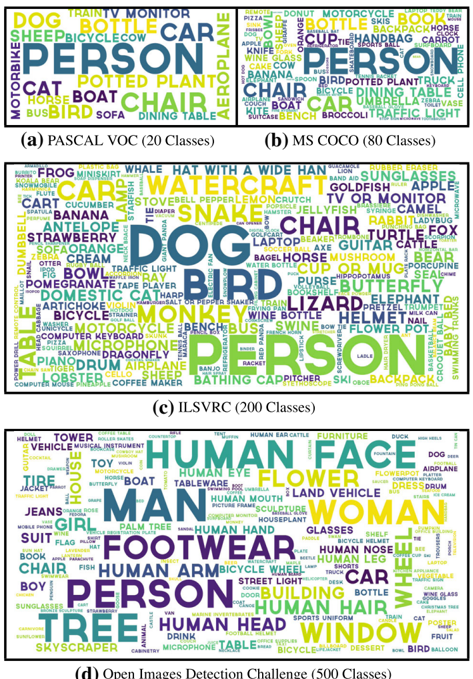
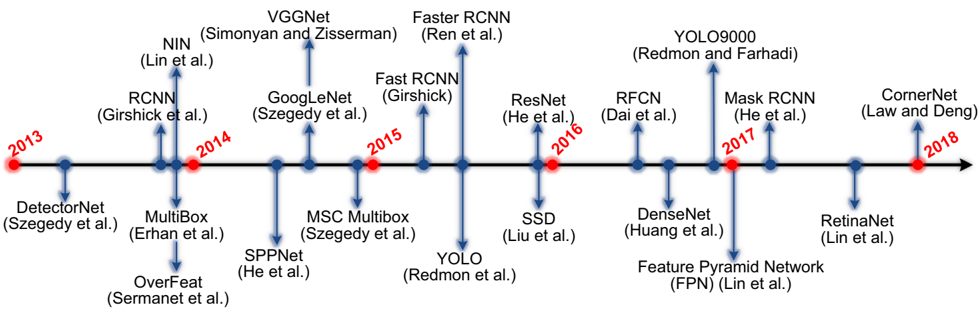
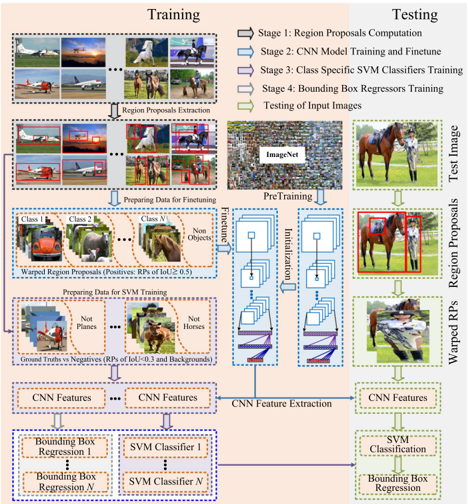
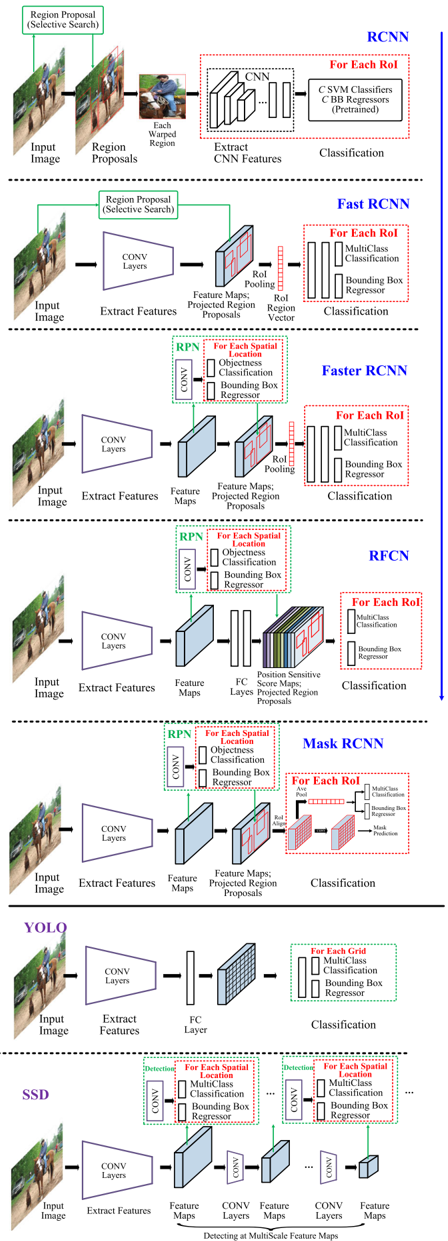
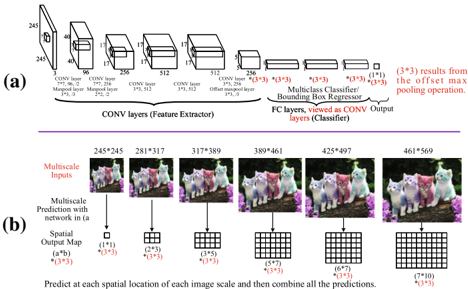
Verification
Claims the paper makes
14 Valid · 16 Not valid · 154 Not checked · 108 Own results and interpretations
The cited sources support only part of this claim — read each source’s verdict below.
In the paper
“To the best of our knowledge, for the evaluation of generic object detection algorithms, it is bounding boxes which are most widely used in the current literature (Everingham et al. 2010;Russakovsky et al. 2015), and therefore this is also the approach we adopt in this survey.”
§ Deep Learning for Generic Object Detection: A Survey > 2.1 The Problem
What the sources say
- Partly supportedcites Everingham et al. 2010 matched to “The pascal visual object classes (VOC) challenge” (2010) sourceExperimental — accuracy not yet measured
Section 2.2 (Detection) and “Bounding box evaluation” show that the VOC challenge evaluated object detections using predicted bounding boxes and their overlap with ground truth. The paper does not establish the broader comparative claim that bounding boxes were the most widely used evaluation approach in the literature. (LLM, conf=0.84)
- Not checked yetcites Russakovsky et al. 2015 matched to “ImageNet Large Scale Visual Recognition Challenge” (2015) source
hedged- Asserted: passes — The authors put it forward as true.
- Checkable: passes — It can be checked against evidence.
- Load-bearing: passes — The paper’s conclusions depend on it.
- Based: passes — The paper gives a reason why it holds.
- Partly supported
The sources with a verdict support this claim; the rest weren’t checked yet, have no full text we could read, or their verdicts aren’t rated yet.
In the paper
“In practice, current detectors focus mainly on structured object categories, such as the 20, 200 and 91 object classes in PASCAL VOC (Everingham et al. 2010), ILSVRC (Russakovsky et al. 2015) and MS COCO (Lin et al. 2014) respectively.”
§ Deep Learning for Generic Object Detection: A Survey > 2.2.1 Accuracy Related Challenges
What the sources say
- Supportedcites Everingham et al. 2010 matched to “The pascal visual object classes (VOC) challenge” (2010) source
The citation is offered for the identification of PASCAL VOC as the benchmark with 20 object classes. Our copy states this repeatedly: Sect. 3.2 'Choice of Classes' says 'Fig. 2 shows the 20 classes selected for annotation in the VOC2007 dataset' and that the count rose from 4 (VOC2005) to 10 (VOC2006) to 20 (VOC2007); Sect. 3.1 refers to 'each of the 20 object classes to be annotated'; Sect. 3.5 notes 'the number of classes doubled from 10 to 20'. The surrounding framing about detectors focusing on structured categories is the citing authors' own conclusion, not attributed to this source. (LLM, conf=0.90)
- Not checked yetcites Russakovsky et al. 2015 matched to “ImageNet Large Scale Visual Recognition Challenge” (2015) source
- Not checked yetcites Lin et al. 2014
plain- Asserted: passes — The authors put it forward as true.
- Checkable: passes — It can be checked against evidence.
- Load-bearing: unclear — It is unclear whether the paper’s conclusions depend on it.
- Based: passes — The paper gives a reason why it holds.
- Supported
The sources with a verdict support this claim; the rest weren’t checked yet, have no full text we could read, or their verdicts aren’t rated yet.
In the paper
“The Faster RCNN framework proposed by Ren et al. (2015Ren et al. ( , 2017) ) offered an efficient and accurate Region Proposal Network (RPN) for generating region proposals.”
§ Deep Learning for Generic Object Detection: A Survey > 5.1 Region Based (Two Stage) Frameworks
What the sources say
- Not checked yetcites Ren et al. 2015
- Supportedcites Ren et al. 2017 matched to “Faster R-CNN: Towards Real-Time Object Detection with Region Proposal Networks” (2017) source
The Abstract (p. 1) states the paper introduces an RPN that shares full-image convolutional features, enabling 'nearly cost-free region proposals' trained end-to-end 'to generate high-quality region proposals', and the Introduction (p. 1) gives the marginal cost as ~10ms per image. Efficiency and accuracy are both borne out: Section 3 (p. 3) defines the RPN as the proposal module of Faster R-CNN, and p. 2 reports it beats the Selective Search baseline in detection accuracy while waiving nearly all of its computational burden. The paraphrase matches the source at the same level of specificity. (LLM, conf=0.92)
plain- Asserted: passes — The authors put it forward as true.
- Checkable: passes — It can be checked against evidence.
- Load-bearing: unclear — It is unclear whether the paper’s conclusions depend on it.
- Based: passes — The paper gives a reason why it holds.
The sources with a verdict support this claim; the rest weren’t checked yet, have no full text we could read, or their verdicts aren’t rated yet.
In the paper
“In contrast, deep learning methods (especially deep CNNs) can learn powerful feature representations with multiple levels of abstraction directly from raw images (Bengio et al. 2013;LeCun et al. 2015).”
§ Deep Learning for Generic Object Detection: A Survey > 6 Object Representation
What the sources say
- Supportedcites Bengio et al. 2013 matched to “Representation Learning: A Review and New Perspectives” (2013) source
Section 3.4 (pp. 4-5) states that deep architectures 'can potentially lead to progressively more abstract features at higher layers' and that in the convolutional neural network this abstraction is built in explicitly via pooling, making representations 'generally highly non-linear functions of the raw input'. The Introduction (p. 1) frames the whole point as reducing dependence on labor-intensive feature engineering so that algorithms can extract discriminative information from low-level sensory data, and Section 11.2 (p. 24) applies this to the 2D layout of pixels in images via local receptive fields, convolution and pooling. Section 10.1 (p. 22-23) reinforces the 'powerful' element with the ImageNet deep convolutional result. Together these support the paraphrased claim, including the CNN emphasis and the multiple-levels-of-abstraction-from-raw-images core. (LLM, conf=0.90)
- Not checked yetcites LeCun et al. 2015 matched to “Deep learning” (2015) source
plainstates a cause- Asserted: passes — The authors put it forward as true.
- Checkable: passes — It can be checked against evidence.
- Load-bearing: passes — The paper’s conclusions depend on it.
- Based: passes — The paper gives a reason why it holds.
- Supported
The cited sources support only part of this claim — read each source’s verdict below.
In the paper
“Furthermore, the relationship between the source and target datasets plays a critical role, for example that ImageNet based CNN features show better performance for object detection than for human action (Zhou et al. 2015;Azizpour et al. 2016).”
§ Deep Learning for Generic Object Detection: A Survey > 6.1 Popular CNN Architectures
What the sources say
- Not checked yetcites Zhou et al. 2015
- Partly supportedcites Azizpour et al. 2016 matched to “Factors of Transferability for a Generic ConvNet Representation” (2016) sourceExperimental — accuracy not yet measured
The Introduction (p. 2) and Table I say that optimal transfer settings depend on the distance between the ImageNet source task and the target task, supporting the general point. The paper does not establish the citing sentence’s specific comparison that ImageNet-based features perform better for object detection than for human action recognition; its discussion of object detection in the Closing Discussion (p. 11) does not make that comparison. (LLM, conf=0.84)
plainstates an association- Asserted: passes — The authors put it forward as true.
- Checkable: passes — It can be checked against evidence.
- Load-bearing: unclear — It is unclear whether the paper’s conclusions depend on it.
- Based: passes — The paper gives a reason why it holds.
98 more claims · 5 with their cited sources checked
Create a free account to see all 292 claims and to verify the 284 references still open.
- Probably not a substantial claim. 108
- It may state two separate claims as one. 121
- The quote only partly states this claim. 2
Claims other papers make about this one
Each is checked against this paper’s own text: does it say what the citing paper says it does?
The cited source says what the claim attributes to it.
In the citing paper
“Modern object detectors employ many hand-crafted components (Liu et al., 2020), e.g., anchor generation, rule-based training target assignment, non-maximum suppression (NMS) post-processing.”
From Deformable DETR: Deformable Transformers for End-to-End Object Detection (2020) · cites this paper as Liu et al., 2020
The check wasn’t confident either way, so it gives no verdict — never disputed.
In the citing paper
“Over the last few decades, most deep learning-based object tracking systems have been based on CNN architectures [84, 139].”
From A survey on deep multimodal learning for computer vision: advances, trends, applications, and datasets (2022) · cites this paper as [84]
Experimental — accuracy not yet measuredIn the citing paper
“Fortunately, advanced imaging techniques and emerging machine learning methods jointly resist the challenges of unsatisfactory imaging environments and quasi real-time requirements [5], forcefully driving the progress of defect recognition, especially in learning classification [8].”
From Automated Visual Defect Classification for Flat Steel Surface: A Survey (2020) · cites this paper as [8]
Self-check
Percentages, sums and reported differences re-computed from the paper’s own numbers.
Rated minor: it would not touch a result — a value no result rests on, a p-value that stays on the same side of the significance level, or a conflict that is clerical, resolved elsewhere in the paper, or outside its own findings.
In the paper
“| VOC10 | 20 | 4998 | 5105 | 9637 | 11,577(13,339) 11,797(13,352) 10,103 | 23,374 | 2.4 | | |”
§ Deep Learning for Generic Object Detection: A Survey > 10.3 Research Directions
Reported 2.4 · recomputed 2.31357
Rated minor: it would not touch a result — a value no result rests on, a p-value that stays on the same side of the significance level, or a conflict that is clerical, resolved elsewhere in the paper, or outside its own findings.
In the paper
“| VOC09 | 20 | 3473 | 3581 | 6650 | 8505(9760) | 8713(9779) | 7054 | 17,218 | 2.3 |”
§ Deep Learning for Generic Object Detection: A Survey > 10.3 Research Directions
Reported 2.3 · recomputed 2.440885
Citations
Cites
Deep Residual Learning for Image Recognition
He, K., Zhang, X., Ren, S., & Sun, J. (2016) · 2016 IEEE Conference on Computer Vision and Pattern Recognition (CVPR) · doi:10.1109/cvpr.2016.90 · Cited by 235,474 · cited 5×
“GNet. Similarly, ResNet demonstrated the effectiveness of skip connections for learning extremely deep networks with hundreds of layers, winning the ILSVRC 2015 classification task. Inspired by ResNet [101], InceptionResNets [265] combined the Inception networks with shortcut connections, on the basis that shortcut con…”
BackgroundMethodInfluentialVaswani, A., Shazeer, N., Parmar, N., Uszkoreit, J., Jones, L., Gomez, A. N., Kaiser, L., & Polosukhin, I. (2017) · arXiv · doi:10.48550/arxiv.1706.03762 · Cited by 120,404 · cited 1×
“ning architecture where image and memory are processed in parallel to obtain detections which further update memory. Inspired by the recent success of attention modules in natural language processing [274], ORN processes a set of objects simultaneously through the interaction between their appearance 22 Li Liu et al.…”
BackgroundVery Deep Convolutional Networks for Large-Scale Image Recognition
Simonyan, K., & Zisserman, A. (2014) · arXiv · doi:10.48550/arxiv.1409.1556 · Cited by 114,148 · cited 1×
“including the following choices: Meta detection frameworks, such as RCNN [85], Fast RCNN [84], Faster RCNN [229], RFCN [50], Mask RCNN [102], YOLO [227] and SSD [175]; Backbone networks such as VGG [248], Inception [263,125, 264], ResNet [101], ResNeXt [291], and Xception [45] etc. listed in Table6; Innovations such a…”
MethodImageNet classification with deep convolutional neural networks
Krizhevsky, A., Sutskever, I., & Hinton, G. E. (2017) · Communications of the ACM · doi:10.1145/3065386 · Cited by 112,155
Hochreiter, S., & Schmidhuber, J. (1997) · Neural Computation · doi:10.1162/neco.1997.9.8.1735 · Cited by 102,318 · cited 1×
“Noting that message passing is not always helpful but dependent on individual samples, Zeng et al. used gated functions to control message transmission, like in Long Short Term Memory (LSTM) networks [83]. Concurrent with GBDNet, Li et al. [123] presented ACCNN (Fig.13(c)) to utilize both global and local contextual i…”
MethodLeCun, Y., Bengio, Y., & Hinton, G. (2015) · Nature · doi:10.1038/nature14539 · Cited by 84,126
Faster R-CNN: Towards Real-Time Object Detection with Region Proposal Networks
Ren, S., He, K., Girshick, R., & Sun, J. (2017) · IEEE Transactions on Pattern Analysis and Machine Intelligence · doi:10.1109/tpami.2016.2577031 · Cited by 73,472 · cited 5×
“Ren ら [229, 230] により提案された Faster RCNN フ レームワークは,物体領域候補(領域提案)生成用に効率的で Input Image Region Proposals Extract CNN Features Each Warped Region”
InfluentialFaster R-CNN: Towards Real-Time Object Detection with Region Proposal Networks
Ren, S., He, K., Girshick, R., & Sun, J. (2015) · arXiv · doi:10.48550/arxiv.1506.01497 · Cited by 70,812 · cited 5×
“Ren ら [229, 230] により提案された Faster RCNN フ レームワークは,物体領域候補(領域提案)生成用に効率的で Input Image Region Proposals Extract CNN Features Each Warped Region”
InfluentialImageNet: A large-scale hierarchical image database
Deng, J., Dong, W., Socher, R., Li, L.-J., Li, K., & Fei-Fei, L. (2009) · 2009 IEEE Conference on Computer Vision and Pattern Recognition · doi:10.1109/cvpr.2009.5206848 · Cited by 65,333 · cited 4×
“pretrained network is typically finetuned11 on a given detection dataset [58,83,85]. Several large scale image classification datasets are used for CNN pretraining. Among them the ImageNet1000 dataset [52,230] with 1.2 million images of 1000 object categories, or the Places dataset [311] which is much larger than ImageN…”
BackgroundMethodInfluentialGradient-based learning applied to document recognition
Lecun, Y., Bottou, L., Bengio, Y., & Haffner, P. (1998) · Proceedings of the IEEE · doi:10.1109/5.726791 · Cited by 58,805
Distinctive Image Features from Scale-Invariant Keypoints
Lowe, D. G. (2004) · International Journal of Computer Vision · doi:10.1023/b:visi.0000029664.99615.94 · Cited by 55,589
You Only Look Once: Unified, Real-Time Object Detection
Redmon, J., Divvala, S., Girshick, R., & Farhadi, A. (2016) · 2016 IEEE Conference on Computer Vision and Pattern Recognition (CVPR) · doi:10.1109/cvpr.2016.91 · Cited by 53,803
Densely Connected Convolutional Networks
Huang, G., Liu, Z., Van Der Maaten, L., & Weinberger, K. Q. (2017) · 2017 IEEE Conference on Computer Vision and Pattern Recognition (CVPR) · doi:10.1109/cvpr.2017.243 · Cited by 48,566
Going deeper with convolutions
Szegedy, C., Liu, W., Jia, Y., Sermanet, P., Reed, S., Anguelov, D., Erhan, D., Vanhoucke, V., & Rabinovich, A. (2015) · 2015 IEEE Conference on Computer Vision and Pattern Recognition (CVPR) · doi:10.1109/cvpr.2015.7298594 · Cited by 48,562
Microsoft COCO: Common Objects in Context
Lin, T.-Y., Maire, M., Belongie, S., Hays, J., Perona, P., Ramanan, D., Dollár, P., & Zitnick, C. L. (2014) · Lecture Notes in Computer Science · doi:10.1007/978-3-319-10602-1_48 · Cited by 45,460
ImageNet Large Scale Visual Recognition Challenge
Russakovsky, O., Deng, J., Su, H., Krause, J., Satheesh, S., Ma, S., Huang, Z., Karpathy, A., Khosla, A., Bernstein, M., et al. (2015) · International Journal of Computer Vision · doi:10.1007/s11263-015-0816-y · Cited by 39,380
Fully convolutional networks for semantic segmentation
Long, J., Shelhamer, E., & Darrell, T. (2015) · 2015 IEEE Conference on Computer Vision and Pattern Recognition (CVPR) · doi:10.1109/cvpr.2015.7298965 · Cited by 38,834
Squeeze-and-Excitation Networks
Hu, J., Shen, L., & Sun, G. (2018) · 2018 IEEE/CVF Conference on Computer Vision and Pattern Recognition · doi:10.1109/cvpr.2018.00745 · Cited by 35,667
Histograms of Oriented Gradients for Human Detection
Dalal, N., & Triggs, B. (2005) · 2005 IEEE Computer Society Conference on Computer Vision and Pattern Recognition (CVPR'05) · doi:10.1109/cvpr.2005.177 · Cited by 33,584 · cited 5×
“gress on various visual recognition tasks was based substantially on the use of local descriptors [183] such as Haar like features [269], SIFT [175], Shape Contexts [12], Histogram of Gradients (HOG) [50] and Local Binary Patterns (LBP) [192], covariance [261]. These local features are usually aggregated by simple con…”
BackgroundMethodInfluentialRich Feature Hierarchies for Accurate Object Detection and Semantic Segmentation
Girshick, R., Donahue, J., Darrell, T., & Malik, J. (2014) · 2014 IEEE Conference on Computer Vision and Pattern Recognition · doi:10.1109/cvpr.2014.81 · Cited by 32,684
Rethinking the Inception Architecture for Computer Vision
Szegedy, C., Vanhoucke, V., Ioffe, S., Shlens, J., & Wojna, Z. (2016) · 2016 IEEE Conference on Computer Vision and Pattern Recognition (CVPR) · doi:10.1109/cvpr.2016.308 · Cited by 32,138
(2016) · Cited by 31,590
Feature Pyramid Networks for Object Detection
Lin, T.-Y., Dollar, P., Girshick, R., He, K., Hariharan, B., & Belongie, S. (2017) · 2017 IEEE Conference on Computer Vision and Pattern Recognition (CVPR) · doi:10.1109/cvpr.2017.106 · Cited by 30,939 · cited 5×
“viate the problem arising from scale variation across object instances. Representative methods include SharpMask [210], Deconvolutional Single Shot Detector (DSSD) [75], Feature Pyramid Network (FPN) [163], Top Down Modulation (TDM )[243], Reverse connection with Objectness prior Network (RON) [132], ZIP [152], Scale…”
MethodInfluentialFocal Loss for Dense Object Detection
Lin, T.-Y., Goyal, P., Girshick, R., He, K., & Dollar, P. (2017) · 2017 IEEE International Conference on Computer Vision (ICCV) · doi:10.1109/iccv.2017.324 · Cited by 30,581 · cited 5×
“RetinaNet [168] − ResNet101 +FPN RetinaNet − − 39.”
BackgroundMethodInfluentialHe, K., Gkioxari, G., Dollar, P., & Girshick, R. (2017) · 2017 IEEE International Conference on Computer Vision (ICCV) · doi:10.1109/iccv.2017.322 · Cited by 29,137
Girshick, R. (2015) · 2015 IEEE International Conference on Computer Vision (ICCV) · doi:10.1109/iccv.2015.169 · Cited by 28,105
Batch Normalization: Accelerating Deep Network Training by Reducing Internal Covariate Shift
Ioffe, S., & Szegedy, C. (2015) · arXiv · doi:10.48550/arxiv.1502.03167 · Cited by 27,818 · cited 8×
“Inspired by ResNet [79], InceptionResNets [202] combine the Inception networks with short-cut connections, claiming that shortcut connections can signifi-cantly accelerate the training of Inception networks.”
MethodInfluentialChen, L.-C., Papandreou, G., Kokkinos, I., Murphy, K., & Yuille, A. L. (2018) · IEEE Transactions on Pattern Analysis and Machine Intelligence · doi:10.1109/tpami.2017.2699184 · Cited by 22,392
Chen, L.-C., Papandreou, G., Kokkinos, I., Murphy, K., & Yuille, A. L. (2016) · arXiv · doi:10.48550/arxiv.1606.00915 · Cited by 22,392
SSD: Single Shot MultiBox Detector
Liu, W., Anguelov, D., Erhan, D., Szegedy, C., Reed, S., Fu, C.-Y., & Berg, A. C. (2016) · Lecture Notes in Computer Science · doi:10.1007/978-3-319-46448-0_2 · Cited by 22,128 · cited 10×
“SSD [136] and MSCNN [20], RBFNet [135], and DSOD [186] combine predictions from multiple feature maps to handle objects of various sizes.”
BackgroundMethodInfluentialReducing the dimensionality of data with neural networks
Hinton, G. E., & Salakhutdinov, R. R. (2006) · Science · doi:10.1126/science.1127647 · Cited by 20,928
Xception: Deep Learning with Depthwise Separable Convolutions
Chollet, F. (2017) · 2017 IEEE Conference on Computer Vision and Pattern Recognition (CVPR) · doi:10.1109/cvpr.2017.195 · Cited by 20,380 · cited 4×
“Research on CNN architectures remain active, and a numer of backbone networks are still emerging such as Dilated Residual Networks [230], Xception [35], DetNet [127], and Dual Path Networks (DPN) [31].”
BackgroundMethodInfluentialYOLO9000: Better, Faster, Stronger
Redmon, J., & Farhadi, A. (2017) · 2017 IEEE Conference on Computer Vision and Pattern Recognition (CVPR) · doi:10.1109/cvpr.2017.690 · Cited by 19,892 · cited 3×
“other layer in a feed forward fashion; Alleviate the vanishing gradient problem, strengthen feature propagation, encourage feature reuse, and substantially reduce the number of parameters. 16 DarkNet [173] 20 19 [173] Similar to VGGNet, but with significantly less parameters due to the use of fewer filters at each layer…”
BackgroundMethodInfluentialDelving Deep into Rectifiers: Surpassing Human-Level Performance on ImageNet Classification
He, K., Zhang, X., Ren, S., & Sun, J. (2015) · 2015 IEEE International Conference on Computer Vision (ICCV) · doi:10.1109/iccv.2015.123 · Cited by 19,741 · cited 1×
“2015) network is replaced with the simpler DarkNet19, plus batch normalization (He et al. 2015), removing the fully connected layers, and using good anchor boxes8 learned via kmeans and multiscale training.”
MethodThe pascal visual object classes (VOC) challenge
Everingham, M., Van Gool, L., Williams, C. K. I., Winn, J., & Zisserman, A. (2010) · International Journal of Computer Vision · doi:10.1007/s11263-009-0275-4 · Cited by 19,599
MobileNets: Efficient Convolutional Neural Networks for Mobile Vision Applications
Howard, A. G., Zhu, M., Chen, B., Kalenichenko, D., Wang, W., Weyand, T., Andreetto, M., & Adam, H. (2017) · arXiv · doi:10.48550/arxiv.1704.04861 · Cited by 19,015 · cited 3×
“8% [88] Faster training with the introduce of Batch Normalization.”
BackgroundMethodRapid object detection using a boosted cascade of simple features
Viola, P., & Jones, M. (2005) · Proceedings of the 2001 IEEE Computer Society Conference on Computer Vision and Pattern Recognition. CVPR 2001 · doi:10.1109/cvpr.2001.990517 · Cited by 18,300 · cited 5×
“e Scale Invariant Feature Transform (SIFT) feature [178], and the progress on various visual recognition tasks was based substantially on the use of local descriptors [187] such as Haar-like features [276], SIFT [179], Shape Contexts [12], Histogram of Gradients (HOG) [52] Local Binary Patterns (LBP) [196], and region…”
InfluentialObject recognition from local scale-invariant features
Lowe, D. G. (1999) · Proceedings of the Seventh IEEE International Conference on Computer Vision · doi:10.1109/iccv.1999.790410 · Cited by 16,472 · cited 3×
“, SIFT [178] and HOG [52]) and to explore approaches (e.”
BackgroundMethodInfluentialVisualizing and understanding convolutional networks
Zeiler, M. D., & Fergus, R. (2014) · Lecture Notes in Computer Science · doi:10.1007/978-3-319-10590-1_53 · Cited by 15,839 · cited 4×
“edges), intermediate layers extract features of increasing complexity, such as combinations of low level features, and later convolutional layers detect objects as combinations of earlier parts [234, 12, 116, 157].”
BackgroundMethodInfluentialMultiresolution gray-scale and rotation invariant texture classification with local binary patterns
Ojala, T., Pietikainen, M., & Maenpaa, T. (2002) · IEEE Transactions on Pattern Analysis and Machine Intelligence · doi:10.1109/tpami.2002.1017623 · Cited by 15,398
A survey on deep learning in medical image analysis
Litjens, G., Kooi, T., Bejnordi, B. E., Setio, A. A. A., Ciompi, F., Ghafoorian, M., van der Laak, J. A. W. M., van Ginneken, B., & Sánchez, C. I. (2017) · Medical Image Analysis · doi:10.1016/j.media.2017.07.005 · Cited by 15,332
Batch Normalization: Accelerating Deep Network Training by Reducing Internal Covariate Shift
Ioffe, S. (2024) · arXiv (Cornell University) · doi:10.57702/o9raffed · Cited by 14,214
Distilling the Knowledge in a Neural Network
Hinton, G., Vinyals, O., & Dean, J. (2015) · arXiv · doi:10.48550/arxiv.1503.02531 · Cited by 14,204 · cited 2×
“• Meta detection frameworks, such as RCNN [65], Fast RCNN [64], Faster RCNN [175], RFCN [40], Mask RCNN [80], YOLO [174] and SSD [136]; • Backbone networks such as VGG [191], Inception [200, 99, 201], ResNet [79], ResNeXt [223], Xception [35] and DetNet [127] etc. listed in Table 2; • Innovations such as multilayer fe…”
BackgroundRepresentation Learning: A Review and New Perspectives
Bengio, Y., Courville, A., & Vincent, P. (2013) · IEEE Transactions on Pattern Analysis and Machine Intelligence · doi:10.1109/tpami.2013.50 · Cited by 13,001
Aggregated Residual Transformations for Deep Neural Networks
Xie, S., Girshick, R., Dollar, P., Tu, Z., & He, K. (2017) · 2017 IEEE Conference on Computer Vision and Pattern Recognition (CVPR) · doi:10.1109/cvpr.2017.634 · Cited by 12,465 · cited 4×
“ion performance. 13 Inception v4 [258] 41 75 An Inception variant without residual connections with roughly the same recognition performance as InceptionResNet v2, but significantly slower. 14 ResNeXt [284] 23 49 3:0% [284] Repeating a building block that aggregates a set of transformations with the same topology. 15 D…”
BackgroundMethodInfluentialSqueeze-and-Excitation Networks
Hu, J., Shen, L., Albanie, S., Sun, G., & Wu, E. (2020) · IEEE Transactions on Pattern Analysis and Machine Intelligence · doi:10.1109/tpami.2019.2913372 · Cited by 12,157
Fully convolutional networks for semantic segmentation
Shelhamer, E., Long, J., & Darrell, T. (2017) · IEEE Transactions on Pattern Analysis and Machine Intelligence · doi:10.1109/tpami.2016.2572683 · Cited by 11,898 · cited 4×
“cent works propose to detect objects at multiple layers, and the resulting features obtained by combining features from different layers. This approach has been found to be effective for segmentation [177,241] and human pose estimation [194], has been widely exploited by both one-stage and two-stage detectors to allev…”
BackgroundMethodInfluential(2016) · Cited by 11,679
Learning Deep Features for Discriminative Localization
Zhou, B., Khosla, A., Lapedriza, A., Oliva, A., & Torralba, A. (2016) · 2016 IEEE Conference on Computer Vision and Pattern Recognition (CVPR) · doi:10.1109/cvpr.2016.319 · Cited by 11,428 · cited 1×
“xternal region proposals. Region proposal computation is exposed as the new speed bottleneck in Fast RCNN. Recent work has shown that CNNs have a remarkable ability to localize objects in CONV layers [309,310, 44,196,94], an ability which is weakened in the FC layers. Therefore, the selective search can be replaced by…”
MethodCaffe: Convolutional Architecture for Fast Feature Embedding
Jia, Y., Shelhamer, E., Donahue, J., Karayev, S., Long, J., Girshick, R., Guadarrama, S., & Darrell, T. (2014) · Proceedings of the 22nd ACM international conference on Multimedia · doi:10.1145/2647868.2654889 · Cited by 11,077
A Comprehensive Survey on Graph Neural Networks
Wu, Z., Pan, S., Chen, F., Long, G., Zhang, C., & Yu, P. S. (2021) · IEEE Transactions on Neural Networks and Learning Systems · doi:10.1109/tnnls.2020.2978386 · Cited by 11,000 · cited 2×
“Given this tremendously rapid evolution, there exist many recent survey papers on deep learning (Bengio et al. 2013; Goodfellow et al. 2016; Gu et al. 2018; LeCun et al. 2015; Litjens et al. 2017; Pouyanfar et al. 2018; Wu et al. 2019; Young et al. 2018; Zhang et al. 2018d; Zhou et al. 2018a; Zhu et al. 2017).”
BackgroundExplaining and Harnessing Adversarial Examples
Goodfellow, I. J., Shlens, J., & Szegedy, C. (2014) · arXiv · doi:10.48550/arxiv.1412.6572 · Cited by 10,381 · cited 1×
“ate learning parameters and network architectures. Trained networks are poorly interpretable, there is a lack of robustness to degradations, and many DCNNs have shown serious vulnerability to attacks [88], all of which currently limit the use of DCNNs in real-world applications. 4 Datasets and Performance Evaluation 4…”
BackgroundInfluentialPath Aggregation Network for Instance Segmentation
Liu, S., Qi, L., Qin, H., Shi, J., & Jia, J. (2018) · 2018 IEEE/CVF Conference on Computer Vision and Pattern Recognition · doi:10.1109/cvpr.2018.00913 · Cited by 10,011
ShuffleNet: An Extremely Efficient Convolutional Neural Network for Mobile Devices
Zhang, X., Zhou, X., Lin, M., & Sun, J. (2018) · 2018 IEEE/CVF Conference on Computer Vision and Pattern Recognition · doi:10.1109/cvpr.2018.00716 · Cited by 9,982
ShuffleNet: An Extremely Efficient Convolutional Neural Network for Mobile Devices
Zhang, X., Zhou, X., Lin, M., & Sun, J. (2017) · arXiv · doi:10.48550/arxiv.1707.01083 · Cited by 9,982
Object Detection with Discriminatively Trained Part-Based Models
Felzenszwalb, P. F., Girshick, R. B., McAllester, D., & Ramanan, D. (2010) · IEEE Transactions on Pattern Analysis and Machine Intelligence · doi:10.1109/tpami.2009.167 · Cited by 9,853
Focal Loss for Dense Object Detection
Lin, T.-Y., Goyal, P., Girshick, R., He, K., & Dollar, P. (2020) · IEEE Transactions on Pattern Analysis and Machine Intelligence · doi:10.1109/tpami.2018.2858826 · Cited by 9,556
Model-Agnostic Meta-Learning for Fast Adaptation of Deep Networks
Finn, C., Abbeel, P., & Levine, S. (2017) · arXiv · doi:10.48550/arxiv.1703.03400 · Cited by 8,512 · cited 1×
“Therefore, the ability to learn from only few examples, few shot detection, is very appealing [30, 61, 75, 129, 144, 228, 237].”
BackgroundBeyond Bags of Features: Spatial Pyramid Matching for Recognizing Natural Scene Categories
Lazebnik, S., Schmid, C., & Ponce, J. (2006) · 2006 IEEE Computer Society Conference on Computer Vision and Pattern Recognition - Volume 2 (CVPR'06) · doi:10.1109/cvpr.2006.68 · Cited by 7,916 · cited 12×
“8, Fast RCNN enables end-to-end detector training (when ignoring the process of region proposal generation) by developing a streamlined training process that simultaneously learns a softmax classifier and class-specific bounding box regression using a multitask loss, rather than training a softmax classifier, SVMs, an…”
BackgroundInfluentialLearning Transferable Architectures for Scalable Image Recognition
Zoph, B., Vasudevan, V., Shlens, J., & Le, Q. V. (2018) · 2018 IEEE/CVF Conference on Computer Vision and Pattern Recognition · doi:10.1109/cvpr.2018.00907 · Cited by 7,831
Multi-scale context aggregation by dilated convolutions
Yu, F., & Koltun, V. (2015) · arXiv · doi:10.48550/arxiv.1511.07122 · Cited by 7,738 · cited 2×
“IEEE Computational Intelligence Magazine 13(3):55–75 6 [298] Yu F.”
BackgroundDeformable Convolutional Networks
Dai, J., Qi, H., Xiong, Y., Li, Y., Zhang, G., Hu, H., & Wei, Y. (2017) · 2017 IEEE International Conference on Computer Vision (ICCV) · doi:10.1109/iccv.2017.89 · Cited by 7,513 · cited 5×
“lore object part deformation; Also utilize context modeling, model averaging, and bounding box location refinement in the multistage detection pipeline; Highly engineered; Training not end to end; DCN [41] RPN ResNet101 IRN RFCN 82:6 (07+12) 58:0 37:5 CVPR17 (Deformable Convolutional Networks, DCN); Design efficient def…”
BackgroundMethodInfluentialCascade R-CNN: Delving Into High Quality Object Detection
Cai, Z., & Vasconcelos, N. (2018) · 2018 IEEE/CVF Conference on Computer Vision and Pattern Recognition · doi:10.1109/cvpr.2018.00644 · Cited by 7,370
The Pascal Visual Object Classes Challenge: A Retrospective
Everingham, M., Eslami, S. M. A., Van Gool, L., Williams, C. K. I., Winn, J., & Zisserman, A. (2015) · International Journal of Computer Vision · doi:10.1007/s11263-014-0733-5 · Cited by 7,139
Graph Neural Networks: A Review of Methods and Applications
Zhou, J., Cui, G., Hu, S., Zhang, Z., Yang, C., Liu, Z., Wang, L., Li, C., & Sun, M. (2018) · arXiv · doi:10.48550/arxiv.1812.08434 · Cited by 6,880 · cited 2×
“Given this time of tremendously rapid evolution, there exist many recent survey papers on deep learning [13, 86, 89, 145, 166, 212, 280, 290, 305, 312, 317].”
BackgroundGraph neural networks: A review of methods and applications
Zhou, J., Cui, G., Hu, S., Zhang, Z., Yang, C., Liu, Z., Wang, L., Li, C., & Sun, M. (2020) · AI Open · doi:10.1016/j.aiopen.2021.01.001 · Cited by 6,880
A performance evaluation of local descriptors
Mikolajczyk, K., & Schmid, C. (2005) · IEEE Transactions on Pattern Analysis and Machine Intelligence · doi:10.1109/tpami.2005.188 · Cited by 6,723
Generalized Intersection Over Union: A Metric and a Loss for Bounding Box Regression
Rezatofighi, H., Tsoi, N., Gwak, J., Sadeghian, A., Reid, I., & Savarese, S. (2019) · 2019 IEEE/CVF Conference on Computer Vision and Pattern Recognition (CVPR) · doi:10.1109/cvpr.2019.00075 · Cited by 6,612 · cited 1×
“There is also recent work (Jiang et al. 2018; Rezatofighi et al. 2019; Huang et al. 2019) formulating IOU directly as the optimization objective, and in proposing improved NMS results (Bodla et al.”
ResultRecent advances in convolutional neural networks
Gu, J., Wang, Z., Kuen, J., Ma, L., Shahroudy, A., Shuai, B., Liu, T., Wang, X., Wang, G., Cai, J., et al. (2018) · Pattern Recognition · doi:10.1016/j.patcog.2017.10.013 · Cited by 6,576
Self-citationVideo Google: a text retrieval approach to object matching in videos
Sivic, & Zisserman (2003) · Proceedings Ninth IEEE International Conference on Computer Vision · doi:10.1109/iccv.2003.1238663 · Cited by 6,367 · cited 3×
“d region covariances [268]. These local features are usually aggregated by simple concatenation or feature pooling encoders such as the Bag of Visual Words approach, introduced by Sivic and Zisserman [252] and Csurka et al. [47], Spatial Pyramid Matching (SPM) of BoW models [147], and Fisher Vectors [212]. For years,…”
BackgroundMethodShape matching and object recognition using shape contexts
Belongie, S., Malik, J., & Puzicha, J. (2002) · IEEE Transactions on Pattern Analysis and Machine Intelligence · doi:10.1109/34.993558 · Cited by 6,306
Joint Face Detection and Alignment Using Multitask Cascaded Convolutional Networks
Zhang, K., Zhang, Z., Li, Z., & Qiao, Y. (2016) · IEEE Signal Processing Letters · doi:10.1109/lsp.2016.2603342 · Cited by 6,214 · cited 1×
“ect detection, particularly for researchers wishing to enter the field. Since our focus is on generic object detection, the extensive work on DCNNs for specific object detection, such as face detection [154,306,116], pedestrian detection [307,109], vehicle detection [322] and traffic sign detection [329] will not be cons…”
BackgroundInfluentialSqueezeNet: AlexNet-level accuracy with 50x fewer parameters and <0.5MB model size
Iandola, F. N., Han, S., Moskewicz, M. W., Ashraf, K., Dally, W. J., & Keutzer, K. (2016) · arXiv · doi:10.48550/arxiv.1602.07360 · Cited by 6,201 · cited 1×
“逆 に,速度やパラメータ数を重視する backbone [112, 123, 312] もいくつか提案されている.”
Deep High-Resolution Representation Learning for Human Pose Estimation
Sun, K., Xiao, B., Liu, D., & Wang, J. (2019) · 2019 IEEE/CVF Conference on Computer Vision and Pattern Recognition (CVPR) · doi:10.1109/cvpr.2019.00584 · Cited by 5,984 · cited 1×
“• Up-scaling: Particularly for the detection of small objects, highresolution networks [255, 256] can be developed.”
BackgroundSelective Search for Object Recognition
Uijlings, J. R. R., van de Sande, K. E. A., Gevers, T., & Smeulders, A. W. M. (2013) · International Journal of Computer Vision · doi:10.1007/s11263-013-0620-5 · Cited by 5,980
Stacked Hourglass Networks for Human Pose Estimation
Newell, A., Yang, K., & Deng, J. (2016) · Lecture Notes in Computer Science · doi:10.1007/978-3-319-46484-8_29 · Cited by 5,634 · cited 3×
“このアプローチはセグメンテーショ ン [177, 241]や人物姿勢推定 [194]で有効性が見いだされ,物 体インスタンス間のスケール変動の問題を軽減するため,1段 階検出器と 2段階検出器の両方で広く利用されている.”
InfluentialSwain, M. J., & Ballard, D. H. (1991) · International Journal of Computer Vision · doi:10.1007/bf00130487 · Cited by 5,623
Recognition-by-components: A theory of human image understanding.
Biederman, I. (1987) · Psychological Review · doi:10.1037/0033-295x.94.2.115 · Cited by 5,621 · cited 2×
“Psychological review 94(2):115 6 [16] Biederman I.”
Face recognition using eigenfaces
Turk, M. A., & Pentland, A. P. (2002) · Proceedings. 1991 IEEE Computer Society Conference on Computer Vision and Pattern Recognition · doi:10.1109/cvpr.1991.139758 · Cited by 5,197 · cited 1×
“field. The milestones of object detection in more recent years are presented in Fig.4, in which two main eras (SIFT vs. DCNN) are highlighted. The appearance features moved from global representations [192,260,267] to local representations that are designed to be invariant to changes in translation, scale, rotation, il…”
BackgroundJaderberg, M., Simonyan, K., Zisserman, A., & Kavukcuoglu, K. (2015) · arXiv · doi:10.48550/arxiv.1506.02025 · Cited by 5,137 · cited 1×
“ce the robustness of CNN representations, aiming at learning invariant CNN representations with respect to different types of transformations such as scale [127,21], rotation [21,40,277,315], or both [122]. One representative work is Spatial Transformer Networks (STN) [122], which introduces a new learnable module to…”
BackgroundVisual categorization with bags of keypoints
Csurka, G. (2004) · European Conference on Computer Vision · Cited by 4,953
Han, S., Mao, H., & Dally, W. J. (2015) · arXiv · doi:10.48550/arxiv.1510.00149 · Cited by 4,662 · cited 1×
“ネットワークの冗長性を低減または除去するため,コン パクトで軽量なネットワークの設計 [29, 4, 119, 112, 169, 300] やネットワークの高速化 [44, 122, 253, 155, 158, 282]を行う研 究への関心が高まっている.”
Inception-v4, Inception-ResNet and the Impact of Residual Connections on Learning
Szegedy, C., Ioffe, S., Vanhoucke, V., & Alemi, A. (2017) · Proceedings of the AAAI Conference on Artificial Intelligence · doi:10.1609/aaai.v31i1.11231 · Cited by 4,636 · cited 5×
“Inspired by ResNet [79], InceptionResNets [202] combine the Inception networks with short-cut connections, claiming that shortcut connections can signifi-cantly accelerate the training of Inception networks.”
BackgroundMethodInfluential3D ShapeNets: A deep representation for volumetric shapes
Wu, Z., Song, S., Khosla, A., Yu, F., Zhang, L., Tang, X., & Xiao, J. (2015) · 2015 IEEE Conference on Computer Vision and Pattern Recognition (CVPR) · doi:10.1109/cvpr.2015.7298801 · Cited by 4,550 · cited 1×
“t detection in other modalities can be highly relevant in domains such as autonomous vehicles, unmanned aerial vehicles, and robotics. These modalities raise new challenges in effectively using depth [36,211,289,286], video [70,130], and point clouds [217,218]. (9) Universal Object Detection: Recently, there has been…”
BackgroundCNN Features Off-the-Shelf: An Astounding Baseline for Recognition
Razavian, A. S., Azizpour, H., Sullivan, J., & Carlsson, S. (2014) · 2014 IEEE Conference on Computer Vision and Pattern Recognition Workshops · doi:10.1109/cvprw.2014.131 · Cited by 4,451 · cited 1×
“A common scenario is for a CNN to be pretrained on a large dataset (usually with a large number of visual categories) with image-level labels; the pretrained CNN can then be applied to a small dataset, directly, as a generic feature extractor [223, 8, 60, 296], which can support a wider range of visual recognition tas…”
BackgroundSemantic Image Segmentation with Deep Convolutional Nets and Fully Connected CRFs
Chen, L.-C., Papandreou, G., Kokkinos, I., Murphy, K., & Yuille, A. L. (2014) · arXiv · doi:10.48550/arxiv.1412.7062 · Cited by 4,213 · cited 1×
“there is strong psychological evidence [13,9] that context plays an essential role in human object recognition. It is recognized that proper modeling of context helps object detection and recognition [203, 155,27,26,47,59], especially when object appearance features are insufficient because of small object size, occlus…”
BackgroundLabelMe: A Database and Web-Based Tool for Image Annotation
Russell, B. C., Torralba, A., Murphy, K. P., & Freeman, W. T. (2008) · International Journal of Computer Vision · doi:10.1007/s11263-007-0090-8 · Cited by 4,210
CenterNet: Keypoint Triplets for Object Detection
Duan, K., Bai, S., Xie, L., Qi, H., Huang, Q., & Tian, Q. (2019) · 2019 IEEE/CVF International Conference on Computer Vision (ICCV) · doi:10.1109/iccv.2019.00667 · Cited by 4,079 · cited 1×
“[60] proposed CenterNet to detect each object as a triplet of keypoints, by introducing one extra keypoint, i.”
BackgroundPlaces: A 10 Million Image Database for Scene Recognition
Zhou, B., Lapedriza, A., Khosla, A., Oliva, A., & Torralba, A. (2018) · IEEE Transactions on Pattern Analysis and Machine Intelligence · doi:10.1109/tpami.2017.2723009 · Cited by 4,042
DeCAF: A Deep Convolutional Activation Feature for Generic Visual Recognition
Donahue, J., Jia, Y., Vinyals, O., Hoffman, J., Zhang, N., Tzeng, E., & Darrell, T. (2013) · arXiv · doi:10.48550/arxiv.1310.1531 · Cited by 4,019 · cited 2×
“arger than ImageNet1000 but with fewer classes, a recent Places-Imagenet hybrid [319], or JFT300M [106,254]. Pretrained CNNs without fine-tuning were explored for object classification and detection in [60,87,1], where it was shown that detection accuracies are different for features extracted from different layers; for…”
BackgroundMethodNeural Architecture Search with Reinforcement Learning
Zoph, B., & Le, Q. V. (2016) · arXiv (Cornell University) · doi:10.48550/arxiv.1611.01578 · Cited by 3,974 · cited 1×
“It is natural to consider automated design of detection backbone architectures, such as the recent Automated Machine Learning (AutoML) [219], which has been applied to image classification and object detection [22, 39, 80, 171, 331, 332].”
MethodCornerNet: Detecting Objects as Paired Keypoints
Law, H., & Deng, J. (2018) · Lecture Notes in Computer Science · doi:10.1007/978-3-030-01264-9_45 · Cited by 3,852
Kuznetsova, A., Rom, H., Alldrin, N., Uijlings, J., Krasin, I., Pont-Tuset, J., Kamali, S., Popov, S., Malloci, M., Kolesnikov, A., et al. (2018) · arXiv · doi:10.48550/arxiv.1811.00982 · Cited by 3,653 · cited 14×
“Recognizing space limitations, we refer interested readers to the original papers [66, 67, 162, 230, 139] for detailed description of these datasets in terms of construction and properties.”
BackgroundMethodInfluentialWu, Y., & He, K. (2020) · International Journal of Computer Vision · doi:10.1007/s11263-019-01198-w · Cited by 3,601 · cited 1×
“ing the design of specific deep model suitable for object detection. In the research community, training from scratch becomes possible, as more training data and better training strategy are available [278,179,178]. More backbone deep models will be specifically designed for object detection. (3) Improving the Robustnes…”
BackgroundNeural network-based face detection
Rowley, H. A., Baluja, S., & Kanade, T. (1998) · IEEE Transactions on Pattern Analysis and Machine Intelligence · doi:10.1109/34.655647 · Cited by 3,554
Detecting faces in images: a survey
Yang, M.-H., Kriegman, D. J., & Ahuja, N. (2002) · IEEE Transactions on Pattern Analysis and Machine Intelligence · doi:10.1109/34.982883 · Cited by 3,427
DOTA: A Large-Scale Dataset for Object Detection in Aerial Images
Xia, G.-S., Bai, X., Ding, J., Zhu, Z., Belongie, S., Luo, J., Datcu, M., Pelillo, M., & Zhang, L. (2018) · 2018 IEEE/CVF Conference on Computer Vision and Pattern Recognition · doi:10.1109/cvpr.2018.00418 · Cited by 3,414
Deep Learning in Remote Sensing: A Comprehensive Review and List of Resources
Zhu, X. X., Tuia, D., Mou, L., Xia, G.-S., Zhang, L., Xu, F., & Fraundorfer, F. (2017) · IEEE Geoscience and Remote Sensing Magazine · doi:10.1109/mgrs.2017.2762307 · Cited by 3,400
Return of the Devil in the Details: Delving Deep into Convolutional Nets
Chatfield, K., Simonyan, K., Vedaldi, A., & Zisserman, A. (2014) · Proceedings of the British Machine Vision Conference 2014 · doi:10.5244/c.28.6 · Cited by 3,335
Pedestrian Detection: An Evaluation of the State of the Art
Dollar, P., Wojek, C., Schiele, B., & Perona, P. (2012) · IEEE Transactions on Pattern Analysis and Machine Intelligence · doi:10.1109/tpami.2011.155 · Cited by 3,190
A Comprehensive Survey on Graph Neural Networks
Wu, Z., Pan, S., Chen, F., Long, G., Zhang, C., & Yu, P. (2020) · UTS ePRESS (University of Technology Sydney) · Cited by 3,174
Learning and Transferring Mid-level Image Representations Using Convolutional Neural Networks
Oquab, M., Bottou, L., Laptev, I., & Sivic, J. (2014) · 2014 IEEE Conference on Computer Vision and Pattern Recognition · doi:10.1109/cvpr.2014.222 · Cited by 3,150 · cited 2×
“一般に,CNN の最初 の数層はエッジなどの低レベル特徴を抽出し,後方の層が複雑 性の増したより一般的な特徴を抽出する [303, 13, 149, 199].”
R-FCN: Object Detection via Region-based Fully Convolutional Networks
Dai, J., Li, Y., He, K., & Sun, J. Z. (2016) · arXiv (Cornell University) · doi:10.48550/arxiv.1605.06409 · Cited by 3,149
Spatial Pyramid Pooling in Deep Convolutional Networks for Visual Recognition
He, K., Zhang, X., Ren, S., & Sun, J. (2014) · Lecture Notes in Computer Science · doi:10.1007/978-3-319-10578-9_23 · Cited by 3,034 · cited 7×
“, an image pyramid) [72, 83, 96], which typically produces more accurate detection, however with obvious limitations of inference time and memory.”
BackgroundMethodInfluentialOne-shot learning of object categories
Fei-Fei, L., Fergus, R., & Perona, P. (2006) · IEEE Transactions on Pattern Analysis and Machine Intelligence · doi:10.1109/tpami.2006.79 · Cited by 3,029 · cited 1×
“ら即座に視覚的な概念を学ぶことができ,たいていうまく汎 化(一般化)できる [16, 144, 71].”
Pruning Filters for Efficient ConvNets
Li, H., Kadav, A., Durdanovic, I., Samet, H., & Graf, H. P. (2016) · arXiv · doi:10.48550/arxiv.1608.08710 · Cited by 2,928 · cited 1×
“In order reduce or remove network redundancy, there has been growing research interest in designing compact and lightweight networks [29, 4, 119, 112, 169, 300] and network acceleration [44, 122, 253, 155, 158, 282].”
BackgroundRecent Trends in Deep Learning Based Natural Language Processing [Review Article]
Young, T., Hazarika, D., Poria, S., & Cambria, E. (2018) · IEEE Computational Intelligence Magazine · doi:10.1109/mci.2018.2840738 · Cited by 2,921
Region-based convolutional networks for accurate object detection and segmentation
Girshick, R., Donahue, J., Darrell, T., & Malik, J. (2016) · IEEE Transactions on Pattern Analysis and Machine Intelligence · doi:10.1109/tpami.2015.2437384 · Cited by 2,912
A discriminatively trained, multiscale, deformable part model
Felzenszwalb, P., McAllester, D., & Ramanan, D. (2008) · 2008 IEEE Conference on Computer Vision and Pattern Recognition · doi:10.1109/cvpr.2008.4587597 · Cited by 2,867 · cited 2×
“be located at any position and scale in an image. During the heyday of handcrafted feature descriptors (SIFT [179], HOG [52] and LBP [196]), the most successful methods for object detection (e.g. DPM [72]) used sliding window techniques [276,52,72,98,275]. However, the number of windows is huge, growing with the numbe…”
BackgroundMethodHuman-level concept learning through probabilistic program induction
Lake, B. M., Salakhutdinov, R., & Tenenbaum, J. B. (2015) · Science · doi:10.1126/science.aab3050 · Cited by 2,817
PointNet: Deep Learning on Point Sets for 3D Classification and Segmentation
Qi, C. R., Su, H., Mo, K., & Guibas, L. J. (2016) · arXiv (Cornell University) · doi:10.48550/arxiv.1612.00593 · Cited by 2,817 · cited 2×
“デプス(奥行き,深度) [36, 211, 289, 286],動画 [70, 130],点 群 [217, 218]の効果的な使用に関して,これらのモダリティは 新たな課題を提起する.”
Speed/Accuracy Trade-Offs for Modern Convolutional Object Detectors
Huang, J., Rathod, V., Sun, C., Zhu, M., Korattikara, A., Fathi, A., Fischer, I., Wojna, Z., Song, Y., Guadarrama, S., et al. (2017) · 2017 IEEE Conference on Computer Vision and Pattern Recognition (CVPR) · doi:10.1109/cvpr.2017.351 · Cited by 2,743
Training Region-Based Object Detectors with Online Hard Example Mining
Shrivastava, A., Gupta, A., & Girshick, R. (2016) · 2016 IEEE Conference on Computer Vision and Pattern Recognition (CVPR) · doi:10.1109/cvpr.2016.89 · Cited by 2,686
OverFeat: Integrated Recognition, Localization and Detection using Convolutional Networks
Sermanet, P., Eigen, D., Zhang, X., Mathieu, M., Fergus, R., & LeCun, Y. (2013) · arXiv · doi:10.48550/arxiv.1312.6229 · Cited by 2,680 · cited 13×
“OverFeat performs object detection in a multiscale sliding window fashion via a single forward pass through the CNN network, which (with the exception of the final classification/regressor layer) consists only of convolutional layers.”
BackgroundMethodInfluentialEdge Boxes: Locating Object Proposals from Edges
Zitnick, C. L., & Dollár, P. (2014) · Lecture Notes in Computer Science · doi:10.1007/978-3-319-10602-1_26 · Cited by 2,656 · cited 3×
“The success of object detection based on detection proposals given by selective search [210, 209] has attracted broad interest [21, 7, 3, 33, 254, 50, 105, 144].”
BackgroundFrustum PointNets for 3D Object Detection from RGB-D Data
Qi, C. R., Liu, W., Wu, C., Su, H., & Guibas, L. J. (2018) · 2018 IEEE/CVF Conference on Computer Vision and Pattern Recognition · doi:10.1109/cvpr.2018.00102 · Cited by 2,655
Improving the Fisher Kernel for Large-Scale Image Classification
Perronnin, F., Sánchez, J., & Mensink, T. (2010) · Lecture Notes in Computer Science · doi:10.1007/978-3-642-15561-1_11 · Cited by 2,588 · cited 5×
“In the past, a great deal of effort was devoted to designing local descriptors ( e.g., SIFT [139] and HOG [42]) and to explore approaches ( e.g., Bag of Words [194] and Fisher Vector [166]) to group and abstract the descriptors into higher level representations in order to allow the discriminative object parts to begi…”
BackgroundMethodInfluentialTraining support vector machines: an application to face detection
Osuna, E., Freund, R., & Girosit, F. (2002) · Proceedings of IEEE Computer Society Conference on Computer Vision and Pattern Recognition · doi:10.1109/cvpr.1997.609310 · Cited by 2,486 · cited 1×
“gnition was based on geometric representations [190,215], with the focus later moving away from geometry and prior models towards the use of statistical classifiers (such as Neural Networks [233], SVM [201] and Adaboost [276,290]) based on appearance features [191,236]. This successful family of object detectors set th…”
MethodRevisiting Unreasonable Effectiveness of Data in Deep Learning Era
Sun, C., Shrivastava, A., Singh, S., & Gupta, A. (2017) · 2017 IEEE International Conference on Computer Vision (ICCV) · doi:10.1109/iccv.2017.97 · Cited by 2,484 · cited 1×
“2 million images of 1000 object categories, Places [319], which is much larger than ImageNet1000 but with fewer classes, a recent Places-Imagenet hybrid [319], or JFT300M [106, 254].”
BackgroundConditional Random Fields as Recurrent Neural Networks
Zheng, S., Jayasumana, S., Romera-Paredes, B., Vineet, V., Su, Z., Du, D., Huang, C., & Torr, P. H. S. (2015) · 2015 IEEE International Conference on Computer Vision (ICCV) · doi:10.1109/iccv.2015.179 · Cited by 2,386 · cited 1×
“It is broadly agreed that DCNNs make use of contextual information implicitly [303, 316] since they learn hierarchical representations with multiple levels of abstraction.”
BackgroundSoft-NMS — Improving Object Detection with One Line of Code
Bodla, N., Singh, B., Chellappa, R., & Davis, L. S. (2017) · 2017 IEEE International Conference on Computer Vision (ICCV) · doi:10.1109/iccv.2017.593 · Cited by 2,274 · cited 3×
“Like YOLO, SSD predicts a fixed number of bounding boxes and scores for the presence of object class instances in these boxes, followed by an NMS step to produce the final detection.”
NAS-FPN: Learning Scalable Feature Pyramid Architecture for Object Detection
Ghiasi, G., Lin, T.-Y., & Le, Q. V. (2019) · 2019 IEEE/CVF Conference on Computer Vision and Pattern Recognition (CVPR) · doi:10.1109/cvpr.2019.00720 · Cited by 2,099 · cited 2×
“IEEE TPAMI 32(7):1239–1258 2, 3 [80] Ghiasi G.”
Receptive Field Block Net for Accurate and Fast Object Detection
Liu, S., Huang, D., & Wang, Y. (2018) · Lecture Notes in Computer Science · doi:10.1007/978-3-030-01252-6_24 · Cited by 1,885
Visual learning and recognition of 3-d objects from appearance
Murase, H., & Nayar, S. K. (1995) · International Journal of Computer Vision · doi:10.1007/bf01421486 · Cited by 1,881
Progressive Neural Architecture Search
Liu, C., Zoph, B., Neumann, M., Shlens, J., Hua, W., Li, L.-J., Fei-Fei, L., Yuille, A., Huang, J., & Murphy, K. (2018) · Lecture Notes in Computer Science · doi:10.1007/978-3-030-01246-5_2 · Cited by 1,833
Yu, F., Koltun, V., & Funkhouser, T. (2017) · 2017 IEEE Conference on Computer Vision and Pattern Recognition (CVPR) · doi:10.1109/cvpr.2017.75 · Cited by 1,804 · cited 1×
“to winning of the ILSVRC 2017 classification task. Research on CNN architectures remains active, and a number of backbone networks are still emerging such as Hourglass [142], Dilated Residual Networks [292], Xception [43], DetNet [160], Dual Path Networks (DPN) [37], FishNet [250], GLoRe [38], etc. The training of a CN…”
BackgroundKuznetsova, A., Rom, H., Alldrin, N., Uijlings, J., Krasin, I., Pont-Tuset, J., Kamali, S., Popov, S., Malloci, M., Kolesnikov, A., et al. (2020) · International Journal of Computer Vision · doi:10.1007/s11263-020-01316-z · Cited by 1,738 · cited 14×
“Recognizing space limitations, we refer interested readers to the original papers [66, 67, 162, 230, 139] for detailed description of these datasets in terms of construction and properties.”
BackgroundMethodInfluentialAn HOG-LBP human detector with partial occlusion handling
Wang, X., Han, T. X., & Yan, S. (2009) · 2009 IEEE 12th International Conference on Computer Vision · doi:10.1109/iccv.2009.5459207 · Cited by 1,727 · cited 1×
“2 Milestones of object detection and recognition, including feature representations [37, 42, 79, 109, 114, 139, 140, 166, 191, 194, 200, 213, 215], detection frameworks [56, 65, 183, 209, 213], and datasets [53, 129, 179].”
Self-citationSingle-Shot Refinement Neural Network for Object Detection
Zhang, S., Wen, L., Bian, X., Lei, Z., & Li, S. Z. (2018) · 2018 IEEE/CVF Conference on Computer Vision and Pattern Recognition · doi:10.1109/cvpr.2018.00442 · Cited by 1,678
Hubara, I., Soudry, D., & Yaniv, R. E. (2016) · arXiv · doi:10.48550/arxiv.1602.02505 · Cited by 1,667 · cited 1×
“n to real-time / embedded applications. In response, there has been growing research interest in designing compact and lightweight networks [25,4,95,88,132, 231], network compression and acceleration [34,97,195,121, 124], and network interpretation and understanding [19,142,146]. (4) Robust Object Representations: One…”
BackgroundLearning RoI Transformer for Oriented Object Detection in Aerial Images
Ding, J., Xue, N., Long, Y., Xia, G.-S., & Lu, Q. (2019) · 2019 IEEE/CVF Conference on Computer Vision and Pattern Recognition (CVPR) · doi:10.1109/cvpr.2019.00296 · Cited by 1,666
Deep Neural Networks for Object Detection
Szegedy, C., Toshev, A., & Erhan, D. (2013) · neural information processing systems · Cited by 1,661
Kirillov, A., He, K., Girshick, R., Rother, C., & Dollár, P. (2019) · 2019 IEEE/CVF Conference on Computer Vision and Pattern Recognition (CVPR) · doi:10.1109/cvpr.2019.00963 · Cited by 1,659 · cited 1×
“xtual information remains to be explored, possibly guided by how human vision uses context, based on scene graphs [161], or via the full segmentation of objects and scenes using panoptic segmentation [134]. (5) Detection Proposals Detection proposals significantly reduce search spaces. As recommended in [110], future d…”
BackgroundInvariant Scattering Convolution Networks
Bruna, J., & Mallat, S. (2013) · IEEE Transactions on Pattern Analysis and Machine Intelligence · doi:10.1109/tpami.2012.230 · Cited by 1,633
DSSD : Deconvolutional Single Shot Detector
Fu, C.-Y., Liu, W., Ranga, A., Tyagi, A., & Berg, A. C. (2017) · arXiv · doi:10.48550/arxiv.1701.06659 · Cited by 1,624
Bar, M. (2004) · Nature Reviews Neuroscience · doi:10.1038/nrn1476 · Cited by 1,613
A Unified Multi-scale Deep Convolutional Neural Network for Fast Object Detection
Cai, Z., Fan, Q., Feris, R. S., & Vasconcelos, N. (2016) · Lecture Notes in Computer Science · doi:10.1007/978-3-319-46493-0_22 · Cited by 1,605 · cited 6×
“SSD [136] and MSCNN [20], RBFNet [135], and DSOD [186] combine predictions from multiple feature maps to handle objects of various sizes.”
BackgroundMethodInfluentialHybrid Task Cascade for Instance Segmentation
Chen, K., Pang, J., Wang, J., Xiong, Y., Li, X., Sun, S., Feng, W., Liu, Z., Shi, J., Ouyang, W., et al. (2019) · 2019 IEEE/CVF Conference on Computer Vision and Pattern Recognition (CVPR) · doi:10.1109/cvpr.2019.00511 · Cited by 1,587 · cited 2×
“s for generic object detection were proposed in the Chained Cascade Network [205], extended in Cascade RCNN [23], and more recently applied for simultaneous object detection and instance segmentation [31], winning the COCO 2018 Detection Challenge. Light Head RCNN: In order to further increase the detection speed of R…”
BackgroundMethodSelf-citationSynthetic Data for Text Localisation in Natural Images
Gupta, A., Vedaldi, A., & Zisserman, A. (2016) · 2016 IEEE Conference on Computer Vision and Pattern Recognition (CVPR) · doi:10.1109/cvpr.2016.254 · Cited by 1,563 · cited 1×
“Some researchers [64, 94] proposed augmenting datasets by pasting real segmented objects into natural images; indeed, Dvornik et al.”
BackgroundRelation Networks for Object Detection
Hu, H., Gu, J., Zhang, Z., Dai, J., & Wei, Y. (2018) · 2018 IEEE/CVF Conference on Computer Vision and Pattern Recognition · doi:10.1109/cvpr.2018.00378 · Cited by 1,524
The pyramid match kernel: discriminative classification with sets of image features
Grauman, K., & Darrell, T. (2005) · Tenth IEEE International Conference on Computer Vision (ICCV'05) Volume 1 · doi:10.1109/iccv.2005.239 · Cited by 1,481 · cited 8×
“Moreover, finetuning in SPPnet [77] is unable to update the convolutional layers before the SPP layer, which limits the accuracy of very deep networks.”
BackgroundInfluentialLocal grayvalue invariants for image retrieval
Schmid, C., & Mohr, R. (1997) · IEEE Transactions on Pattern Analysis and Machine Intelligence · doi:10.1109/34.589215 · Cited by 1,432
A Survey on Deep Learning: Algorithms, Techniques, and Applications
Pouyanfar, S., Sadiq, S., Yan, Y., Tian, H., Tao, Y., Reyes, M. P., Shyu, M.-L., Chen, S.-C., & Iyengar, S. S. (2019) · ACM Computing Surveys · doi:10.1145/3234150 · Cited by 1,403
A convolutional neural network cascade for face detection
Li, H., Lin, Z., Shen, X., Brandt, J., & Hua, G. (2015) · 2015 IEEE Conference on Computer Vision and Pattern Recognition (CVPR) · doi:10.1109/cvpr.2015.7299170 · Cited by 1,390 · cited 1×
“xisting work is essential for further progress in object detection, particularly for researchers wishing to enter the field. Extensive work on CNNs for specific object detection, such as face detection [120,237,92], pedestrian detection [238,85], vehicle detection [247] and traffic sign detection [253] will not be includ…”
BackgroundThe Representation and Matching of Pictorial Structures
Fischler, M. A., & Elschlager, R. A. (1973) · IEEE Transactions on Computers · doi:10.1109/t-c.1973.223602 · Cited by 1,322
Inside-Outside Net: Detecting Objects in Context with Skip Pooling and Recurrent Neural Networks
Bell, S., Zitnick, C. L., Bala, K., & Girshick, R. (2016) · 2016 IEEE Conference on Computer Vision and Pattern Recognition (CVPR) · doi:10.1109/cvpr.2016.314 · Cited by 1,292 · cited 8×
“w ith m ul til ay er fe at ur es ION [10] SS+EB MCG+RPN VGG16 Fast RCNN 79.”
BackgroundMethodInfluentialInstance-aware Semantic Segmentation via Multi-task Network Cascades
Dai, J., He, K., & Sun, J. (2015) · arXiv · doi:10.48550/arxiv.1512.04412 · Cited by 1,273 · cited 1×
“セグメント 候補は bbox候補よりも情報量が多く,物体インスタンスセグメ ンテーション [96, 49, 162]へと一歩近付く.”
Arbitrary-Oriented Scene Text Detection via Rotation Proposals
Ma, J., Shao, W., Ye, H., Wang, L., Wang, H., Zheng, Y., & Xue, X. (2018) · IEEE Transactions on Multimedia · doi:10.1109/tmm.2018.2818020 · Cited by 1,260
Instance-Aware Semantic Segmentation via Multi-task Network Cascades
Dai, J., He, K., & Sun, J. (2016) · 2016 IEEE Conference on Computer Vision and Pattern Recognition (CVPR) · doi:10.1109/cvpr.2016.343 · Cited by 1,244 · cited 1×
“セグメント 候補は bbox候補よりも情報量が多く,物体インスタンスセグメ ンテーション [96, 49, 162]へと一歩近付く.”
Focal Loss for Dense Object Detection
Lin, T.-Y., Goyal, P., Girshick, R., He, K., & Dollár, P. (2017) · arXiv · doi:10.48550/arxiv.1708.02002 · Cited by 1,227
Monocular Pedestrian Detection: Survey and Experiments
Enzweiler, M., & Gavrila, D. M. (2009) · IEEE Transactions on Pattern Analysis and Machine Intelligence · doi:10.1109/tpami.2008.260 · Cited by 1,213
Recent Trends in Deep Learning Based Natural Language Processing
Young, T., Hazarika, D., Poria, S., & Cambria, E. (2017) · arXiv (Cornell University) · doi:10.48550/arxiv.1708.02709 · Cited by 1,192
Measuring the Objectness of Image Windows
Alexe, B., Deselaers, T., & Ferrari, V. (2012) · IEEE Transactions on Pattern Analysis and Machine Intelligence · doi:10.1109/tpami.2012.28 · Cited by 1,186
Scalable Object Detection Using Deep Neural Networks
Erhan, D., Szegedy, C., Toshev, A., & Anguelov, D. (2014) · 2014 IEEE Conference on Computer Vision and Pattern Recognition · doi:10.1109/cvpr.2014.276 · Cited by 1,161 · cited 4×
“RCNN [175]. RPN has been broadly selected as the proposal method by many state of the art object detectors, as can be observed from Tables3and4. Instead of fixing a priori a set of anchors as MultiBox [52,199] and RPN [175], Lu et al. [141] proposed to generate anchor locations by using a recursive search strategy whic…”
MethodInfluentialMultiscale Combinatorial Grouping
Arbelaez, P., Pont-Tuset, J., Barron, J., Marques, F., & Malik, J. (2014) · 2014 IEEE Conference on Computer Vision and Pattern Recognition · doi:10.1109/cvpr.2014.49 · Cited by 1,155 · cited 2×
“ince 2014 used detection proposals [85,203,84,229,305,102]. Among object proposal approaches based on traditional lowlevel cues (e.g., color, texture, edge and gradients), Selective Search [271], MCG [7] and EdgeBoxes [330] are among the more popular. As the domain rapidly progressed, traditional object proposal appro…”
BackgroundMethodOn-road vehicle detection: a review
Sun, Z., Bebis, G., & Miller, R. (2006) · IEEE Transactions on Pattern Analysis and Machine Intelligence · doi:10.1109/tpami.2006.104 · Cited by 1,150
Fully Convolutional Instance-Aware Semantic Segmentation
Li, Y., Qi, H., Dai, J., Ji, X., & Wei, Y. (2017) · 2017 IEEE Conference on Computer Vision and Pattern Recognition (CVPR) · doi:10.1109/cvpr.2017.472 · Cited by 1,116 · cited 1×
“o generate segment proposals that are likely to correspond to objects. Segment proposals are more informative than bounding box proposals, and take a step further towards object instance segmentation [96,49,162]. In addition, using instance segmentation supervision can improve the performance of bounding box object de…”
BackgroundRegion Covariance: A Fast Descriptor for Detection and Classification
Tuzel, O., Porikli, F., & Meer, P. (2006) · Lecture Notes in Computer Science · doi:10.1007/11744047_45 · Cited by 1,115 · cited 1×
“Handcrafted local invariant features gained tremendous popularity, starting from the Scale Invariant Feature Transform (SIFT) feature [139], and the progress on various visual recognition tasks was based substantially on the use of local descriptors [145] such as Haar like features [213], SIFT [140], Shape Contexts [1…”
BackgroundScale-Aware Trident Networks for Object Detection
Li, Y., Chen, Y., Wang, N., & Zhang, Z.-X. (2019) · 2019 IEEE/CVF International Conference on Computer Vision (ICCV) · doi:10.1109/iccv.2019.00615 · Cited by 1,087 · cited 2×
“[159] proposed TridentNet by constructing a parallel multibranch architecture where each branch shares the same transformation parameters but with different receptive fields.”
BackgroundMethodSimultaneous Detection and Segmentation
Hariharan, B., Arbeláez, P., Girshick, R., & Malik, J. (2014) · Lecture Notes in Computer Science · doi:10.1007/978-3-319-10584-0_20 · Cited by 1,085 · cited 1×
“Segment proposals are more informative than bounding box proposals, and take a step further towards object instance segmentation [74, 39, 126].”
BackgroundThe role of context in object recognition
Oliva, A., & Torralba, A. (2007) · Trends in Cognitive Sciences · doi:10.1016/j.tics.2007.09.009 · Cited by 1,063 · cited 2×
“特に小さな物体,遮蔽された物体,低画質の場 合に,コンテキスト情報(物体の関係性,大域シーン統計)が物 体の検出と認識に役立つ [197]と認識されている.”
Traffic-Sign Detection and Classification in the Wild
Zhu, Z., Liang, D., Zhang, S., Huang, X., Li, B., & Hu, S. (2016) · 2016 IEEE Conference on Computer Vision and Pattern Recognition (CVPR) · doi:10.1109/cvpr.2016.232 · Cited by 1,062 · cited 1×
“Since our focus is on generic object detection, the extensive work on DCNNs for specific object detection, such as face detection [154, 306, 116], pedestrian detection [307, 109], vehicle detection [322] and traffic sign detection [329] will not be considered.”
BackgroundAcquisition of Localization Confidence for Accurate Object Detection
Jiang, B., Luo, R., Mao, J., Xiao, T., & Jiang, Y. (2018) · Lecture Notes in Computer Science · doi:10.1007/978-3-030-01264-9_48 · Cited by 1,059
BING: Binarized Normed Gradients for Objectness Estimation at 300fps
Cheng, M.-M., Zhang, Z., Lin, W.-Y., & Torr, P. (2014) · 2014 IEEE Conference on Computer Vision and Pattern Recognition · doi:10.1109/cvpr.2014.414 · Cited by 1,050
Huang, Z., Huang, L., Gong, Y., Huang, C., & Wang, X. (2019) · 2019 IEEE/CVF Conference on Computer Vision and Pattern Recognition (CVPR) · doi:10.1109/cvpr.2019.00657 · Cited by 1,049
Self-citationLee, C., Xie, S., Gallagher, P., Zhang, Z., & Zhuowen Tu, A. (2014) · arXiv (Cornell University) · doi:10.48550/arxiv.1409.5185 · Cited by 993 · cited 1×
“The benefits of deep supervision have previously been demonstrated in Deeply Supervised Nets (DSN) [150].”
BackgroundSurvey of Pedestrian Detection for Advanced Driver Assistance Systems
Gerónimo, D., López, A. M., Sappa, A. D., & Graf, T. (2010) · IEEE Transactions on Pattern Analysis and Machine Intelligence · doi:10.1109/tpami.2009.122 · Cited by 974
Object Detectors Emerge in Deep Scene CNNs
Zhou, B., Khosla, A., Lapedriza, A., Oliva, A., & Torralba, A. (2014) · arXiv · doi:10.48550/arxiv.1412.6856 · Cited by 971 · cited 2×
“xternal region proposals. Region proposal computation is exposed as the new speed bottleneck in Fast RCNN. Recent work has shown that CNNs have a remarkable ability to localize objects in CONV layers [309,310, 44,196,94], an ability which is weakened in the FC layers. Therefore, the selective search can be replaced by…”
MethodInfluentialHyperNet: Towards Accurate Region Proposal Generation and Joint Object Detection
Kong, T., Yao, A., Chen, Y., & Sun, F. (2016) · 2016 IEEE Conference on Computer Vision and Pattern Recognition (CVPR) · doi:10.1109/cvpr.2016.98 · Cited by 934 · cited 10×
“HyperNet [103] RPN VGG16 Faster RCNN 76.”
BackgroundMethodInfluentialCascade object detection with deformable part models
Felzenszwalb, P. F., Girshick, R. B., & McAllester, D. (2010) · 2010 IEEE Computer Society Conference on Computer Vision and Pattern Recognition · doi:10.1109/cvpr.2010.5539906 · Cited by 913
An Analysis of Scale Invariance in Object Detection - SNIP
Singh, B., & Davis, L. S. (2018) · 2018 IEEE/CVF Conference on Computer Vision and Pattern Recognition · doi:10.1109/cvpr.2018.00377 · Cited by 913
CondenseNet: An Efficient DenseNet Using Learned Group Convolutions
Huang, G., Liu, S., Maaten, L. V. D., & Weinberger, K. Q. (2018) · 2018 IEEE/CVF Conference on Computer Vision and Pattern Recognition · doi:10.1109/cvpr.2018.00291 · Cited by 904
Is object localization for free? - Weakly-supervised learning with convolutional neural networks
Oquab, M., Bottou, L., Laptev, I., & Sivic, J. (2015) · 2015 IEEE Conference on Computer Vision and Pattern Recognition (CVPR) · doi:10.1109/cvpr.2015.7298668 · Cited by 886 · cited 1×
“xternal region proposals. Region proposal computation is exposed as the new speed bottleneck in Fast RCNN. Recent work has shown that CNNs have a remarkable ability to localize objects in CONV layers [309,310, 44,196,94], an ability which is weakened in the FC layers. Therefore, the selective search can be replaced by…”
MethodM2Det: A Single-Shot Object Detector Based on Multi-Level Feature Pyramid Network
Zhao, Q., Sheng, T., Wang, Y., Tang, Z., Chen, Y., Cai, L., & Ling, H. (2019) · Proceedings of the AAAI Conference on Artificial Intelligence · doi:10.1609/aaai.v33i01.33019259 · Cited by 860
Is Faster R-CNN Doing Well for Pedestrian Detection?
Zhang, L., Lin, L., Liang, X., & He, K. (2016) · Lecture Notes in Computer Science · doi:10.1007/978-3-319-46475-6_28 · Cited by 852
Deeplysupervised netsPreprint
Lee, C., Xie, S., Gallagher, P., Zhang, Z., & Tu, Z. (2015) · Cited by 850
Cheng, Y., Wang, D., Zhou, P., & Zhang, T. (2018) · IEEE Signal Processing Magazine · doi:10.1109/msp.2017.2765695 · Cited by 817
Object Detection via a Multi-region and Semantic Segmentation-Aware CNN Model
Gidaris, S., & Komodakis, N. (2015) · 2015 IEEE International Conference on Computer Vision (ICCV) · doi:10.1109/iccv.2015.135 · Cited by 801 · cited 13×
“大域コンテキストを捉え るため,入力画像に対するアテンションマップを繰り返し生 成して有望なコンテキストの位置を強調する Multiscale Local Contextualized(MLC)サブネットワークが使用され,局所コン テキストにはMRCNN [82]と同様の手法が採用された.”
InfluentialFew-Shot Object Detection via Feature Reweighting
Kang, B., Liu, Z., Wang, X., Yu, F., Feng, J., & Darrell, T. (2019) · 2019 IEEE/CVF International Conference on Computer Vision (ICCV) · doi:10.1109/iccv.2019.00851 · Cited by 799
Self-citationNISP: Pruning Networks Using Neuron Importance Score Propagation
Yu, R., Li, A., Chen, C.-F., Lai, J.-H., Morariu, V. I., Han, X., Gao, M., Lin, C.-Y., & Davis, L. S. (2018) · 2018 IEEE/CVF Conference on Computer Vision and Pattern Recognition · doi:10.1109/cvpr.2018.00958 · Cited by 794
Low-Shot Visual Recognition by Shrinking and Hallucinating Features
Hariharan, B., & Girshick, R. (2017) · 2017 IEEE International Conference on Computer Vision (ICCV) · doi:10.1109/iccv.2017.328 · Cited by 792 · cited 1×
“ries included in the dataset, but blind, in principle, to other object categories outside the dataset, although ideally a powerful detection system should be able to recognize novel object categories [112,73]. Current detection datasets [53,179,129] contain only dozens to hundreds of categories, which is significantly…”
BackgroundText Detection and Recognition in Imagery: A Survey
Ye, Q., & Doermann, D. (2015) · IEEE Transactions on Pattern Analysis and Machine Intelligence · doi:10.1109/tpami.2014.2366765 · Cited by 780
Alexe, B., Deselaers, T., & Ferrari, V. (2010) · 2010 IEEE Computer Society Conference on Computer Vision and Pattern Recognition · doi:10.1109/cvpr.2010.5540226 · Cited by 776 · cited 1×
“Originating in the idea of objectness proposed by [2], object proposals are a set of candidate regions in an image that are likely to contain objects, and if high object recall can be achieved with a modest number of object proposals (like one hundred), significant speed-ups over the sliding window approach can be gai…”
BackgroundContextual Priming for Object Detection
Torralba, A. (2003) · International Journal of Computer Vision · doi:10.1023/a:1023052124951 · Cited by 776
1Salient Object Detection: A Survey
Borji, A., Jiang, H., & Li, J. (2016) · Cited by 761
Multiple kernels for object detection
Vedaldi, A., Gulshan, V., Varma, M., & Zisserman, A. (2009) · 2009 IEEE 12th International Conference on Computer Vision · doi:10.1109/iccv.2009.5459183 · Cited by 757 · cited 2×
“in an image. During the heyday of handcrafted feature descriptors (SIFT [179], HOG [52] and LBP [196]), the most successful methods for object detection (e.g. DPM [72]) used sliding window techniques [276,52,72,98,275]. However, the number of windows is huge, growing with the number of pixels in an image, and the need…”
BackgroundMethodPedestrian Detection with Unsupervised Multi-stage Feature Learning
Sermanet, P., Kavukcuoglu, K., Chintala, S., & Lecun, Y. (2013) · 2013 IEEE Conference on Computer Vision and Pattern Recognition · doi:10.1109/cvpr.2013.465 · Cited by 742 · cited 2×
“検出・位置推定での CNN の使用 [233] は 1990 年代にさ かのぼることができ,使用される隠れ層はあまり多くなかっ た [272, 233, 238] が,顔検出などの制限されたドメインで”
Segmentation as selective search for object recognition
van de Sande, K. E. A., Uijlings, J. R. R., Gevers, T., & Smeulders, A. W. M. (2011) · 2011 International Conference on Computer Vision · doi:10.1109/iccv.2011.6126456 · Cited by 739 · cited 3×
“The success of object detection based on detection proposals given by selective search [210, 209] has attracted broad interest [21, 7, 3, 33, 254, 50, 105, 144].”
BackgroundLearning Non-maximum Suppression
Hosang, J., Benenson, R., & Schiele, B. (2017) · 2017 IEEE Conference on Computer Vision and Pattern Recognition (CVPR) · doi:10.1109/cvpr.2017.685 · Cited by 736 · cited 4×
“(2016) What makes for effective detection proposals? IEEE TPAMI 38(4):814–829 9, 22, 27 [111] Hosang J.”
BackgroundInfluentialLearning to Refine Object Segments
Pinheiro, P. O., Lin, T.-Y., Collobert, R., & Dollár, P. (2016) · Lecture Notes in Computer Science · doi:10.1007/978-3-319-46448-0_5 · Cited by 731 · cited 9×
“[170] proposed ScaleNet to extend previous object proposal methods like SharpMask [168] by explicitly adding a scale prediction phase.”
BackgroundMethodInfluentialWhat Makes for Effective Detection Proposals?
Hosang, J., Benenson, R., Dollar, P., & Schiele, B. (2016) · IEEE Transactions on Pattern Analysis and Machine Intelligence · doi:10.1109/tpami.2015.2465908 · Cited by 727
Beyond PASCAL: A benchmark for 3D object detection in the wild
Xiang, Y., Mottaghi, R., & Savarese, S. (2014) · IEEE Winter Conference on Applications of Computer Vision · doi:10.1109/wacv.2014.6836101 · Cited by 727 · cited 1×
“The depth modality can be employed to help object detection and recognition, however there is only limited work in this direction [30, 165, 220], but which might benefit from taking advantage of large collections of high quality CAD models [219].”
BackgroundHu, P., & Ramanan, D. (2017) · 2017 IEEE Conference on Computer Vision and Pattern Recognition (CVPR) · doi:10.1109/cvpr.2017.166 · Cited by 705 · cited 1×
“xisting work is essential for further progress in object detection, particularly for researchers wishing to enter the field. Extensive work on CNNs for specific object detection, such as face detection [120,237,92], pedestrian detection [238,85], vehicle detection [247] and traffic sign detection [253] will not be includ…”
BackgroundMeta-Learning for Semi-Supervised Few-Shot Classification
Ren, M., Triantafillou, E., Ravi, S., Snell, J., Swersky, K., Tenenbaum, J. B., Larochelle, H., & Zemel, R. S. (2018) · arXiv (Cornell University) · doi:10.48550/arxiv.1803.00676 · Cited by 694
Biederman, I. (1972) · Science · doi:10.1126/science.177.4043.77 · Cited by 687 · cited 2×
“Context can broadly be grouped into one of three categories [13, 59]:”
BackgroundBeyond sliding windows: Object localization by efficient subwindow search
Lampert, C. H., Blaschko, M. B., & Hofmann, T. (2008) · 2008 IEEE Conference on Computer Vision and Pattern Recognition · doi:10.1109/cvpr.2008.4587586 · Cited by 683 · cited 2×
“Science 350(6266):1332–1338 27, 28 [145] Lampert C.”
Joint Deep Learning for Pedestrian Detection
Ouyang, W., & Wang, X. (2013) · 2013 IEEE International Conference on Computer Vision · doi:10.1109/iccv.2013.257 · Cited by 660 · cited 1×
“ormation loss from object instances. The use of synthetic occlusions can alleviate this problem to some extent. Deformable parts idea is useful for occlusion handling, and thus deformable RoI Pooling [49,184,198] and deformable convolution [49] were proposed to alleviate the occlusion problem by giving more flexibility…”
BackgroundSelf-citation(2015) · Cited by 656
A-Fast-RCNN: Hard Positive Generation via Adversary for Object Detection
Wang, X., Shrivastava, A., & Gupta, A. (2017) · 2017 IEEE Conference on Computer Vision and Pattern Recognition (CVPR) · doi:10.1109/cvpr.2017.324 · Cited by 655
Self-citationCut, Paste and Learn: Surprisingly Easy Synthesis for Instance Detection
Dwibedi, D., Misra, I., & Hebert, M. (2017) · 2017 IEEE International Conference on Computer Vision (ICCV) · doi:10.1109/iccv.2017.146 · Cited by 651 · cited 1×
“Some researchers [64, 94] proposed augmenting datasets by pasting real segmented objects into natural images; indeed, Dvornik et al.”
Background
Research works printed but not linked: 9
- 16. Biederman, I. (1987b). Recognition by components: A theory of human image understanding. Psychological Review, 94(2), 115. · DOI · Paper page
- 29. Chen, G., Choi, W., Yu, X., Han, T., & Chandraker M. (2017a). Learning efficient object detection models with knowledge distillation. In NIPS.
- 65. Endres, I., & Hoiem, D. (2010). Category independent object propos- als. In K. Daniilidis, P. Maragos, & N. Paragios (Eds.), European Conference on Computer Vision (pp. 575-588). Berlin: Springer.
- 128. Jaderberg, M., Simonyan, K., Zisserman, A., et al. (2015). Spatial trans- former networks. In NIPS (pp. 2017-2025).
- 143. Krizhevsky, A., Sutskever, I., & Hinton, G. (2012b). ImageNet clas- sification with deep convolutional neural networks. In NIPS (pp. 1097-1105).
- 195. Murase, H., & Nayar, S. (1995b). Visual learning and recognition of 3d objects from appearance. IJCV, 14(1), 5-24. · DOI · Paper page
- 231. Ren, M., Triantafillou, E., Ravi, S., Snell, J., Swersky, K., Tenenbaum, J. B., Larochelle, H., & Zemel R. S. (2018). Meta learning for semisupervised few shot classification. In ICLR.
- 279. Wan, L., Eigen, D., & Fergus, R. (2015). End to end integration of a convolution network, deformable parts model and nonmaximum suppression. In CVPR (pp. 851-859).
- 298. Yosinski, J., Clune, J., Bengio, Y., & Lipson, H. (2014). How trans- ferable are features in deep neural networks? In NIPS (pp. 3320-3328).
Cited by
SwinIR: Image Restoration Using Swin Transformer
Liang, J., Cao, J., Sun, G., Zhang, K., Van Gool, L., & Timofte, R. (2021) · 2021 IEEE/CVF International Conference on Computer Vision Workshops (ICCVW) · doi:10.1109/iccvw54120.2021.00210 · Cited by 4,734
“When used in vision problems such as image classification [66, 19, 84, 56, 45, 55, 75], object detection [6, 53, 74, 56], segmentation [84, 99, 56, 4] and crowd counting [47, 69], it learns to attend to important image regions by exploring the global interactions between different regions.”
MethodDeep Learning for 3D Point Clouds: A Survey
Guo, Y., Wang, H., Hu, Q., Liu, H., Liu, L., & Bennamoun, M. (2021) · IEEE Transactions on Pattern Analysis and Machine Intelligence · doi:10.1109/tpami.2020.3005434 · Cited by 2,398
Self-citationObject detection in optical remote sensing images: A survey and a new benchmark
Li, K., Wan, G., Cheng, G., Meng, L., & Han, J. (2020) · ISPRS Journal of Photogrammetry and Remote Sensing · doi:10.1016/j.isprsjprs.2019.11.023 · Cited by 2,317
“…learning based object detection approaches have achieved great success in natural scene images (Agarwal et al., 2018; Dai et al., 2016; Girshick, 2015; Girshick et al., 2014; Han et al., 2018; Liu et al., 2018a; Liu et al., 2016a; Redmon et al., 2016; Redmon and Farhadi, 2017; Ren et al., 2017).”
BackgroundA Survey of Autonomous Driving: Common Practices and Emerging Technologies
Yurtsever, E., Lambert, J., Carballo, A., & Takeda, K. (2020) · IEEE Access · doi:10.1109/access.2020.2983149 · Cited by 1,889
“There exists a number of extensive surveys on general image-based object detection [133]–[135].”
BackgroundDeformable DETR: Deformable Transformers for End-to-End Object Detection
Zhu, X., Su, W., Lu, L., Li, B., Wang, X., & Dai, J. (2020) · arXiv · doi:10.48550/arxiv.2010.04159 · Cited by 6,027
“Modern object detectors employ many hand-crafted components (Liu et al., 2020), e.g., anchor generation, rule-based training target assignment, non-maximum suppression (NMS) post-processing.”
BackgroundSelf-citation
Metadata
- Authors
- Liu, L., Ouyang, W., Wang, X., Fieguth, P., Chen, J., Liu, X., & Pietikäinen, M.
- Affiliations
- National University of Defense Technology (CN)
- The University of Sydney (AU)
- Chinese University of Hong Kong (HK)
- University of Waterloo (CA)
- University of Oulu (FI)
- Corresponding author
- Liu, Li
- Venue
- International Journal of Computer Vision
- Published
- 2019-10-31
- Volume
- 128
- Issue
- 2
- Pages
- 261-318
- ISSN
- 0920-5691 (ISSN-L)
- 1573-1405
- OpenAlex
- W2988916019
- Cited by
- 2,965
- References
- 349
- Citations by year
- 2026: 217 · 2025: 362 · 2024: 396 · 2023: 485 · 2022: 538 · 2021: 544 · 2020: 319 · 2019: 92
- FWCI
- 166.93
- Type
- journal article
- Language
- en
- Open access
- hybrid
- doi.org
- Licence
- cc-by
- creativecommons.org/licenses/by/4.0 (tdm)
- creativecommons.org/licenses/by/4.0 (vor)
- Locations
- International Journal of Computer Vision (publishedVersion, cc-by)
- arXiv (Cornell University) (submittedVersion)
- arXiv (Cornell University)
- Funders
- NSFC China (61872379)
- Topics
- Physical Sciences › Computer Science › Computer Vision and Pattern Recognition › Advanced Neural Network Applications
- Physical Sciences › Computer Science › Computer Vision and Pattern Recognition › Advanced Image and Video Retrieval Techniques
- Physical Sciences › Computer Science › Computer Vision and Pattern Recognition › Visual Attention and Saliency Detection
- Keywords
- generic object detection, instance segmentation, object proposal generation, context modeling, training strategies, evaluation metrics, detection framework, deep learning
About these checks
Registry, retraction, Cites and statistics results are computed, not judged, with one exception: a printed reference that no index lists is read once by a model before it counts as a citation error. Claims are extracted by a model and kept only when their quote appears verbatim in the text; each cited source is then checked, with a model’s help, for whether it says what the claim relies on. Those verdicts can be wrong — read the claim’s quote and the cited source before relying on one.
The claim verdicts this report counts are experimental: their accuracy is not yet measured.
A language model drew the claims from the paper on 2026-09-28, under version 3 of the claim definition (prompt extract-v3).
A second model labelled each claim on 2026-09-28 (model jev-1.13-20260917, definition revision gold-guideline-v0.2).
Cited sources are checked with a language model’s help (gpt-6-sol and qwen3.8-omni-flash).
Statistics and arithmetic are recomputed, not judged.
Confidence bands are shown only for fields calibrated on our annotated test set. None is calibrated yet, so no band is shown.
What counts as a claim ›How we measure confidence ›How we check this ›
Are you an author, or do you see a problem with this page? Request a review
Data sources
Bibliographic data: Semantic Scholar, OpenAlex, Crossref.
Contains information from the Semantic Scholar Academic Graph Datasets, made available under the ODC Attribution License (ODC-BY 1.0).
Semantic Scholar’s data is described in: Kinney, R., et al. (2023). The Semantic Scholar Open Data Platform. arXiv:2301.10140.
