

Applications of Explainable Artificial Intelligence in Finance—a systematic review of Finance, Information Systems, and Computer Science literature
Open accessThe DOI matches its Crossref record; 126 of the 126 references it cites were found in a registry or an index; 6 of the 38 sources its claims cite were checked for support.
Abstract
Explainable Artificial Intelligence (XAI) is of tremendous importance in the highly-regulated finance domain. This paper provides a systematic literature review screening 2,022 articles from leading outlets, identifying 60 relevant papers. It classifies XAI methods and goals, highlighting that risk management, portfolio optimization, and stock market applications are well-researched, while anti-money laundering is understudied. Both transparent models and post-hoc explainability are implemented.
Overview
CoChat Summary
## TL;DR
This paper systematically reviews explainable AI (XAI) research in Finance across Finance, Information Systems, and Computer Science outlets. From 2,022 screened articles, the authors identify 60 relevant papers and show that the literature is growing, but unevenly concentrated in a few finance areas and XAI goals.
## Key findings
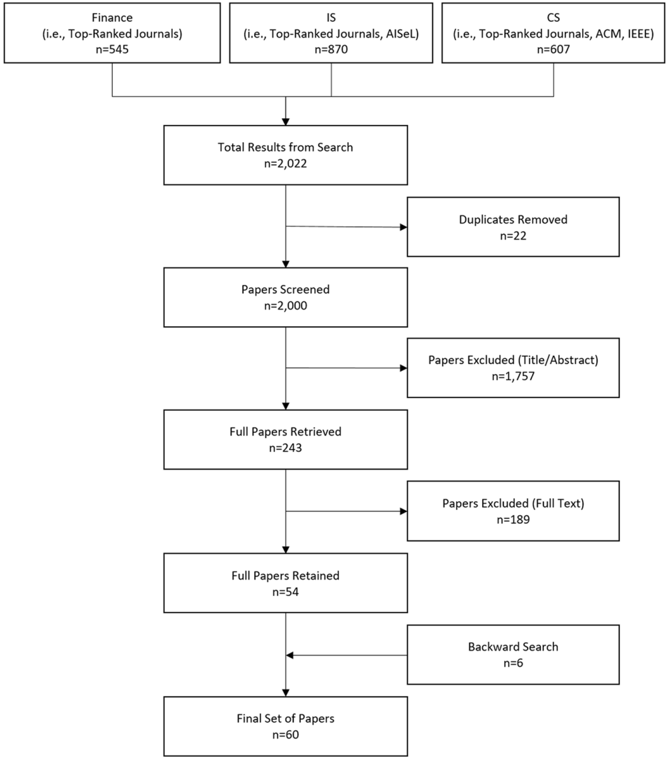
- The search screened 2,022 articles, removed duplicates to 2,000, narrowed to 243 after title/abstract screening, yielded 54 full-text matches, and ended with 60 papers after backward searching.
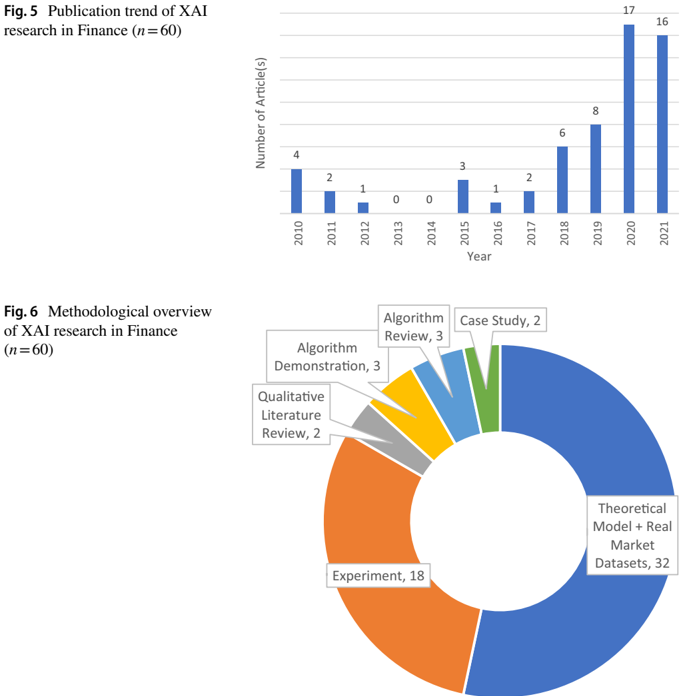
- Publication volume is concentrated in recent years: 2020 (n = 17) and 2021 (n = 16) together account for over 55% of the sample.
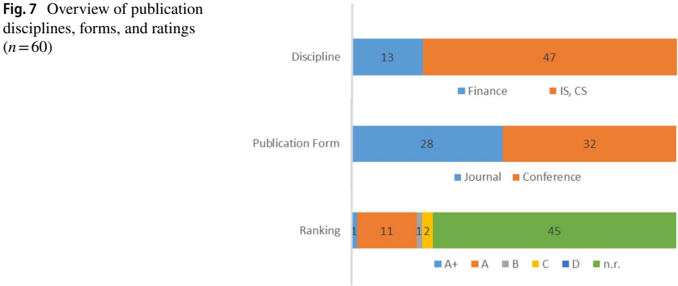
- By discipline, about a quarter of the sample is in Finance literature (n = 13), while most papers are from IS and CS (n = 47).
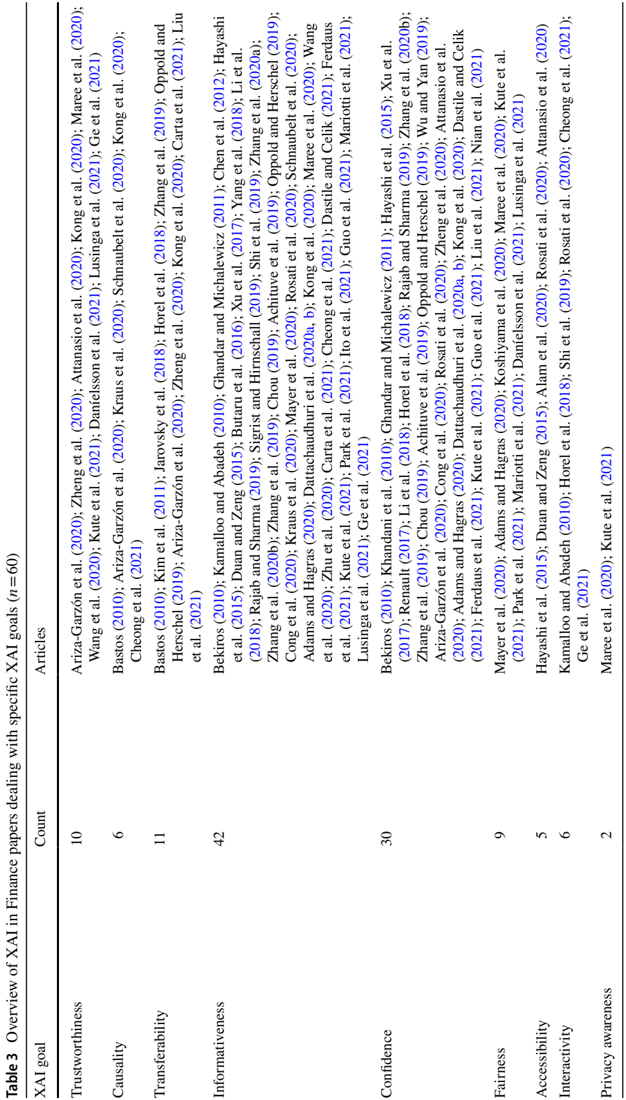
- On XAI goals, most papers address informativeness (n = 43), while only 2 target privacy awareness.
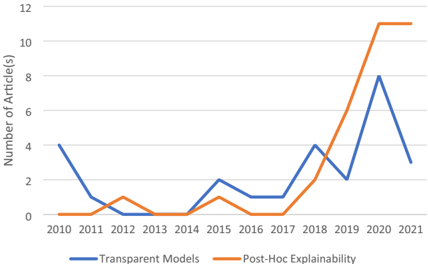
- On methods, the sample is split between transparent models (n = 26) and post-hoc explainability (n = 32); among post-hoc methods, model-agnostic (n = 16) and model-specific (n = 21) approaches are both used.
- The paper reports that risk management, portfolio optimization, and stock market applications are well-researched, while anti-money laundering is understudied.
## Methods
- The study is a systematic literature review (SLR) guided by Kitchenham (2004), using a transparent and reproducible review protocol.
- Search scope covered the top-ranked Finance journals, the eight IS basket journals, top CS journals, and databases including ACM Digital Library, AIS eLibrary, and IEEE Xplore; the search window was 2010 to 2021 and ran from October 2021 to January 2022.
- The authors coded the final set by publication details, XAI goal, XAI method, and area of Finance, using three independent coders and a multiple-classification scheme.
## Limitations
- The paper states that an exhaustive SLR remains impossible and that the search could be expanded with more databases, different keywords, and a broader publication-date range.
- The review is limited to recent research from the last decade and to the outlets/databases searched; this is stated in the paper.
- The text also makes evident that some tables and figures are only partially visible in the provided text, but this is a limitation of the supplied excerpt, not stated as a paper limitation.
Model-written summary of a shortened version of the paper’s full text (it is longer than we read). Check it against the paper before relying on it.
Integrity signals
Registry
Cites
Statistics
Figures
Verification
Claims the paper makes
4 Valid · 10 Not valid · 18 Not checked · 54 Own results and interpretations
The sources with a verdict support this claim; the rest weren’t checked yet, have no full text we could read, or their verdicts aren’t rated yet.
In the paper
“Related studies (e.g., Arrieta et al. 2019; Chou 2019) confirm decision trees to be well-employed in XAI research”
What the sources say
- Supportedcites Arrieta et al. 2019 matched to “Explainable Artificial Intelligence (XAI): Concepts, Taxonomies, Opportunities and Challenges toward Responsible AI” (2019) source
Section 3.2, “Decision Trees,” treats decision trees as a transparent model relevant to explainable AI and says they have long been used in decision-support contexts, with many applications. This supports the broad claim that they are well employed in XAI research; the source does not quantify their prevalence. (LLM, conf=0.86)
- Not checked — no full text of the sourcecites Chou 2019 matched to “An Explainable Hybrid Model for Bankruptcy Prediction Based on the Decision Tree and Deep Neural Network” (2019) source
boostedn = 12- Asserted: passes — The authors put it forward as true.
- Checkable: passes — It can be checked against evidence.
- Load-bearing: unclear — It is unclear whether the paper’s conclusions depend on it.
- Based: passes — The paper gives a reason why it holds.
- Supported
The cited sources support only part of this claim — read each source’s verdict below.
In the paper
“Besides, regulators in many countries demand greater transparency and explainability of decisions in the financial sector by requiring XAI rather than AI-based systems (Kalyanathaya 2022).”
What the sources say
- Partly supportedcites Kalyanathaya 2022 matched to “A Literature Review and Research Agenda on Explainable Artificial Intelligence (XAI)” (2022) sourceExperimental — accuracy not yet measured
The 'Why explainable AI is important?' section does carry a regulatory-demand point: it states that AI decision-making 'must ensure compliance with company policies, industry standards and government regulations' and that under Article 14 of the GDPR a company using automated decision-making tools 'must explain the rationale, importance and consequences of such processing', and it names finance (with healthcare) as a domain where trust/reliance is critical. However, our copy attributes no such requirement to 'regulators in many countries', ties no XAI mandate specifically to the financial sector, and nowhere says regulators require XAI *rather than* AI-based systems; the Table 3 summary (Conclusion) mentions regulatory bodies' research agendas on XAI only while describing Arrieta et al. [44]. So the general regulatory-demand-for-explainability element is supported, but the multi-country, financial-sector and XAI-instead-of-AI elements of the claim are not. (LLM, conf=0.78)
plainstates a cause- Asserted: passes — The authors put it forward as true.
- Checkable: passes — It can be checked against evidence.
- Load-bearing: passes — The paper’s conclusions depend on it.
- Based: passes — The paper gives a reason why it holds.
- Partly supported
The cited sources support only part of this claim — read each source’s verdict below.
In the paper
“Thus, XAI is a driver of further AI usage and adoption (Adadi and Berrada 2018; Janiesch etal. 2021; Mirbabaie etal. 2021; Sigrist and Hirnschall 2019) in particular in these domains as it helps to mitigate the current black-box nature of AI-based systems, i.e., unobservable inner workings.”
What the sources say
- Partly supportedcites Adadi and Berrada 2018 matched to “Peeking Inside the Black-Box: A Survey on Explainable Artificial Intelligence (XAI)” (2018) sourceExperimental — accuracy not yet measured
Our copy supports the regulated-domain half of the claim: the FINANCE section (XAI application domains) states that 'the financial industry is highly regulated', that AI credit models struggle to provide the required 'reason code' because the basis for denial is 'the output from an opaque ML algorithm', and that bureaus such as Equifax/Experian are working to make these decisions 'more explainable and auditor friendly'. The adoption half is only implicit: the paper says explainability 'leads to building trust' and 'leads towards more trustworthy AI systems' (a: EXPLAIN TO JUSTIFY; d: EXPLAIN TO DISCOVER), and that unexplained errors 'could... deter adoption of such systems' (d: EXPLAIN TO DISCOVER) — i.e., that opacity hinders uptake, not that XAI drives further AI usage/adoption. Indeed the same section hedges that 'explainability... is not always a necessity' and that making AI explainable 'is undoubtedly expensive', and the survey nowhere reports adoption as an outcome of XAI. (LLM, conf=0.72)
- Not matchedcites Janiesch etal. 2021
An author–year citation the paper’s reference list doesn’t settle. We don’t search these by name.
- Not matchedcites Mirbabaie etal. 2021
An author–year citation the paper’s reference list doesn’t settle. We don’t search these by name.
plainstates a cause- Asserted: passes — The authors put it forward as true.
- Checkable: passes — It can be checked against evidence.
- Load-bearing: unclear — It is unclear whether the paper’s conclusions depend on it.
- Based: passes — The paper gives a reason why it holds.
- Partly supported
The cited sources support only part of this claim — read each source’s verdict below.
In the paper
“Increased trust ultimately results in more widespread adoption of AI applications (Adadi and Berrada 2018; Janiesch etal. 2021; Mirbabaie et al. 2021; Sigrist and Hirnschall 2019).”
What the sources say
- Partly supportedcites Adadi and Berrada 2018 matched to “Peeking Inside the Black-Box: A Survey on Explainable Artificial Intelligence (XAI)” (2018) sourceExperimental — accuracy not yet measured
Our copy connects trust and adoption only indirectly and at lower generality: in 'd: EXPLAIN TO DISCOVER' it says errors in an AI-based diagnosis system 'could not only harm the patient but also deter adoption of such systems', and in 'a: EXPLAIN TO JUSTIFY' and 'd: EXPLAIN TO DISCOVER' it holds that explainability 'leads to building trust' and 'towards more trustworthy AI systems' (echoing the DARPA goal quoted in 'II. Background A'). What the paper does not state is the positive causal chain the citing sentence asserts — that increased trust ultimately results in more widespread adoption of AI applications across the board; its adoption remark is a domain-specific warning about errors deterring uptake, and its trust statements stop at trust itself. So the trust-and-adoption ingredients are present, but the generalised 'trust → wider adoption' conclusion attributed to this source is not. (LLM, conf=0.65)
- Not matchedcites Janiesch etal. 2021
An author–year citation the paper’s reference list doesn’t settle. We don’t search these by name.
- Partly supportedcites Mirbabaie et al. 2021 matched to “The rise of artificial intelligence – understanding the AI identity threat at the workplace” (2022) sourceExperimental — accuracy not yet measured
Our copy of Mirbabaie et al. supports only the adoption-side of the claim and via a different antecedent: the Discussion states that 'a positive association with AI could reduce resistance behavior and support the individual acceptance of AI' (individual-level, driven by AI identity, not trust), and the Conclusion recommends 'introducing explainable AI as well focusing on trustworthy, responsible, and ethical employees who supervise AI implementations and applications' (Qualitative evaluation likewise frames trustworthiness as a property of supervising employees, and explainability as needed against the black box). No passage in our copy states that increased trust in AI results in more widespread adoption of AI applications, so the trust-to-adoption causal link attributed here is not supported by this source. (LLM, conf=0.65)
plainstates a cause- Asserted: passes — The authors put it forward as true.
- Checkable: passes — It can be checked against evidence.
- Load-bearing: unclear — It is unclear whether the paper’s conclusions depend on it.
- Based: passes — The paper gives a reason why it holds.
- Partly supported
None of the sources cited for this claim have been checked yet.
In the paper
“Relevant research concerning XAI in the form of general additive models in Finance (Berg 2007; Taylan etal. 2007; Calabrese 2012) did not appear in our search.”
What the sources say
- Not checked — no full text of the sourcecites Berg 2007 matched to “Bankruptcy prediction by generalized additive models” (2007) source
- Not matchedcites Taylan etal. 2007
An author–year citation the paper’s reference list doesn’t settle. We don’t search these by name.
- Not matchedcites Calabrese 2012
An author–year citation the paper’s reference list doesn’t settle. We don’t search these by name.
plain- Asserted: passes — The authors put it forward as true.
- Checkable: passes — It can be checked against evidence.
- Load-bearing: passes — The paper’s conclusions depend on it.
- Based: passes — The paper gives a reason why it holds.
- Rests on 2 assumptions not shown here.
35 more claims
Create a free account to see all 86 claims and to verify the 1 reference still open.
- It may state two separate claims as one. 31
- Probably not a substantial claim. 23
Citations
Cites
A Unified Approach to Interpreting Model Predictions
Lundberg, S., & Lee, S.-I. (2017) · arXiv · doi:10.48550/arxiv.1705.07874 · Cited by 23,707
The Market for "Lemons": Quality Uncertainty and the Market Mechanism
Akerlof, G. A. (1970) · The Quarterly Journal of Economics · doi:10.2307/1879431 · Cited by 23,016
"Why Should I Trust You?": Explaining the Predictions of Any Classifier
Ribeiro, M. T., Singh, S., & Guestrin, C. (2016) · Proceedings of the 22nd ACM SIGKDD International Conference on Knowledge Discovery and Data Mining · doi:10.1145/2939672.2939778 · Cited by 17,555 · cited 1×
“LIME is a rule extraction technique and builds locally linear models around the prediction of the model that it tries to explain (Ribeiro et al. 2016).”
Literature review as a research methodology: An overview and guidelines
Snyder, H. (2019) · Journal of Business Research · doi:10.1016/j.jbusres.2019.07.039 · Cited by 11,524 · cited 3×
“Thus, SLRs cluster the current state of research according to predefined criteria and thereby contribute to the conceptualization of the topic under investigation (Paré et al. 2015; Snyder 2019).”
Arrieta, A. B., Díaz-Rodríguez, N., Del Ser, J., Bennetot, A., Tabik, S., Barbado, A., García, S., Gil-López, S., Molina, D., Benjamins, R., et al. (2019) · arXiv · doi:10.48550/arxiv.1910.10045 · Cited by 11,321
Artificial intelligence: A modern approach
Nilsson, N. J. (1996) · Artificial Intelligence · doi:10.1016/0004-3702(96)00007-0 · Cited by 10,583
Barredo Arrieta, A., Díaz-Rodríguez, N., Del Ser, J., Bennetot, A., Tabik, S., Barbado, A., Garcia, S., Gil-Lopez, S., Molina, D., Benjamins, R., et al. (2020) · Information Fusion · doi:10.1016/j.inffus.2019.12.012 · Cited by 10,423
Peeking Inside the Black-Box: A Survey on Explainable Artificial Intelligence (XAI)
Adadi, A., & Berrada, M. (2018) · IEEE Access · doi:10.1109/access.2018.2870052 · Cited by 6,294 · cited 3×
“Therefore, research on XAI in Finance gains interest (Adadi and Berrada 2018).”
The Black Box Society: The Secret Algorithms That Control Money and Information
Pasquale, F. (2015) · doi:10.4159/harvard.9780674736061 · Cited by 3,796
Machine learning and deep learning
Janiesch, C., Zschech, P., & Heinrich, K. (2021) · Electronic Markets · doi:10.1007/s12525-021-00475-2 · Cited by 2,959 · cited 2×
“Increased trust ultimately results in more widespread adoption of AI applications (Adadi and Berrada 2018; Janiesch et al. 2021; Mirbabaie et al. 2021; Sigrist and Hirnschall 2019).”
Research works printed but not linked: 6
- Hoofnagle CJ (2013) How the fair credit reporting act regulates big data. SSRN, Rochester, NY
- IEEE (2021) IEEE finance playbook version 1.0 trusted data and artificial intelligence systems (AIS) for financial services
- Kim J, Bae JK, Delen D (2011) Understading black boxes: knowledge induction from models. PACIS 2011 Proceedings
- Padmanabhan B, Fang X, Sahoo N, Burton-Jones A (2022) Machine learning in information systems research. MIS Q 46:iii-xix
- Rzepka C, Berger B (2018) User interaction with ai-enabled systems: a systematic review of IS research. In: 39th International conference on information systems, San Francisco 2018
- Shapiro SC (1992) Artificial intelligence. Encycl Artif Intell 1:54-57
Cited by
A literature review on applications of explainable artificial intelligence (XAI)
Kalasampath, K., Spoorthi, K. N., Sajeev, S., Kuppa, S. S., Ajay, K., & Maruthamuthu, A. (2025) · IEEE Access · doi:10.1109/access.2025.3546681 · Cited by 180
“Weber, Carl, and Hinz, [84] offer the readers a comprehensive overview and detailed review of several existing techniques, including SHAP and LIME, all the while highlighting how each could be applied in specific portfolios and credit risk assessments.”
Mathew, D. E., Ebem, D. U., Ikegwu, A. C., Ukeoma, P. E., & Dibiaezue, N. F. (2025) · Neural Processing Letters · doi:10.1007/s11063-025-11732-2 · Cited by 168
“(ii) Finance: Weber et al. [163, 164], the explainability of AI in finance, particularly in credit scoring and risk assessment, is crucial for several reasons, including regulatory compliance, transparency, and trust-building with both lenders and borrowers.”
Dey, M. T. (2024) · Advances in Environmental Engineering and Green Technologies · doi:10.4018/979-8-3693-7822-9.ch012 · Cited by 131
The dark side of artificial intelligence in services
Belanche, D., Belk, R. W., Casaló, L. V., & Flavián, C. (2024) · The Service Industries Journal · doi:10.1080/02642069.2024.2305451 · Cited by 128
“Against the opacity of AI systems (Müller, 2020), research clearly shows that customers and employees distrust decisions they do not understand (Weber et al., 2023).”
BackgroundA comprehensive review on financial explainable AI
Yeo, W. J., van der Heever, W., Mao, R., Cambria, E., Satapathy, R., & Mengaldo, G. (2023) · Artificial Intelligence Review · doi:10.1007/s10462-024-11077-7 · Cited by 172
“A collection of existing literature reviews are analyzed and collated to give the reader a better understanding of commonly used terminologies in the XAI field, as well as the interlink between AI, linguistics, and social sciences which is essential to provide a solid understanding of the subject.”
Metadata
- Authors
- Weber, P., Carl, K. V., & Hinz, O.
- Affiliations
- Goethe University Frankfurt (DE)
- Corresponding author
- Weber, Patrick
- Venue
- Management Review Quarterly
- Published
- 2023-02-28
- Volume
- 74
- Issue
- 2
- Pages
- 867-907
- ISSN
- 2198-1620 (ISSN-L)
- 2198-1639
- OpenAlex
- W4322775759
- Cited by
- 292
- References
- 119
- Citations by year
- 2026: 86 · 2025: 114 · 2024: 73 · 2023: 18
- FWCI
- 6.10
- Type
- journal article
- Language
- en
- Open access
- hybrid
- doi.org
- Licence
- cc-by
- creativecommons.org/licenses/by/4.0 (tdm)
- creativecommons.org/licenses/by/4.0 (vor)
- Locations
- Management Review Quarterly (publishedVersion, cc-by)
- Econstor (Econstor) (submittedVersion, cc-by)
- RePEc: Research Papers in Economics (submittedVersion)
- Publication Server of Goethe University Frankfurt am Main (Goethe University Frankfurt) (submittedVersion, cc-by)
- Funders
- efl – the Data Science Institute
- Johann Wolfgang Goethe-Universität, Frankfurt am Main
- Topics
- Physical Sciences › Computer Science › Artificial Intelligence › Explainable Artificial Intelligence (XAI)
- Physical Sciences › Computer Science › Artificial Intelligence › Ethics and Social Impacts of AI
- Physical Sciences › Computer Science › Artificial Intelligence › Artificial Intelligence Applications
- Keywords
- explainable AI, financial decision-making, transparency, regulatory compliance, risk management, portfolio optimization, stock market prediction, anti-money laundering, post-hoc explanation, model interpretability
About these checks
Registry, retraction, Cites and statistics results are computed, not judged, with one exception: a printed reference that no index lists is read once by a model before it counts as a citation error. Claims are extracted by a model and kept only when their quote appears verbatim in the text; each cited source is then checked, with a model’s help, for whether it says what the claim relies on. Those verdicts can be wrong — read the claim’s quote and the cited source before relying on one.
The claim verdicts this report counts are experimental: their accuracy is not yet measured.
A language model drew the claims from the paper on 2026-10-09, under version 3 of the claim definition (model deepseek-v4.1-flash, prompt extract-v3).
A second model labelled each claim on 2026-10-09 (model jev-1.13-20260917, definition revision gold-guideline-v0.2).
Cited sources are checked with a language model’s help (gpt-6-sol and qwen3.8-omni-flash).
Statistics and arithmetic are recomputed, not judged.
Confidence bands are shown only for fields calibrated on our annotated test set. None is calibrated yet, so no band is shown.
What counts as a claim ›How we measure confidence ›How we check this ›
Are you an author, or do you see a problem with this page? Request a review
Data sources
Bibliographic data: Semantic Scholar, OpenAlex, Crossref.
Contains information from the Semantic Scholar Academic Graph Datasets, made available under the ODC Attribution License (ODC-BY 1.0).
Semantic Scholar’s data is described in: Kinney, R., et al. (2023). The Semantic Scholar Open Data Platform. arXiv:2301.10140.
