

The DOI matches its Crossref record; 228 of the 228 references it cites were found in a registry or an index.
The potential of P2X7 receptors as a therapeutic target, including inflammation and tumour progression
Open accessAbstract
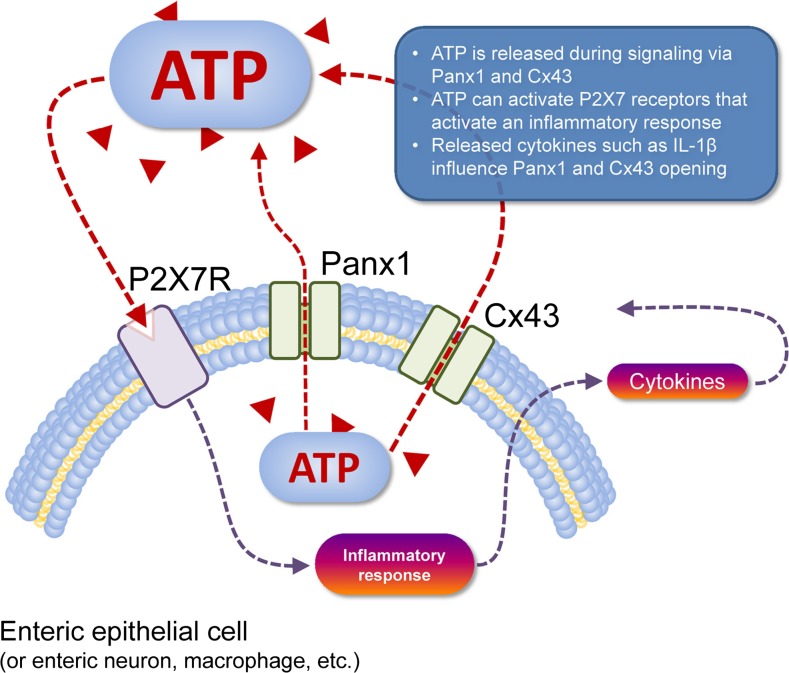
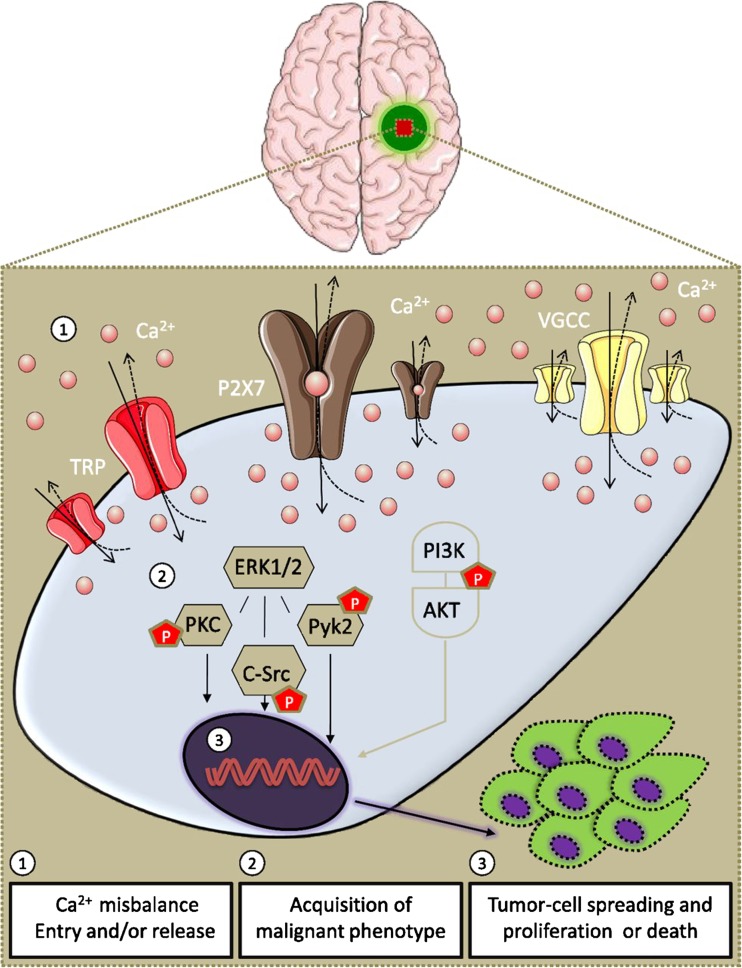
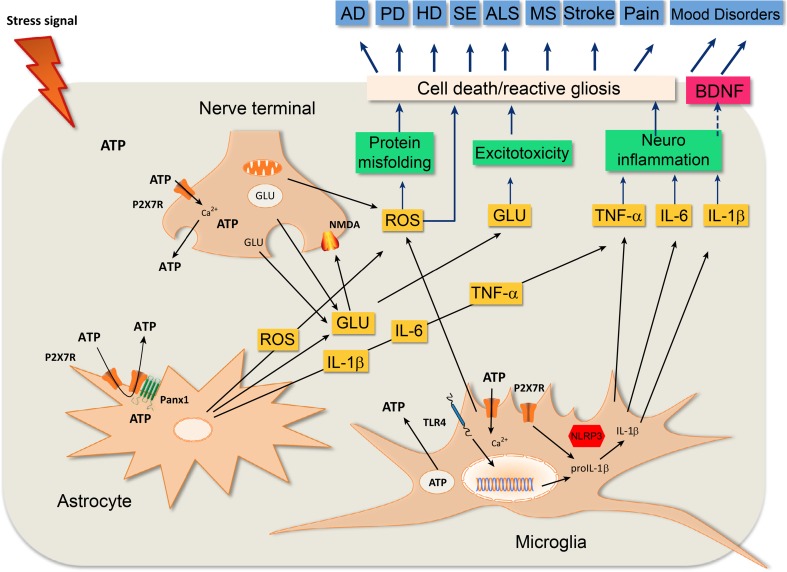
Seven P2X ion channel nucleotide receptor subtypes have been cloned and characterised. P2X7 receptors (P2X7R) are unusual in that there are extra amino acids in the intracellular C terminus. Low concentrations of ATP open cation channels sometimes leading to cell proliferation, whereas high concentrations of ATP open large pores that release inflammatory cytokines and can lead to apoptotic cell death. Since many diseases involve inflammation and immune responses, and the P2X7R regulates inflammation, there has been recent interest in the pathophysiological roles of P2X7R and the potential of P2X7R antagonists to treat a variety of diseases. These include neurodegenerative diseases, psychiatric disorders, epilepsy and a number of diseases of peripheral organs, including the cardiovascular, airways, kidney, liver, bladder, skin and musculoskeletal. The potential of P2X7R drugs to treat tumour progression is discussed.
Overview
The claims and statistics of this paper haven’t been checked yet.
Run the check — free, no account needed. It reads the open-access text and checks the sources it cites.
Integrity signals
Registry
Cites
Statistics
Figures
Verification
Claims the paper makes
The claims and statistics of this paper haven’t been checked yet.
Run the check — free, no account needed. It reads the open-access text and checks the sources it cites.
Claims other papers make about this one
Each is checked against this paper’s own text: does it say what the citing paper says it does?
In the citing paper
“P2X7R-mediated effects, which mainly occurs through activation of the neuroinflammatory response, have been involved in MDD, neurodegenerative diseases, schizophrenia, epilepsy, neuropathic pain and brain injury [28,66,67,68].”
From P2X7 Receptor Signaling in Stress and Depression (2019) · cites this paper as [66]
Self-check
Percentages, sums and reported differences re-computed from the paper’s own numbers.
The self-check needs the paper’s full text.
Citations
Cites
Receptors for Purines and Pyrimidines
Burnstock, G., & Verkhratsky, A. (2012) · Springer eBooks · doi:10.1007/978-3-642-28863-0_5 · Cited by 3,962
Self-citationReceptors for Purines and Pyrimidines
Ralevic, V., & Burnstock, G. (1998) · Pharmacological Reviews · doi:10.1016/s0031-6997(24)01373-5 · Cited by 2,028
Self-citationPhysiology and Pathophysiology of Purinergic Neurotransmission
Burnstock, G. (2007) · Physiological Reviews · doi:10.1152/physrev.00043.2006 · Cited by 1,609
Self-citationThe P2X7 Receptor in Infection and Inflammation
Di Virgilio, F., Dal Ben, D., Sarti, A. C., Giuliani, A. L., & Falzoni, S. (2017) · Immunity · doi:10.1016/j.immuni.2017.06.020 · Cited by 1,267
A P2X purinoceptor expressed by a subset of sensory neurons
Chen, C., Akopian, A. N., Sivilotti, L. G., Colquhoun, D., Burnstock, G., & Wood, J. N. (1995) · Nature · doi:10.1038/377428a0 · Cited by 1,016
Self-citationYang, D., He, Y., Muñoz-Planillo, R., Liu, Q., & Núñez, G. (2015) · Immunity · doi:10.1016/j.immuni.2015.10.009 · Cited by 622
Pathophysiology and Therapeutic Potential of Purinergic Signaling
Burnstock, G. (2006) · Pharmacological Reviews · doi:10.1124/pr.58.1.5 · Cited by 618
Self-citationExtracellular purines, purinergic receptors and tumor growth
Virgilio, F. D., & Adinolfi, E. (2016) · Oncogene · doi:10.1038/onc.2016.206 · Cited by 566
CD73 promotes anthracycline resistance and poor prognosis in triple negative breast cancer
Loi, S., Pommey, S., Haibe‐Kains, B., Beavis, P. A., Darcy, P. K., Smyth, M. J., & Stagg, J. (2013) · Proceedings of the National Academy of Sciences · doi:10.1073/pnas.1222251110 · Cited by 504
Abdulqawi, R., Dockry, R., Holt, K. J., Layton, G. R., McCarthy, B. G., Ford, A. P. D. W., & Smith, J. A. (2014) · The Lancet · doi:10.1016/s0140-6736(14)61255-1 · Cited by 488
Cited by
Sorted by citations
Extracellular ATP and P2 purinergic signalling in the tumour microenvironment
Virgilio, F. D., Sarti, A. C., Falzoni, S., Marchi, E. D., & Adinolfi, E. (2018) · Nature reviews. Cancer · doi:10.1038/s41568-018-0037-0 · Cited by 748
The Role of Inflammation in the Pathogenesis of Osteoarthritis
Chow, Y. Y., & Chin, K. (2020) · Mediators of Inflammation · doi:10.1155/2020/8293921 · Cited by 536
Grams, R. J., Santos, W. L., Scorei, I. R., Abad-García, A., Rosenblum, C. A., Biţă, A., Cerecetto, H., Viñas, C., & Soriano-Ursua, M. A. (2024) · Chemical Reviews · doi:10.1021/acs.chemrev.3c00663 · Cited by 389
Interleukin-1β is a potential therapeutic target for periodontitis: a narrative review
Cheng, R., Wu, Z., Li, M., Shao, M., & Hu, T. (2020) · International Journal of Oral Science · doi:10.1038/s41368-019-0068-8 · Cited by 304
Microglia in Alzheimer’s disease: pathogenesis, mechanisms, and therapeutic potentials
Miao, J., Ma, H., Yang, Y., Liao, Y., Lin, C., Zheng, J., Yu, M., & Lan, J. (2023) · Frontiers in Aging Neuroscience · doi:10.3389/fnagi.2023.1201982 · Cited by 293
Metadata
- Authors
- Burnstock, G., & Knight, G. E.
- Affiliations
- The University of Melbourne (AU)
- University College London (GB)
- Corresponding author
- Burnstock, Geoffrey
- ORCID
- Burnstock, Geoffrey
- Venue
- Purinergic Signalling
- Published
- 2017-11-21
- Volume
- 14
- Issue
- 1
- Pages
- 1-18
- ISSN
- 1573-9538 (ISSN-L)
- 1573-9546
- PMC
- PMC5842154
- OpenAlex
- W2768734810
- Semantic Scholar
- 1aa37d0f163277fbeb968b6bb8cea0a8afcbe622
- Cited by
- 248
- References
- 228
- Citations by year
- 2026: 13 · 2025: 20 · 2024: 22 · 2023: 25 · 2022: 28 · 2021: 48 · 2020: 52 · 2019: 27 · 2018: 13
- FWCI
- 2.65
- Type
- journal article
- Language
- en
- Open access
- hybrid
- doi.org
- Locations
- Purinergic Signalling (publishedVersion, cc-by)
- Europe PMC (PubMed Central) (publishedVersion, cc-by)
- PubMed Central (publishedVersion, cc-by)
- PubMed (publishedVersion)
- UCL Discovery (University College London) (submittedVersion)
- Minerva Access (University of Melbourne) (submittedVersion, cc-by)
- Funders
- University College London (UCL)
- Topics
- Life Sciences › Biochemistry, Genetics and Molecular Biology › Physiology › Adenosine and Purinergic Signaling
- Health Sciences › Medicine › Physiology (medical) › Pain Mechanisms and Treatments
- Life Sciences › Biochemistry, Genetics and Molecular Biology › Physiology › Calcium signaling and nucleotide metabolism
- Keywords
- P2X7 receptor, ATP, P2X7 receptor antagonists, inflammation, tumor progression, apoptosis, neurodegenerative diseases, mental illness, epilepsy, therapeutic target
- MeSH terms
- Animals, Humans, Inflammation, Neoplasms, Disease Progression, Receptors, Purinergic P2X7, Purinergic P2X Receptor Antagonists
About these checks
Registry, retraction, Cites and statistics results are computed, not judged, with one exception: a printed reference that no index lists is read once by a model before it counts as a citation error. Claims are extracted by a model and kept only when their quote appears verbatim in the text; each cited source is then checked, with a model’s help, for whether it says what the claim relies on. Those verdicts can be wrong — read the claim’s quote and the cited source before relying on one.
Statistics and arithmetic are recomputed, not judged.
Confidence bands are shown only for fields calibrated on our annotated test set. None is calibrated yet, so no band is shown.
What counts as a claim ›How we measure confidence ›How we check this ›
Are you an author, or do you see a problem with this page? Request a review
