

Shared Decision Making: A Model for Clinical Practice
Open accessThe DOI matches its Crossref record; 54 of the 56 references it cites were found in a registry or an index.
Abstract
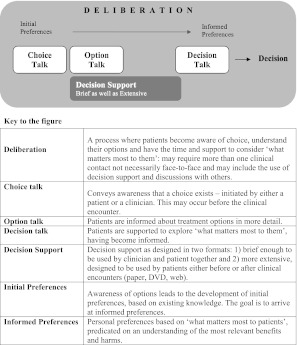
The principles of shared decision making are well documented but there is a lack of guidance about how to accomplish the approach in routine clinical practice. Our aim here is to translate existing conceptual descriptions into a three-step model that is practical, easy to remember, and can act as a guide to skill development. Achieving shared decision making depends on building a good relationship in the clinical encounter so that information is shared and patients are supported to deliberate and express their preferences and views during the decision making process. To accomplish these tasks, we propose a model of how to do shared decision making that is based on choice, option and decision talk. The model has three steps: a) introducing choice, b) describing options, often by integrating the use of patient decision support, and c) helping patients explore preferences and make decisions. This model rests on supporting a process of deliberation, and on understanding that decisions should be influenced by exploring and respecting "what matters most" to patients as individuals, and that this exploration in turn depends on them developing informed preferences.
Overview
The claims and statistics of this paper haven’t been checked yet.
Free: it reads the open-access text and checks the first 5 claims that cite a source we can check. Create a free account to check every claim.
Integrity signals
Registry
Cites
Statistics
Figures
Verification
Claims the paper makes
The claims and statistics of this paper haven’t been checked yet.
Free: it reads the open-access text and checks the first 5 claims that cite a source we can check. Create a free account to check every claim.
Claims other papers make about this one
Each is checked against this paper’s own text: does it say what the citing paper says it does?
The source backs part of the claim, not all of it — or backs it for a different population, condition or comparison.
In the citing paper
“It also highlights the value of each patient’s own experiences, thereby promoting their autonomy and empowering them to improve their health.72”
From Joint Clinical Practice Guideline on Benzodiazepine Tapering: Considerations When Risks Outweigh Benefits (2025) · cites this paper as [72]
Experimental — accuracy not yet measuredThe cited source says what the claim attributes to it.
In the citing paper
“Presenting evidence-based treatment options for both PTSD and insomnia and supporting patient preferences is consistent with a shared decision-making approach (Elwyn et al., 2012).”
From Benefits of Cognitive Behavioral Therapy for Insomnia for Women Veterans with and without Probable Post-Traumatic Stress Disorder (2022) · cites this paper as Elwyn et al., 2012
The cited source says what the claim attributes to it.
In the citing paper
“The concept of shared decision-making is built on engaging patients as active participants in their treatment rather than as passive recipients.72”
From Joint Clinical Practice Guideline on Benzodiazepine Tapering: Considerations When Risks Outweigh Benefits (2025) · cites this paper as [72]
The check wasn’t confident either way, so it gives no verdict — never disputed.
In the citing paper
“AI and robotics redefine the roles of healthcare professionals. For instance, radiologists may transition from image interpretation to supervising AI algorithms that assist in diagnostics, requiring new skill sets and responsibilities.[36]”
From Ethical implications of AI and robotics in healthcare: A review (2023) · cites this paper as [36]
Experimental — accuracy not yet measuredIn the citing paper
“Models of care that integrate education, engagement, and shared decision making are now available, 1023 and may be of particular value in the management of AF.”
From 2016 ESC Guidelines for the management of atrial fibrillation developed in collaboration with EACTS (2016) · cites this paper as [1023]
1 more claim about this paper
Create a free account to see every claim other papers make about this one.
Self-check
Percentages, sums and reported differences re-computed from the paper’s own numbers.
The self-check needs the paper’s full text.
Citations
Cites
Ryan, R. M., & Deci, E. L. (2000) · American Psychologist · doi:10.1037//0003-066x.55.1.68 · Cited by 54,599 · cited 1×
“Self-determination theory is concerned with our intrinsic tendencies to protect and preserve our well-being.(13) Relational autonomy is the term used to describe the view that we are not entirely free, self-governing agents but that our decisions Received August 22, 2011”
BackgroundPharmacological interventions for somatoform disorders in adults
Kleinstäuber, M., Witthöft, M., Steffanowski, A., van Marwijk, H., Hiller, W., & Lambert, M. J. (2014) · Cochrane Database of Systematic Reviews · doi:10.1002/14651858.cd010628.pub2 · Cited by 11,335
Decision aids for people facing health treatment or screening decisions
Stacey, D., Légaré, F., Lewis, K., Barry, M. J., Bennett, C. L., Eden, K. B., Holmes-Rovner, M., Llewellyn-Thomas, H., Lyddiatt, A., Thomson, R., et al. (2017) · Cochrane Database of Systematic Reviews · doi:10.1002/14651858.cd001431.pub5 · Cited by 6,685
Self-citationCharles, C., Gafni, A., & Whelan, T. (1997) · Social Science & Medicine · doi:10.1016/s0277-9536(96)00221-3 · Cited by 4,137
Shared decision making — The pinnacle of patient-centered care
Barry, M. J., & Edgman-Levitan, S. (2012) · New England Journal of Medicine · doi:10.1056/nejmp1109283 · Cited by 3,433
Self-citationSchiffrin, D. (1987) · Cambridge University Press eBooks · doi:10.1017/cbo9780511611841 · Cited by 2,810
Four Models of the Physician-Patient Relationship
Emanuel, E. J. (1992) · JAMA: The Journal of the American Medical Association · doi:10.1001/jama.1992.03480160079038 · Cited by 2,449
An integrative model of shared decision making in medical encounters
Makoul, G., & Clayman, M. L. (2006) · Patient Education and Counseling · doi:10.1016/j.pec.2005.06.010 · Cited by 1,621 · cited 2×
“The principles of SDM are well documented and the common elements have been summarized.(5) The earliest mention was in 1982,(6) but the idea draws on and deepens the principles of patient centered care.”
BackgroundPatient-Centered Medicine: Transforming the Clinical Method
Stewart, M., Brown, J. B., Weston, W. W., McWhinney, I. R., McWilliam, C. L., & Freeman, T. R. (1995) · Cited by 1,299
Skills for Communicating with Patients
Silverman, J., Kurtz, S., & Draper, J. (2016) · CRC Press eBooks · doi:10.1201/9781910227268 · Cited by 1,238
Implementing shared decision making in the NHS
Elwyn, G., Laitner, S., Coulter, A., Walker, E., Watson, P., & Thomson, R. (2010) · BMJ · doi:10.1136/bmj.c5146 · Cited by 1,090
Self-citationThe Patient Protection and Affordable Care Act
(2018) · Policy and Program Planning for Older Adults and People With Disabilities · doi:10.1891/9780826128393.0010 · Cited by 863
Decision aids for people facing health treatment or screening decisions
Stacey, D., Bennett, C. L., Barry, M. J., Col, N. F., Eden, K. B., Holmes-Rovner, M., Llewellyn-Thomas, H., Lyddiatt, A., Légaré, F., & Thomson, R. (2011) · Cochrane Database of Systematic Reviews · doi:10.1002/14651858.cd001431.pub3 · Cited by 849
Self-citationDeveloping Physician Communication Skills For Patient-Centered Care
Levinson, W., Lesser, C. S., & Epstein, R. M. (2010) · Health Affairs · doi:10.1377/hlthaff.2009.0450 · Cited by 750
(2000) · Europe PMC (PubMed Central) · Cited by 737
Self-citationShared decision making in clinical medicine: past research and future directions
Frosch, D. L., & Kaplan, R. M. (1999) · American Journal of Preventive Medicine · doi:10.1016/s0749-3797(99)00097-5 · Cited by 721
Self-citationDecision aids for people facing health treatment or screening decisions
O'Connor, A. M., Bennett, C. L., Stacey, D., Barry, M., Col, N. F., Eden, K. B., Entwistle, V. A., Fiset, V., Holmes-Rovner, M., Khangura, S., et al. (2003) · The Cochrane Database of Systematic Reviews · doi:10.1002/14651858.cd001431 · Cited by 662
Self-citationTowle, A., Godolphin, W., Greenhalgh, T., & Gambrill, J. (1999) · BMJ · doi:10.1136/bmj.319.7212.766 · Cited by 646 · cited 1×
“Others(9,10) provided more detail and this led to a greater focus on the skills required.(11,12) Yet, despite attention to principles and competences, there remains a lack of clear guidance about how to accomplish SDM in routine practice.”
BackgroundExplaining risks: turning numerical data into meaningful pictures
Edwards, A., Elwyn, G., & Mulley, A. (2002) · BMJ · doi:10.1136/bmj.324.7341.827 · Cited by 644
Self-citationPatients’ preference for involvement in medical decision making: A narrative review
Say, R., Murtagh, M., & Thomson, R. (2006) · Patient Education and Counseling · doi:10.1016/j.pec.2005.02.003 · Cited by 633 · cited 1×
“Some patients initially decline decisional responsibility role, and are wary about participating.(32) A MODEL FOR CLINICAL PRACTICE”
BackgroundSelf-citationCommunicating Evidence for Participatory Decision Making
Epstein, R. M. (2004) · JAMA · doi:10.1001/jama.291.19.2359 · Cited by 628
Strategies to help patients understand risks
Paling, J. (2003) · BMJ · doi:10.1136/bmj.327.7417.745 · Cited by 552
Supporting Patient Autonomy: The Importance of Clinician-patient Relationships
Entwistle, V. A., Carter, S. M., Cribb, A., & McCaffery, K. (2010) · Journal of General Internal Medicine · doi:10.1007/s11606-010-1292-2 · Cited by 540 · cited 1×
“These are the key tenets of both self-determination(13) and relational autonomy.(14) Self-determination theory is concerned with our intrinsic tendencies to protect and preserve our well-being.”
BackgroundKurtz, S. M., & Silverman, J. D. (1996) · Medical Education · doi:10.1111/j.1365-2923.1996.tb00724.x · Cited by 525
The OPTION scale: measuring the extent that clinicians involve patients in decision‐making tasks
Elwyn, G., Hutchings, H., Edwards, A., Rapport, F., Wensing, M., Cheung, W., & Grol, R. (2005) · Health Expectations · doi:10.1111/j.1369-7625.2004.00311.x · Cited by 496
Self-citationPatient-centred medicine: Transforming the clinical method
Brown, J. B. (1998) · Patient Education and Counseling · doi:10.1016/s0738-3991(98)90096-9 · Cited by 449
Toward The ‘Tipping Point’: Decision Aids And Informed Patient Choice
O’Connor, A. M., Wennberg, J. E., Legare, F., Llewellyn-Thomas, H. A., Moulton, B. W., Sepucha, K. R., Sodano, A. G., & King, J. S. (2007) · Health Affairs · doi:10.1377/hlthaff.26.3.716 · Cited by 445
Whelan, T., Levine, M., Willan, A., Gafni, A., Sanders, K., Mirsky, D., Chambers, S., O'Brien, M. A., Reid, S., & Dubois, S. (2004) · JAMA · doi:10.1001/jama.292.4.435 · Cited by 415
Patient Protection and Affordable Care Act of 2010
(2018) · The SAGE Encyclopedia of Surveillance, Security, and Privacy · doi:10.4135/9781483359922.n327 · Cited by 400
Relational Autonomy, Normative Authority and Perfectionism
Mackenzie, C. (2008) · Journal of Social Philosophy · doi:10.1111/j.1467-9833.2008.00440.x · Cited by 397 · cited 1×
“will always relate to interpersonal relationships and mutual dependencies.(15) As King and Moulton have noted, these principles extend the concept of informed consent beyond that of simple information transfer towards honoring informed preferences.”
BackgroundBraddock, C. H., Fihn, S. D., Levinson, W., Jonsen, A. R., & Pearlman, R. A. (1997) · Journal of General Internal Medicine · doi:10.1007/s11606-006-5081-x · Cited by 353
Beyond Information: Exploring Patients' Preferences
Epstein, R. M., & Peters, E. (2009) · JAMA · doi:10.1001/jama.2009.984 · Cited by 302
Elwyn, G., Edwards, A., Gwyn, R., & Grol, R. (1999) · BMJ · doi:10.1136/bmj.319.7212.753 · Cited by 299
Self-citationRethinking Informed Consent: The Case for Shared Medical Decision-Making
King, J. S., & Moulton, B. W. (2006) · American Journal of Law & Medicine · doi:10.1177/009885880603200401 · Cited by 276 · cited 1×
“As King and Moulton have noted, these principles extend the concept of informed consent beyond that of simple information transfer towards honoring informed preferences.(16) We acknowledge that good clinical practice balances these principles with those of beneficence and justice.”
BackgroundGafni, A., Charles, C., & Whelan, T. (1998) · Social Science & Medicine · doi:10.1016/s0277-9536(98)00091-4 · Cited by 272
Elwyn, G., Frosch, D., Volandes, A. E., Edwards, A., & Montori, V. M. (2010) · Medical Decision Making · doi:10.1177/0272989x10386231 · Cited by 271 · cited 5×
“The use of brief patient decision support tools can catalyze SDM.(38,42) This model builds on the previous work in this field by integrating a number of contributions.”
MethodInfluentialSelf-citationSkills for Communicating with Patients
Hughes, C. (1999) · Physiotherapy · doi:10.1016/s0031-9406(05)61259-x · Cited by 263 · cited 1×
“We cannot therefore emphasize too strongly that SDM has to be built on the core skills of good clinical communication skills, as recognized in many seminal texts, including building rapport and structuring the consultations.(24)”
BackgroundShared Mind: Communication, Decision Making, and Autonomy in Serious Illness
Epstein, R. M., & Street, R. L. (2011) · The Annals of Family Medicine · doi:10.1370/afm.1301 · Cited by 257
Nonabandonment: A Central Obligation for Physicians
Quill, T. E., & Cassel, C. K. (1995) · Annals of Internal Medicine · doi:10.7326/0003-4819-122-5-199503010-00008 · Cited by 256 · cited 1×
“If all responsibility for decision making is transferred to patients they may feel ‘abandoned’.(31) Some patients initially decline decisional responsibility role, and are wary about participating.”
BackgroundDistributed decision making: the anatomy of decisions‐in‐action
Rapley, T. (2008) · Sociology of Health & Illness · doi:10.1111/j.1467-9566.2007.01064.x · Cited by 240
Deliberation before determination: the definition and evaluation of good decision making
Elwyn, G., & Miron‐Shatz, T. (2010) · Health Expectations · doi:10.1111/j.1369-7625.2009.00572.x · Cited by 222 · cited 1×
“Recognizing this need, and allowing time for it, is a cornerstone for effective SDM .(33,37) The model also includes the use of decision support interventions,(38) which summarize information in formats that are accessible to patients, using the most up to date evidence about the harms and the benefits.”
BackgroundSelf-citationPoliti, M. C., Clark, M. A., Ombao, H., Dizon, D., & Elwyn, G. (2011) · Health Expectations · doi:10.1111/j.1369-7625.2010.00626.x · Cited by 181
Self-citationBreslin, M., Mullan, R. J., & Montori, V. M. (2008) · Patient Education and Counseling · doi:10.1016/j.pec.2008.07.024 · Cited by 170
Zikmund‐Fisher, B. J., Couper, M. P., Singer, E., Levin, C. A., Fowler, F. J., Ziniel, S. I., Ubel, P. A., & Fagerlin, A. (2010) · Medical Decision Making · doi:10.1177/0272989x09353792 · Cited by 155
Mills, M. K. (1992) · Applications of Decision-Aiding Software · doi:10.1007/978-1-349-12498-5_6 · Cited by 155
Do patients want a choice and does it work?
Coulter, A. (2010) · BMJ · doi:10.1136/bmj.c4989 · Cited by 125
O'Connor, A. M. C., Graham, I. D., & Visser, A. P. (2005) · Patient Education and Counseling · doi:10.1016/j.pec.2005.04.010 · Cited by 66
Informed consent : patient autonomy and clinician beneficence within health care
Wear, S. (1998) · Cited by 65
Walter, F. M., Emery, J. D., Rogers, M., & Britten, N. (2004) · Patient Education and Counseling · doi:10.1016/j.pec.2003.11.001 · Cited by 57 · cited 1×
“Patients will want time to study new information and to consider their personal preferences, particularly for futures that are unknown to them, to think about outcome states that they have never experienced.(34,35) Deliberation may, in part, be done outside the clinical encounter, although often patients wish to conso…”
BackgroundAssessment of Medical Students’ Shared Decision-Making in Standardized Patient Encounters
Hauer, K. E., Fernández, A., Teherani, A., Boscardin, C., & Saba, G. W. (2010) · Journal of General Internal Medicine · doi:10.1007/s11606-010-1567-7 · Cited by 34
The Patient-centred general practice consultation
Levenstein, J. (1984) · South African Family Practice · doi:10.4102/safp.v5i9.3209 · Cited by 31
Informed Decision Making in Outpatient Practice: Time to Get Back to Basics
Braddock III, C. H., Edwards, K. A., Hasenberg, N. M., Laidley, T. L., & Levinson, W. (1999) · JAMA · doi:10.1001/jama.282.24.2313 · Cited by 19
Elwyn, G. J., Lloyd, A., Williams, N. J., Beasley, A., & Tomkinson, A. (2012) · The International Journal of Person Centered Medicine · doi:10.5750/ijpcm.v2i3.262 · Cited by 7
Self-citation
Cited by
2016 ESC Guidelines for the management of atrial fibrillation developed in collaboration with EACTS
Kirchhof, P., Benussi, S., Kotecha, D., Ahlsson, A., Atar, D., Casadei, B., Castella, M., Diener, H.-C., Heidbuchel, H., Hendriks, J., et al. (2016) · Europace · doi:10.1093/europace/euw295 · Cited by 6,439
2016 ESC Guidelines for the management of atrial fibrillation developed in collaboration with EACTS
Kirchhof, P., Benussi, S., Kotecha, D., Ahlsson, A., Atar, D., Casadei, B., Castella, M., Diener, H.-C., Heidbuchel, H., Hendriks, J., et al. (2016) · European Heart Journal · doi:10.1093/eurheartj/ehw210 · Cited by 6,418
Kolasinski, S. L., Neogi, T., Hochberg, M. C., Oatis, C., Guyatt, G., Block, J., Callahan, L., Copenhaver, C., Dodge, C., Felson, D., et al. (2020) · Arthritis Care & Research · doi:10.1002/acr.24131 · Cited by 2,516
Kolasinski, S. L., Neogi, T., Hochberg, M. C., Oatis, C., Guyatt, G., Block, J., Callahan, L., Copenhaver, C., Dodge, C., Felson, D., et al. (2020) · Arthritis & Rheumatology · doi:10.1002/art.41142 · Cited by 1,965
“Thus, conditional recommendations are particularly value-and preference-sensitive and always warrant a full shared decision-making approach involving a complete and clear explication of benefits, harms, and burdens in language and in a context that patients understand (16).”
BackgroundYatham, L. N., Kennedy, S. H., Parikh, S. V., Schaffer, A., Bond, D. J., Frey, B. N., Sharma, V., Goldstein, B. I., Rej, S., Beaulieu, S., et al. (2018) · Bipolar Disorders · doi:10.1111/bdi.12609 · Cited by 1,852
“Providers should encourage individuals to actively participate in treatment planning, using a shared decision-making approach (61, 62).”
Background
Metadata
- Authors
- Elwyn, G., Frosch, D., Thomson, R., Joseph-Williams, N., Lloyd, A., Kinnersley, P., Cording, E., Tomson, D., Dodd, C., Rollnick, S., Edwards, A., & Barry, M.
- Affiliations
- Cardiff University (GB)
- Palo Alto Medical Foundation (US)
- Newcastle University (GB)
- Royal Victoria Infirmary (GB)
- Massachusetts General Hospital (US)
- Corresponding author
- Elwyn, Glyn
- ORCID
- Venue
- Journal of General Internal Medicine
- Published
- 2012-05-23
- Volume
- 27
- Issue
- 10
- Pages
- 1361-1367
- ISSN
- 0884-8734 (ISSN-L)
- 1525-1497
- PMC
- PMC3445676
- OpenAlex
- W2041927436
- Semantic Scholar
- 010654700f3b5c98fd2dba4f97661bd80e7c15b3
- Cited by
- 4,405
- References
- 56
- Citations by year
- 2026: 531 · 2025: 503 · 2024: 430 · 2023: 396 · 2022: 412 · 2021: 437 · 2020: 409 · 2019: 310 · 2018: 248 · 2017: 254 · 2016: 180 · 2015: 125 · 2014: 101 · 2013: 55 · 2012: 9
- FWCI
- 13.71
- Type
- journal article
- Language
- en
- Open access
- hybrid
- doi.org
- Licence
- cc-by
- Locations
- Journal of General Internal Medicine (publishedVersion, cc-by)
- PubMed Central (publishedVersion, cc-by)
- PubMed (publishedVersion)
- ORCA Online Research @Cardiff (Cardiff University) (submittedVersion)
- Radboud Repository (Radboud University) (submittedVersion)
- Newcastle University ePrints (Newcastle Univesity)
- Funders
- Dartmouth College
- Topics
- Health Sciences › Health Professions › General Health Professions › Patient-Provider Communication in Healthcare
- Health Sciences › Medicine › Public Health, Environmental and Occupational Health › Palliative Care and End-of-Life Issues
- Health Sciences › Medicine › Public Health, Environmental and Occupational Health › Ethics and bioethics in healthcare
- Keywords
- shared decision-making, patient preferences, patient decision support, patient encounters, deliberation, patient-clinician relationship, clinical practice model
- MeSH terms
- Cooperative Behavior, Decision Making, Humans, Models, Psychological, Patient Participation, Physician-Patient Relations, Patient-Centered Care
About these checks
Registry, retraction, Cites and statistics results are computed, not judged, with one exception: a printed reference that no index lists is read once by a model before it counts as a citation error. Claims are extracted by a model and kept only when their quote appears verbatim in the text; each cited source is then checked, with a model’s help, for whether it says what the claim relies on. Those verdicts can be wrong — read the claim’s quote and the cited source before relying on one.
Statistics and arithmetic are recomputed, not judged.
Confidence bands are shown only for fields calibrated on our annotated test set. None is calibrated yet, so no band is shown.
What counts as a claim ›How we measure confidence ›How we check this ›
Are you an author, or do you see a problem with this page? Request a review
Data sources
Bibliographic data: Semantic Scholar, OpenAlex, Crossref.
Contains information from the Semantic Scholar Academic Graph Datasets, made available under the ODC Attribution License (ODC-BY 1.0).
Semantic Scholar’s data is described in: Kinney, R., et al. (2023). The Semantic Scholar Open Data Platform. arXiv:2301.10140.
