

Randomized Controlled Trial of Brief Mindfulness Training and Hypnotic Suggestion for Acute Pain Relief in the Hospital Setting.
Open accessThe DOI matches its Crossref record; 36 of the 36 references it cites were found in a registry or an index; 13 of the 31 sources its claims cite were checked for support.
Abstract
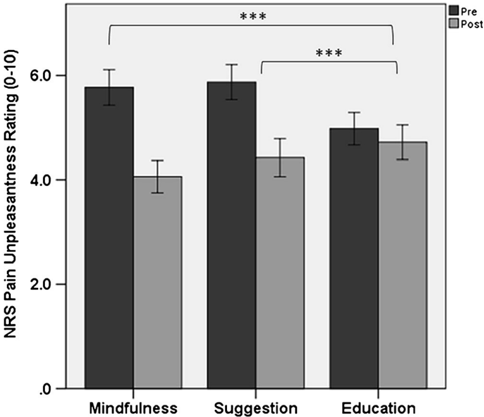
Background: Medical management of acute pain among hospital inpatients may be enhanced by mind-body interventions.Objective: We hypothesized that a single, scripted session of mindfulness training focused on acceptance of pain or hypnotic suggestion focused on changing pain sensations through imagery would significantly reduce acute pain intensity and unpleasantness compared to a psychoeducation pain coping control. We also hypothesized that mindfulness and suggestion would produce significant improvements in secondary outcomes including relaxation, pleasant body sensations, anxiety, and desire for opioids, compared to the control condition.Methods: This three-arm, parallel-group randomized controlled trial conducted at a university-based hospital examined the acute effects of 15-min psychosocial interventions (mindfulness, hypnotic suggestion, psychoeducation) on adult inpatients reporting "intolerable pain" or "inadequate pain control." Participants (N = 244) were assigned to one of three intervention conditions: mindfulness (n = 86), suggestion (n = 73), or psychoeducation (n = 85).Key Results: Participants in the mind-body interventions reported significantly lower baseline-adjusted pain intensity post-intervention than those assigned to psychoeducation (p < 0.001, percentage pain reduction: mindfulness = 23%, suggestion = 29%, education = 9%), and lower baseline-adjusted pain unpleasantness (p < 0.001). Intervention conditions differed significantly with regard to relaxation (p < 0.001), pleasurable body sensations (p = 0.001), and desire for opioids (p = 0.015), but all three interventions were associated with a significant reduction in anxiety (p < 0.001).Conclusions: Brief, single-session mind-body interventions delivered by hospital social workers led to clinically significant improvements in pain and related outcomes, suggesting that such interventions may be useful adjuncts to medical pain management.Trial Registration: Trial Registry: ClinicalTrials.gov ; registration ID number: NCT02590029 URL: https://clinicaltrials.gov/ct2/show/NCT02590029.
Overview
CoChat Summary
TL;DR
This single-site randomized controlled trial found that two 15-minute scripted mind-body interventions delivered by hospital social workers—mindfulness training and hypnotic suggestion—reduced acute inpatient pain more than psychoeducation. The effects were immediate, modest in size, and accompanied by improvements in some related outcomes such as relaxation and pleasant body sensations.
Key findings
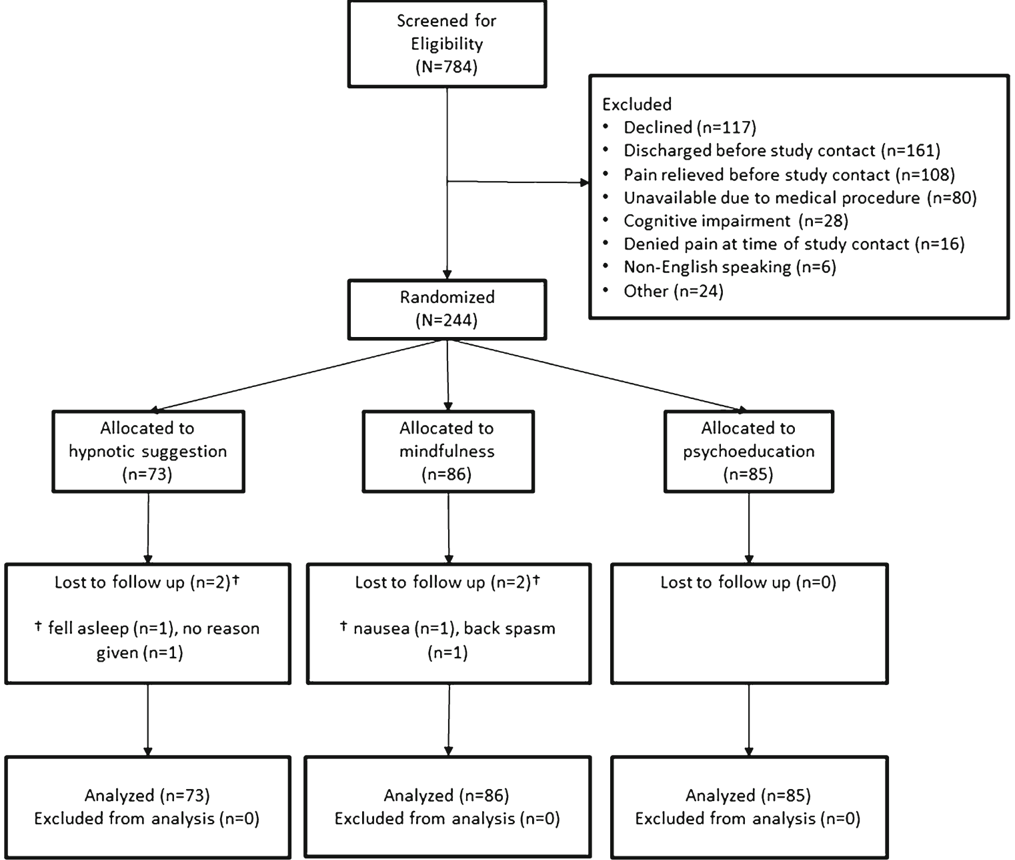
- Of 784 patients screened, 244 were randomized: mindfulness (n = 86), suggestion (n = 73), and psychoeducation (n = 85); 240 completed post-intervention assessments, and no adverse events were reported.
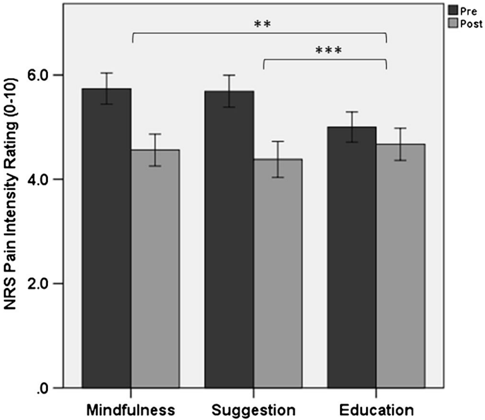
- Pain intensity decreased more in the mind-body conditions than in psychoeducation: baseline-adjusted post-intervention pain severity was significantly lower for mindfulness (B = -0.78, p = 0.001) and suggestion (B = -0.91, p < 0.001), with within-group pain reductions of 23%, 29%, and 9% for mindfulness, suggestion, and education, respectively.
- A clinically meaningful ≥30% pain-intensity reduction occurred in 27% of mindfulness participants, 39% of suggestion participants, and 15% of psychoeducation participants (χ² = 11.56, p = 0.003).
- Secondary outcomes also favored the mind-body interventions: relaxation (p < 0.001), pleasant body sensations (p = 0.001), and desire for opioids (p = 0.015) differed by condition; anxiety decreased across all three conditions, but not differentially (p = 0.15).
Methods
- Single-site, three-arm, parallel-group randomized controlled trial conducted in a university hospital in Salt Lake City from October 2015 through October 2016.
- English-speaking adult inpatients (≥18 years) reporting “intolerable pain” or “inadequate pain control” were enrolled; patients with altered mental status due to delirium, psychosis, or pharmacological sedation were excluded.
- Participants received one 15-minute session of mindfulness training, hypnotic suggestion, or psychoeducation delivered by clinical social workers; outcomes were measured immediately before and after the intervention using 0–10 numeric rating scales, and analyzed with ANCOVA and intention-to-treat linear mixed models.
Limitations
- The paper states there was no follow-up, so the duration of effects is unknown.
- The paper states the suggestion and mindfulness scripts overlapped somewhat in focused attention/body-sensation monitoring, and the psychoeducation arm did not fully control for placebo/suggestibility; there was no sham condition and suggestibility was not measured.
- The paper states it was not powered to compare mindfulness versus hypnotic suggestion head-to-head.
- Evident from the text: the sample was overwhelmingly White (94.3%) and from a single hospital, which limits generalizability.
Model-written summary. Check it against the paper before relying on it.
Integrity signals
Registry
Cites
Statistics
Figures
Verification
Claims the paper makes
12 Valid · 0 Not valid · 11 Not checked · 62 Own results and interpretations
The cited sources support only part of this claim — read each source’s verdict below.
In the paper
“Psychological factors including maladaptive cognitions (e.g., catastrophizing, fear of pain) and negative emotions can exacerbate pain perception via cortico-limbic brain circuitry, 9 -11”
What the sources say
- Partly supportedcites [9] 9. Apkarian, A. V., Bushnell, M. C., Treede, R. D. & Zubieta, J. K. Human brain mechanisms of pain perception and regulation in health and disease. Eur. J. Pain 9, 463 -463 (2005). sourceExperimental — accuracy not yet measured
Section 3.3, “Psychological modulation of pain” (page unavailable), says negative emotional states enhance pain-evoked activity in limbic regions and that expectation of pain activates pain-related circuitry. The psychological-modulation table also reports amplified pain-related responses with anxiety. These passages support the general link, but the copy does not specifically identify catastrophizing or fear of pain as the maladaptive cognitions responsible. (LLM, conf=0.84)
- Not checked — no full text of the sourcecites [10] 10. Weissman-Fogel, I., Sprecher, E. & Pud, D. Effects of catastrophizing on pain perception and pain modulation. Exp. Brain Res. 186, 79 -85 (2008). source
- Not checked — no full text of the sourcecites [11] 11. Wiech, K. & Tracey, I. The influence of negative emotions on pain: behavioral effects and neural mechanisms. Neuroimage 47, 987 -994 (2009). source
plainstates a possible cause- Asserted: passes — The authors put it forward as true.
- Checkable: passes — It can be checked against evidence.
- Load-bearing: passes — The paper’s conclusions depend on it.
- Based: passes — The paper gives a reason why it holds.
- Partly supported
Every source the paper cites for this claim was checked and supports it.
In the paper
“By contrast, suggestive interventions have been shown to reduce pain and distress in the hospital. 17”
What the sources say
- Supportedcites [17] 17. Kekecs, Z. & Varga, K. Positive suggestion techniques in somatic medicine: A review of the empirical studies. Interv. Med. Appl. Sci. 5, 101 -111 (2013). source
The review’s table in “Taped suggestions played during surgery” (page unavailable) reports reduced anxiety and pain after suggestions before and during gynecological surgery. Its table in “The focus of the review” also reports lower pain during radiological procedures and less anxiety increase during breast biopsy. These hospital-based findings support the claim that suggestive interventions have been shown to reduce pain and distress. (LLM, conf=0.92)
plainstates a cause- Asserted: passes — The authors put it forward as true.
- Checkable: passes — It can be checked against evidence.
- Load-bearing: passes — The paper’s conclusions depend on it.
- Based: passes — The paper gives a reason why it holds.
- Supported
The cited sources support only part of this claim — read each source’s verdict below.
In the paper
“Randomized trials indicate that mindfulness alleviates pain by facilitating a shift from affective to sensory processing of pain sensations 13”
What the sources say
- Partly supportedcites [13] 13. Garland, E. L. et al. Therapeutic mechanisms of a mindfulness-based treatment for IBS: effects on visceral sensitivity, catastrophizing, and affective processing of pain sensations. J. Behav. Med. 35, 591 -602(2012). sourceExperimental — accuracy not yet measured
The Discussion (page unavailable) reports that mindfulness treatment increased reinterpretation of pain sensations as sensory signals, which predicted reduced IBS severity in women with IBS. It describes a shift from affective to sensory processing as a possible mechanism, but cautions that the measurements cannot establish the causal order. The claim overstates this exploratory finding as an established explanation for pain relief across randomized trials. (LLM, conf=0.86)
hedgedstates a cause- Asserted: passes — The authors put it forward as true.
- Checkable: passes — It can be checked against evidence.
- Load-bearing: passes — The paper’s conclusions depend on it.
- Based: passes — The paper gives a reason why it holds.
- Partly supported
A result the paper reports from its own data — it cites no other source for it, so there is none to check. The quote shows it is in the paper.
In the paper
“Participants in the mind-body interventions reported significantly lower baseline-adjusted pain intensity post-intervention than those assigned to psychoeducation ( p < 0.001, percentage pain reduction: mindfulness = 23%, suggestion = 29%, education = 9%)”
plainstates a cause- Asserted: passes — The authors put it forward as true.
- Checkable: passes — It can be checked against evidence.
- Load-bearing: passes — The paper’s conclusions depend on it.
- Based: passes — The paper gives a reason why it holds.
A result the paper reports from its own data — it cites no other source for it, so there is none to check. The quote shows it is in the paper.
In the paper
“but all three interventions were associated with a significant reduction in anxiety ( p < 0.001).”
plainstates an association- Asserted: passes — The authors put it forward as true.
- Checkable: passes — It can be checked against evidence.
- Load-bearing: unclear — It is unclear whether the paper’s conclusions depend on it.
- Based: passes — The paper gives a reason why it holds.
40 more claims
Create a free account to see all 85 claims and to verify the 1 reference still open.
- Probably not a substantial claim. 31
- It may state two separate claims as one. 18
Claims other papers make about this one
Each is checked against this paper’s own text: does it say what the citing paper says it does?
The source backs part of the claim, not all of it — or backs it for a different population, condition or comparison.
In the citing paper
“Although mindfulness can be an effective approach to the self-management of chronic pain, most research to date has been conducted on either brief inductions of mindfulness14,28,49 or on more time-intensive and resource-intensive group-based interventions.7,19”
From Randomized, wait-list–controlled pilot study of app-delivered mindfulness for patients reporting chronic pain (2021) · cites this paper as [14]
Experimental — accuracy not yet measured
Statistics recomputed
Every reported test result, recomputed from its test statistic and degrees of freedom. A result shows as not adding up only once an independent check has confirmed it.
- ConsistentF(2, 237) = 1.98reported p = .14 · recomputed p = .140
“F (2,237) = 1.98, p = .14”
Self-check
Percentages, sums and reported differences re-computed from the paper’s own numbers.
Self-check results appear here once an independent check has confirmed them.
Citations
Cites
Farrar, J. T., Young, J. P., LaMoreaux, L., Werth, J. L., & Poole, M. R. (2001) · Pain · doi:10.1016/s0304-3959(01)00349-9 · Cited by 5,808
Persistent postsurgical pain: risk factors and prevention
Kehlet, H., Jensen, T. S., & Woolf, C. J. (2006) · The Lancet · doi:10.1016/s0140-6736(06)68700-x · Cited by 4,086
Dworkin, R. H., Turk, D. C., Wyrwich, K. W., Beaton, D., Cleeland, C. S., Farrar, J. T., Haythornthwaite, J. A., Jensen, M. P., Kerns, R. D., Ader, D. N., et al. (2008) · The Journal of Pain · doi:10.1016/j.jpain.2007.09.005 · Cited by 3,471
Human brain mechanisms of pain perception and regulation in health and disease
Apkarian, A. V., Bushnell, M. C., Treede, R., & Zubieta, J. (2005) · European Journal of Pain · doi:10.1016/j.ejpain.2004.11.001 · Cited by 3,126
The Neuroscience of Mindfulness Meditation
Tang, Y.-Y., Hölzel, B. K., & Posner, M. I. (2015) · Nature reviews. Neuroscience · doi:10.1038/nrn3916 · Cited by 2,889
Dworkin, R. H., Turk, D. C., McDermott, M. P., Peirce-Sandner, S., Burke, L. B., Cowan, P., Farrar, J. T., Hertz, S., Raja, S. N., Rappaport, B. A., et al. (2009) · Pain · doi:10.1016/j.pain.2009.08.019 · Cited by 654
Brain Mechanisms Supporting the Modulation of Pain by Mindfulness Meditation
Zeidan, F., Martucci, K. T., Kraft, R. A., Gordon, N. S., McHaffie, J. G., & Coghill, R. C. (2011) · The Journal of Neuroscience · doi:10.1523/jneurosci.5791-10.2011 · Cited by 640
The influence of negative emotions on pain: Behavioral effects and neural mechanisms
Wiech, K., & Tracey, I. (2009) · NeuroImage · doi:10.1016/j.neuroimage.2009.05.059 · Cited by 614
Cortical Representation of the Sensory Dimension of Pain
Hofbauer, R. K., Rainville, P., Duncan, G. H., & Bushnell, M. C. (2001) · Journal of Neurophysiology · doi:10.1152/jn.2001.86.1.402 · Cited by 611
Frison, L., & Pocock, S. J. (1992) · Statistics in Medicine · doi:10.1002/sim.4780111304 · Cited by 593
Cited by
Basso, J. C., McHale, A., Ende, V., Oberlin, D. J., & Suzuki, W. A. (2019) · Behavioural Brain Research · doi:10.1016/j.bbr.2018.08.023 · Cited by 255
Effects of Brief Mindfulness-Based Interventions on Health-Related Outcomes: a Systematic Review
Howarth, A., Smith, J. G., Perkins-Porras, L., & Ussher, M. (2019) · Mindfulness · doi:10.1007/s12671-019-01163-1 · Cited by 219
Mind-Body Therapies for Opioid-Treated Pain: A Systematic Review and Meta-analysis
Garland, E. L., Brintz, C. E., Hanley, A. W., Roseen, E. J., Atchley, R. M., Gaylord, S. A., Faurot, K. R., Yaffe, J., Fiander, M., & Keefe, F. J. (2020) · JAMA Internal Medicine · doi:10.1001/jamainternmed.2019.4917 · Cited by 190
Self-citationGarland, E. L., Hanley, A. W., Riquino, M. R., Reese, S. E., Baker, A. K., Salas, K., Yack, B. P., Bedford, C. E., Bryan, M. A., Atchley, R., et al. (2019) · Journal of Consulting and Clinical Psychology · doi:10.1037/ccp0000390 · Cited by 167
“A uthor M anuscript A uthor M anuscript A uthor M anuscript A uthor M anuscript clinical pain (Garland et al., 2017; Jensen & Patterson, 2014), can also occasion mystical and self-transcendent experiences (Lynn & Evans, 2017).”
BackgroundSelf-citationEdwards, D. A., Hedrick, T. L., Jayaram, J., Argoff, C. E., Gulur, P., Holubar, S. D., Gan, T. J., Mythen, M. G., Miller, T. E., Shaw, A., et al. (2019) · Anesthesia & Analgesia · doi:10.1213/ane.0000000000004018 · Cited by 144
Brief Mindfulness-Based Interventions for Acute and Chronic Pain: A Systematic Review
McClintock, A. S., McCarrick, S. M., Garland, E. L., Zeidan, F., & Zgierska, A. E. (2019) · The Journal of Alternative and Complementary Medicine · doi:10.1089/acm.2018.0351 · Cited by 107
Self-citationManagement of Postoperative Pain in Patients Following Spine Surgery: A Narrative Review
Prabhakar, N., Chadwick, A. L., Nwaneshiudu, C. A., Aggarwal, A. K., Salmasi, V., Lii, T. R., & Hah, J. M. (2022) · International Journal of General Medicine · doi:10.2147/ijgm.s292698 · Cited by 128
Harrison, T. K., Kornfeld, H., Aggarwal, A. K., & Lembke, A. (2018) · Anesthesiology Clinics · doi:10.1016/j.anclin.2018.04.002 · Cited by 101
Hanley, A. W., Gililland, J., Erickson, J., Pelt, C., Peters, C., Rojas, J., & Garland, E. L. (2021) · Pain · doi:10.1097/j.pain.0000000000002195 · Cited by 70
Self-citationThe Role of Heart Rate Variability in Mindfulness-Based Pain Relief
Adler-Neal, A. L., Waugh, C. E., Garland, E. L., Shaltout, H. A., Diz, D. I., & Zeidan, F. (2020) · The Journal of Pain · doi:10.1016/j.jpain.2019.07.003 · Cited by 68
Self-citationBuresh, M., Ratner, J., Zgierska, A. E., Gordin, V., & Alvanzo, A. A. H. (2020) · Journal of General Internal Medicine · doi:10.1007/s11606-020-06115-3 · Cited by 78
Hanley, A. W., Gililland, J., & Garland, E. L. (2021) · Journal of Consulting and Clinical Psychology · doi:10.1037/ccp0000657 · Cited by 63
Mindful moments: A review of brief, low‐intensity mindfulness meditation and induced mindful states
Heppner, W. L., & Shirk, S. D. (2018) · Social and Personality Psychology Compass · doi:10.1111/spc3.12424 · Cited by 57
Herzig, S. J., Mosher, H. J., Calcaterra, S. L., Jena, A. B., & Nuckols, T. K. (2018) · Journal of Hospital Medicine · doi:10.12788/jhm.2980 · Cited by 56
Hanley, A. W., Bernstein, A., Nakamura, Y., Hadash, Y., Rojas, J., Tennant, K. E., Jensen, R. L., & Garland, E. L. (2020) · Psychological Assessment · doi:10.1037/pas0000931 · Cited by 45
“The mindfulness intervention involved a standardized, mindful breathing practice (e.g., Garland, 2013) that has been previously validated with a clinical pain population (Garland et al., 2017).”
MethodSelf-citationGarland, E. L. (2020) · Pain · doi:10.1097/j.pain.0000000000001988 · Cited by 39
Self-citationClarke, H. A., Manoo, V., Pearsall, E. A., Goel, A., Feinberg, A. E., Weinrib, A., Chiu, J. C., Shah, B., Ladak, S. S. J., Ward, S. E., et al. (2020) · Canadian Journal of Pain · doi:10.1080/24740527.2020.1724775 · Cited by 41
Jaaniste, T., Noel, M. E., Yee, R. D., Bang, J., Tan, A., & Champion, G. D. (2019) · Children · doi:10.3390/children6120132 · Cited by 46
Joseph, A., Moman, R. N., Barman, R. A., Kleppel, D. J., Eberhart, N. D., Gerberi, D., Murad, M. H., & Hooten, W. M. (2022) · Journal of Evidence-Based Integrative Medicine · doi:10.1177/2515690x221078006 · Cited by 77
Weston, E., Raker, C., Huang, D., Parker, A. B., Robison, K. M., & Mathews, C. A. (2019) · Journal of Minimally Invasive Gynecology · doi:10.1016/j.jmig.2019.08.021 · Cited by 30
Palmer, P. K., Wehrmeyer, K., Florian, M. P., Raison, C. L., Idler, E. L., & Mascaro, J. S. (2021) · PLoS ONE · doi:10.1371/journal.pone.0260921 · Cited by 39
Hanley, A. W., & Garland, E. L. (2022) · Mindfulness · doi:10.1007/s12671-022-01896-6 · Cited by 27
Self-citationPain management in thoracic trauma
Muldowney, M., & Bhalla, P. I. (2021) · International Anesthesiology Clinics · doi:10.1097/aia.0000000000000311 · Cited by 30
Meditation as an Adjunct to the Management of Acute Pain
Wipplinger, F., Holthof, N., Andereggen, L., Urman, R. D., Luedi, M. M., & Bello, C. (2023) · Current Pain and Headache Reports · doi:10.1007/s11916-023-01119-0 · Cited by 20
Perioperative Buprenorphine Management
Hickey, T. R., Abelleira, A., Acampora, G. A., Becker, W. C., Falker, C. G., Nazario, M., & Weimer, M. B. (2021) · Medical Clinics of North America · doi:10.1016/j.mcna.2021.09.001 · Cited by 23
Coelho, B. A., Paiva, S. D. P. C., & Filho, A. L. D. S. (2018) · Breast Cancer Research and Treatment · doi:10.1007/s10549-018-4869-9 · Cited by 21
Vekhter, D., Robbins, M. S., Minen, M. T., & Buse, D. C. (2020) · Current Pain and Headache Reports · doi:10.1007/s11916-020-00899-z · Cited by 23
Hanley, A. W., Hinich, J., Kennedy, A., Newman, C., Martorella, G., Anderson, L. A., Pelt, C. E., Gililland, J. M., & Garland, E. L. (2023) · Mindfulness · doi:10.1007/s12671-023-02112-9 · Cited by 23
Self-citationKrane, N. A., Simmons, J. K., Sykes, K. J., Kriet, J. D., & Humphrey, C. D. (2021) · Facial Plastic Surgery & Aesthetic Medicine · doi:10.1089/fpsam.2021.0184 · Cited by 19
The Association Between Mindfulness and Hypnotizability: Clinical and Theoretical Implications
Grover, M. P., Jensen, M. P., Patterson, D. R., Gertz, K. J., & Day, M. A. (2018) · American Journal of Clinical Hypnosis · doi:10.1080/00029157.2017.1419458 · Cited by 17
Parisi, A. B., Hanley, A. W., & Garland, E. L. (2022) · Behaviour Research and Therapy · doi:10.1016/j.brat.2022.104066 · Cited by 19
Self-citationHanley, A. W., & Garland, E. L. (2019) · Psychosomatic Medicine · doi:10.1097/psy.0000000000000725 · Cited by 19
Self-citationMiller-Matero, L. R., Coleman, J. P., Smith-Mason, C. E., Moore, D. A., Marszalek, D., & Ahmedani, B. K. (2019) · Pain Medicine · doi:10.1093/pm/pnz082 · Cited by 17
Pérez-Aranda, A., Barceló-Soler, A., Andrés-Rodríguez, L., Peñarrubia-María, M. T., Tuccillo, R., Borraz-Estruch, G., García-Campayo, J., Feliu-Soler, A., & Luciano, J. V. (2017) · Mindfulness & Compassion · doi:10.1016/j.mincom.2017.10.002 · Cited by 17
“…unpleasant pain without affecting its intensity; for instance, the person subject to hypnosis can feel pain but is not so disturbed by the sensation (Garland et al., 2017; Kropotov, Crawford, & Polyakov, 1997; Montgomery, Duhamel, & Redd, 2000; Rainville, Carrier, Hof-bauer, Bushnell, & Duncan,…”
BackgroundHymowitz, G., Hasan, F., Yerramalli, G., & Cervoni, C. (2024) · The American Surgeon™ · doi:10.1177/00031348221117025 · Cited by 16
Mascaro, J. S., Singh, V., Wehrmeyer, K., Scott, B., Juan, J., McKenzie-Brown, A. M., Lane, O. P., & Haack, C. (2021) · PAIN Reports · doi:10.1097/pr9.0000000000000924 · Cited by 14
Buse, D. C., Rabany, L., Lin, T., Ironi, A., Connelly, M. A., & Bickel, J. L. (2022) · Pain Medicine · doi:10.1093/pm/pnac021 · Cited by 14
Gurram, P., Narayanan, V., Chandran, S., Ramakrishnan, K., Abinaya, S., & Kalakumari, A. P. (2021) · Journal of Oral and Maxillofacial Surgery · doi:10.1016/j.joms.2021.04.027 · Cited by 21
Roberts, R. L., Hanley, A. W., & Garland, E. L. (2022) · The American Surgeon · doi:10.1177/00031348221114019 · Cited by 15
Self-citationJiménez, Ó., Díaz, N. S. R., González-Moraleda, Á., & Resurrección, D. M. (2020) · Mindfulness · doi:10.1007/s12671-020-01320-x · Cited by 13
Day, M. A., Matthews, N. L., Davies, J. N., Walker, C., Bray, N. A., Kim, J. J., & Jensen, M. P. (2023) · Journal of Pain & Palliative Care Pharmacotherapy · doi:10.1080/15360288.2022.2141944 · Cited by 11
Effects of Music and Relaxation Suggestions on Experimental Pain
Johnson, A. J., & Elkins, G. R. (2020) · International Journal of Clinical and Experimental Hypnosis · doi:10.1080/00207144.2020.1719842 · Cited by 15
Martorella, G., Hanley, A. W., Pickett, S. M., & Gélinas, C. (2021) · JMIR Research Protocols · doi:10.2196/30951 · Cited by 12
Self-citationImmediate Effects of Mindfulness Meditation on the Voice
Becker, D. R., Shelly, S., Kavalieratos, D., Maira, C. P., & Gillespie, A. I. (2022) · Journal of Voice · doi:10.1016/j.jvoice.2022.10.022 · Cited by 17
Hanley, A. W., Garland, E. L., & Zingg, R. W. (2021) · Journal of Osteopathic Medicine · doi:10.1515/jom-2020-0186 · Cited by 9
Self-citationAssociation between positive and negative affect and musculoskeletal pain among US home health aides
Mayer-Hirshfeld, I., Brannan, D., Murphy, L. A., Hecht, E. M., & Caban-Martinez, A. J. (2017) · Archives of Environmental & Occupational Health · doi:10.1080/19338244.2017.1373056 · Cited by 9
Beng, T. S., Chai, C.-S., Ng, D.-L.-C., Zainuddin, S. I., Capelle, D. P., Lam, C. L., Ang, C. M., Chai, W. L., Ishak, N. N. N., Ong, Y. X., et al. (2024) · BMJ Supportive & Palliative Care · doi:10.1136/spcare-2023-004762 · Cited by 12
The effect of emotion regulation on the emotional modulation of pain and nociceptive flexion reflex
Toledo, T. A., Vore, C. N., Huber, F. A., & Rhudy, J. L. (2024) · Pain · doi:10.1097/j.pain.0000000000003127 · Cited by 10
Mirabito, G., & Verhaeghen, P. (2023) · Psychological Reports · doi:10.1177/00332941231216899 · Cited by 12
Ballejos, K. G., Calvetti, P. Ü., Schaab, B. L., & Reppold, C. T. (2023) · Frontiers in Psychology · doi:10.3389/fpsyg.2023.1270287 · Cited by 10
Hanley, A. W., Lingard, A., & Garland, E. L. (2024) · Journal of Integrative and Complementary Medicine · doi:10.1089/jicm.2023.0501 · Cited by 8
Self-citationThe Mindful Warm-Up: Proof of Concept for a Brief Embedded Intervention
Hanley, A. W., Walker, D., Zingg, R. W., Garland, E. L., & Hansen, P. A. (2023) · Mindfulness · doi:10.1007/s12671-023-02181-w · Cited by 7
Self-citationPatients on Buprenorphine Formulations Undergoing Surgery
Champagne, K., Date, P., Forero, J. P., Arany, J., & Gritsenko, K. (2022) · Current Pain and Headache Reports · doi:10.1007/s11916-022-01046-6 · Cited by 6
Identification of a novel breathing circuit that controls pain and anxietyPreprint
Liu, S., Ye, M., Pao, G. M., Song, S. M., Jhang, J., & Han, S. S. (2020) · bioRxiv (Cold Spring Harbor Laboratory) · doi:10.1101/2020.01.09.900738 · Cited by 5
Hanley, A. W., Zingg, R. W., Smith, B., Zappa, M., White, S., Davis, A., Worts, P. R., Culjat, C., & Martorella, G. (2024) · Journal of Integrative and Complementary Medicine · doi:10.1089/jicm.2024.0020 · Cited by 5
Self-citationHypnotherapy as a medical treatment: Evidence-based or pseudoscience?
van Tilburg, M. A. L., Monis, E. L., Braumann, R. E., Fleishman, K., & Lamm, K. (2024) · Complementary Therapies in Clinical Practice · doi:10.1016/j.ctcp.2024.101841 · Cited by 7
Hinzmann, D., Haneveld, J., Heininger, S. K., & Spitznagel, N. (2022) · Medicine · doi:10.1097/md.0000000000032302 · Cited by 7
Diller, M. L., & Master, V. A. (2022) · The American Surgeon · doi:10.1177/00031348221110244 · Cited by 7
Integrative surgical oncology: A model of acute integrative oncology
Diller, M. L., & Master, V. A. (2021) · Cancer · doi:10.1002/cncr.33688 · Cited by 7
Efficacy of hypnosis in the management of non-procedural pain: systematic review
Machado, R. S., da Silva, J. C., & da Silva, A. S. (2021) · Brazilian Journal Of Pain · doi:10.5935/2595-0118.20210045 · Cited by 6
Management of Postoperative Pain in Septorhinoplasty: A Systematic Review
Coviello, C. M., Ramesh, U. R., Varman, B., Olson, K. L., & Sivam, S. K. (2025) · The Laryngoscope · doi:10.1002/lary.32433 · Cited by 3
EEG Signatures and Effects of Mindfulness Approaches in Adolescents With Nonsuicidal Self‐Injury
Zhen, Y., Liu, P., Jiang, L., Li, F., Li, Y., Liu, J., Xu, P., Lu, J., & Zhang, Z. (2025) · Psychophysiology · doi:10.1111/psyp.70085 · Cited by 6
Ugarte, D. A., Hanley, A. W., Dusek, J. A., Martin, S. R., Cumberland, W. G., & Young, S. D. (2023) · Cureus · doi:10.7759/cureus.35073 · Cited by 2
Self-citationHanley, A. W., Coleman, C., Davis, A., Sorkpor, S. K., Gililland, J. M., & Zgierska, A. E. (2025) · Journal of the American Academy of Orthopaedic Surgeons · doi:10.5435/jaaos-d-24-01375 · Cited by 2
Self-citationScoping Review of Psychological Therapies in Acute Pain Relief—To Whom, From Who, and Which Channels
Tololiu, K. E., Kurnianto, A. A., Kusuma, I. Y., Ehlers, J. S., Deák, A., Kocsor, F., & Csókási, K. (2025) · Journal of PeriAnesthesia Nursing · doi:10.1016/j.jopan.2025.03.005 · Cited by 4
Hanley, A. W., Davis, A., Worts, P. R., & Pratscher, S. D. (2025) · Journal of Behavioral Medicine · doi:10.1007/s10865-024-00548-5 · Cited by 3
Self-citationQanadli, S. D., Gudmundsson, L., Gullo, G., Ponti, A., Saltiel, S., Jouannic, A.-M., Faouzi, M., & Rotzinger, D. C. (2022) · PLoS ONE · doi:10.1371/journal.pone.0263002 · Cited by 2
Mindfulness and Health: The Nursing Science Bridge
Saban, K. L., & Janusek, L. W. (2020) · Western Journal of Nursing Research · doi:10.1177/0193945920973748 · Cited by 4
Hanley, A. W., Gililland, J. M., Erickson, J. A., et al. (2020) · doi:10.31231/osf.io/zrm7t · Cited by 2
Self-citationAfrican American Young Adults’ Pain and Pain Reduction Strategies
Eze, B., & McDonald, D. D. (2020) · Pain Management Nursing · doi:10.1016/j.pmn.2020.05.004 · Cited by 2
Zunzarren, G., Garet, B., Cabarkapa, S., et al. (2026) · JMIR Research Protocols · doi:10.2196/87895 · Cited by 1
Hipnose odontológica no HC da UNICAMP benefício na diminuição da dor e do medo pré e trans cirúrgico
Vieira, W. R., Franco, J. B., Sampaio, M., Bellini, B. S., Frazzato, C. R. G., dos Santos, C. M., & Neto, I. F. M. (2026) · Revista Saberes Universitários · doi:10.20396/saberes.v5i00.20446 · Cited by 1
Young, S. D., & Hanley, A. W. (2025) · European Journal of Investigation in Health Psychology and Education · doi:10.3390/ejihpe15120239 · Cited by 1
Self-citationTropiano, H., Robertson, J., Rathbun, A. M., Yates, B. T., & Fromm, N. M. (2025) · Anthrozoös · doi:10.1080/08927936.2025.2529681 · Cited by 1
Södermark, M. (2023) · Linköping University medical dissertations · doi:10.3384/9789180753692 · Cited by 3
Diller, M. L., Mascaro, J. S., Haack, C. I., & Master, V. A. (2022) · The American Surgeon · doi:10.1177/00031348221109815 · Cited by 1
Martelletti, P. (2022) · Springer eBooks · doi:10.1007/978-3-030-97359-9_4 · Cited by 1
Intervenciones basadas en mindfulness para el manejo de pacientes con dolor
Schuler, G. S. R., & Badoui, N. (2021) · Universitas Médica · doi:10.11144/javeriana.umed62-4.mind · Cited by 3
Brief one-time mind–body interventions for pain relief before joint arthroplasty
Riddle, D. L. (2021) · Pain · doi:10.1097/j.pain.0000000000002250 · Cited by 1
Pain Psychology and Perioperative Pain Management
Tsui, P. W., Gupta, A. K., Cervoni, C., Page, C. R., & Sonty, N. (2021) · Springer eBooks · doi:10.1007/978-3-030-56081-2_9 · Cited by 1
Заводов, А. О., Беляцкая, А. Я., Жан, Б., & Александрович, Б. С. (2021) · Познание · doi:10.37882/2500-3682.2021.06.07 · Cited by 1
Hypnose périopératoire : quel impact antalgique ?
Zaccarini, S., Walther-Lagger, S., Potié, A., & Berna, C. (2020) · JMIG · doi:10.53738/revmed.2020.16.700.1354 · Cited by 4
Principles of Comprehensive Approach to Pain Management in Patients with the Disease of Addiction
Lazaridou, A., & Zgierska, A. E. (2019) · Pain · doi:10.1007/978-3-319-99124-5_242 · Cited by 1
Minnick, C., Hanley, A. W., & Garland, E. L. (2026) · International Journal of Behavioral Medicine · doi:10.1007/s12529-026-10464-4
Self-citationRomain, G., Alashi, A., Tapia, C. M., Sinusas, A. J., Galiana, G., Barry, D. T., Vashist, A., Lang, E. V., Garland, E. L., Mena‐Hurtado, C., et al. (2026) · Journal of Pain · doi:10.1016/j.jpain.2026.106320 · Cited by 1
Self-citationChang, S.-H., Tseng, P.-K., Wu, J.-T., Chen, K.-J., & Cheng, Y. (2026) · BMC Psychology · doi:10.1186/s40359-026-04445-1
Ziadni, M. S., Dildine, T. C., Edwards, K. A., Herrick, A., You, D. S., & Darnall, B. D. (2026) · Journal of Pain · doi:10.1016/j.jpain.2026.106220 · Cited by 2
Shah, Y. M., Zador, L., Money, S. L., Haddad, R., Sibai, N., Guerra‐Londono, C. E., Nowak, K., & Zador, V. (2026) · Journal of Integrative and Complementary Medicine · doi:10.1177/27683605261425598
Pandey, D., & Bhavsar, A. (2026) · Studies in Rhythm Engineering · doi:10.1007/978-3-032-21704-2_13
Acute Pain in Critical Care Oncologic Patients
Vu, C., Popat, K. U., & Donahue, H. (2026) · Springer eBooks · doi:10.1007/978-3-319-74698-2_141-2
Brief psychological interventions to increase wellbeing
Vázquez, C., Contreras, A., Trucharte, A., García‐Rubio, C., & de la Muela, P. (2026) · Elsevier eBooks · doi:10.1016/b978-0-443-27346-9.00018-2
Zhang, N., Guo, J., Yang, B., Fang, S., Cheng, Y., Chen, J., Sun, B., & Li, Y. (2025) · BMC Public Health · doi:10.1186/s12889-025-25705-6 · Cited by 6
Hanley, A. W., Gibson, R. W., Davis, A., Stecher, C. D., Childs, K., & Worts, P. R. (2025) · International Journal of Behavioral Medicine · doi:10.1007/s12529-025-10398-3
Self-citationAnxiety and sleep quality in the undergraduate stress–depression link: A moderated mediation studyPreprint
Koebeli, C., Koebeli, M., Morgan, K., Edginton, T. L., & Boubert, L. (2025) · medRxiv · doi:10.1101/2025.08.01.25332606
Strategies for Diagnosis and Management of Opioid Usage Disorder
Nguyen, A., Shah, S., Embry, N. J., Shekoohi, S., & Kaye, A. D. (2025) · Springer eBooks · doi:10.1007/978-3-032-07407-2_16
Directive Illocutionary Acts in Progressive Relaxation
Nurhadi, J., Fauzy, E. R., Khotima, N. A., & Rahman, S. H. (2024) · KEMBARA Journal of Scientific Language Literature and Teaching · doi:10.22219/kembara.v10i2.29499
Cooperman, N. A., Shen, J., Gordon, A. J., & Garland, E. L. (2024) · Substance Use & Addiction Journal · doi:10.1177/29767342241261890 · Cited by 1
Self-citationMiller, M. A. (2024) · Digital Repository Service (Northeastern University) · doi:10.17760/d20652992
Martelletti, P. (2023) · Springer eBooks · doi:10.1007/978-3-031-20894-2_1 · Cited by 2
How Does One Approach the Patient With an Opioid Use Disorder?
Ho, J. J., Jones, K. F., Merlin, J. S., & Childers, J. W. (2023) · Elsevier eBooks · doi:10.1016/b978-0-323-84702-5.00012-9
Metadata
- Authors
- Garland, E. L., Baker, A. K., Larsen, P., Riquino, M. R., Priddy, S. E., Thomas, E., Hanley, A. W., Galbraith, P., Wanner, N., & Nakamura, Y.
- Affiliations
- University of Utah (US)
- University of Utah Hospital (US)
- Corresponding author
- Garland, Eric L.
- Venue
- Journal of General Internal Medicine
- Published
- 2017-07-12
- Volume
- 32
- Issue
- 10
- Pages
- 1106-1113
- ISSN
- 0884-8734 (ISSN-L)
- 1525-1497
- PMC
- PMC5602767
- OpenAlex
- W2736016695
- Semantic Scholar
- 109707ffcc815992fbfc28a6b3a5b079d6258b64
- Cited by
- 109
- References
- 33
- Citations by year
- 2026: 12 · 2025: 11 · 2024: 8 · 2023: 10 · 2022: 16 · 2021: 17 · 2020: 12 · 2019: 12 · 2018: 8 · 2017: 3
- FWCI
- 11.84
- Type
- journal article
- Language
- en
- Open access
- bronze
- doi.org
- Locations
- Journal of General Internal Medicine (publishedVersion)
- Europe PMC (PubMed Central) (publishedVersion)
- PubMed Central (publishedVersion)
- PubMed (publishedVersion)
- Funders
- National Institutes of Health
- National Institute on Drug Abuse (R01DA042033)
- National Center for Complementary and Integrative Health (R61AT009296)
- Topics
- Social Sciences › Psychology › Clinical Psychology › Mindfulness and Compassion Interventions
- Life Sciences › Neuroscience › Cognitive Neuroscience › Pain Management and Placebo Effect
- Health Sciences › Medicine › Pediatrics, Perinatology and Child Health › Pediatric Pain Management Techniques
- Keywords
- mindfulness training, hypnotic suggestion, acute pain, pain intensity, pain unpleasantness, mind-body interventions, hospitalized patients, psychoeducation, relaxation, anxiety, opioid use, hospital social workers, pain coping
- MeSH terms
- Adult, Aged, Female, Hospitalization, Humans, Hypnosis, Male, Middle Aged, Pain Measurement, Time Factors, Pain Management, Acute Pain, Mindfulness
About these checks
Registry, retraction, Cites and statistics results are computed, not judged, with one exception: a printed reference that no index lists is read once by a model before it counts as a citation error. Claims are extracted by a model and kept only when their quote appears verbatim in the text; each cited source is then checked, with a model’s help, for whether it says what the claim relies on. Those verdicts can be wrong — read the claim’s quote and the cited source before relying on one.
The claim verdicts this report counts are experimental: their accuracy is not yet measured.
A language model drew the claims from the paper on 2026-10-11, under version 3 of the claim definition (model deepseek-v4.1-flash, prompt extract-v3).
A second model labelled each claim on 2026-10-11 (model jev-1.13-20260917, definition revision gold-guideline-v0.2).
Cited sources are checked with a language model’s help (gpt-6-sol).
Statistics and arithmetic are recomputed, not judged.
Confidence bands are shown only for fields calibrated on our annotated test set. None is calibrated yet, so no band is shown.
What counts as a claim ›How we measure confidence ›How we check this ›
Are you an author, or do you see a problem with this page? Request a review
Data sources
Bibliographic data: Semantic Scholar, OpenAlex, Crossref.
Contains information from the Semantic Scholar Academic Graph Datasets, made available under the ODC Attribution License (ODC-BY 1.0).
Semantic Scholar’s data is described in: Kinney, R., et al. (2023). The Semantic Scholar Open Data Platform. arXiv:2301.10140.
