

Distant agricultural landscapes
Open accessThe DOI matches its Crossref record; 75 of the 75 references it cites were found in a registry or an index.
Abstract
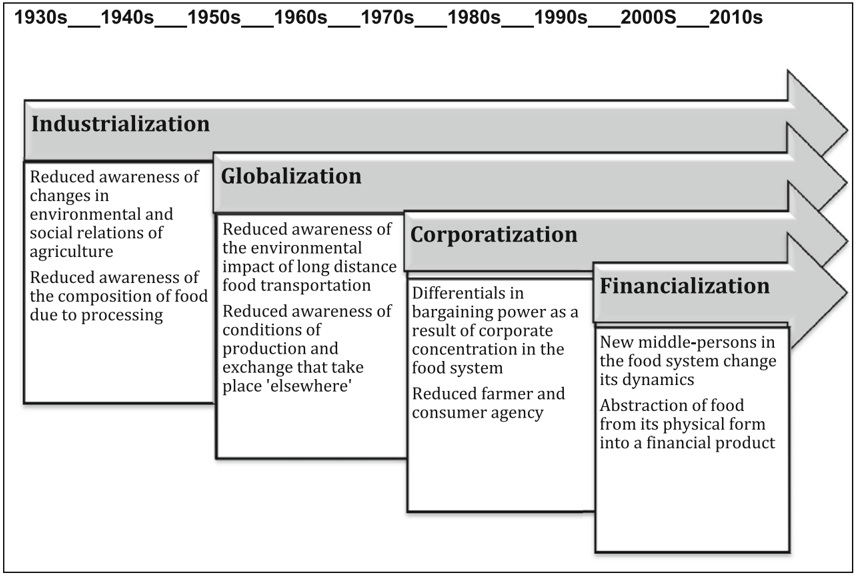
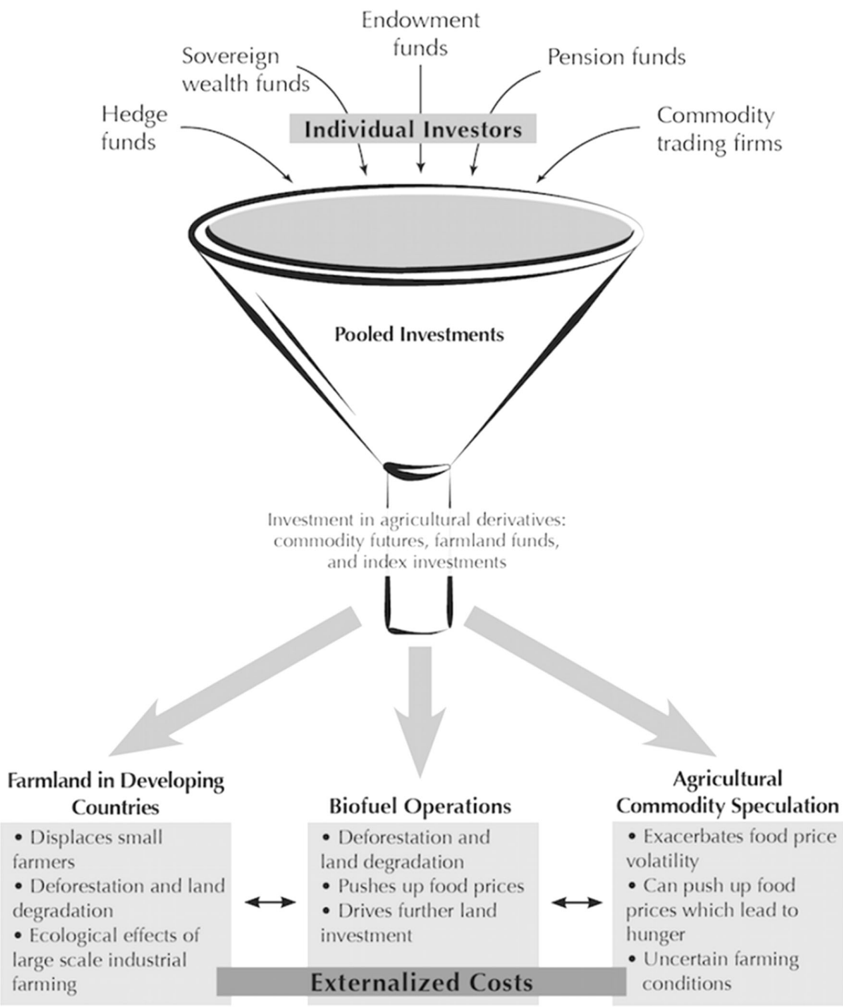
This paper examines the relationship between the development of the dominant industrial food system and its associated global economic drivers and the environmental sustainability of agricultural landscapes. It makes the case that the growth of the global industrial food system has encouraged increasingly complex forms of “distance” that separate food both geographically and mentally from the landscapes on which it was produced. This separation between food and its originating landscape poses challenges for the ability of more localized agricultural sustainability initiatives to address some of the broader problems in the global food system. In particular, distance enables certain powerful actors to externalize ecological and social costs, which in turn makes it difficult to link specific global actors to particular biophysical and social impacts felt on local agricultural landscapes. Feedback mechanisms that normally would provide pressure for improved agricultural sustainability are weak because there is a lack of clarity regarding responsibility for outcomes. The paper provides a brief illustration of these dynamics with a closer look at increased financialization in the food system. It shows that new forms of distancing are encouraged by the growing significance of financial markets in global agrifood value chains. This dynamic has a substantial impact on food system outcomes and ultimately complicates efforts to scale up small-scale local agricultural models that are more sustainable.
Overview
The claims and statistics of this paper haven’t been checked yet.
Free: it reads the open-access text and checks the first 5 claims that cite a source we can check. Create a free account to check every claim.
Integrity signals
Registry
Cites
Statistics
Figures

Verification
Claims the paper makes
The claims and statistics of this paper haven’t been checked yet.
Free: it reads the open-access text and checks the first 5 claims that cite a source we can check. Create a free account to check every claim.
Claims other papers make about this one
Each is checked against this paper’s own text: does it say what the citing paper says it does?
The check wasn’t confident either way, so it gives no verdict — never disputed.
In the citing paper
“This chilling effect is enhanced when HIC governments representing the interests of TFBCs (mainly the US and EU) have used WTO trade dispute mechanisms to challenge food regulations adopted by other countries 119,218 .”
From Ultra‐processed foods and the nutrition transition: global, regional and national trends, food systems transformations and political economy drivers (2020) · cites this paper as [218]
Experimental — accuracy not yet measured
Self-check
Percentages, sums and reported differences re-computed from the paper’s own numbers.
The self-check needs the paper’s full text.
Citations
Cites
The State of Food Insecurity in the World
WFP, W. (2015) · Cited by 2,947
Green Revolution: Impacts, limits, and the path ahead
Pingali, P. L. (2012) · Proceedings of the National Academy of Sciences · doi:10.1073/pnas.0912953109 · Cited by 2,442 · cited 1×
“The spread of industrial agricultural production methods under the Green Revolution, for example, sought to make food production more efficient by increasing output and addressing the problem of hunger and food shortages (Evenson and Gollin 2003; Pingali 2012).”
MethodClimate Change and Food Systems
Vermeulen, S. J., Campbell, B. M., & Ingram, J. S. I. (2012) · Annual Review of Environment and Resources · doi:10.1146/annurev-environ-020411-130608 · Cited by 2,423
Assessing the Impact of the Green Revolution, 1960 to 2000
Evenson, R. E., & Gollin, D. (2003) · Science · doi:10.1126/science.1078710 · Cited by 2,228 · cited 1×
“The spread of industrial agricultural production methods under the Green Revolution, for example, sought to make food production more efficient by increasing output and addressing the problem of hunger and food shortages (Evenson and Gollin 2003; Pingali 2012).”
MethodSustainable Intensification in Agriculture: Premises and Policies
Garnett, T., Appleby, M. C., Balmford, A., Bateman, I. J., Benton, T. G., Bloomer, P., Burlingame, B., Dawkins, M., Dolan, L., Fraser, D., et al. (2013) · Science · doi:10.1126/science.1234485 · Cited by 1,741 · cited 2×
“Corporations also have a say in how food is processed and stored, with rising levels of highly processed, packaged, and refrigerated foods marketed in the global food system, using increasing amounts of water and energy (Garnett 2013).”
BackgroundConceptualizing food systems for global environmental change research
Ericksen, P. J. (2008) · Global Environmental Change · doi:10.1016/j.gloenvcha.2007.09.002 · Cited by 1,486 · cited 2×
“Indeed, as Erikson notes in her articulation of a framework for analyzing food system–environment interactions (Ericksen 2008), there is a need to better understand the influence of external socioeconomic and environmental drivers that influence food systems, including their associated feedbacks (p.”
BackgroundAGRICULTURE AND THE STATE SYSTEM: The rise and decline of national agricultures, 1870 to the present
FRIEDMA, H., & McMICHAEL, P. (1989) · Sociologia Ruralis · doi:10.1111/j.1467-9523.1989.tb00360.x · Cited by 1,247 · cited 1×
“The industrial food system became increasingly globalized since the 1960s and 70s as integration within the world economy intensified (Friedmann and McMichael 1989).”
BackgroundMcMichael, P. (2009) · The Journal of Peasant Studies · doi:10.1080/03066150902820354 · Cited by 1,238
Food, livestock production, energy, climate change, and health
McMichael, A. J., Powles, J. W., Butler, C. D., & Uauy, R. (2007) · The Lancet · doi:10.1016/s0140-6736(07)61256-2 · Cited by 1,226 · cited 2×
“…an extensive literature emerge that highlights how these external economic drivers have been linked to a variety of ecological and social effects within food systems that have brought profound changes to agricultural landscapes (Weis 2007; McMichael et al. 2007; Sage 2011; Vermeulen et al. 2012).”
BackgroundRising global interest in farmland: can it yield sustainable and equitable benefits?
(2011) · Choice Reviews Online · doi:10.5860/choice.49-0396 · Cited by 1,204
Research works printed but not linked: 6
- Clapp J (2012) Food. Cambridge, Polity
- Daniel S, Mittal A (2011) The great land grab: rush for the world's farmland threatens food security for the poor. Oakland Institute, Oakland
- Fuchs N, Hoffmann U (2013) Ensuring food security and environ- mental resilience-the need for supportive agricultural trade rules. UNCTAD trade and environment review. UNCTAD, Geneva, pp 266-275
- Mintz S (1985) Sweetness and power: the place of sugar in world history. Viking, New York
- Princen T (2002) Distancing: consumption and the severing of feedback. In: Princen T, Maniates M, Conca K (eds) Confronting consumption. MIT Press, Cambridge
- Smith P (2013) Delivering food security without increasing pressure on land. Global Food Security 2(1):18-23 United Nations Conference on Trade and Development (2011) Price formation in financialized commodity markets: the role of information. http://www.unctad.org/en/docs/gds20111_en.pdf
Cited by
Baker, P., Machado, P., Santos, T., Sievert, K., Backholer, K., Hadjikakou, M., Russell, C., Huse, O., Bell, C., Scrinis, G., et al. (2020) · Obesity Reviews · doi:10.1111/obr.13126 · Cited by 1,194
The Global Food‐Energy‐Water Nexus
D'Odorico, P., Davis, K. F., Rosa, L., Carr, J. A., Chiarelli, D., Dell'Angelo, J., Gephart, J., MacDonald, G. K., Seekell, D. A., Suweis, S., et al. (2018) · Reviews of Geophysics · doi:10.1029/2017rg000591 · Cited by 796
“33 Clapp, 2015; Headey, 2008).”
BackgroundSustainable Agri-Food Systems: Environment, Economy, Society, and Policy
El Bilali, H., Strassner, C., & Ben Hassen, T. (2021) · Sustainability · doi:10.3390/su13116260 · Cited by 213
Rewiring food systems to enhance human health and biosphere stewardship
Gordon, L. J., Bignet, V., Crona, B., Henriksson, P. J. G., Van Holt, T., Jonell, M., Lindahl, T., Troell, M., Barthel, S., Deutsch, L., et al. (2017) · Environmental Research Letters · doi:10.1088/1748-9326/aa81dc · Cited by 180
Sustainable Food Systems: Building a New Paradigm
(2014) · Routledge eBooks · doi:10.4324/9780203083499 · Cited by 144
Pol, J. L. V. (2017) · Sustainability · doi:10.3390/su9030442 · Cited by 218
“12 Ultimately, the industrial food system alienates food consumers from food producers in socially disembedded and physically-distant food relations [92], and in so doing they damage societal well-being - disconnecting us from nature and deeply undermining a holistic sense of life.”
BackgroundFinance for Agriculture or Agriculture for Finance?
Martin, S. J., & Jennifer A. Clapp (University of Waterloo) (2015) · Journal of Agrarian Change · doi:10.1111/joac.12110 · Cited by 136
The rise of financial investment and common ownership in global agrifood firms
Clapp, J. (2019) · Review of International Political Economy · doi:10.1080/09692290.2019.1597755 · Cited by 131
“In other words, the causes and effects are ‘distanced’ from one another, making political mobilization around the issue challenging (Clapp, 2014, 2015; Princen, 2002).”
BackgroundDisappearing nature? Agribusiness, biotechnology and distance in Argentine soybean production
Leguizamón, A. (2016) · The Journal of Peasant Studies · doi:10.1080/03066150.2016.1140647 · Cited by 114
“lization of the corporate food system under neoliberal globalization (Harvey 2003; Araghi 2009; McMichael 2012, 2013; Clapp 2015).”
BackgroundInfluentialPeterson, C. A., Deiss, L., & Gaudin, A. C. M. (2020) · PLoS ONE · doi:10.1371/journal.pone.0231840 · Cited by 134
The erosion of relational values resulting from landscape simplification
Riechers, M., Balázsi, Á., Betz, L., Jiren, T. S., & Fischer, J. (2020) · Landscape Ecology · doi:10.1007/s10980-020-01012-w · Cited by 89
The Global Politics of the Business of “Sustainable” Palm Oil
Dauvergne, P. (2018) · Global Environmental Politics · doi:10.1162/glep_a_00455 · Cited by 120
Weber, H., Poeggel, K., Eakin, H. C., Fischer, D., Lang, D. J., von Wehrden, H., & Wiek, A. (2020) · Environmental Research Letters · doi:10.1088/1748-9326/ab99fd · Cited by 105
The idea of food as commons or commodity in academia. A systematic review of English scholarly texts
Pol, J. L. V. (2017) · Journal of Rural Studies · doi:10.1016/j.jrurstud.2017.05.015 · Cited by 97
Hebinck, A., Galli, F., Arcuri, S., Carroll, B., O’Connor, D., & Oostindie, H. A. (2018) · Local Environment · doi:10.1080/13549839.2017.1423046 · Cited by 74
James, D., Bowness, E., Robin, T., McIntyre, A. M., Dring, C. C., Desmarais, A. A., & Wittman, H. K. (2021) · Journal of Agriculture Food Systems and Community Development · doi:10.5304/jafscd.2021.102.019 · Cited by 61
“This is in part due to the obscuring effects—or mental and geographic “distance”—introduced by industrialization, globalization, and financialization (Clapp, 2014, 2015; Goodman & Redclift, 1991; Goodman & Watts, 1997; Kneen, 2002).”
BackgroundMincytė, D., & Dobernig, K. (2016) · Environment and Planning A Economy and Space · doi:10.1177/0308518x16651444 · Cited by 58
“Scholars and public commentators have been increasingly concerned with the growing geographical and social gap between consumption and production prevalent in industrial agro-food economies, often captured in the notions of food miles and distancing (Clapp, 2015; Friedmann, 1994; Princen, 2002; Wilk, 2008).”
BackgroundAmengual, M., & Bartley, T. (2022) · American Sociological Review · doi:10.1177/00031224221092340 · Cited by 54
Kuns, B., Виссер, О., & Wästfelt, A. (2016) · Journal of Rural Studies · doi:10.1016/j.jrurstud.2016.03.009 · Cited by 62
Smith, J. M., Lang, T., Vorley, B., & Barling, D. (2016) · Sustainability · doi:10.3390/su8040299 · Cited by 57
“Exploration of the relationship between global flows and networks and local practices has been extensively applied to food systems, and there is recognition of the hybridity and interconnectedness of the global and local, including the inter-relationships between the political, institutional and regulatory context in…”
BackgroundWeber, H., Loschelder, D. D., Lang, D. J., & Wiek, A. (2021) · Journal of Marketing Management · doi:10.1080/0267257x.2021.1897650 · Cited by 49
“behaviour due to the aforementioned large geographical and relational distances (Clapp, 2015; Iles, 2005).”
BackgroundConverging social justice issues and movements: implications for political actions and research
Borras, S. M., Moreda, T., Alonso‐Fradejas, A., & Brent, Z. W. (2018) · Third World Quarterly · doi:10.1080/01436597.2018.1491301 · Cited by 48
Food sovereignty: shifting debates on democratic food governance
Dekeyser, K., Korsten, L., & Fioramonti, L. (2018) · Food Security · doi:10.1007/s12571-017-0763-2 · Cited by 60
“Localisation could impact the food and nutritional security of many households that depend on food that is spatially ever more distant (Clapp 2014b, 2015).”
BackgroundSustainable food systems with ICT
Svenfelt, A., & Zapico, J. L. (2016) · Proceedings of ICT for Sustainability 2016 · doi:10.2991/ict4s-16.2016.23 · Cited by 35
Introduction to a Symposium on Global Finance and the Agri‐food Sector: Risk and Regulation
Виссер, О., Clapp, J., & Isakson, S. R. (2015) · Journal of Agrarian Change · doi:10.1111/joac.12123 · Cited by 46
Can shareholder advocacy shape energy governance? The case of the US antifracking movement
Neville, K. J., Cook, J., Baka, J., Bakker, K., & Weinthal, E. S. (2018) · Review of International Political Economy · doi:10.1080/09692290.2018.1488757 · Cited by 38
“At times, financial instruments reinforce the power of corporations and of holders of capital (Clapp, 2014), with producers, especially smallholders, exposed to new risks (Isakson, 2015).”
BackgroundThe Global Environmental Politics of Food
Jennifer A. Clapp (University of Waterloo), & Scott, C. (2018) · Global Environmental Politics · doi:10.1162/glep_a_00464 · Cited by 37
5 Key Challenges and Solutions for Governing Complex Adaptive (Food) Systems
Chapman, M., Klassen, S., Kreitzman, M., Semmelink, A., Sharp, K., Singh, G. G., & Chan, K. M. A. (2017) · Sustainability · doi:10.3390/su9091594 · Cited by 44
“Unable to Determine”: Limits to Metrical Governance in Agricultural Supply chains
Freidberg, S. (2019) · Science Technology & Human Values · doi:10.1177/0162243919870234 · Cited by 37
“Princen and others use this term to describe consumers’ lack of understanding about the conditions of production—a lack that has allowed “certain powerful actors in commodity chains . . . to externalize or obscure ecological and social costs” (Clapp 2014, 309; see also Dauvergne 2010).”
BackgroundUnfolding sustainability transitions in food systems: Insights from UK and French trajectories
Lamine, C., & Marsden, T. (2023) · Proceedings of the National Academy of Sciences · doi:10.1073/pnas.2206231120 · Cited by 42
Human ecology and food discourses in a smallholder agricultural system in Leyte, The Philippines
Davila, F. (2019) · Agriculture and Human Values · doi:10.1007/s10460-019-10007-6 · Cited by 31
“The macro-economic pressures on national policies to supply cash commodities to global markets perpetuates a discourse of maximising food output for the ultimate goal of food security (Clapp 2015; Lee 2013).”
BackgroundSustainability entrepreneurship to address large distances in international food supply
Weber, H., Wiek, A., & Lang, D. J. (2019) · Business Strategy & Development · doi:10.1002/bsd2.97 · Cited by 30
The Case for Studying Non-Market Food Systems
Bliss, S. (2019) · Sustainability · doi:10.3390/su11113224 · Cited by 28
“Markets, however, distance consumers from both the ecology of food production and the environmental damage it causes [146].”
BackgroundLawrence, T. J., Stedman, R. C., Morreale, S. J., & Taylor, S. R. (2019) · Tropical Conservation Science · doi:10.1177/1940082919889503 · Cited by 21
“With transnational corporations and investors now playing a key role in organizing production, including the land and resources utilized for production, the acquisition by these actors of large tracts of land has increased dramatically over the last decade (Clapp, 2015).”
BackgroundBringing the city to the country? Responsibility, privilege and urban agrarianism in Metro Vancouver
Bowness, E., & Wittman, H. K. (2020) · The Journal of Peasant Studies · doi:10.1080/03066150.2020.1803842 · Cited by 27
“The knowledge and epistemic rifts, also conceptualized as agricultural ‘distance’ (Clapp 2014), hide the damaging externalities of food production – deforestation, soil erosion, pollution – from eaters through complex and obscure processes of commodification, financialization, and globalized trade,…”
BackgroundHow to feed the cities? Co-creating inclusive, healthy and sustainable city region food systems
Säumel, I., Reddy, S., Wachtel, T., Schlecht, M. T., & Ramos‐Jiliberto, R. (2022) · Frontiers in Sustainable Food Systems · doi:10.3389/fsufs.2022.909899 · Cited by 23
“The food system along these supply chains is complex, often lacks transparency and is characterized by large food-miles between detached food producers, processors, distributors and consumers (Clapp, 2014).”
BackgroundInfluentialDeveloping the agroecological niche in Nicaragua: The roles of knowledge flows and intermediaries
Schiller, K., Klerkx, L., Centeno, D. J. S., & Poortvliet, P. M. (2023) · Proceedings of the National Academy of Sciences · doi:10.1073/pnas.2206195120 · Cited by 22
Nikologianni, A., Betta, A., Pianegonda, A., Favargiotti, S., Moore, K., Grayson, N., Morganti, E., Berg, M., Ternell, A., Ciolli, M., et al. (2020) · Sustainability · doi:10.3390/su12208419 · Cited by 18
“Even though issues such as climate adaptation and mitigation are gaining increasing recognition, the legislation in place is not as up to date as it should be [9] considering the significance of the environmental challenges.”
BackgroundFueling Resistance: The Contentious Political Economy of Biofuels and Fracking
Neville, K. J. (2021) · Oxford University Press eBooks · doi:10.1093/oso/9780197535585.001.0001 · Cited by 31
Stahlbrand, L. (2018) · International journal of sociology of agriculture and food · doi:10.48416/ijsaf.v24i1.117 · Cited by 21
Human Ecology and Food Systems: Insights from the Philippines
Davila, F. (2018) · Human Ecology Review · doi:10.22459/her.24.01.2018.02 · Cited by 14
“This dominant discourse confirms research that contends that a market-oriented focus prevents alternative discourse and knowledge types from being included in food system activities (Clapp, 2015; Jarosz, 2014; Rivera-Ferre, 2012; Wittman et al., 2010).”
BackgroundWeber, H., & Wiek, A. (2021) · Frontiers in Sustainable Food Systems · doi:10.3389/fsufs.2021.663716 · Cited by 19
“…(2009) suggests that intermediary coffee businesses adopt fair trade practices to counteract global socio-ecological problems caused Frontiers in Sustainable Food Systems | www.frontiersin.org 10 July 2021 | Volume 5 | Article 663716 by externalizing socio-ecological costs (cf. Clapp, 2015).”
BackgroundDavila, F., Dyball, R., & Amparo, J. M. (2018) · Environmental Development · doi:10.1016/j.envdev.2018.10.001 · Cited by 17
Structure and Context: A Multi-Level Approach to Supply Chain Governance
Steinberg, J. (2023) · Annual Review of Political Science · doi:10.1146/annurev-polisci-051120-111543 · Cited by 18
Risk and responsibility in the corporate food regime: research pathways beyond the COVID-19 crisis
Bowness, E., James, D., Desmarais, A. A., McIntyre, A. M., Robin, T., Dring, C. C., & Wittman, H. K. (2020) · Studies in Political Economy · doi:10.1080/07078552.2020.1849986 · Cited by 18
Hentschl, M., Michalke, A., Pieper, M., Gaugler, T., & Stoll‐Kleemann, S. (2023) · Sustainability Science · doi:10.1007/s11625-023-01326-z · Cited by 21
“Consequently, the complex and non-transparent value chains of some food products increasingly blur the lines of responsibility for the generated social and environmental damages and hinder the identification of liable actors within the food sector (Clapp 2015).”
Social Finance Investing for a Resilient Food Future
Stephens, P. (2021) · Sustainability · doi:10.3390/su13126512 · Cited by 17
“These investments are often made on land that produces commodities, or adopts large-scale industrial farming methods that are harmful to the environment [22] (p.”
BackgroundKozar, R., Djalante, R., Leimona, B., Subramanian, S. M., & Saitô, O. (2023) · Earth System Governance · doi:10.1016/j.esg.2023.100164 · Cited by 18
Beyond the Pampas: Global capital and uneven development in Argentine soybean expansion
Neiman, M., & Blanco, M. (2020) · Journal of Agrarian Change · doi:10.1111/joac.12370 · Cited by 24
Creating pathways to just and sustainable food systems with citizen assemblies
Schmid, P., Lamotte, L., Curran, M. P., & Bieri, S. (2024) · Innovation The European Journal of Social Science Research · doi:10.1080/13511610.2024.2309173 · Cited by 13
“The industrialisation, globalisation and corporatisation of the food system have been intensi fi ed by increasing fi nancialisation (Clapp 2015).”
BackgroundEditorial: Pathways towards sustainable landscapes
Bohnet, I., & Beilin, R. (2015) · Sustainability Science · doi:10.1007/s11625-015-0291-y · Cited by 17
“pers deal with, for example, the global use of pesticides in agricultural production systems (Parker 2014) and the effects of the global industrial food system on agricultural landscapes (Clapp 2014).”
BackgroundInfluentialHuan, Y., Nijhuis, S., & Tillie, N. (2024) · Frontiers in Sustainability · doi:10.3389/frsus.2024.1330292 · Cited by 12
Leimkühler, M., Specht, K., Schröter, B., Wissman, A., Iodice-Kraft, C., Fox-Kämper, R., Steines, A.-K., Monticone, F., Samoggia, A., Modarelli, G. C., et al. (2024) · Frontiers in Sustainable Food Systems · doi:10.3389/fsufs.2024.1315399 · Cited by 9
Leite, S. P. (2020) · Estudos Sociedade e Agricultura · doi:10.36920/esa-v28n1-10 · Cited by 12
Access and allocation in food governance, a decadal view 2008–2018
Azizi, D. (2020) · International Environmental Agreements Politics Law and Economics · doi:10.1007/s10784-020-09481-9 · Cited by 12
“This underlying structure of the global system which leads to a physical and mental separation of production and consumption (Clapp 2015; Clapp and Scott 2018) has devastating consequences for the global poor (Lang and Barling 2012; Terlau et al.”
BackgroundTraçando a saída para o desenvolvimento: o caso do Corredor de Nacala em Moçambique
Kato, K. (2019) · Estudos Sociedade e Agricultura · doi:10.36920/esa-v27n2-1 · Cited by 8
de la Vega-Leinert, A. C. (2018) · Estudios Demográficos y Urbanos · doi:10.24201/edu.v34i1.1859 · Cited by 7
Community financing for sustainable food systems
Stephens, P., Knežević, I., & Best, L. (2019) · Canadian Food Studies / La Revue canadienne des études sur l alimentation · doi:10.15353/cfs-rcea.v6i3.353 · Cited by 8
Land Investments, Food Systems Change and Democracy in Kenya and Mozambique
Dekeyser, K. (2019) · Politics and Governance · doi:10.17645/pag.v7i4.2101 · Cited by 9
Spanier, J. (2025) · Geoforum · doi:10.1016/j.geoforum.2025.104211 · Cited by 7
Takagi, S., Numazawa, Y., Katsube, K., Omukai, W., Saijo, M., & Ohashi, T. (2024) · Agricultural and Food Economics · doi:10.1186/s40100-024-00318-6 · Cited by 18
“It emphasizes strengthening the direct connections between producers and consumers and promoting the consumption of locally produced food (Princen 1997; Galli and Brunori 2013; Clapp 2015; Weber, Wiek, and Lang 2020).”
BackgroundCazelles, K., Zemlak, T., Gutgesell, M., Myles-Gonzalez, E., Hanner, R., & McCann, K. S. (2021) · Foods · doi:10.3390/foods10040717 · Cited by 6
Environmental and public health co-benefits of consumer switches to immunity-supporting food
TULLOCH, A. I. T., Oh, R. R. Y., & Gallegos, D. (2022) · AMBIO · doi:10.1007/s13280-021-01693-w · Cited by 5
“Many societies, particularly industrial agro-food economies, are increasingly distanced both geographically and socially from the source of their food, and therefore, from the impacts of their food choices on ecosystems and species (Clapp 2015; Mincyte and Dobernig 2016).”
BackgroundA Human Ecological Approach to Policy in the Context of Food and Nutrition Security
Dyball, R., Davila, F., & Wilkes, B. (2020) · Springer eBooks · doi:10.1007/978-981-13-0370-8_11-1 · Cited by 8
Human Ecology Review: Volume 24, Number 1
Dyball, R. (2018) · Human Ecology Review · doi:10.22459/her.24.01.2018 · Cited by 5
The emerging political economy of deep-sea mining: an analysis of opaque ownership structures
Alger, J., Neville, K. J., & Calabretta, M. (2025) · Review of International Political Economy · doi:10.1080/09692290.2025.2553557 · Cited by 9
“Clapp (2014) has documented two dimensions of distancing in global food systems: an increase in the number and types of actors in supply chains, and the abstracting of physical commodities from their economic value through complex financial instruments.”
Kativu, S. N. (2025) · Current Research in Environmental Sustainability · doi:10.1016/j.crsust.2025.100322 · Cited by 4
Dai, D. N., Stephens, P., & Si, Z. (2024) · Food Security · doi:10.1007/s12571-024-01436-1 · Cited by 4
“A political economy perspective elucidates how the prevailing industrial model of agriculture is shaped by policies that have supported consolidated corporate power and financialization (Clapp, 2015).”
InfluentialPol, J. L. V. (2016) · SSRN Electronic Journal · doi:10.2139/ssrn.2874174 · Cited by 4
Yuan, Y., Si, Z., & Zhong, T. (2026) · Sustainability · doi:10.3390/su18031613 · Cited by 3
Monstruos (in)visibles y naturalezas (in)humanas: Distancia de rescate (2014) de Samanta Schweblin,
Mira, E. A. (2023) · Anales de Literatura Hispanoamericana · doi:10.5209/alhi.85135 · Cited by 5
Landscape as filter - farm adaptation to changing contexts
Wästfelt, A. (2021) · Journal of Land Use Science · doi:10.1080/1747423x.2021.1879296 · Cited by 3
“Over the past two to three decades, this has resulted in accelerating global market integration with increases in long-distance food trade (Bergmann & Holmberg, 2016; Clapp, 2015).”
BackgroundNikologianni, A., Moore, K., & Larkham, P. J. (2020) · Infrastructures · doi:10.3390/infrastructures5110097 · Cited by 5
“Instead of an area that can be celebrated and embraced by the wider community, farming landscapes are often separated “geographically and mentally” from their surroundings because of their principal role in contributing to the global food system [7].”
BackgroundInfluentialFinancialization of agriculture through purchase of farming land
Franc‐Dąbrowska, J. (2018) · Proceedings of the International Scientific Conference "Economic Science for Rural Development"/Economic Science for Rural Development · doi:10.22616/esrd.2018.124 · Cited by 2
“Similarly, Clapp points to the increase in importance of financial markets in the global food markets, observable since the 19th century, and dates the beginning of increased importance of financialization in the agri-food processing sector to the early 21st century (Clapp, 2015).”
Gray, A. (2021) · Journal of Agrarian Change · doi:10.1111/joac.12406 · Cited by 2
“It is important to continually understand food rifts as including both geographic and material (ontological) distancing as well as cultural-knowledge (epistemological) dissociation, which are intimately connected and radically encouraged by global industrial food systems (Clapp, 2015).”
BackgroundPol, J. L. V. (2016) · SSRN Electronic Journal · doi:10.2139/ssrn.2865837 · Cited by 4
Three Pillars of the Global Governance of Coffee Production
Dulci, L. B. (2022) · Springer eBooks · doi:10.1007/978-3-031-10264-6_13 · Cited by 1
Raisa, D. M., Sirajuddin, S. N., Syamsu, J. A., & Arsyad, M. (2024) · AIP conference proceedings · doi:10.1063/5.0223880 · Cited by 4
O’Keeffe, P. (2019) · Springer eBooks · doi:10.1007/978-981-13-3519-8_4 · Cited by 1
SOCIO-ECONOMIC ASSESSMENT OF DISTURBENT FACTORS OF FOOD SAFETY SUPPLY
Yurchenko, Y., & Антошкін, В. К. (2019) · Ekonomika ta derzhava · doi:10.32702/2306-6806.2019.10.4 · Cited by 1
A Human Ecological Approach to Policy in the Context of Food and Nutrition Security
Dyball, R., Davila, F., & Wilkes, B. (2020) · Springer eBooks · doi:10.1007/978-981-13-0370-8_11-2 · Cited by 4
Intra-urban agriculture in Nanjing, China: Practices, motivations, and challenges
Luehr, G. (2019) · UWSpace (University of Waterloo) · Cited by 3
Messner, R. (2021) · Queensland University of Technology · doi:10.5204/thesis.eprints.207785 · Cited by 2
Hedberg, N. (2017) · DiVA (Stockholm University)
Kramer, J. M. (2017) · UNM’s Digital Repository (University of New Mexico) · Cited by 2
Gonçalves, B. F. (2017) · Mural Internacional · doi:10.12957/rmi.2017.36058
What is food in the food regime?: remaking food and markets in a time of crisis
Hawkes, S. (2018) · The University of Queensland · doi:10.14264/uql.2020.68
Biofuels in Kenya’s Tana Delta
Neville, K. J. (2021) · Oxford University Press eBooks · doi:10.1093/oso/9780197535585.003.0004
Catalyzing Local Contention: The Political Economy Drivers
Neville, K. J. (2021) · Oxford University Press eBooks · doi:10.1093/oso/9780197535585.003.0003
Neville, K. J. (2021) · Oxford University Press eBooks · doi:10.1093/oso/9780197535585.003.0005
Triple Wins? The Rise and Fall of Biofuels and Fracking
Neville, K. J. (2021) · Oxford University Press eBooks · doi:10.1093/oso/9780197535585.003.0002
Conclusions: Political Economies and Resistance
Neville, K. J. (2021) · Oxford University Press eBooks · doi:10.1093/oso/9780197535585.003.0006
Introduction: The Changing Politics of Global Energy
Neville, K. J. (2021) · Oxford University Press eBooks · doi:10.1093/oso/9780197535585.003.0001
Fréguin‐Gresh, S., & Cortés, G. (2020) · Estudos Sociedade e Agricultura · doi:10.36920/esa-v28n1
Social Finance for Sustainable Food Systems
Stephens, P. (2021) · UWSpace (University of Waterloo) · doi:10.13140/rg.2.2.17527.55202
Gonçalves, B. F. (2018) · LA Referencia (Red Federada de Repositorios Institucionales de Publicaciones Científicas) · doi:10.17771/pucrio.acad.35015
A Human Ecological Approach to Policy in the Context of Food and Nutrition Security
Dyball, R., Davila, F., & Wilkes, B. (2021) · Springer eBooks · doi:10.1007/978-981-15-0720-5_11 · Cited by 2
Turzi, M. (2016) · Springer eBooks · doi:10.1007/978-3-319-45946-2_3
Metadata
- Authors
- Clapp, J.
- Venue
- Sustainability Science
- Published
- 2014-10-31
- Volume
- 10
- Issue
- 2
- Pages
- 305-316
- ISSN
- 1862-4057 (ISSN-L)
- 1862-4065
- OpenAlex
- W2129118005
- Cited by
- 113
- References
- 75
- Citations by year
- 2026: 2 · 2025: 4 · 2024: 8 · 2023: 7 · 2022: 6 · 2021: 24 · 2020: 15 · 2019: 13 · 2018: 14 · 2017: 7 · 2016: 9 · 2015: 3 · 2014: 1
- FWCI
- 24.55
- Type
- journal article
- Language
- en
- Open access
- hybrid
- doi.org
- Locations
- Sustainability Science (publishedVersion, cc-by)
- UWSpace (University of Waterloo) (submittedVersion, cc-by)
- Funders
- Pierre Elliott Trudeau Foundation
- Social Sciences and Humanities Research Council of Canada
- Topics
- Social Sciences › Development › Agriculture, Land Use, Rural Development
- Social Sciences › Business, Management and Accounting › Strategy and Management › Global trade, sustainability, and social impact
- Physical Sciences › Environmental Science › Ecology › Agriculture Sustainability and Environmental Impact
- Keywords
- industrial food system, agricultural landscapes, distance, food system sustainability, financialization, agri-food value chains, cost externalization, feedback mechanisms, scale-up, global food system
About these checks
Registry, retraction, Cites and statistics results are computed, not judged, with one exception: a printed reference that no index lists is read once by a model before it counts as a citation error. Claims are extracted by a model and kept only when their quote appears verbatim in the text; each cited source is then checked, with a model’s help, for whether it says what the claim relies on. Those verdicts can be wrong — read the claim’s quote and the cited source before relying on one.
Statistics and arithmetic are recomputed, not judged.
Confidence bands are shown only for fields calibrated on our annotated test set. None is calibrated yet, so no band is shown.
What counts as a claim ›How we measure confidence ›How we check this ›
Are you an author, or do you see a problem with this page? Request a review
Data sources
Bibliographic data: Semantic Scholar, OpenAlex, Crossref.
Contains information from the Semantic Scholar Academic Graph Datasets, made available under the ODC Attribution License (ODC-BY 1.0).
Semantic Scholar’s data is described in: Kinney, R., et al. (2023). The Semantic Scholar Open Data Platform. arXiv:2301.10140.
