

Japanese 2011 guidelines for prevention and treatment of osteoporosis—executive summary
Open accessThe DOI matches its Crossref record; 15 of the 15 references it cites were found in a registry or an index.
Abstract
INTRODUCTION: In 1998, the first Japanese practice guidelines on osteoporosis was published. It has been updated several times, with the most recent being the full-scale 2011 edition and its abridged edition. The present guidelines provide information for the managements of primary osteoporosis in postmenopausal women and men over 50 years old, a summary of the evidence for the treatment of secondary osteoporosis, and a summary of the evidence for the prevention of osteoporosis in younger people. METHOD: The present Executive Summary is primarily based on the content of the 2011 Japanese abridged edition. One of the key changes is revision of the criteria for initiation of pharmacological treatment, along with an introduction of the fracture risk factors used in FRAX®. Key figures and tables were selected from the Japanese abridged edition and a reference list was added. RESULT AND CONCLUSIONS: The essential points of the Japanese practice guidelines on osteoporosis were translated into English for the first time. It is hoped that the content of the guidelines becomes known throughout the world.
Overview
The claims and statistics of this paper haven’t been checked yet.
Free: it reads the open-access text and checks the first 5 claims that cite a source we can check. Create a free account to check every claim.
Integrity signals
Registry
Cites
Statistics
Figures
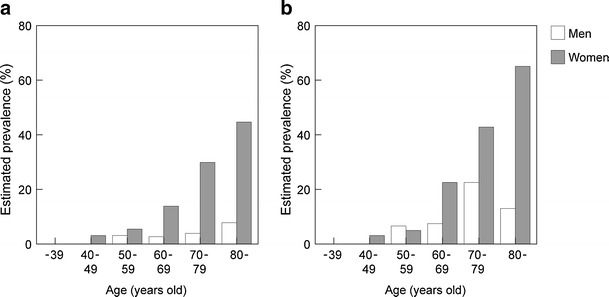
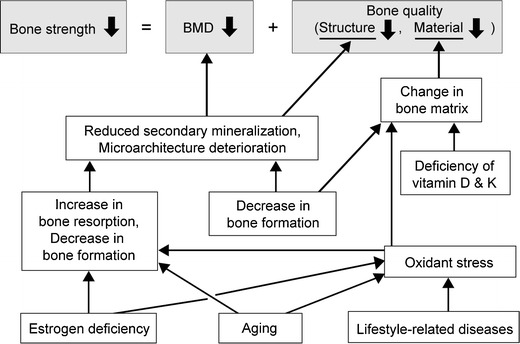
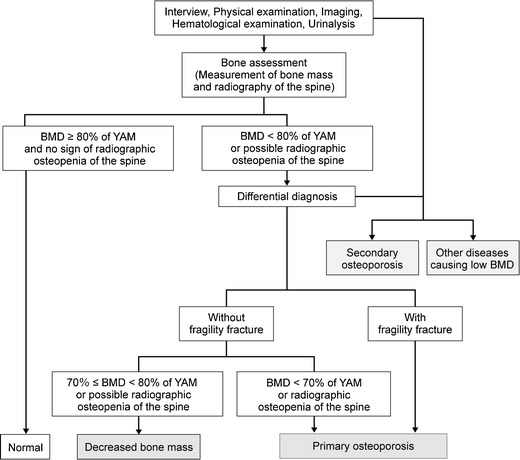
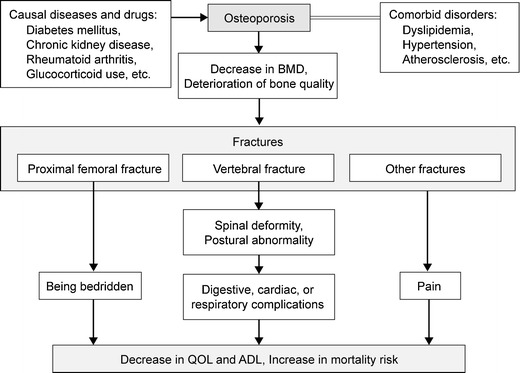
Verification
Claims the paper makes
The claims and statistics of this paper haven’t been checked yet.
Free: it reads the open-access text and checks the first 5 claims that cite a source we can check. Create a free account to check every claim.
Claims other papers make about this one
Each is checked against this paper’s own text: does it say what the citing paper says it does?
The source backs part of the claim, not all of it — or backs it for a different population, condition or comparison.
In the citing paper
“It was apparent that some systematic reviews and guidelines, particularly for the earlier three patient groups, would be different for vitamin K and risedronate 2.5 mg/day if the affected trial reports were removed”
From An investigation into the impact and implications of published papers from retracted research: systematic search of affected literature (2019) · cites this paper as [23]
Experimental — accuracy not yet measuredThe source backs part of the claim, not all of it — or backs it for a different population, condition or comparison.
In the citing paper
“and that some affected systematic reviews and guidelines have themselves been widely disseminated.18 23 30 49 52”
From An investigation into the impact and implications of published papers from retracted research: systematic search of affected literature (2019) · cites this paper as [23]
Experimental — accuracy not yet measuredThe cited source says what the claim attributes to it.
In the citing paper
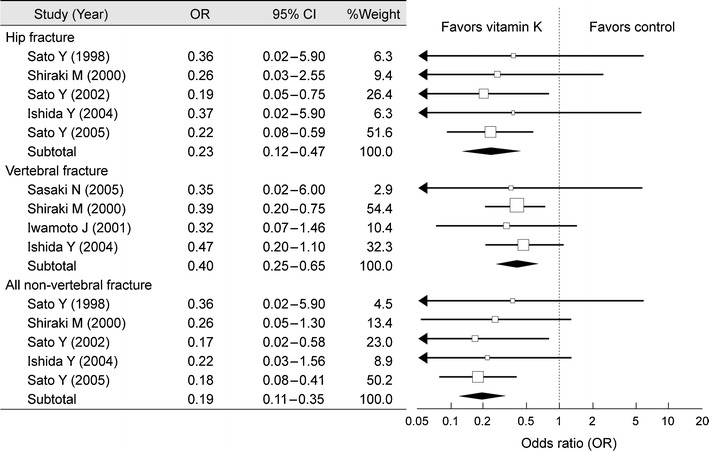
“Importantly, this 2006 meta-analysis, without any caveat related to the sensitivity analysis, is the sole evidence cited for vitamin K preventing vertebral and non-vertebral fractures in the journal publication of the 2011 Japanese guidelines for osteoporosis23 (122 citations, October 2018).”
From An investigation into the impact and implications of published papers from retracted research: systematic search of affected literature (2019) · cites this paper as [23]
The cited source says what the claim attributes to it.
In the citing paper
“However, for randomised trials in clinical areas affecting systematic reviews and guidelines further propagation is likely, as we show in the case of the systematic review by Cockayne et al 18 and its influence on Japanese osteoporosis guidelines.23”
From An investigation into the impact and implications of published papers from retracted research: systematic search of affected literature (2019) · cites this paper as [23]
Self-check
Percentages, sums and reported differences re-computed from the paper’s own numbers.
The self-check needs the paper’s full text.
Citations
Cites
Effect of Vitamin D on Falls: A Meta-analysis
Bischoff-Ferrari, H. A., Dawson-Hughes, B., Willett, W. C., Staehelin, H. B., Bazemore, M. G., Zee, R. Y., & Wong, J. B. (2004) · JAMA · doi:10.1001/jama.291.16.1999 · Cited by 1,324
Yoshimura, N., Muraki, S., Oka, H., Mabuchi, A., En-Yo, Y., Yoshida, M., Saika, A., Yoshida, H., Suzuki, T., Yamamoto, S., et al. (2009) · Journal of Bone and Mineral Metabolism · doi:10.1007/s00774-009-0080-8 · Cited by 819
Self-citationMacLean, C., Newberry, S., Maglione, M., McMahon, M., Ranganath, V., Suttorp, M., Mojica, W., Timmer, M., Alexander, A., McNamara, M., et al. (2008) · Annals of Internal Medicine · doi:10.7326/0003-4819-148-3-200802050-00198 · Cited by 529
Diagnostic criteria for primary osteoporosis: year 2000 revision
Orimo, H., Hayashi, Y., Fukunaga, M., Sone, T., Fujiwara, S., Shiraki, M., Kushida, K., Miyamoto, S., Soen, S., Nishimura, J., et al. (2001) · Journal of Bone and Mineral Metabolism · doi:10.1007/s007740170001 · Cited by 465
Self-citationCockayne, S., Adamson, J., Lanham-New, S., Shearer, M. J., Gilbody, S., & Torgerson, D. J. (2006) · Archives of Internal Medicine · doi:10.1001/archinte.166.12.1256 · Cited by 361 · cited 1×
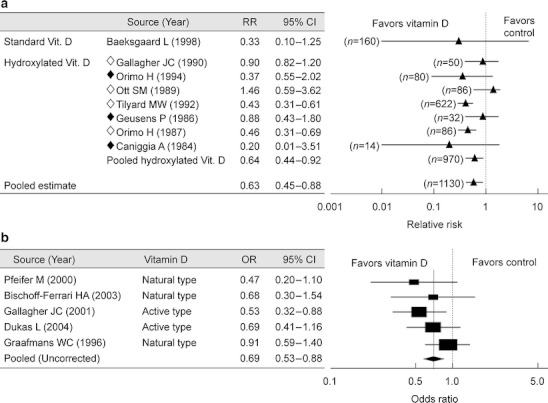
“OR odds ratio,CI confidence interval (Cockayne [13] (Copyright© 2006American Medical Association)) Arch Osteoporos”
BackgroundPapadimitropoulos, E., Wells, G., Shea, B., Gillespie, W., Weaver, B., Zytaruk, N., Cranney, A., Adachi, J., Tugwell, P., Josse, R., et al. (2002) · Endocrine Reviews · doi:10.1210/er.2001-8002 · Cited by 302
Matsumoto, T., Ito, M., Hayashi, Y., Hirota, T., Tanigawara, Y., Sone, T., Fukunaga, M., Shiraki, M., & Nakamura, T. (2011) · Bone · doi:10.1016/j.bone.2011.07.011 · Cited by 189
Self-citationHip fracture incidence in Japan: estimates of new patients in 2007 and 20-year trends
Orimo, H., Yaegashi, Y., Onoda, T., Fukushima, Y., Hosoi, T., & Sakata, K. (2009) · Archives of Osteoporosis · doi:10.1007/s11657-009-0031-y · Cited by 161
Self-citationNishizawà, Y., Ohta, H., Miura, M., Inaba, M., Ichimura, S., Shiraki, M., Takada, J., Chaki, O., Hagino, H., Fujiwara, S., et al. (2012) · Journal of Bone and Mineral Metabolism · doi:10.1007/s00774-012-0392-y · Cited by 143
Self-citationMatsumoto, T., Hagino, H., Shiraki, M., Fukunaga, M., Nakano, T., Takaoka, K., Morii, H., Ohashi, Y., & Nakamura, T. (2008) · Osteoporosis International · doi:10.1007/s00198-008-0816-7 · Cited by 115
Self-citation
Research works printed but not linked: 3
- You K Osteoporos Jpn 2011 19 626
- Orimo H Hosoi T Fukunaga M Manual for osteoporosis screening and health guidance 2009 Tokyo Life Science Publishing
- Nakano T Clinical effect of calcitonin (elcatonin) on acute pain for osteoporotic vertebral fracture: semi blind randomized controlled trial Osteoporos Jpn 2011 19 279
Cited by
Items 301–358 of 358
Artificial Intelligence-Enabled Electrocardiography Identifies Osteoporosis and has Prognostic Value
Hsing, S.-C., Tsai, D., Lin, C., Lin, C.-S., Lee, C., Wang, C. H., & Fang, W. (2025) · Journal of Medical Systems · doi:10.1007/s10916-025-02333-6 · Cited by 1
Yukishima, T., Kobayakawa, T., Hirano, Y., Kanayama, Y., Niimi, R., Etani, Y., Noguchi, T., Shimoyama, K., Maekawa, Y., Nakata, K., et al. (2026) · Rheumatology · doi:10.1093/rheumatology/keag082 · Cited by 2
Iwamoto, J. (2013) · Journal of Osteoporosis and Physical Activity · doi:10.4172/2329-9509.1000e105 · Cited by 1
“The patient was instructed to perform maximum jumping exercise (5 times per day, 5 days per week) and intake calcium (800 mg/day), vitamin D (800 IU or 20 μg/day), and vitamin K (300 μg/day) based on the recommended daily intake of calcium, vitamin D, and vitamin K [4].”
BackgroundRetrospective Analysis of Osteoporotic Vertebral Fractures
Akar, A. (2023) · Ahi Evran Medical Journal · doi:10.46332/aemj.1220863 · Cited by 1
Nakai, Y., Kumagai, K., Ino, Y., Akiyama, T. H., Moriyama, K., Takeda, Y., Egashira, K., Ohira, T., Ryo, A., Saito, T., et al. (2024) · Journal of Proteomics · doi:10.1016/j.jprot.2024.105166 · Cited by 1
Association Between the Bone Density of Alveolar and General Skeletal Bones in the Young
Sugino, N., Kuroiwa, H., Osanai, H., Yamada, S., Dewake, N., Suzuki, S., Kawahara, Y., Yoshinari, N., Udagawa, N., & Taguchi, A. (2025) · Cureus · doi:10.7759/cureus.78643 · Cited by 1
“Furthermore, this study focused on measuring LSBMD and FNBMD, as these sites are considered clinically significant for osteoporosis screening and diagnosis [17,18].”
Changes In Care Management After “Fast Track” Protocol Introduction For Hip Fracture Patients
Dobožinskas, P., Valavičienė, R., & Hommel, A. (2015) · Sveikatos mokslai · doi:10.5200/sm-hs.2015.099 · Cited by 1
Yılmaz, M., Başbuğ, A., Kaya, A. E., Çağlar, M., Özkara, A., Sungur, M. A., & Ataoğlu, S. (2017) · Konuralp Tıp Dergisi · doi:10.18521/ktd.286409 · Cited by 1
Pegoraro, T., Padilha, E. L. D. O., Conti, C. F. B., & da Silva, L. M. (2017) · Arquivos Catarinenses de Medicina · doi:10.63845/5fyeec61 · Cited by 1
Management of Male Osteoporosis: an Update
Almohaya, M. S., Alobedollah, A., & Kendler, D. L. (2018) · Current Treatment Options in Rheumatology · doi:10.1007/s40674-018-0107-1 · Cited by 1
Yang, K. C., Wang, S., Lee, J. J., Fann, J. C. ‐., Chiu, S. Y. ‐., Chen, S. L. ‐., Yen, A. M., Chen, H. H., Chen, M. K., & Hung, H. F. (2019) · QJM · doi:10.1093/qjmed/hcz009 · Cited by 1
Iida, C. H., Lavor, N. I. C., Munhoz, L., Júnior, R. A., Abdala, R., & Arita, E. S. (2019) · J of Health Science · doi:10.17265/2328-7136/2019.01.003 · Cited by 1
“QL is negatively affected by osteoporosis as well as decreased BMD and fragility fractures [5].”
BackgroundOsteoporosis Screening and Diagnosis
Yu, E. W.-Y. (2020) · Contemporary Endocrinology · doi:10.1007/978-3-319-69287-6_7 · Cited by 1
Hamaya, E. (2020) · Folia Pharmacologica Japonica · doi:10.1254/fpj.20007 · Cited by 1
Mettawi, A. S., Soliman, S., & Taha, M. E. (2020) · Archives of Osteoporosis · doi:10.1007/s11657-020-00830-4 · Cited by 1
Kanis, J. А., Harvey, N. C., Johansson, H., Lorentzon, M., Liu, E., Leslie, W. D., & McCloskey, E. V. (2022) · Springer eBooks · doi:10.1007/978-3-030-91483-7_10 · Cited by 1
Tomatsu, E., Shibata, M., Yoshino, Y., Sekiguchi-Ueda, S., Kakita, A., Takayanagi, T., Makino, M., Hayakawa, N., & Suzuki, A. (2018) · Institutional Repositories DataBase (IRDB) · doi:10.20407/fmj.4.1_1 · Cited by 1
Kittithamvongs, P., & Pongpirul, K. (2018) · Chula Digiverse · doi:10.58837/chula.the.2018.279 · Cited by 1
Bone mineral density in residents of care facilities for the aged and effect of pharmacotherapy.
Tokuda, T., Hasegawa, J., Matsuda, A., & Hagino, H. (2014) · PubMed
Self-citationIwamoto, J., Takakuwa, M., & Suzuki, Y. (2013)
重症心身障害児(者)における栄養の観点からの骨粗鬆症の検討 −経管栄養とビタミンKの関係−
朋子, 酒., 牧子, 加., 岩崎, 裕., & 龍雄, 益. (2017) · 日本重症心身障害学会誌 · doi:10.24635/jsmid.42.1_63
Wainberg, S. K. (2019) · Digital Library of Theses and Dissertations (Universidade de São Paulo) · doi:10.11606/d.9.2019.tde-03122019-135146
“gov/pubmed/23203733 (221) 67% 22% 28% 61% 24% 67%”
Carvalho, M. J., Moreira, F., Pinho, C. M. L., & Cruz, A. (2016) · Portuguese National Funding Agency for Science, Research and Technology (RCAAP Project by FCT)
Ivanova, S. A., Kirkova-Bogdanova, A. G., & Becheva, M. S. V. (2020) · Iranian Journal of Public Health · doi:10.18502/ijph.v49i12.4834
Guideline concordance of bisphosphonates used for osteoporosis in a University Hospital, Thailand
Anusathitwattana, S., Sa-ngasoongsong, P., Montakantikul, P., Lekpittaya, N., & Chindavijak, B. (2021) · Pharmaceutical Sciences Asia · doi:10.29090/psa.2021.01.19.089
びまん性特発性骨増殖症(DISH)を伴う胸腰椎骨折に対する椎体終板を貫通させる新しいスクリュー挿入法(Transdiscal Screw for DISH:TSD)と従来法の比較検討
久敬, 生., & 廣瀬友彦 (2021) · Journal of spine research · doi:10.34371/jspineres.2020-0038
How to Identify Individuals Requiring Anti-osteoporosis Therapy: Imaging in Bone Health
Fuggle, N. R., & Ward, K. A. (2021) · Springer eBooks · doi:10.1007/978-3-030-78128-6_2
Azurin, E. S., Yamamoto, N., Hayashi, K., Takeuchi, A., Miwa, S., Igarashi, K., Higuchi, T., Yonezawa, H., Morinaga, S., Asano, Y., et al. (2022) · Cancer Diagnosis & Prognosis · doi:10.21873/cdp.10082
Zhang, H., Sheng, X., Zhang, F., Hu, Y., Huang, L.-R., Yuan, X., & Cui, A. (2021) · Research Square · doi:10.21203/rs.3.rs-737845/v1
Kyriakos, G. (2016) · Buleria (Universidad de León) · doi:10.18002/10612/5167
Liu, Y., Sun, Y., Ye, X., Yan, Y., Li, C., & Li, X. (2023) · Research Square · doi:10.21203/rs.3.rs-2449695/v1
Tsai, D., Lin, C. S., Lin, C., Lee, C., Wang, C., & Fang, W. (2023) · Research Square · doi:10.21203/rs.3.rs-2959194/v1
Nagai, T., Kuroda, T., Ishikawa, K., Sakamoto, K., 白土, な., & Kudo, Y. (2023) · International Journal of Surgery Case Reports · doi:10.1016/j.ijscr.2023.108464
Zhao, H., Wang, J., Shao, L. H., Wu, X., Liu, C., Ni, S., Dai, T., & Liu, H. (2023) · SSRN Electronic Journal · doi:10.2139/ssrn.4489240
Tsai, D., Lin, C. S., Lin, C., Lee, C., Wang, C., & Fang, W. (2023) · Research Square · doi:10.21203/rs.3.rs-2959194/v2
An Overview of Bone Toxicology
Doyle, N., Bédard, A., Schafbuch, R. M., Boyd, G., Felx, M., White, J. R., & Varela, A. (2023) · Springer eBooks · doi:10.1007/978-3-030-73317-9_119-1
Genetic influence on bone mineral density for Japanese women: a twin studyPreprint
Saeki, S., Tomizawa, R., Minamitani, K., Nakata, K., & Honda, C. (2023) · Research Square · doi:10.21203/rs.3.rs-3784702/v1
Ohta, T., Sasai, H., Kikuchi, N., Nakazato, K., & Okamoto, T. (2024) · Calcified Tissue International · doi:10.1007/s00223-024-01269-2
Lawongsa, K., Kanchanabul, T., & Tepakorn, J. (2024) · Vajira Medical Journal: Journal of Urban Medicine · doi:10.62691/vmj.2024.269726
Suzuki, N., Imada, T., Ueshima, N., Orikoshi, H., & Takara, T. (2024) · International Journal of Food Sciences and Nutrition · doi:10.1080/09637486.2024.2397056
“The effect of the intervention using bone turnover markers has been shown to be valid when bone resorption and bone formation markers are measured after 3–6 and after 6–12 months, respectively (Orimo et al. 2012).”
An Overview of Bone Toxicology
Doyle, N., Bédard, A., Schafbuch, R. M., Boyd, G., Felx, M., White, J. R., & Varela, A. (2024) · Springer eBooks · doi:10.1007/978-3-031-35529-5_119
Exploring Menatetrenone: Origin, Chemistry, Therapies and Delivery
Singh, W., Kushwaha, P., & Kushwaha, S. P. (2025) · Journal of the American Nutrition Association · doi:10.1080/27697061.2025.2460539
Difference in Bone Density in Young Women With Normal Occlusion and Malocclusion
Hatori, H., Udagawa, N., Yoshinari, N., Uenishi, K., Sugino, N., & Taguchi, A. (2025) · Cureus · doi:10.7759/cureus.79731
Self-citationHeritability of bone mineral density among Japanese women: A twin study
Saeki, S., Tomizawa, R., Minamitani, K., Nakata, K., & Honda, C. (2025) · Maturitas · doi:10.1016/j.maturitas.2025.108251
Liu, M., Liu, C., Cevallos, N., Orbach, B. N., Hernandez, C. J., Fu, X., Lee, J., Booth, S. L., & Shea, M. K. (2025) · JBMR Plus · doi:10.1093/jbmrpl/ziaf059
“32 Evidence is also mixed regarding the protective effects of MK7.”
Effect of vitamin K on musculoskeletal health in postmenopausal women
Jan, R., & Stančíková, M. (2019) · Clinical Osteology · doi:10.36290/clo.2019.001
Feng, L., Zheng, H., Xiao, Y., & Huang, J. (2026) · Journal of Clinical Densitometry · doi:10.1016/j.jocd.2026.101693
Nagai, T., Kasai, F., Sugiyama, M., Okano, I., Tani, S., Tsuchiya, K., Ishikawa, K., Inagaki, K., Sakamoto, K., Kudo, Y., et al. (2026) · Scientific Reports · doi:10.1038/s41598-026-43802-3
“Osteoporosis causes compression fractures of the vertebrae, fractures of the proximal femur, and wrist fractures owing to deterioration in bone density and bone quality 3 .”
Bergeron, M. È. (2018) · theses.fr (ABES) · doi:10.70675/094bfc15z22b5z495azabecz67ea700ff1ec
“L’importance de la mesure de la DMO avant toute instauration de traitement anti-ostéoporotique est également soulignée dans les recommandations japonaises de 2011 (43) ou encore dans les recommandations américaines de 2016 (44).”
BackgroundNiimi, R., Kobayakawa, T., Etani, Y., Noguchi, T., Sugimoto, A., Nakata, K., Okada, S., Hasegawa, M., & Ebina, K. (2026) · Osteoporosis International · doi:10.1007/s00198-026-07985-9
“Eligible participants were postmenopausal females and males diagnosed as osteoporosis with a high fracture risk, according to the World Health Organization’s 1998 criteria or the 2011 Japanese Guidelines for Prevention and Treatment of Osteoporosis [16].”
Nonoura, N., Yamada, M., Nagasawa, N., Yamashita, T., Hisazumi, H., & Yamazaki, H. (2026) · European Journal of Radiology · doi:10.1016/j.ejrad.2026.112878
Nakano, R., Suzuki, A., Iwasaki, H., & Fukuda, A. (2026) · Bone · doi:10.1016/j.bone.2026.117978
Liu, X., Chui, E. C. S., Wu, X., Wang, Y., Li, T., Xie, T., Cheung, W. H., Sang, H., Liu, C., & Wong, R. M. Y. (2026) · Injury · doi:10.1016/j.injury.2026.113521
Yano, Y., Uchihara, Y., Kawasaki, S., Seko, M., Okamoto, M., Fujii, T., & Kawamura, K. (2026) · Arthroplasty · doi:10.1186/s42836-026-00419-1
“In several countries, including Japan, the presence of VF is explicitly incorporated into the diagnostic or therapeutic criteria for osteoporosis, reflecting the recognition of fracture-based diagnosis as an essential component of fragility assessment [10, 28, 29].”
Kobayakawa, T., Takenaka, H., Kobayashi, T., & Nakamura, Y. (2026) · Osteoporosis International · doi:10.1007/s00198-026-08241-w
Yoshizawa, K., Chino, A., Konishi, M., Nakashima, A., Morisaka, H., Yokomichi, H., Abdelghafaar, M., Moroi, A., & Ueki, K. (2026) · Journal of Bone and Mineral Metabolism · doi:10.1007/s00774-026-01771-7
Chida, K., Hananoe, A., Tetsuo, I., & Kawakami, E. (2026) · Bone Reports · doi:10.1016/j.bonr.2026.101966
Cooper, L. (2013) · Adelaide Research & Scholarship (AR&S) (University of Adelaide) · Cited by 1
Metadata
- Authors
- Orimo, H., Nakamura, T., Hosoi, T., Iki, M., Uenishi, K., Endo, N., Ohta, H., Shiraki, M., Sugimoto, T., Suzuki, T., Soen, S., Nishizawa, Y., Hagino, H., Fukunaga, M., & Fujiwara, S.
- Affiliations
- Japan Osteoporosis Foundation (JP)
- University of Occupational and Environmental Health Japan (JP)
- National Center for Geriatrics and Gerontology (JP)
- Kindai University (JP)
- Japan Nutrition University (JP)
- Niigata University (JP)
- Sanno Medical Center (JP)
- Research Institute and Practice for Involutional Diseases (JP)
- Shimane University (JP)
- Research Institute, National Center for Geriatrics and Gerontology (JP)
- Tottori University (JP)
- Kawasaki Medical School (JP)
- Radiation Effects Research Foundation (JP)
- Corresponding author
- Hosoi, Takayuki
- ORCID
- Venue
- Archives of Osteoporosis
- Published
- 2012-12
- Volume
- 7
- Issue
- 1-2
- Pages
- 3-20
- ISSN
- 1862-3514 (ISSN-L)
- 1862-3522
- PMC
- PMC3517709
- OpenAlex
- W2030203316
- Cited by
- 358
- References
- 15
- Citations by year
- 2026: 12 · 2025: 19 · 2024: 27 · 2023: 22 · 2022: 27 · 2021: 35 · 2020: 34 · 2019: 28 · 2018: 32 · 2017: 33 · 2016: 38 · 2015: 22 · 2014: 14 · 2013: 13 · 2012: 2
- FWCI
- 17.43
- Type
- journal article
- Language
- en
- Open access
- hybrid
- doi.org
- Licence
- cc-by-nc
- Locations
- Archives of Osteoporosis (publishedVersion, cc-by-nc)
- Europe PMC (PubMed Central) (publishedVersion, cc-by-nc)
- PubMed Central (publishedVersion, cc-by-nc)
- PubMed (publishedVersion)
- Topics
- Health Sciences › Medicine › Orthopedics and Sports Medicine › Bone health and osteoporosis research
- Health Sciences › Medicine › Endocrinology, Diabetes and Metabolism › Menopause: Health Impacts and Treatments
- Health Sciences › Medicine › Oncology › Bone health and treatments
- Keywords
- osteoporosis, osteoporosis prevention, osteoporosis treatment, postmenopausal women, men over 50, secondary osteoporosis, fracture risk assessment, FRAX, Japanese clinical practice guidelines
- MeSH terms
- Adult, Aged, Aged, 80 and over, Female, Humans, Japan, Male, Middle Aged, Osteoporosis, Risk Factors, Incidence, Practice Guidelines as Topic, Age Distribution, Sex Distribution, Antirheumatic Agents, Fractures, Bone
About these checks
Registry, retraction, Cites and statistics results are computed, not judged, with one exception: a printed reference that no index lists is read once by a model before it counts as a citation error. Claims are extracted by a model and kept only when their quote appears verbatim in the text; each cited source is then checked, with a model’s help, for whether it says what the claim relies on. Those verdicts can be wrong — read the claim’s quote and the cited source before relying on one.
Statistics and arithmetic are recomputed, not judged.
Confidence bands are shown only for fields calibrated on our annotated test set. None is calibrated yet, so no band is shown.
What counts as a claim ›How we measure confidence ›How we check this ›
Are you an author, or do you see a problem with this page? Request a review
Data sources
Bibliographic data: Semantic Scholar, OpenAlex, Crossref.
Contains information from the Semantic Scholar Academic Graph Datasets, made available under the ODC Attribution License (ODC-BY 1.0).
Semantic Scholar’s data is described in: Kinney, R., et al. (2023). The Semantic Scholar Open Data Platform. arXiv:2301.10140.
