

Ozone disrupts the communication between plants and insects in urban and suburban areas: an updated insight on plant volatiles
Open accessThe DOI matches its Crossref record; 161 of the 163 references it cites were found in a registry or an index.
Abstract
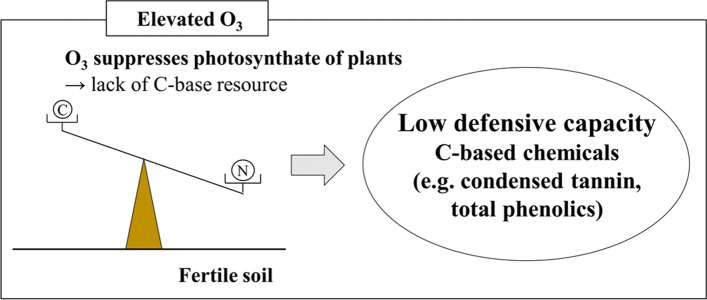
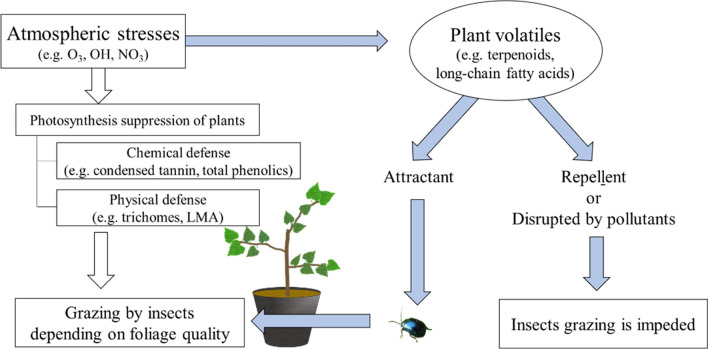
Plant–insect interactions are basic components of biodiversity conservation. To attain the international Sustainable Development Goals (SDGs), the interactions in urban and in suburban systems should be better understood to maintain the health of green infrastructure. The role of ground-level ozone (O 3) as an environmental stress disrupting interaction webs is presented. Ozone mixing ratios in suburbs are usually higher than in the center of cities and may reduce photosynthetic productivity at a relatively higher degree. Consequently, carbon-based defense capacities of plants may be suppressed by elevated O 3 more in the suburbs. However, contrary to this expectation, grazing damages by leaf beetles have been severe in some urban centers in comparison with the suburbs. To explain differences in grazing damages between urban areas and suburbs, the disruption of atmospheric communication signals by elevated O 3 via changes in plant-regulated biogenic volatile organic compounds and long-chain fatty acids are considered. The ecological roles of plant volatiles and the effects of O 3 from both a chemical and a biological perspective are presented. Ozone-disrupted plant volatiles should be considered to explain herbivory phenomena in urban and suburban systems.
Overview
The claims and statistics of this paper haven’t been checked yet.
Free: it reads the open-access text and checks the first 5 claims that cite a source we can check. Create a free account to check every claim.
Integrity signals
Registry
Cites
Statistics
Figures
Verification
Claims the paper makes
The claims and statistics of this paper haven’t been checked yet.
Free: it reads the open-access text and checks the first 5 claims that cite a source we can check. Create a free account to check every claim.
Claims other papers make about this one
Each is checked against this paper’s own text: does it say what the citing paper says it does?
The cited source says what the claim attributes to it.
In the citing paper
“For example, tropospheric O3 can destroy or change biogenic volatile chemicals and, thus, interfere with attraction of pollinators or pests to plants [135].”
From Changes in tropospheric air quality related to the protection of stratospheric ozone in a changing climate (2023) · cites this paper as [135]
Self-check
Percentages, sums and reported differences re-computed from the paper’s own numbers.
The self-check needs the paper’s full text.
Citations
Cites
Importance of pollinators in changing landscapes for world crops
Klein, A.-M., Vaissière, B. E., Cane, J. H., Steffan-Dewenter, I., Cunningham, S. A., Kremen, C., & Tscharntke, T. (2007) · Proceedings of the Royal Society B: Biological Sciences · doi:10.1098/rspb.2006.3721 · Cited by 7,176
Guenther, A., Karl, T., Harley, P., Wiedinmyer, C., Palmer, P. I., & Geron, C. (2006) · Atmospheric Chemistry and Physics · doi:10.5194/acp-6-3181-2006 · Cited by 4,603
The Dilemma of Plants: To Grow or Defend
Herms, D. A., & Mattson, W. J. (1992) · The Quarterly Review of Biology · doi:10.1086/417659 · Cited by 4,262
How many flowering plants are pollinated by animals?
Ollerton, J., Winfree, R., & Tarrant, S. (2011) · Oikos · doi:10.1111/j.1600-0706.2010.18644.x · Cited by 3,874
Causes and consequences of variation in leaf mass per area (LMA): a meta‐analysis
Poorter, H., Niinemets, Ü., Poorter, L., Wright, I. J., & Villar, R. (2009) · New Phytologist · doi:10.1111/j.1469-8137.2009.02830.x · Cited by 2,911
Carbon/Nutrient Balance of Boreal Plants in Relation to Vertebrate Herbivory
Bryant, J. P., Chapin, F. S., & Klein, D. R. (1983) · Oikos · doi:10.2307/3544308 · Cited by 2,497
Plant Immunity to Insect Herbivores
Howe, G. A., & Jander, G. (2008) · Annual Review of Plant Biology · doi:10.1146/annurev.arplant.59.032607.092825 · Cited by 2,427
Defensive Function of Herbivore-Induced Plant Volatile Emissions in Nature
Kessler, A., & Baldwin, I. T. (2001) · Science · doi:10.1126/science.291.5511.2141 · Cited by 2,182
Mechanisms of plant defense against insect herbivores
War, A. R., Paulraj, M. G., Ahmad, T., Buhroo, A. A., Hussain, B., Ignacimuthu, S., & Sharma, H. C. (2012) · Plant Signaling & Behavior · doi:10.4161/psb.21663 · Cited by 2,180
Arisz, S. A., van Wijk, R., Roels, W., Zhu, J.-K., Haring, M. A., & Munnik, T. (2013) · Frontiers in Plant Science · doi:10.3389/fpls.2013.00001 · Cited by 1,922
Research works printed but not linked: 1
- Mukherjee A Barik A Long-chain free fatty acids from Momordica cochinchinensis Spreng flowers as allelochemical influencing the attraction of Aulacophora foveicollis Lucas (Coleoptera: Chrysomelidae) Allelopath J 2014 33 2 255 266
Cited by
Kumar, D., Singh, R., Upadhyay, S. K., VERMA, K. K., Tripathi, R. M., Liu, H., Dhankher, O. P., Tripathi, R. D., Sahi, S. V., & Seth, C. S. (2023) · Plant Science · doi:10.1016/j.plantsci.2023.111964 · Cited by 123
Nature and human well-being: The olfactory pathway
Bratman, G. N., Bembibre, C., Daily, G. C., Doty, R. L., Hummel, T. R., Jacobs, L. F., Kahn, P. H., Lashus, C., Majid, A., Miller, J. D., et al. (2024) · Science Advances · doi:10.1126/sciadv.adn3028 · Cited by 145
Emerging challenges of ozone impacts on asian plants: actions are needed to protect ecosystem health
Feng, Z., Agathokleous, E., Yue, X., Oksanen, E. J., Paoletti, E., Sase, H., Gandin, A., Koike, T., Calatayud, V., Yuan, X., et al. (2021) · Ecosystem Health and Sustainability · doi:10.1080/20964129.2021.1911602 · Cited by 90
Self-citationMadronich, S., Sulzberger, B., Longstreth, J. D., Schikowski, T., Andersen, M. P. S., Solomon, K. R., & Wilson, S. R. (2023) · Photochemical & Photobiological Sciences · doi:10.1007/s43630-023-00369-6 · Cited by 64
“For example, tropospheric O3 can destroy or change biogenic volatile chemicals and, thus, interfere with attraction of pollinators or pests to plants [135].”
BackgroundAir pollution disproportionately impairs beneficial invertebrates: a meta-analysis
Ryalls, J. M. W., Bishop, J., Mofikoya, A. O., Bromfield, L. M., Nakagawa, S., & Girling, R. D. (2024) · Nature Communications · doi:10.1038/s41467-024-49729-5 · Cited by 48
“Line 409: why use a model comparison instead of QM to assess the importance of each moderator?”
Sperdouli, I., Andreadis, S. S., Adamakis, I. S., Moustaka, J., Koutsogeorgiou, E. I., & Moustakas, M. (2022) · Insects · doi:10.3390/insects13050409 · Cited by 36
“Plants emit volatile organic compounds (VOCs), and the profiles of emissions depend on the plant species [9].”
BackgroundIndividual Effects of High Temperature and Tropospheric Ozone on Tomato: A Review
Gupta, A., Yadav, D. S., Agrawal, S. B., & Agrawal, M. (2022) · Journal of Plant Growth Regulation · doi:10.1007/s00344-022-10678-2 · Cited by 34
“Variability in levels of O3 between suburban and urban regions showed that interaction between plants and insects can be afflicted differently under warmer climates (Duque et al. 2019; Masui et al. 2021).”
BackgroundMasui, N., Shiojiri, K., Agathokleous, E., Tani, A., & Koike, T. (2023) · Critical Reviews in Environmental Science and Technology · doi:10.1080/10643389.2023.2202105 · Cited by 29
“Risks associated with elevated O3 in BVOC-mediated communication O3 inhibits numerous types of communication, including insect and plants (Masui et al., 2021; Knaden et al., 2022).”
BackgroundSelf-citationYoungsteadt, E., & Keighron, M. (2023) · Annual Review of Ecology Evolution and Systematics · doi:10.1146/annurev-ecolsys-102221-044616 · Cited by 34
Otieno, M., Kárpáti, Z., Peters, M. K., Duque, L., Schmitt, T., & Steffan-Dewenter, I. D. (2023) · PLoS ONE · doi:10.1371/journal.pone.0283480 · Cited by 20
“Also, compositional changes of the VOCs emitted by the plant can act as a repellent for insects [3].”
BackgroundLi, S., Agathokleous, E., Li, S., Xu, Y., Xia, J., & Feng, Z. (2023) · Plant Cell & Environment · doi:10.1111/pce.14777 · Cited by 19
Self-citationMasui, N., Agathokleous, E., Tani, A., Matsuura, H., & Koike, T. (2021) · Environmental Research · doi:10.1016/j.envres.2021.111996 · Cited by 20
Self-citationAgathokleous, E., Kitao, M., Shi, C., Masui, N., ElEla, S. A., Hikino, K., Satoh, F., & Koike, T. (2021) · Journal of Forestry Research · doi:10.1007/s11676-021-01400-1 · Cited by 16
Self-citationLiu, Y., Schallhart, S., Taipale, D., Tykkä, T., Räsänen, M., Merbold, L., Hellén, H., & Pellikka, P. (2021) · Atmospheric chemistry and physics · doi:10.5194/acp-21-14761-2021 · Cited by 14
“, O3) are also abiotic factors which affect BVOC emissions negatively or positively (Velikova, 2008; Masui et al., 2021).”
BackgroundAgathokleous, E., Kitao, M., Hoshika, Y., Haworth, M., Tang, Y., & Koike, T. (2023) · The Science of The Total Environment · doi:10.1016/j.scitotenv.2023.162672 · Cited by 14
Self-citationRyalls, J. M. W., Staton, T., Mullinger, N. J., Bromfield, L. M., Langford, B., Pfrang, C., Nemitz, E., Blande, J. D., & Girling, R. D. (2022) · Frontiers in Ecology and Evolution · doi:10.3389/fevo.2022.833088 · Cited by 13
Making “scents” of how plant volatiles influence agriculturally important insects: a review
Thompson, M. N., Russavage, E. M., & Bernauer, O. M. (2025) · Environmental Entomology · doi:10.1093/ee/nvaf108 · Cited by 12
Cotrozzi, L., Conti, B., Lorenzini, G., Pellegrini, E., & Nali, C. (2021) · Environmental Research · doi:10.1016/j.envres.2021.111581 · Cited by 12
Li, S., Yuan, X., Feng, Z., Du, Y., Agathokleous, E., & Paoletti, E. (2022) · Science of The Total Environment · doi:10.1016/j.scitotenv.2021.150949 · Cited by 10
Self-citationVigor and Health of Urban Green Resources under Elevated O3in Far East Asia
Qu, L., Wang, Y., Shi, C., Wang, X., Masui, N., Rötzer, T., Watanabe, T., & Koike, T. (2022) · Environmental sciences · doi:10.5772/intechopen.106957 · Cited by 7
Self-citationZeni, V., Grassi, A., Santin, M., Ricciardi, R., Pieracci, Y., Flamini, G., Giovanni, F. D., Marmugi, M., Agnolucci, M., Avio, L., et al. (2022) · Insects · doi:10.3390/insects14010020 · Cited by 6
“However, depending on the amount emitted and its relative abundance in the VOCs blend, it may display opposing behaviours on the same insect species [85,86].”
BackgroundSelf-citationde Araújo, H. H., Soares, G. D. D., Mendes, J. D., Anselmo‐Moreira, F., da Costa, B. R. B., Nascimento, A., Meireles, C. S., Catharino, E. L. M., Rodrigues, P. M. F., Rocco, M., et al. (2025) · Environmental Science and Pollution Research · doi:10.1007/s11356-025-35952-0 · Cited by 6
“…in addition to the parameters explored in our study, variations in environmental factors such as light intensity, temperature, humidity, precipitation, wind, and seasonal variations can interfere with the range of responses from plants to air pollution (Masui et al. 2021; Singh et al. 2023a, b).”
InfluentialUnveiling sesquiterpene emissions in dominant trees of a Brazilian Atlantic Forest remnant
da Costa, B. R. B., Anselmo‐Moreira, F., Nascimento, A., Pedrosa, G. D. S., Catharino, E. L. M., Borbon, A., Fornaro, A., Furlan, C. M., & de Souza, S. R. (2025) · Atmospheric Environment X · doi:10.1016/j.aeaoa.2025.100358 · Cited by 4
Peñalver‐Cruz, A., Escudero‐Colomar, L. A., Alins, G., Franco, M. E. E., & Bosch, D. (2025) · Entomologia Generalis · doi:10.1127/entomologia/2024/2803 · Cited by 4
Agathokleous, E., Zhang, K., & Saitanis, C. J. (2023) · MethodsX · doi:10.1016/j.mex.2023.102214 · Cited by 4
Self-citationAgathokleous, E., Feng, Z., & Saitanis, C. J. (2022) · Springer eBooks · doi:10.1007/978-981-15-2527-8_24-1 · Cited by 6
Self-citationClassifying Severity of Unhealthy Air Pollution Events in Malaysia: A Decision Tree Model
Masseran, N., Tajuddin, R. R. M., & Latif, M. T. (2023) · Sains Malaysiana · doi:10.17576/jsm-2023-5210-18 · Cited by 3
Henschel, J. M., de Resende, J. T. V., Pulga, P. S., Zeist, A. R., dos Santos, R. L., Giloni-Lima, P. C., & Batista, D. S. (2024) · Acta Physiologiae Plantarum · doi:10.1007/s11738-024-03651-x · Cited by 2
“In addition to their role as chemical barriers, volatile organic compounds released upon insect attack can also attract natural enemies and induce defense response in intact organs and neighbor plants (Masui et al. 2021; Sperdouli et al. 2022).”
Shi, C., Masui, N., Koike, T., Terada, C., Nakamura, M., & Watanabe, T. (2023) · Journal of Forest Research · doi:10.1080/13416979.2023.2280730 · Cited by 2
“Several studies have reported that eO 3 alters the physical and chemical defense properties of leaves and subsequently affects the productivity of tree species (Goodger and Woodrow 2014; Izuta 2017; Masui et al. 2021 ) .”
BackgroundSelf-citationPlants as Designers of Better Futures: Can Humans Let Them Lead?
Rutten, J., Holland, A., & Roudavski, S. (2024) · Plant Perspectives · doi:10.3197/whppp.63845494909729 · Cited by 5
Agathokleous, E., Feng, Z., & Saitanis, C. J. (2023) · Springer eBooks · doi:10.1007/978-981-15-2760-9_24 · Cited by 1
Self-citation多樹種の生物起源揮発性有機炭素(BVOC)の計測と植食性昆虫の動態解明
Masui, N., 松浦, 英., 渡部, 敏., 藤戸, 永., 佐々木, 圭., 佐藤, 冬., 高木, 健., アガトクレオス, エ., & 小池, 孝. (2021) · Institutional Repositories DataBase (IRDB)
Self-citationLiu, Y. (2021) · Atmospheric chemistry and physics · doi:10.5194/acp-2021-445-ac1
Liu, Y. (2021) · Atmospheric chemistry and physics · doi:10.5194/acp-2021-445-ac2
(2021) · Atmospheric chemistry and physics · doi:10.5194/acp-2021-445-rc1
(2021) · Atmospheric chemistry and physics · doi:10.5194/acp-2021-445-rc2
Yu, L. (2023) · Journal of Forestry Research · doi:10.1007/s11676-022-01579-x
“Agathokleous and his colleagues provided a new insight into the role of volatile compounds emitted by plants in the communication between plants and insects in urban and suburban areas (Masui et al. 2021).”
BackgroundQuintana-Rodríguez, E., Vallejo, A. R. R., Claudio, J. D. J. E., Cumplido, J. H., & Orona‐Tamayo, D. (2024) · Perspectivas de la Ciencia y la Tecnología · doi:10.61820/pct.v7i12.1136
EXAMINING AIR POLLUTANTS AS INFLUENCING FACTORS OF HONEY BEE COLONY COLLAPSE DISORDER
Rašović, M. B. (2025) · Applied Ecology and Environmental Research · doi:10.15666/aeer/2306_1161911644
“Ozone affects the learning and memory processes of pollinators and disrupts communication between insects and plants (Vanderplanck et al., 2021; Masui et al., 2021; Otieno et al., 2023).”
高濃度オゾン環境下におけるシラカンバの虫害と植物由来揮発性有機化合物の関係性に関する研究
増井, 昇. (2023) · Hokkaido University Collection of Scholarly and Academic Papers (Hokkaido University) · doi:10.14943/doctoral.r7188
開放系オゾン付加施設で生育させたハコヤナギ属2樹種の病虫害と成長の季節変化 : 2021年の事例
増井, 昇., 北岡, 哲., 渡邊, 陽., 渡部, 敏., 藤戸, 永., 佐々木, 圭., 佐藤, 冬., アガトクレオス, エ., & 小池, 孝. (2022) · Institutional Repositories DataBase (IRDB)
Exploring innate and learned sensory behaviors in drosophila under natural and perturbed contexts
Arumugam, S. (2025) · Common Library Network (Der Gemeinsame Bibliotheksverbund) · doi:10.22032/dbt.69777
Effects of elevated ozone on life history traits, olfactory detection, and behavior in Drosophila
Arumugam, S., Rihani, K., Venkateswaran, V., Shiota, Y., Thiagarajan, D., Hansson, B. S., Knaden, M., & Sachse, S. (2026) · The Science of The Total Environment · doi:10.1016/j.scitotenv.2026.181864
Trade-offs determine plant responses to ozone pollution
Shang, B., Agathokleous, E., Calatayud, V., Kobayashi, K., & Feng, Z. (2026) · Trends in Plant Science · doi:10.1016/j.tplants.2026.09.007
Self-citationSmart pest management and herbivore defense
Senthil‐Nathan, S., Vasantha‐Srinivasan, P., & Jogaiah, S. (2026) · Elsevier eBooks · doi:10.1016/b978-0-443-45109-6.00009-1
A Comprehensive Review on Jasmonate-Mediated Plant Stress Responses: Mechanism and Current Paradigm
Raina, M., Ali, A., Hussain, K., & Shahnawaz, M. (2026) · Plant Stress · doi:10.1016/j.stress.2026.101620
Metadata
- Authors
- Masui, N., Agathokleous, E., Mochizuki, T., Tani, A., Matsuura, H., & Koike, T.
- Affiliations
- Hokkaido University (JP)
- Nanjing University of Information Science and Technology (CN)
- Shizuoka University (JP)
- Chinese Academy of Sciences (CN)
- Corresponding author
- Masui, Noboru
- Venue
- Journal of Forestry Research
- Published
- 2021-01-10
- Volume
- 32
- Issue
- 4
- Pages
- 1337-1349
- ISSN
- 1007-662X (ISSN-L)
- 1993-0607
- PMC
- PMC7797194
- OpenAlex
- W3120140383
- Semantic Scholar
- 6a17515c54e8007f73caebe2619eef3c4c6e3b63
- Cited by
- 38
- References
- 162
- Citations by year
- 2026: 2 · 2025: 3 · 2024: 5 · 2023: 12 · 2022: 6 · 2021: 10
- FWCI
- 5.68
- Type
- journal article
- Language
- en
- Open access
- hybrid
- doi.org
- Licence
- cc-by
- creativecommons.org/licenses/by/4.0 (tdm)
- creativecommons.org/licenses/by/4.0 (vor)
- Locations
- Journal of Forestry Research (publishedVersion, cc-by)
- PubMed Central (publishedVersion, cc-by)
- PubMed (publishedVersion)
- Funders
- Ministry of Environment
- Nanjing University of Information Science and Technology (003080)
- Nanjing University
- Japan Society for the Promotion of Science
- Topics
- Life Sciences › Agricultural and Biological Sciences › Insect Science › Insect-Plant Interactions and Control
- Life Sciences › Agricultural and Biological Sciences › Plant Science › Plant responses to elevated CO2
- Physical Sciences › Environmental Science › Ecology › Forest Insect Ecology and Management
- Keywords
- surface ozone, plant-insect interactions, plant volatiles, biogenic volatile organic compounds, long-chain fatty acids, herbivory, Chrysomelidae, urban green infrastructure, suburbs, photosynthetic productivity
About these checks
Registry, retraction, Cites and statistics results are computed, not judged, with one exception: a printed reference that no index lists is read once by a model before it counts as a citation error. Claims are extracted by a model and kept only when their quote appears verbatim in the text; each cited source is then checked, with a model’s help, for whether it says what the claim relies on. Those verdicts can be wrong — read the claim’s quote and the cited source before relying on one.
Statistics and arithmetic are recomputed, not judged.
Confidence bands are shown only for fields calibrated on our annotated test set. None is calibrated yet, so no band is shown.
What counts as a claim ›How we measure confidence ›How we check this ›
Are you an author, or do you see a problem with this page? Request a review
Data sources
Bibliographic data: Semantic Scholar, OpenAlex, Crossref.
Contains information from the Semantic Scholar Academic Graph Datasets, made available under the ODC Attribution License (ODC-BY 1.0).
Semantic Scholar’s data is described in: Kinney, R., et al. (2023). The Semantic Scholar Open Data Platform. arXiv:2301.10140.
