

Early sepsis mortality prediction model based on interpretable machine learning approach: development and validation study
Open accessThe DOI matches its Crossref record; 42 of the 42 references it cites were found in a registry or an index.
Abstract
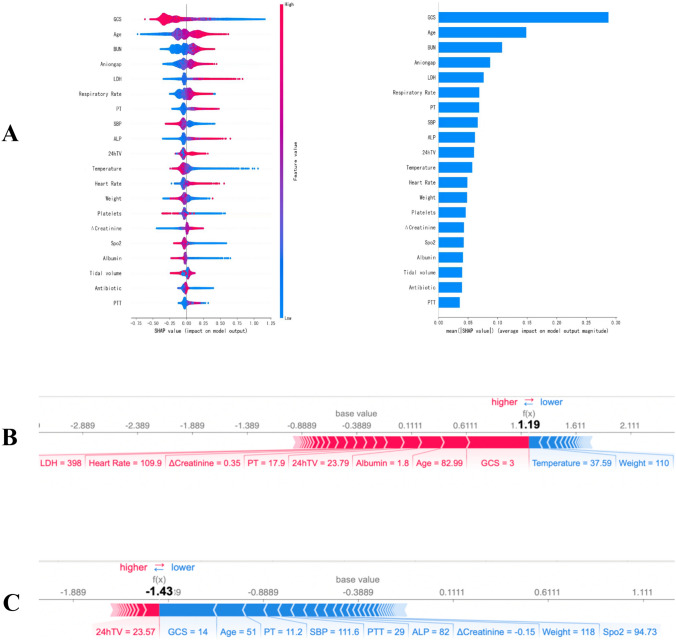
Sepsis triggers a harmful immune response due to infection, causing high mortality. Predicting sepsis outcomes early is vital. Despite machine learning’s (ML) use in medical research, local validation within the Medical Information Mart for Intensive Care IV (MIMIC-IV) database is lacking. We aimed to devise a prognostic model, leveraging MIMIC-IV data, to predict sepsis mortality and validate it in a Chinese teaching hospital. MIMIC-IV provided patient data, split into training and internal validation sets. Four ML models logistic regression (LR), support vector machine (SVM), deep neural networks (DNN), and extreme gradient boosting (XGBoost) were employed. Shapley additive interpretation offered early and interpretable mortality predictions. Area under the ROC curve (AUROC) gaged predictive performance. Results were cross verified in a Chinese teaching hospital. The study included 27,134 sepsis patients from MIMIC-IV and 487 from China. After comparing, 52 clinical indicators were selected for ML model development. All models exhibited excellent discriminative ability. XGBoost surpassed others, with AUROC of 0.873 internally and 0.844 externally. XGBoost outperformed other ML models (LR: 0.829; SVM: 0.830; DNN: 0.837) and clinical scores (Simplified Acute Physiology Score II: 0.728; Sequential Organ Failure Assessment: 0.728; Oxford Acute Severity of Illness Score: 0.738; Glasgow Coma Scale: 0.691). XGBoost’s hospital mortality prediction achieved AUROC 0.873, sensitivity 0.818, accuracy 0.777, specificity 0.768, and F1 score 0.551. We crafted an interpretable model for sepsis death risk prediction. ML algorithms surpassed traditional scores for sepsis mortality forecast. Validation in a Chinese teaching hospital echoed these findings.
Overview
The claims and statistics of this paper haven’t been checked yet.
Free: it reads the open-access text and checks the first 5 claims that cite a source we can check. Create a free account to check every claim.
Integrity signals
Registry
Cites
Statistics
Figures


Verification
Claims the paper makes
The claims and statistics of this paper haven’t been checked yet.
Free: it reads the open-access text and checks the first 5 claims that cite a source we can check. Create a free account to check every claim.
Self-check
Percentages, sums and reported differences re-computed from the paper’s own numbers.
The self-check needs the paper’s full text.
Citations
Cites
The third international consensus definitions for sepsis and septic shock (Sepsis-3).
Singer, M., Deutschman, C. S., Seymour, C. W., Shankar-Hari, M., Annane, D., Bauer, M., Bellomo, R., Bernard, G. R., Chiche, J.-D., Coopersmith, C. M., et al. (2016) · JAMA · doi:10.1001/jama.2016.0287 · Cited by 28,250
Early goal-directed therapy in the treatment of severe sepsis and septic shock
Rivers, E., Nguyen, B., Havstad, S., Ressler, J., Muzzin, A., Knoblich, B., Peterson, E., & Tomlanovich, M. (2001) · New England Journal of Medicine · doi:10.1056/nejmoa010307 · Cited by 10,743
Angus, D. C., Linde-Zwirble, W. T., Lidicker, J., Clermont, G., Carcillo, J., & Pinsky, M. R. (2001) · Critical Care Medicine · doi:10.1097/00003246-200107000-00002 · Cited by 8,503
Surviving Sepsis Campaign: International guidelines for management of sepsis and septic shock: 2016.
Rhodes, A., Evans, L. E., Alhazzani, W., Levy, M. M., Antonelli, M., Ferrer, R., Kumar, A., Sevransky, J. E., Sprung, C. L., Nunnally, M. E., et al. (2017) · Intensive Care Medicine · doi:10.1007/s00134-017-4683-6 · Cited by 6,621 · cited 1×
“…various clinical scores such as the Sequential Organ Failure Assessment (SOFA), quick Sequential (Sepsis-related) Organ Failure Assessment (qSOFA) [5], Acute Physiology and Chronic Health Assessment Scoring System II (APACHE II), Oxford Acute Severity of Illness Score (OASIS) and Simplified Acute…”
Seymour, C. W., Liu, V. X., Iwashyna, T. J., Brunkhorst, F. M., Rea, T. D., Scherag, A., Rubenfeld, G., Kahn, J. M., Shankar-Hari, M., Singer, M., et al. (2016) · JAMA · doi:10.1001/jama.2016.0288 · Cited by 3,939 · cited 1×
“Meeting the criteria for a suspected infection as outlined by Seymour CW et al. [20].”
Surviving Sepsis Campaign: International Guidelines for Management of Sepsis and Septic Shock 2021.
Evans, L., Rhodes, A., Alhazzani, W., Antonelli, M., Coopersmith, C. M., French, C., Machado, F. R., Mcintyre, L., Ostermann, M., Prescott, H. C., et al. (2021) · Critical Care Medicine · doi:10.1097/ccm.0000000000005337 · Cited by 2,935
Machine Learning and Prediction in Medicine — Beyond the Peak of Inflated Expectations
Chen, J. H., & Asch, S. M. (2017) · New England Journal of Medicine · doi:10.1056/nejmp1702071 · Cited by 1,171
An interpretable machine learning model for accurate prediction of sepsis in the ICU
Nemati, S., Holder, A., Razmi, F., Stanley, M. D., Clifford, G. D., & Buchman, T. G. (2018) · Critical Care Medicine · doi:10.1097/ccm.0000000000002936 · Cited by 832
Vincent, J.-L., Jones, G., David, S., Olariu, E., & Cadwell, K. K. (2019) · Critical Care · doi:10.1186/s13054-019-2478-6 · Cited by 524
The MIMIC Code Repository: enabling reproducibility in critical care research
Johnson, A. E. W., Stone, D. J., Celi, L. A., & Pollard, T. J. (2018) · Journal of the American Medical Informatics Association · doi:10.1093/jamia/ocx084 · Cited by 442 · cited 1×
“Our objective was to construct a risk forecasting algorithm utilizing the MIMIC-IV dataset to detect sepsis patients with a heightened likelihood of mortality upon admission to the hospital [10] and validate.”
Cited by
Mou, C., Yang, J., Wu, Q., Qin, L., & Lu, J. (2026) · Frontiers in Medicine · doi:10.3389/fmed.2026.1732164 · Cited by 19
Athukorala, V. S., & Ilmini, W. M. K. S. (2026) · BMC Medical Informatics and Decision Making · doi:10.1186/s12911-026-03344-0 · Cited by 10
“Likewise, Wang et al. [34] proposed an interpretable framework Athukorala and Ilmini BMC Medical Informatics and Decision Making (2026) 26:64 that visually represented contributing clinical factors, demonstrating how transparency can support timely and well-informed clinical decisions.”
Prognostic value of SAPS II score for 28-day mortality in ICU patients with acute pulmonary embolism
Liu, P., & Ren, Y. (2025) · International Journal of Cardiology · doi:10.1016/j.ijcard.2025.133201 · Cited by 10
Septic Shock in Hematological Malignancies: Role of Artificial Intelligence in Predicting Outcomes
Alvaro, M. E., Caserta, S., Stagno, F., Fazio, M., Gangemi, S., Genovese, S., & Allegra, A. (2025) · Current Oncology · doi:10.3390/curroncol32080450 · Cited by 7
Xu, J.-S., Yang, K., Quan, B., Xie, J., & Zheng, Y. (2025) · Frontiers in Microbiology · doi:10.3389/fmicb.2025.1557922 · Cited by 6
Metadata
- Authors
- Wang, Y., Gao, Z., Zhang, Y., Lu, Z., & Sun, F.
- Affiliations
- First Affiliated Hospital of Wenzhou Medical University (CN)
- Corresponding author
- Lu, Zhongqiu
- Sun, Fangyuan
- Venue
- Internal and Emergency Medicine
- Published
- 2024-08-14
- Volume
- 20
- Issue
- 3
- Pages
- 909-918
- ISSN
- 1828-0447 (ISSN-L)
- 1970-9366
- PMC
- PMC12009225
- OpenAlex
- W4401576307
- Cited by
- 29
- References
- 42
- Citations by year
- 2026: 17 · 2025: 12
- FWCI
- 8.85
- Type
- journal article
- Language
- en
- Open access
- hybrid
- doi.org
- Licence
- cc-by
- creativecommons.org/licenses/by/4.0 (tdm)
- creativecommons.org/licenses/by/4.0 (vor)
- Locations
- Internal and Emergency Medicine (publishedVersion, cc-by)
- PubMed Central (publishedVersion, cc-by)
- PubMed (publishedVersion)
- Funders
- Key Research and Development Program of Zhejiang Province (2021C03072)
- the Science and Technology Program of Wenzhou (Y20210718)
- Topics
- Health Sciences › Medicine › Critical Care and Intensive Care Medicine › Sepsis Diagnosis and Treatment
- Physical Sciences › Computer Science › Artificial Intelligence › Machine Learning in Healthcare
- Health Sciences › Health Professions › Health Information Management › Artificial Intelligence in Healthcare
- Keywords
- sepsis, sepsis mortality prediction, prognostic model, model interpretability, SHAP, XGBoost, MIMIC-IV, intensive care, clinical risk score, external validation, in-hospital mortality
- MeSH terms
- Machine Learning, Adult, Aged, China, Female, Humans, Male, Middle Aged, Prognosis, ROC Curve, Logistic Models, Hospital Mortality, Sepsis
About these checks
Registry, retraction, Cites and statistics results are computed, not judged, with one exception: a printed reference that no index lists is read once by a model before it counts as a citation error. Claims are extracted by a model and kept only when their quote appears verbatim in the text; each cited source is then checked, with a model’s help, for whether it says what the claim relies on. Those verdicts can be wrong — read the claim’s quote and the cited source before relying on one.
Statistics and arithmetic are recomputed, not judged.
Confidence bands are shown only for fields calibrated on our annotated test set. None is calibrated yet, so no band is shown.
What counts as a claim ›How we measure confidence ›How we check this ›
Are you an author, or do you see a problem with this page? Request a review
How to cite
Cite CoChat for the checks on this page, and the paper for its own findings.
- This page
- CoChat. (2026). Citation check: Early sepsis mortality prediction model based on interpretable machine learning approach: development and validation study. https://app.cochat.ai/papers/10.1007/s11739-024-03732-2
- The paper
- Wang, Y., Gao, Z., Zhang, Y., Lu, Z., & Sun, F. (2025). Early sepsis mortality prediction model based on interpretable machine learning approach: development and validation study. Internal and Emergency Medicine. https://doi.org/10.1007/s11739-024-03732-2
Data sources
Bibliographic data: Semantic Scholar, OpenAlex, Crossref.
Contains information from the Semantic Scholar Academic Graph Datasets, made available under the ODC Attribution License (ODC-BY 1.0).
Semantic Scholar’s data is described in: Kinney, R., et al. (2023). The Semantic Scholar Open Data Platform. arXiv:2301.10140.
