

Early sepsis mortality prediction model based on interpretable machine learning approach: development and validation study
Open accessThe DOI matches its Crossref record; 42 of the 42 references it cites were found in a registry or an index.
Abstract
Sepsis triggers a harmful immune response due to infection, causing high mortality. Predicting sepsis outcomes early is vital. Despite machine learning’s (ML) use in medical research, local validation within the Medical Information Mart for Intensive Care IV (MIMIC-IV) database is lacking. We aimed to devise a prognostic model, leveraging MIMIC-IV data, to predict sepsis mortality and validate it in a Chinese teaching hospital. MIMIC-IV provided patient data, split into training and internal validation sets. Four ML models logistic regression (LR), support vector machine (SVM), deep neural networks (DNN), and extreme gradient boosting (XGBoost) were employed. Shapley additive interpretation offered early and interpretable mortality predictions. Area under the ROC curve (AUROC) gaged predictive performance. Results were cross verified in a Chinese teaching hospital. The study included 27,134 sepsis patients from MIMIC-IV and 487 from China. After comparing, 52 clinical indicators were selected for ML model development. All models exhibited excellent discriminative ability. XGBoost surpassed others, with AUROC of 0.873 internally and 0.844 externally. XGBoost outperformed other ML models (LR: 0.829; SVM: 0.830; DNN: 0.837) and clinical scores (Simplified Acute Physiology Score II: 0.728; Sequential Organ Failure Assessment: 0.728; Oxford Acute Severity of Illness Score: 0.738; Glasgow Coma Scale: 0.691). XGBoost’s hospital mortality prediction achieved AUROC 0.873, sensitivity 0.818, accuracy 0.777, specificity 0.768, and F1 score 0.551. We crafted an interpretable model for sepsis death risk prediction. ML algorithms surpassed traditional scores for sepsis mortality forecast. Validation in a Chinese teaching hospital echoed these findings.
Overview
The claims and statistics of this paper haven’t been checked yet.
Free: it reads the open-access text and checks the first 5 claims that cite a source we can check. Create a free account to check every claim.
Integrity signals
Registry
Cites
Statistics
Figures


Verification
Claims the paper makes
The claims and statistics of this paper haven’t been checked yet.
Free: it reads the open-access text and checks the first 5 claims that cite a source we can check. Create a free account to check every claim.
Self-check
Percentages, sums and reported differences re-computed from the paper’s own numbers.
The self-check needs the paper’s full text.
Citations
Cites
The third international consensus definitions for sepsis and septic shock (Sepsis-3).
Singer, M., Deutschman, C. S., Seymour, C. W., Shankar-Hari, M., Annane, D., Bauer, M., Bellomo, R., Bernard, G. R., Chiche, J.-D., Coopersmith, C. M., et al. (2016) · JAMA · doi:10.1001/jama.2016.0287 · Cited by 28,250 · cited 1×
“This model’s accessibility to readily available admission variables can aid clinicians in making timely interventions [4, 37].”
Early goal-directed therapy in the treatment of severe sepsis and septic shock
Rivers, E., Nguyen, B., Havstad, S., Ressler, J., Muzzin, A., Knoblich, B., Peterson, E., & Tomlanovich, M. (2001) · New England Journal of Medicine · doi:10.1056/nejmoa010307 · Cited by 10,743
Angus, D. C., Linde-Zwirble, W. T., Lidicker, J., Clermont, G., Carcillo, J., & Pinsky, M. R. (2001) · Critical Care Medicine · doi:10.1097/00003246-200107000-00002 · Cited by 8,503 · cited 1×
“By meticulously documenting infection-related diagnoses using the International Classification of Diseases, ninth revision, Clinical Modification (ICD-9-CM) codes, as provided by Angus et al. [19]; 2.”
Surviving Sepsis Campaign: International guidelines for management of sepsis and septic shock: 2016.
Rhodes, A., Evans, L. E., Alhazzani, W., Levy, M. M., Antonelli, M., Ferrer, R., Kumar, A., Sevransky, J. E., Sprung, C. L., Nunnally, M. E., et al. (2017) · Intensive Care Medicine · doi:10.1007/s00134-017-4683-6 · Cited by 6,621 · cited 1×
“…various clinical scores such as the Sequential Organ Failure Assessment (SOFA), quick Sequential (Sepsis-related) Organ Failure Assessment (qSOFA) [5], Acute Physiology and Chronic Health Assessment Scoring System II (APACHE II), Oxford Acute Severity of Illness Score (OASIS) and Simplified Acute…”
Seymour, C. W., Liu, V. X., Iwashyna, T. J., Brunkhorst, F. M., Rea, T. D., Scherag, A., Rubenfeld, G., Kahn, J. M., Shankar-Hari, M., Singer, M., et al. (2016) · JAMA · doi:10.1001/jama.2016.0288 · Cited by 3,939 · cited 1×
“Meeting the criteria for a suspected infection as outlined by Seymour CW et al. [20].”
Surviving Sepsis Campaign: International Guidelines for Management of Sepsis and Septic Shock 2021.
Evans, L., Rhodes, A., Alhazzani, W., Antonelli, M., Coopersmith, C. M., French, C., Machado, F. R., Mcintyre, L., Ostermann, M., Prescott, H. C., et al. (2021) · Critical Care Medicine · doi:10.1097/ccm.0000000000005337 · Cited by 2,935
Machine Learning and Prediction in Medicine — Beyond the Peak of Inflated Expectations
Chen, J. H., & Asch, S. M. (2017) · New England Journal of Medicine · doi:10.1056/nejmp1702071 · Cited by 1,171 · cited 2×
“According to Table 1, it is evident that individuals who did not survive sepsis tended to be older (65.9 ± 15.6 vs. 70.0 ± 15.1; P < 0.01), exhibited reduced systolic blood pressure (113 [105–123] vs. 108 [101 − 120]; P < 0.01), and had a higher SOFA score (6 [4–8] vs. 9 [6–12]; P < 0.01).”
InfluentialAn interpretable machine learning model for accurate prediction of sepsis in the ICU
Nemati, S., Holder, A., Razmi, F., Stanley, M. D., Clifford, G. D., & Buchman, T. G. (2018) · Critical Care Medicine · doi:10.1097/ccm.0000000000002936 · Cited by 832 · cited 3×
“Presently, numerous associated prototypes employ artificial intelligence (AI) to forecast sepsis [9, 35], thereby augmenting doctors’ capacity for medical decision-making concerning patients afflicted with sepsis [15].”
Vincent, J.-L., Jones, G., David, S., Olariu, E., & Cadwell, K. K. (2019) · Critical Care · doi:10.1186/s13054-019-2478-6 · Cited by 524 · cited 1×
“The occurrence and death rates worldwide are increasing [3].”
The MIMIC Code Repository: enabling reproducibility in critical care research
Johnson, A. E. W., Stone, D. J., Celi, L. A., & Pollard, T. J. (2018) · Journal of the American Medical Informatics Association · doi:10.1093/jamia/ocx084 · Cited by 442 · cited 1×
“Our objective was to construct a risk forecasting algorithm utilizing the MIMIC-IV dataset to detect sepsis patients with a heightened likelihood of mortality upon admission to the hospital [10] and validate.”
Mao, Q., Jay, M., Hoffman, J. L., Calvert, J., Barton, C., Shimabukuro, D., Shieh, L., Chettipally, U., Fletcher, G., Kerem, Y., et al. (2018) · BMJ Open · doi:10.1136/bmjopen-2017-017833 · Cited by 336 · cited 1×
“To the best of our understanding, this study is one of the earliest attempts to predict premature death in sepsis patients using a comprehensive public database and a locally validated data-base [15, 38, 39].”
An algorithm based on deep learning for predicting in-hospital cardiac arrest
Kwon, J., Lee, Y., Lee, Y., Lee, S., & Park, J. (2018) · Journal of the American Heart Association · doi:10.1161/jaha.118.008678 · Cited by 299 · cited 1×
“…attributes [29], ML can construct predictive models for various medical scenarios, including the prognosis of cardiac arrest in septic patients [30, 31], forecasting multiple organ function in elderly individuals [32, 33], predicting the risk of premature mortality in critically ill patients…”
Prediction of sepsis patients using machine learning approach: a meta-analysis
Islam, M. M., Nasrin, T., Walther, B. A., Wu, C.-C., Yang, H.-C., & Li, Y.-C. (2019) · Computer Methods and Programs in Biomedicine · doi:10.1016/j.cmpb.2018.12.027 · Cited by 259 · cited 1×
“Over the past few years, there has been a gradual integration of machine learning (ML) into medical research [7].”
Hu, C., Li, L., Huang, W., Wu, T., Xu, Q., Liu, J., & Hu, B. (2022) · Infectious Diseases and Therapy · doi:10.1007/s40121-022-00628-6 · Cited by 160
Artificial Intelligence in Critical Care Medicine
Yoon, J. H., Pinsky, M. R., & Clermont, G. (2022) · Critical Care · doi:10.1186/s13054-022-03915-3 · Cited by 137 · cited 1×
“To the best of our understanding, this study is one of the earliest attempts to predict premature death in sepsis patients using a comprehensive public database and a locally validated data-base [15, 38, 39].”
Green, M., Björk, J., Forberg, J. L., Ekelund, U. E. G., Edenbrandt, L., & Ohlsson, M. (2006) · Artificial Intelligence in Medicine · doi:10.1016/j.artmed.2006.07.006 · Cited by 129 · cited 1×
“…scenarios, including the prognosis of cardiac arrest in septic patients [30, 31], forecasting multiple organ function in elderly individuals [32, 33], predicting the risk of premature mortality in critically ill patients [29], and anticipating readmission outcomes for those in intensive care…”
Ho, K. F., Swindell, R., & Brammer, C. (2008) · Acta Oncologica · doi:10.1080/02841860701846160 · Cited by 102 · cited 1×
“The χ 2 test was used to compare the groups by expressing the enumeration data in terms of rate and percentage [26].”
Wardi, G., Carlile, M., Holder, A., Shashikumar, S., Hayden, S. R., & Nemati, S. (2021) · Annals of Emergency Medicine · doi:10.1016/j.annemergmed.2020.11.007 · Cited by 96 · cited 2×
“With the flexibility to incorporate diverse clinical criteria and data attributes [29], ML can construct predictive models for various medical scenarios, including the prognosis of cardiac arrest in septic patients [30, 31], forecasting multiple organ function in elderly individuals [32, 33],…”
Using classification tree and logistic regression methods to diagnose myocardial infarction.
Tsien, C. L., Fraser, H., Long, W. J., & Kennedy, R. L. (1998) · PubMed · Cited by 91
Chen, H., Zhu, Z., Zhao, C., Guo, Y., Chen, D., Wei, Y., & Jin, J. (2020) · Critical Care · doi:10.1186/s13054-020-03109-9 · Cited by 91
A Time-Phased Machine Learning Model for Real-Time Prediction of Sepsis in Critical Care
Li, X., Xu, X., Xie, F., Xu, X., Sun, Y., Liu, X., Jia, X., Kang, Y., Xie, L., Wang, F., et al. (2020) · Critical Care Medicine · doi:10.1097/ccm.0000000000004494 · Cited by 82
Charatcharoenwitthaya, P., Kuljiratitikal, K., Aksornchanya, O., Chaiyasoot, K., Bandidniyamanon, W., & Charatcharoenwitthaya, N. (2021) · Clinical and Translational Gastroenterology · doi:10.14309/ctg.0000000000000316 · Cited by 64 · cited 1×
“The SPSS software (version 26.0, Chicago, USA) was utilized for conducting statistical analyses [27].”
InfluentialSeki, T., Tamura, T., & Suzuki, M. (2019) · Resuscitation · doi:10.1016/j.resuscitation.2019.06.006 · Cited by 55
Wang, J., Chen, Z., Yang, H., Li, H., Chen, R., & Yu, J. (2022) · Journal of Cardiovascular Development and Disease · doi:10.3390/jcdd9110400 · Cited by 54
Mollura, M., Lehman, L.-W. H., Mark, R. G., & Barbieri, R. (2021) · Philosophical Transactions of the Royal Society A: Mathematical, Physical and Engineering Sciences · doi:10.1098/rsta.2020.0252 · Cited by 49 · cited 1×
“…scenarios, including the prognosis of cardiac arrest in septic patients [30, 31], forecasting multiple organ function in elderly individuals [32, 33], predicting the risk of premature mortality in critically ill patients [29], and anticipating readmission outcomes for those in intensive…”
Liu, C., Liu, X., Mao, Z., HU, P., Li, X., Hu, J., Hong, Q., Geng, X., Chi, K., Zhou, F., et al. (2021) · Medicine & Science in Sports & Exercise · doi:10.1249/mss.0000000000002674 · Cited by 46 · cited 5×
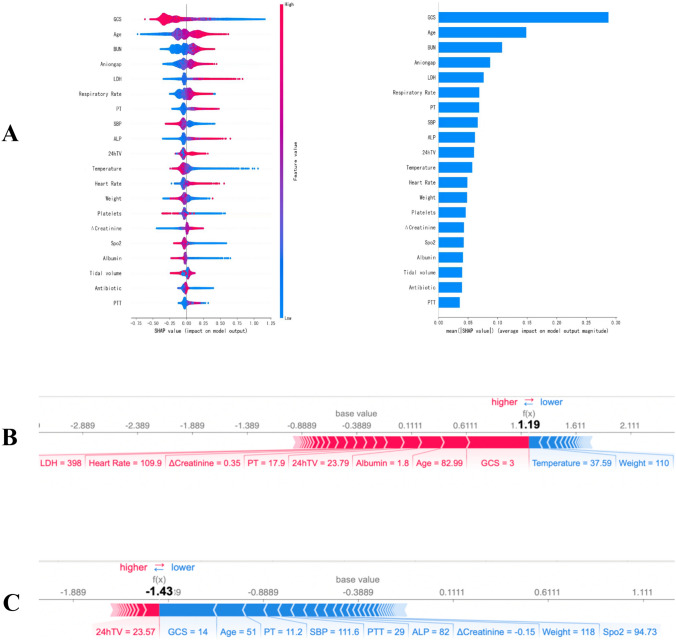
“In each feature importance row, all patient attributes related to the outcome are visualized using differently colored dots, with red dots representing high values and blue dots representing low values [11].”
InfluentialZeng, Z., Yao, S., Zheng, J., & Gong, X. (2021) · BioData Mining · doi:10.1186/s13040-021-00276-5 · Cited by 46 · cited 2×
“According to Table 1, it is evident that individuals who did not survive sepsis tended to be older (65.9 ± 15.6 vs. 70.0 ± 15.1; P < 0.01), exhibited reduced systolic blood pressure (113 [105–123] vs. 108 [101 − 120]; P < 0.01), and had a higher SOFA score (6 [4–8] vs. 9 [6–12]; P < 0.01).”
InfluentialPredicting Sepsis Mortality in a Population-Based National Database: Machine Learning Approach
Park, J. Y., Hsu, T., Hu, J., Chen, C., Hsu, W., Lee, M., Ho, J., & Lee, C. (2022) · Journal of Medical Internet Research · doi:10.2196/29982 · Cited by 39
Application of Machine Learning for Clinical Subphenotype Identification in Sepsis
Hu, C., Li, Y., Wang, F., & Peng, Z. (2022) · Infectious Diseases and Therapy · doi:10.1007/s40121-022-00684-y · Cited by 36 · cited 1×
“…the successful fulfillment of the web-based training course offered by the National Institutes of Health (NIH) and the completion of the Protecting Human Research Participants examination [17] (Certification Number no.37920768), Yiping Wang was granted permission to retrieve data from the database.”
Zhu, Y. K., He, Z., Jin, Y., Zhu, S., Xu, W., Li, B., Nie, C., Liu, G., Lyu, J., & Han, S. (2022) · Journal of Intensive Care Medicine · doi:10.1177/08850666221123483 · Cited by 32
Kwon, D. H., Obuchowski, N. A., Marwick, T. H., Menon, V., Griffin, B. P., Flamm, S. D., & Hachamovitch, R. (2018) · Journal of the American Heart Association · doi:10.1161/jaha.118.009394 · Cited by 28
Early predicting 30-day mortality in sepsis in MIMIC-III by an artificial neural networks model
Su, Y., Guo, C., Zhou, S., Li, C., & Ding, N. (2022) · European journal of medical research · doi:10.1186/s40001-022-00925-3 · Cited by 28
Prediction of Poststroke Depression Based on the Outcomes of Machine Learning Algorithms
Ryu, Y. H., Kim, S., Kim, T. U., Lee, S. J., Park, S. J., Jung, H.-Y., & Hyun, J. K. (2022) · Journal of Clinical Medicine · doi:10.3390/jcm11082264 · Cited by 27
Liu, W., Tao, G., Zhang, Y., Xiao, W., Zhang, J., Liu, Y., Lu, Z., Hua, T., & Yang, M. (2022) · Frontiers in Medicine · doi:10.3389/fmed.2021.814566 · Cited by 25 · cited 4×
“The Beth Israel Deaconess Medical Center has admitted more than 70,000 ICU patients between the years 2008 and 2019, and this database holds their data [15].”
InfluentialSelf-citationOptimization of patient-based real-time quality control based on the Youden index
Topçu, D. İ., & Çubukçu, H. C. (2022) · Clinica Chimica Acta · doi:10.1016/j.cca.2022.06.028 · Cited by 21 · cited 1×
“Considering the class imbalance, we adopted the way of Youden’s J statistic [23] to locate the optimal threshold of all the models.”
Thyroid hormone levels as a predictor marker predict the prognosis of patients with sepsis
Wang, Y., Sun, F., Hong, G., & Lu, Z. (2021) · The American Journal of Emergency Medicine · doi:10.1016/j.ajem.2021.02.014 · Cited by 17 · cited 2×
“Policymakers consider the high expenses of intensive care unit (ICU) care and the frequent readmissions of sepsis survivors as a significant concern [1].”
Self-citationJiang, X., Wang, Y., Pan, Y., & Zhang, W. (2022) · Frontiers in Medicine · doi:10.3389/fmed.2022.837382 · Cited by 16
Self-citationLi, D., Gao, J., Hong, N., Wang, H., Su, L., Liu, C., He, J., Jiang, H., Wang, Q., Long, Y., et al. (2021) · Journal of Medical Internet Research · doi:10.2196/27118 · Cited by 14 · cited 1×
“To improve the accuracy of sepsis outcome predictions, we plan to construct a dynamic model in future and include additional features [40].”
Qin, X., Zhang, W., Zhu, X., Hu, X., & Zhou, W. (2021) · Frontiers in Medicine · doi:10.3389/fmed.2021.754859 · Cited by 14 · cited 1×
“After receiving approval from the Hospital Ethics Committee (Issuing Number KY2022-R138) [18], external validation took place at the First Affiliated Hospital of Wenzhou Medical University (Wenzhou, Zhejiang, China).”
Shan, N., Xu, X., Bao, X., & Qiu, S. (2022) · Sensors · doi:10.3390/s22113997 · Cited by 14
Li, Q., Wang, J., Liu, G., Xu, M., Qin, Y., Han, Q., Liu, H., Wang, X., Wang, Z., Yang, K., et al. (2018) · Journal of International Medical Research · doi:10.1177/0300060518781253 · Cited by 13 · cited 1×
“Authorized users were granted approval by the Massachusetts Institute of Technology (located in Cambridge, MA, USA) and the Institutional Review Board of BIDMC (based in Boston, MA, USA) to utilize the MIMIC-IV database [16].”
Ma, Y., Tian, T., Wang, T., Wang, J., Guan, H., Yuan, J., Song, L., Yang, W., & Qiao, S. (2022) · Frontiers in Cardiovascular Medicine · doi:10.3389/fcvm.2022.854107 · Cited by 6 · cited 1×
“Measurement data that follows a normal distribution are typically represented as X ± S and are compared between groups using a two-independent-sample t test [25].”
Cited by
Mou, C., Yang, J., Wu, Q., Qin, L., & Lu, J. (2026) · Frontiers in Medicine · doi:10.3389/fmed.2026.1732164 · Cited by 19
Athukorala, V. S., & Ilmini, W. M. K. S. (2026) · BMC Medical Informatics and Decision Making · doi:10.1186/s12911-026-03344-0 · Cited by 10
“Likewise, Wang et al. [34] proposed an interpretable framework Athukorala and Ilmini BMC Medical Informatics and Decision Making (2026) 26:64 that visually represented contributing clinical factors, demonstrating how transparency can support timely and well-informed clinical decisions.”
Prognostic value of SAPS II score for 28-day mortality in ICU patients with acute pulmonary embolism
Liu, P., & Ren, Y. (2025) · International Journal of Cardiology · doi:10.1016/j.ijcard.2025.133201 · Cited by 10
Septic Shock in Hematological Malignancies: Role of Artificial Intelligence in Predicting Outcomes
Alvaro, M. E., Caserta, S., Stagno, F., Fazio, M., Gangemi, S., Genovese, S., & Allegra, A. (2025) · Current Oncology · doi:10.3390/curroncol32080450 · Cited by 7
“Wang et al. developed a model that personalized fluid administration using dynamic physiological data, reducing both under-and over-resuscitation and improving patient outcomes [72].”
Xu, J.-S., Yang, K., Quan, B., Xie, J., & Zheng, Y. (2025) · Frontiers in Microbiology · doi:10.3389/fmicb.2025.1557922 · Cited by 9
“This is particularly important because existing prognostic models often rely on a large volume of laboratory and imaging data that are not easily accessible, limiting their use in actual clinical practice (Chen et al., 2023; Wang et al., 2024; Zheng et al., 2023; Zhou et al., 2024).”
Metadata
- Authors
- Wang, Y., Gao, Z., Zhang, Y., Lu, Z., & Sun, F.
- Affiliations
- First Affiliated Hospital of Wenzhou Medical University (CN)
- Corresponding author
- Lu, Zhongqiu
- Sun, Fangyuan
- Venue
- Internal and Emergency Medicine
- Published
- 2024-08-14
- Volume
- 20
- Issue
- 3
- Pages
- 909-918
- ISSN
- 1828-0447 (ISSN-L)
- 1970-9366
- PMC
- PMC12009225
- OpenAlex
- W4401576307
- Cited by
- 29
- References
- 42
- Citations by year
- 2026: 17 · 2025: 12
- FWCI
- 8.85
- Type
- journal article
- Language
- en
- Open access
- hybrid
- doi.org
- Licence
- cc-by
- creativecommons.org/licenses/by/4.0 (tdm)
- creativecommons.org/licenses/by/4.0 (vor)
- Locations
- Internal and Emergency Medicine (publishedVersion, cc-by)
- PubMed Central (publishedVersion, cc-by)
- PubMed (publishedVersion)
- Funders
- Key Research and Development Program of Zhejiang Province (2021C03072)
- the Science and Technology Program of Wenzhou (Y20210718)
- Topics
- Health Sciences › Medicine › Critical Care and Intensive Care Medicine › Sepsis Diagnosis and Treatment
- Physical Sciences › Computer Science › Artificial Intelligence › Machine Learning in Healthcare
- Health Sciences › Health Professions › Health Information Management › Artificial Intelligence in Healthcare
- Keywords
- sepsis, sepsis mortality prediction, prognostic model, model interpretability, SHAP, XGBoost, MIMIC-IV, intensive care, clinical risk score, external validation, in-hospital mortality
- MeSH terms
- Machine Learning, Adult, Aged, China, Female, Humans, Male, Middle Aged, Prognosis, ROC Curve, Logistic Models, Hospital Mortality, Sepsis
About these checks
Registry, retraction, Cites and statistics results are computed, not judged, with one exception: a printed reference that no index lists is read once by a model before it counts as a citation error. Claims are extracted by a model and kept only when their quote appears verbatim in the text; each cited source is then checked, with a model’s help, for whether it says what the claim relies on. Those verdicts can be wrong — read the claim’s quote and the cited source before relying on one.
Statistics and arithmetic are recomputed, not judged.
Confidence bands are shown only for fields calibrated on our annotated test set. None is calibrated yet, so no band is shown.
What counts as a claim ›How we measure confidence ›How we check this ›
Are you an author, or do you see a problem with this page? Request a review
Data sources
Bibliographic data: Semantic Scholar, OpenAlex, Crossref.
Contains information from the Semantic Scholar Academic Graph Datasets, made available under the ODC Attribution License (ODC-BY 1.0).
Semantic Scholar’s data is described in: Kinney, R., et al. (2023). The Semantic Scholar Open Data Platform. arXiv:2301.10140.
