

The unmet supportive care needs of people affected by cancer during the COVID-19 pandemic: an integrative review
Open accessThe DOI matches its Crossref record; 35 of the 35 references it cites were found in a registry or an index; 9 of the 22 sources its claims cite were checked for support.
Abstract
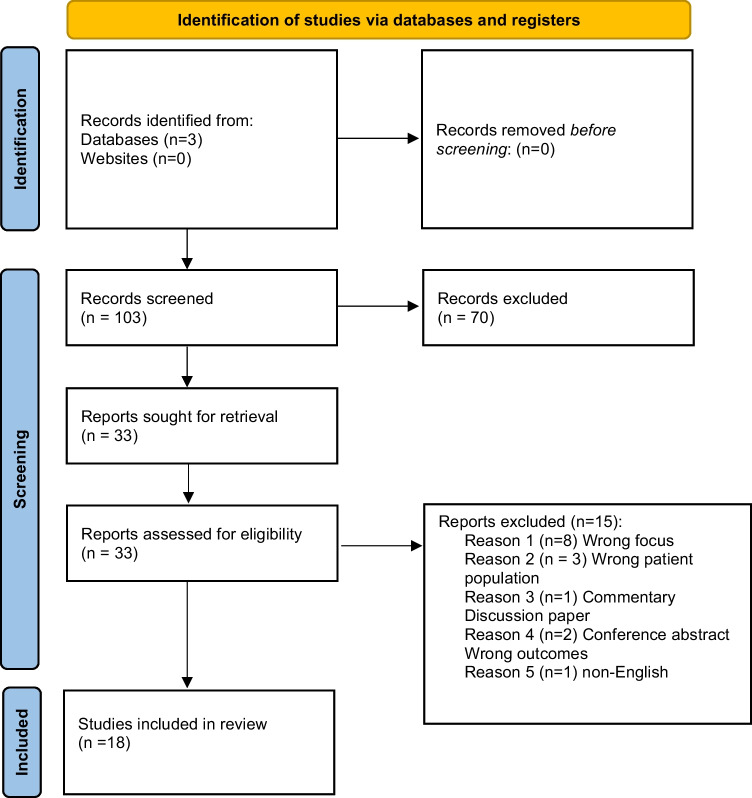
Purpose: To critically synthesise evidence regarding the supportive care needs of those living with cancer during the COVID-19 pandemic. Methods: An integrative systematic review followed a pre-registered protocol, reported according to the Preferred Reporting Items for Systematic Reviews and Meta-analysis (PRISMA) Guidelines. We searched three databases (CINAHL, MEDLINE, and APA PsycINFO) using keywords and included all qualitative, quantitative, and mixed methods studies irrespective of research design published between December 2019 and February 2022. All articles were double screened according to a pre-determined eligibility criterion with reference lists of the final included studies checked for further studies. The review process was managed using Covidence systematic review software. Data from the studies were extracted, methodological quality appraisal conducted, and a narrative synthesis conducted. Results: Eighteen publications were included. The findings identified that individuals affected by cancer reported a range of physical, psychological, social, and health system unmet needs during the global pandemic. Unique to the pandemic itself, there was fear of the unknown of the longer-term impact that the pandemic would have on treatment outcomes, cancer care follow-up, and clinical service delays. Conclusion: Many individuals living with cancer experienced unmet needs and distress throughout the different waves of the COVID-19 pandemic, irrespective of cancer type, stage, and demographic factors. Implications for Cancer Survivors: We recommend clinicians use these findings to identify the individual person-centred needs to optimise recovery as we transition to the post-pandemic cancer care.
Overview
CoChat Summary
## TL;DR
This integrative systematic review synthesized 18 publications on supportive care needs among people affected by cancer during the COVID-19 pandemic. It found unmet needs across physical, psychological, social, communication, and health-system domains, with particular concern about telehealth, service disruptions, and fear about unknown long-term effects.
## Key findings
- The review included 18 publications with a total sample size of 3924; study samples ranged from 16 to 1529 participants.
- Across studies, participants reported unmet needs in physical, psychological/emotional, cognitive, patient-clinician communication, health system/information, spiritual, daily living, interpersonal/intimacy, practical, family, and social domains.
- Commonly reported physical needs included fatigue, weakness, mobility issues, pain, nausea, vomiting, poor appetite, dry mouth, constipation, and sleep disturbances.
- Pandemic-specific concerns included fear of the unknown about treatment outcomes, cancer care follow-up, and clinical service delays, plus concerns that telehealth reduced reassurance and opportunities to ask questions.
## Methods
- Design: Integrative systematic review, pre-registered and reported according to PRISMA; narrative synthesis was used.
- Data/sample: Searches of CINAHL, MEDLINE, and APA PsycINFO for studies published December 2019 to February 2022; included qualitative, quantitative, and mixed-methods studies involving people affected by cancer and, where relevant, family members/caregivers.
- Main analysis: Two authors double-screened records and full texts; data were extracted and quality appraised with the Mixed Methods Appraisal Tool (MMAT), then synthesized via tabulation and narrative synthesis.
## Limitations
- The paper states it included only peer-reviewed English-language studies, which it says may have limited understanding of the wider global impact of COVID-19 on people living with cancer.
- The included studies were conducted mostly in developed and western nations, which the authors say may bias the picture of pandemic management and impact.
- Evident from the text: the evidence base was heterogeneous, with varied study designs and populations, and some result areas were thinly covered or scarcely studied, such as interpersonal/intimacy and spiritual needs.
Model-written summary. Check it against the paper before relying on it.
Integrity signals
Registry
Cites
Statistics
Figures
Verification
Claims the paper makes
2 Valid · 1 Not valid · 10 Not checked · 31 Own results and interpretations
The cited sources that could be checked couldn’t confirm or dispute this claim.
In the paper
“Therefore, evidence is yet to be pooled and critically synthesised to enable health care professionals and researchers to comprehensively understand the impacts of COVID-19 on supportive care experiences among people affected by cancer [3].”
§ The unmet supportive care needs of people affected by cancer during the COVID-19 pandemic: an integrative review > Introduction
What the sources say
- Could not verifycites [3] Paterson C, Bacon R, Dwyer R, Morrison KS, Toohey K, O’Dea A, et al. The role of telehealth during the COVID-19 pandemic across the interdisciplinary cancer team: implications for practice. Seminars in Oncology Nursing. 2020;36(6):151090. PMC7561334 33218886 sourceExperimental — accuracy not yet measured
The Introduction’s “Impact of COVID-19 on Cancer Care” section discusses possible effects on patients’ distress, access to care, and support networks. However, no passage found states that evidence about supportive-care experiences had yet to be pooled and critically synthesised; searches for that phrase and for a systematic review or synthesis of those experiences did not establish the claimed gap. Page numbers were not available in our copy. (LLM, conf=0.70)
plain- Asserted: passes — The authors put it forward as true.
- Checkable: passes — It can be checked against evidence.
- Load-bearing: passes — The paper’s conclusions depend on it.
- Based: passes — The paper gives a reason why it holds.
- Could not verify
A result the paper reports from its own data — it cites no other source for it, so there is none to check. The quote shows it is in the paper.
In the paper
“The findings identified that individuals affected by cancer reported a range of physical, psychological, social, and health system unmet needs during the global pandemic.”
§ The unmet supportive care needs of people affected by cancer during the COVID-19 pandemic: an integrative review > Abstract > Results
plain- Asserted: passes — The authors put it forward as true.
- Checkable: passes — It can be checked against evidence.
- Load-bearing: passes — The paper’s conclusions depend on it.
- Based: passes — The paper gives a reason why it holds.
A result the paper reports from its own data — it cites no other source for it, so there is none to check. The quote shows it is in the paper.
In the paper
“There were a range of unmet supportive care needs related to physical, psychological/emotional, cognitive, patient-clinician communication, health system/information, spiritual, daily living, interpersonal/intimacy, practical, family, and social needs”
§ The unmet supportive care needs of people affected by cancer during the COVID-19 pandemic: an integrative review > Results > Experiences of unmet supportive care needs
plain- Asserted: passes — The authors put it forward as true.
- Checkable: passes — It can be checked against evidence.
- Load-bearing: passes — The paper’s conclusions depend on it.
- Based: passes — The paper gives a reason why it holds.
A result the paper reports from its own data — it cites no other source for it, so there is none to check. The quote shows it is in the paper.
In the paper
“studies included five qualitative, 12 quantitative, and one mixed methods study.”
§ The unmet supportive care needs of people affected by cancer during the COVID-19 pandemic: an integrative review > Results
plain- Asserted: passes — The authors put it forward as true.
- Checkable: passes — It can be checked against evidence.
- Load-bearing: unclear — It is unclear whether the paper’s conclusions depend on it.
- Based: passes — The paper gives a reason why it holds.
A result the paper states — it cites no source for it, so there is none to check. The quote shows it is in the paper.
In the paper
“Many individuals living with cancer experienced unmet needs and distress throughout the different waves of the COVID-19 pandemic, irrespective of cancer type, stage, and demographic factors.”
§ The unmet supportive care needs of people affected by cancer during the COVID-19 pandemic: an integrative review > Abstract > Conclusion
plain- Asserted: passes — The authors put it forward as true.
- Checkable: passes — It can be checked against evidence.
- Load-bearing: passes — The paper’s conclusions depend on it.
- Based: passes — The paper gives a reason why it holds.
7 more claims
Create a free account to see all 44 claims and to verify the 13 references still open.
- Probably not a substantial claim. 19
- It may state two separate claims as one. 19
- The quote only partly states this claim. 8
Claims other papers make about this one
Each is checked against this paper’s own text: does it say what the citing paper says it does?
The cited source says what the claim attributes to it.
In the citing paper
“Furthermore, the intervention was able to be quickly adapted for online delivery and ensured continued supportive care during the pandemic when many supportive interventions for people affected by cancer were reduced or withdrawn [28].”
Citations
Cites
The PRISMA 2020 statement: An updated guideline for reporting systematic reviews
Page, M. J., McKenzie, J. E., Bossuyt, P. M., Boutron, I., Hoffmann, T. C., Mulrow, C. D., Shamseer, L., Tetzlaff, J. M., Akl, E. A., Brennan, S. E., et al. (2021) · BMJ · doi:10.1136/bmj.n71 · Cited by 108,283
The PRISMA 2020 Statement: An Updated Guideline for Reporting Systematic Reviews
Page, M. J., McKenzie, J. E., Bossuyt, P. M., Boutron, I., Hoffmann, T. C., Mulrow, C. D., Shamseer, L., Tetzlaff, J. M., Akl, E. A., Brennan, S. E., et al. (2021) · International Journal of Surgery · doi:10.1016/j.ijsu.2021.105906 · Cited by 11,748
The integrative review: updated methodology
Whittemore, R., & Knafl, K. (2005) · Journal of Advanced Nursing · doi:10.1111/j.1365-2648.2005.03621.x · Cited by 10,241 · cited 2×
“The data synthesis process followed the integrated review methodology proposed by Whittemore and Knafl [14].”
MethodThe Mixed Methods Appraisal Tool (MMAT) version 2018 for information professionals and researchers
Hong, Q. N., Fàbregues, S., Bartlett, G., Boardman, F., Cargo, M., Dagenais, P., Gagnon, M.-P., Griffiths, F., Nicolau, B., O’Cathain, A., et al. (2018) · Education for Information · doi:10.3233/efi-180221 · Cited by 4,737 · cited 3×
“The quality appraisal of all included studies was conducted by utilising the Mixed Methods Appraisal Tool (MMAT) [18].”
MethodInfluentialMortality due to cancer treatment delay: systematic review and meta-analysis
Hanna, T. P., King, W. D., Thibodeau, S., Jalink, M., Paulin, G. A., Harvey-Jones, E., O’Sullivan, D. E., Booth, C. M., Sullivan, R., & Aggarwal, A. (2020) · BMJ · doi:10.1136/bmj.m4087 · Cited by 1,742 · cited 1×
“An interruption or change to the accessibility of cancer screening, diagnostic, and treatment services has a significantly negative impact on the outcomes of cancer treatment for patients [13].”
BackgroundBoyes, A., Girgis, A., & Lecathelinais, C. (2009) · Journal of Evaluation in Clinical Practice · doi:10.1111/j.1365-2753.2008.01057.x · Cited by 530 · cited 2×
“The primary outcome of this review was related to unmet supportive care needs (e.g. the Supportive Care Needs Survey [17]) and qualitative experiences, informed by the definition of supportive care [7] explicitly reported in relation to the COVID-19 pandemic (see Table 1).”
MethodHart, N. H., Crawford-Williams, F., Crichton, M., Yee, J., Smith, T. J., Koczwara, B., Fitch, M. I., Crawford, G. B., Mukhopadhyay, S., Mahony, J., et al. (2022) · Critical Reviews in Oncology/Hematology · doi:10.1016/j.critrevonc.2022.103728 · Cited by 270 · cited 1×
“Noteworthy, one recent systematic review [12] excluded patients reporting unmet supportive care needs during the COVID-19 pandemic because this was beyond the scope of their review.”
BackgroundPaterson, C., Robertson, A., Smith, A., & Nabi, G. (2015) · European Journal of Oncology Nursing · doi:10.1016/j.ejon.2014.12.007 · Cited by 182 · cited 3×
“the Supportive Care Needs Survey [17]) and qualitative experiences, informed by the definition of supportive care [7] explicitly reported in relation to the COVID-19 pandemic (see Table 1).”
BackgroundMethodSelf-citationImpact of COVID-19 on healthcare activity in NSW, Australia
Sutherland, K., Chessman, J., Zhao, J., Sara, G. E., Shetty, A., Smith, S., Went, A., Dyson, S., & Lévesque, J. (2020) · Public Health Research & Practice · doi:10.17061/phrp3042030 · Cited by 162 · cited 1×
“Cancer services had to manage burgeoning clinical service demand due to COVID-19 and adapt to adhere to constant changes in legislation, restrictions, and transition cancer service models of care to models of telehealth [5].”
BackgroundPaterson, C., Bacon, R., Dwyer, R., Morrison, K. S., Toohey, K., O'Dea, A., Slade, J., Mortazavi, R., Roberts, C., Pranavan, G., et al. (2020) · Seminars in Oncology Nursing · doi:10.1016/j.soncn.2020.151090 · Cited by 139 · cited 5×
“A significant global push and rapid adoption to transition to cancer care to telehealth services remains [3] but for many participants represented in this review they expressed that they had concerns with this model of care.”
BackgroundInfluentialSelf-citationOncology Nursing During a Pandemic: Critical Reflections in the Context of COVID-19
Paterson, C., Gobel, B., Gosselin, T., Haylock, P. J., Papadopoulou, C., Slusser, K., Rodriguez, A., & Pituskin, E. (2020) · Seminars in Oncology Nursing · doi:10.1016/j.soncn.2020.151028 · Cited by 116 · cited 1×
“This pandemic has consumed peoples’ existing way of life in every aspect, from lockdowns, mandated mask wearing, to transitioning new models of cancer care delivery [3], and adhering to ever changing social distancing requirements [4].”
BackgroundSelf-citationTelehealth in cancer care: during and beyond the COVID‐19 pandemic
Burbury, K., Wong, Z., Yip, D., Thomas, H., Brooks, P., Gilham, L., Piper, A., Solo, I., & Underhill, C. (2021) · Internal Medicine Journal · doi:10.1111/imj.15039 · Cited by 78
Paterson, C. C., Jensen, B. T., Jensen, J. B., & Nabi, G. (2018) · European Journal of Oncology Nursing · doi:10.1016/j.ejon.2018.05.006 · Cited by 60
Self-citationExamining the association among fear of COVID‐19, psychological distress, and delays in cancer care
Caston, N. E., Lawhon, V. M., Smith, K. L., Gallagher, K., Angove, R., Anderson, E., Balch, A., Azuero, A., Huang, C. S., & Rocque, G. B. (2021) · Cancer Medicine · doi:10.1002/cam4.4391 · Cited by 56 · cited 5×
“Practically, participants expressed varying issues with transport [20, 25], resulting in deficits in the accessibility of care [20, 32] or medications [21], and causing an overall disruption to their daily lives [22].”
BackgroundInfluentialPaterson, C. C., Primeau, C., Bowker, M., Jensen, B. T., MacLennan, S., Yuan, Y., & N’Dow, J. (2020) · European Journal of Oncology Nursing · doi:10.1016/j.ejon.2020.101805 · Cited by 49
Self-citationZomerdijk, N., Jongenelis, M., Short, C. E., Smith, A., Turner, J., & Huntley, K. (2021) · Supportive Care in Cancer · doi:10.1007/s00520-021-06369-5 · Cited by 47 · cited 3×
“…Y Y Y Y U U Y Falcone et al., 2020 Y Y Y Y Y Y Y Fisher et al 2021 Y Y Y Y Y Y Y Hewi -Williams et al., 2021 Y Y Y Y Y Y Y McFarlene et al., 2022 Y Y Y Y U Y Y Kabak et al., 2020 Y Y Y Y Y Y Y Ostermann et.al., 2020 Y Y Y Y Y Y Y Zomerdijk et al., 2021 Y Y Y Y Y Y y Item number check list key*: S1.”
BackgroundPaterson, C. C., Kozlovskaia, M., Turner, M. R., Strickland, K., Roberts, C., Ogilvie, R., Pranavan, G., & Craft, P. (2020) · Journal of Cancer Survivorship · doi:10.1007/s11764-020-00907-6 · Cited by 46 · cited 1×
“It has been suggested that addressing supportive care needs is the foundation of a successful intervention because of its positive influence on quality of life and psychosocial outcomes [6, 7, 10].”
BackgroundSelf-citationCancer Care During COVID-19 Era: The Quality of Life of Patients With Thyroid Malignancies
Falcone, R., Grani, G., Ramundo, V., Melcarne, R., Giacomelli, L., Filetti, S., & Durante, C. (2020) · Frontiers in Oncology · doi:10.3389/fonc.2020.01128 · Cited by 42 · cited 5×
“Participants with endocrine-based cancers reported isolation negatively affected their quality of life [26] and others shared feelings of loneliness due to lack of social interaction during treatment [31].”
BackgroundInfluentialExperiences of cancer care during COVID-19: Phase 1 results of a longitudinal qualitative study
Drury, A., Eicher, M., & Dowling, M. (2021) · International Journal of Nursing Studies Advances · doi:10.1016/j.ijnsa.2021.100030 · Cited by 41 · cited 9×
“Participants with endocrine-based cancers reported isolation negatively affected their quality of life [26] and others shared feelings of loneliness due to lack of social interaction during treatment [31].”
BackgroundInfluentialMirlashari, J., Ebrahimpour, F., & Salisu, W. J. (2020) · Journal of Pediatric Nursing · doi:10.1016/j.pedn.2020.10.024 · Cited by 40 · cited 5×
“Many participants described that they had come to terms with living with cancer, but were afraid, experienced anxiety and a sense of a lack of control due to the ongoing pandemic as illustrated by this quote: corona is strange and unknown to me [30] page 3.”
BackgroundInfluentialDoyle, R., Craft, P., Turner, M. R., & Paterson, C. C. (2022) · Journal of Cancer Survivorship · doi:10.1007/s11764-022-01219-7 · Cited by 36
Self-citationHulbert‐Williams, N. J., Leslie, M., Hulbert‐Williams, L., Smith, E., Howells, L., & Pinato, D. J. (2021) · European Journal of Cancer Care · doi:10.1111/ecc.13442 · Cited by 34 · cited 6×
“Participants expressed feelings of isolation because they were not allowed to attend or support the patient during treatment or be present during discussions with the medical team due to COVID-19 restrictions [19, 23, 27].”
BackgroundInfluentialIdentifying the unmet supportive care needs of people affected by kidney cancer: a systematic review
O’Dea, A., Gedye, C. A., Jago, B., & Paterson, C. C. (2021) · Journal of Cancer Survivorship · doi:10.1007/s11764-021-01113-8 · Cited by 30 · cited 2×
“1 3 Supportive care is defined as a person-centred holistic approach to the provision of cancer services for those living with or affected by cancer [3, 6].”
BackgroundSelf-citationShay, L. A., Allicock, M., & Li, A. (2022) · Journal of Cancer Survivorship · doi:10.1007/s11764-021-01069-9 · Cited by 26 · cited 11×
“People affected by cancer also shared worries in relation to job security and the disruption that this causes to daily functioning and broader family-related needs [22, 23].”
BackgroundInfluentialImpact of COVID‐19 on adolescent and emerging adult brain tumor survivors and their parents
Fisher, A. P., Patronick, J., Gerhardt, C. A., Radonovich, K., Salloum, R., & Wade, S. L. (2021) · Pediatric Blood & Cancer · doi:10.1002/pbc.29116 · Cited by 25 · cited 7×
“People affected by cancer also shared worries in relation to job security and the disruption that this causes to daily functioning and broader family-related needs [22, 23].”
BackgroundInfluentialTake care or “German Angst”? Lessons from cancer care during COVID-19 pandemic in spring 2020
Büntzel, J., Micke, O., Klein, M., Büntzel, J., Walter, S., Keinki, C., & Huebner, J. (2021) · Journal of Cancer Research and Clinical Oncology · doi:10.1007/s00432-020-03492-4 · Cited by 24 · cited 3×
“Patients alluded to a positive association between feelings of restriction due to the isolation and psychological distress which significantly impacted their mental well-being [20, 23, 32].”
BackgroundYildiz Kabak, V., Atasavun Uysal, S., & Duger, T. (2021) · Supportive Care in Cancer · doi:10.1007/s00520-020-05965-1 · Cited by 19
Kirtane, K., Geiss, C., Arredondo, B. L., Hoogland, A. I., Chung, C. H., Muzaffar, J., Patel, K., Gonzalez, B. D., Jim, H., & Oswald, L. B. (2022) · Supportive Care in Cancer · doi:10.1007/s00520-021-06773-x · Cited by 19 · cited 5×
“Feelings of social isolation extend further beyond support within their home, to simple daily living needs [29] or support when attending hospitals for cancer treatment.”
BackgroundInfluentialRisk stratification and outreach to hematology/oncology patients during the COVID-19 pandemic
Osterman, C. K., Triglianos, T., Winzelberg, G. S., Nichols, A. D., Rodriguez-O’Donnell, J., Bigelow, S. M., van Deventer, H., Sanoff, H. K., & Ray, E. M. (2021) · Supportive Care in Cancer · doi:10.1007/s00520-020-05744-y · Cited by 10
Dimelow, J., Lowe, D., & Rogers, S. N. (2021) · European Archives of Oto-Rhino-Laryngology · doi:10.1007/s00405-021-06662-3 · Cited by 10 · cited 1×
“Y Y Y Y Y Y Y Büntzel et al., 2020 Y Y Y U Y U U Caston et al., 2021 Y Y Y Y Y Y Y Davis et al., 2021 U U U U Y Y Y Dimelow et al., 2021 Y Y Y Y U U Y Falcone et al., 2020 Y Y Y Y Y Y Y Fisher et al 2021 Y Y Y Y Y Y Y Hewi -Williams et al., 2021 Y Y Y Y Y Y Y McFarlene et al., 2022 Y Y Y Y U Y…”
BackgroundThe Needs of Older Adult Cancer Survivors During COVID-19: Implications for Oncology Nursing
Kilgour, H. M., Galica, J., Oliffe, J. L., & Haase, K. R. (2021) · Seminars in Oncology Nursing · doi:10.1016/j.soncn.2021.151229 · Cited by 9 · cited 4×
“Drury et al., 2021 Y Y Y Y Y Y Y Kilgour et al., 2021 Y Y Y Y Y Y Y Kirtane et al., 2021 Y Y Y Y Y Y Y Mirlashari et al., 2020 Y Y Y Y Y Y Y Salha et al., 2021 Y Y Y Y Y Y Y Y Y Item number check list key*: S1.”
BackgroundInfluentialAmidei, C., Arzbaecher, J., Maher, M. E., Mungoshi, C., Cashman, R., Farrimond, S., Kruchko, C., Tse, C., Daniels, M., Lamb, S., et al. (2021) · Neuro-Oncology Advances · doi:10.1093/noajnl/vdaa166 · Cited by 8 · cited 8×
“People affected by brain cancer [25] expressed concerns with “end of life” care.”
BackgroundInfluentialCaregivers of Individuals with Cancer in the COVID-19 Pandemic: A Phenomenological Study
Salha, L. A., Silva, J. C. S., Martins, C. A., Araújo, C. S. C., da Silva, E. A. S., Alves, Â. G., de Paula, C. R., de Lima, F. H. A., de Moura, V. S., de Menezes, J. E., et al. (2021) · International Journal of Environmental Research and Public Health · doi:10.3390/ijerph19010185 · Cited by 8 · cited 3×
“Many participants expressed concerns about reduced household income from not being able to attend work [36] due to enforced lockdowns.”
BackgroundDavis, K., Wilbur, K., Metzger, S., Garcia, S. F., Cahue, S., Webster, K., Lylerohr, M., Himelhoch, H. L., Bilimoria, K., & Cella, D. (2021) · Journal of Psychosocial Oncology · doi:10.1080/07347332.2021.1890663 · Cited by 6 · cited 5×
“Practically, participants expressed varying issues with transport [20, 25], resulting in deficits in the accessibility of care [20, 32] or medications [21], and causing an overall disruption to their daily lives [22].”
BackgroundInfluentialEnd-of-Life Experiences for Cancer Patients Dying in Hospital with COVID-19
McFarlane, P., Halley, A., Kano, Y., Wade, N., Wilson, S., & Droney, J. (2022) · Journal of Patient Experience · doi:10.1177/23743735221074171 · Cited by 4 · cited 6×
“Participants expressed feelings of isolation because they were not allowed to attend or support the patient during treatment or be present during discussions with the medical team due to COVID-19 restrictions [19, 23, 27].”
BackgroundInfluential
Cited by
The human crisis in cancer: a Lancet Oncology Commission
Rodin, G., Feldman, A., Trapani, D., Skelton, M., Unger‐Saldaña, K., Essue, B. M., Pihlak, R., Walshe, C., Rosa, W. E., Banegas, M. P., et al. (2025) · The Lancet Oncology · doi:10.1016/s1470-2045(25)00530-3 · Cited by 81
Paterson, C., Roberts, C., Li, J., Chapman, M., Strickland, K., Johnston, N., Law, E., Bacon, R., Turner, M., Mohanty, I., et al. (2024) · Journal of Cancer Survivorship · doi:10.1007/s11764-023-01401-5 · Cited by 41
“This current review and a recently published systematic review [55] identified that little is known about experiences of supportive care during the pandemic among people affected by brain cancer, and this should be a focus for future research.”
BackgroundSelf-citationMuka, T., Li, J. J. X., Farahani, S. J., & Ioannidis, J. P. A. (2023) · eLife · doi:10.7554/elife.85679 · Cited by 46
“…and periods of the pandemic, and thus the available review findings are rather fragmented ( Teglia et al., 2022a ; Teglia et al., 2022b ; Donkor et al., 2021 ; Gascon et al., 2022 ; Hojaij et al., 2020 ; Legge et al., 2022 ; Murphy et al., 2022 ; Gadsden et al., 2022 ; Majeed et al., 2022 ).”
InfluentialPrimeau, C., Chau, M. T., Turner, M., & Paterson, C. C. (2024) · Seminars in Oncology Nursing · doi:10.1016/j.soncn.2024.151680 · Cited by 49
Self-citationTanrıverdi, A., Kahraman, B. Ö., Ergin, G., Karadibak, D., & Savcı, S. (2023) · Supportive Care in Cancer · doi:10.1007/s00520-023-07655-0 · Cited by 17
Metadata
- Authors
- Legge, H., Toohey, K., Kavanagh, P. S., & Paterson, C.
- Affiliations
- University of Canberra (AU)
- University of South Australia (AU)
- Corresponding author
- Paterson, C.
- Venue
- Journal of Cancer Survivorship
- Published
- 2022-10-29
- Volume
- 17
- Issue
- 4
- Pages
- 1036-1056
- ISSN
- 1932-2259 (ISSN-L)
- 1932-2267
- PMC
- PMC9616701
- OpenAlex
- W4307727068
- Semantic Scholar
- 904e605b38b9e7783aef396a35d86a9b6ff4c763
- Cited by
- 31
- References
- 35
- Citations by year
- 2026: 2 · 2025: 12 · 2024: 7 · 2023: 10
- FWCI
- 0.89
- Type
- journal article
- Language
- en
- Open access
- hybrid
- doi.org
- Licence
- cc-by
- creativecommons.org/licenses/by/4.0 (tdm)
- creativecommons.org/licenses/by/4.0 (vor)
- Locations
- Journal of Cancer Survivorship (publishedVersion, cc-by)
- PubMed Central (publishedVersion, cc-by)
- PubMed (publishedVersion)
- Cross Connect (Southern Cross University) (submittedVersion, cc-by)
- UniSA Research Outputs Repository (University of South Australia) (submittedVersion, cc-by)
- Adelaide Research & Scholarship (AR&S) (University of Adelaide) (submittedVersion, cc-by)
- Open Access Institutional Repository at Robert Gordon University (Robert Gordon University) (submittedVersion, cc-by)
- Funders
- University of Canberra
- Topics
- Health Sciences › Medicine › Oncology › Cancer survivorship and care
- Health Sciences › Medicine › Oncology › COVID-19 and healthcare impacts
- Social Sciences › Psychology › Clinical Psychology › COVID-19 and Mental Health
- Keywords
- cancer supportive care, unmet needs, COVID-19 pandemic, cancer survivors, psychological distress, social needs, health system needs, person-centred care
- MeSH terms
- Cancer Survivors, COVID-19, Humans, Neoplasms, Pandemics
About these checks
Registry, retraction, Cites and statistics results are computed, not judged, with one exception: a printed reference that no index lists is read once by a model before it counts as a citation error. Claims are extracted by a model and kept only when their quote appears verbatim in the text; each cited source is then checked, with a model’s help, for whether it says what the claim relies on. Those verdicts can be wrong — read the claim’s quote and the cited source before relying on one.
The claim verdicts this report counts are experimental: their accuracy is not yet measured.
A language model drew the claims from the paper on 2026-10-11, under version 3 of the claim definition (model deepseek-v4.1-flash, prompt extract-v3).
A second model labelled each claim on 2026-10-11 (model jev-1.13-20260917, definition revision gold-guideline-v0.2).
Cited sources are checked with a language model’s help (gpt-6-sol).
Statistics and arithmetic are recomputed, not judged.
Confidence bands are shown only for fields calibrated on our annotated test set. None is calibrated yet, so no band is shown.
What counts as a claim ›How we measure confidence ›How we check this ›
Are you an author, or do you see a problem with this page? Request a review
Data sources
Bibliographic data: Semantic Scholar, OpenAlex, Crossref.
Contains information from the Semantic Scholar Academic Graph Datasets, made available under the ODC Attribution License (ODC-BY 1.0).
Semantic Scholar’s data is described in: Kinney, R., et al. (2023). The Semantic Scholar Open Data Platform. arXiv:2301.10140.
