

Bempedoic Acid (ETC-1002): an Investigational Inhibitor of ATP Citrate Lyase
Open accessThe DOI matches its Crossref record; 28 of the 28 references it cites were found in a registry or an index.
Abstract
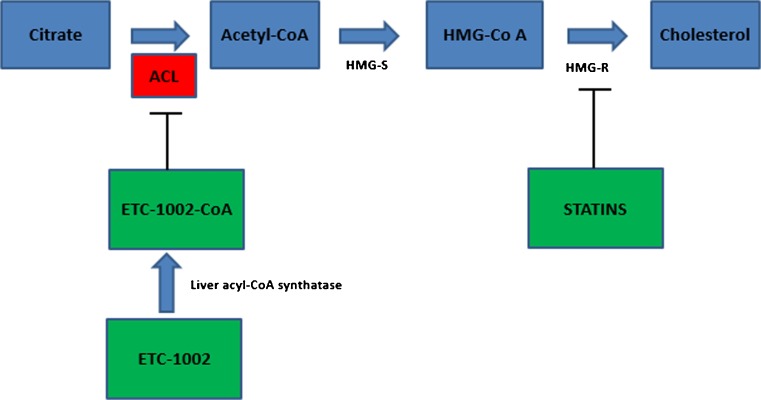
Bempedoic acid (ETC-1002), a novel therapeutic approach for low-density lipoprotein cholesterol (LDL-C) lowering, inhibits ATP citrate lyase (ACL), an enzyme involved in fatty acid and cholesterol synthesis. Although rodent studies suggested potential effects of ACL inhibition on both fatty acid and cholesterol synthesis, studies in humans show an effect only on cholesterol synthesis. In phase 2 studies, ETC-1002 reduced LDL-C as monotherapy, combined with ezetimibe, and added to statin therapy, with LDL-C lowering most pronounced when ETC-1002 was combined with ezetimibe in patients who cannot tolerate statins. Whether clinically relevant favorable effects on other cardiometabolic risk factors such as hyperglycemia and insulin resistance occur in humans is unknown and requires further investigation. Promising phase 2 results have led to the design of a large phase 3 program to gain more information on efficacy and safety of ETC-1002 in combination with statins and when added to ezetimibe in statin-intolerant patients.
Overview
The claims and statistics of this paper haven’t been checked yet.
Free: it reads the open-access text and checks the first 5 claims that cite a source we can check. Create a free account to check every claim.
Integrity signals
Registry
Cites
Statistics
Figures
Verification
Claims the paper makes
The claims and statistics of this paper haven’t been checked yet.
Free: it reads the open-access text and checks the first 5 claims that cite a source we can check. Create a free account to check every claim.
Claims other papers make about this one
Each is checked against this paper’s own text: does it say what the citing paper says it does?
The cited source says what the claim attributes to it.
In the citing paper
“Bempedoic acid inhibits adenosine triphosphate (ATP)-citrate lyase and thereby cholesterol biosynthesis [126].”
From Established and Emerging Lipid-Lowering Drugs for Primary and Secondary Cardiovascular Prevention (2023) · cites this paper as [126]
Self-check
Percentages, sums and reported differences re-computed from the paper’s own numbers.
The self-check needs the paper’s full text.
Citations
Cites
Schwartz, G. G. (2001) · JAMA · doi:10.1001/jama.285.13.1711 · Cited by 2,499
de Lemos, J. A., Blazing, M. A., Wiviott, S. D., Lewis, E. F., Fox, K. A. A., White, H. D., Rouleau, J.-L., Pedersen, T. R., Gardner, L. H., Mukherjee, R., et al. (2004) · JAMA · doi:10.1001/jama.292.11.1307 · Cited by 1,333
De novo lipogenesis in health and disease
Ameer, F., Scandiuzzi, L., Hasnain, S., Kalbacher, H., & Zaidi, N. (2014) · Metabolism · doi:10.1016/j.metabol.2014.04.003 · Cited by 611
Statin use and risk of diabetes mellitus in postmenopausal women in the Women's Health Initiative
Culver, A. L. (2012) · Archives of Internal Medicine · doi:10.1001/archinternmed.2011.625 · Cited by 444
Wiviott, S. D., Cannon, C. P., Morrow, D. A., Ray, K. K., Pfeffer, M. A., & Braunwald, E. (2005) · Journal of the American College of Cardiology · doi:10.1016/j.jacc.2005.04.064 · Cited by 340 · cited 3×
“ing efficacy of ETC-1002 versus ezetimibe, and assess safety and tolerability, including muscle-related adverse events, in patients with or without statin intolerance, defined as inability to tolerate two or more statins because of muscle pain, weakness, or cramping that began or increased during statin therapy and re…”
MethodInfluentialThe broad spectrum of statin myopathy: from myalgia to rhabdomyolysis
Harper, C. R., & Jacobson, T. A. (2007) · Current Opinion in Lipidology · doi:10.1097/mol.0b013e32825a6773 · Cited by 246
Pinkosky, S. L., Filippov, S., Srivastava, R. A. K., Hanselman, J. C., Bradshaw, C. D., Hurley, T. R., Cramer, C. T., Spahr, M. A., Brant, A. F., Houghton, J. L., et al. (2013) · Journal of Lipid Research · doi:10.1194/jlr.m030528 · Cited by 239
Acute coronary syndromes: morbidity, mortality, and pharmacoeconomic burden.
Kolansky, D. M. (2009) · PubMed · Cited by 187
Ballantyne, C. M., Davidson, M. H., MacDougall, D. E., Bays, H. E., DiCarlo, L. A., Rosenberg, N. L., Margulies, J., & Newton, R. S. (2013) · Journal of the American College of Cardiology · doi:10.1016/j.jacc.2013.05.050 · Cited by 175
Self-citationGutierrez, M. J., Rosenberg, N. L., MacDougall, D. E., Hanselman, J. C., Margulies, J. R., Strange, P., Milad, M. A., McBride, S. J., & Newton, R. S. (2014) · Arteriosclerosis, Thrombosis, and Vascular Biology · doi:10.1161/atvbaha.113.302677 · Cited by 170
Cited by
Items 101–121 of 121
Defining the role of bempedoic acid in lowering low-density lipoprotein cholesterol
Korzh, O. (2020) · Journal of Applied Pharmaceutical Science · doi:10.7324/japs.2020.101217 · Cited by 2
“ETC-1002 effectively reduces LDL and apolipoprotein (apo) B-containing lipoproteins (Bilen and Ballantyne, 2016; Pinkosky et al., 2013).”
BackgroundOroko, M., & Fisher, M. (2022) · Practical Diabetes · doi:10.1002/pdi.2380 · Cited by 1
Large Clinical Trials of Statin-Associated Muscle Symptoms
Moriarty, P. M. (2020) · Contemporary cardiology · doi:10.1007/978-3-030-33304-1_8
Fatty acid synthesis and prostate cancer
Koltai, T., Reshkin, S. J., Baltazar, F., & Fliegel, L. (2021) · Elsevier eBooks · doi:10.1016/b978-0-323-90528-2.00004-7
Kardiovaskuläre Hochrisikopatienten: Hilfe bei der LDL-C-Zielwerterreichung
Makhmudova, U., Schulze, P. C., Vogt, A., & Weingärtner, O. (2021) · CardioVasc · doi:10.1007/s15027-021-3603-4 · Cited by 1
Weingärtner, O., Marx, N., Klose, G., & Laufs, U. (2022) · Diabetes aktuell · doi:10.1055/a-1979-7992
“Die Bempedoinsäure wirkt als „pro-drug“ und wird über die „Very long Chain Acyl-CoA Synthase“ (ACVL1) in den aktiven Metaboliten überführt [23, 24].”
Gerő, L. (2022) · Diabetologia Hungarica · doi:10.24121/dh.2022.11
Emerging Lipoprotein-Related Therapeutics for Patients with Diabetes
Bobik, A., Cohen, N. D., Jenkins, A. J., Kyaw, T. S., SULLIVAN, D. R., Wu, X., Yu, X.-Y., & Little, P. J. (2023) · Contemporary diabetes · doi:10.1007/978-3-031-26681-2_30
CARDIOLOGIA EM FOCO: PREVENÇÃO, DIAGNÓSTICO E TRATAMENTOS ATUAIS
Almeida, A. B., & Horevicht, C. M. (2023) · EPITAYA eBooks · doi:10.47879/ed.ep.2023809
Efficacy and Safety of Bempedoic Acid in Patients with High Cardiovascular Risk: An Update
Çaklılı, Ö. T., Rizzo, M., & Cesur, M. (2024) · Current Vascular Pharmacology · doi:10.2174/0115701611290763240126045433
Moderne Strategien zur Lipidsenkung – die frühe Kombinationstherapie
Geiling, J. A., Schulze, P. C., & Weingärtner, O. (2024) · Zeitschrift für Herz- Thorax- und Gefäßchirurgie · doi:10.1007/s00398-024-00650-5
Badshah, A., Asif, M., Jamil, E., Almas, M., Mehboob, Z., Zainab, Z., Faisal, M., Abubakar, M., & Ullah, M. (2024) · Hamdard Journal of Pharmacy · doi:10.61744/hjp.v3i2.74
Использование бемпедоевой кислоты в клинической практике
Курочкина, Н. С., Зубарева, М. Ю., Р., А. А., & Владимирович, С. И. (2024) · Атеросклероз и дислипидемии · doi:10.34687/2219-8202.jad.2024.03.0002
Kennedy, C., Conroy, L., Millar, B., & de Gaetano, M. (2025) · Bleeding Thrombosis and Vascular Biology · doi:10.4081/btvb.2025.187
Puertas-Umbert, L., Alonso, J., Blanco-Casoliva, L., Bentanachs, R., Asmarats, L., Arderiu, G., Martínez‐González, J., & Rodríguez, C. (2025) · Clínica e Investigación en Arteriosclerosis · doi:10.1016/j.arteri.2025.500856
Prodrugs as drug delivery systems
Zhang, W. (2025) · Elsevier eBooks · doi:10.1016/b978-0-443-23521-4.00005-9
Puertas-Umbert, L., Alonso, J., Blanco-Casoliva, L., Bentanachs, R., Asmarats, L., Arderiu, G., Martínez-González, J., & Rodriguez, C. R. (2026) · Clínica e Investigación en Arteriosclerosis (English Edition) · doi:10.1016/j.artere.2026.500856
Manshadi, M. D., Setoodeh, P., & Zare, H. (2026) · bioRxiv (Cold Spring Harbor Laboratory) · doi:10.64898/2026.04.19.716936
“Taken together, these findings suggest that the observed synthetic lethal effect is relatively selective for HCC cells, with only limited synergistic activity in non-cancerous liver cells, thereby supporting its therapeutic potential.”
Alaspure, A. C., Yadav, A. D., Lodha, S. R., Gore, A. H., Kalyankar, G. G., & Patole, S. P. (2026) · Arabian Journal of Chemistry · doi:10.25259/ajc_360_2025
Samusieva, A. A., Gorodetska, I., Socha, O., Lytovchenko, Y., Kisielov, R., Dons’koi, B. V., Kozeretska, D., Lukiyanchuk, V., Dubrovska, A., Cheshuk, V., et al. (2026) · Frontiers in Oncology · doi:10.3389/fonc.2026.1911207
“Therefore, ACLY inhibitors, such as bempedoic acid (ETC-1002), are being explored not only for their established role in lowering cholesterol but also as potential anti-cancer agents that can disrupt the metabolic engine of tumors (16, 20 – 22).”
Metadata
- Authors
- Bilen, O., & Ballantyne, C. M.
- Affiliations
- Houston Methodist (US)
- Corresponding author
- Ballantyne, Christie M.
- Venue
- Current Atherosclerosis Reports
- Published
- 2016-09-23
- Volume
- 18
- Issue
- 10
- Pages
- 61-61
- ISSN
- 1523-3804 (ISSN-L)
- 1534-6242
- PMC
- PMC5035316
- OpenAlex
- W2521647868
- Semantic Scholar
- d783981a9d00e0e4bbb6266bb8b28549d026a834
- Cited by
- 119
- References
- 28
- Citations by year
- 2026: 7 · 2025: 15 · 2024: 17 · 2023: 12 · 2022: 13 · 2021: 18 · 2020: 10 · 2019: 14 · 2018: 8 · 2017: 5
- FWCI
- 1.85
- Type
- journal article
- Language
- en
- Open access
- hybrid
- doi.org
- Locations
- Current Atherosclerosis Reports (publishedVersion, cc-by)
- Europe PMC (PubMed Central) (publishedVersion, cc-by)
- PubMed Central (publishedVersion, cc-by)
- PubMed (publishedVersion)
- Topics
- Health Sciences › Medicine › Cardiology and Cardiovascular Medicine › Lipoproteins and Cardiovascular Health
- Life Sciences › Biochemistry, Genetics and Molecular Biology › Biochemistry › Cholesterol and Lipid Metabolism
- Life Sciences › Biochemistry, Genetics and Molecular Biology › Cancer Research › Cancer, Lipids, and Metabolism
- Keywords
- bempedoic acid, ATP-citrate lyase inhibition, LDL cholesterol lowering, statin intolerance, cholesterol biosynthesis, fatty acid synthesis, hypertriglyceridemia, insulin resistance, cardiometabolic risk factors
- MeSH terms
- Ezetimibe, Anticholesteremic Agents, ATP Citrate (pro-S)-Lyase, Dicarboxylic Acids, Drug Therapy, Combination, Fatty Acids, Humans, Hypercholesterolemia, Cholesterol, LDL, Hydroxymethylglutaryl-CoA Reductase Inhibitors
About these checks
Registry, retraction, Cites and statistics results are computed, not judged, with one exception: a printed reference that no index lists is read once by a model before it counts as a citation error. Claims are extracted by a model and kept only when their quote appears verbatim in the text; each cited source is then checked, with a model’s help, for whether it says what the claim relies on. Those verdicts can be wrong — read the claim’s quote and the cited source before relying on one.
Statistics and arithmetic are recomputed, not judged.
Confidence bands are shown only for fields calibrated on our annotated test set. None is calibrated yet, so no band is shown.
What counts as a claim ›How we measure confidence ›How we check this ›
Are you an author, or do you see a problem with this page? Request a review
Data sources
Bibliographic data: Semantic Scholar, OpenAlex, Crossref.
Contains information from the Semantic Scholar Academic Graph Datasets, made available under the ODC Attribution License (ODC-BY 1.0).
Semantic Scholar’s data is described in: Kinney, R., et al. (2023). The Semantic Scholar Open Data Platform. arXiv:2301.10140.
