

Advanced Glycation End Products, Diabetes, and Bone Strength
Open accessThe DOI matches its Crossref record; 78 of the 78 references it cites were found in a registry or an index.
Abstract
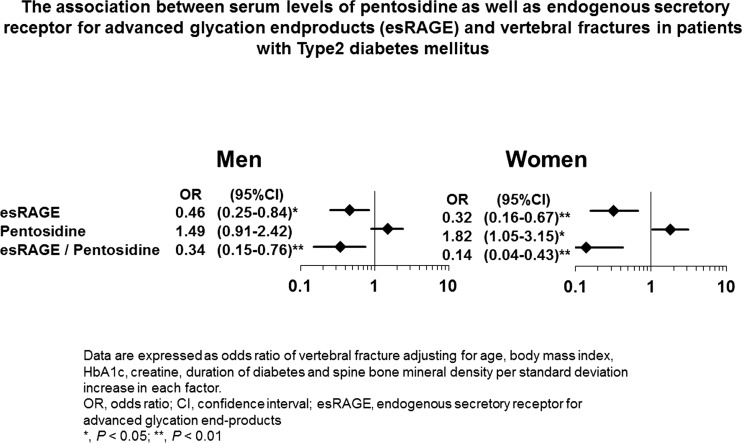
Diabetic patients have a higher fracture risk than expected by their bone mineral density (BMD). Poor bone quality is the most suitable and explainable cause for the elevated fracture risk in this population. Advanced glycation end products (AGEs), which are diverse compounds generated via a non-enzymatic reaction between reducing sugars and amine residues, physically affect the properties of the bone material, one of a component of bone quality, through their accumulation in the bone collagen fibers. On the other hand, these compounds biologically act as agonists for these receptors for AGEs (RAGE) and suppress bone metabolism. The concentrations of AGEs and endogenous secretory RAGE, which acts as a "decoy receptor" that inhibits the AGEs-RAGE signaling axis, are associated with fracture risk in a BMD-independent manner. AGEs are closely associated with the pathogenesis of this unique clinical manifestation through physical and biological mechanisms in patients with diabetes mellitus.
Overview
The claims and statistics of this paper haven’t been checked yet.
Free: it reads the open-access text and checks the first 5 claims that cite a source we can check. Create a free account to check every claim.
Integrity signals
Registry
Cites
Statistics
Figures
Verification
Claims the paper makes
The claims and statistics of this paper haven’t been checked yet.
Free: it reads the open-access text and checks the first 5 claims that cite a source we can check. Create a free account to check every claim.
Claims other papers make about this one
Each is checked against this paper’s own text: does it say what the citing paper says it does?
The cited source says what the claim attributes to it.
In the citing paper
“Diabetes (T1DM and T2DM) harms bone quality and increases fracture risk via advanced glycation end products that damage collagen structure and reduce osteoblast activity [104,105]”
From Interorgan Communications in Skeletal Pathophysiology: From Molecular Pathways to Multidisciplinary Therapies (2026) · cites this paper as [105]
Self-check
Percentages, sums and reported differences re-computed from the paper’s own numbers.
The self-check needs the paper’s full text.
Citations
Cites
Osteoporosis Prevention, Diagnosis, and Therapy
NIH Consensus Development Panel on Osteoporosis Prevention, D. (2001) · JAMA: The Journal of the American Medical Association · doi:10.1001/jama.285.6.785 · Cited by 5,529
Vestergaard, P. (2007) · Osteoporosis International · doi:10.1007/s00198-006-0253-4 · Cited by 1,808 · cited 1×
“Indeed, several studies of non-diabetic subjects revealed that increased AGEs crosslinking was associated with reduced post-yield properties and toughness [31, 32, 38–41]. Curr Osteoporos Rep (2016) 14:320–326 321”
BackgroundCROSS-LINKING IN COLLAGEN AND ELASTIN
Eyre, D. R., Paz, M. A., & Gallop, P. M. (1984) · Annual Review of Biochemistry · doi:10.1146/annurev.bi.53.070184.003441 · Cited by 1,309
Systematic Review of Type 1 and Type 2 Diabetes Mellitus and Risk of Fracture
Janghorbani, M., Van Dam, R. M., Willett, W. C., & Hu, F. B. (2007) · American Journal of Epidemiology · doi:10.1093/aje/kwm106 · Cited by 1,209
Structure Elucidation of a Senescence Cross-Link from Human Extracellular Matrix
Sell, D. R., & Monnier, V. M. (1989) · Journal of Biological Chemistry · doi:10.1016/s0021-9258(20)88225-8 · Cited by 1,081
The Role of Advanced Glycation End Products in Progression and Complications of Diabetes
Goh, S.-Y., & Cooper, M. E. (2008) · The Journal of Clinical Endocrinology & Metabolism · doi:10.1210/jc.2007-1817 · Cited by 987
Kislinger, T., Fu, C., Huber, B., Qu, W., Taguchi, A., Du Yan, S., Hofmann, M., Yan, S. F., Pischetsrieder, M., Stern, D., et al. (1999) · Journal of Biological Chemistry · doi:10.1074/jbc.274.44.31740 · Cited by 869
Older Women with Diabetes Have an Increased Risk of Fracture: A Prospective Study
Schwartz, A. V. (2001) · Journal of Clinical Endocrinology & Metabolism · doi:10.1210/jc.86.1.32 · Cited by 789
Age-related changes in the collagen network and toughness of bone
Wang, X., Shen, X., Li, X., & Mauli Agrawal, C. (2002) · Bone · doi:10.1016/s8756-3282(01)00697-4 · Cited by 777
Consensus development conference: prophylaxis and treatment of osteoporosis.
(1987) · BMJ · doi:10.1136/bmj.295.6603.914 · Cited by 727
Cited by
Twarda-Clapa, A., Olczak, A., Białkowska, A. M., & Koziołkiewicz, M. (2022) · Cells · doi:10.3390/cells11081312 · Cited by 746
“Diabetes mellitus can develop into a number of complications, such as retinopathy [173], nephropathy, bone strength weakness [174], neuropathy [175], atherosclerosis [176], and CVD [177].”
BackgroundEbeling, P. R., Nguyen, H. H., Aleksova, J., Vincent, A. J., Wong, P., & Milat, F. (2022) · Endocrine Reviews · doi:10.1210/endrev/bnab028 · Cited by 338
Collins, K. H., Herzog, W., MacDonald, G. Z., Reimer, R. A., Rios, J. L., Smith, I. C., Zernicke, R. F., & Hart, D. A. (2018) · Frontiers in Physiology · doi:10.3389/fphys.2018.00112 · Cited by 308
“In bone, AGEs are associated with decreased bone mineral density and impaired bone quality, eliciting oxidative stress and inflammatory responses in bone cells, while altering material properties of bone collagen fibers via cross-linking (Yamamoto and Sugimoto, 2016).”
BackgroundType 2 diabetes mellitus and bone
Compston, J. (2018) · Journal of Internal Medicine · doi:10.1111/joim.12725 · Cited by 198
Electroactive Biomaterials for Facilitating Bone Defect Repair under Pathological Conditions
Heng, B. C., Bai, Y., Li, X., Lim, L. W., Li, W., Ge, Z., Zhang, X., & Deng, X. (2022) · Advanced Science · doi:10.1002/advs.202204502 · Cited by 178
Metadata
- Authors
- Yamamoto, M., & Sugimoto, T.
- Affiliations
- Shimane University (JP)
- Corresponding author
- Yamamoto, Masahiro
- Venue
- Current Osteoporosis Reports
- Published
- 2016-10-04
- Volume
- 14
- Issue
- 6
- Pages
- 320-326
- ISSN
- 1544-1873 (ISSN-L)
- 1544-2241
- PMC
- PMC5104767
- OpenAlex
- W2529327478
- Cited by
- 215
- References
- 78
- Citations by year
- 2026: 25 · 2025: 21 · 2024: 23 · 2023: 29 · 2022: 41 · 2021: 22 · 2020: 20 · 2019: 12 · 2018: 14 · 2017: 8
- FWCI
- 1.17
- Type
- journal article
- Language
- en
- Open access
- hybrid
- doi.org
- Locations
- Current Osteoporosis Reports (publishedVersion, cc-by)
- Europe PMC (PubMed Central) (publishedVersion, cc-by)
- PubMed Central (publishedVersion, cc-by)
- PubMed (publishedVersion)
- Institutional Repositories DataBase (IRDB) (submittedVersion, other-oa)
- Topics
- Life Sciences › Biochemistry, Genetics and Molecular Biology › Clinical Biochemistry › Advanced Glycation End Products research
- Health Sciences › Medicine › Orthopedics and Sports Medicine › Bone health and osteoporosis research
- Life Sciences › Biochemistry, Genetics and Molecular Biology › Molecular Biology › Bone Metabolism and Diseases
- Keywords
- advanced glycation end products, diabetes mellitus, bone strength, fracture risk, bone quality, bone mineral density, receptor for advanced glycation end products, bone collagen, bone metabolism
- MeSH terms
- Receptor for Advanced Glycation End Products, Bone and Bones, Diabetes Mellitus, Humans, Bone Density, Glycation End Products, Advanced, Fractures, Bone
About these checks
Registry, retraction, Cites and statistics results are computed, not judged, with one exception: a printed reference that no index lists is read once by a model before it counts as a citation error. Claims are extracted by a model and kept only when their quote appears verbatim in the text; each cited source is then checked, with a model’s help, for whether it says what the claim relies on. Those verdicts can be wrong — read the claim’s quote and the cited source before relying on one.
Statistics and arithmetic are recomputed, not judged.
Confidence bands are shown only for fields calibrated on our annotated test set. None is calibrated yet, so no band is shown.
What counts as a claim ›How we measure confidence ›How we check this ›
Are you an author, or do you see a problem with this page? Request a review
How to cite
Cite CoChat for the checks on this page, and the paper for its own findings.
- This page
- CoChat. (2026). Citation check: Advanced Glycation End Products, Diabetes, and Bone Strength. https://app.cochat.ai/papers/10.1007/s11914-016-0332-1
- The paper
- Yamamoto, M., & Sugimoto, T. (2016). Advanced Glycation End Products, Diabetes, and Bone Strength. Current Osteoporosis Reports. https://doi.org/10.1007/s11914-016-0332-1
Data sources
Bibliographic data: Semantic Scholar, OpenAlex, Crossref.
Contains information from the Semantic Scholar Academic Graph Datasets, made available under the ODC Attribution License (ODC-BY 1.0).
Semantic Scholar’s data is described in: Kinney, R., et al. (2023). The Semantic Scholar Open Data Platform. arXiv:2301.10140.
