

Paracetamol: A History of Assumptions, Errors, and Evidence Reversals in Pain Management
Open accessThe DOI matches its Crossref record; 65 of the 65 references it cites were found in a registry or an index; 56 of the 127 sources its claims cite were checked for support.
Abstract
PURPOSE OF REVIEW: Paracetamol (acetaminophen) is among the most widely used medications in the history of humanity for treatment of pain conditions. For more than half a century, it has occupied a unique position as the archetypal first-line analgesic and antipyretic, recommended across age groups, clinical settings, and healthcare systems. Its remarkable success has been based on three fundamental assumptions: it is effective for common painful conditions, substantially safer than alternative analgesics, and suitable for broad population use with minimal restrictions. Over the last two decades, however, these assumptions have been increasingly challenged by accumulating evidence from randomized trials, systematic reviews, pharmaco-epidemiological studies, and regulatory analyses. RECENT FINDINGS: The history of paracetamol represents an instructive example of evidence reversal in modern medicine and pain management. Originally introduced as a safer successor to phenacetin, paracetamol benefited from a favorable safety reputation that often exceeded the available scientific evidence. Subsequent investigations have revealed a more complex reality. Hepatotoxicity has emerged as a leading cause of acute liver failure worldwide, efficacy in chronic musculoskeletal disorders has proved substantially lower than previously assumed, and concerns regarding long-term safety and use during pregnancy have generated ongoing scientific debate. Simultaneously, clinical practice and prescribing habits remained largely unchanged despite evolving evidence and repeated modifications of international guidelines. By examining major assumptions, scientific misconceptions, regulatory decisions, and evidence reversals, this review explores how one of medicine's most familiar drugs in pain medicine became a paradigm of the challenges inherent in translating evolving scientific evidence into clinical practice. Beyond paracetamol itself, this story provides broader lessons regarding therapeutic inertia, medical dogma, risk perception, and the dynamic nature of evidence-based medicine.
Overview
CoChat Summary
TL;DR
This narrative review uses paracetamol as a case study of evidence reversal: long-standing assumptions of broad efficacy, safety, and universal use were challenged by later trials, meta-analyses, safety signals, and guideline changes. It argues that clinical use persisted despite this reassessment, illustrating therapeutic inertia and the evidence-practice gap.
Key findings
- The review identifies three foundational assumptions that drove paracetamol’s adoption—effective analgesia for common pain, safety relative to alternatives, and broad use across populations—and says each was substantially reassessed over the last two decades.
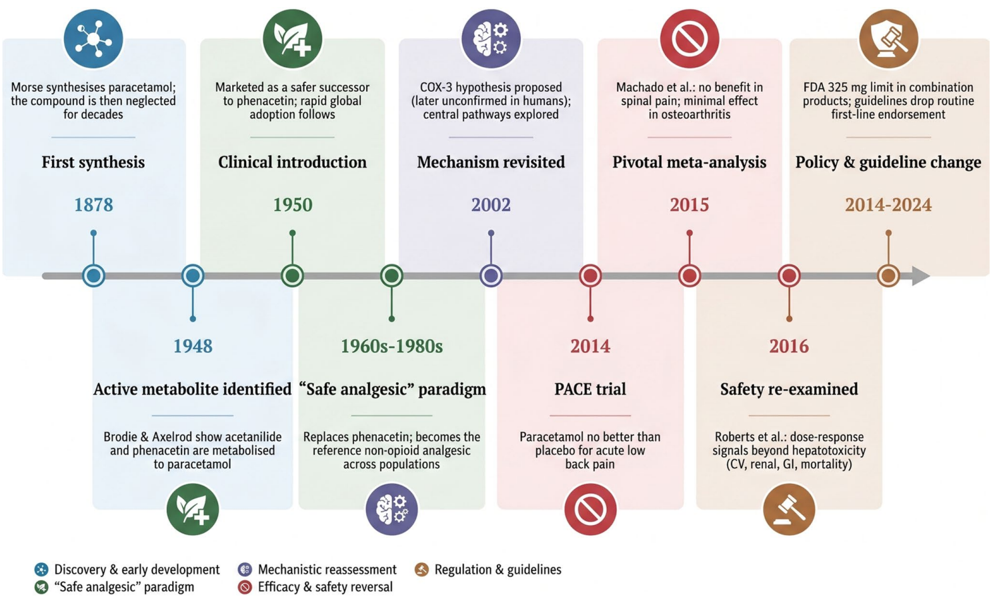
- Efficacy in chronic pain was challenged: the PACE trial found paracetamol no more effective than placebo for acute low back pain across pain intensity, disability, recovery time, sleep quality, and quality of life; Machado et al. found no meaningful benefit for spinal pain and only minimal, clinically insignificant osteoarthritis improvement, with a pooled low back pain effect of approximately −0.5 on a 0–100 pain scale.
- Safety concerns expanded beyond hepatotoxicity: Roberts et al. reported consistent dose-response relationships across several adverse outcomes, and the review notes possible cardiovascular, hypertension, gastrointestinal, renal, and mortality risks at the upper therapeutic range; the FDA restricted paracetamol in prescription combination products to 325 mg per dosage unit.
- Guideline and regulatory reversals occurred alongside persistent use: the ACR/Arthritis Foundation downgraded paracetamol to a conditional recommendation in 2019, while real-world studies show it remains a commonly prescribed first-line analgesic for low back pain and osteoarthritis; for pregnancy/neurodevelopment, a sibling-control analysis in nearly 2.5 million children attenuated associations toward the null, and a 2025 umbrella review concluded existing evidence does not clearly establish a link with autism or ADHD.
Methods
- Structured historical narrative review conducted and reported according to SANRA principles, intended as a broad historical and interpretative synthesis rather than a systematic review or meta-analysis.
- Literature searched in PubMed/MEDLINE, Scopus, Web of Science, and Embase from database inception through June 1, 2026, with manual reference-list checks; two reviewers independently screened sources, with a third senior reviewer resolving disagreements.
- Qualitative thematic synthesis organized around chronological-conceptual phases (discovery, successor status, “safe analgesic” paradigm, mechanisms, efficacy reassessment, safety concerns, regulatory responses, persistence of use); no formal risk-of-bias assessment was performed.
Limitations
- The paper states that, as a narrative review, source selection and interpretation involve author judgment; conclusions are an evidence-informed historical analysis, not quantitative treatment-effect estimates.
- The paper states that long-term safety evidence is largely observational and vulnerable to confounding by indication, channeling bias, and residual confounding, so associations cannot be equated with causation; efficacy trials differ in dose, duration, comparator, and population and mainly address chronic musculoskeletal conditions.
- The paper states that pregnancy/neurodevelopment evidence is rapidly evolving and contested, so the balance of evidence may shift; evident from the text, no formal risk-of-bias assessment or quantitative pooling was performed, and no datasets were generated or analyzed.
Model-written summary. Check it against the paper before relying on it.
Integrity signals
Registry
Cites
Statistics
Figures
Verification
Claims the paper makes
39 Valid · 1 Not valid · 39 Not checked · 36 Own results and interpretations
The cited sources support only part of this claim — read each source’s verdict below.
In the paper
“In many healthcare systems, paracetamol became the default analgesic against which alternative therapies were compared [ 32 ].”
What the sources say
- Partly supportedcites [32] Petrides M, Peletidi A, Petrou C, Nena E, Papavasili M, Constantinidis T, et al. Exploring public knowledge and perceptions regarding per os OTC pain-relieving medications: the case of paracetamol (acetaminophen). J Pharm Policy Pract. 2023;16(1):93. PMC10360319 37475043 sourceExperimental — accuracy not yet measured
The Background (page not available in our copy) describes paracetamol as one of the most frequently used analgesics internationally, supporting its widespread use. It does not say that healthcare systems adopted it as a default analgesic or that alternative therapies were compared against it. (LLM, conf=0.82)
plainstates a cause- Asserted: passes — The authors put it forward as true.
- Checkable: passes — It can be checked against evidence.
- Load-bearing: unclear — It is unclear whether the paper’s conclusions depend on it.
- Based: passes — The paper gives a reason why it holds.
- Partly supported
The cited sources support only part of this claim — read each source’s verdict below.
In the paper
“Paracetamol continues to occupy a privileged position within healthcare systems despite growing uncertainty regarding its efficacy in many chronic pain conditions [ 2 , 9 , 18 ].”
What the sources say
- Supportedcites [2] Freo U, Ruocco C, Valerio A, Scagnol I, Nisoli E, Paracetamol. A Review of Guideline Recommendations. J Clin Med. 2021;10(15):3420. PMC8347233 34362203 source
The Introduction says paracetamol remains a recommended analgesic despite reports that its efficacy may be lower than previously thought. Section 5.2 (Chronic Pain) says evidence of reduced efficacy has changed some guidelines, yet paracetamol continues to be used and recommended by several others. Section 7 also reports uncertainty about its efficacy in common pain conditions. (LLM, conf=0.91)
- Partly supportedcites [9] Machado GC, Maher CG, Ferreira PH, Pinheiro MB, Lin CW, Day RO, et al. Efficacy and safety of paracetamol for spinal pain and osteoarthritis: systematic review and meta-analysis of randomised placebo controlled trials. BMJ. 2015;350:h1225. PMC4381278 25828856 sourceExperimental — accuracy not yet measured
The Introduction says guidelines consistently recommend paracetamol as a first-line analgesic for spinal pain and hip or knee osteoarthritis, supporting its privileged position in care. The ‘What This Study Adds’ section questions its efficacy for low back pain and finds only a small, clinically unimportant benefit for hip or knee osteoarthritis. The claim’s reference to ‘many chronic pain conditions’ reaches beyond the conditions this review assesses; the paper says its effects for neck pain are unknown. (LLM, conf=0.83)
- Partly supportedcites [18] Pickering G, Mezouar L, Kechemir H, Ebel-Bitoun C. Paracetamol Use in Patients with Osteoarthritis and Lower Back Pain: Infodemiology Study and Observational Analysis of Electronic Medical Record Data. JMIR Public Health Surveill. 2022;8(10):e37790. PMC9650576 36301591 sourceExperimental — accuracy not yet measured
The Introduction describes paracetamol as a commonly used first-line analgesic for osteoarthritis and lower back pain, while the Discussion reports conflicting efficacy evidence and continued prescribing despite divergent guidelines. The paper supports the claim for those conditions, but does not establish a privileged position across healthcare systems or uncertainty about efficacy in many chronic pain conditions more broadly. (LLM, conf=0.85)
plain- Asserted: passes — The authors put it forward as true.
- Checkable: passes — It can be checked against evidence.
- Load-bearing: passes — The paper’s conclusions depend on it.
- Based: passes — The paper gives a reason why it holds.
- Supported
The cited sources support only part of this claim — read each source’s verdict below.
In the paper
“Contemporary reviews have consistently concluded that paracetamol offers limited or negligible efficacy in chronic low back pain”
What the sources say
- Supportedcites [10] Jones CMP, Underwood M, Chou R, Schoene M, Sabzwari S, Cavanagh J, et al. Analgesia for non-specific low back pain. BMJ. 2024;385:e080064. PMC11208989 38936847 source
The Paracetamol subsection states that moderate- to high-certainty evidence shows no effect over placebo for both acute and chronic low back pain. The efficacy table reports essentially no pain benefit in the systematic review it summarizes. No page numbers are provided in our copy. (LLM, conf=0.91)
- Partly supportedcites [39] Leopoldino AO, Machado GC, Ferreira PH, Pinheiro MB, Day R, McLachlan AJ, et al. Paracetamol versus placebo for knee and hip osteoarthritis. Cochrane Database Syst Rev. 2019;2(2):CD013273. PMC6388567 30801133 sourceExperimental — accuracy not yet measured
The Authors’ conclusions (page not available) find only minimal improvements from paracetamol, but specifically for hip or knee osteoarthritis. The review does not establish limited efficacy in chronic low back pain or that reviews have consistently reached that conclusion for that condition; its Additional information section mentions a low-back-pain trial only in a disclosure. (LLM, conf=0.83)
boosted- Asserted: passes — The authors put it forward as true.
- Checkable: passes — It can be checked against evidence.
- Load-bearing: passes — The paper’s conclusions depend on it.
- Based: passes — The paper gives a reason why it holds.
- Supported
Every source the paper cites for this claim was checked and supports it.
In the paper
“A landmark systematic review by Roberts et al. [ 15 ] demonstrated consistent dose-response relationships across several adverse outcomes”
What the sources say
- Supportedcites [15] Roberts E, Delgado Nunes V, Buckner S, Latchem S, Constanti M, Miller P, et al. Paracetamol: not as safe as we thought? A systematic literature review of observational studies. Ann Rheum Dis. 2016;75(3):552–9. PMC4789700 25732175 source
The Discussion states that the review found a consistent dose–response relationship between paracetamol use and several adverse outcomes, including mortality, cardiovascular, gastrointestinal and renal events. The paper notes that the evidence came from observational studies and was rated low or very low quality. (LLM, conf=0.94)
boostedstates an association- Asserted: passes — The authors put it forward as true.
- Checkable: passes — It can be checked against evidence.
- Load-bearing: passes — The paper’s conclusions depend on it.
- Based: passes — The paper gives a reason why it holds.
- Supported
The cited sources support only part of this claim — read each source’s verdict below.
In the paper
“Quantitatively, the pooled effect on low back pain was indistinguishable from placebo (weighted mean difference of approximately − 0.5 on a 0-100 pain scale)”
What the sources say
- Partly supportedcites [9] Machado GC, Maher CG, Ferreira PH, Pinheiro MB, Lin CW, Day RO, et al. Efficacy and safety of paracetamol for spinal pain and osteoarthritis: systematic review and meta-analysis of randomised placebo controlled trials. BMJ. 2015;350:h1225. PMC4381278 25828856 sourceExperimental — accuracy not yet measured
The Short term follow-up section reports a weighted mean difference of −0.5 and no effect on low back pain, but that estimate comes from one trial, not a pooled analysis. The pooled immediate-term estimate in the spinal pain section is 1.4 (95% CI −1.3 to 4.1), also showing no effect. (LLM, conf=0.90)
plain- Asserted: passes — The authors put it forward as true.
- Checkable: passes — It can be checked against evidence.
- Load-bearing: passes — The paper’s conclusions depend on it.
- Based: passes — The paper gives a reason why it holds.
- Partly supported
48 more claims · 16 with their cited sources checked
Create a free account to see all 115 claims and every source verdict.
- It may state two separate claims as one. 49
- Probably not a substantial claim. 20
- Not yet classified. 2
Self-check
Percentages, sums and reported differences re-computed from the paper’s own numbers.
Each contradiction between two passages listed here was confirmed by an independent check.
Rated minor: it would not touch a result — a value no result rests on, a p-value that stays on the same side of the significance level, or a conflict that is clerical, resolved elsewhere in the paper, or outside its own findings.
In the paper
“Conflict of Interest Dr. Kaye discloses his role as editor-in-chief of the Current Pain and Headache Reports Journal.”
“Competing Interests The authors declare no competing interests.”
Citations
Cites
SANRA—a scale for the quality assessment of narrative review articles
Baethge, C., Goldbeck-Wood, S., & Mertens, S. (2019) · Research Integrity and Peer Review · doi:10.1186/s41073-019-0064-8 · Cited by 3,469
The answer is 17 years, what is the question: understanding time lags in translational research
Morris, Z. S., Wooding, S., & Grant, J. (2011) · Journal of the Royal Society of Medicine · doi:10.1258/jrsm.2011.110180 · Cited by 3,340
Hochberg, M. C., Altman, R. D., April, K. T., Benkhalti, M., Guyatt, G., McGowan, J., Towheed, T., Welch, V., Wells, G., & Tugwell, P. (2012) · Arthritis Care & Research · doi:10.1002/acr.21596 · Cited by 3,068
Kolasinski, S. L., Neogi, T., Hochberg, M. C., Oatis, C., Guyatt, G., Block, J., Callahan, L., Copenhaver, C., Dodge, C., Felson, D., et al. (2020) · Arthritis Care & Research · doi:10.1002/acr.24131 · Cited by 2,516
Jordan, K. M., Arden, N. K., Doherty, M., Bannwarth, B., Bijlsma, J. W. J., Dieppe, P., Gunther, K., Hauselmann, H., Herrero-Beaumont, G., Kaklamanis, P., et al. (2003) · Annals of the Rheumatic Diseases · doi:10.1136/ard.2003.011742 · Cited by 2,048
Chandrasekharan, N. V., Dai, H., Roos, K. L. T., Evanson, N. K., Tomsik, J., Elton, T. S., & Simmons, D. L. (2002) · Proceedings of the National Academy of Sciences · doi:10.1073/pnas.162468699 · Cited by 1,989
Phillips, L. S., Branch, W. T., Cook, C. B., Doyle, J. P., El-Kebbi, I. M., Gallina, D. L., Miller, C. D., Ziemer, D. C., & Barnes, C. S. (2001) · Annals of Internal Medicine · doi:10.7326/0003-4819-135-9-200111060-00012 · Cited by 1,370
Cognitive biases associated with medical decisions: a systematic review
Saposnik, G., Redelmeier, D., Ruff, C. C., & Tobler, P. N. (2016) · BMC Medical Informatics and Decision Making · doi:10.1186/s12911-016-0377-1 · Cited by 1,001
Graham, G. G., Davies, M. J., Day, R. O., Mohamudally, A., & Scott, K. F. (2013) · Inflammopharmacology · doi:10.1007/s10787-013-0172-x · Cited by 671
Machado, G. C., Maher, C. G., Ferreira, P. H., Pinheiro, M. B., Lin, C.-W. C., Day, R. O., McLachlan, A. J., & Ferreira, M. L. (2015) · BMJ · doi:10.1136/bmj.h1225 · Cited by 580
Paracetamol (Acetaminophen): mechanisms of action
ANDERSON, B. J. (2008) · Pediatric Anesthesia · doi:10.1111/j.1460-9592.2008.02764.x · Cited by 497
Paracetamol: not as safe as we thought? A systematic literature review of observational studies
Roberts, E., Delgado Nunes, V., Buckner, S., Latchem, S., Constanti, M., Miller, P., Doherty, M., Zhang, W., Birrell, F., Porcheret, M., et al. (2016) · Annals of the Rheumatic Diseases · doi:10.1136/annrheumdis-2014-206914 · Cited by 412
A Decade of Reversal: An Analysis of 146 Contradicted Medical Practices
Prasad, V., Vandross, A., Toomey, C., Cheung, M., Rho, J., Quinn, S., Chacko, S. J., Borkar, D., Gall, V., Selvaraj, S., et al. (2013) · Mayo Clinic Proceedings · doi:10.1016/j.mayocp.2013.05.012 · Cited by 381
Towards understanding the de-adoption of low-value clinical practices: a scoping review
Niven, D. J., Mrklas, K. J., Holodinsky, J. K., Straus, S. E., Hemmelgarn, B. R., Jeffs, L. P., & Stelfox, H. T. (2015) · BMC Medicine · doi:10.1186/s12916-015-0488-z · Cited by 369
Efficacy of paracetamol for acute low-back pain: a double-blind, randomised controlled trial
Williams, C. M., Maher, C. G., Latimer, J., McLachlan, A. J., Hancock, M. J., Day, R. O., & Lin, C.-W. C. (2014) · The Lancet · doi:10.1016/s0140-6736(14)60805-9 · Cited by 325
Long‐term adverse effects of paracetamol – a review
McCrae, J. C., Morrison, E. E., MacIntyre, I. M., Dear, J. W., & Webb, D. J. (2018) · British Journal of Clinical Pharmacology · doi:10.1111/bcp.13656 · Cited by 308
Hawton, K., Bergen, H., Simkin, S., Dodd, S., Pocock, P., Bernal, W., Gunnell, D., & Kapur, N. (2013) · BMJ · doi:10.1136/bmj.f403 · Cited by 273
Acute Liver Failure Including Acetaminophen Overdose
Fontana, R. J. (2008) · Medical Clinics of North America · doi:10.1016/j.mcna.2008.03.005 · Cited by 249
Care for low back pain: can health systems deliver?
Traeger, A., Buchbinder, R., Elshaug, A., Croft, P., & Maher, C. (2019) · Bulletin of the World Health Organizatino · doi:10.2471/blt.18.226050 · Cited by 243
Paracetamol: Past, Present, and Future
Prescott, L. F. (2000) · American Journal of Therapeutics · doi:10.1097/00045391-200007020-00011 · Cited by 233
Paracetamol use during pregnancy — a call for precautionary action
Bauer, A. Z., Swan, S. H., Kriebel, D., Liew, Z., Taylor, H. S., Bornehag, C.-G., Andrade, A. M., Olsen, J., Jensen, R. H., Mitchell, R. T., et al. (2021) · Nature Reviews Endocrinology · doi:10.1038/s41574-021-00553-7 · Cited by 228
Endocannabinoid and serotonergic systems are needed for acetaminophen-induced analgesia
Mallet, C., Daulhac, L., Bonnefont, J., Ledent, C., Etienne, M., Chapuy, E., Libert, F., & Eschalier, A. (2008) · Pain · doi:10.1016/j.pain.2008.03.030 · Cited by 223
Paracetamol (acetaminophen): A familiar drug with an unexplained mechanism of action
Ayoub, S. S. (2021) · Temperature · doi:10.1080/23328940.2021.1886392 · Cited by 223
Chidiac, A. S., Buckley, N. A., Noghrehchi, F., & Cairns, R. (2023) · Expert Opinion on Drug Metabolism & Toxicology · doi:10.1080/17425255.2023.2223959 · Cited by 215
Acetaminophen/paracetamol: A history of errors, failures and false decisions
Brune, K., Renner, B., & Tiegs, G. (2015) · European Journal of Pain · doi:10.1002/ejp.621 · Cited by 213
Paracetamol: A Review of Guideline Recommendations
Freo, U., Ruocco, C., Valerio, A., Scagnol, I., & Nisoli, E. (2021) · Journal of Clinical Medicine · doi:10.3390/jcm10153420 · Cited by 208
Paracetamol – An old drug with new mechanisms of action
Przybyła, G. W., Szychowski, K. A., & Gmiński, J. (2021) · Clinical and Experimental Pharmacology and Physiology · doi:10.1111/1440-1681.13392 · Cited by 190
Rüegg, L., Pluma, A., Hamroun, S., Cecchi, I., Perez-Garcia, L. F., Anderson, P. O., Andreoli, L., Wirström, S. B., Boyadhzieva, V., Chambers, C., et al. (2025) · Annals of the Rheumatic Diseases · doi:10.1016/j.ard.2025.02.023 · Cited by 169
Acetaminophen Reinforces Descending Inhibitory Pain Pathways
Pickering, G., Estève, V, Loriot, M.-A., Eschalier, A., & Dubray, C. (2008) · Clinical Pharmacology & Therapeutics · doi:10.1038/sj.clpt.6100403 · Cited by 168
THE FATE OF ACETANILIDE IN MAN
Brodie, B. B., & Axelrod, J. (1948) · The Journal of Pharmacology and Experimental Therapeutics · doi:10.1016/s0022-3565(25)03462-7 · Cited by 168
Paracetamol versus placebo for knee and hip osteoarthritis
Leopoldino, A. O., Machado, G. C., Ferreira, P. H., Pinheiro, M. B., Day, R., McLachlan, A. J., Hunter, D. J., & Ferreira, M. L. (2019) · Cochrane Database of Systematic Reviews · doi:10.1002/14651858.cd013273 · Cited by 167
Hepatotoxicity of paracetamol and related fatalities.
Tittarelli, R., Pellegrini, M., Scarpellini, M. G., Marinelli, E., Bruti, V., di Luca, N. M., Busardò, F. P., & Zaami, S. (2017) · PubMed · Cited by 163
Acetaminophen Use During Pregnancy and Children’s Risk of Autism, ADHD, and Intellectual Disability
Ahlqvist, V. H., Sjöqvist, H., Dalman, C., Karlsson, H., Stephansson, O., Johansson, S., Magnusson, C., Gardner, R. M., & Lee, B. K. (2024) · JAMA · doi:10.1001/jama.2024.3172 · Cited by 147
Acetaminophen: Old Drug, New Issues
Aminoshariae, A., & Khan, A. (2015) · Journal of Endodontics · doi:10.1016/j.joen.2015.01.024 · Cited by 146
De Broe, M. E., & Elseviers, M. M. (1998) · New England Journal of Medicine · doi:10.1056/nejm199802123380707 · Cited by 139
Prenatal paracetamol exposure and child neurodevelopment: A review
Bauer, A. Z., Kriebel, D., Herbert, M. R., Bornehag, C.-G., & Swan, S. H. (2018) · Hormones and Behavior · doi:10.1016/j.yhbeh.2018.01.003 · Cited by 127
The efficacy and safety of paracetamol for pain relief: an overview of systematic reviews
Abdel Shaheed, C., Ferreira, G. E., Dmitritchenko, A., McLachlan, A. J., Day, R. O., Saragiotto, B., Lin, C., Langendyk, V., Stanaway, F., Latimer, J., et al. (2021) · Medical Journal of Australia · doi:10.5694/mja2.50992 · Cited by 110
Safety of Paracetamol in Osteoarthritis: What Does the Literature Say?
Conaghan, P. G., Arden, N., Avouac, B., Migliore, A., & Rizzoli, R. (2019) · Drugs & Aging · doi:10.1007/s40266-019-00658-9 · Cited by 101
Prasad, V. (2019) · doi:10.1353/book.49286 · Cited by 72
A Comprehensive Review of Over the Counter Treatment for Chronic Low Back Pain
Peck, J., Urits, I., Peoples, S., Foster, L., Malla, A., Berger, A. A., Cornett, E. M., Kassem, H., Herman, J., Kaye, A. D., et al. (2021) · Pain and Therapy · doi:10.1007/s40122-020-00209-w · Cited by 65
Self-citationAlchin, J., Dhar, A., Siddiqui, K., & Christo, P. J. (2022) · Current Medical Research and Opinion · doi:10.1080/03007995.2022.2049551 · Cited by 65
Pharmacological management of cancer pain: Novel therapeutics
Virgen, C. G., Kelkar, N., Tran, A., Rosa, C. M., Cruz-Topete, D., Amatya, S., Cornett, E. M., Urits, I., Viswanath, O., & Kaye, A. D. (2022) · Biomedicine & Pharmacotherapy · doi:10.1016/j.biopha.2022.113871 · Cited by 60
Self-citationA Comprehensive Review of Over-the-counter Treatment for Chronic Migraine Headaches
Peck, J., Urits, I., Zeien, J., Hoebee, S., Mousa, M., Alattar, H., Kaye, A. D., & Viswanath, O. (2020) · Current Pain and Headache Reports · doi:10.1007/s11916-020-00852-0 · Cited by 37
Self-citationSheikh, J., Allotey, J., Sobhy, S., Plana, M. N., Martinez-Barros, H., Naidu, H., Junaid, F., Sofat, R., Mol, B. W., Kenny, L. C., et al. (2025) · BMJ · doi:10.1136/bmj-2025-088141 · Cited by 33
The Position of Paracetamol in the World of Analgesics
Day, R. O., Graham, G. G., & Whelton, A. (2000) · American Journal of Therapeutics · doi:10.1097/00045391-200007020-00002 · Cited by 32
Orandi, B. J., McLeod, M. C., MacLennan, P. A., Lee, W. M., Fontana, R. J., Karvellas, C. J., McGuire, B. M., Lewis, C. E., Terrault, N. M., Locke, J. E., et al. (2023) · JAMA · doi:10.1001/jama.2023.1080 · Cited by 30
Cowans, C., Love, A., Tangiisuran, B., & Jacob, S. A. (2023) · Pharmacy · doi:10.3390/pharmacy11060184 · Cited by 27
Bateman, D. N., Dart, R. C., Dear, J. W., Prescott, L. F., & Rumack, B. H. (2023) · Clinical Toxicology · doi:10.1080/15563650.2023.2293452 · Cited by 25
Analgesia for non-specific low back pain
Jones, C. M. P., Underwood, M., Chou, R., Schoene, M., Sabzwari, S., Cavanagh, J., & Lin, C.-W. C. (2024) · BMJ · doi:10.1136/bmj-2024-080064 · Cited by 21
McGill, M. R., & Curry, S. C. (2023) · Livers · doi:10.3390/livers3040039 · Cited by 16
Berardino, K., Carroll, A. H., Popovsky, D., Ricotti, R., Civilette, M. D., Sherman, W. F., & Kaye, A. D. (2022) · Orthopedic Reviews · doi:10.52965/001c.35318 · Cited by 14
Self-citationFathelrahman, A. I. (2021) · JOURNAL OF CLINICAL AND DIAGNOSTIC RESEARCH · doi:10.7860/jcdr/2021/48219.14580 · Cited by 11
Alqudah, M., Stubbs, M. A., Al-Masaeed, M., & Fernandez, R. (2025) · Journal of Pediatric Nursing · doi:10.1016/j.pedn.2024.12.018 · Cited by 11
Pickering, G., Mezouar, L., Kechemir, H., & Ebel-Bitoun, C. (2022) · JMIR Public Health and Surveillance · doi:10.2196/37790 · Cited by 9
Petrides, M., Peletidi, A., Petrou, C., Nena, E., Papavasili, M., Constantinidis, T., & Kontogiorgis, C. (2023) · Journal of Pharmaceutical Policy and Practice · doi:10.1186/s40545-023-00598-1 · Cited by 8
A Review on Safety and Public Health Implications of Use of Over-the-Counter Pain Medication
Nwokedi, V. U., Ogadah, C. O., Adeyemi, B. I., Iregbu, J. K., Chioma, F. J., Enechukwu, E. O., Adeyemo, O. A., Barrah, V. U., & Sone, P. E. (2025) · Journal of Pharma Insights and Research. · doi:10.69613/7maz7058 · Cited by 8
Perrot, S., Eschalier, A., Desmeules, J., Lanteri-Minet, M., & Attal, N. (2022) · Current Medical Research and Opinion · doi:10.1080/03007995.2022.2076475 · Cited by 6
Barriers and facilitators to reducing paracetamol use in low back pain: A qualitative study
Patterson, T., Beckenkamp, P. R., Turner, J. P., Gnjidic, D., Mintzes, B. J., Bennett, C., Bywaters, L., Clavisi, O., Baysari, M. T., Ferreira, M. L., et al. (2023) · Musculoskeletal Science and Practice · doi:10.1016/j.msksp.2023.102856 · Cited by 6
Spillers, N. J., Luther, P. M., Talbot, N. C., Ly, G. H., Downs, E. M., Lavespere, G., Pavlickova, D., Ahmadzadeh, S., Viswanath, O., Varrassi, G., et al. (2023) · Cureus · doi:10.7759/cureus.41116 · Cited by 5
Self-citationPrenatal Acetaminophen Exposure and its Associated Risk for Attention Deficit Hyperactivity Disorder
J. Spillers, N., C. Talbot, N., M. Luther, P., H. Ly, G., J. Roberts, C., Ahmadzadeh, S., Shekoohi, S., Viswanath, O., & D. Kaye, A. (2024) · Health Psychology Research · doi:10.52965/001c.125267 · Cited by 5
Self-citationMilani, G. P., Nicolini, G., Cananzi, M., Spiezia, L., & Vidal, E. (2026) · Children · doi:10.3390/children13010071 · Cited by 5
Introduction to Drug Safety and Pharmacovigilance
Jose, J., Cox, A. R., & Bate, A. (2024) · Principles and Practice of Pharmacovigilance and Drug Safety · doi:10.1007/978-3-031-51089-2_1 · Cited by 3
Vedel, C., Jørgensen, D. S., Kristensen, D. M., Petersen, O. B., & Greisen, G. O. (2022) · PLoS ONE · doi:10.1371/journal.pone.0271537 · Cited by 2
Saad, H. B., Barki, C., Dergaa, I., Dhahbi, W., Ceylan, H. İ., Chalghaf, N., Omri, A. E., & Rahmouni, H. B. (2026) · EXCLI journal · doi:10.17179/excli2026-9237 · Cited by 2
Lakshmanan, V., & Rosser, M. (2025) · Cureus · doi:10.7759/cureus.92108 · Cited by 1
Research works printed but not linked: 5
- National Guideline C. Evidence review for pharmacological management of sciatica: Low back pain and sciatica in over 16s: assessment and management: Evidence review A. London: National Institute for Health and Care Excellence (NICE); 2020. 33090751
- Schaffer DH, Murray BP, Khazaeni B. Acetaminophen Toxicity. StatPearls [Internet]. Treasure Island (FL): StatPearls Publishing; 2026. 28722946
- Morse HN, Remsen I, Iles MW. On the Oxidation of Bromethyl-toluene and of Similar Substitution-products. Baltimore, MD: Johns Hopkins University; 1878.
- Food, Drug A. Acetaminophen Over-the-Counter (OTC) Monograph and Historical Review Board Proceedings (1950–2010). Pre-2011 Regulatory Framework Review. Silver Spring, MD: US Food and Drug Administration; 2010.
- National Collaborating Centre for Primary C. Low Back Pain: Early Management of Persistent Non-specific Low Back Pain. London: Royal College of General Practitioners (UK); 2009. 20704057
Metadata
- Authors
- Nicolas, J., Leoni, M. L. G., Van Tran, Y., Van Phong, P., Farì, G., Puttini, P. S., Kaye, A. D., & Varrassi, G.
- Affiliations
- Hôpital Paris Saint-Joseph (FR)
- Fondazione Paolo Procacci (IT)
- University of Salento (IT)
- Louisiana State University Health Sciences Center Shreveport (US)
- University of Baghdad (IQ)
- Corresponding author
- Kaye, Alan D.
- Venue
- Current Pain and Headache Reports
- Published
- 2026-09-12
- Volume
- 30
- Issue
- 1
- ISSN
- 1531-3433 (ISSN-L)
- 1534-3081
- PMC
- PMC13570823
- OpenAlex
- W7212372627
- Cited by
- 0
- References
- 57
- FWCI
- 0.00
- Type
- journal article
- Language
- en
- Open access
- hybrid
- doi.org
- Licence
- cc-by
- creativecommons.org/licenses/by/4.0 (tdm)
- creativecommons.org/licenses/by/4.0 (vor)
- Locations
- Current Pain and Headache Reports (publishedVersion, cc-by)
- PubMed Central (publishedVersion, cc-by)
- PubMed (publishedVersion)
- Topics
- Health Sciences › Medicine › Anesthesiology and Pain Medicine › Pain Management and Opioid Use
- Health Sciences › Medicine › Anesthesiology and Pain Medicine › Anesthesia and Pain Management
- Health Sciences › Medicine › Pharmacology (medical) › Inflammatory mediators and NSAID effects
- Keywords
- paracetamol, analgesic safety, hepatotoxicity, acute liver failure, chronic musculoskeletal pain, therapeutic inertia, medical dogma, risk perception, evidence-based medicine, drug regulation, prescribing patterns, phenacetin
- MeSH terms
- Acetaminophen, Humans, Pain, Analgesics, Non-Narcotic, Evidence-Based Medicine, History, 20th Century, History, 21st Century, Pain Management
About these checks
Registry, retraction, Cites and statistics results are computed, not judged, with one exception: a printed reference that no index lists is read once by a model before it counts as a citation error. Claims are extracted by a model and kept only when their quote appears verbatim in the text; each cited source is then checked, with a model’s help, for whether it says what the claim relies on. Those verdicts can be wrong — read the claim’s quote and the cited source before relying on one.
The claim verdicts this report counts are experimental: their accuracy is not yet measured.
A language model drew the claims from the paper on 2026-09-28, under version 3 of the claim definition (model deepseek-v4.1-flash, prompt extract-v3).
A second model labelled each claim on 2026-09-28 (model jev-1.13-20260917, definition revision gold-guideline-v0.2).
Cited sources are checked with a language model’s help (gpt-6-sol).
Statistics and arithmetic are recomputed, not judged.
Confidence bands are shown only for fields calibrated on our annotated test set. None is calibrated yet, so no band is shown.
What counts as a claim ›How we measure confidence ›How we check this ›
Are you an author, or do you see a problem with this page? Request a review
Data sources
Bibliographic data: Semantic Scholar, OpenAlex, Crossref.
Contains information from the Semantic Scholar Academic Graph Datasets, made available under the ODC Attribution License (ODC-BY 1.0).
Semantic Scholar’s data is described in: Kinney, R., et al. (2023). The Semantic Scholar Open Data Platform. arXiv:2301.10140.
