

The DOI matches its Crossref record; 216 of the 216 references it cites were found in a registry or an index.
Anti-inflammatory Action of Statins in Cardiovascular Disease: the Role of Inflammasome and Toll-Like Receptor Pathways
Open accessAbstract
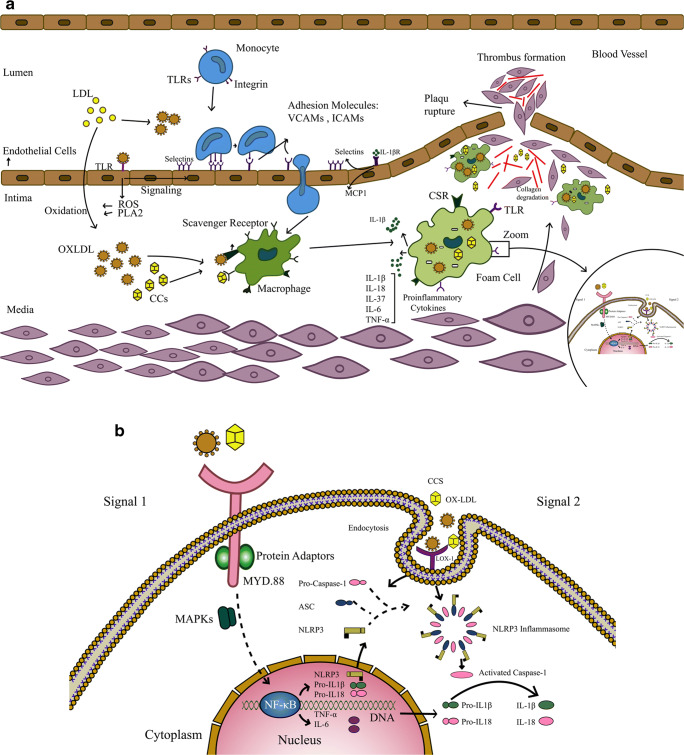
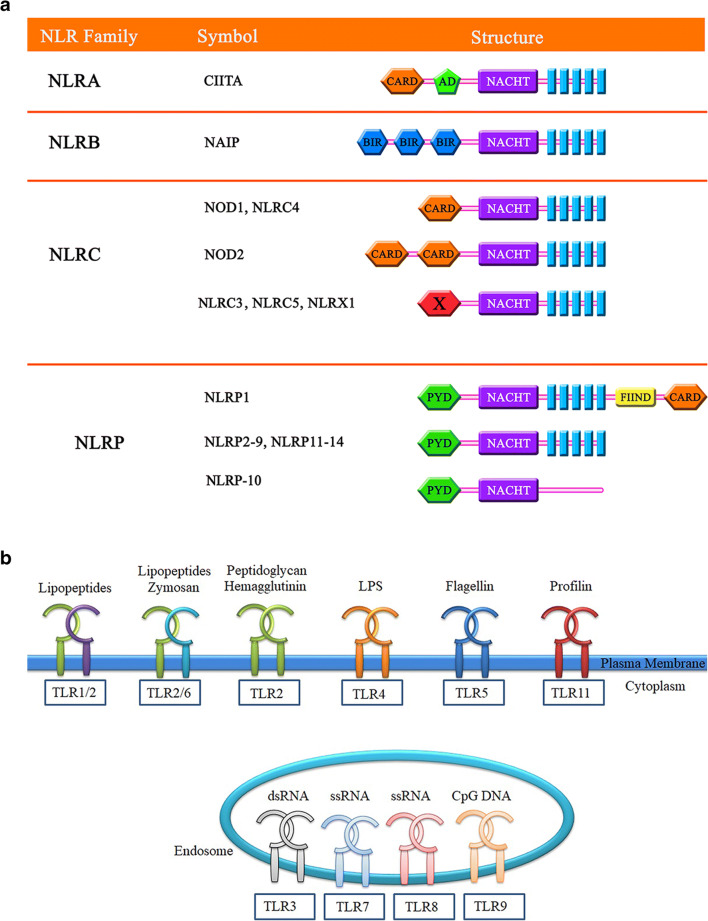
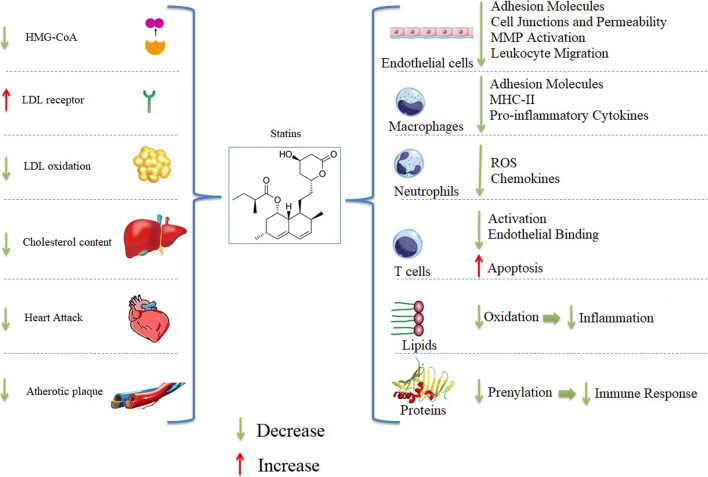
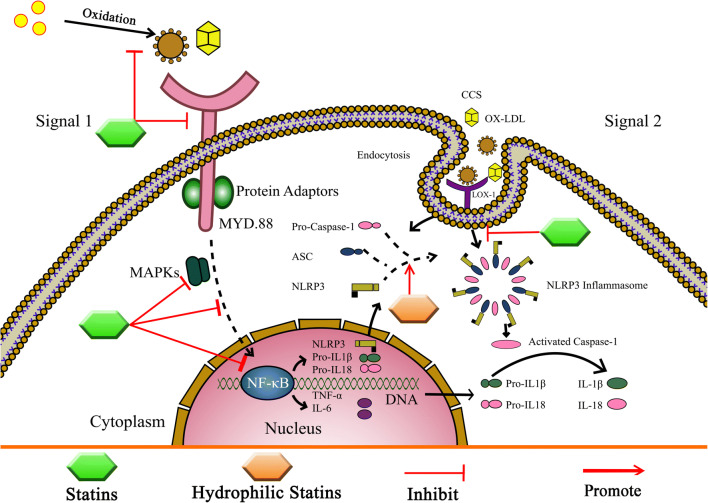
Atherosclerosis is one type of cardiovascular disease (CVD) in which activation of the NLRP3 inflammasome and toll-like receptor (TLR) pathways is implicated. One of the most effective treatments for atherosclerosis is the use of statin medications. Recent studies have indicated that statins, in addition to their lipid-lowering effects, exert inhibitory and/or stimulatory effects on the NLRP3 inflammasome and TLRs. Some of the statins lead to activation of the inflammasome and subsequently cause secretion of IL-1β and IL-18. Thus, these actions may further aggravate the disease. On the other hand, some statins cause inhibition of the inflammasome or TLRs and along with lipid-lowering, help to improve the disease by reducing inflammation. In this article, we discuss these contradictory studies and the mechanisms of action of statins on the NLRP3 inflammasome and TLR pathways. The dose-dependent effects of statins on the NLRP3 complex are related to their chemistry, pharmacokinetic properties, and danger signals. Lipophilic statins have more pleiotropic effects on the NLRP3 complex in comparison to hydrophilic statins. Statins can suppress TLR4/MyD88/NF-ĸB signaling and cause an immune response shift to an anti-inflammatory response. Furthermore, statins inhibit the NF-ĸB pathway by decreasing the expression of TLRs 2 and 4. Statins are cost-effective drugs, which should have a continued future in the treatment of atherosclerosis due to both their immune-modulating and lipid-lowering effects.
Overview
The claims and statistics of this paper haven’t been checked yet.
Run the check — free, no account needed. It reads the open-access text and checks the sources it cites.
Integrity signals
Registry
Cites
Statistics
Figures
Verification
Claims the paper makes
The claims and statistics of this paper haven’t been checked yet.
Run the check — free, no account needed. It reads the open-access text and checks the sources it cites.
Claims other papers make about this one
Each is checked against this paper’s own text: does it say what the citing paper says it does?
The cited source says what the claim attributes to it.
In the citing paper
“In addition to their primary role in lowering LDL cholesterol, statins have demonstrated potential in various off‐label applications, such as anti‐inflammatory and immunomodulatory effects, which continue to drive research into their expanded therapeutic uses [108, 109].”
From Statins as Antifungal Agents: A Review on Drug Repurposing and Nanotechnology-Driven Delivery Strategies (2025) · cites this paper as [108]
The cited source says what the claim attributes to it.
In the citing paper
“These drugs have exhibited other pleiotropic effects; antioxidant, anticoagulant (Vadivoo et al. 2018), anticancer (Gupta et al. 2019; Di Bello et al. 2020); anti-inflammatory (Koushki et al. 2021) and antibacterial activities (Ko et al. 2017; Vadivoo et al. 2018”
From In vitro study on the potential fungicidal effects of atorvastatin in combination with some azole drugs against multidrug resistant Candida albicans (2021) · cites this paper as Koushki et al. 2021
Self-check
Percentages, sums and reported differences re-computed from the paper’s own numbers.
The self-check needs the paper’s full text.
Citations
Cites
Atherosclerosis--an inflammatory disease
Ross, R. (1999) · New England Journal of Medicine · doi:10.1056/nejm199901143400207 · Cited by 21,725
Pathogen Recognition and Innate Immunity
Akira, S., Uematsu, S., & Takeuchi, O. (2006) · Cell · doi:10.1016/j.cell.2006.02.015 · Cited by 11,976
Inflammation, Atherosclerosis, and Coronary Artery Disease
Hansson, G. K. (2005) · New England Journal of Medicine · doi:10.1056/nejmra043430 · Cited by 8,773
Inflammation and Atherosclerosis
Libby, P., Ridker, P. M., & Maseri, A. (2002) · Circulation · doi:10.1161/hc0902.104353 · Cited by 7,724
Ticagrelor versus clopidogrel in patients with acute coronary syndromes
Wallentin, L., Becker, R. C., Budaj, A., Cannon, C. P., Emanuelsson, H., Held, C., Horrow, J., Husted, S., James, S., Katus, H., et al. (2009) · New England Journal of Medicine · doi:10.1056/nejmoa0904327 · Cited by 7,117 · cited 1×
“Long-term treatment with ticagrelor, an antiplatelet medication, reduces cardiovascular events in patients with acute coronary syndrome [177, 178].”
BackgroundDowns, J. R., Clearfield, M., Weis, S., Whitney, E., Shapiro, D. R., Beere, P. A., Langendorfer, A., Stein, E. A., Kruyer, W., Gotto, Jr., et al. (1998) · JAMA · doi:10.1001/jama.279.20.1615 · Cited by 5,236
The Pathogenesis of Atherosclerosis — An Update
Ross, R. (1986) · New England Journal of Medicine · doi:10.1056/nejm198602203140806 · Cited by 4,885
Taganov, K. D., Boldin, M. P., Chang, K.-J., & Baltimore, D. (2006) · Proceedings of the National Academy of Sciences · doi:10.1073/pnas.0605298103 · Cited by 4,317
NLRP3 inflammasomes are required for atherogenesis and activated by cholesterol crystals
Duewell, P., Kono, H., Rayner, K. J., Sirois, C. M., Vladimer, G., Bauernfeind, F. G., Abela, G. S., Franchi, L., Nuñez, G., Schnurr, M., et al. (2010) · Nature · doi:10.1038/nature08938 · Cited by 4,026 · cited 2×
“These events increase the inflammatory macrophage phenotype, which exerts effects on cardiac muscle cells to promote their proliferation [19].”
BackgroundFerence, B. A., Ginsberg, H. N., Graham, I., Ray, K. K., Packard, C. J., Bruckert, E., Hegele, R. A., Krauss, R. M., Raal, F. J., Schunkert, H., et al. (2017) · European Heart Journal · doi:10.1093/eurheartj/ehx144 · Cited by 3,962
Research works printed but not linked: 1
- Galea J, Armstrong J, Gadsdon P, Holden H, Francis SE, Holt CM (1996) Interleukin-1β in coronary arteries of patients with ischemic heart disease. Arterioscler Thromb Vasc Biol 16(8):1000–1006 · DOI
Cited by
Sorted by citations
Inflammation and atherosclerosis: signaling pathways and therapeutic intervention
Kong, P., Cui, Z.-Y., Huang, X.-F., Zhang, D.-D., Guo, R.-J., & Han, M. (2022) · Signal Transduction and Targeted Therapy · doi:10.1038/s41392-022-00955-7 · Cited by 1,183
Bai, J., Zhang, Y., Tang, C., Hou, Y., Ai, X., Chen, X., Zhang, Y., Wang, X., & Meng, X. (2021) · Biomedicine & Pharmacotherapy · doi:10.1016/j.biopha.2020.110985 · Cited by 720
The Role of Inflammation in Diabetic Retinopathy
Forrester, J. V., Kuffová, L., & Delibegović, M. (2020) · Frontiers in Immunology · doi:10.3389/fimmu.2020.583687 · Cited by 462
Arterial stiffness and vascular aging: mechanisms, prevention, and therapy
Herzog, M. J., Müller, P., Lechner, K., Stiebler, M., Arndt, P., Kunz, M., Ahrens, D., Schmeißer, A., Schreiber, S., & Braun-Dullaeus, R. C. (2025) · Signal Transduction and Targeted Therapy · doi:10.1038/s41392-025-02346-0 · Cited by 275
Henning, R. J. (2021) · Europe PMC (PubMed Central) · Cited by 209
Metadata
- Authors
- Koushki, K., Shahbaz, S. K., Mashayekhi, K., Sadeghi, M., Zayeri, Z. D., Taba, M. Y., Banach, M., Al-Rasadi, K., Johnston, T. P., & Sahebkar, A.
- Affiliations
- Mashhad University of Medical Sciences (IR)
- Ahvaz Jundishapur University of Medical Sciences (IR)
- Medical University of Lodz (PL)
- University of Missouri–Kansas City (US)
- Corresponding author
- Sahebkar, Amirhossein
- ORCID
- Venue
- Clinical Reviews in Allergy & Immunology
- Published
- 2020-05-06
- Volume
- 60
- Issue
- 2
- Pages
- 175-199
- ISSN
- 1080-0549 (ISSN-L)
- 1559-0267
- PMC
- PMC7985098
- OpenAlex
- W3021399606
- Cited by
- 382
- References
- 216
- Citations by year
- 2026: 50 · 2025: 74 · 2024: 70 · 2023: 86 · 2022: 52 · 2021: 40 · 2020: 9
- FWCI
- 4.48
- Type
- journal article
- Language
- en
- Open access
- hybrid
- doi.org
- Locations
- Clinical Reviews in Allergy & Immunology (publishedVersion, cc-by)
- PubMed Central (publishedVersion, cc-by)
- PubMed (publishedVersion)
- Funders
- Polish Mother's Memorial Hospital Research Institute
- Topics
- Life Sciences › Biochemistry, Genetics and Molecular Biology › Molecular Biology › Inflammasome and immune disorders
- Life Sciences › Immunology and Microbiology › Immunology › Atherosclerosis and Cardiovascular Diseases
- Health Sciences › Medicine › Cardiology and Cardiovascular Medicine › Lipoproteins and Cardiovascular Health
- Keywords
- statins, atherosclerosis, NLRP3 inflammasome, Toll-like receptors, TLR4/MyD88/NF-κB signaling, IL-1β, IL-18, anti-inflammatory activity, hypolipidemic effect, dose-dependent effects, cardiovascular disease
- MeSH terms
- NLR Family, Pyrin Domain-Containing 3 Protein, Animals, Anti-Inflammatory Agents, Cardiovascular Diseases, Humans, Signal Transduction, NF-kappa B, Hydroxymethylglutaryl-CoA Reductase Inhibitors, Interleukin-18, Toll-Like Receptors, Interleukin-1beta, Inflammasomes
About these checks
Registry, retraction, Cites and statistics results are computed, not judged, with one exception: a printed reference that no index lists is read once by a model before it counts as a citation error. Claims are extracted by a model and kept only when their quote appears verbatim in the text; each cited source is then checked, with a model’s help, for whether it says what the claim relies on. Those verdicts can be wrong — read the claim’s quote and the cited source before relying on one.
Statistics and arithmetic are recomputed, not judged.
Confidence bands are shown only for fields calibrated on our annotated test set. None is calibrated yet, so no band is shown.
What counts as a claim ›How we measure confidence ›How we check this ›
Are you an author, or do you see a problem with this page? Request a review
