

Mutations in proteasome-related genes are associated with thyroid hemiagenesis
Open accessThe DOI matches its Crossref record; 31 of the 31 references it cites were found in a registry or an index.
Abstract
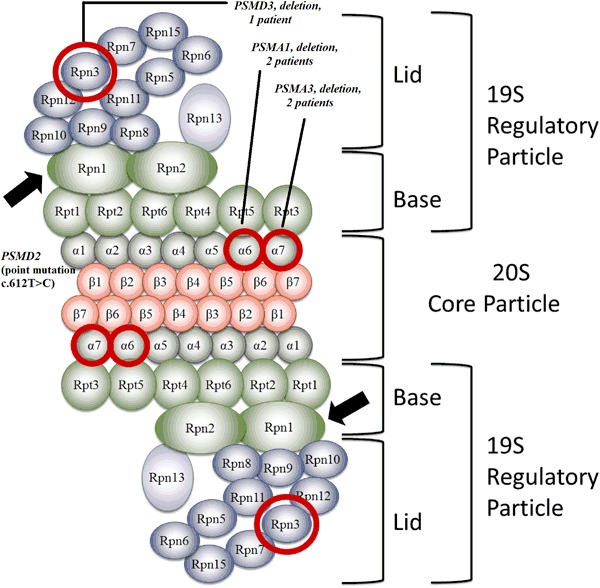
PURPOSE: Human thyroid development is a complex and still unexplained process. Thyroid hemiagenesis is a congenital anomaly, where one of the thyroid lobes fails to develop. In the majority of patients with thyroid hemiagenesis, the genetic background remains unknown. The aim of the study was to search for novel genetic contributors to the etiology of thyroid hemiagenesis. METHODS: A cohort of 34 sporadic patients diagnosed with thyroid hemiagenesis and one three-generation family were subjected to comprehensive genomic examination. Initially, targeted screening of associated transcription factors, known to be linked to thyroid development, was performed. As a next step, genomic examinations were applied using high-resolution microarrays, whereas for the thyroid hemiagenesis family, additionally the whole exome sequencing was performed. RESULTS: Screening of transcription factors revealed no causative mutations in the studied cohort. Genomic examinations revealed the presence of four recurrent defects (three deletions and one duplication) affecting highly conservative proteasome genes PSMA1, PSMA3, and PSMD3. In a thyroid hemiagenesis family a splice site mutation in a proteasome gene PSMD2 (c.612T > C cDNA.1170T > C, g.3271T > C) was found in both affected mother and daughter. CONCLUSIONS: Our results shed a new light on etiology of thyroid hemiagenesis, so far suspected to be linked only to mutations in the genes directly involved in the thyroid development. We demonstrated, for the first time, that genomic alterations in proteasome-associated genes co-occur in patients presenting this developmental anomaly.
Overview
The claims and statistics of this paper haven’t been checked yet.
Free: it reads the open-access text and checks the first 5 claims that cite a source we can check. Create a free account to check every claim.
Integrity signals
Registry
Cites
Statistics
Figures
Verification
Claims the paper makes
The claims and statistics of this paper haven’t been checked yet.
Free: it reads the open-access text and checks the first 5 claims that cite a source we can check. Create a free account to check every claim.
Claims other papers make about this one
Each is checked against this paper’s own text: does it say what the citing paper says it does?
The source backs part of the claim, not all of it — or backs it for a different population, condition or comparison.
In the citing paper
“Nonetheless, variants in other genes encoding subunits of the 26S proteasome—such as PSMA1, PSMA3, PSMD3, and PSMD2—have been associated with thyroid dysfunction [17].”
From Strengthening the Role of PSMC5 as a Potential Gene Associated with Neurodevelopmental Disorders (2025) · cites this paper as [17]
Experimental — accuracy not yet measured
Self-check
Percentages, sums and reported differences re-computed from the paper’s own numbers.
The self-check needs the paper’s full text.
Citations
Cites
Systematic and integrative analysis of large gene lists using DAVID bioinformatics resources
Huang, D. W., Sherman, B. T., & Lempicki, R. A. (2009) · Nature Protocols · doi:10.1038/nprot.2008.211 · Cited by 35,890 · cited 1×
“CNVs encompassing genes, were subjected to a search for phenotype relevancy using GENECODIS, whereas functional annotation was conducted with the database for annotation, visualization, and integrated discovery [16].”
MethodA method and server for predicting damaging missense mutations.
Adzhubei, I. A., Schmidt, S., Peshkin, L., Ramensky, V. E., Gerasimova, A., Bork, P., Kondrashov, A. S., & Sunyaev, S. R. (2010) · Nature Methods · doi:10.1038/nmeth0410-248 · Cited by 13,194 · cited 2×
“The amino acid changes were examined using Sift [12], and PolyPhen2 [13] as well as Splice Site mutations using Human Splicing Finder (HSF3.”
MethodKumar, P., Henikoff, S., & Ng, P. C. (2009) · Nature Protocols · doi:10.1038/nprot.2009.86 · Cited by 6,521 · cited 2×
“The amino acid changes were examined using Sift [12], and PolyPhen2 [13] as well as Splice Site mutations using Human Splicing Finder (HSF3.”
MethodMutationTaster2: mutation prediction for the deep-sequencing age
Schwarz, J. M., Cooper, D. N., Schuelke, M., & Seelow, D. (2014) · Nature Methods · doi:10.1038/nmeth.2890 · Cited by 3,362
Human Splicing Finder: an online bioinformatics tool to predict splicing signals
Desmet, F.-O., Hamroun, D., Lalande, M., Collod-Béroud, G., Claustres, M., & Béroud, C. (2009) · Nucleic Acids Research · doi:10.1093/nar/gkp215 · Cited by 2,512
A copy number variation morbidity map of developmental delay
Cooper, G. M., Coe, B. P., Girirajan, S., Rosenfeld, J. A., Vu, T. H., Baker, C., Williams, C., Stalker, H., Hamid, R., Hannig, V., et al. (2011) · Nature Genetics · doi:10.1038/ng.909 · Cited by 1,351
Mapping copy number variation by population-scale genome sequencing
1000 Genomes Project, Mills, R. E., Walter, K., Stewart, C., Handsaker, R. E., Chen, K., Alkan, C., Abyzov, A., Yoon, S. C., Ye, K., et al. (2011) · Nature · doi:10.1038/nature09708 · Cited by 1,140
Population analysis of large copy number variants and hotspots of human genetic disease
Itsara, A., Cooper, G. M., Baker, C., Girirajan, S., Li, J., Absher, D., Krauss, R. M., Myers, R. M., Ridker, P. M., Chasman, D. I., et al. (2009) · The American Journal of Human Genetics · doi:10.1016/j.ajhg.2008.12.014 · Cited by 591
PAX8 mutations associated with congenital hypothyroidism caused by thyroid dysgenesis
Macchia, P. E., Lapi, P., Krude, H., Pirro, M. T., Missero, C., Chiovato, L., Souabni, A., Baserga, M., Tassi, V., Pinchera, A., et al. (1998) · Nature Genetics · doi:10.1038/ng0598-83 · Cited by 501 · cited 5×
“, NKX2-1, FOXE1, PAX8) are rarely altered in THA patients, and only one THA familial case was reported to be caused by a heterozygous mutation in PAX8 [5].”
BackgroundInfluentialThe role of Hoxa-3 in mouse thymus and thyroid development
Manley, N. R., & Capecchi, M. R. (1995) · Development · doi:10.1242/dev.121.7.1989 · Cited by 429
Cited by
Zou, M., Alzahrani, A. S., Al-Odaib, A., Alqahtani, M. A., Babiker, O., Al-Rijjal, R. A., BinEssa, H. A., Kattan, W. E., Al-Enezi, A. F., Al Qarni, A., et al. (2018) · The Journal of Clinical Endocrinology & Metabolism · doi:10.1210/jc.2017-02202 · Cited by 78
Yamaguchi, T., Nakamura, A., Nakayama, K., Hishimura, N., Morikawa, S., Ishizu, K., & Tajima, T. (2020) · The Journal of Clinical Endocrinology & Metabolism · doi:10.1210/clinem/dgaa308 · Cited by 59
Thyroid Hemiagenesis: Incidence, Clinical Significance, and Genetic Background
Szczepanek‐Parulska, E., Zybek‐Kocik, A., Wartofsky, L., & Ruchała, M. (2017) · The Journal of Clinical Endocrinology & Metabolism · doi:10.1210/jc.2017-00784 · Cited by 54
“(121) 34 sporadic and 2 familial cases Human DNA from peripheral blood PAX8, TTF1, TTF2 No mutations”
BackgroundInfluentialSelf-citationWang, W., Li, W., Jiang, W., Lin, H., Wu, Y., Wen, Y., Xu, C., Tian, X., Li, S., Tan, Q., et al. (2020) · Journal of Psychiatric Research · doi:10.1016/j.jpsychires.2020.10.031 · Cited by 40
Thyroid Hemiagenesis: Narrative Review and Clinical Implications
Lesi, O. K., Thapar, A., Appaiah, N. N. B., Iqbal, M. R., Kumar, S., Maharaj, D., Al‐Zawi, A. S. A., & Dindyal, S. (2022) · Cureus · doi:10.7759/cureus.22401 · Cited by 24
Alqahtani, S. M., Alanesi, S. F., & Alalawi, Y. (2021) · Clinical Case Reports · doi:10.1002/ccr3.3856 · Cited by 13
Mikosch, P., Weixlbaumer, V., Irrgang, M., Aistleitner, A., & Trifina-Mikosch, E. (2020) · Wiener Medizinische Wochenschrift · doi:10.1007/s10354-020-00783-w · Cited by 12
Copy Number Variants Contributing to Combined Pituitary Hormone Deficiency
Budny, B., Karmelita‐Katulska, K., Stajgis, M., Żemojtel, T., Ruchała, M., & Ziemnicka, K. (2020) · International Journal of Molecular Sciences · doi:10.3390/ijms21165757 · Cited by 10
Self-citationNakamura, T., Ichii, O., Sunden, Y., Elewa, Y. H. A., Yoshiyasu, T., Hattori, H., Tatsumi, O., Kon, Y., & Nagasaki, K. (2019) · PLoS ONE · doi:10.1371/journal.pone.0221939 · Cited by 9
Compound heterozygous GLI3 variants in siblings with thyroid hemiagenesis
Szczepanek‐Parulska, E., Budny, B., Borowczyk, M., Zawadzka, K., Sztromwasser, P., & Ruchała, M. (2020) · Endocrine · doi:10.1007/s12020-020-02422-1 · Cited by 9
Self-citationWawrocka, A., Walczak‐Sztulpa, J., Socha, M., Kuszel, Ł., Sowińska‐Seidler, A., Budny, B., Bukowska‐Olech, E., Pilas‐Pomykalska, M., Jamsheer, A., & Krawczynski, M. R. (2021) · American Journal of Medical Genetics Part A · doi:10.1002/ajmg.a.62559 · Cited by 7
“Analysis was performed according to standard protocols provided by the manufacturer as described previously (Budny et al., 2017).”
MethodSelf-citationHypothyroidism in Thyroid Hemiagenesis: A Case Report
Shah, R. K., Bohara, G., Juveria, F., & Mirza, L. (2022) · Cureus · doi:10.7759/cureus.23087 · Cited by 5
“The cause of thyroid hemiagenesis remains unknown, but there might be a genetic component to its etiology [3].”
BackgroundPSMC5 insufficiency and P320R mutation impair proteasome function
Yu, Z.-Q., Carmichael, J., Collins, G. A., D'Agostino, M. D., Lessard, M., Firth, H. V., Harijan, P., Fry, A. E., Dean, J., Zhang, J., et al. (2024) · Human Molecular Genetics · doi:10.1093/hmg/ddae085 · Cited by 4
“…PSMC5, pathogenic truncated or missense variants of other subunits of the 19S RP: AAA ATPase subunit PSMC3 [19, 20] and non-ATPase subunits PSMD2 [29] and PSMD12 [21–23, 30 ], were reported in To further address how the depletion of subunits of the 19S RP impairs proteasome function, we…”
Toxic Adenoma in a Patient with Thyroid Hemiagenesis
Gürleyik, E., Doğan, S., Cetin, F., Gürsoy, F., & İpor, A. M. (2017) · Cureus · doi:10.7759/cureus.1695 · Cited by 4
“Hemiagenesis is an incomplete genesis of a lobe for which the aetiology remains unclear [1,7].”
BackgroundStrengthening the Role of PSMC5 as a Potential Gene Associated with Neurodevelopmental Disorders
Vinci, M., Musumeci, A., Papa, C., Ragalmuto, A., Saccone, S., Federico, C., Greco, D., Greco, V., Calì, F., & Treccarichi, S. (2025) · International Journal of Molecular Sciences · doi:10.3390/ijms26136386 · Cited by 2
“Nonetheless, variants in other genes encoding subunits of the 26S proteasome—such as PSMA1 , PSMA3 , PSMD3 , and PSMD2 —have been associated with thyroid dysfunction [17].”
Thyroid hemiagenesis with Graves' disease: The first reported case in Lebanon
Fleifel, M., Masri, D. E., Alam, A. E., Khoury, G., Genadry, N., & Hirbli, K. (2022) · Journal of Clinical and Translational Endocrinology Case Reports · doi:10.1016/j.jecr.2022.100128 · Cited by 2
Fetal and Postnatal Disorders of Thyroid Function
Lawrence, S. E., Oettingen, J. E. V., & Deladoëy, J. (2019) · Elsevier eBooks · doi:10.1016/b978-0-12-814823-5.00044-1 · Cited by 2
Thyroid hemiagenesis with Graves’ disease: The first reported case in Lebanon
Fleifel, M., Masri, D. E., Alam, A. E., Khoury, G., Genadry, N., & Hirbli, K. (2022) · Journal of Clinical and Translational Endocrinology Case Reports · doi:10.1016/j.jecr.2022.100134 · Cited by 1
Szczepanek‐Parulska, E., Zybek‐Kocik, A., Fichna, M., Niedziela, M., Czarnywojtek, A., Fularz, P., Michalak, M., Moczko, J., & Ruchała, M. (2018) · Iranian Journal of Pediatrics · doi:10.5812/ijp.61373
Self-citationChumber, S., Sharma, J. K., Ranjan, P., Singh, A., Singh, D., Kataria, K., Aphale, R., Rathore, Y. S., & Malhi, A. S. (2024) · Indian Journal of Endocrine Surgery and Research · doi:10.5005/jp-journals-10088-11216
Kar, S., Mishra, P., Sahoo, T., & Devi, U. (2024) · Indian Pediatrics Case Reports · doi:10.4103/ipcares.ipcares_191_23
新生児マス・スクリーニング陽性の先天性甲状腺機能低下症に対する次世代シークエンサーを用いたターゲットリシークエンス
山口, 健. (2020) · Institutional Repositories DataBase (IRDB) · doi:10.14943/doctoral.k14095
Güneş, Z. (2024) · Dspace Repository (Marmara Üniversitesi)
Fu, G., Zhou, H., Wan, T., Li, Y., Wang, Z., & Hou, Y. (2026) · Frontiers in Endocrinology · doi:10.3389/fendo.2026.1841194
Metadata
- Authors
- Budny, B., Szczepanek-Parulska, E., Zemojtel, T., Szaflarski, W., Rydzanicz, M., Wesoly, J., Handschuh, L., Wolinski, K., Piatek, K., Niedziela, M., Ziemnicka, K., Figlerowicz, M., Zabel, M., & Ruchala, M.
- Affiliations
- Poznan University of Medical Sciences (PL)
- Institute of Bioorganic Chemistry, Polish Academy of Sciences (PL)
- ORCID
- Venue
- Endocrine
- Published
- 2017-04-07
- Volume
- 56
- Issue
- 2
- Pages
- 279-285
- ISSN
- 0969-711X (ISSN-L)
- 1355-008X
- 1559-0100
- PMC
- PMC5395596
- OpenAlex
- W2604467117
- Cited by
- 22
- References
- 30
- Citations by year
- 2026: 1 · 2025: 1 · 2024: 3 · 2022: 4 · 2021: 2 · 2020: 5 · 2019: 2 · 2018: 2 · 2017: 2
- FWCI
- 2.38
- Type
- journal article
- Language
- en
- Open access
- hybrid
- doi.org
- Licence
- cc-by
- creativecommons.org/licenses/by/4.0 (tdm)
- Locations
- Endocrine (publishedVersion, cc-by)
- PubMed Central (publishedVersion, cc-by)
- PubMed (publishedVersion)
- Funders
- Polish National Science Center (DEC-2011/03/D/NZ5/06142.)
- National Multidisciplinary Laboratory of Functional Nanomaterials NanoFun (POIG.02.02.00-00-025/09)
- Topics
- Health Sciences › Medicine › Endocrinology, Diabetes and Metabolism › Thyroid Disorders and Treatments
- Health Sciences › Medicine › Surgery › Head and Neck Anomalies
- Life Sciences › Biochemistry, Genetics and Molecular Biology › Genetics › Genomics and Rare Diseases
- Keywords
- thyroid hemiagenesis, proteasome genes, PSMA1, PSMA3, PSMD2, congenital thyroid anomaly, thyroid development, splice site mutation, gene deletion, gene duplication, genetic etiology
- MeSH terms
- Humans, Mutation, Gene Deletion, Genetic Predisposition to Disease, Gene Duplication, Proteasome Endopeptidase Complex, TNF Receptor-Associated Factor 2, Thyroid Dysgenesis, Genetic Association Studies
About these checks
Registry, retraction, Cites and statistics results are computed, not judged, with one exception: a printed reference that no index lists is read once by a model before it counts as a citation error. Claims are extracted by a model and kept only when their quote appears verbatim in the text; each cited source is then checked, with a model’s help, for whether it says what the claim relies on. Those verdicts can be wrong — read the claim’s quote and the cited source before relying on one.
Statistics and arithmetic are recomputed, not judged.
Confidence bands are shown only for fields calibrated on our annotated test set. None is calibrated yet, so no band is shown.
What counts as a claim ›How we measure confidence ›How we check this ›
Are you an author, or do you see a problem with this page? Request a review
Data sources
Bibliographic data: Semantic Scholar, OpenAlex, Crossref.
Contains information from the Semantic Scholar Academic Graph Datasets, made available under the ODC Attribution License (ODC-BY 1.0).
Semantic Scholar’s data is described in: Kinney, R., et al. (2023). The Semantic Scholar Open Data Platform. arXiv:2301.10140.
