

Addictive social media use during Covid-19 outbreak: Validation of the Bergen Social Media Addiction Scale (BSMAS) and investigation of protective factors in nine countries
Open accessThe DOI matches its Crossref record, with a small difference in title or year; 116 of the 116 references it cites were found in a registry or an index.
Abstract
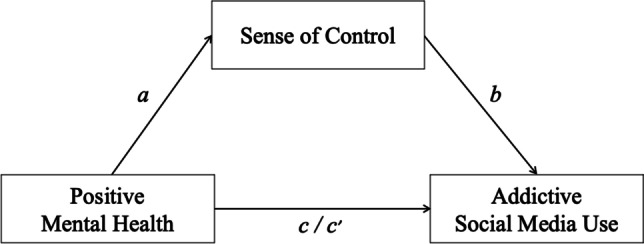
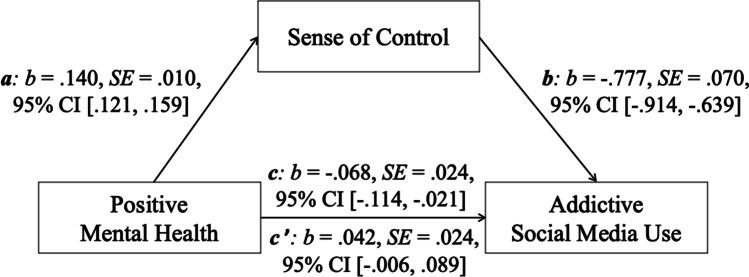
Since the Covid-19 outbreak, addictive social media use increased in many countries. To better understand this development, a universal instrument for the assessment of addictive social media use is required. Against this background, we examined the psychometric properties of the Bergen Social Media Addiction Scale (BSMAS) in representative population samples in nine countries (N = 9418, age range: “18 to 24 years” (youngest group), “55 years and older” (oldest group): China, France, Germany, Poland, Russia, Spain, Sweden, U.K., U.S.). Furthermore, we investigated potential factors and mechanisms that could be associated with addictive social media use. Our cross-national findings show that the BSMAS is a unidimensional reliable and valid instrument. Moreover, they reveal that the negative association between positive mental health and addictive social media use is mediated by sense of control in seven of the nine countries (exception: China, Russia). Thus, it can be hypothesized that activities which increase positive mental health could indirectly contribute to the decrease of addictive social media use. We identified conscious engagement in physical activity and a regular sleep rhythm during the pandemic as such potential activities. The fostering of both by governmental programs could enhance positive mental health and reduce addictive social media use.
Overview
The claims and statistics of this paper haven’t been checked yet.
Free: it reads the open-access text and checks the first 5 claims that cite a source we can check. Create a free account to check every claim.
Integrity signals
Registry
Cites
Statistics
Figures
Verification
Claims the paper makes
The claims and statistics of this paper haven’t been checked yet.
Free: it reads the open-access text and checks the first 5 claims that cite a source we can check. Create a free account to check every claim.
Claims other papers make about this one
Each is checked against this paper’s own text: does it say what the citing paper says it does?
The check wasn’t confident either way, so it gives no verdict — never disputed.
In the citing paper
“Studies show that excessive engagement with social media can impair attention.”
From Does social media addiction disrupt mindful attention of students in health colleges at a university in Saudi Arabia? (2025) · cites this paper as [10]
Experimental — accuracy not yet measured
Self-check
Percentages, sums and reported differences re-computed from the paper’s own numbers.
The self-check needs the paper’s full text.
Citations
Cites
Diagnostic and Statistical Manual of Mental Disorders
American Psychiatric Association (2013) · doi:10.1176/appi.books.9780890425596 · Cited by 116,369
(2013) · Cited by 44,563
(2017) · Cited by 16,319
Lovibond, P. F., & Lovibond, S. H. (1995) · Behaviour Research and Therapy · doi:10.1016/0005-7967(94)00075-u · Cited by 14,523 · cited 2×
“…nine countries, the mean scores of depression and anxiety symptoms that were assessed by the DASS-21 were within the described normal (not-pathological) range (i.e., subscale depression: normal range up to a score of 9; subscale anxiety: normal range up to a score of 7; Lovibond & Lovibond, 1995).”
Constructing validity: Basic issues in objective scale development.
Clark, L. A., & Watson, D. (1995) · Psychological Assessment · doi:10.1037/1040-3590.7.3.309 · Cited by 6,567 · cited 1×
“In all the other countries, it was slightly above the recommended range (i.e., .150 to .500; Briggs & Cheek, 1986; Clark & Watson, 1995): France: r mi = .522 (range: .360 to .722), Germany: r mi = .609 (range: .491 to .741), Poland: r mi = .567 (range: .404 to .760), Russia: r mi = .532 (range:…”
Sohrabi, C., Alsafi, Z., O'Neill, N., Khan, M., Kerwan, A., Al-Jabir, A., Iosifidis, C., & Agha, R. (2020) · International Journal of Surgery · doi:10.1016/j.ijsu.2020.02.034 · Cited by 6,069 · cited 1×
“To slow down the pandemic spread, governments and authorities all over the globe introduced restrictive behavior measures that reduce physical contact among the population (so-called “social distancing”) (Howard et al., 2021; Sohrabi et al., 2020).”
A “components” model of addiction within a biopsychosocial framework
Griffiths, M. (2005) · Journal of Substance Use · doi:10.1080/14659890500114359 · Cited by 3,088 · cited 4×
“Six core addiction elements (Griffiths, 2005) define addictive social media use: salience (permanent thinking about social media use), tolerance (enhanced amount of time is spent on social media to experience positive emotions), mood modification (mood improvement by social media use), relapse…”
InfluentialMental health problems and social media exposure during COVID-19 outbreak
Gao, J., Zheng, P., Jia, Y., Chen, H., Mao, Y., Chen, S., Wang, Y., Fu, H., & Dai, J. (2020) · PLoS ONE · doi:10.1371/journal.pone.0231924 · Cited by 2,830 · cited 2×
“…from both countries reported a remarkable increase of problematic social media use since the pandemic outbreak that is negatively linked to mental health (e.g., enhanced level of depression and anxiety symptoms) (Gao et al., 2020; Nek-liudov et al., 2020; Zhao & Zhou, 2021; Zhong et al., 2021).”
Mental Health Problems and Social Media Exposure During COVID-19 Outbreak
Gao, J., Zheng, P., Jia, Y., Chen, H., Mao, Y., Chen, S., Wang, Y., Fu, H., & Dai, J. (2020) · SSRN Electronic Journal · doi:10.2139/ssrn.3541120 · Cited by 2,830
The role of factor analysis in the development and evaluation of personality scales
Briggs, S. R., & Cheek, J. M. (1986) · Journal of Personality · doi:10.1111/j.1467-6494.1986.tb00391.x · Cited by 2,359 · cited 1×
“In all the other countries, it was slightly above the recommended range (i.e., .150 to .500; Briggs & Cheek, 1986; Clark & Watson, 1995): France: r mi = .522 (range: .360 to .722), Germany: r mi = .609 (range: .491 to .741), Poland: r mi = .567 (range: .404 to .760), Russia: r mi = .532 (range:…”
Research works printed but not linked: 3
- Berry JW Triandis H Berry JW Introduction to methodology Handbook of cross-cultural psychology 1989 Allyn & Bacon 1 28
- Lienert GA Raatz U Testaufbau und Testanalyse (5., völlig neubearb. und erw. Aufl.) 1994 Psychologie Verlags Union
- World Health Organization Global recommendations on physical activity for health 2010 World Health Organization 26180873
Cited by
Brailovskaia, J., & Margraf, J. (2023) · Computers in Human Behavior · doi:10.1016/j.chb.2023.107984 · Cited by 137
Self-citationCasale, S., Akbari, M., Seydavi, M., Bocci Benucci, S., & Fioravanti, G. (2023) · Addictive Behaviors · doi:10.1016/j.addbeh.2023.107838 · Cited by 85
Brailovskaia, J., Ozimek, P., Rohmann, E., & Bierhoff, H. (2023) · Computers in Human Behavior · doi:10.1016/j.chb.2023.107725 · Cited by 111
Self-citationBrailovskaia, J., Swarlik, V. J., Grethe, G. A., Schillack, H., & Margraf, J. (2022) · Journal of Public Health · doi:10.1007/s10389-022-01751-x · Cited by 73
“(Brailovskaia and Margraf 2022a).”
BackgroundSelf-citationSayılı, U., Pirdal, B. Z., Kara, B., Acar, N., Camcioglu, E., Yilmaz, E., Can, G., & Erginöz, E. (2022) · Journal of Community Health · doi:10.1007/s10900-022-01153-w · Cited by 67
“Thus, it can be hypothesized that activities that increase positive mental health could indirectly contribute to the decrease of addictive social media use [53].”
Background
Metadata
- Authors
- Brailovskaia, J., & Margraf, J.
- Affiliations
- Ruhr University Bochum (DE)
- Corresponding author
- Brailovskaia, Julia
- Venue
- Current Psychology
- Published
- 2022-05-21
- Volume
- 43
- Issue
- 14
- Pages
- 13022-13040
- ISSN
- 1046-1310 (ISSN-L)
- 1936-4733
- PMC
- PMC9122809
- OpenAlex
- W4281250389
- Cited by
- 101
- References
- 116
- Citations by year
- 2026: 20 · 2025: 25 · 2024: 20 · 2023: 30 · 2022: 6
- FWCI
- 29.14
- Type
- journal article
- Language
- en
- Open access
- hybrid
- doi.org
- Licence
- cc-by
- creativecommons.org/licenses/by/4.0 (tdm)
- creativecommons.org/licenses/by/4.0 (vor)
- Locations
- Current Psychology (publishedVersion, cc-by)
- PubMed Central (publishedVersion, cc-by)
- PubMed (publishedVersion)
- Funders
- Ruhr-Universität Bochum
- Topics
- Social Sciences › Sociology and Political Science › Impact of Technology on Adolescents
- Social Sciences › Psychology › Clinical Psychology › COVID-19 and Mental Health
- Social Sciences › Psychology › Clinical Psychology › Sexuality, Behavior, and Technology
- Keywords
- Bergen Social Media Addiction Scale, scale validation, psychometric properties, COVID-19 pandemic, positive mental health, perceived control, physical activity, sleep rhythm, protective factors, cross-national comparison
About these checks
Registry, retraction, Cites and statistics results are computed, not judged, with one exception: a printed reference that no index lists is read once by a model before it counts as a citation error. Claims are extracted by a model and kept only when their quote appears verbatim in the text; each cited source is then checked, with a model’s help, for whether it says what the claim relies on. Those verdicts can be wrong — read the claim’s quote and the cited source before relying on one.
Statistics and arithmetic are recomputed, not judged.
Confidence bands are shown only for fields calibrated on our annotated test set. None is calibrated yet, so no band is shown.
What counts as a claim ›How we measure confidence ›How we check this ›
Are you an author, or do you see a problem with this page? Request a review
How to cite
Cite CoChat for the checks on this page, and the paper for its own findings.
- This page
- CoChat. (2026). Citation check: Addictive social media use during Covid-19 outbreak: Validation of the Bergen Social Media Addiction Scale (BSMAS) and investigation of protective factors in nine countries. https://app.cochat.ai/papers/10.1007/s12144-022-03182-z
- The paper
- Brailovskaia, J., & Margraf, J. (2024). Addictive social media use during Covid-19 outbreak: Validation of the Bergen Social Media Addiction Scale (BSMAS) and investigation of protective factors in nine countries. Current Psychology. https://doi.org/10.1007/s12144-022-03182-z
Data sources
Bibliographic data: Semantic Scholar, OpenAlex, Crossref.
Contains information from the Semantic Scholar Academic Graph Datasets, made available under the ODC Attribution License (ODC-BY 1.0).
Semantic Scholar’s data is described in: Kinney, R., et al. (2023). The Semantic Scholar Open Data Platform. arXiv:2301.10140.
